MGMT1101: Ford Motor Company Management: SWOT, Structure, and Control
VerifiedAdded on 2023/01/19
|10
|1968
|82
Project
AI Summary
This project analyzes the management strategies of Ford Motor Company, covering various aspects such as SWOT analysis, environmental constraints (PESTEL), stakeholder identification, and organizational structure. The paper delves into strategic planning, including formulating strategies based on strengths, weaknesses, opportunities, and threats. It examines the company's organizational structure, identifying it as a divisional structure, and discusses motivational theories, specifically Herzberg's Two-Factor Theory, to improve employee engagement. The analysis provides recommendations, such as partnering with tech companies to improve technology, and highlights control mechanisms like feedforward, concurrent, and feedback controls to monitor and measure the effectiveness of the proposed strategies and recommendations. The project aims to provide a comprehensive overview of Ford's management practices and offer insights into its future strategies, incorporating elements from the MGMT1101 course curriculum.
Running head: Introduction to Management 1
Introduction to Management
Students Name
Institutional Affiliation
Introduction to Management
Students Name
Institutional Affiliation
Paraphrase This Document
Need a fresh take? Get an instant paraphrase of this document with our AI Paraphraser

Introduction to Management 2
Summary.
Ford Motor Company is a global automotive company that was founded by Henry Ford
in 1903 (Levinson, 2012). The company is accredited for methods such as the early mass
production technique that allowed the company to improve labor productivity and performance.
Ford is at the forefront of pursuing product excellence through instilling the spirit of innovation.
For instance, Ford’s Smart Mobility is expected to take the company to the next level through
mobility, connectivity, customer experience and autonomous vehicles (Ford Motor Company,
2019).
In this paper, I’ll be addressing a number of themes. To begin with, we have SWOT-
formulating strategies. In this theme, different options/actions that can be adopted for each
strategy will be addressed. Secondly, we have environmental constraints. Thirdly, the
stakeholders within the organization and general environment will be highlighted. Fourthly, the
organizational structure and design will be comprehensively discussed in the inclusion of Ford's
organizational chart. Fifth, motivation theories and strategies that can be used in the organization
will be highlighted, and lastly, the recommendation and controls for the company will be
addressed.
SWOT- formulating strategies
Beginning with the strengths, I would take advantage of the strengths in various ways.
First, due to the company’s effective innovation and new technologies, I would direct the
company into adopting aggressive autonomous and electric car technology. This would create a
competitive advantage for the company hence being able to compete effectively with electric car
companies such as Tesla (Okubo, Kuang, Syed, Okubo, & Kozarekar, 2017). Second, I would
Summary.
Ford Motor Company is a global automotive company that was founded by Henry Ford
in 1903 (Levinson, 2012). The company is accredited for methods such as the early mass
production technique that allowed the company to improve labor productivity and performance.
Ford is at the forefront of pursuing product excellence through instilling the spirit of innovation.
For instance, Ford’s Smart Mobility is expected to take the company to the next level through
mobility, connectivity, customer experience and autonomous vehicles (Ford Motor Company,
2019).
In this paper, I’ll be addressing a number of themes. To begin with, we have SWOT-
formulating strategies. In this theme, different options/actions that can be adopted for each
strategy will be addressed. Secondly, we have environmental constraints. Thirdly, the
stakeholders within the organization and general environment will be highlighted. Fourthly, the
organizational structure and design will be comprehensively discussed in the inclusion of Ford's
organizational chart. Fifth, motivation theories and strategies that can be used in the organization
will be highlighted, and lastly, the recommendation and controls for the company will be
addressed.
SWOT- formulating strategies
Beginning with the strengths, I would take advantage of the strengths in various ways.
First, due to the company’s effective innovation and new technologies, I would direct the
company into adopting aggressive autonomous and electric car technology. This would create a
competitive advantage for the company hence being able to compete effectively with electric car
companies such as Tesla (Okubo, Kuang, Syed, Okubo, & Kozarekar, 2017). Second, I would

Introduction to Management 3
take advantage of the company’s brand. Ford brand is known globally; therefore, I would use it
to increase the attractiveness of Ford's products as well as improving customer loyalty.
On weaknesses, I would protect the organization in various ways. First, due to Ford’s
limitation of its network of production facilities, I would ensure the company adopts new
methods of production that would ensure the brand image of the company grows. This would
ensure most of its production facilities remain viable (Rowland, 2017). Two, Ford’s products are
relatively highly priced hence failing to attract most customers. On this issue, I would ensure the
company incorporates innovation and cost-cutting measures that ensure better prices compared
to rivals.
On opportunities, I would take advantage of the opportunities in various ways. First,
since the automotive industry/market is growing, I would ensure Ford introduced its facilities
and products in new markets hence capturing a larger market share. Second, on the opportunity
to expand the company’s supply chain, I would ensure the company expands its supply chain in
order to reduce production costs and achieve better economies of scale.
Lastly, on threats, I would protect the company in various ways. First, due to the
aggressive competitive rivalry, I would ensure Ford engages in aggressive innovation and
marketing hence gaining more market. Second, due to increased regulation on the protection of
the environment, I would ensure the organization focusses on both hybrid technology as well as
electric technology hence reducing any environmental effect.
take advantage of the company’s brand. Ford brand is known globally; therefore, I would use it
to increase the attractiveness of Ford's products as well as improving customer loyalty.
On weaknesses, I would protect the organization in various ways. First, due to Ford’s
limitation of its network of production facilities, I would ensure the company adopts new
methods of production that would ensure the brand image of the company grows. This would
ensure most of its production facilities remain viable (Rowland, 2017). Two, Ford’s products are
relatively highly priced hence failing to attract most customers. On this issue, I would ensure the
company incorporates innovation and cost-cutting measures that ensure better prices compared
to rivals.
On opportunities, I would take advantage of the opportunities in various ways. First,
since the automotive industry/market is growing, I would ensure Ford introduced its facilities
and products in new markets hence capturing a larger market share. Second, on the opportunity
to expand the company’s supply chain, I would ensure the company expands its supply chain in
order to reduce production costs and achieve better economies of scale.
Lastly, on threats, I would protect the company in various ways. First, due to the
aggressive competitive rivalry, I would ensure Ford engages in aggressive innovation and
marketing hence gaining more market. Second, due to increased regulation on the protection of
the environment, I would ensure the organization focusses on both hybrid technology as well as
electric technology hence reducing any environmental effect.
⊘ This is a preview!⊘
Do you want full access?
Subscribe today to unlock all pages.

Trusted by 1+ million students worldwide

Introduction to Management 4
Environmental constraints.
Fords PESTEL analysis.
PESTEL analysis presents various opportunities based on Ford’s external factors. To
begin with, we have political factors. The government has begun providing incentives of which
Ford can take advantage in developing environmentally sustainable products (Rowland, 2017).
Secondly, economic factors. Due to the notable growth of the US market, Ford has the
opportunity to grow both in the USA and other potential developing countries.
Thirdly, we have social factors. The increasing demand for electric and hybrid
automobiles offers Ford the opportunity to leverage on this demand hence growing its products
and services. Fourthly, we have technological factors. The rising usage of mobile computing also
creates opportunities for Ford to grow its brand through mobile marketing and mobile service
support (Rowland, 2017). Fifthly, we have environmental factors. Climate change creates
opportunities for Ford since the company will able to create products that promote environmental
conservation. Lastly, we have legal factors. The increase in intellectual property laws enables the
company to protect its proprietary intellectual property rights.
Environmental constraints.
Ford faces different environmental constraints. One, the increasing wealth gap threatens
Ford’s Lincoln automobiles majorly due to the high prices hence losing to other automobile
companies (Zanchi, Delogu, Zamagni, & Pierini, 2018). Secondly, competition due to high levels
of innovation is pulling Ford backward and therefore, I believe the company may need to focus
on product innovation. However, Ford addresses such constraints in order to ensure success.
Beginning with the increased wealth gap, Ford is designing products that favor each income gap
Environmental constraints.
Fords PESTEL analysis.
PESTEL analysis presents various opportunities based on Ford’s external factors. To
begin with, we have political factors. The government has begun providing incentives of which
Ford can take advantage in developing environmentally sustainable products (Rowland, 2017).
Secondly, economic factors. Due to the notable growth of the US market, Ford has the
opportunity to grow both in the USA and other potential developing countries.
Thirdly, we have social factors. The increasing demand for electric and hybrid
automobiles offers Ford the opportunity to leverage on this demand hence growing its products
and services. Fourthly, we have technological factors. The rising usage of mobile computing also
creates opportunities for Ford to grow its brand through mobile marketing and mobile service
support (Rowland, 2017). Fifthly, we have environmental factors. Climate change creates
opportunities for Ford since the company will able to create products that promote environmental
conservation. Lastly, we have legal factors. The increase in intellectual property laws enables the
company to protect its proprietary intellectual property rights.
Environmental constraints.
Ford faces different environmental constraints. One, the increasing wealth gap threatens
Ford’s Lincoln automobiles majorly due to the high prices hence losing to other automobile
companies (Zanchi, Delogu, Zamagni, & Pierini, 2018). Secondly, competition due to high levels
of innovation is pulling Ford backward and therefore, I believe the company may need to focus
on product innovation. However, Ford addresses such constraints in order to ensure success.
Beginning with the increased wealth gap, Ford is designing products that favor each income gap
Paraphrase This Document
Need a fresh take? Get an instant paraphrase of this document with our AI Paraphraser

Introduction to Management 5
hence attracting more people. Secondly, competition has been a challenging constraint since it
can’t be controlled. In my opinion, emerging and established tech-companies are challenging
Ford; however, the company is adopting new technologies to combat the competition (Law,
2017). One major element that creates and may continue to create opportunities for Ford is the
adoption of innovations and technologies. This happens to be the latest trend in the automobile
industry, and therefore, in my opinion, Ford will only survive if it invests heavily in this area.
Stakeholders.
Ford’s various stakeholders include; one, employees. Employees ensure Ford’s
operations are carried out in accordance to plans hence ensuring the growth of the company.
Two, customers. Ford’s products have to be purchased in order for the company to make a profit;
therefore, customers dictate products that Ford produces. Three, suppliers. Suppliers are crucial
since they source raw materials for Ford thereby allowing them to timely deliver the required
products (Hoffman, 2012). In my opinion, I believe Ford should give their priority to customers.
Managing customers is very critical since if their needs are not met, choosing alternative
automobile companies is much easier hence resulting in losses.
hence attracting more people. Secondly, competition has been a challenging constraint since it
can’t be controlled. In my opinion, emerging and established tech-companies are challenging
Ford; however, the company is adopting new technologies to combat the competition (Law,
2017). One major element that creates and may continue to create opportunities for Ford is the
adoption of innovations and technologies. This happens to be the latest trend in the automobile
industry, and therefore, in my opinion, Ford will only survive if it invests heavily in this area.
Stakeholders.
Ford’s various stakeholders include; one, employees. Employees ensure Ford’s
operations are carried out in accordance to plans hence ensuring the growth of the company.
Two, customers. Ford’s products have to be purchased in order for the company to make a profit;
therefore, customers dictate products that Ford produces. Three, suppliers. Suppliers are crucial
since they source raw materials for Ford thereby allowing them to timely deliver the required
products (Hoffman, 2012). In my opinion, I believe Ford should give their priority to customers.
Managing customers is very critical since if their needs are not met, choosing alternative
automobile companies is much easier hence resulting in losses.

Introduction to Management 6
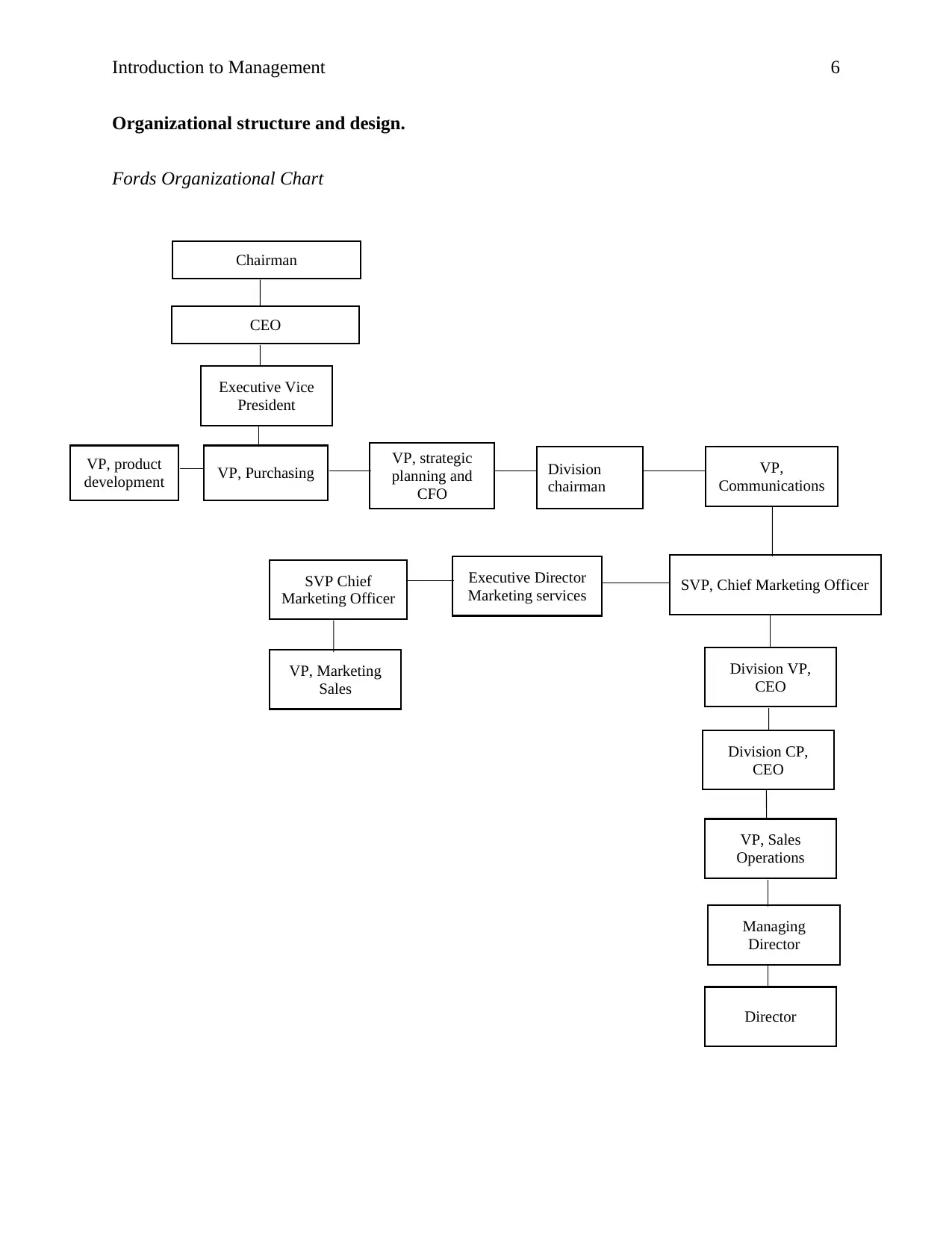
Organizational structure and design.
Fords Organizational Chart
Chairman
CEO
VP, product
development VP, Purchasing VP, strategic
planning and
CFO
Division
chairman
VP,
Communications
SVP Chief
Marketing Officer
Executive Director
Marketing services SVP, Chief Marketing Officer
VP, Marketing
Sales
Executive Vice
President
Director
Managing
Director
VP, Sales
Operations
Division CP,
CEO
Division VP,
CEO
Organizational structure and design.
Fords Organizational Chart
Chairman
CEO
VP, product
development VP, Purchasing VP, strategic
planning and
CFO
Division
chairman
VP,
Communications
SVP Chief
Marketing Officer
Executive Director
Marketing services SVP, Chief Marketing Officer
VP, Marketing
Sales
Executive Vice
President
Director
Managing
Director
VP, Sales
Operations
Division CP,
CEO
Division VP,
CEO
⊘ This is a preview!⊘
Do you want full access?
Subscribe today to unlock all pages.

Trusted by 1+ million students worldwide

Introduction to Management 7
Ford company has a divisional organizational structure. The structure is based on various
business needs particularly in changing market needs. I believe Ford’s organization structure is
more mechanistic since the structure is hierarchical and bureaucratic. For instance, Ford exhibits
a traditional corporate hierarchy since the vice executive president report to CEO (Marx, 2016).
In my opinion, this approach aims to ensure top-down control. In addition, the organization has a
highly centralized authority, specialized functions, practices, and procedures. This means that
decision making in the organization is centralized as well as formalized.
Motivating employees.
In motivating employees in Ford, I would consider the Herzberg Two-Factor Theory.
This motivation theory determines what makes people feel bad or good about their job
(Alshmemri, Shahwan-Akl, & Maude, 2017). In applying this theory, I would create an action
plan of creating opportunities for personal recognition, enrichment, and growth among
employees. In achieving this, I would ensure employees are promoted after every stage of their
career as well as receive recognition for certain achievements.
Recommendations.
On the environmental constraints, one major recommendation that would be of assistance
in Ford may be partnering with tech companies to improve technology such as autonomous
driving. In achieving this, I would assess both emerging and established tech companies that
have promising proprietary software that can be assistance to Ford. This would increase the
chances of Ford achieving autonomous driving innovation much quicker hence beating its rivals.
Ford company has a divisional organizational structure. The structure is based on various
business needs particularly in changing market needs. I believe Ford’s organization structure is
more mechanistic since the structure is hierarchical and bureaucratic. For instance, Ford exhibits
a traditional corporate hierarchy since the vice executive president report to CEO (Marx, 2016).
In my opinion, this approach aims to ensure top-down control. In addition, the organization has a
highly centralized authority, specialized functions, practices, and procedures. This means that
decision making in the organization is centralized as well as formalized.
Motivating employees.
In motivating employees in Ford, I would consider the Herzberg Two-Factor Theory.
This motivation theory determines what makes people feel bad or good about their job
(Alshmemri, Shahwan-Akl, & Maude, 2017). In applying this theory, I would create an action
plan of creating opportunities for personal recognition, enrichment, and growth among
employees. In achieving this, I would ensure employees are promoted after every stage of their
career as well as receive recognition for certain achievements.
Recommendations.
On the environmental constraints, one major recommendation that would be of assistance
in Ford may be partnering with tech companies to improve technology such as autonomous
driving. In achieving this, I would assess both emerging and established tech companies that
have promising proprietary software that can be assistance to Ford. This would increase the
chances of Ford achieving autonomous driving innovation much quicker hence beating its rivals.
Paraphrase This Document
Need a fresh take? Get an instant paraphrase of this document with our AI Paraphraser

Introduction to Management 8
Control and recommendations.
In monitoring the progress of my business plan, I would adopt feedforward controls to
monitor the activities since I would determine if the input variables in the plan may produce
results. In addition, in order to measure the progress and effectiveness of my recommendations, I
would use concurrent and feedback controls. For instance, I would measure employee
participation in the organization so as to identify their level of involvement in the new
recommendation. Besides, in determining whether a goal is being accomplished, I would adopt
the feedback control method since this control method allows a manager to determine the
individual performance of an employee hence being able to understand what can be put together
to ensure the attainment of a goal. In addition, the output can be evaluated hence determining
what can be adjusted to ensure the achievement of a goal.
Control and recommendations.
In monitoring the progress of my business plan, I would adopt feedforward controls to
monitor the activities since I would determine if the input variables in the plan may produce
results. In addition, in order to measure the progress and effectiveness of my recommendations, I
would use concurrent and feedback controls. For instance, I would measure employee
participation in the organization so as to identify their level of involvement in the new
recommendation. Besides, in determining whether a goal is being accomplished, I would adopt
the feedback control method since this control method allows a manager to determine the
individual performance of an employee hence being able to understand what can be put together
to ensure the attainment of a goal. In addition, the output can be evaluated hence determining
what can be adjusted to ensure the achievement of a goal.

Introduction to Management 9
References
Alshmemri, M., Shahwan-Akl, L., & Maude, P. (2017). Herzberg’s two-factor theory. Life
Science Journal, 14(5), 12-16.
Ford Motor Company. (2019). Ford Motor Company Timeline. Retrieved from
https://corporate.ford.com/history.html
Hoffman, B. G. (2012). American icon: Alan Mulally and the fight to save Ford Motor
Company. Three Rivers Press.
Law, C. M. (2017). Motor vehicle manufacturing: the representative industry. In Restructuring
the Global Automobile Industry (pp. 1-18). Routledge.
Levinson, W. A. (2012). Henry Ford's lean vision: Enduring principles from the first Ford
motor
plant. Productivity Press.
Marx, T. G. (2016). The impacts of business strategy on organizational structure. Journal of
Management History, 22(3), 249-268.
Okubo, S., Kuang, M. L., Syed, F. U., Okubo, C. L., & Kozarekar, S. S. (2017). U.S. Patent No.
9,545,839. Washington, DC: U.S. Patent and Trademark Office.
Rowland, C. (2017). Ford Motor Company PESTEL/PESTLE Analysis. Retrieved from
http://panmore.com/ford-motor-company-pestel-pestle-analysis/
Rowland, C. (2017). Ford Motor Company SWOT Analysis - Panmore Institute. Retrieved from
References
Alshmemri, M., Shahwan-Akl, L., & Maude, P. (2017). Herzberg’s two-factor theory. Life
Science Journal, 14(5), 12-16.
Ford Motor Company. (2019). Ford Motor Company Timeline. Retrieved from
https://corporate.ford.com/history.html
Hoffman, B. G. (2012). American icon: Alan Mulally and the fight to save Ford Motor
Company. Three Rivers Press.
Law, C. M. (2017). Motor vehicle manufacturing: the representative industry. In Restructuring
the Global Automobile Industry (pp. 1-18). Routledge.
Levinson, W. A. (2012). Henry Ford's lean vision: Enduring principles from the first Ford
motor
plant. Productivity Press.
Marx, T. G. (2016). The impacts of business strategy on organizational structure. Journal of
Management History, 22(3), 249-268.
Okubo, S., Kuang, M. L., Syed, F. U., Okubo, C. L., & Kozarekar, S. S. (2017). U.S. Patent No.
9,545,839. Washington, DC: U.S. Patent and Trademark Office.
Rowland, C. (2017). Ford Motor Company PESTEL/PESTLE Analysis. Retrieved from
http://panmore.com/ford-motor-company-pestel-pestle-analysis/
Rowland, C. (2017). Ford Motor Company SWOT Analysis - Panmore Institute. Retrieved from
⊘ This is a preview!⊘
Do you want full access?
Subscribe today to unlock all pages.

Trusted by 1+ million students worldwide

Introduction to Management 10
http://panmore.com/ford-motor-company-swot-analysis
Zanchi, L., Delogu, M., Zamagni, A., & Pierini, M. (2018). Analysis of the main elements
affecting social LCA applications: challenges for the automotive sector. The
International Journal of Life Cycle Assessment, 23(3), 519-535.
http://panmore.com/ford-motor-company-swot-analysis
Zanchi, L., Delogu, M., Zamagni, A., & Pierini, M. (2018). Analysis of the main elements
affecting social LCA applications: challenges for the automotive sector. The
International Journal of Life Cycle Assessment, 23(3), 519-535.
1 out of 10
Related Documents
Your All-in-One AI-Powered Toolkit for Academic Success.
+13062052269
info@desklib.com
Available 24*7 on WhatsApp / Email
Unlock your academic potential
Copyright © 2020–2025 A2Z Services. All Rights Reserved. Developed and managed by ZUCOL.