Forensic Accounting: Voided Invoice Analysis and Evidence

Verified

Added on  2023/01/11

|5
|586
|81
Report
AI Summary
This report analyzes a voided invoice as a crucial piece of evidence in financial fraud investigations, focusing on the role of forensic accounting. The report begins by classifying the voided invoice as documentary evidence and explores its relevance, admissibility, and the legal considerations surrounding it. It examines how the invoice can be used to uncover fraudulent activities, referencing the importance of legal binding agreements and the limitations of handwritten invoices. The report further discusses the application of general rules of evidence, the types of evidence, and the exclusionary rules. The conclusion emphasizes the need for a comprehensive approach by forensic accountants to gather all related evidence for identifying those responsible for financial fraud. The report references several academic sources to support its analysis.
Document Page
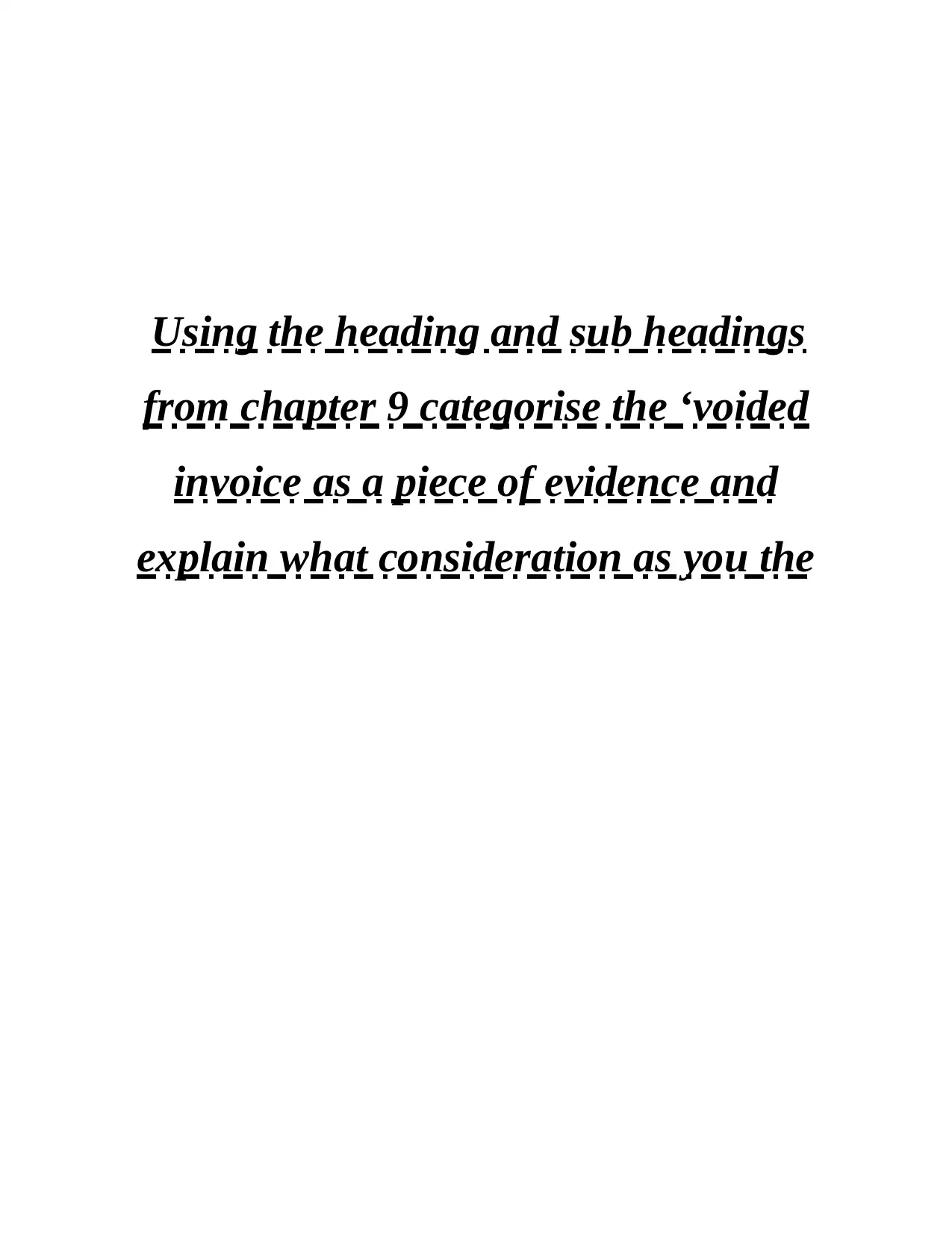
Using the heading and sub headings
from chapter 9 categorise the ‘voided
invoice as a piece of evidence and
explain what consideration as you the
tabler-icon-diamond-filled.svg

Paraphrase This Document

Need a fresh take? Get an instant paraphrase of this document with our AI Paraphraser
Document Page
Table of Contents
Introduction......................................................................................................................................3
Voided invoice........................................................................................................................3
Conclusion.......................................................................................................................................3
References........................................................................................................................................4
Document Page
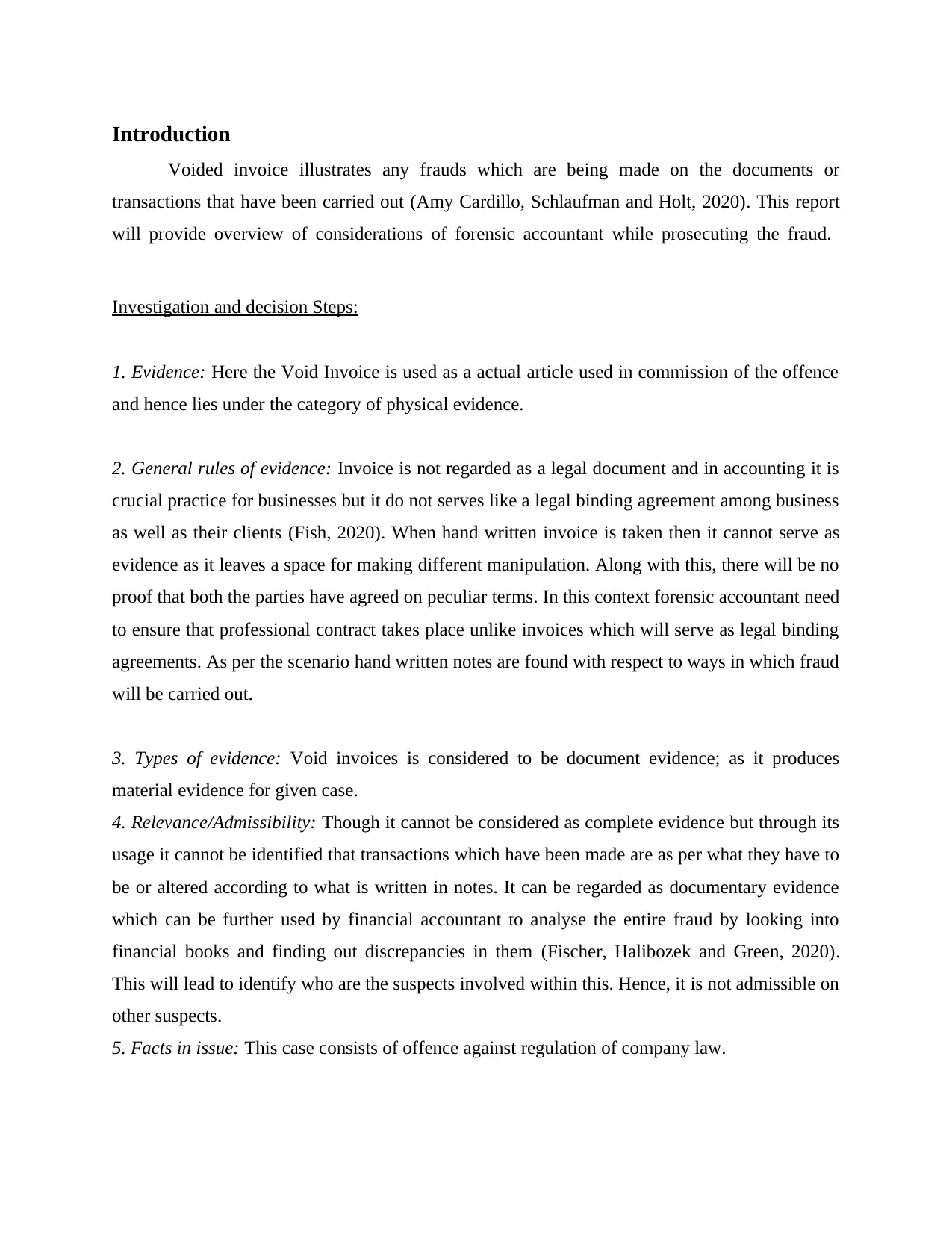
Introduction
Voided invoice illustrates any frauds which are being made on the documents or
transactions that have been carried out (Amy Cardillo, Schlaufman and Holt, 2020). This report
will provide overview of considerations of forensic accountant while prosecuting the fraud.
Investigation and decision Steps:
1. Evidence: Here the Void Invoice is used as a actual article used in commission of the offence
and hence lies under the category of physical evidence.
2. General rules of evidence: Invoice is not regarded as a legal document and in accounting it is
crucial practice for businesses but it do not serves like a legal binding agreement among business
as well as their clients (Fish, 2020). When hand written invoice is taken then it cannot serve as
evidence as it leaves a space for making different manipulation. Along with this, there will be no
proof that both the parties have agreed on peculiar terms. In this context forensic accountant need
to ensure that professional contract takes place unlike invoices which will serve as legal binding
agreements. As per the scenario hand written notes are found with respect to ways in which fraud
will be carried out.
3. Types of evidence: Void invoices is considered to be document evidence; as it produces
material evidence for given case.
4. Relevance/Admissibility: Though it cannot be considered as complete evidence but through its
usage it cannot be identified that transactions which have been made are as per what they have to
be or altered according to what is written in notes. It can be regarded as documentary evidence
which can be further used by financial accountant to analyse the entire fraud by looking into
financial books and finding out discrepancies in them (Fischer, Halibozek and Green, 2020).
This will lead to identify who are the suspects involved within this. Hence, it is not admissible on
other suspects.
5. Facts in issue: This case consists of offence against regulation of company law.
Document Page
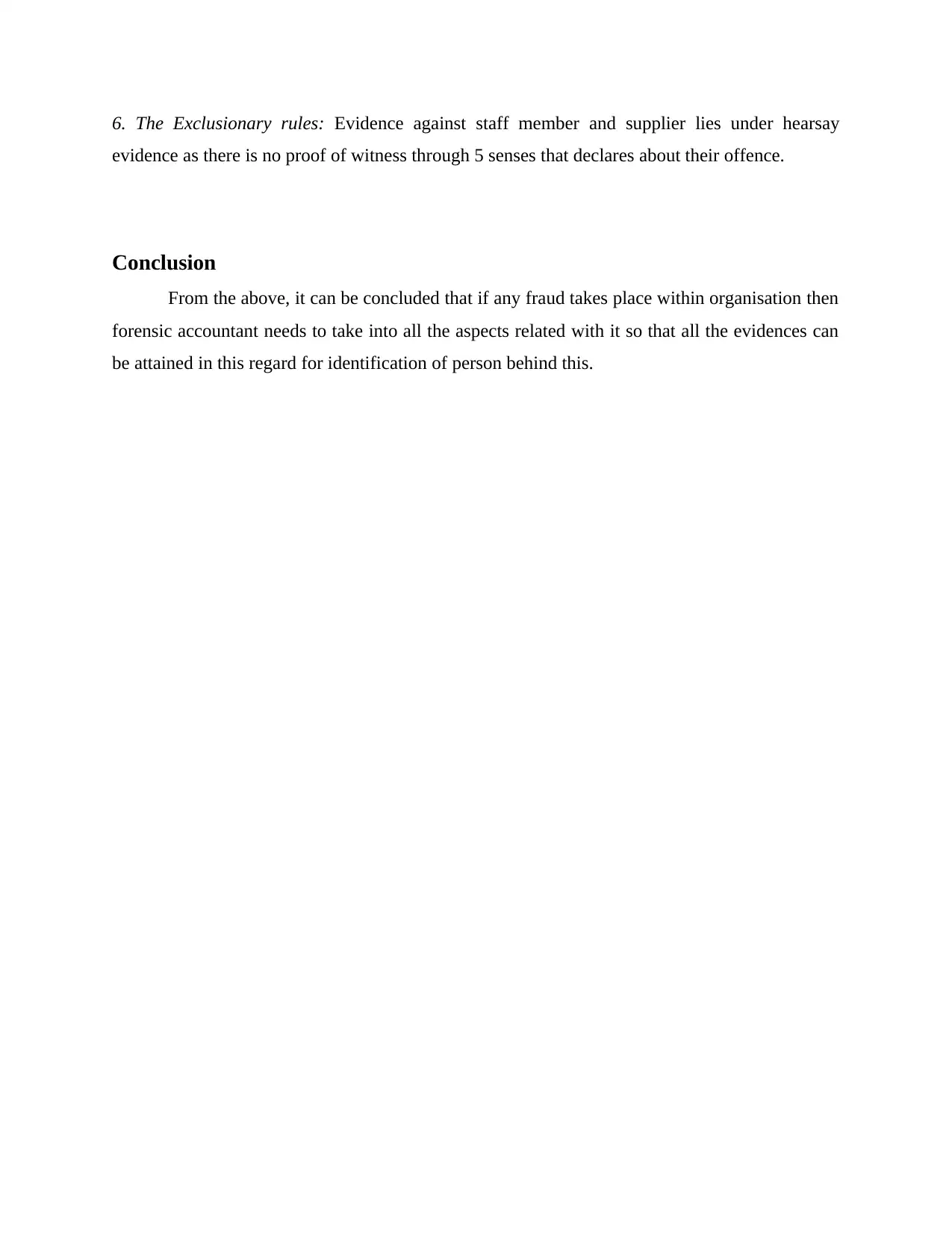
6. The Exclusionary rules: Evidence against staff member and supplier lies under hearsay
evidence as there is no proof of witness through 5 senses that declares about their offence.
Conclusion
From the above, it can be concluded that if any fraud takes place within organisation then
forensic accountant needs to take into all the aspects related with it so that all the evidences can
be attained in this regard for identification of person behind this.
tabler-icon-diamond-filled.svg

Paraphrase This Document

Need a fresh take? Get an instant paraphrase of this document with our AI Paraphraser
Document Page
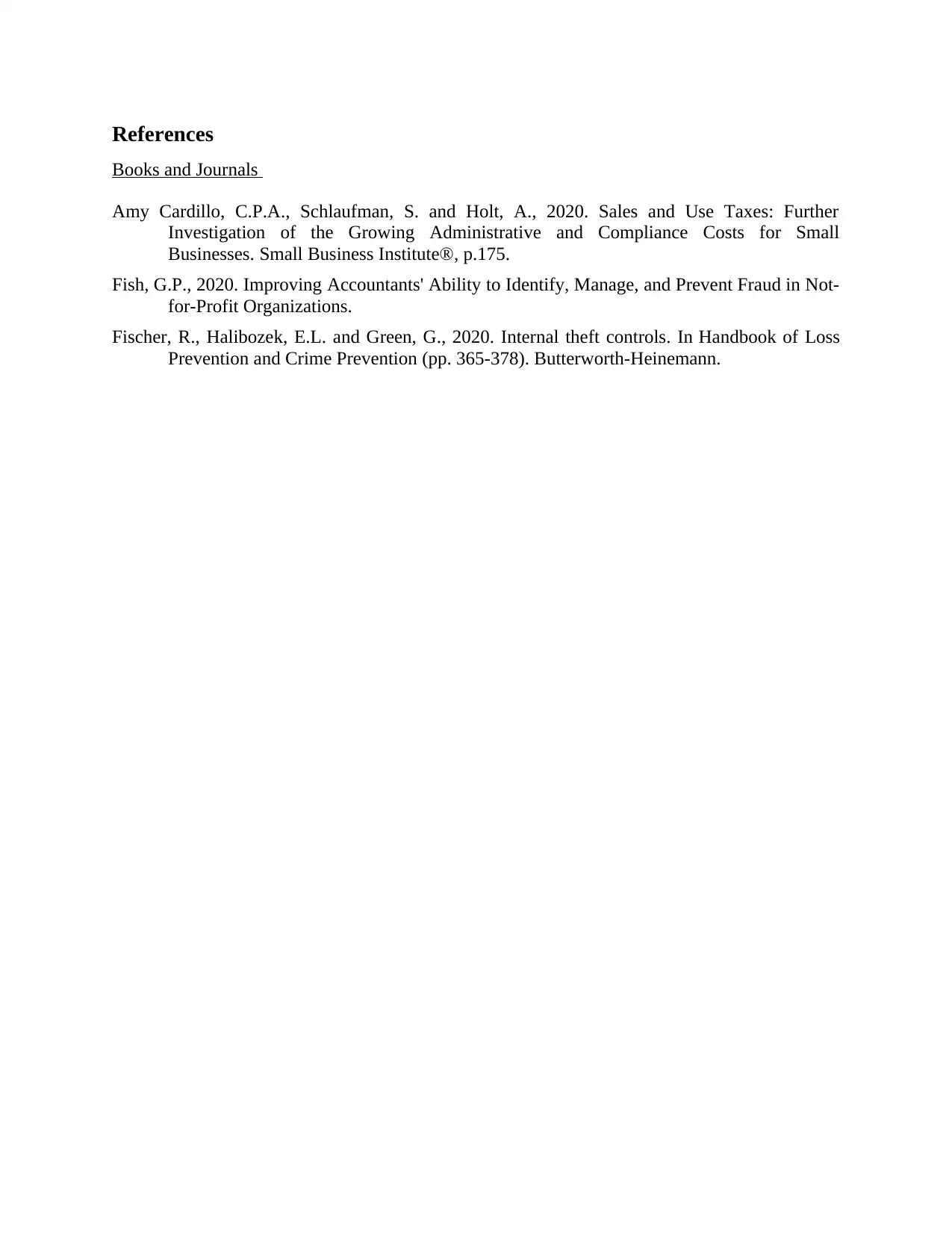
References
Books and Journals
Amy Cardillo, C.P.A., Schlaufman, S. and Holt, A., 2020. Sales and Use Taxes: Further
Investigation of the Growing Administrative and Compliance Costs for Small
Businesses. Small Business Institute®, p.175.
Fish, G.P., 2020. Improving Accountants' Ability to Identify, Manage, and Prevent Fraud in Not-
for-Profit Organizations.
Fischer, R., Halibozek, E.L. and Green, G., 2020. Internal theft controls. In Handbook of Loss
Prevention and Crime Prevention (pp. 365-378). Butterworth-Heinemann.
chevron_up_icon
1 out of 5
circle_padding
hide_on_mobile
zoom_out_icon
[object Object]