Comparative Study: Forest Reserve Policies of China and Canada
VerifiedAdded on 2023/06/15
|35
|9356
|350
Report
AI Summary
This report provides a comparative analysis of forest policies and nature reserve legislations in China and Canada. It begins with an introduction to the global concern for environmental conservation, highlighting UN initiatives and sustainable development goals related to forest management. The report then delves into the history, development, and types of forest reserves in both countries, examining relevant legal systems and specific examples of forest reserves such as Yancheng Red-Crowned Crane Nature Reserve in China and Wood Buffalo National Park in Canada. A critical literature review of forest reserve policies worldwide is conducted to evaluate the strengths and weaknesses of the policies implemented by China and Canada, culminating in a set of recommendations aimed at upgrading protection-related norms and fostering better reserve development in the future. Desklib provides students access to similar solved assignments and resources.

Running head: COMPARISON BETWEEN TWO COUNTRIES FOREST POLICIES
COMPARISON BETWEEN TWO COUNTRIES FOREST POLICIES
Name of the Student
Name of the Student
Author note
COMPARISON BETWEEN TWO COUNTRIES FOREST POLICIES
Name of the Student
Name of the Student
Author note

Paraphrase This Document
Need a fresh take? Get an instant paraphrase of this document with our AI Paraphraser

1COMPARISON BETWEEN TWO COUNTRIES FOREST POLICIES
Table of Contents
Introduction..........................................................................................................................3
Background......................................................................................................................3
What are forest reserves related acts?..............................................................................4
Aim..................................................................................................................................4
Objectives........................................................................................................................5
Information about forest reserves legislations of both the countries...................................6
China’s forest reserves.....................................................................................................6
History and background...............................................................................................6
Development of present forest reserves.......................................................................7
Type of forest reserves.................................................................................................8
Canada’s forest reserves..................................................................................................9
History and background...............................................................................................9
Development to present forest reserves.....................................................................10
Type of nature reserves in Canada.............................................................................10
Nature reserve related legislation......................................................................................11
China..............................................................................................................................11
Canada...........................................................................................................................12
Details of the legal system of both the country.................................................................13
Table of Contents
Introduction..........................................................................................................................3
Background......................................................................................................................3
What are forest reserves related acts?..............................................................................4
Aim..................................................................................................................................4
Objectives........................................................................................................................5
Information about forest reserves legislations of both the countries...................................6
China’s forest reserves.....................................................................................................6
History and background...............................................................................................6
Development of present forest reserves.......................................................................7
Type of forest reserves.................................................................................................8
Canada’s forest reserves..................................................................................................9
History and background...............................................................................................9
Development to present forest reserves.....................................................................10
Type of nature reserves in Canada.............................................................................10
Nature reserve related legislation......................................................................................11
China..............................................................................................................................11
Canada...........................................................................................................................12
Details of the legal system of both the country.................................................................13
2COMPARISON BETWEEN TWO COUNTRIES FOREST POLICIES
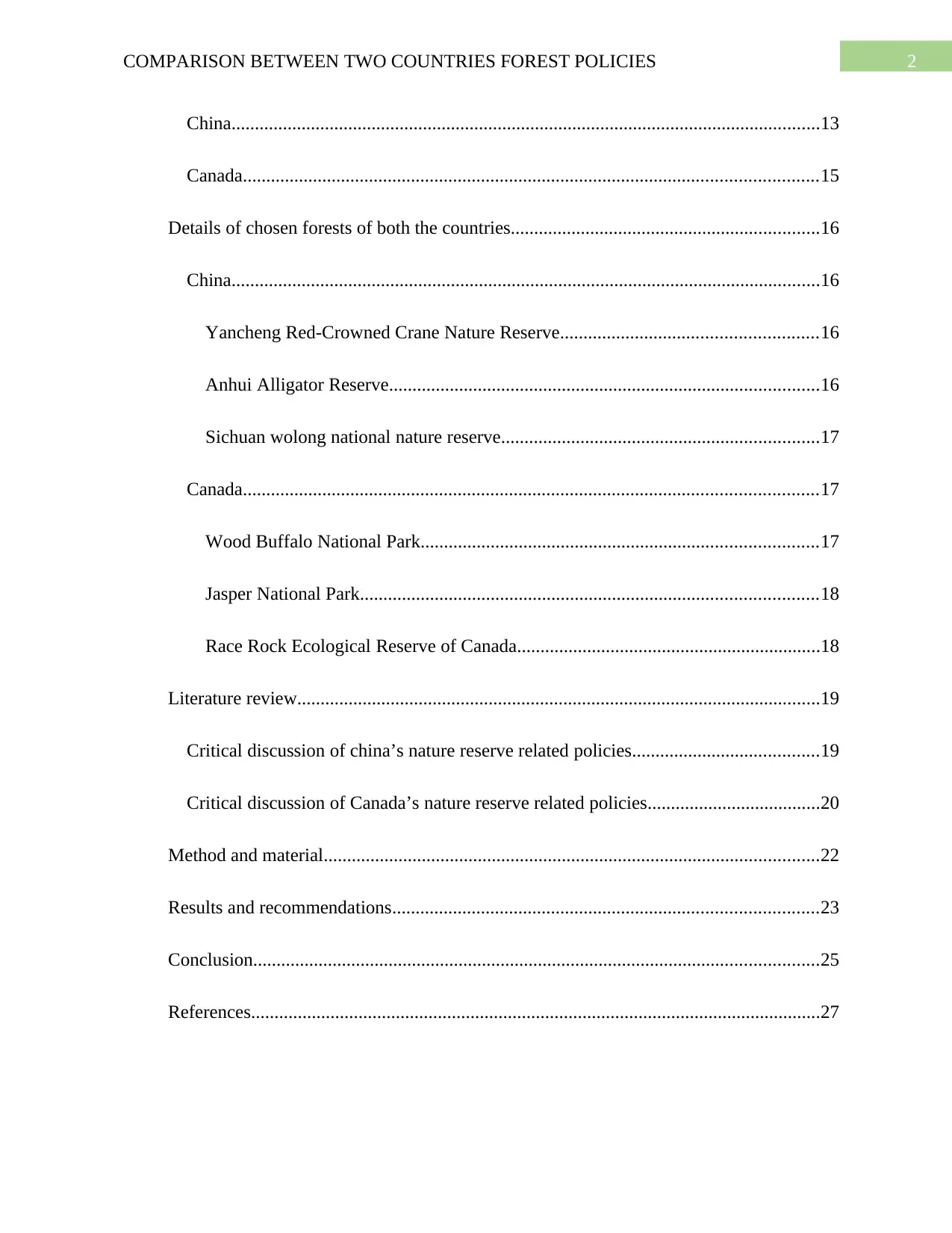
China..............................................................................................................................13
Canada...........................................................................................................................15
Details of chosen forests of both the countries..................................................................16
China..............................................................................................................................16
Yancheng Red-Crowned Crane Nature Reserve.......................................................16
Anhui Alligator Reserve............................................................................................16
Sichuan wolong national nature reserve....................................................................17
Canada...........................................................................................................................17
Wood Buffalo National Park.....................................................................................17
Jasper National Park..................................................................................................18
Race Rock Ecological Reserve of Canada.................................................................18
Literature review................................................................................................................19
Critical discussion of china’s nature reserve related policies........................................19
Critical discussion of Canada’s nature reserve related policies.....................................20
Method and material..........................................................................................................22
Results and recommendations...........................................................................................23
Conclusion.........................................................................................................................25
References..........................................................................................................................27
China..............................................................................................................................13
Canada...........................................................................................................................15
Details of chosen forests of both the countries..................................................................16
China..............................................................................................................................16
Yancheng Red-Crowned Crane Nature Reserve.......................................................16
Anhui Alligator Reserve............................................................................................16
Sichuan wolong national nature reserve....................................................................17
Canada...........................................................................................................................17
Wood Buffalo National Park.....................................................................................17
Jasper National Park..................................................................................................18
Race Rock Ecological Reserve of Canada.................................................................18
Literature review................................................................................................................19
Critical discussion of china’s nature reserve related policies........................................19
Critical discussion of Canada’s nature reserve related policies.....................................20
Method and material..........................................................................................................22
Results and recommendations...........................................................................................23
Conclusion.........................................................................................................................25
References..........................................................................................................................27
⊘ This is a preview!⊘
Do you want full access?
Subscribe today to unlock all pages.

Trusted by 1+ million students worldwide

3COMPARISON BETWEEN TWO COUNTRIES FOREST POLICIES
Paraphrase This Document
Need a fresh take? Get an instant paraphrase of this document with our AI Paraphraser

4COMPARISON BETWEEN TWO COUNTRIES FOREST POLICIES
Introduction
In the year 1972, Stockholm, Sweden witnessed the first general concern of the global
society regarding the environmental changes and its reservation as it hosted the very first United
Nations Conference on the Human Environment with 113 delegates around the globe and two
state heads (Douguédroit, Annick and Sébastien). The impact of this program was such that the
United Nations Environment Program was introduced and the primary objective decided was –
developed and developing nations should focus their financial budgets so that sustainable
environments can be maintained (Xu et al.). In 1992, the UN Conference on Environment and
Development or UNCED ‘The Earth Summit’ was organized in Rio de Janeiro and the topic of
discussion was using sustainable forest resources for the development and preservation of forest
reserves. Furthermore, the UN also dedicated one of its sustainable developmental goals for 2020
and according to it, the goal 15th was dedicated for the life on land and decided to manage
forests, combat with desertification and to halt biodiversity loss and forest reserves (Zheng,
Heran and Shixiong). Hence, it was understood that the world is concerned for the 80% of
animals, plants and insects that are dependent on the forest and those 1.6 billion of people, who
are dependent on these forest reserves for their growth and livelihood. This leads to the
formation of wildlife reserves and protected lands throughout the world to achieve the objectives
of maintaining and protecting wildlife in the ecosystem as well as entertaining human. As
different wildlife has diverse habitats that need different ways for protection, policies and
legislation are also formed to support different reserves (Douguédroit, Annick and Sébastien).
Introduction
In the year 1972, Stockholm, Sweden witnessed the first general concern of the global
society regarding the environmental changes and its reservation as it hosted the very first United
Nations Conference on the Human Environment with 113 delegates around the globe and two
state heads (Douguédroit, Annick and Sébastien). The impact of this program was such that the
United Nations Environment Program was introduced and the primary objective decided was –
developed and developing nations should focus their financial budgets so that sustainable
environments can be maintained (Xu et al.). In 1992, the UN Conference on Environment and
Development or UNCED ‘The Earth Summit’ was organized in Rio de Janeiro and the topic of
discussion was using sustainable forest resources for the development and preservation of forest
reserves. Furthermore, the UN also dedicated one of its sustainable developmental goals for 2020
and according to it, the goal 15th was dedicated for the life on land and decided to manage
forests, combat with desertification and to halt biodiversity loss and forest reserves (Zheng,
Heran and Shixiong). Hence, it was understood that the world is concerned for the 80% of
animals, plants and insects that are dependent on the forest and those 1.6 billion of people, who
are dependent on these forest reserves for their growth and livelihood. This leads to the
formation of wildlife reserves and protected lands throughout the world to achieve the objectives
of maintaining and protecting wildlife in the ecosystem as well as entertaining human. As
different wildlife has diverse habitats that need different ways for protection, policies and
legislation are also formed to support different reserves (Douguédroit, Annick and Sébastien).

5COMPARISON BETWEEN TWO COUNTRIES FOREST POLICIES
What are forest reserves related acts?
As the world progresses, there is shift in mindset of people has been observed regarding
nature and its components. This developing world provided each individual with fundamental
needs of life hence, the shift from fundamental to sustainable needs lead them to think about
nature and its components (Ramcilovic-Suominen et al.). People are now more focused to create
an environment which is pure and healthy and to sustain that they started advocating protection
of wildlife and forests. the protected area is defined as a geographical outline which is
maintained, protected and recognized through legal means so that effective and long-term
conservation of the ecosystem, its nature, its animals and cultural values can be can be achieved
(Sparovek et al.). However, to protect these protected lands from illegal or unpleasant activities
of human, the formation and implementation of legislation and protective acts was important for
the protection and sustainable maintenance of forest reserves around the world (Ramcilovic-
Suominen, Sabaheta and Christian).
Aim
The primary aim of this project is to understand the history of infrastructure and
characteristics of forest reservoirs of Canada and China as these two countries are diligently
focused on this major concern of UN sustainable development goals. Furthermore the project
will compare the governmental norms and policies for effective and sustainable maintenance of
forest reserves of the two countries so that the comparison can help to understand the
implications of the policies. Finally, this project will provide a list of recommendations regarding
legislation sand policies so that implementation of those can upgrade the protection policies of
these countries and they are able to develop better reserves in the near future.
What are forest reserves related acts?
As the world progresses, there is shift in mindset of people has been observed regarding
nature and its components. This developing world provided each individual with fundamental
needs of life hence, the shift from fundamental to sustainable needs lead them to think about
nature and its components (Ramcilovic-Suominen et al.). People are now more focused to create
an environment which is pure and healthy and to sustain that they started advocating protection
of wildlife and forests. the protected area is defined as a geographical outline which is
maintained, protected and recognized through legal means so that effective and long-term
conservation of the ecosystem, its nature, its animals and cultural values can be can be achieved
(Sparovek et al.). However, to protect these protected lands from illegal or unpleasant activities
of human, the formation and implementation of legislation and protective acts was important for
the protection and sustainable maintenance of forest reserves around the world (Ramcilovic-
Suominen, Sabaheta and Christian).
Aim
The primary aim of this project is to understand the history of infrastructure and
characteristics of forest reservoirs of Canada and China as these two countries are diligently
focused on this major concern of UN sustainable development goals. Furthermore the project
will compare the governmental norms and policies for effective and sustainable maintenance of
forest reserves of the two countries so that the comparison can help to understand the
implications of the policies. Finally, this project will provide a list of recommendations regarding
legislation sand policies so that implementation of those can upgrade the protection policies of
these countries and they are able to develop better reserves in the near future.
⊘ This is a preview!⊘
Do you want full access?
Subscribe today to unlock all pages.
Trusted by 1+ million students worldwide

6COMPARISON BETWEEN TWO COUNTRIES FOREST POLICIES
Objectives
To fulfill the aims of the project, several objectives need to be completed. Those
objectives are:
The first objective will be understanding the forest reserves of the two country
and for this purpose three forest reserves form each country has been selected.
These forest reserves are: Yancheng Red-crowned Crane Nature Reserve, Anhui
Alligator Reserve and Sichuan wolong national nature reserve of China and wood
buffalo National Park, Jasper National Park, Race Rock Ecological Reserve of
Canada.
the second objective will be comparing the plants, animals and other natural
resources related legislations of these forest reserves of both the countries so that
the state of the forests can be understood and the level of protection needed for
the development can be under stood.
The third objective will be conducting literature review of forest reserve related
polices used worldwide and critically compare that with both these countries
policies so that positive and negatives of the legislations used by China and
Canada can be understood.
Provide a set of recommendations regarding these policies and legislations so that
implementation of that helps to upgrade the protection related norms of both these
countries.
Objectives
To fulfill the aims of the project, several objectives need to be completed. Those
objectives are:
The first objective will be understanding the forest reserves of the two country
and for this purpose three forest reserves form each country has been selected.
These forest reserves are: Yancheng Red-crowned Crane Nature Reserve, Anhui
Alligator Reserve and Sichuan wolong national nature reserve of China and wood
buffalo National Park, Jasper National Park, Race Rock Ecological Reserve of
Canada.
the second objective will be comparing the plants, animals and other natural
resources related legislations of these forest reserves of both the countries so that
the state of the forests can be understood and the level of protection needed for
the development can be under stood.
The third objective will be conducting literature review of forest reserve related
polices used worldwide and critically compare that with both these countries
policies so that positive and negatives of the legislations used by China and
Canada can be understood.
Provide a set of recommendations regarding these policies and legislations so that
implementation of that helps to upgrade the protection related norms of both these
countries.
Paraphrase This Document
Need a fresh take? Get an instant paraphrase of this document with our AI Paraphraser
7COMPARISON BETWEEN TWO COUNTRIES FOREST POLICIES
Information about forest reserves legislations of both the countries
China’s forest reserves
History and background
As the Chinese economy started increasing, the focus of Chinese government started
shifting towards protecting nature and its resources as the government understood that tourism
will be the biggest way to generate revenue in the next that is twenty first century (Li, Wen-Yao
and Da-Wen). In the Chinese history, the development of Chinese nature reserves can be divided
into three stages, create, stagnation and rapid developmental stages. The first stage stagnation
lasted from 1950s to 1980s when the government understood the value of nature and natural
resources and started spreading the awareness among the countrymen so that the killing of wild
animals can be stopped (He et al.). At this stage, the government did not have any legislation
regarding animal protection and due to which the primary reserves created by the government
were destroyed by local population (Harwood). On the other hand, government continued its
awareness campaigns regarding reservation of wildlife and forests so that the rest reserves can be
protected. But from 1967 to 1976, China’s legal system destroyed and hence, all the work of
nature reserves was stopped, although there are some policies promulgated during the period
(Zhou et al.).
The second phase of forest reservation continued the struggle period of Chinese
government as the second stage lasted from 1980s to 2000s. During this period the Chinese
delegation attended the Earth Summit 1992 in Rio de Janeiro and focused its concentration on
animals and plant species that are on the verge of extinction (He et al.). The biggest step the
government took during this period was developing and implementing an animal protection
legislation in 1989. The government also took help from different global organizations regarding
Information about forest reserves legislations of both the countries
China’s forest reserves
History and background
As the Chinese economy started increasing, the focus of Chinese government started
shifting towards protecting nature and its resources as the government understood that tourism
will be the biggest way to generate revenue in the next that is twenty first century (Li, Wen-Yao
and Da-Wen). In the Chinese history, the development of Chinese nature reserves can be divided
into three stages, create, stagnation and rapid developmental stages. The first stage stagnation
lasted from 1950s to 1980s when the government understood the value of nature and natural
resources and started spreading the awareness among the countrymen so that the killing of wild
animals can be stopped (He et al.). At this stage, the government did not have any legislation
regarding animal protection and due to which the primary reserves created by the government
were destroyed by local population (Harwood). On the other hand, government continued its
awareness campaigns regarding reservation of wildlife and forests so that the rest reserves can be
protected. But from 1967 to 1976, China’s legal system destroyed and hence, all the work of
nature reserves was stopped, although there are some policies promulgated during the period
(Zhou et al.).
The second phase of forest reservation continued the struggle period of Chinese
government as the second stage lasted from 1980s to 2000s. During this period the Chinese
delegation attended the Earth Summit 1992 in Rio de Janeiro and focused its concentration on
animals and plant species that are on the verge of extinction (He et al.). The biggest step the
government took during this period was developing and implementing an animal protection
legislation in 1989. The government also took help from different global organizations regarding

8COMPARISON BETWEEN TWO COUNTRIES FOREST POLICIES
protection of animals and biosphere and in the course the Chinese Academy of Science
established the People’s Republic of China National Commission for Man and Biosphere and
joined the International Man and the Biosphere Reserve Network in 1993. The Chinese National
Commission for man and biosphere also contributed to the project by providing proper
information to other animal and forest related departs formed in this stage such as forestry
department and ministry of agriculture so that these departments can do a better job in protecting
wild animals (Li, Wen-Yao and Da-Wen).
The third stage, the rapid development stage started after 2000 as Chinese government
developed forest reserves in tremendous pace. This is determined as 50 natural reserves in 1980s
becomes 5000 protected areas and more than 2000 natural reserves by the end of 2003
(Harwood). The area of the nature reserves is about 13% of the Chinese total area. Further In
2016, the Chinese government republished the Law on the protection of wildlife with some
prominent changes to the old legislation. In this new law, the content provided information about
the ways using which, the population can contribute to protect wildlife and some general idea on
finding or manage wildlife reserves (Zhou et al.).
Development of present forest reserves
The present Chinese nature reserves have experienced five stages such as creation,
stagnation, restoration of growth, comprehensive planning and rapid growth. Other than these
each reserve has been created using scientific planning and construction and intensive operation
and management (Wang et al.). The first three stages of development followed the idea of rescue
and protection and according to that planning followed by construction leads to gradual
improvement in the future. However, maximum of the forest reserves in China are not developed
protection of animals and biosphere and in the course the Chinese Academy of Science
established the People’s Republic of China National Commission for Man and Biosphere and
joined the International Man and the Biosphere Reserve Network in 1993. The Chinese National
Commission for man and biosphere also contributed to the project by providing proper
information to other animal and forest related departs formed in this stage such as forestry
department and ministry of agriculture so that these departments can do a better job in protecting
wild animals (Li, Wen-Yao and Da-Wen).
The third stage, the rapid development stage started after 2000 as Chinese government
developed forest reserves in tremendous pace. This is determined as 50 natural reserves in 1980s
becomes 5000 protected areas and more than 2000 natural reserves by the end of 2003
(Harwood). The area of the nature reserves is about 13% of the Chinese total area. Further In
2016, the Chinese government republished the Law on the protection of wildlife with some
prominent changes to the old legislation. In this new law, the content provided information about
the ways using which, the population can contribute to protect wildlife and some general idea on
finding or manage wildlife reserves (Zhou et al.).
Development of present forest reserves
The present Chinese nature reserves have experienced five stages such as creation,
stagnation, restoration of growth, comprehensive planning and rapid growth. Other than these
each reserve has been created using scientific planning and construction and intensive operation
and management (Wang et al.). The first three stages of development followed the idea of rescue
and protection and according to that planning followed by construction leads to gradual
improvement in the future. However, maximum of the forest reserves in China are not developed
⊘ This is a preview!⊘
Do you want full access?
Subscribe today to unlock all pages.
Trusted by 1+ million students worldwide

9COMPARISON BETWEEN TWO COUNTRIES FOREST POLICIES
after scientific planning and construction due to which, the effectiveness of the protection of the
reserves has a big deviation. The fourth and fifth stage of development was about the
standardization of planning and management according to which, using modern technology all
the background data of the forest reserves were collected and possible changes in the
construction were made (Liu et al.).
Type of forest reserves
Based on the purpose, requirements and the conditions of present reserves, the Chinese
forest reserves can be divided in to six different types:
1) a. strict nature reserve, b. Wilderness protection.
2) National park.
3) Natural monument.
4) Habitat and species management.
5) terrestrial/marine landscape protection and
6) Ecological function reserve/resource protection site (Liu et al.).
Further, depending on the functional areas, the government divided forest reserves into
three sections such as core area, test area and buffer area. Core area is the well preserved natural
ecosystem or key habitats where the rare and endangered animals are protected. This place is
prohibited for general entry and if any organization or individual wants to conduct any scientific
research, a proper authorization will be provided by the government (Liu et al.). On the other
after scientific planning and construction due to which, the effectiveness of the protection of the
reserves has a big deviation. The fourth and fifth stage of development was about the
standardization of planning and management according to which, using modern technology all
the background data of the forest reserves were collected and possible changes in the
construction were made (Liu et al.).
Type of forest reserves
Based on the purpose, requirements and the conditions of present reserves, the Chinese
forest reserves can be divided in to six different types:
1) a. strict nature reserve, b. Wilderness protection.
2) National park.
3) Natural monument.
4) Habitat and species management.
5) terrestrial/marine landscape protection and
6) Ecological function reserve/resource protection site (Liu et al.).
Further, depending on the functional areas, the government divided forest reserves into
three sections such as core area, test area and buffer area. Core area is the well preserved natural
ecosystem or key habitats where the rare and endangered animals are protected. This place is
prohibited for general entry and if any organization or individual wants to conduct any scientific
research, a proper authorization will be provided by the government (Liu et al.). On the other
Paraphrase This Document
Need a fresh take? Get an instant paraphrase of this document with our AI Paraphraser

10COMPARISON BETWEEN TWO COUNTRIES FOREST POLICIES
hand, buffer area is the place where scientific research is allowed to conduct but tourism or
production activities are not allowed as per the legislation. Finally the test area where the
government allows to do educational activities, scientific research, visit and tourism activities,
but these activities also need though the corresponding legal process (Wang et al.).
Canada’s forest reserves
History and background
The Canadian history regarding forest and nature reserves is rich as the practice started
from 1873 when the government of Canada started separating the public lands from the
resourceful lands using interior dominion land branches. However the forestry in Canada started
from the British government and according to (Šamonil et al.), the Canadian government
currently helps to protect more than 2.8 million acres of land full of natural resources and
animals across the country. However, due to the effect of World War 2, maximum of the wildlife
sanctuaries and reserves were abolished and many species become endangered. The government
further focused on preparing legislation and policies so that more endangered or threatened
species of birds and other wildlife animals can be preserved (Lankia et al.). Each Canadian
believes that forest and nature is a part of their culture, heritage, economy and environment.
Further to protect that the government implemented sustainable forest management, strict
policies and legislations and spread awareness among the countrymen so that their support can
help this project to attain success (Rohner et al.).
The reason behind these practices implemented by Canadian government was their
understanding about the fact that these forest resources and natural biodiversity are helpful for
the sustainable growth and development of the Canadian economy and community (Šamonil et
hand, buffer area is the place where scientific research is allowed to conduct but tourism or
production activities are not allowed as per the legislation. Finally the test area where the
government allows to do educational activities, scientific research, visit and tourism activities,
but these activities also need though the corresponding legal process (Wang et al.).
Canada’s forest reserves
History and background
The Canadian history regarding forest and nature reserves is rich as the practice started
from 1873 when the government of Canada started separating the public lands from the
resourceful lands using interior dominion land branches. However the forestry in Canada started
from the British government and according to (Šamonil et al.), the Canadian government
currently helps to protect more than 2.8 million acres of land full of natural resources and
animals across the country. However, due to the effect of World War 2, maximum of the wildlife
sanctuaries and reserves were abolished and many species become endangered. The government
further focused on preparing legislation and policies so that more endangered or threatened
species of birds and other wildlife animals can be preserved (Lankia et al.). Each Canadian
believes that forest and nature is a part of their culture, heritage, economy and environment.
Further to protect that the government implemented sustainable forest management, strict
policies and legislations and spread awareness among the countrymen so that their support can
help this project to attain success (Rohner et al.).
The reason behind these practices implemented by Canadian government was their
understanding about the fact that these forest resources and natural biodiversity are helpful for
the sustainable growth and development of the Canadian economy and community (Šamonil et

11COMPARISON BETWEEN TWO COUNTRIES FOREST POLICIES
al.). Further according to Lankia et al., Canada occupies more than 9 percent of global forest
hence, by protecting the ecosystem the government aimed to contribute in maintaining the global
environment. The current practice is such that Canada is the leader in sustainable forest
management and has also collaborated with other countries and organizations to adapt to their
framework to monitor and report different changes in these reserves due to climate change
(Rohner et al.).
Development to present forest reserves
Wild animals are an integral part of Canadian heritage, as the second largest country in
the world, Canada has a very large land area with a small population. This makes Canada a
country, which owns large natural ecosystems (Venier et al.). There are only few countries in the
world with such forest percentage and hence, the Canadian government is focused to protect the
forest and its ecosystem. After attending the Earth Summit in Rio de Janeiro, the Canadian
government focused into scientific planning and management of forest reserves (Stambouli et
al.). The current forest reserves criteria and indicators help the organizations and individuals,
who use forest resources for their production and business related matters to clarify different
issues related to trade and environment and the environmental credentials of Canadian
government. Further, as a founding member of Montreal process, the Canadian government also
collaborated with other organizations to promote the growth and development of nature reserves
indicators and criteria that are currently used around the world (Venier et al.).
Type of nature reserves in Canada
Unlike China, there are mainly two types of protected lands in Canada, forest
conservation and forest protection lands. Forest conservation is an array of activities, approaches
al.). Further according to Lankia et al., Canada occupies more than 9 percent of global forest
hence, by protecting the ecosystem the government aimed to contribute in maintaining the global
environment. The current practice is such that Canada is the leader in sustainable forest
management and has also collaborated with other countries and organizations to adapt to their
framework to monitor and report different changes in these reserves due to climate change
(Rohner et al.).
Development to present forest reserves
Wild animals are an integral part of Canadian heritage, as the second largest country in
the world, Canada has a very large land area with a small population. This makes Canada a
country, which owns large natural ecosystems (Venier et al.). There are only few countries in the
world with such forest percentage and hence, the Canadian government is focused to protect the
forest and its ecosystem. After attending the Earth Summit in Rio de Janeiro, the Canadian
government focused into scientific planning and management of forest reserves (Stambouli et
al.). The current forest reserves criteria and indicators help the organizations and individuals,
who use forest resources for their production and business related matters to clarify different
issues related to trade and environment and the environmental credentials of Canadian
government. Further, as a founding member of Montreal process, the Canadian government also
collaborated with other organizations to promote the growth and development of nature reserves
indicators and criteria that are currently used around the world (Venier et al.).
Type of nature reserves in Canada
Unlike China, there are mainly two types of protected lands in Canada, forest
conservation and forest protection lands. Forest conservation is an array of activities, approaches
⊘ This is a preview!⊘
Do you want full access?
Subscribe today to unlock all pages.
Trusted by 1+ million students worldwide

1 out of 35


Related Documents


Your All-in-One AI-Powered Toolkit for Academic Success.
+13062052269
info@desklib.com
Available 24*7 on WhatsApp / Email
![[object Object]](/_next/static/media/star-bottom.7253800d.svg)
Unlock your academic potential
Copyright © 2020–2026 A2Z Services. All Rights Reserved. Developed and managed by ZUCOL.