Nursing Resilience and Recommendation: Fostering Resilience in Nurses

Verified

Added on  2022/12/15

|4
|804
|436
Report
AI Summary
This assignment analyzes nursing resilience, particularly emotional resilience, and its importance in clinical practice, referencing the case study of Shannon Doe, a third-year undergraduate nurse. The report defines resilience, discusses its types, and highlights its significance in helping nurses cope with stressful situations, moral distress, and emotional exhaustion. It emphasizes the role of social connections, compassion, and empathy in building resilience. The assignment then links recommendations to the Nursing and Midwifery Board of Australia (NMBA) standards, particularly focusing on building therapeutic relationships and lifelong learning. The report draws on peer-reviewed literature to support its arguments and provide evidence-based recommendations for fostering resilience in future nursing placements. The report also includes references to relevant research and guidelines to support its claims. The assignment aims to provide a comprehensive understanding of resilience in nursing and its practical implications.
Document Page
Running head: NURSING RESILIENCE AND RECOMMENDATION
Nursing resilience and recommendation
Student Name
University Name
Author Note
tabler-icon-diamond-filled.svg

Paraphrase This Document

Need a fresh take? Get an instant paraphrase of this document with our AI Paraphraser
Document Page
1
Nursing
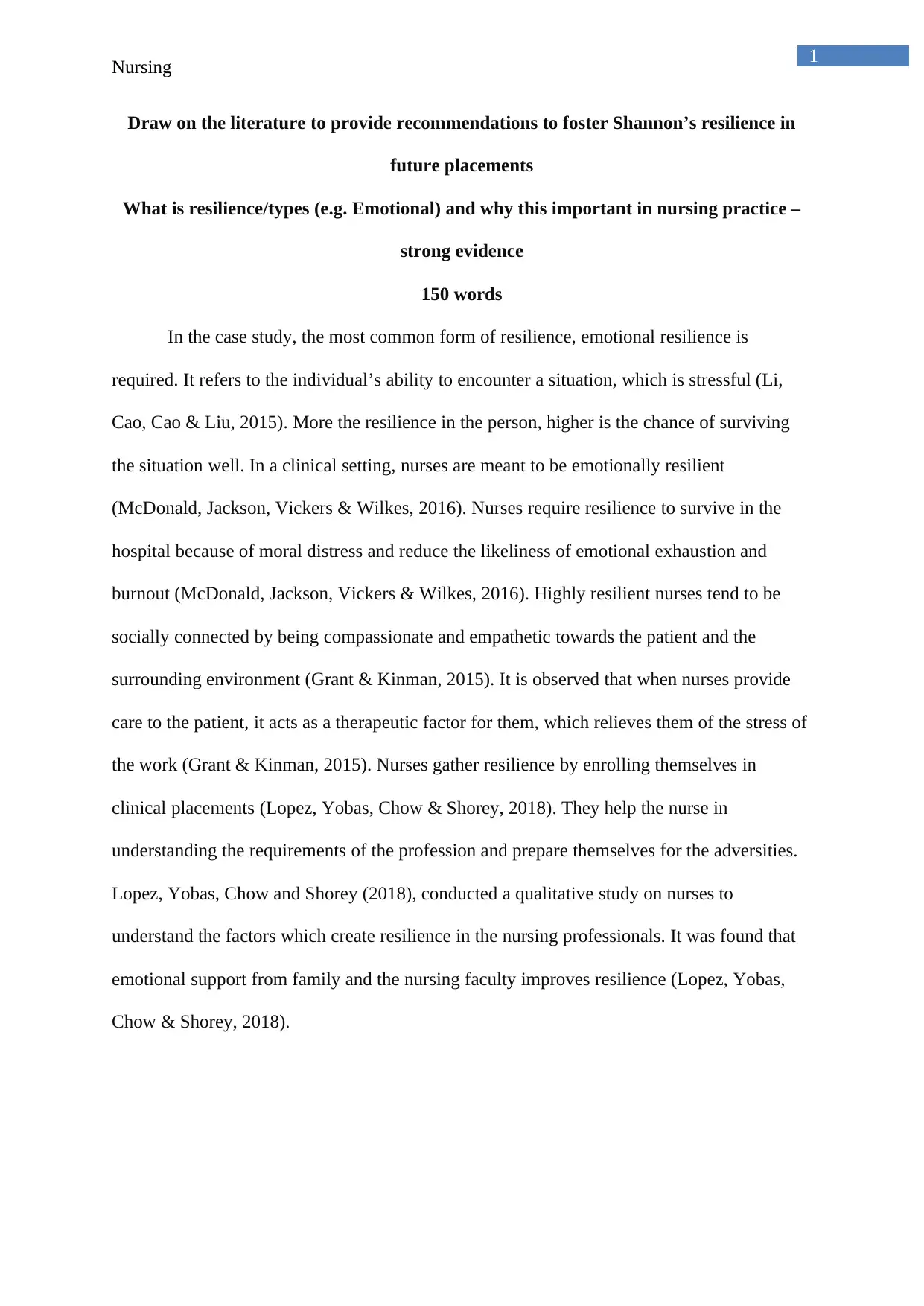
Draw on the literature to provide recommendations to foster Shannon’s resilience in
future placements
What is resilience/types (e.g. Emotional) and why this important in nursing practice –
strong evidence
150 words
In the case study, the most common form of resilience, emotional resilience is
required. It refers to the individual’s ability to encounter a situation, which is stressful (Li,
Cao, Cao & Liu, 2015). More the resilience in the person, higher is the chance of surviving
the situation well. In a clinical setting, nurses are meant to be emotionally resilient
(McDonald, Jackson, Vickers & Wilkes, 2016). Nurses require resilience to survive in the
hospital because of moral distress and reduce the likeliness of emotional exhaustion and
burnout (McDonald, Jackson, Vickers & Wilkes, 2016). Highly resilient nurses tend to be
socially connected by being compassionate and empathetic towards the patient and the
surrounding environment (Grant & Kinman, 2015). It is observed that when nurses provide
care to the patient, it acts as a therapeutic factor for them, which relieves them of the stress of
the work (Grant & Kinman, 2015). Nurses gather resilience by enrolling themselves in
clinical placements (Lopez, Yobas, Chow & Shorey, 2018). They help the nurse in
understanding the requirements of the profession and prepare themselves for the adversities.
Lopez, Yobas, Chow and Shorey (2018), conducted a qualitative study on nurses to
understand the factors which create resilience in the nursing professionals. It was found that
emotional support from family and the nursing faculty improves resilience (Lopez, Yobas,
Chow & Shorey, 2018).
Document Page
2
Nursing
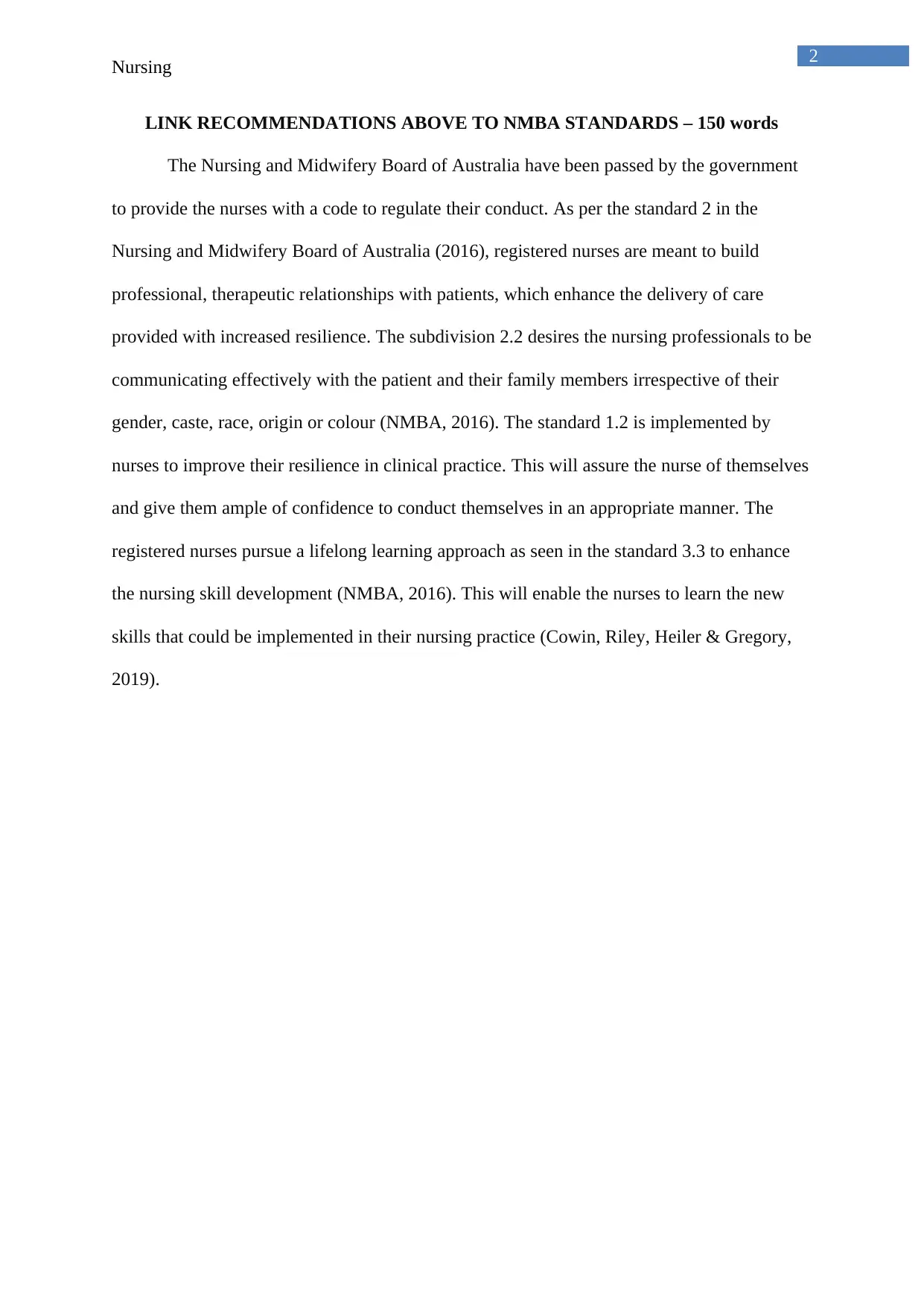
LINK RECOMMENDATIONS ABOVE TO NMBA STANDARDS – 150 words
The Nursing and Midwifery Board of Australia have been passed by the government
to provide the nurses with a code to regulate their conduct. As per the standard 2 in the
Nursing and Midwifery Board of Australia (2016), registered nurses are meant to build
professional, therapeutic relationships with patients, which enhance the delivery of care
provided with increased resilience. The subdivision 2.2 desires the nursing professionals to be
communicating effectively with the patient and their family members irrespective of their
gender, caste, race, origin or colour (NMBA, 2016). The standard 1.2 is implemented by
nurses to improve their resilience in clinical practice. This will assure the nurse of themselves
and give them ample of confidence to conduct themselves in an appropriate manner. The
registered nurses pursue a lifelong learning approach as seen in the standard 3.3 to enhance
the nursing skill development (NMBA, 2016). This will enable the nurses to learn the new
skills that could be implemented in their nursing practice (Cowin, Riley, Heiler & Gregory,
2019).
Document Page
3
Nursing
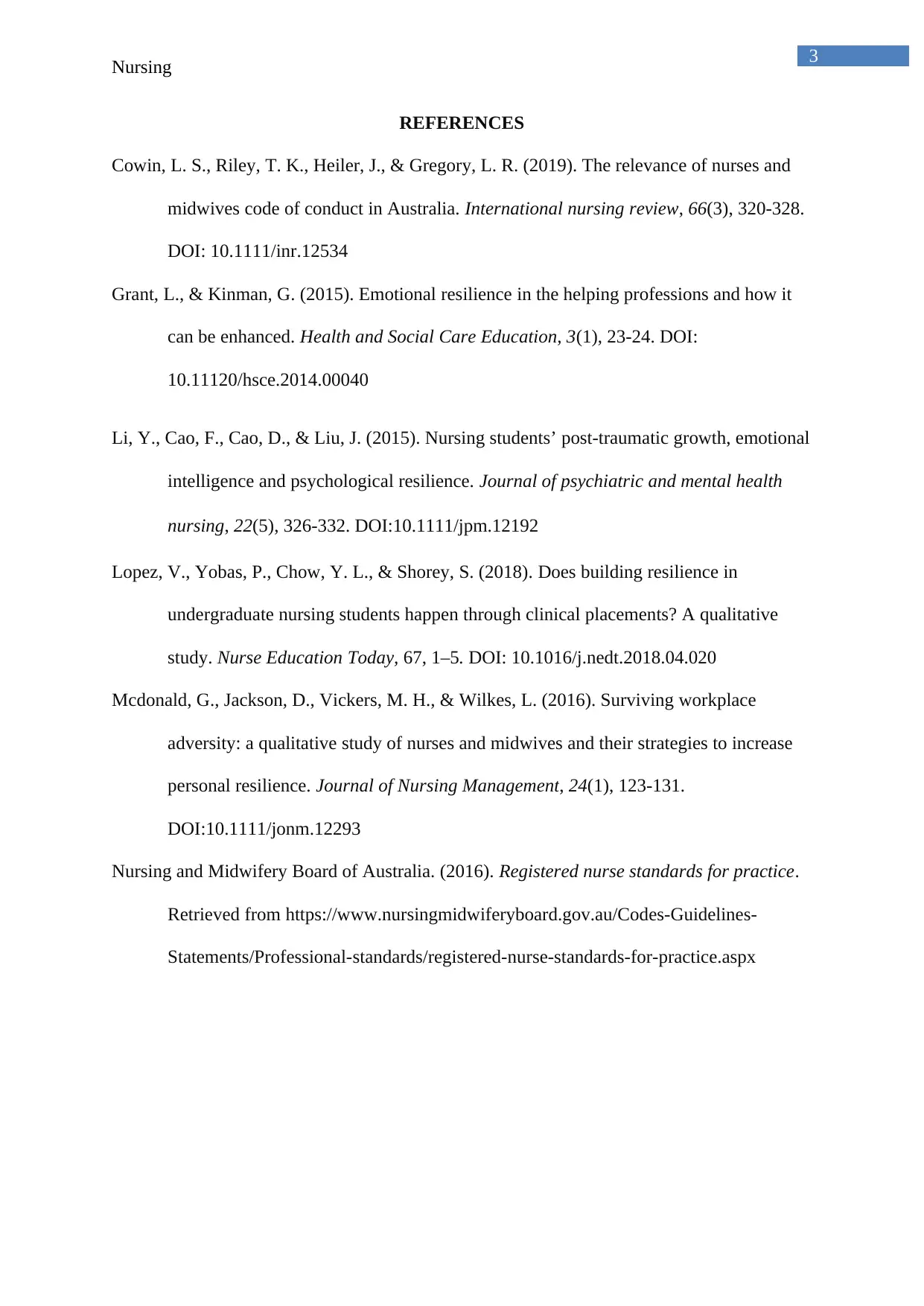
REFERENCES
Cowin, L. S., Riley, T. K., Heiler, J., & Gregory, L. R. (2019). The relevance of nurses and
midwives code of conduct in Australia. International nursing review, 66(3), 320-328.
DOI: 10.1111/inr.12534
Grant, L., & Kinman, G. (2015). Emotional resilience in the helping professions and how it
can be enhanced. Health and Social Care Education, 3(1), 23-24. DOI:
10.11120/hsce.2014.00040
Li, Y., Cao, F., Cao, D., & Liu, J. (2015). Nursing students’ post‐traumatic growth, emotional
intelligence and psychological resilience. Journal of psychiatric and mental health
nursing, 22(5), 326-332. DOI:10.1111/jpm.12192
Lopez, V., Yobas, P., Chow, Y. L., & Shorey, S. (2018). Does building resilience in
undergraduate nursing students happen through clinical placements? A qualitative
study. Nurse Education Today, 67, 1–5. DOI: 10.1016/j.nedt.2018.04.020
Mcdonald, G., Jackson, D., Vickers, M. H., & Wilkes, L. (2016). Surviving workplace
adversity: a qualitative study of nurses and midwives and their strategies to increase
personal resilience. Journal of Nursing Management, 24(1), 123-131.
DOI:10.1111/jonm.12293
Nursing and Midwifery Board of Australia. (2016). Registered nurse standards for practice.
Retrieved from https://www.nursingmidwiferyboard.gov.au/Codes-Guidelines-
Statements/Professional-standards/registered-nurse-standards-for-practice.aspx
chevron_up_icon
1 out of 4
circle_padding
hide_on_mobile
zoom_out_icon
[object Object]