Legal & Ethical Analysis of FRA's Audit Engagement with PGM
VerifiedAdded on 2023/04/23
|25
|6434
|62
Case Study
AI Summary
This case study delves into the complexities of Freedom Rock Accounting's (FRA) potential audit engagement with Pure Grain Milling (PGM), a bulk milling and food processing firm. The analysis identifies several legal and ethical concerns arising from FRA's existing relationships with PGM, including a prior bookkeeping engagement by a merged firm, tax advisory services, and the provision of PGM's 401(k) plan through its subsidiary, Freedom Rock Financial Services (FRFS). Furthermore, the prior employment of an FRFS director as PGM's CFO and the audit committee chair's financial ties to PGM raise additional conflict-of-interest issues. The study examines potential violations of the Sarbanes-Oxley Act of 2002 (SOX), Securities Exchange Act of 1934, and AICPA rules, emphasizing the importance of auditor independence, objectivity, and adherence to professional standards. The case requires a thorough assessment of these issues to determine FRA's ability to perform the audit while maintaining integrity and complying with legal and ethical requirements.
Running head: AUDITING
Auditing
Name of the Student
Name of the University
Authors Note
Course ID
Auditing
Name of the Student
Name of the University
Authors Note
Course ID

Paraphrase This Document
Need a fresh take? Get an instant paraphrase of this document with our AI Paraphraser
1AUDITING
Table of Contents
Task 1:........................................................................................................................................3
Answer to 1:...........................................................................................................................3
Answer to 2:...........................................................................................................................4
Answer to 3:...........................................................................................................................6
Answer to 4:...........................................................................................................................7
Answer to 5:...........................................................................................................................8
Task 2:........................................................................................................................................9
Answer to question 1:.................................................................................................................9
Answer A:............................................................................................................................10
Answer B:.............................................................................................................................10
Answer to C:........................................................................................................................11
Answer to D:........................................................................................................................11
Answer to E:.........................................................................................................................12
Answer to question 2:...............................................................................................................13
Answer to question 3:...............................................................................................................13
Task 3:......................................................................................................................................14
Answer to question 1................................................................................................................14
Questions to be asked to Senior Management:....................................................................14
Answer to B:........................................................................................................................14
Answer to C:........................................................................................................................15
Table of Contents
Task 1:........................................................................................................................................3
Answer to 1:...........................................................................................................................3
Answer to 2:...........................................................................................................................4
Answer to 3:...........................................................................................................................6
Answer to 4:...........................................................................................................................7
Answer to 5:...........................................................................................................................8
Task 2:........................................................................................................................................9
Answer to question 1:.................................................................................................................9
Answer A:............................................................................................................................10
Answer B:.............................................................................................................................10
Answer to C:........................................................................................................................11
Answer to D:........................................................................................................................11
Answer to E:.........................................................................................................................12
Answer to question 2:...............................................................................................................13
Answer to question 3:...............................................................................................................13
Task 3:......................................................................................................................................14
Answer to question 1................................................................................................................14
Questions to be asked to Senior Management:....................................................................14
Answer to B:........................................................................................................................14
Answer to C:........................................................................................................................15
2AUDITING
Answer to Question 2:..........................................................................................................15
Answer to Question 3:..........................................................................................................16
Internal Control of Payroll and Personal Cycle.......................................................................16
Answer to question 4:...........................................................................................................17
Internal Control of Inventory and Warehouse Cycle...............................................................17
Answer to question B:..............................................................................................................18
Answer to 1:.........................................................................................................................18
Answer to 2:.........................................................................................................................18
Answer to 3:.........................................................................................................................18
Answer to question 4:...............................................................................................................19
Answer to A:........................................................................................................................19
Answer to B:........................................................................................................................19
Answer to C:........................................................................................................................19
Answer to Part C:.....................................................................................................................20
References:...............................................................................................................................21
Answer to Question 2:..........................................................................................................15
Answer to Question 3:..........................................................................................................16
Internal Control of Payroll and Personal Cycle.......................................................................16
Answer to question 4:...........................................................................................................17
Internal Control of Inventory and Warehouse Cycle...............................................................17
Answer to question B:..............................................................................................................18
Answer to 1:.........................................................................................................................18
Answer to 2:.........................................................................................................................18
Answer to 3:.........................................................................................................................18
Answer to question 4:...............................................................................................................19
Answer to A:........................................................................................................................19
Answer to B:........................................................................................................................19
Answer to C:........................................................................................................................19
Answer to Part C:.....................................................................................................................20
References:...............................................................................................................................21
⊘ This is a preview!⊘
Do you want full access?
Subscribe today to unlock all pages.

Trusted by 1+ million students worldwide
3AUDITING
Task 1:
Answer to 1:
Three possible lawful issues or conflicts related to FRA’s capability to perform the audit of
PGM:
The three possible lawful issues that s related with the FRA’s capability to perform the audit
of the PGM is given below;
a. The first and the primary issues is the OFA, a company that has amalgamated with the
FRA in the last year was the auditor of the PGM all through the four-year span. The
issues arise that the member of the PFA was the bookkeeper of the PGM, and may
potentially be the auditor or the auditor assistant under this engagement (Kumar &
Sharma, 2015). This might infringe the prohibited service that is registered under the
“SOX Act of 2002” title 2 under section 201-Subsection G.
b. The additional probable issues that may have created a conflict is the CFO of PGM
who was the director of the FRAS and continues to offer services for the PGM’s
(401k). This might create a violation of the prohibited relationship and lead to the
conflict of interest based on SOX Act of the 2002 Title 2 Section 206 (Cook et al.,
2016).
c. The third potential issues are the chair committee of the audit committee and is also
the original proprietor of the PGM. He possesses the 10% rights and obtains the 10%
dividends from the PGM. On assessing the contextual background of the audit
commission it is concluded that Mr Ed is either the CEO or the COO of the PGM.
Therefore, Mr Ed is not the regarded as the independent board member of PGM.
There is a violation of Securities Exchange Act 1934 under section 10-A M-3-B ii
relating to the objectivity of audit commission.
Task 1:
Answer to 1:
Three possible lawful issues or conflicts related to FRA’s capability to perform the audit of
PGM:
The three possible lawful issues that s related with the FRA’s capability to perform the audit
of the PGM is given below;
a. The first and the primary issues is the OFA, a company that has amalgamated with the
FRA in the last year was the auditor of the PGM all through the four-year span. The
issues arise that the member of the PFA was the bookkeeper of the PGM, and may
potentially be the auditor or the auditor assistant under this engagement (Kumar &
Sharma, 2015). This might infringe the prohibited service that is registered under the
“SOX Act of 2002” title 2 under section 201-Subsection G.
b. The additional probable issues that may have created a conflict is the CFO of PGM
who was the director of the FRAS and continues to offer services for the PGM’s
(401k). This might create a violation of the prohibited relationship and lead to the
conflict of interest based on SOX Act of the 2002 Title 2 Section 206 (Cook et al.,
2016).
c. The third potential issues are the chair committee of the audit committee and is also
the original proprietor of the PGM. He possesses the 10% rights and obtains the 10%
dividends from the PGM. On assessing the contextual background of the audit
commission it is concluded that Mr Ed is either the CEO or the COO of the PGM.
Therefore, Mr Ed is not the regarded as the independent board member of PGM.
There is a violation of Securities Exchange Act 1934 under section 10-A M-3-B ii
relating to the objectivity of audit commission.
Paraphrase This Document
Need a fresh take? Get an instant paraphrase of this document with our AI Paraphraser
4AUDITING
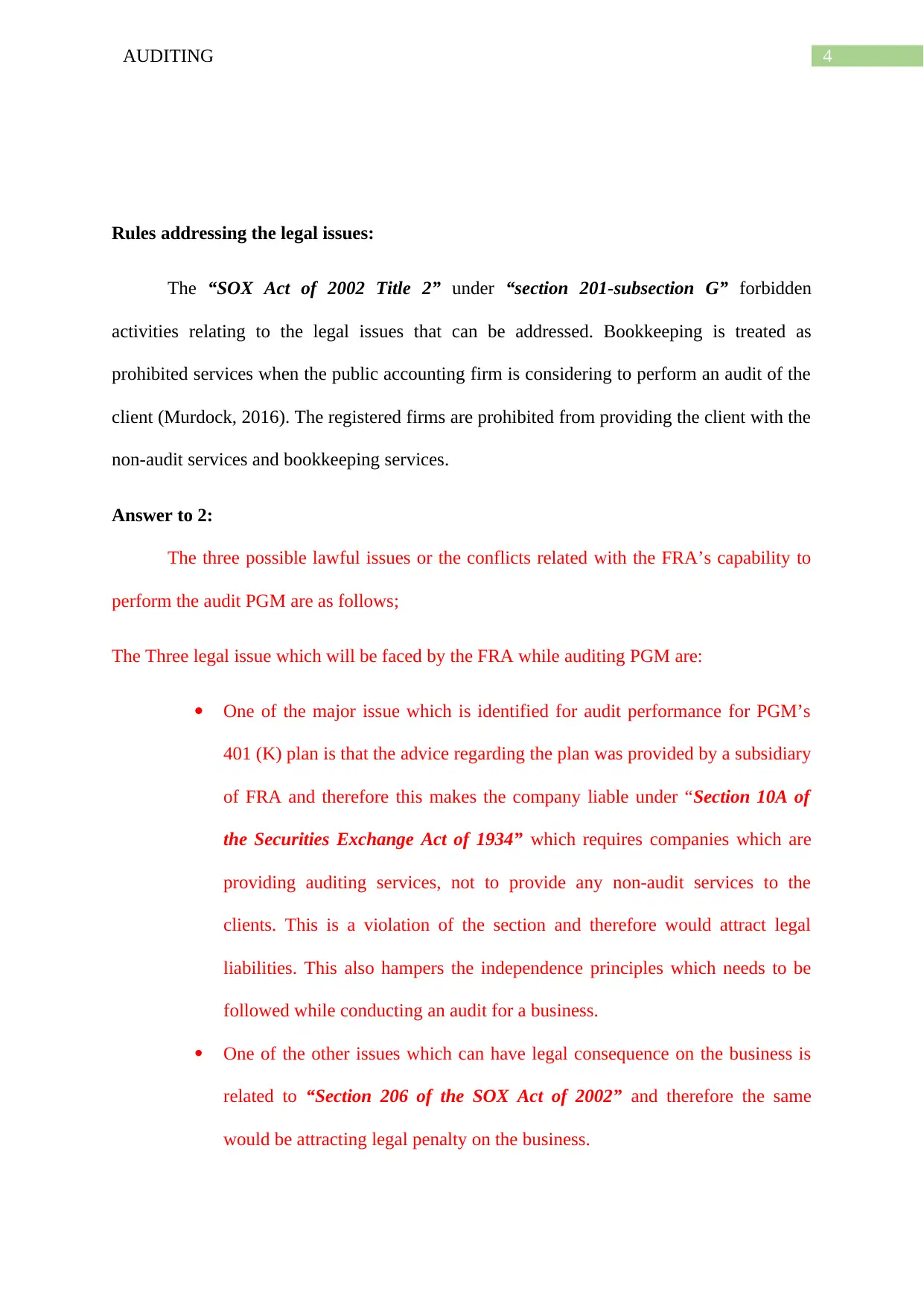
Rules addressing the legal issues:
The “SOX Act of 2002 Title 2” under “section 201-subsection G” forbidden
activities relating to the legal issues that can be addressed. Bookkeeping is treated as
prohibited services when the public accounting firm is considering to perform an audit of the
client (Murdock, 2016). The registered firms are prohibited from providing the client with the
non-audit services and bookkeeping services.
Answer to 2:
The three possible lawful issues or the conflicts related with the FRA’s capability to
perform the audit PGM are as follows;
The Three legal issue which will be faced by the FRA while auditing PGM are:
One of the major issue which is identified for audit performance for PGM’s
401 (K) plan is that the advice regarding the plan was provided by a subsidiary
of FRA and therefore this makes the company liable under “Section 10A of
the Securities Exchange Act of 1934” which requires companies which are
providing auditing services, not to provide any non-audit services to the
clients. This is a violation of the section and therefore would attract legal
liabilities. This also hampers the independence principles which needs to be
followed while conducting an audit for a business.
One of the other issues which can have legal consequence on the business is
related to “Section 206 of the SOX Act of 2002” and therefore the same
would be attracting legal penalty on the business.
Rules addressing the legal issues:
The “SOX Act of 2002 Title 2” under “section 201-subsection G” forbidden
activities relating to the legal issues that can be addressed. Bookkeeping is treated as
prohibited services when the public accounting firm is considering to perform an audit of the
client (Murdock, 2016). The registered firms are prohibited from providing the client with the
non-audit services and bookkeeping services.
Answer to 2:
The three possible lawful issues or the conflicts related with the FRA’s capability to
perform the audit PGM are as follows;
The Three legal issue which will be faced by the FRA while auditing PGM are:
One of the major issue which is identified for audit performance for PGM’s
401 (K) plan is that the advice regarding the plan was provided by a subsidiary
of FRA and therefore this makes the company liable under “Section 10A of
the Securities Exchange Act of 1934” which requires companies which are
providing auditing services, not to provide any non-audit services to the
clients. This is a violation of the section and therefore would attract legal
liabilities. This also hampers the independence principles which needs to be
followed while conducting an audit for a business.
One of the other issues which can have legal consequence on the business is
related to “Section 206 of the SOX Act of 2002” and therefore the same
would be attracting legal penalty on the business.
5AUDITING
The audit would not be conducted appropriately and would be in direct
violation of section 303 which is a section to protect the best interest of the
investors of the business.
(A) To avoid conflict in legal matters the auditor should get some expertise related
to the topic, in the given case FRA does not have any professional experience
regarding the project so they take help of some expert who have the knowledge to
perform the task and also, they can take help of lawyers who have the knowledge
of legal compliance of the project. The lawyers would be able to give the best
advice regarding the course of action which the management of the company
needs to take for ensuring that proper legal process is followed.
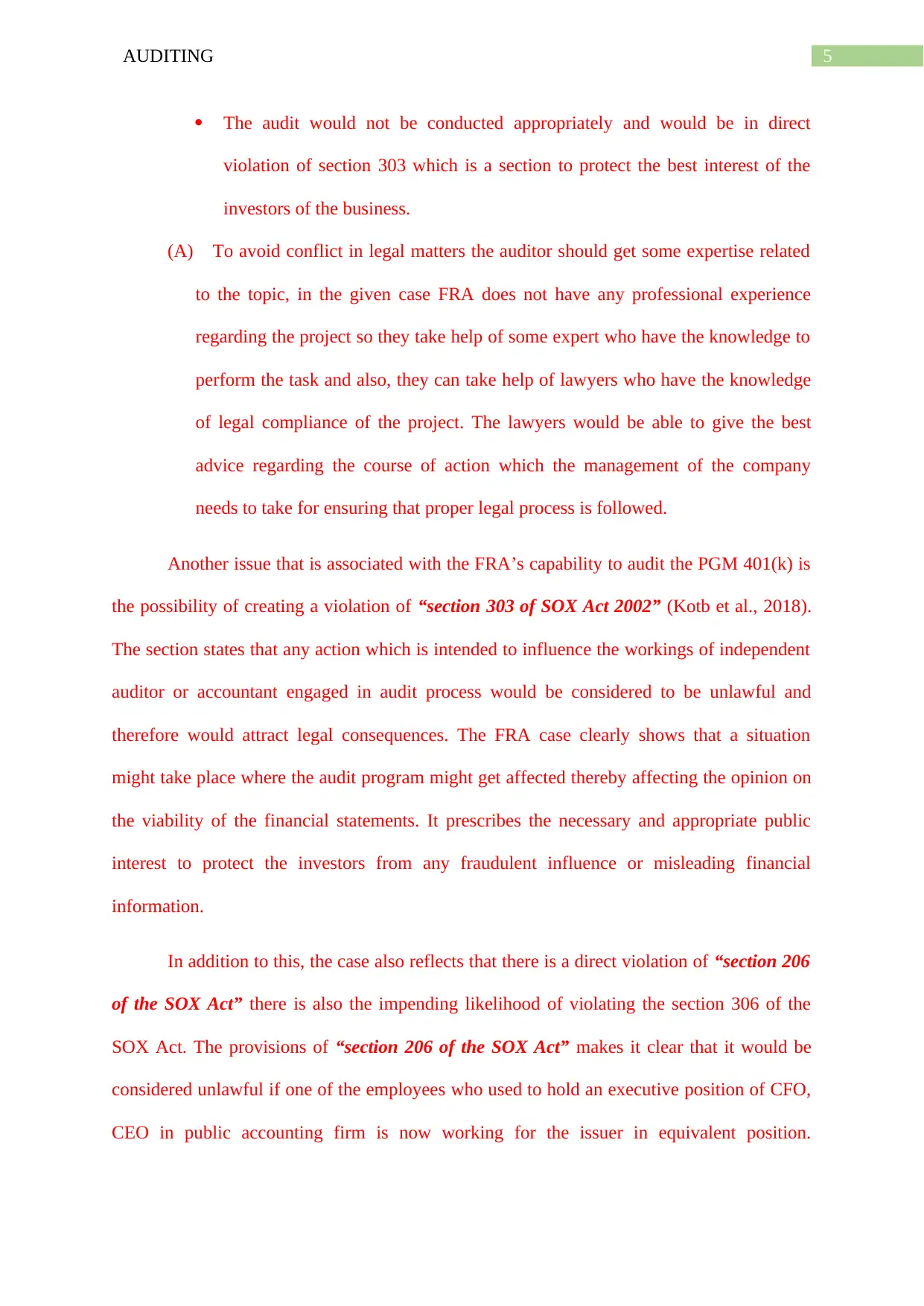
Another issue that is associated with the FRA’s capability to audit the PGM 401(k) is
the possibility of creating a violation of “section 303 of SOX Act 2002” (Kotb et al., 2018).
The section states that any action which is intended to influence the workings of independent
auditor or accountant engaged in audit process would be considered to be unlawful and
therefore would attract legal consequences. The FRA case clearly shows that a situation
might take place where the audit program might get affected thereby affecting the opinion on
the viability of the financial statements. It prescribes the necessary and appropriate public
interest to protect the investors from any fraudulent influence or misleading financial
information.
In addition to this, the case also reflects that there is a direct violation of “section 206
of the SOX Act” there is also the impending likelihood of violating the section 306 of the
SOX Act. The provisions of “section 206 of the SOX Act” makes it clear that it would be
considered unlawful if one of the employees who used to hold an executive position of CFO,
CEO in public accounting firm is now working for the issuer in equivalent position.
The audit would not be conducted appropriately and would be in direct
violation of section 303 which is a section to protect the best interest of the
investors of the business.
(A) To avoid conflict in legal matters the auditor should get some expertise related
to the topic, in the given case FRA does not have any professional experience
regarding the project so they take help of some expert who have the knowledge to
perform the task and also, they can take help of lawyers who have the knowledge
of legal compliance of the project. The lawyers would be able to give the best
advice regarding the course of action which the management of the company
needs to take for ensuring that proper legal process is followed.
Another issue that is associated with the FRA’s capability to audit the PGM 401(k) is
the possibility of creating a violation of “section 303 of SOX Act 2002” (Kotb et al., 2018).
The section states that any action which is intended to influence the workings of independent
auditor or accountant engaged in audit process would be considered to be unlawful and
therefore would attract legal consequences. The FRA case clearly shows that a situation
might take place where the audit program might get affected thereby affecting the opinion on
the viability of the financial statements. It prescribes the necessary and appropriate public
interest to protect the investors from any fraudulent influence or misleading financial
information.
In addition to this, the case also reflects that there is a direct violation of “section 206
of the SOX Act” there is also the impending likelihood of violating the section 306 of the
SOX Act. The provisions of “section 206 of the SOX Act” makes it clear that it would be
considered unlawful if one of the employees who used to hold an executive position of CFO,
CEO in public accounting firm is now working for the issuer in equivalent position.
⊘ This is a preview!⊘
Do you want full access?
Subscribe today to unlock all pages.
Trusted by 1+ million students worldwide
6AUDITING
However, it is to be remembered that time gap needs to be within 1 year to attract this
section.
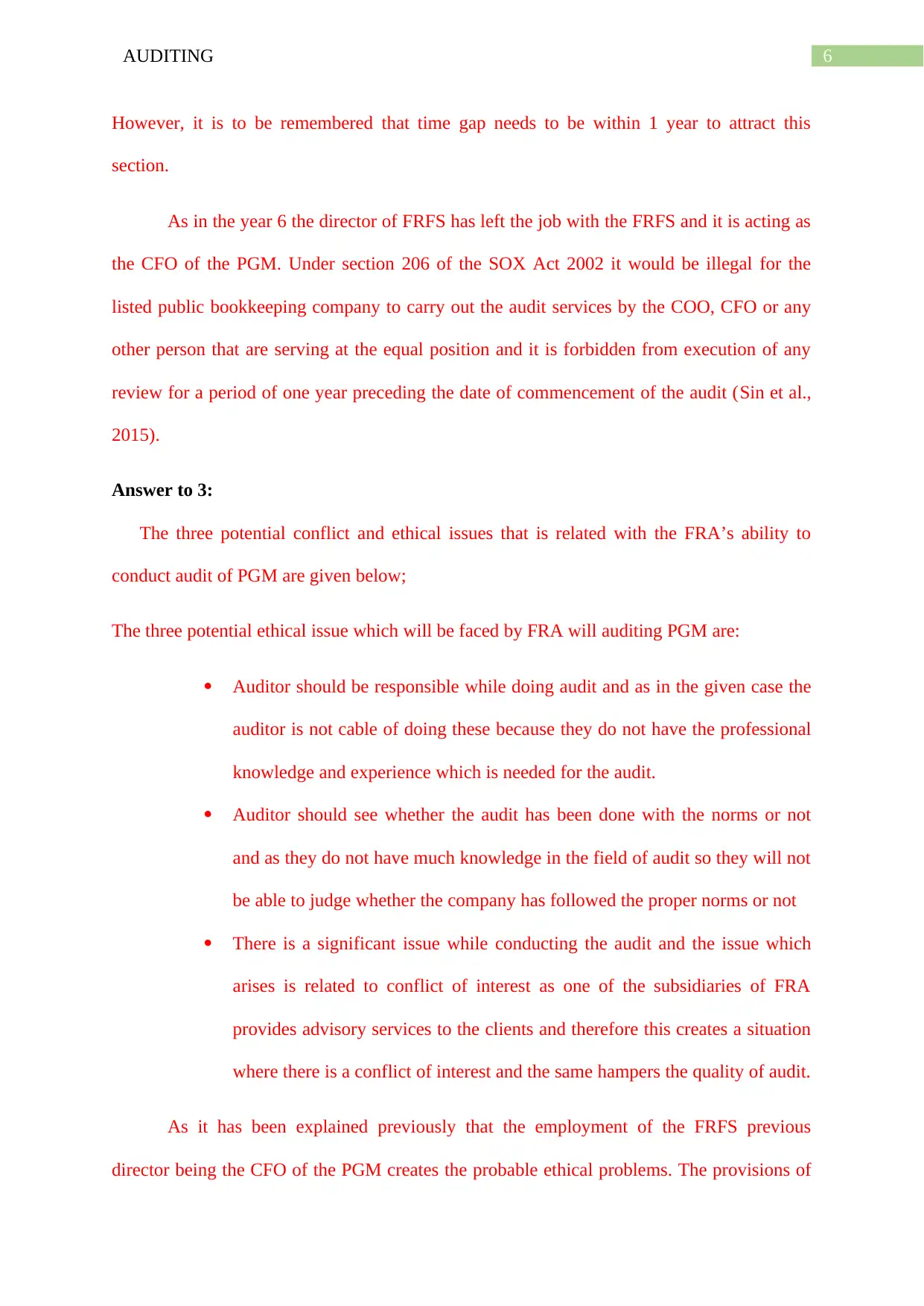
As in the year 6 the director of FRFS has left the job with the FRFS and it is acting as
the CFO of the PGM. Under section 206 of the SOX Act 2002 it would be illegal for the
listed public bookkeeping company to carry out the audit services by the COO, CFO or any
other person that are serving at the equal position and it is forbidden from execution of any
review for a period of one year preceding the date of commencement of the audit (Sin et al.,
2015).
Answer to 3:
The three potential conflict and ethical issues that is related with the FRA’s ability to
conduct audit of PGM are given below;
The three potential ethical issue which will be faced by FRA will auditing PGM are:
Auditor should be responsible while doing audit and as in the given case the
auditor is not cable of doing these because they do not have the professional
knowledge and experience which is needed for the audit.
Auditor should see whether the audit has been done with the norms or not
and as they do not have much knowledge in the field of audit so they will not
be able to judge whether the company has followed the proper norms or not
There is a significant issue while conducting the audit and the issue which
arises is related to conflict of interest as one of the subsidiaries of FRA
provides advisory services to the clients and therefore this creates a situation
where there is a conflict of interest and the same hampers the quality of audit.
As it has been explained previously that the employment of the FRFS previous
director being the CFO of the PGM creates the probable ethical problems. The provisions of
However, it is to be remembered that time gap needs to be within 1 year to attract this
section.
As in the year 6 the director of FRFS has left the job with the FRFS and it is acting as
the CFO of the PGM. Under section 206 of the SOX Act 2002 it would be illegal for the
listed public bookkeeping company to carry out the audit services by the COO, CFO or any
other person that are serving at the equal position and it is forbidden from execution of any
review for a period of one year preceding the date of commencement of the audit (Sin et al.,
2015).
Answer to 3:
The three potential conflict and ethical issues that is related with the FRA’s ability to
conduct audit of PGM are given below;
The three potential ethical issue which will be faced by FRA will auditing PGM are:
Auditor should be responsible while doing audit and as in the given case the
auditor is not cable of doing these because they do not have the professional
knowledge and experience which is needed for the audit.
Auditor should see whether the audit has been done with the norms or not
and as they do not have much knowledge in the field of audit so they will not
be able to judge whether the company has followed the proper norms or not
There is a significant issue while conducting the audit and the issue which
arises is related to conflict of interest as one of the subsidiaries of FRA
provides advisory services to the clients and therefore this creates a situation
where there is a conflict of interest and the same hampers the quality of audit.
As it has been explained previously that the employment of the FRFS previous
director being the CFO of the PGM creates the probable ethical problems. The provisions of
Paraphrase This Document
Need a fresh take? Get an instant paraphrase of this document with our AI Paraphraser
7AUDITING
“section 206 of the SOX Act” clearly covers the rules which is to be followed by the business
in order to ensure that such conflicts does not arises in future. One should also consider the
fact that this person also possesses the most likely arbitrary impact over the team of audit and
also holds influence to the depth of knowledge regarding how FRA perform their audit.
Presently it is understood that FRA provides services to PGM regarding the tax
advice. As per the rules of AICPA Contingent Fees Rule (AICPA 1.510.001) a member of the
AICPA is prohibited from preparing or changing the returning or claiming any kind of tax
refunds depending upon the contingent fees rules. Even though it is imperative that the
appropriate procedure for audit are in place for defining that any kind of tax planning fees are
not contingent based on the auditing outcome and also includes that any kind of audit fees is
not contingent on the planning of tax.
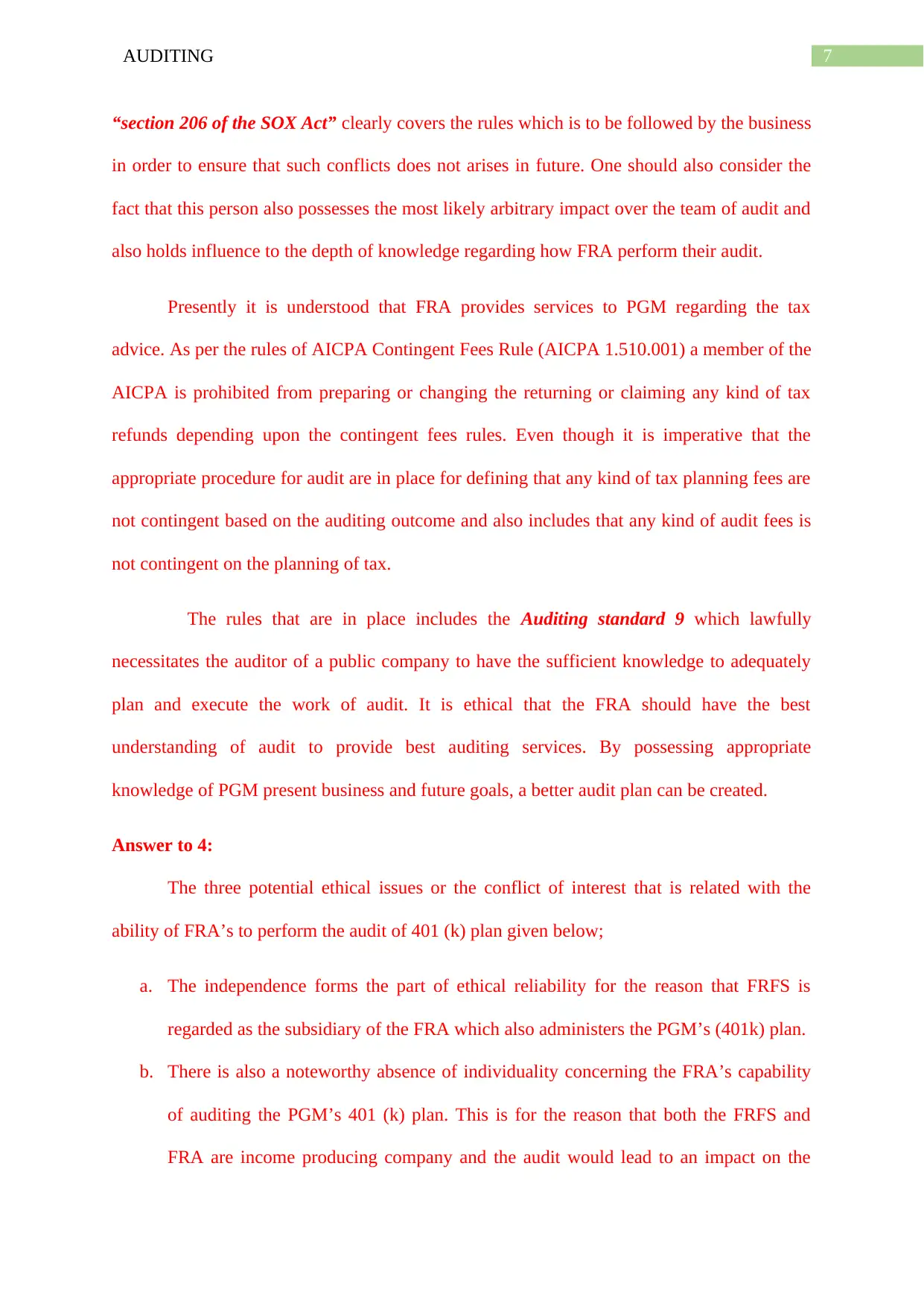
The rules that are in place includes the Auditing standard 9 which lawfully
necessitates the auditor of a public company to have the sufficient knowledge to adequately
plan and execute the work of audit. It is ethical that the FRA should have the best
understanding of audit to provide best auditing services. By possessing appropriate
knowledge of PGM present business and future goals, a better audit plan can be created.
Answer to 4:
The three potential ethical issues or the conflict of interest that is related with the
ability of FRA’s to perform the audit of 401 (k) plan given below;
a. The independence forms the part of ethical reliability for the reason that FRFS is
regarded as the subsidiary of the FRA which also administers the PGM’s (401k) plan.
b. There is also a noteworthy absence of individuality concerning the FRA’s capability
of auditing the PGM’s 401 (k) plan. This is for the reason that both the FRFS and
FRA are income producing company and the audit would lead to an impact on the
“section 206 of the SOX Act” clearly covers the rules which is to be followed by the business
in order to ensure that such conflicts does not arises in future. One should also consider the
fact that this person also possesses the most likely arbitrary impact over the team of audit and
also holds influence to the depth of knowledge regarding how FRA perform their audit.
Presently it is understood that FRA provides services to PGM regarding the tax
advice. As per the rules of AICPA Contingent Fees Rule (AICPA 1.510.001) a member of the
AICPA is prohibited from preparing or changing the returning or claiming any kind of tax
refunds depending upon the contingent fees rules. Even though it is imperative that the
appropriate procedure for audit are in place for defining that any kind of tax planning fees are
not contingent based on the auditing outcome and also includes that any kind of audit fees is
not contingent on the planning of tax.
The rules that are in place includes the Auditing standard 9 which lawfully
necessitates the auditor of a public company to have the sufficient knowledge to adequately
plan and execute the work of audit. It is ethical that the FRA should have the best
understanding of audit to provide best auditing services. By possessing appropriate
knowledge of PGM present business and future goals, a better audit plan can be created.
Answer to 4:
The three potential ethical issues or the conflict of interest that is related with the
ability of FRA’s to perform the audit of 401 (k) plan given below;
a. The independence forms the part of ethical reliability for the reason that FRFS is
regarded as the subsidiary of the FRA which also administers the PGM’s (401k) plan.
b. There is also a noteworthy absence of individuality concerning the FRA’s capability
of auditing the PGM’s 401 (k) plan. This is for the reason that both the FRFS and
FRA are income producing company and the audit would lead to an impact on the
8AUDITING
financial position of FRA (Adelopo, 2016). It would be illogical to believe that FRA
may not probably change the audit results so that it can have highly favourable
outcome and creates a practical uncertainty even though FRA perform the audit with
premier standard.
c. The ethical dilemma created by FRA auditing of financial statements is that the
financial instrument that is sold by the subsidiary hardly bodes well for the FRA. This
introduces the question of integrity and involves the violation of AICPA rules of
1.100.001.01 (Antipova, 2016). Therefore, FRA is not permitted to perform audit of
PGM’s 401 (k) plan. Even though it has been mentioned numerous times before, it is
noteworthy to denote that employment by the PGM of FRFS previous director may
lead to the probable ethical issues during the auditing of 401(k) simultaneously.
According to the AICPA Code of Professional Conduct Rule 2 self-interest,
acquaintance and undue amount of influence might be prevalent and his or her supervisor or
any other person inside the organization might have the different kind of opinion associated
to the application of the accounting principles, auditing standards and other appropriate
professional standards. It also includes the standards that are relevant for the tax and
consulting services. Based on the above three situations it directly involves the violation of
the AICPA rule and it would be unethical for the FRA to indulge in the audit of PGM 401 (k)
audit plan.
The regulations which are covered under “SOX Act 2002” are to be considered for the
purpose of ensuring legal provisions are considered regarding the capacity of conducting an
audit for the business.
financial position of FRA (Adelopo, 2016). It would be illogical to believe that FRA
may not probably change the audit results so that it can have highly favourable
outcome and creates a practical uncertainty even though FRA perform the audit with
premier standard.
c. The ethical dilemma created by FRA auditing of financial statements is that the
financial instrument that is sold by the subsidiary hardly bodes well for the FRA. This
introduces the question of integrity and involves the violation of AICPA rules of
1.100.001.01 (Antipova, 2016). Therefore, FRA is not permitted to perform audit of
PGM’s 401 (k) plan. Even though it has been mentioned numerous times before, it is
noteworthy to denote that employment by the PGM of FRFS previous director may
lead to the probable ethical issues during the auditing of 401(k) simultaneously.
According to the AICPA Code of Professional Conduct Rule 2 self-interest,
acquaintance and undue amount of influence might be prevalent and his or her supervisor or
any other person inside the organization might have the different kind of opinion associated
to the application of the accounting principles, auditing standards and other appropriate
professional standards. It also includes the standards that are relevant for the tax and
consulting services. Based on the above three situations it directly involves the violation of
the AICPA rule and it would be unethical for the FRA to indulge in the audit of PGM 401 (k)
audit plan.
The regulations which are covered under “SOX Act 2002” are to be considered for the
purpose of ensuring legal provisions are considered regarding the capacity of conducting an
audit for the business.
⊘ This is a preview!⊘
Do you want full access?
Subscribe today to unlock all pages.
Trusted by 1+ million students worldwide
9AUDITING
Answer to 5:
The two possible fraud risks associated with the PGM or PGM’s 401 (k) plan are given
below;
a. The chief administrative officer brother is the owner of the pest control company that
is contracted by the PGM for all kind of services related to pest. On reviewing the
financial statement it is understood that the pest control expenditure have increased to
$36,000 during the year 6 which accounts an increase of 33%. While in the year 7 the
pest control expenditure rose to $78,000 which accounts 116% rise from the previous
year. Therefore it comes necessary to conduct test on the internal controls over the
disbursement of cash along with the procedure of accounts payable to make sure that
no incorrect handling of the funds are happening.
b. Secondly, the sales during the year 7 increased from $9,978,000 to $10,814,000 what
accounts an 8% growth while the cost of goods sold decreased to 13%. Documentary
evidences have suggested that expansion of business has resulted in the rise of COGS
because of local farmers inadequacy to satisfy the PGM’s business demand. This
gives rise to poor quality and resources are allocated to quality inspection for the
purchase of produce that are out of the local area. It should be noted that the bottom
line of the financial statement represents a fall. While an in-detail review of accounts
payable process and purchase order invoice inspection should be done in the audit
process.
Task 2:
Answer to question 1:
The comparison of audit and review services are as follows;
Answer to 5:
The two possible fraud risks associated with the PGM or PGM’s 401 (k) plan are given
below;
a. The chief administrative officer brother is the owner of the pest control company that
is contracted by the PGM for all kind of services related to pest. On reviewing the
financial statement it is understood that the pest control expenditure have increased to
$36,000 during the year 6 which accounts an increase of 33%. While in the year 7 the
pest control expenditure rose to $78,000 which accounts 116% rise from the previous
year. Therefore it comes necessary to conduct test on the internal controls over the
disbursement of cash along with the procedure of accounts payable to make sure that
no incorrect handling of the funds are happening.
b. Secondly, the sales during the year 7 increased from $9,978,000 to $10,814,000 what
accounts an 8% growth while the cost of goods sold decreased to 13%. Documentary
evidences have suggested that expansion of business has resulted in the rise of COGS
because of local farmers inadequacy to satisfy the PGM’s business demand. This
gives rise to poor quality and resources are allocated to quality inspection for the
purchase of produce that are out of the local area. It should be noted that the bottom
line of the financial statement represents a fall. While an in-detail review of accounts
payable process and purchase order invoice inspection should be done in the audit
process.
Task 2:
Answer to question 1:
The comparison of audit and review services are as follows;
Paraphrase This Document
Need a fresh take? Get an instant paraphrase of this document with our AI Paraphraser
10AUDITING
Level of assurance: The degree of assurance that the financial statement of the customers is
fairly provided is considered at the highest level for the audit and lowest for the compilation
while for review it stands somewhat in between.
Reliance on Management: In the audit procedure the auditor commences with the account
balances that are provided by the management since audit requires significant amount of
corroboration of information. While review requires the testing of information and remains
dependent on the information presented.
Understanding the internal control: The auditor under audit only perform test of the
internal controls while review performs no kind of testing.
Answer A:
The auditor is regarded as the independently qualified person that are appointed to provide
the shareholders with the independent, specialized and knowledgeable opinion relating to the
fiscal statements by the directors. The responsibilities of the provider of the audit service is
stated below;
a. Provide an Audit Report: The chief accountability of the auditor is to provide report
to the associates. The report should state whether the judgement provided by the
auditor offers true and fair opinion of the financial state of the business and whether
the statement has been prepared in compliance with the pertinent provision of the
corporation acts and other applicable legislation or bookkeeping standards (Knechel
& Salterio, 2016).
b. Duty to exercise professional integrity: The audit service provider should carry out
the work of audit professional integrity. The independent audit service provider has
the accountability of complying with the audit standard that are accepted by the
practitioners.
Level of assurance: The degree of assurance that the financial statement of the customers is
fairly provided is considered at the highest level for the audit and lowest for the compilation
while for review it stands somewhat in between.
Reliance on Management: In the audit procedure the auditor commences with the account
balances that are provided by the management since audit requires significant amount of
corroboration of information. While review requires the testing of information and remains
dependent on the information presented.
Understanding the internal control: The auditor under audit only perform test of the
internal controls while review performs no kind of testing.
Answer A:
The auditor is regarded as the independently qualified person that are appointed to provide
the shareholders with the independent, specialized and knowledgeable opinion relating to the
fiscal statements by the directors. The responsibilities of the provider of the audit service is
stated below;
a. Provide an Audit Report: The chief accountability of the auditor is to provide report
to the associates. The report should state whether the judgement provided by the
auditor offers true and fair opinion of the financial state of the business and whether
the statement has been prepared in compliance with the pertinent provision of the
corporation acts and other applicable legislation or bookkeeping standards (Knechel
& Salterio, 2016).
b. Duty to exercise professional integrity: The audit service provider should carry out
the work of audit professional integrity. The independent audit service provider has
the accountability of complying with the audit standard that are accepted by the
practitioners.
11AUDITING
Answer B:
The benefits of the auditor are numerous. Audits helps in improving the efficiency
and profitability of the company by helping the management in better understanding their
working as well as financial systems (William et al., 2016). The audits can recognize the
areas in the organization that requires the improvement and how it can apply the necessary
changes and adjustments. The benefits are audits is summarized below;
a. Audit services helps in assuring the directors that are involved in functions of
accounting based on the daily basis that the business is successively in compliance
with the info which they are in receipt of. Audit helps in reducing the risk of fraud and
poor accounting.
b. Audit helps in facilitating the provision of advice which may have actual financial
benefits for the business, including how the business is running, what margins can be
anticipated and how they can be attained (Messier Jr, 2016). Advice can cover
anything from the tightening of the internal controls for planning of tax and reducing
the risks of frauds.
Answer to C:
The accountabilities of the provider of the review service are as follows;
a. The responsibilities of the review service provider are to perform review engagements
in compliance with the statements on standards for accounting and review services
promulgated by the accounting and review services committee of the AICPA and in
relation to International Standard on Review Engagements.
b. The accountabilities of the review service provider include his accountability towards
his profession. It includes the responsibility of complying with the standards that are
accepted by the practitioners. The responsibilities of the review service provider are
Answer B:
The benefits of the auditor are numerous. Audits helps in improving the efficiency
and profitability of the company by helping the management in better understanding their
working as well as financial systems (William et al., 2016). The audits can recognize the
areas in the organization that requires the improvement and how it can apply the necessary
changes and adjustments. The benefits are audits is summarized below;
a. Audit services helps in assuring the directors that are involved in functions of
accounting based on the daily basis that the business is successively in compliance
with the info which they are in receipt of. Audit helps in reducing the risk of fraud and
poor accounting.
b. Audit helps in facilitating the provision of advice which may have actual financial
benefits for the business, including how the business is running, what margins can be
anticipated and how they can be attained (Messier Jr, 2016). Advice can cover
anything from the tightening of the internal controls for planning of tax and reducing
the risks of frauds.
Answer to C:
The accountabilities of the provider of the review service are as follows;
a. The responsibilities of the review service provider are to perform review engagements
in compliance with the statements on standards for accounting and review services
promulgated by the accounting and review services committee of the AICPA and in
relation to International Standard on Review Engagements.
b. The accountabilities of the review service provider include his accountability towards
his profession. It includes the responsibility of complying with the standards that are
accepted by the practitioners. The responsibilities of the review service provider are
⊘ This is a preview!⊘
Do you want full access?
Subscribe today to unlock all pages.
Trusted by 1+ million students worldwide

1 out of 25


Related Documents


Your All-in-One AI-Powered Toolkit for Academic Success.
+13062052269
info@desklib.com
Available 24*7 on WhatsApp / Email
![[object Object]](/_next/static/media/star-bottom.7253800d.svg)
Unlock your academic potential
Copyright © 2020–2026 A2Z Services. All Rights Reserved. Developed and managed by ZUCOL.