Case Study of Fraser Foods: Managing People and Organisation
VerifiedAdded on 2023/05/27
|14
|2303
|315
Case Study
AI Summary
This case study solution provides an in-depth analysis of Fraser Foods, a family-owned ready meal business, focusing on its mission, organizational structure, and management practices. The analysis includes an examination of the company's informal organization, its open system dynamics, and a PESTEC analysis to assess the external factors influencing its operations. Key stakeholders are identified, and methods for controlling output are discussed. The report concludes with an overview of the company's potential for growth and the importance of adapting to market trends and consumer preferences while maintaining its commitment to quality and innovation. Desklib offers a platform to access this document and many similar assignments for students.
Running head: MANAGING PEOPLE AND ORGANISATION
MANAGING PEOPLE AND ORGANISATION
Name of student:
Name of university:
Author’s note:
MANAGING PEOPLE AND ORGANISATION
Name of student:
Name of university:
Author’s note:

Paraphrase This Document
Need a fresh take? Get an instant paraphrase of this document with our AI Paraphraser
1
PEOPLE AND PERFORMANCE IN ORGANISATIONS
Table of Contents
Introduction....................................................................................................................2
Question 1......................................................................................................................2
Mission of the business..............................................................................................2
Question 2......................................................................................................................3
Informal organisation.................................................................................................3
Question 3......................................................................................................................4
Open system...............................................................................................................4
PESTEC analysis.......................................................................................................4
Question 4......................................................................................................................7
Stakeholders...............................................................................................................7
Question 5......................................................................................................................8
Methods for controlling output..................................................................................8
Conclusion......................................................................................................................9
Bibliography.................................................................................................................10
PEOPLE AND PERFORMANCE IN ORGANISATIONS
Table of Contents
Introduction....................................................................................................................2
Question 1......................................................................................................................2
Mission of the business..............................................................................................2
Question 2......................................................................................................................3
Informal organisation.................................................................................................3
Question 3......................................................................................................................4
Open system...............................................................................................................4
PESTEC analysis.......................................................................................................4
Question 4......................................................................................................................7
Stakeholders...............................................................................................................7
Question 5......................................................................................................................8
Methods for controlling output..................................................................................8
Conclusion......................................................................................................................9
Bibliography.................................................................................................................10
2
PEOPLE AND PERFORMANCE IN ORGANISATIONS
Introduction
This report aims to discuss about the Fraser foods and then analyse the company. The
organisational goals is clearly stated in this report. The overall purpose of the business is
stated in this report. An organisational chart is provided for the case study for identifying the
functional, line and the relationships of staff is provided in this report. A PESTEC analysis is
conducted of the company and a SWOT analysis of the company is carried out. The
stakeholders (Internal and external) are identified. The methods that are used for controlling
the output of the business is clearly defined in this report. Lastly, this report concludes with
an appropriate conclusion for this report.
The considered company Fraser Foods is a firm of family that is based on the
Bishopton and it was set up by the individual, David Fraser in 1994 for tapping in the
growing demand of the ready meals.
Question 1
Mission of the business
The main mission of the business is to provide the customers with vast range of the
finest quality ready meals, with the commitment to innovation, value and service in a shared
relationship that is profitable. The company aims to achieve the goals in a business culture of
respect and dignity and by creating partnerships that are long term. The company perceives
that the development of the staff of the company is the major aspect in the success and each
opportunity would be undertaken for maximising the potential of each individual within the
business. The objective of the company is to provide the best quality services to the
customers and gain revenue and achieve growth.
PEOPLE AND PERFORMANCE IN ORGANISATIONS
Introduction
This report aims to discuss about the Fraser foods and then analyse the company. The
organisational goals is clearly stated in this report. The overall purpose of the business is
stated in this report. An organisational chart is provided for the case study for identifying the
functional, line and the relationships of staff is provided in this report. A PESTEC analysis is
conducted of the company and a SWOT analysis of the company is carried out. The
stakeholders (Internal and external) are identified. The methods that are used for controlling
the output of the business is clearly defined in this report. Lastly, this report concludes with
an appropriate conclusion for this report.
The considered company Fraser Foods is a firm of family that is based on the
Bishopton and it was set up by the individual, David Fraser in 1994 for tapping in the
growing demand of the ready meals.
Question 1
Mission of the business
The main mission of the business is to provide the customers with vast range of the
finest quality ready meals, with the commitment to innovation, value and service in a shared
relationship that is profitable. The company aims to achieve the goals in a business culture of
respect and dignity and by creating partnerships that are long term. The company perceives
that the development of the staff of the company is the major aspect in the success and each
opportunity would be undertaken for maximising the potential of each individual within the
business. The objective of the company is to provide the best quality services to the
customers and gain revenue and achieve growth.
⊘ This is a preview!⊘
Do you want full access?
Subscribe today to unlock all pages.

Trusted by 1+ million students worldwide
3
PEOPLE AND PERFORMANCE IN ORGANISATIONS
Question 2
Informal organisation
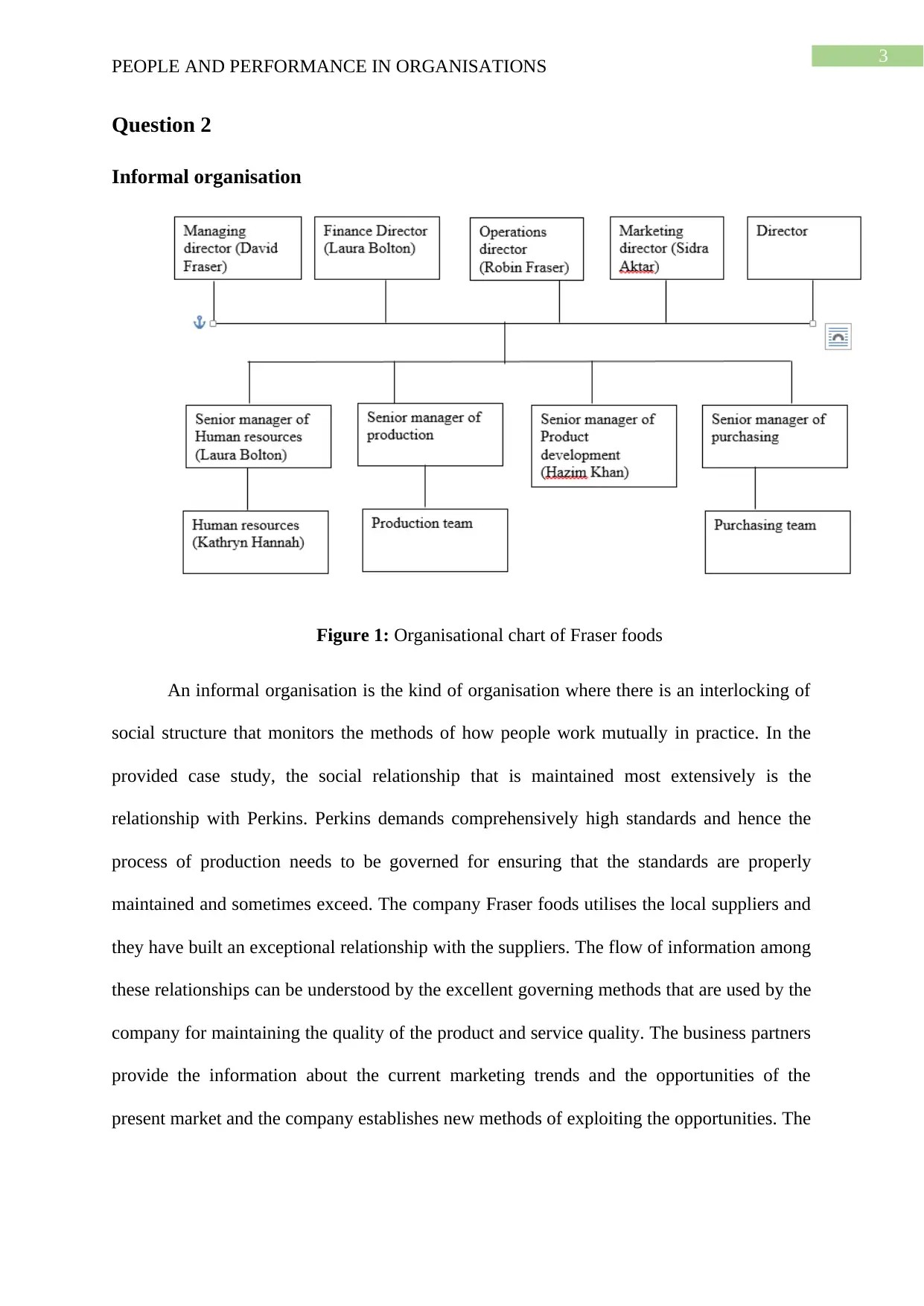
Figure 1: Organisational chart of Fraser foods
An informal organisation is the kind of organisation where there is an interlocking of
social structure that monitors the methods of how people work mutually in practice. In the
provided case study, the social relationship that is maintained most extensively is the
relationship with Perkins. Perkins demands comprehensively high standards and hence the
process of production needs to be governed for ensuring that the standards are properly
maintained and sometimes exceed. The company Fraser foods utilises the local suppliers and
they have built an exceptional relationship with the suppliers. The flow of information among
these relationships can be understood by the excellent governing methods that are used by the
company for maintaining the quality of the product and service quality. The business partners
provide the information about the current marketing trends and the opportunities of the
present market and the company establishes new methods of exploiting the opportunities. The
PEOPLE AND PERFORMANCE IN ORGANISATIONS
Question 2
Informal organisation
Figure 1: Organisational chart of Fraser foods
An informal organisation is the kind of organisation where there is an interlocking of
social structure that monitors the methods of how people work mutually in practice. In the
provided case study, the social relationship that is maintained most extensively is the
relationship with Perkins. Perkins demands comprehensively high standards and hence the
process of production needs to be governed for ensuring that the standards are properly
maintained and sometimes exceed. The company Fraser foods utilises the local suppliers and
they have built an exceptional relationship with the suppliers. The flow of information among
these relationships can be understood by the excellent governing methods that are used by the
company for maintaining the quality of the product and service quality. The business partners
provide the information about the current marketing trends and the opportunities of the
present market and the company establishes new methods of exploiting the opportunities. The
Paraphrase This Document
Need a fresh take? Get an instant paraphrase of this document with our AI Paraphraser
4
PEOPLE AND PERFORMANCE IN ORGANISATIONS
company is effected by this informations as it can help the organisation is achieving growth
at a faster rate than the competitors.
Question 3
Open system
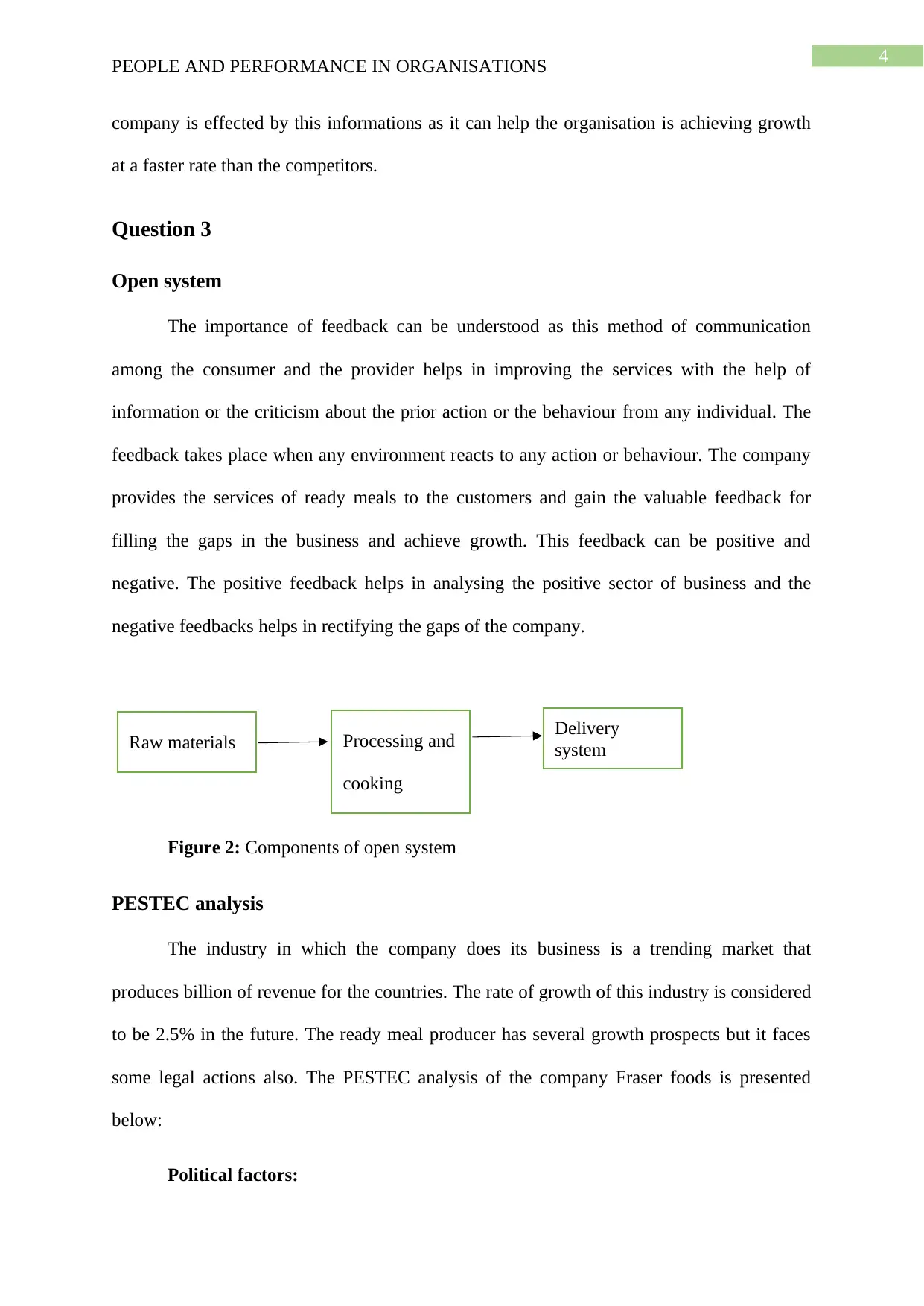
The importance of feedback can be understood as this method of communication
among the consumer and the provider helps in improving the services with the help of
information or the criticism about the prior action or the behaviour from any individual. The
feedback takes place when any environment reacts to any action or behaviour. The company
provides the services of ready meals to the customers and gain the valuable feedback for
filling the gaps in the business and achieve growth. This feedback can be positive and
negative. The positive feedback helps in analysing the positive sector of business and the
negative feedbacks helps in rectifying the gaps of the company.
Figure 2: Components of open system
PESTEC analysis
The industry in which the company does its business is a trending market that
produces billion of revenue for the countries. The rate of growth of this industry is considered
to be 2.5% in the future. The ready meal producer has several growth prospects but it faces
some legal actions also. The PESTEC analysis of the company Fraser foods is presented
below:
Political factors:
Raw materials Delivery
systemProcessing and
cooking
PEOPLE AND PERFORMANCE IN ORGANISATIONS
company is effected by this informations as it can help the organisation is achieving growth
at a faster rate than the competitors.
Question 3
Open system
The importance of feedback can be understood as this method of communication
among the consumer and the provider helps in improving the services with the help of
information or the criticism about the prior action or the behaviour from any individual. The
feedback takes place when any environment reacts to any action or behaviour. The company
provides the services of ready meals to the customers and gain the valuable feedback for
filling the gaps in the business and achieve growth. This feedback can be positive and
negative. The positive feedback helps in analysing the positive sector of business and the
negative feedbacks helps in rectifying the gaps of the company.
Figure 2: Components of open system
PESTEC analysis
The industry in which the company does its business is a trending market that
produces billion of revenue for the countries. The rate of growth of this industry is considered
to be 2.5% in the future. The ready meal producer has several growth prospects but it faces
some legal actions also. The PESTEC analysis of the company Fraser foods is presented
below:
Political factors:
Raw materials Delivery
systemProcessing and
cooking
5
PEOPLE AND PERFORMANCE IN ORGANISATIONS
The political factors that affects the ready meal delivery can vary in countries. The
most important factor is the compliance. Worldwide, the ready meal delivery providers are
required to comply with the requirements of the countries to conduct business in a successful
matter.
Economic factors:
The recession influenced the businesses of ready meals to some level. After the
recession, the spending per consumer has significantly increased in the last decade. Several
providers have added the options that are cheaper and enhanced the customer service. The
service to the customers is the area as the brands.
Social factors:
The trends of lifestyle and health also impacts the businesses of ready meals. If in any
area the trend is to have food at the homes and not buy any ready meals then the businesses
working in that area can be significantly affected. The attitude of the consumers forced the
businesses of ready meals in adding options of low calorie.
Technological factors:
The factors related to technology has significant impact on the ready meals industry.
With the help of technology the businesses can advertise about the brand and attract more
customers. Moreover, the can gain the valuable feedback of the customers and improve the
products on the basis of the feedbacks. This method helps in the growth of the business.
Environmental factors:
The factor associated to the sustainability is a major factor to impact the businesses
globally. The altering regulations and laws of the government has pressed the businesses in
PEOPLE AND PERFORMANCE IN ORGANISATIONS
The political factors that affects the ready meal delivery can vary in countries. The
most important factor is the compliance. Worldwide, the ready meal delivery providers are
required to comply with the requirements of the countries to conduct business in a successful
matter.
Economic factors:
The recession influenced the businesses of ready meals to some level. After the
recession, the spending per consumer has significantly increased in the last decade. Several
providers have added the options that are cheaper and enhanced the customer service. The
service to the customers is the area as the brands.
Social factors:
The trends of lifestyle and health also impacts the businesses of ready meals. If in any
area the trend is to have food at the homes and not buy any ready meals then the businesses
working in that area can be significantly affected. The attitude of the consumers forced the
businesses of ready meals in adding options of low calorie.
Technological factors:
The factors related to technology has significant impact on the ready meals industry.
With the help of technology the businesses can advertise about the brand and attract more
customers. Moreover, the can gain the valuable feedback of the customers and improve the
products on the basis of the feedbacks. This method helps in the growth of the business.
Environmental factors:
The factor associated to the sustainability is a major factor to impact the businesses
globally. The altering regulations and laws of the government has pressed the businesses in
⊘ This is a preview!⊘
Do you want full access?
Subscribe today to unlock all pages.
Trusted by 1+ million students worldwide
6
PEOPLE AND PERFORMANCE IN ORGANISATIONS
adopting the greener approach. The company minimised the utilisation of the non-renewable
resources and focussed on the use of sustainable energy for running the business.
Competitors:
The competitors in the ready meal sector do not impact the company significantly.
The customer loyalty in this sector is significantly higher than the other businesses. And the
company has a trend of introducing new products for the customers for retaining the majority
of the consumer base.
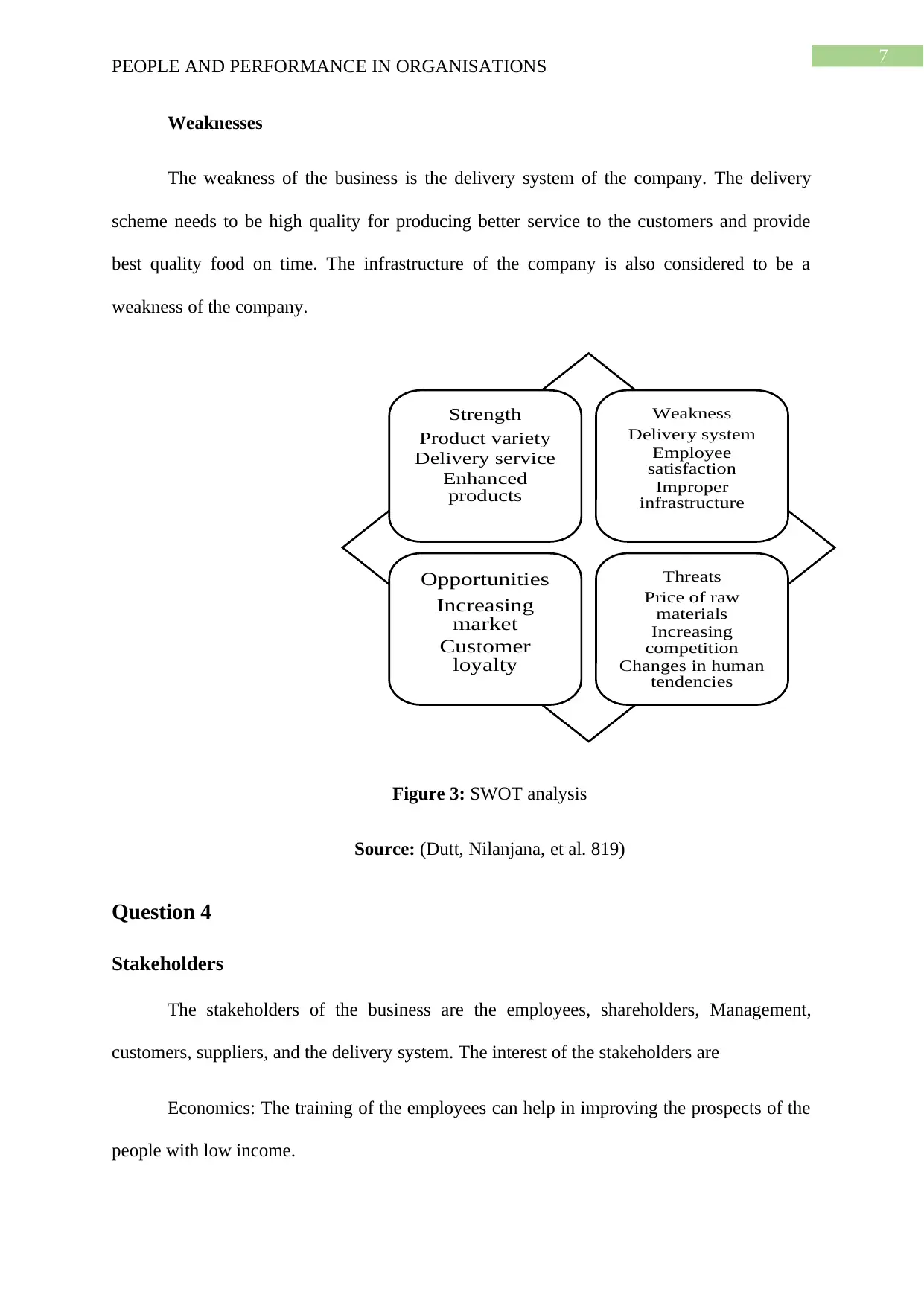
The SWOT analysis of the company can be understood as:
Strength
The strength of the company is product varieties and the delivery service. The
company aims to provide the customers with improved products and enhanced delivery
methods. This can help in gaining significant advantage for the company over the
competitors.
Opportunities
The opportunities of the business can be growing employment sector where the
demand of ready meals is increasing over the last decade. The trend of the people of
consuming high quality food at significantly lower price is the opportunities that can be
exploited by the business.
Threats
The threats of the business is are the attitude of the consumers to intake homemade
food and low calories food. This can affect the business and the company needs to introduce
new variety of products with low calorie for the people.
PEOPLE AND PERFORMANCE IN ORGANISATIONS
adopting the greener approach. The company minimised the utilisation of the non-renewable
resources and focussed on the use of sustainable energy for running the business.
Competitors:
The competitors in the ready meal sector do not impact the company significantly.
The customer loyalty in this sector is significantly higher than the other businesses. And the
company has a trend of introducing new products for the customers for retaining the majority
of the consumer base.
The SWOT analysis of the company can be understood as:
Strength
The strength of the company is product varieties and the delivery service. The
company aims to provide the customers with improved products and enhanced delivery
methods. This can help in gaining significant advantage for the company over the
competitors.
Opportunities
The opportunities of the business can be growing employment sector where the
demand of ready meals is increasing over the last decade. The trend of the people of
consuming high quality food at significantly lower price is the opportunities that can be
exploited by the business.
Threats
The threats of the business is are the attitude of the consumers to intake homemade
food and low calories food. This can affect the business and the company needs to introduce
new variety of products with low calorie for the people.
Paraphrase This Document
Need a fresh take? Get an instant paraphrase of this document with our AI Paraphraser
7
PEOPLE AND PERFORMANCE IN ORGANISATIONS
Weaknesses
The weakness of the business is the delivery system of the company. The delivery
scheme needs to be high quality for producing better service to the customers and provide
best quality food on time. The infrastructure of the company is also considered to be a
weakness of the company.
Figure 3: SWOT analysis
Source: (Dutt, Nilanjana, et al. 819)
Question 4
Stakeholders
The stakeholders of the business are the employees, shareholders, Management,
customers, suppliers, and the delivery system. The interest of the stakeholders are
Economics: The training of the employees can help in improving the prospects of the
people with low income.
Strength
Product variety
Delivery service
Enhanced
products
Weakness
Delivery system
Employee
satisfaction
Improper
infrastructure
Opportunities
Increasing
market
Customer
loyalty
Threats
Price of raw
materials
Increasing
competition
Changes in human
tendencies
PEOPLE AND PERFORMANCE IN ORGANISATIONS
Weaknesses
The weakness of the business is the delivery system of the company. The delivery
scheme needs to be high quality for producing better service to the customers and provide
best quality food on time. The infrastructure of the company is also considered to be a
weakness of the company.
Figure 3: SWOT analysis
Source: (Dutt, Nilanjana, et al. 819)
Question 4
Stakeholders
The stakeholders of the business are the employees, shareholders, Management,
customers, suppliers, and the delivery system. The interest of the stakeholders are
Economics: The training of the employees can help in improving the prospects of the
people with low income.
Strength
Product variety
Delivery service
Enhanced
products
Weakness
Delivery system
Employee
satisfaction
Improper
infrastructure
Opportunities
Increasing
market
Customer
loyalty
Threats
Price of raw
materials
Increasing
competition
Changes in human
tendencies
8
PEOPLE AND PERFORMANCE IN ORGANISATIONS
Social change: This is the effort of enhancing the racial harmony that can alter the
climate of the society for all the sections of a society.
Time: The flexible hours of work, caregivers relief program, leave for childbirth, and
several other efforts can help in providing the people with the time for leisure or take care of
business.
Environment: The protection of open space, the resource conservation, awareness to
the changes in the climatic conditions, and several other environmental efforts are included in
the interest of the stakeholders.
The shareholders of the business provide valuable decisions for the growth of the
business and provide the customers with improved products and services. The shareholders
are the major external stakeholders that effect the business directly.
Question 5
Methods for controlling output
There are major three methods of controlling the output of the business.
Visual methods: It includes the checklists, dashboards, and budgets. It helps in the
monitoring of the happening of any activity in the business and it provide the opportunity of
fixing the gaps in the business.
Procedural methods: It consists of having 2 completely unrelated sections of people
internally checked and monitored for following the money flow in the business. Standard
review needs to be done for all the new employees.
Embedded methods: It consists of the methods of working with the standardised
contracts, data backups that work automatically, and intentionally structured financial
methods for working automatically for protecting the business from harmful decisions.
PEOPLE AND PERFORMANCE IN ORGANISATIONS
Social change: This is the effort of enhancing the racial harmony that can alter the
climate of the society for all the sections of a society.
Time: The flexible hours of work, caregivers relief program, leave for childbirth, and
several other efforts can help in providing the people with the time for leisure or take care of
business.
Environment: The protection of open space, the resource conservation, awareness to
the changes in the climatic conditions, and several other environmental efforts are included in
the interest of the stakeholders.
The shareholders of the business provide valuable decisions for the growth of the
business and provide the customers with improved products and services. The shareholders
are the major external stakeholders that effect the business directly.
Question 5
Methods for controlling output
There are major three methods of controlling the output of the business.
Visual methods: It includes the checklists, dashboards, and budgets. It helps in the
monitoring of the happening of any activity in the business and it provide the opportunity of
fixing the gaps in the business.
Procedural methods: It consists of having 2 completely unrelated sections of people
internally checked and monitored for following the money flow in the business. Standard
review needs to be done for all the new employees.
Embedded methods: It consists of the methods of working with the standardised
contracts, data backups that work automatically, and intentionally structured financial
methods for working automatically for protecting the business from harmful decisions.
⊘ This is a preview!⊘
Do you want full access?
Subscribe today to unlock all pages.
Trusted by 1+ million students worldwide
9
PEOPLE AND PERFORMANCE IN ORGANISATIONS
Conclusion
Therefore it can be concluded that the business has the potential of achieving
significant growth. The considered company Fraser Foods is a firm of family that is based on
the Bishopton and it was set up by the individual, David Fraser in 1994 for tapping in the
growing demand of the ready meals. The main mission of the business is to provide the
customers with vast range of the finest quality ready meals, with the commitment to
innovation, value and service in a shared relationship that is profitable. An informal
organisation is the kind of organisation where there is an interlocking of social structure that
monitors the methods of how people work mutually in practice. The importance of feedback
can be understood as this method of communication among the consumer and the provider
helps in improving the services with the help of information or the criticism about the prior
action or the behaviour from any individual. The industry in which the company does its
business is a trending market that produces billion of revenue for the countries.
PEOPLE AND PERFORMANCE IN ORGANISATIONS
Conclusion
Therefore it can be concluded that the business has the potential of achieving
significant growth. The considered company Fraser Foods is a firm of family that is based on
the Bishopton and it was set up by the individual, David Fraser in 1994 for tapping in the
growing demand of the ready meals. The main mission of the business is to provide the
customers with vast range of the finest quality ready meals, with the commitment to
innovation, value and service in a shared relationship that is profitable. An informal
organisation is the kind of organisation where there is an interlocking of social structure that
monitors the methods of how people work mutually in practice. The importance of feedback
can be understood as this method of communication among the consumer and the provider
helps in improving the services with the help of information or the criticism about the prior
action or the behaviour from any individual. The industry in which the company does its
business is a trending market that produces billion of revenue for the countries.
Paraphrase This Document
Need a fresh take? Get an instant paraphrase of this document with our AI Paraphraser
10
PEOPLE AND PERFORMANCE IN ORGANISATIONS
Bibliography
Argyris, Chris. Integrating the Individual and the Organization. Routledge, 2017.
Thompson, James D. Organizations in action: Social science bases of administrative theory.
Routledge, 2017.
Silberschatz, Abraham, Greg Gagne, and Peter B. Galvin. Operating system concepts. Wiley,
2018.
Dutt, Nilanjana, et al. "How open system intermediaries address institutional failures: The
case of business incubators in emerging-market countries." Academy of Management
Journal 59.3 (2016): 818-840.
Manuti, Amelia, et al. "Formal and informal learning in the workplace: a research
review." International journal of training and development 19.1 (2015): 1-17.
Bolden, Richard. "Leadership, management and organisational development." Gower
handbook of leadership and management development. Routledge, 2016. 143-158.
Goffee, Robert, and Richard Scase. Corporate Realities (Routledge Revivals): The Dynamics
of Large and Small Organisations. Routledge, 2015.
Whittaker, Joshua, Blythe McLennan, and John Handmer. "A review of informal
volunteerism in emergencies and disasters: Definition, opportunities and
challenges." International journal of disaster risk reduction 13 (2015): 358-368.
Cohen, Abner. Two-dimensional man: An essay on the anthropology of power and symbolism
in complex society. Routledge, 2015.
PEOPLE AND PERFORMANCE IN ORGANISATIONS
Bibliography
Argyris, Chris. Integrating the Individual and the Organization. Routledge, 2017.
Thompson, James D. Organizations in action: Social science bases of administrative theory.
Routledge, 2017.
Silberschatz, Abraham, Greg Gagne, and Peter B. Galvin. Operating system concepts. Wiley,
2018.
Dutt, Nilanjana, et al. "How open system intermediaries address institutional failures: The
case of business incubators in emerging-market countries." Academy of Management
Journal 59.3 (2016): 818-840.
Manuti, Amelia, et al. "Formal and informal learning in the workplace: a research
review." International journal of training and development 19.1 (2015): 1-17.
Bolden, Richard. "Leadership, management and organisational development." Gower
handbook of leadership and management development. Routledge, 2016. 143-158.
Goffee, Robert, and Richard Scase. Corporate Realities (Routledge Revivals): The Dynamics
of Large and Small Organisations. Routledge, 2015.
Whittaker, Joshua, Blythe McLennan, and John Handmer. "A review of informal
volunteerism in emergencies and disasters: Definition, opportunities and
challenges." International journal of disaster risk reduction 13 (2015): 358-368.
Cohen, Abner. Two-dimensional man: An essay on the anthropology of power and symbolism
in complex society. Routledge, 2015.
11
PEOPLE AND PERFORMANCE IN ORGANISATIONS
Marchington, Mick. "Analysing the forces shaping employee involvement and participation
(EIP) at organisation level in liberal market economies (LME s)." Human Resource
Management Journal 25.1 (2015): 1-18.
Behrendt, Sebastian, Alexander Richter, and Kai Riemer. "Conceptualisation of digital traces
for the identification of informal networks in enterprise social networks." ACIS, 2014.
Kallio, Tomi J., Kirsi-Mari Kallio, and Annika Johanna Blomberg. "Physical space, culture
and organisational creativity–a longitudinal study." Facilities 33.5/6 (2015): 389-411.
PEOPLE AND PERFORMANCE IN ORGANISATIONS
Marchington, Mick. "Analysing the forces shaping employee involvement and participation
(EIP) at organisation level in liberal market economies (LME s)." Human Resource
Management Journal 25.1 (2015): 1-18.
Behrendt, Sebastian, Alexander Richter, and Kai Riemer. "Conceptualisation of digital traces
for the identification of informal networks in enterprise social networks." ACIS, 2014.
Kallio, Tomi J., Kirsi-Mari Kallio, and Annika Johanna Blomberg. "Physical space, culture
and organisational creativity–a longitudinal study." Facilities 33.5/6 (2015): 389-411.
⊘ This is a preview!⊘
Do you want full access?
Subscribe today to unlock all pages.
Trusted by 1+ million students worldwide

1 out of 14


Related Documents


Your All-in-One AI-Powered Toolkit for Academic Success.
+13062052269
info@desklib.com
Available 24*7 on WhatsApp / Email
![[object Object]](/_next/static/media/star-bottom.7253800d.svg)
Unlock your academic potential
Copyright © 2020–2025 A2Z Services. All Rights Reserved. Developed and managed by ZUCOL.