R. v. Inshanalli: A Detailed Fraud Theory Analysis - Case Study
VerifiedAdded on 2023/06/15
|7
|1370
|462
Case Study
AI Summary
This case study provides a detailed fraud theory analysis of the R. v. Inshanalli case, where Ms. Inshanalli plead guilty to fraud over $5000. The analysis applies several fraud theories, including the Fraud Triangle, Fraud Scale, and Rational Choice Theory, to understand the motivations and circumstances behind the fraudulent activities. The study contrasts Inshanalli's case with R. v. Paterson, highlighting differences in motives and pressures. It concludes that Inshanalli's actions were driven by a rational choice to maximize personal financial gain, given her history of similar offenses and perceived low risk of severe punishment. The document references relevant legal citations and academic sources to support its analysis.
Running Head: CASE DISCUSSION
Case discussion
Nam of the Student:
Name of the University:
Author Note
Case discussion
Nam of the Student:
Name of the University:
Author Note
Paraphrase This Document
Need a fresh take? Get an instant paraphrase of this document with our AI Paraphraser

1CASE DISCUSSION
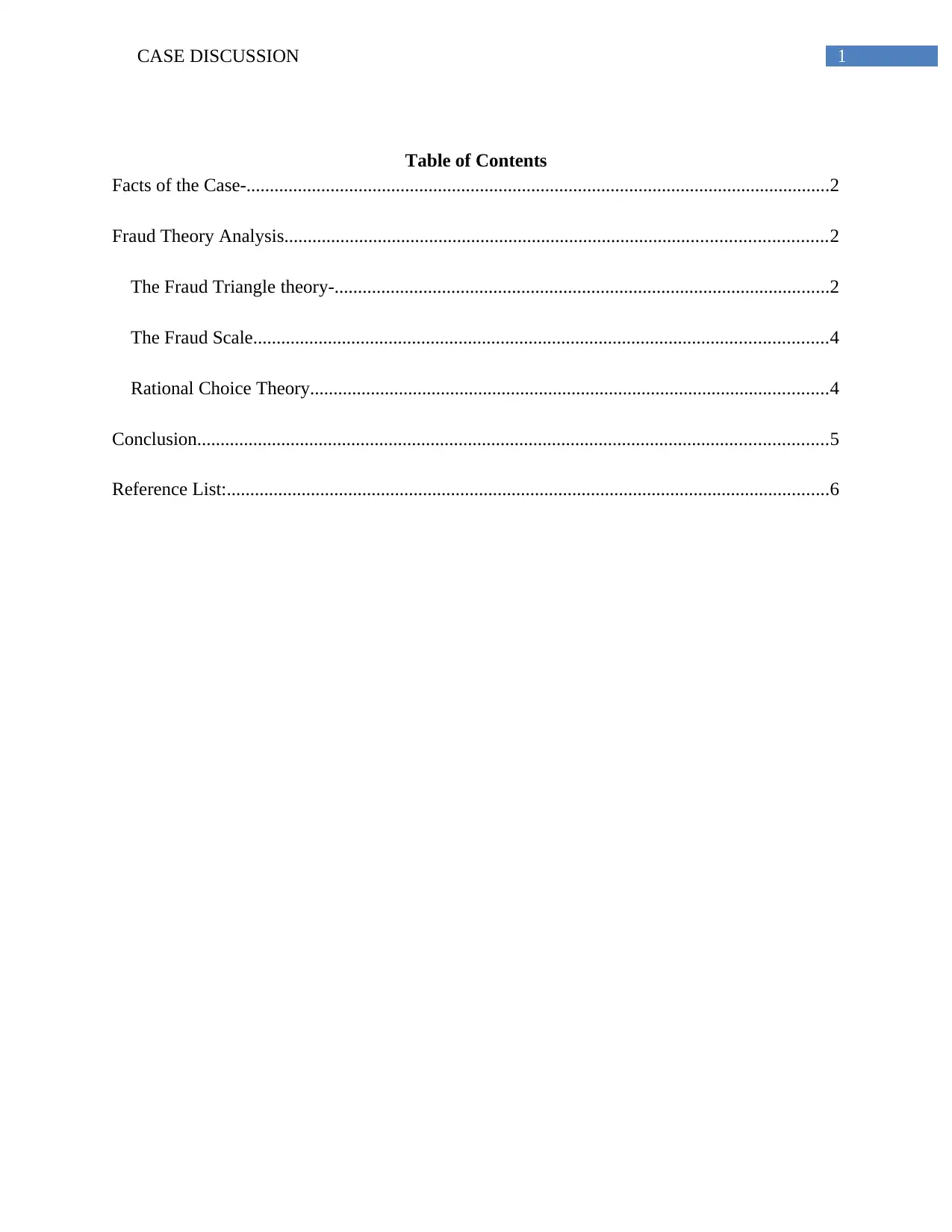
Table of Contents
Facts of the Case-.............................................................................................................................2
Fraud Theory Analysis....................................................................................................................2
The Fraud Triangle theory-..........................................................................................................2
The Fraud Scale...........................................................................................................................4
Rational Choice Theory...............................................................................................................4
Conclusion.......................................................................................................................................5
Reference List:.................................................................................................................................6
Table of Contents
Facts of the Case-.............................................................................................................................2
Fraud Theory Analysis....................................................................................................................2
The Fraud Triangle theory-..........................................................................................................2
The Fraud Scale...........................................................................................................................4
Rational Choice Theory...............................................................................................................4
Conclusion.......................................................................................................................................5
Reference List:.................................................................................................................................6

2CASE DISCUSSION
Facts of the Case-
It is to be stated that Ms. Inshanalli had plead guilty to a charge of fraud amounting to
more than $5000. She was charged for breach of the provision stated in section 380(1) and 733.
(1)(a) of the Criminal Code. Ms Inshanalli had defrauded the victim WSC Corporation
Coppinwood Golf Club. Ms. Inshanalli had been employed as a book keeper to the victim for a
time period starting from April 2014 to January 2016. During her employment period she had
written 134 cheques fraudulently to herself. All the cheques were made to Zamroon Nisha
Inshanalli and were deposited into three bank accounts all in the name of Zamroon Nisha
Inshanalli. Further it is to be stated that out of the 134 cheques she had forged the signature of
Gerard Waslens on 125 cheques.
Zamroon Nisha Inshanalli is of 62 years of age and is married to RaffiqInshanalli with one son
who is 34 years old and resides with them. Apparently her husband and son had been aware of
her convictions for fraudulent activities of the past.
The defendant in this case, Ms. Inshanalli had committed a total fraud of $463,824.42. However,
the defendant has made a restitution of $54,000 dollars leaving $409,824.42 outstanding.
Fraud Theory Analysis
It is to be stated that there are a number of theories that can be applied to analyze the conduct of
fraudsters and gain insight about the reason for commitment of the fraud. Some of the theories
that can be applied to the case include:
Facts of the Case-
It is to be stated that Ms. Inshanalli had plead guilty to a charge of fraud amounting to
more than $5000. She was charged for breach of the provision stated in section 380(1) and 733.
(1)(a) of the Criminal Code. Ms Inshanalli had defrauded the victim WSC Corporation
Coppinwood Golf Club. Ms. Inshanalli had been employed as a book keeper to the victim for a
time period starting from April 2014 to January 2016. During her employment period she had
written 134 cheques fraudulently to herself. All the cheques were made to Zamroon Nisha
Inshanalli and were deposited into three bank accounts all in the name of Zamroon Nisha
Inshanalli. Further it is to be stated that out of the 134 cheques she had forged the signature of
Gerard Waslens on 125 cheques.
Zamroon Nisha Inshanalli is of 62 years of age and is married to RaffiqInshanalli with one son
who is 34 years old and resides with them. Apparently her husband and son had been aware of
her convictions for fraudulent activities of the past.
The defendant in this case, Ms. Inshanalli had committed a total fraud of $463,824.42. However,
the defendant has made a restitution of $54,000 dollars leaving $409,824.42 outstanding.
Fraud Theory Analysis
It is to be stated that there are a number of theories that can be applied to analyze the conduct of
fraudsters and gain insight about the reason for commitment of the fraud. Some of the theories
that can be applied to the case include:
⊘ This is a preview!⊘
Do you want full access?
Subscribe today to unlock all pages.

Trusted by 1+ million students worldwide

3CASE DISCUSSION
The Fraud Triangle theory-
According to this theory it can be stated that there are three factors which can drive a trustworthy
person to committing frauds. These factors are:
Perceived Pressure- It can be stated that perceived pressure provides the motivation for
committing fraud to most fraudsters. It can be said that a trustworthy person commits
fraud when he encounters the financial problems that cannot be solved legitimately. He
therefore resorts to unethical and illegal standards for solving the problem.
Perceived opportunity- It can be stated that this factor generally provides insight about
how the fraud takes place. According to this factor a trustworthy person also commits
fraud when he perceives an opportunity to take advantage of the trust of the victim and
abuse his trusted position.
Rationalization- According to this factor it can be stated that most of the fraudsters are
not criminal minded and seasoned criminals and there needs to be a personal justification
of the fraudsters for committing the fraud.
However this theory cannot be applied to analyze the reason for committing fraud in case of
predatory fraudsters.
After applying the principles of this theory to the facts of this case it can be stated that this theory
cannot assess Ms. Inshanalli’s reason for committing fraud as she has been involved in other
fraudulent activities in the past. She has an extensive history of committing frauds and criminal
activities. She was first convicted on May 13 2004 in New Market where she had committed
theft of $750,000. She had exhibited similar behavior, when she had stolen from her employer
Sherwood Innovations a sum of $141, 000 over a period of two years from 2010 to 2012. She
The Fraud Triangle theory-
According to this theory it can be stated that there are three factors which can drive a trustworthy
person to committing frauds. These factors are:
Perceived Pressure- It can be stated that perceived pressure provides the motivation for
committing fraud to most fraudsters. It can be said that a trustworthy person commits
fraud when he encounters the financial problems that cannot be solved legitimately. He
therefore resorts to unethical and illegal standards for solving the problem.
Perceived opportunity- It can be stated that this factor generally provides insight about
how the fraud takes place. According to this factor a trustworthy person also commits
fraud when he perceives an opportunity to take advantage of the trust of the victim and
abuse his trusted position.
Rationalization- According to this factor it can be stated that most of the fraudsters are
not criminal minded and seasoned criminals and there needs to be a personal justification
of the fraudsters for committing the fraud.
However this theory cannot be applied to analyze the reason for committing fraud in case of
predatory fraudsters.
After applying the principles of this theory to the facts of this case it can be stated that this theory
cannot assess Ms. Inshanalli’s reason for committing fraud as she has been involved in other
fraudulent activities in the past. She has an extensive history of committing frauds and criminal
activities. She was first convicted on May 13 2004 in New Market where she had committed
theft of $750,000. She had exhibited similar behavior, when she had stolen from her employer
Sherwood Innovations a sum of $141, 000 over a period of two years from 2010 to 2012. She
Paraphrase This Document
Need a fresh take? Get an instant paraphrase of this document with our AI Paraphraser

4CASE DISCUSSION
plead guilty to the charges and she was sentenced to a eighteen month conditional sentence
following a two year probation period. Based on this behavior it can be stated that she exhibits
behavior of a predatory fraudster.
The Fraud Scale
This theory was introduced in the year 1984 and was said to substitute the fraud triangle
theory. This theory takes in to consideration the integrity along with the other factors of the fraud
triangle. Integrity of a person can be assessed by assessing a person’s commitment to ethics. The
fraud scale theory can be predictive. It can be stated that a person with low pressure, low
opportunity and low high integrity is less likely to commit fraud than a person with high a person
with high pressure, high opportunity and low integrity.
In this case the fraud scale does not completely apply as the defendant had exhibited
similar behavior in the past on numerous occasions. However the element of integrity can be
applied. She supposedly has low integrity. Therefore low integrity combined with high
opportunity makes her more likely to commit fraud.
Rational Choice Theory
According to this theory there are three primary conditions of fraud:
The fraudster often considers himself as a separate individual
Individuals work to maximize their goals
Individuals work in their self interest.
The main principle of the Rational Choice Theory states that the crme is chosen based on the
benefit of such crime. In this case Ms. Inshanalli had had committed fraud in order to maximize
plead guilty to the charges and she was sentenced to a eighteen month conditional sentence
following a two year probation period. Based on this behavior it can be stated that she exhibits
behavior of a predatory fraudster.
The Fraud Scale
This theory was introduced in the year 1984 and was said to substitute the fraud triangle
theory. This theory takes in to consideration the integrity along with the other factors of the fraud
triangle. Integrity of a person can be assessed by assessing a person’s commitment to ethics. The
fraud scale theory can be predictive. It can be stated that a person with low pressure, low
opportunity and low high integrity is less likely to commit fraud than a person with high a person
with high pressure, high opportunity and low integrity.
In this case the fraud scale does not completely apply as the defendant had exhibited
similar behavior in the past on numerous occasions. However the element of integrity can be
applied. She supposedly has low integrity. Therefore low integrity combined with high
opportunity makes her more likely to commit fraud.
Rational Choice Theory
According to this theory there are three primary conditions of fraud:
The fraudster often considers himself as a separate individual
Individuals work to maximize their goals
Individuals work in their self interest.
The main principle of the Rational Choice Theory states that the crme is chosen based on the
benefit of such crime. In this case Ms. Inshanalli had had committed fraud in order to maximize

5CASE DISCUSSION
her financial status and well-being. It can be stated that she evaluated the benefits of the crime to
be more than the cost of it as she was lightly punished on the previous occasions.
Conclusion
Thus in conclusion it can be mentioned that all of the three theories have provided
insights into the factors responsible for committing frauds by fraudsters.
In the case R vs Paterson, 2013 the court analyzed that the primary motive of the defendant
behind committing fraud was his failing business. It can be stated that the victim had suffered a
huge financial loss and this was the driving factor which led to the commitment of fraud. By
applying the fraud theory to this case it can be stated that the defendant was under a lot of
pressure and had the opportunity to take advantage of his position. Primarily because of this
reason he had taken the decision to deviate from ethical and legal standards and commit fraud.
However, in case of Ms. Inshanalli, there was no pressure on her to and she did not
commit the fraud in order to provide relief to her situation. By applying the Rational choice
theory it can be stated that she committed the frauds as it seemed to her that the benefits of the
crime committed outweighed the cost of the same. She had indulged in the crime in order to
sustain her lavish lifestyle.
her financial status and well-being. It can be stated that she evaluated the benefits of the crime to
be more than the cost of it as she was lightly punished on the previous occasions.
Conclusion
Thus in conclusion it can be mentioned that all of the three theories have provided
insights into the factors responsible for committing frauds by fraudsters.
In the case R vs Paterson, 2013 the court analyzed that the primary motive of the defendant
behind committing fraud was his failing business. It can be stated that the victim had suffered a
huge financial loss and this was the driving factor which led to the commitment of fraud. By
applying the fraud theory to this case it can be stated that the defendant was under a lot of
pressure and had the opportunity to take advantage of his position. Primarily because of this
reason he had taken the decision to deviate from ethical and legal standards and commit fraud.
However, in case of Ms. Inshanalli, there was no pressure on her to and she did not
commit the fraud in order to provide relief to her situation. By applying the Rational choice
theory it can be stated that she committed the frauds as it seemed to her that the benefits of the
crime committed outweighed the cost of the same. She had indulged in the crime in order to
sustain her lavish lifestyle.
⊘ This is a preview!⊘
Do you want full access?
Subscribe today to unlock all pages.

Trusted by 1+ million students worldwide

6CASE DISCUSSION
Reference List:
R. v. Inshanalli, 2017 ONCJ 234
R. v. Paterson, 2013 BCPC 5
Cornish, D. B., & Clarke, R. V. (Eds.). (2014). The reasoning criminal: Rational choice
perspectives on offending. Transaction Publishers.
Clarke, R. V. G., & Felson, M. (Eds.). (1993). Routine activity and rational choice (Vol. 5).
Transaction Publishers.
Dorminey, J., Fleming, A. S., Kranacher, M. J., & Riley Jr, R. A. (2012). The evolution of fraud
theory. Issues in Accounting Education, 27(2), 555-579.
Ruankaew, T. (2016). Beyond the fraud diamond. International Journal of Business
Management and Economic Research, 7(1), 474-476.
Kassem, R., & Higson, A. (2012). The new fraud triangle model. Journal of Emerging Trends in
Economics and Management Sciences, 3(3), 191.
Reference List:
R. v. Inshanalli, 2017 ONCJ 234
R. v. Paterson, 2013 BCPC 5
Cornish, D. B., & Clarke, R. V. (Eds.). (2014). The reasoning criminal: Rational choice
perspectives on offending. Transaction Publishers.
Clarke, R. V. G., & Felson, M. (Eds.). (1993). Routine activity and rational choice (Vol. 5).
Transaction Publishers.
Dorminey, J., Fleming, A. S., Kranacher, M. J., & Riley Jr, R. A. (2012). The evolution of fraud
theory. Issues in Accounting Education, 27(2), 555-579.
Ruankaew, T. (2016). Beyond the fraud diamond. International Journal of Business
Management and Economic Research, 7(1), 474-476.
Kassem, R., & Higson, A. (2012). The new fraud triangle model. Journal of Emerging Trends in
Economics and Management Sciences, 3(3), 191.
1 out of 7
Related Documents
Your All-in-One AI-Powered Toolkit for Academic Success.
+13062052269
info@desklib.com
Available 24*7 on WhatsApp / Email
Unlock your academic potential
Copyright © 2020–2025 A2Z Services. All Rights Reserved. Developed and managed by ZUCOL.