Question and Answers on French Monarchy and Enlightenment Government
VerifiedAdded on 2022/09/12
|5
|1138
|13
Homework Assignment
AI Summary
This assignment provides a question-and-answer analysis of the French Monarchy and Government during the Age of Enlightenment. It explores the concept of Absolutism, defining it as the King's supreme authority based on divine right, exemplified by Louis XIV's reign. The assignment examines the weaknesses of the monarchy, particularly concerning taxation and the rise of opposition. It further delves into the philosophical debates on governance, discussing Hobbes' support for monarchy and Locke, Montesquieu, and Rousseau's contributions to theories of government, including the social contract and the rights of individuals. The assignment references key historical figures and their ideas, providing a comprehensive overview of the period's political and philosophical landscape.
Running Head: QUESTION AND ANSWERS ON THE FRENCH MONARCHY AND
GOVERNMENT IN THE AGE OF ENLIGHTENMENT
Question and answers on the French Monarchy and Government in the Age of Enlightenment
Name of the Student:
Name of the University:
Author Note:
GOVERNMENT IN THE AGE OF ENLIGHTENMENT
Question and answers on the French Monarchy and Government in the Age of Enlightenment
Name of the Student:
Name of the University:
Author Note:
Paraphrase This Document
Need a fresh take? Get an instant paraphrase of this document with our AI Paraphraser

1
QUESTION AND ANSWERS ON THE FRENCH MONARCHY AND GOVERNMENT IN
THE AGE OF ENLIGHTENMENT
Answer to Question Three
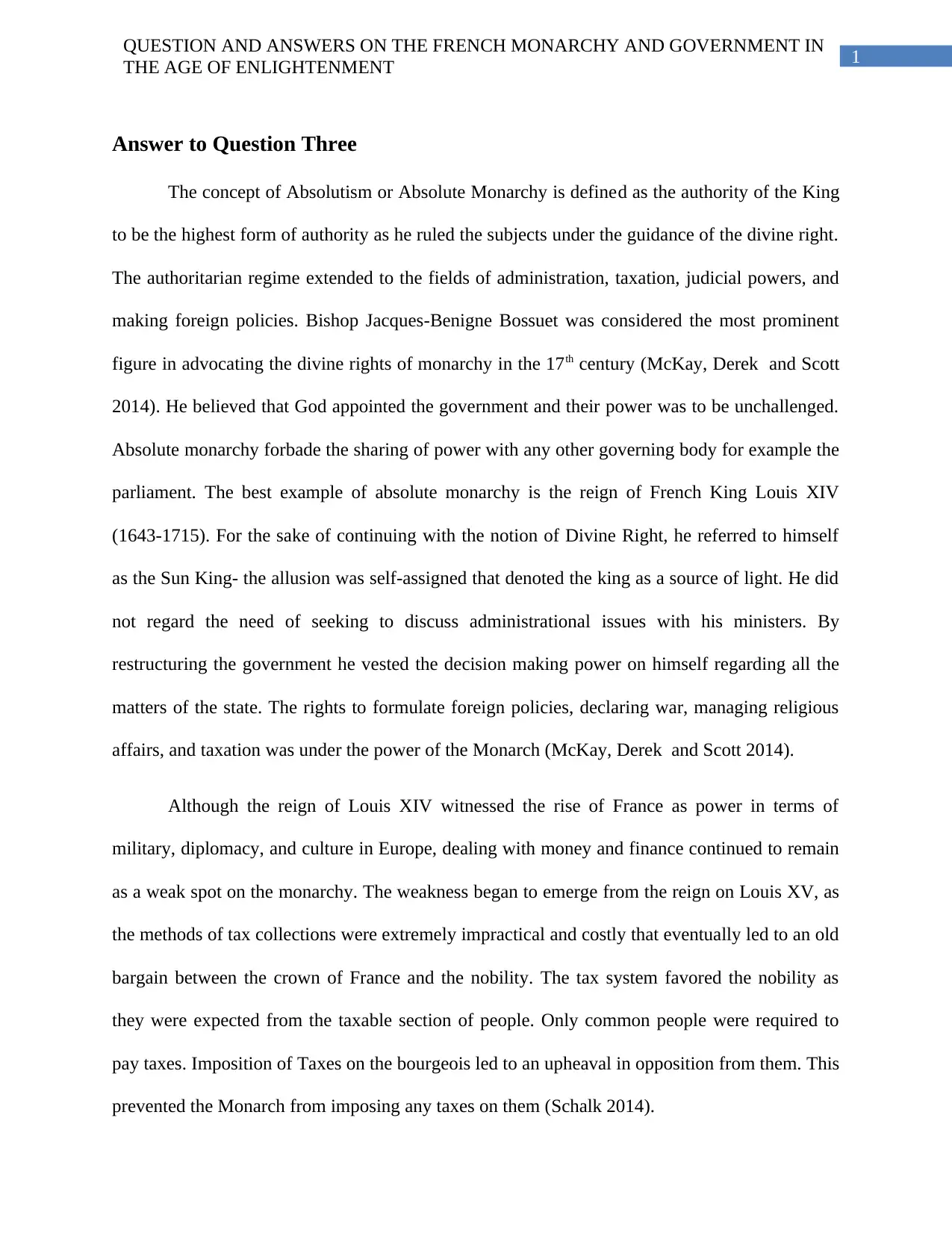
The concept of Absolutism or Absolute Monarchy is defined as the authority of the King
to be the highest form of authority as he ruled the subjects under the guidance of the divine right.
The authoritarian regime extended to the fields of administration, taxation, judicial powers, and
making foreign policies. Bishop Jacques-Benigne Bossuet was considered the most prominent
figure in advocating the divine rights of monarchy in the 17th century (McKay, Derek and Scott
2014). He believed that God appointed the government and their power was to be unchallenged.
Absolute monarchy forbade the sharing of power with any other governing body for example the
parliament. The best example of absolute monarchy is the reign of French King Louis XIV
(1643-1715). For the sake of continuing with the notion of Divine Right, he referred to himself
as the Sun King- the allusion was self-assigned that denoted the king as a source of light. He did
not regard the need of seeking to discuss administrational issues with his ministers. By
restructuring the government he vested the decision making power on himself regarding all the
matters of the state. The rights to formulate foreign policies, declaring war, managing religious
affairs, and taxation was under the power of the Monarch (McKay, Derek and Scott 2014).
Although the reign of Louis XIV witnessed the rise of France as power in terms of
military, diplomacy, and culture in Europe, dealing with money and finance continued to remain
as a weak spot on the monarchy. The weakness began to emerge from the reign on Louis XV, as
the methods of tax collections were extremely impractical and costly that eventually led to an old
bargain between the crown of France and the nobility. The tax system favored the nobility as
they were expected from the taxable section of people. Only common people were required to
pay taxes. Imposition of Taxes on the bourgeois led to an upheaval in opposition from them. This
prevented the Monarch from imposing any taxes on them (Schalk 2014).
QUESTION AND ANSWERS ON THE FRENCH MONARCHY AND GOVERNMENT IN
THE AGE OF ENLIGHTENMENT
Answer to Question Three
The concept of Absolutism or Absolute Monarchy is defined as the authority of the King
to be the highest form of authority as he ruled the subjects under the guidance of the divine right.
The authoritarian regime extended to the fields of administration, taxation, judicial powers, and
making foreign policies. Bishop Jacques-Benigne Bossuet was considered the most prominent
figure in advocating the divine rights of monarchy in the 17th century (McKay, Derek and Scott
2014). He believed that God appointed the government and their power was to be unchallenged.
Absolute monarchy forbade the sharing of power with any other governing body for example the
parliament. The best example of absolute monarchy is the reign of French King Louis XIV
(1643-1715). For the sake of continuing with the notion of Divine Right, he referred to himself
as the Sun King- the allusion was self-assigned that denoted the king as a source of light. He did
not regard the need of seeking to discuss administrational issues with his ministers. By
restructuring the government he vested the decision making power on himself regarding all the
matters of the state. The rights to formulate foreign policies, declaring war, managing religious
affairs, and taxation was under the power of the Monarch (McKay, Derek and Scott 2014).
Although the reign of Louis XIV witnessed the rise of France as power in terms of
military, diplomacy, and culture in Europe, dealing with money and finance continued to remain
as a weak spot on the monarchy. The weakness began to emerge from the reign on Louis XV, as
the methods of tax collections were extremely impractical and costly that eventually led to an old
bargain between the crown of France and the nobility. The tax system favored the nobility as
they were expected from the taxable section of people. Only common people were required to
pay taxes. Imposition of Taxes on the bourgeois led to an upheaval in opposition from them. This
prevented the Monarch from imposing any taxes on them (Schalk 2014).

2
QUESTION AND ANSWERS ON THE FRENCH MONARCHY AND GOVERNMENT IN
THE AGE OF ENLIGHTENMENT
Answer to Question Five
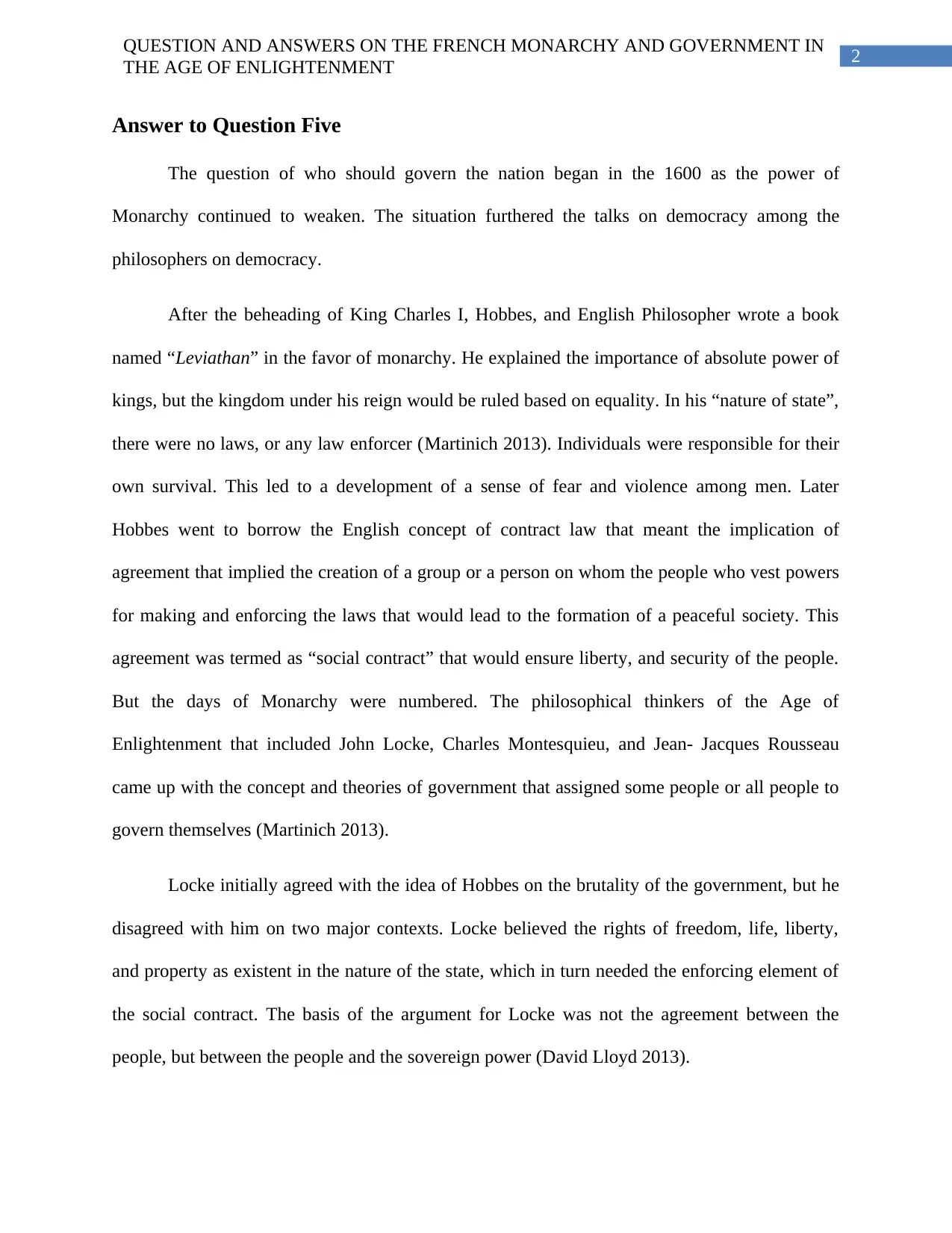
The question of who should govern the nation began in the 1600 as the power of
Monarchy continued to weaken. The situation furthered the talks on democracy among the
philosophers on democracy.
After the beheading of King Charles I, Hobbes, and English Philosopher wrote a book
named “Leviathan” in the favor of monarchy. He explained the importance of absolute power of
kings, but the kingdom under his reign would be ruled based on equality. In his “nature of state”,
there were no laws, or any law enforcer (Martinich 2013). Individuals were responsible for their
own survival. This led to a development of a sense of fear and violence among men. Later
Hobbes went to borrow the English concept of contract law that meant the implication of
agreement that implied the creation of a group or a person on whom the people who vest powers
for making and enforcing the laws that would lead to the formation of a peaceful society. This
agreement was termed as “social contract” that would ensure liberty, and security of the people.
But the days of Monarchy were numbered. The philosophical thinkers of the Age of
Enlightenment that included John Locke, Charles Montesquieu, and Jean- Jacques Rousseau
came up with the concept and theories of government that assigned some people or all people to
govern themselves (Martinich 2013).
Locke initially agreed with the idea of Hobbes on the brutality of the government, but he
disagreed with him on two major contexts. Locke believed the rights of freedom, life, liberty,
and property as existent in the nature of the state, which in turn needed the enforcing element of
the social contract. The basis of the argument for Locke was not the agreement between the
people, but between the people and the sovereign power (David Lloyd 2013).
QUESTION AND ANSWERS ON THE FRENCH MONARCHY AND GOVERNMENT IN
THE AGE OF ENLIGHTENMENT
Answer to Question Five
The question of who should govern the nation began in the 1600 as the power of
Monarchy continued to weaken. The situation furthered the talks on democracy among the
philosophers on democracy.
After the beheading of King Charles I, Hobbes, and English Philosopher wrote a book
named “Leviathan” in the favor of monarchy. He explained the importance of absolute power of
kings, but the kingdom under his reign would be ruled based on equality. In his “nature of state”,
there were no laws, or any law enforcer (Martinich 2013). Individuals were responsible for their
own survival. This led to a development of a sense of fear and violence among men. Later
Hobbes went to borrow the English concept of contract law that meant the implication of
agreement that implied the creation of a group or a person on whom the people who vest powers
for making and enforcing the laws that would lead to the formation of a peaceful society. This
agreement was termed as “social contract” that would ensure liberty, and security of the people.
But the days of Monarchy were numbered. The philosophical thinkers of the Age of
Enlightenment that included John Locke, Charles Montesquieu, and Jean- Jacques Rousseau
came up with the concept and theories of government that assigned some people or all people to
govern themselves (Martinich 2013).
Locke initially agreed with the idea of Hobbes on the brutality of the government, but he
disagreed with him on two major contexts. Locke believed the rights of freedom, life, liberty,
and property as existent in the nature of the state, which in turn needed the enforcing element of
the social contract. The basis of the argument for Locke was not the agreement between the
people, but between the people and the sovereign power (David Lloyd 2013).
⊘ This is a preview!⊘
Do you want full access?
Subscribe today to unlock all pages.

Trusted by 1+ million students worldwide

3
QUESTION AND ANSWERS ON THE FRENCH MONARCHY AND GOVERNMENT IN
THE AGE OF ENLIGHTENMENT
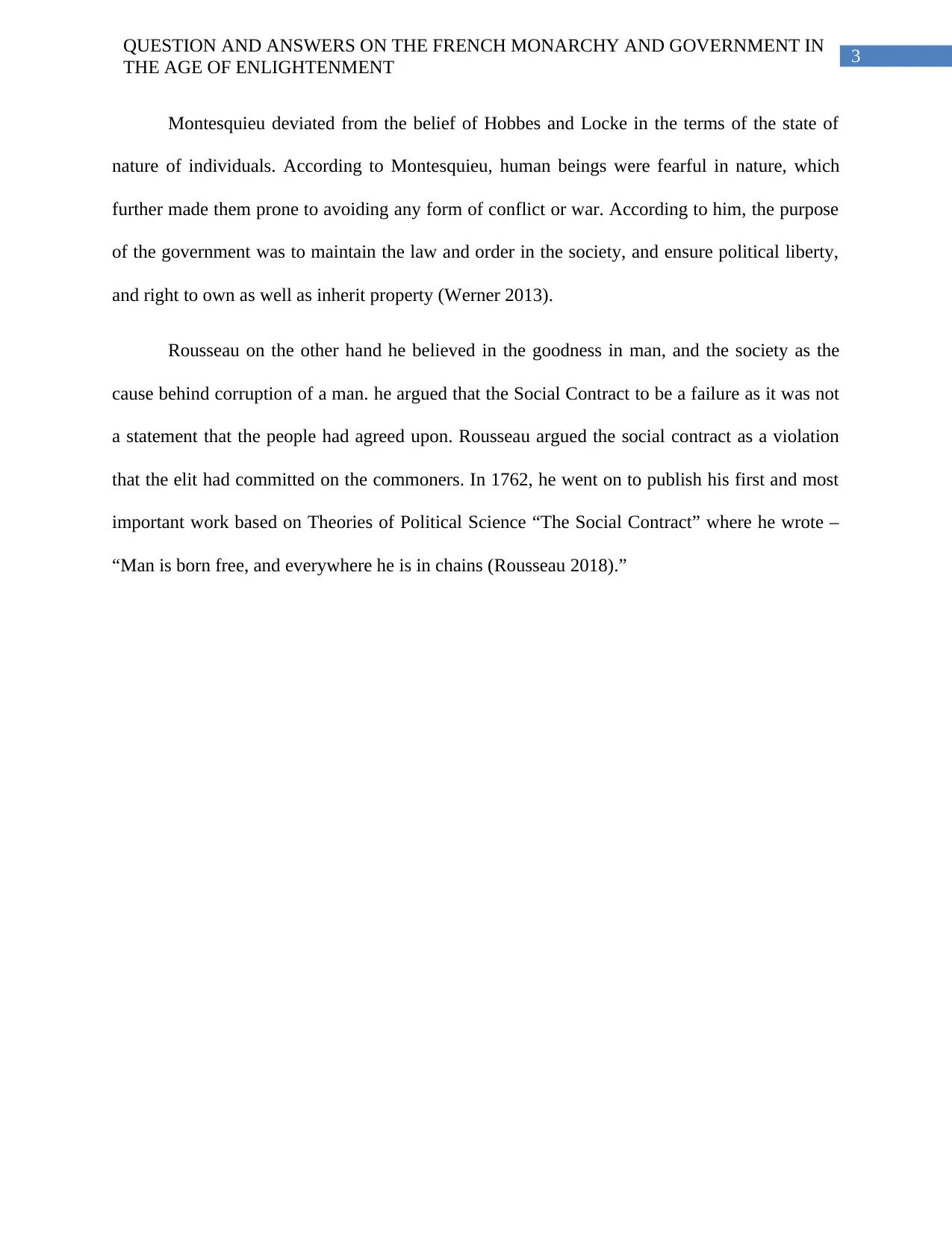
Montesquieu deviated from the belief of Hobbes and Locke in the terms of the state of
nature of individuals. According to Montesquieu, human beings were fearful in nature, which
further made them prone to avoiding any form of conflict or war. According to him, the purpose
of the government was to maintain the law and order in the society, and ensure political liberty,
and right to own as well as inherit property (Werner 2013).
Rousseau on the other hand he believed in the goodness in man, and the society as the
cause behind corruption of a man. he argued that the Social Contract to be a failure as it was not
a statement that the people had agreed upon. Rousseau argued the social contract as a violation
that the elit had committed on the commoners. In 1762, he went on to publish his first and most
important work based on Theories of Political Science “The Social Contract” where he wrote –
“Man is born free, and everywhere he is in chains (Rousseau 2018).”
QUESTION AND ANSWERS ON THE FRENCH MONARCHY AND GOVERNMENT IN
THE AGE OF ENLIGHTENMENT
Montesquieu deviated from the belief of Hobbes and Locke in the terms of the state of
nature of individuals. According to Montesquieu, human beings were fearful in nature, which
further made them prone to avoiding any form of conflict or war. According to him, the purpose
of the government was to maintain the law and order in the society, and ensure political liberty,
and right to own as well as inherit property (Werner 2013).
Rousseau on the other hand he believed in the goodness in man, and the society as the
cause behind corruption of a man. he argued that the Social Contract to be a failure as it was not
a statement that the people had agreed upon. Rousseau argued the social contract as a violation
that the elit had committed on the commoners. In 1762, he went on to publish his first and most
important work based on Theories of Political Science “The Social Contract” where he wrote –
“Man is born free, and everywhere he is in chains (Rousseau 2018).”
Paraphrase This Document
Need a fresh take? Get an instant paraphrase of this document with our AI Paraphraser

4
QUESTION AND ANSWERS ON THE FRENCH MONARCHY AND GOVERNMENT IN
THE AGE OF ENLIGHTENMENT
Reference
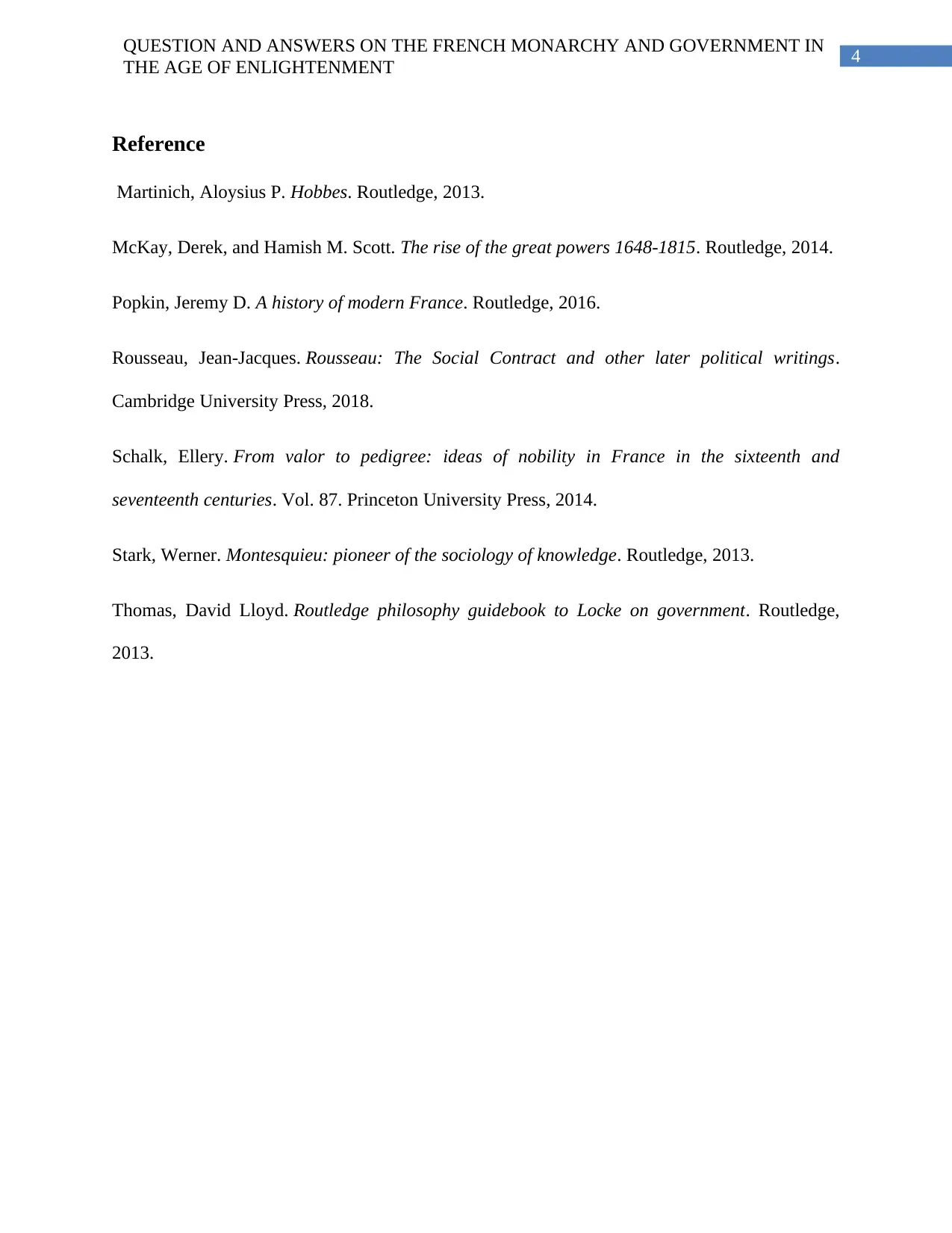
Martinich, Aloysius P. Hobbes. Routledge, 2013.
McKay, Derek, and Hamish M. Scott. The rise of the great powers 1648-1815. Routledge, 2014.
Popkin, Jeremy D. A history of modern France. Routledge, 2016.
Rousseau, Jean-Jacques. Rousseau: The Social Contract and other later political writings.
Cambridge University Press, 2018.
Schalk, Ellery. From valor to pedigree: ideas of nobility in France in the sixteenth and
seventeenth centuries. Vol. 87. Princeton University Press, 2014.
Stark, Werner. Montesquieu: pioneer of the sociology of knowledge. Routledge, 2013.
Thomas, David Lloyd. Routledge philosophy guidebook to Locke on government. Routledge,
2013.
QUESTION AND ANSWERS ON THE FRENCH MONARCHY AND GOVERNMENT IN
THE AGE OF ENLIGHTENMENT
Reference
Martinich, Aloysius P. Hobbes. Routledge, 2013.
McKay, Derek, and Hamish M. Scott. The rise of the great powers 1648-1815. Routledge, 2014.
Popkin, Jeremy D. A history of modern France. Routledge, 2016.
Rousseau, Jean-Jacques. Rousseau: The Social Contract and other later political writings.
Cambridge University Press, 2018.
Schalk, Ellery. From valor to pedigree: ideas of nobility in France in the sixteenth and
seventeenth centuries. Vol. 87. Princeton University Press, 2014.
Stark, Werner. Montesquieu: pioneer of the sociology of knowledge. Routledge, 2013.
Thomas, David Lloyd. Routledge philosophy guidebook to Locke on government. Routledge,
2013.
1 out of 5
Related Documents
Your All-in-One AI-Powered Toolkit for Academic Success.
+13062052269
info@desklib.com
Available 24*7 on WhatsApp / Email
Unlock your academic potential
Copyright © 2020–2025 A2Z Services. All Rights Reserved. Developed and managed by ZUCOL.