Performance & Reward Management: French and Reynolds Consultancy

Verified

Added on  2023/06/12

|4
|775
|220
Report
AI Summary
This report analyzes performance and reward management within the context of an HR consultancy, specifically focusing on a case involving Alex Wright at French and Reynolds. It examines the challenges Alex faced, including difficulties in written communication and team collaboration, as highlighted by various practice leaders. The report delves into the appraisal process, outlining the appraiser's objectives, the style of the interview, and sample questions designed to assess Alex's performance against the firm's standards. It also considers Alex's perspective, his confidence in improvement, and his perceived lack of support from practice leaders. The analysis is grounded in relevant literature on staff appraisal and human resource management, providing a comprehensive overview of the factors influencing performance and reward within the consultancy setting. Desklib provides a platform to access this document along with numerous resources for students.
Document Page
Performance and Reward Management 1
PERFORMANCE AND REWARD MANAGEMENT
By
Name
Professor
Course
Date
tabler-icon-diamond-filled.svg

Paraphrase This Document

Need a fresh take? Get an instant paraphrase of this document with our AI Paraphraser
Document Page
Performance and Reward Management 2
Performance and reward management
Question A
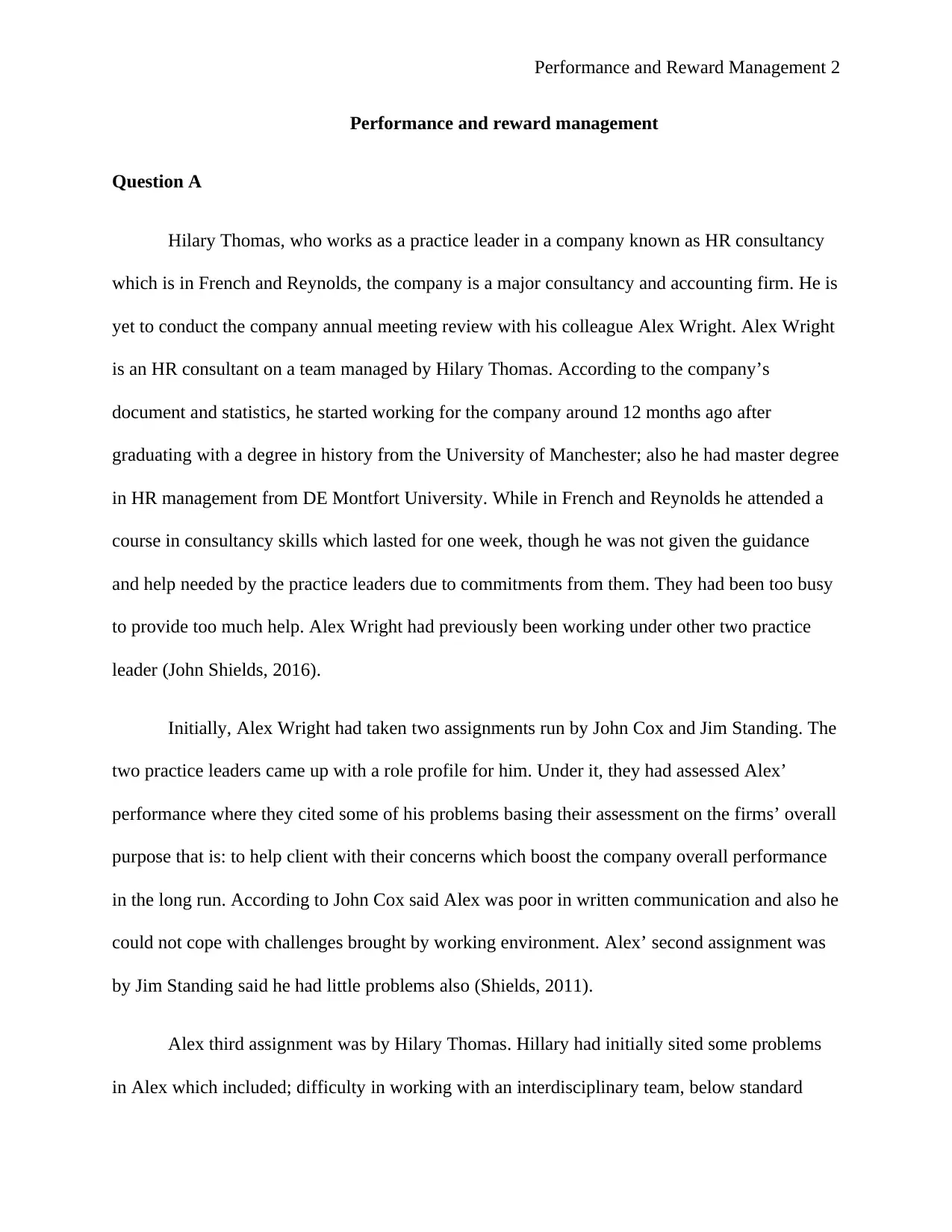
Hilary Thomas, who works as a practice leader in a company known as HR consultancy
which is in French and Reynolds, the company is a major consultancy and accounting firm. He is
yet to conduct the company annual meeting review with his colleague Alex Wright. Alex Wright
is an HR consultant on a team managed by Hilary Thomas. According to the company’s
document and statistics, he started working for the company around 12 months ago after
graduating with a degree in history from the University of Manchester; also he had master degree
in HR management from DE Montfort University. While in French and Reynolds he attended a
course in consultancy skills which lasted for one week, though he was not given the guidance
and help needed by the practice leaders due to commitments from them. They had been too busy
to provide too much help. Alex Wright had previously been working under other two practice
leader (John Shields, 2016).
Initially, Alex Wright had taken two assignments run by John Cox and Jim Standing. The
two practice leaders came up with a role profile for him. Under it, they had assessed Alex’
performance where they cited some of his problems basing their assessment on the firms’ overall
purpose that is: to help client with their concerns which boost the company overall performance
in the long run. According to John Cox said Alex was poor in written communication and also he
could not cope with challenges brought by working environment. Alex’ second assignment was
by Jim Standing said he had little problems also (Shields, 2011).
Alex third assignment was by Hilary Thomas. Hillary had initially sited some problems
in Alex which included; difficulty in working with an interdisciplinary team, below standard
Document Page
Performance and Reward Management 3
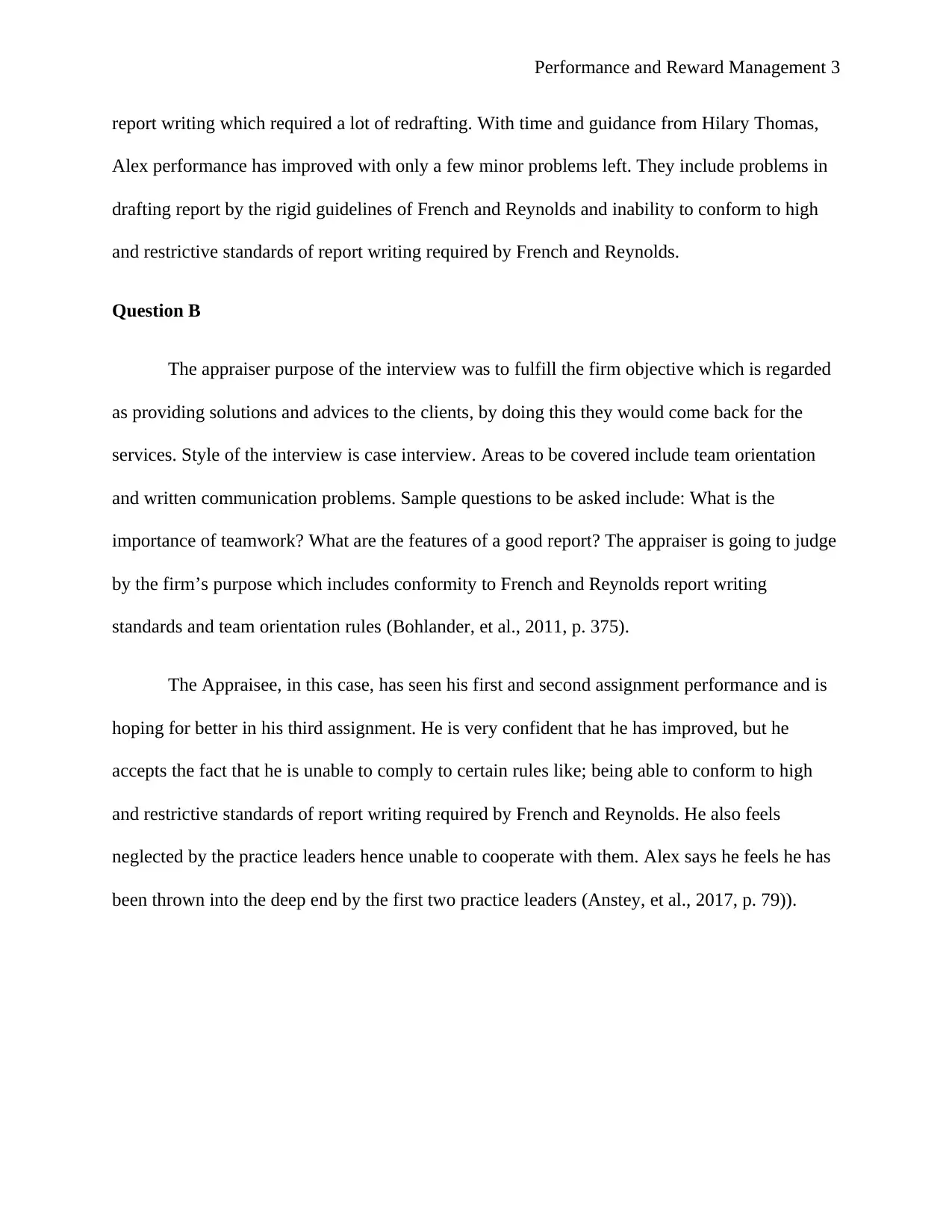
report writing which required a lot of redrafting. With time and guidance from Hilary Thomas,
Alex performance has improved with only a few minor problems left. They include problems in
drafting report by the rigid guidelines of French and Reynolds and inability to conform to high
and restrictive standards of report writing required by French and Reynolds.
Question B
The appraiser purpose of the interview was to fulfill the firm objective which is regarded
as providing solutions and advices to the clients, by doing this they would come back for the
services. Style of the interview is case interview. Areas to be covered include team orientation
and written communication problems. Sample questions to be asked include: What is the
importance of teamwork? What are the features of a good report? The appraiser is going to judge
by the firm’s purpose which includes conformity to French and Reynolds report writing
standards and team orientation rules (Bohlander, et al., 2011, p. 375).
The Appraisee, in this case, has seen his first and second assignment performance and is
hoping for better in his third assignment. He is very confident that he has improved, but he
accepts the fact that he is unable to comply to certain rules like; being able to conform to high
and restrictive standards of report writing required by French and Reynolds. He also feels
neglected by the practice leaders hence unable to cooperate with them. Alex says he feels he has
been thrown into the deep end by the first two practice leaders (Anstey, et al., 2017, p. 79)).
Document Page
Performance and Reward Management 4
Works Cited
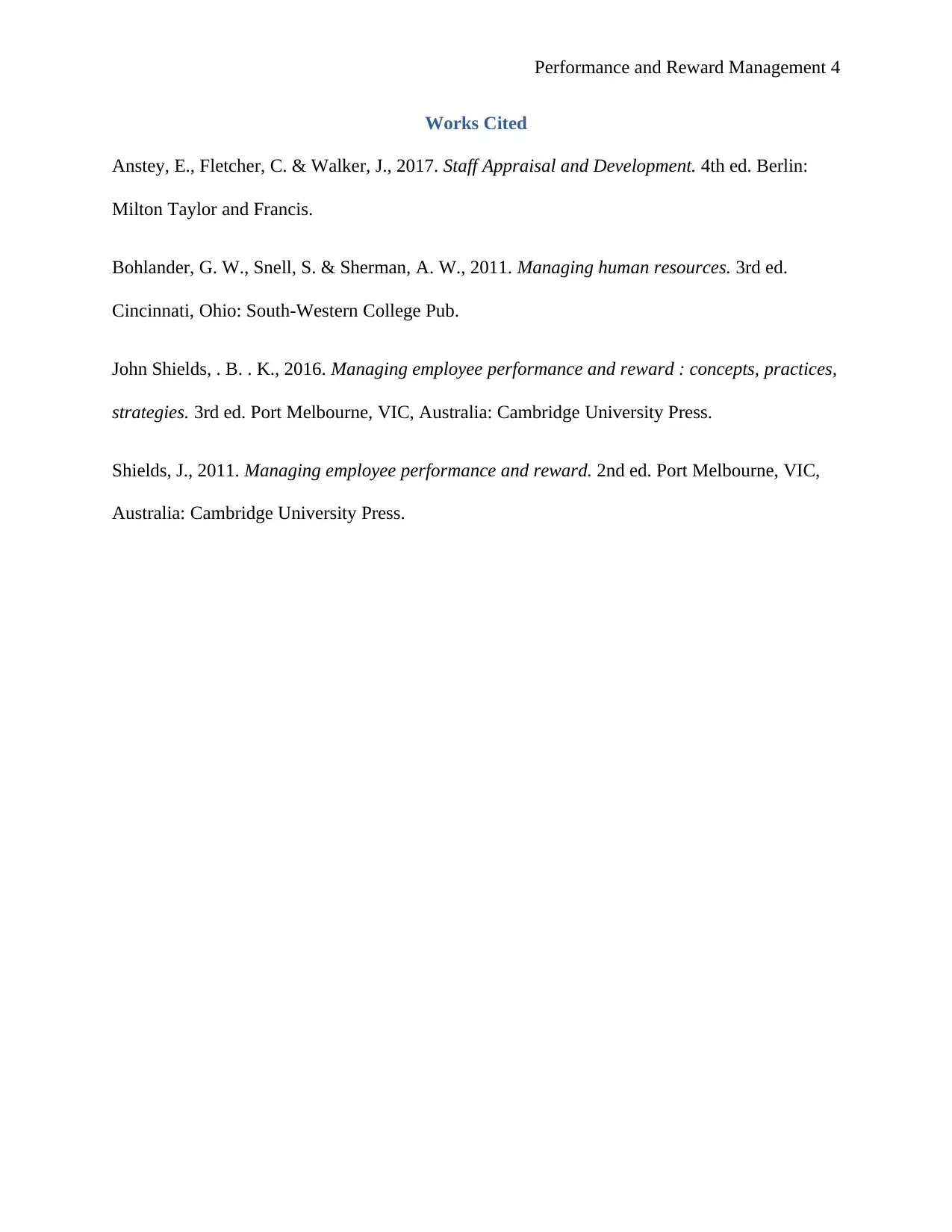
Anstey, E., Fletcher, C. & Walker, J., 2017. Staff Appraisal and Development. 4th ed. Berlin:
Milton Taylor and Francis.
Bohlander, G. W., Snell, S. & Sherman, A. W., 2011. Managing human resources. 3rd ed.
Cincinnati, Ohio: South-Western College Pub.
John Shields, . B. . K., 2016. Managing employee performance and reward : concepts, practices,
strategies. 3rd ed. Port Melbourne, VIC, Australia: Cambridge University Press.
Shields, J., 2011. Managing employee performance and reward. 2nd ed. Port Melbourne, VIC,
Australia: Cambridge University Press.
chevron_up_icon
1 out of 4
circle_padding
hide_on_mobile
zoom_out_icon
[object Object]