BPD2100: Freshtel's India Expansion Business Case Report
VerifiedAdded on 2020/04/07
|30
|7153
|41
Report
AI Summary
This report presents a comprehensive business case for Freshtel Holdings Limited, an Australian telecommunications company, to expand its operations into India. The report begins with an executive summary outlining the rationale for expansion, driven by stagnation in the Australian market and opportunities in India. It includes an analysis of Freshtel's website and a detailed examination of the Indian telecommunications market, including FDI trends, revenue figures, and subscriber growth. The report explores the company's commitment to corporate social responsibility, drawing on relevant literature. It defines the business case, identifies stakeholders, and provides a stakeholder analysis. A program logic model, feasibility analysis, and a Gantt chart are included to assess the project's viability. The report also outlines resource allocation, a detailed budget, and concludes with recommendations for a successful market entry strategy, emphasizing the potential for profitability and growth. The report is structured to evaluate the scope of the company's offshore expansion plans, considering budgetary allocation, time-related factors, and human resources. The report provides recommendations for a suitable model that will allow it to expand in a more profitable manner.
Freshtel expansion into India
International Business Challenge (IBC-2)
Assessment 2: Business Case
Student Name: Student ID:
Subject Name: Subject Code: BPD2100
Date Due: Professor Name:
Page | 1
International Business Challenge (IBC-2)
Assessment 2: Business Case
Student Name: Student ID:
Subject Name: Subject Code: BPD2100
Date Due: Professor Name:
Page | 1

Paraphrase This Document
Need a fresh take? Get an instant paraphrase of this document with our AI Paraphraser
Executive Summary
Corporations are expanding at a rapid rate post ease of norms in globalisation. Technological
advent have created immense opportunities for several corporations to expand and set up
their own businesses. Australian telecommunication sector in recent times have been facing
significant stagnation in growth and is unable to expand. Demographic factors are leading
these companies to look for profitable ventures offshore. Freshtel Holdings limited is an
Australian corporation that is considering expanding to offshore countries for exploring greater
opportunities. Senior stakeholders including shareholders of the organisation have provided
$5million seed funding for investment into various projects. A team of project managers post
careful evaluation of various processes have found that expanding company operations into
India will yield significant benefits for the Company. The scope of this study evaluates scope
of the Company while expanding offshore and taking into consideration budgetary allocation
and time related factors along with its human resources with other allocation. Considering
such factors for allocating the Company resources into offshore countries will yield various
benefits for the same and will allow development of a profit center. Along with careful
allocation of resources there are recommendations developed for the Company which
suggests a suitable model that will allow it to expand in a more profitable manner.
Page | 2
Corporations are expanding at a rapid rate post ease of norms in globalisation. Technological
advent have created immense opportunities for several corporations to expand and set up
their own businesses. Australian telecommunication sector in recent times have been facing
significant stagnation in growth and is unable to expand. Demographic factors are leading
these companies to look for profitable ventures offshore. Freshtel Holdings limited is an
Australian corporation that is considering expanding to offshore countries for exploring greater
opportunities. Senior stakeholders including shareholders of the organisation have provided
$5million seed funding for investment into various projects. A team of project managers post
careful evaluation of various processes have found that expanding company operations into
India will yield significant benefits for the Company. The scope of this study evaluates scope
of the Company while expanding offshore and taking into consideration budgetary allocation
and time related factors along with its human resources with other allocation. Considering
such factors for allocating the Company resources into offshore countries will yield various
benefits for the same and will allow development of a profit center. Along with careful
allocation of resources there are recommendations developed for the Company which
suggests a suitable model that will allow it to expand in a more profitable manner.
Page | 2
Table of Contents
Executive Summary.................................................................................................................. 2
Table of Figures........................................................................................................................ 3
1. Introduction......................................................................................................................... 4
1.1 Background of the Study..................................................................................................4
2. Review of Freshtel Holding Website...................................................................................4
3. Researching India...............................................................................................................6
4. Literature on Corporate Social Responsibility.....................................................................8
5. Research Entrepreneurship, Business Development or Corporate Social Responsibility. .9
6. Business Case Definition..................................................................................................10
7. Business Case stakeholders and Stakeholder Analysis...................................................11
8. Program Logic Model........................................................................................................12
9. Feasibility Analysis........................................................................................................... 13
10. Gantt Chart....................................................................................................................15
11. Resources..................................................................................................................... 17
12. Budget........................................................................................................................... 18
13. Conclusion and Recommendations...............................................................................22
13. Reference Lists................................................................................................................. 23
14. Appendices........................................................................................................................26
Appendix 1: The Project Team......................................................................................26
Appendix 2: Business Case Methodology.....................................................................26
Page | 3
Executive Summary.................................................................................................................. 2
Table of Figures........................................................................................................................ 3
1. Introduction......................................................................................................................... 4
1.1 Background of the Study..................................................................................................4
2. Review of Freshtel Holding Website...................................................................................4
3. Researching India...............................................................................................................6
4. Literature on Corporate Social Responsibility.....................................................................8
5. Research Entrepreneurship, Business Development or Corporate Social Responsibility. .9
6. Business Case Definition..................................................................................................10
7. Business Case stakeholders and Stakeholder Analysis...................................................11
8. Program Logic Model........................................................................................................12
9. Feasibility Analysis........................................................................................................... 13
10. Gantt Chart....................................................................................................................15
11. Resources..................................................................................................................... 17
12. Budget........................................................................................................................... 18
13. Conclusion and Recommendations...............................................................................22
13. Reference Lists................................................................................................................. 23
14. Appendices........................................................................................................................26
Appendix 1: The Project Team......................................................................................26
Appendix 2: Business Case Methodology.....................................................................26
Page | 3
⊘ This is a preview!⊘
Do you want full access?
Subscribe today to unlock all pages.

Trusted by 1+ million students worldwide
Table of Figures
Figure 1: Plans of Freshtel.................................................................................................................................5
Figure 2: FDI in Indian Telecom Sector............................................................................................................6
Figure 3: Revenues from Indian Telecom Sector............................................................................................7
Figure 4: Growth in India Telecom Sector Subscribers..................................................................................8
Figure 5: Stakeholder Analysis........................................................................................................................12
Figure 6: SWOT Analysis.................................................................................................................................15
Figure 7: Resources..........................................................................................................................................17
Figure 8: Human Resources............................................................................................................................18
Figure 9: Physical Resources..........................................................................................................................19
Page | 4
Figure 1: Plans of Freshtel.................................................................................................................................5
Figure 2: FDI in Indian Telecom Sector............................................................................................................6
Figure 3: Revenues from Indian Telecom Sector............................................................................................7
Figure 4: Growth in India Telecom Sector Subscribers..................................................................................8
Figure 5: Stakeholder Analysis........................................................................................................................12
Figure 6: SWOT Analysis.................................................................................................................................15
Figure 7: Resources..........................................................................................................................................17
Figure 8: Human Resources............................................................................................................................18
Figure 9: Physical Resources..........................................................................................................................19
Page | 4
Paraphrase This Document
Need a fresh take? Get an instant paraphrase of this document with our AI Paraphraser
1. Introduction
Corporations around the world are expanding at a rapid rate to take benefits of globalisation
(Knight, 2009). Globalisation along with rapid technological advent are providing companies
capabilities to build profit centers abroad for creation of a greater brand name.
Telecommunication sector within Australia are expanding at a rapid rate in the recent years.
Coupled with their capacities to grow and expand they are faced with significant competition
in Australia. Various companies are offshoring multiple non-core activities such that they are
able to gain significantly from returns of larger scale (Beamish, 2013). Australian economy
has been experiencing a stagnant growth over the past few years due to lower rates of growth
and rising unemployment in certain sectors. On the contrary some other companies are
planning to expand to emerging economies in order to generate more profitability for their
businesses. Freshtel is an established telecommunication business in Australia which has
tremendous potential to expand overseas (Killing, 2012). The scope of this project defines
and discusses several opportunities that Freshtel can benefit from in case it expands with its
operations in overseas emerging countries as India.
1.1 Background of the Study
Telecommunication sector has undergone significant changes and transformations in the
recent past. There are multiple types of associated businesses that have emerged along with
telephony services as data services that telecommunication companies are providing (Ball,
2012). Currently, Companies in Australia are providing 4G as well as some companies are
providing 5G connections at increasing cheap rates. Along with data connections there are a
large number of associated businesses as fixed telephone lines, mobile services, broadband
services and so on. Though there are immense business scopes yet presence of a large
number of telecommunication giants have made the industry scenario more competitive
(Harzing, 2013). Freshtel a growing company in Australia market post receiving seed
financing can make use of the same to divert its resources to developing countries around the
world to gain substantial advantages. The scope of this study examines the relevant issues
and opportunities that the Company can gain in case it expands its business to India. A brief
review of feasibility analysis is conducted along with necessary time frame and budgetary
analysis (Cheng, 2009).
2. Review of Freshtel Holding Website
Freshtel Holding Limited is an Australian based telephony company which is recently
developing Voice over IR services along with products. It was established in 2004 and has its
headquarters based in Melbourne in Australia (freshtelholdings, Retrieved on 4th October
2017). The Company offers VoIP solutions for its wholesale customers and other retail
products for direct sale to customers. It has two subsidiaries as Voicedot and Virbiage. Its
retail producst are marketed through Freshtel Pty Ltd. It has a global base for its wholesale
products. Its current CEO is Rhonda O’Donnell and Chairman is Kenneth V Loughnan. It has
Page | 5
Corporations around the world are expanding at a rapid rate to take benefits of globalisation
(Knight, 2009). Globalisation along with rapid technological advent are providing companies
capabilities to build profit centers abroad for creation of a greater brand name.
Telecommunication sector within Australia are expanding at a rapid rate in the recent years.
Coupled with their capacities to grow and expand they are faced with significant competition
in Australia. Various companies are offshoring multiple non-core activities such that they are
able to gain significantly from returns of larger scale (Beamish, 2013). Australian economy
has been experiencing a stagnant growth over the past few years due to lower rates of growth
and rising unemployment in certain sectors. On the contrary some other companies are
planning to expand to emerging economies in order to generate more profitability for their
businesses. Freshtel is an established telecommunication business in Australia which has
tremendous potential to expand overseas (Killing, 2012). The scope of this project defines
and discusses several opportunities that Freshtel can benefit from in case it expands with its
operations in overseas emerging countries as India.
1.1 Background of the Study
Telecommunication sector has undergone significant changes and transformations in the
recent past. There are multiple types of associated businesses that have emerged along with
telephony services as data services that telecommunication companies are providing (Ball,
2012). Currently, Companies in Australia are providing 4G as well as some companies are
providing 5G connections at increasing cheap rates. Along with data connections there are a
large number of associated businesses as fixed telephone lines, mobile services, broadband
services and so on. Though there are immense business scopes yet presence of a large
number of telecommunication giants have made the industry scenario more competitive
(Harzing, 2013). Freshtel a growing company in Australia market post receiving seed
financing can make use of the same to divert its resources to developing countries around the
world to gain substantial advantages. The scope of this study examines the relevant issues
and opportunities that the Company can gain in case it expands its business to India. A brief
review of feasibility analysis is conducted along with necessary time frame and budgetary
analysis (Cheng, 2009).
2. Review of Freshtel Holding Website
Freshtel Holding Limited is an Australian based telephony company which is recently
developing Voice over IR services along with products. It was established in 2004 and has its
headquarters based in Melbourne in Australia (freshtelholdings, Retrieved on 4th October
2017). The Company offers VoIP solutions for its wholesale customers and other retail
products for direct sale to customers. It has two subsidiaries as Voicedot and Virbiage. Its
retail producst are marketed through Freshtel Pty Ltd. It has a global base for its wholesale
products. Its current CEO is Rhonda O’Donnell and Chairman is Kenneth V Loughnan. It has
Page | 5
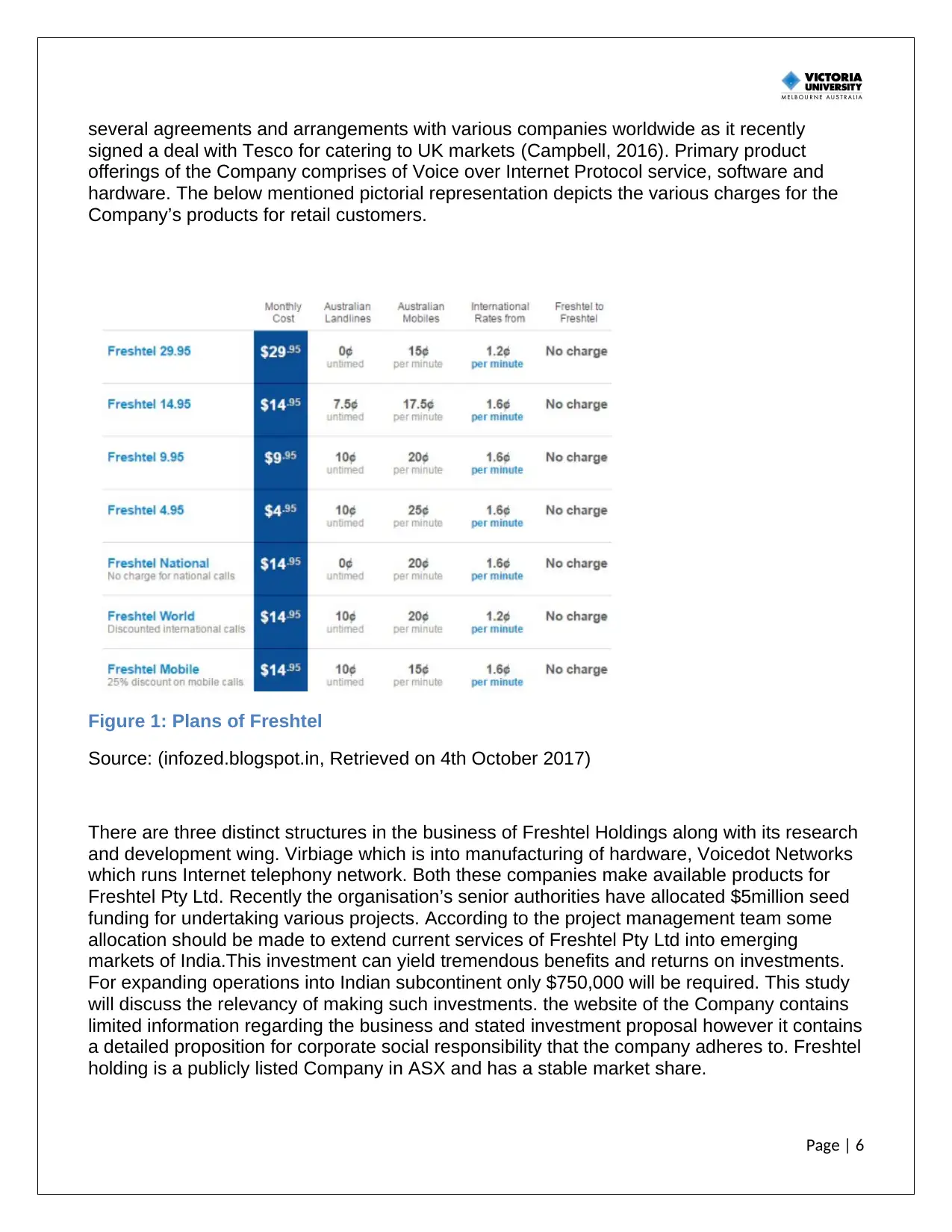
several agreements and arrangements with various companies worldwide as it recently
signed a deal with Tesco for catering to UK markets (Campbell, 2016). Primary product
offerings of the Company comprises of Voice over Internet Protocol service, software and
hardware. The below mentioned pictorial representation depicts the various charges for the
Company’s products for retail customers.
Figure 1: Plans of Freshtel
Source: (infozed.blogspot.in, Retrieved on 4th October 2017)
There are three distinct structures in the business of Freshtel Holdings along with its research
and development wing. Virbiage which is into manufacturing of hardware, Voicedot Networks
which runs Internet telephony network. Both these companies make available products for
Freshtel Pty Ltd. Recently the organisation’s senior authorities have allocated $5million seed
funding for undertaking various projects. According to the project management team some
allocation should be made to extend current services of Freshtel Pty Ltd into emerging
markets of India.This investment can yield tremendous benefits and returns on investments.
For expanding operations into Indian subcontinent only $750,000 will be required. This study
will discuss the relevancy of making such investments. the website of the Company contains
limited information regarding the business and stated investment proposal however it contains
a detailed proposition for corporate social responsibility that the company adheres to. Freshtel
holding is a publicly listed Company in ASX and has a stable market share.
Page | 6
signed a deal with Tesco for catering to UK markets (Campbell, 2016). Primary product
offerings of the Company comprises of Voice over Internet Protocol service, software and
hardware. The below mentioned pictorial representation depicts the various charges for the
Company’s products for retail customers.
Figure 1: Plans of Freshtel
Source: (infozed.blogspot.in, Retrieved on 4th October 2017)
There are three distinct structures in the business of Freshtel Holdings along with its research
and development wing. Virbiage which is into manufacturing of hardware, Voicedot Networks
which runs Internet telephony network. Both these companies make available products for
Freshtel Pty Ltd. Recently the organisation’s senior authorities have allocated $5million seed
funding for undertaking various projects. According to the project management team some
allocation should be made to extend current services of Freshtel Pty Ltd into emerging
markets of India.This investment can yield tremendous benefits and returns on investments.
For expanding operations into Indian subcontinent only $750,000 will be required. This study
will discuss the relevancy of making such investments. the website of the Company contains
limited information regarding the business and stated investment proposal however it contains
a detailed proposition for corporate social responsibility that the company adheres to. Freshtel
holding is a publicly listed Company in ASX and has a stable market share.
Page | 6
⊘ This is a preview!⊘
Do you want full access?
Subscribe today to unlock all pages.
Trusted by 1+ million students worldwide
3. Researching India
Amongst the various BRICS countries of Brazil, Russia, India, China and South Africa,
Freshtel Pty Ltd has selected India for expanding its operations into. India is a rapidly growing
emerging nation in Asia, that offers perfect destination for FDI endeavors (Birkinshaw, 2011).
Demographic trends within the country is promising, socio-cultural trends are rapidly
transforming especially in major cities in the country. However, the country remains affected
form political interferences especially in businesses, but the present government is providing
several endeavors such that FDIs are made in the country. Economic situation are also stable
in the country within the Asian region compared to its past offering a stable rate of GDP. The
telecommunication sector within the country is highly regulated by TRAI. TRAI is an
association of various telephony companies along with participation of government (Doz,
2011). The body allows significant investment of foreign authorities into the country, which is
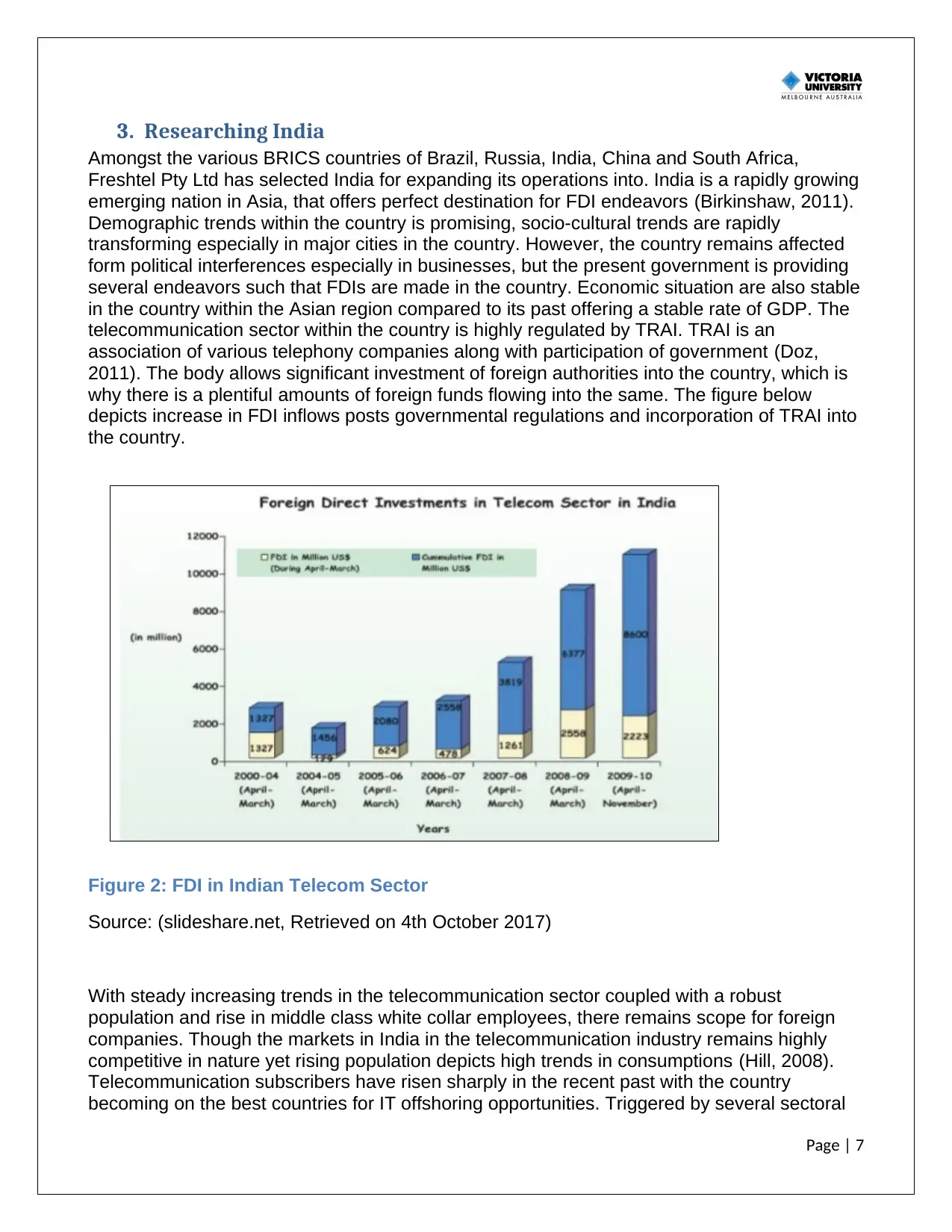
why there is a plentiful amounts of foreign funds flowing into the same. The figure below
depicts increase in FDI inflows posts governmental regulations and incorporation of TRAI into
the country.
Figure 2: FDI in Indian Telecom Sector
Source: (slideshare.net, Retrieved on 4th October 2017)
With steady increasing trends in the telecommunication sector coupled with a robust
population and rise in middle class white collar employees, there remains scope for foreign
companies. Though the markets in India in the telecommunication industry remains highly
competitive in nature yet rising population depicts high trends in consumptions (Hill, 2008).
Telecommunication subscribers have risen sharply in the recent past with the country
becoming on the best countries for IT offshoring opportunities. Triggered by several sectoral
Page | 7
Amongst the various BRICS countries of Brazil, Russia, India, China and South Africa,
Freshtel Pty Ltd has selected India for expanding its operations into. India is a rapidly growing
emerging nation in Asia, that offers perfect destination for FDI endeavors (Birkinshaw, 2011).
Demographic trends within the country is promising, socio-cultural trends are rapidly
transforming especially in major cities in the country. However, the country remains affected
form political interferences especially in businesses, but the present government is providing
several endeavors such that FDIs are made in the country. Economic situation are also stable
in the country within the Asian region compared to its past offering a stable rate of GDP. The
telecommunication sector within the country is highly regulated by TRAI. TRAI is an
association of various telephony companies along with participation of government (Doz,
2011). The body allows significant investment of foreign authorities into the country, which is
why there is a plentiful amounts of foreign funds flowing into the same. The figure below
depicts increase in FDI inflows posts governmental regulations and incorporation of TRAI into
the country.
Figure 2: FDI in Indian Telecom Sector
Source: (slideshare.net, Retrieved on 4th October 2017)
With steady increasing trends in the telecommunication sector coupled with a robust
population and rise in middle class white collar employees, there remains scope for foreign
companies. Though the markets in India in the telecommunication industry remains highly
competitive in nature yet rising population depicts high trends in consumptions (Hill, 2008).
Telecommunication subscribers have risen sharply in the recent past with the country
becoming on the best countries for IT offshoring opportunities. Triggered by several sectoral
Page | 7
Paraphrase This Document
Need a fresh take? Get an instant paraphrase of this document with our AI Paraphraser
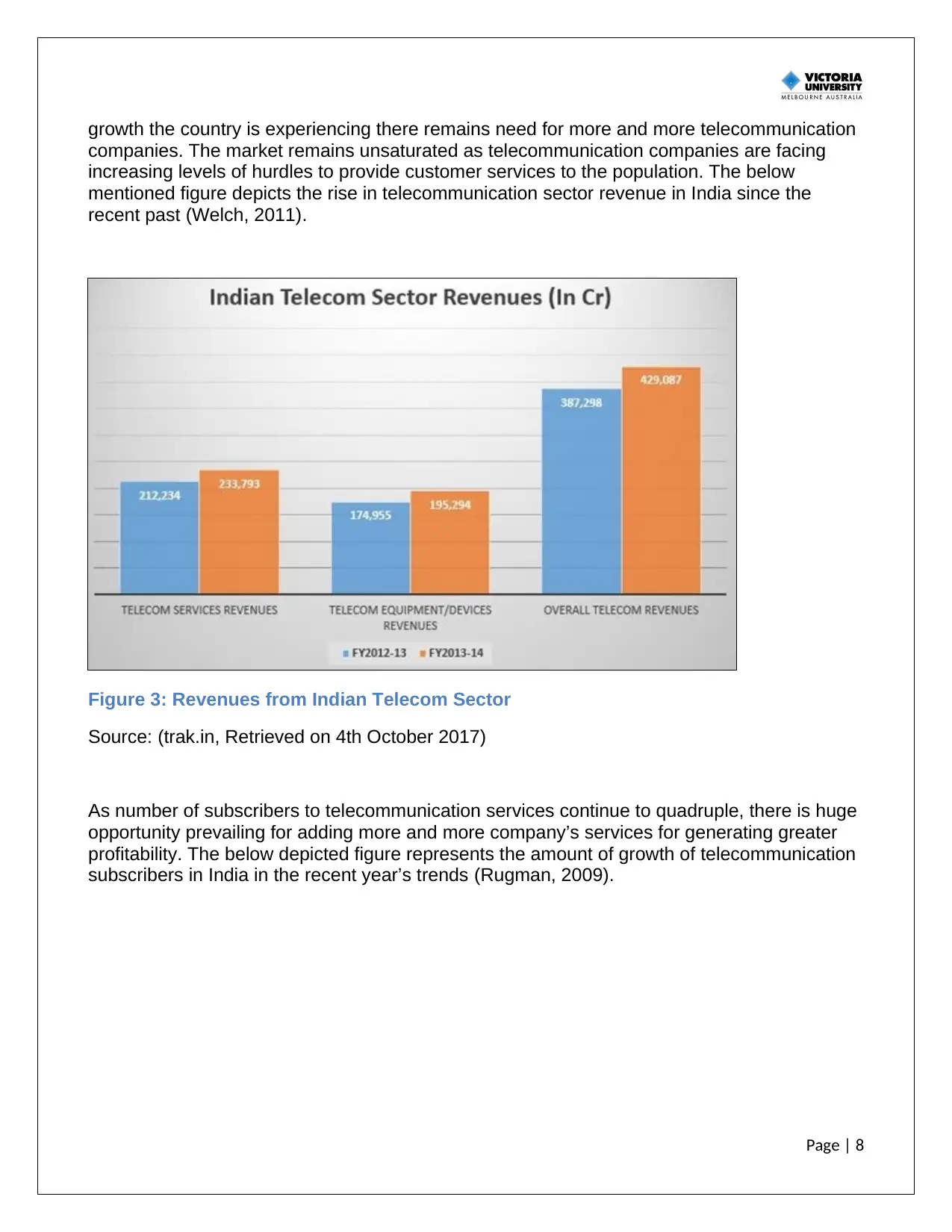
growth the country is experiencing there remains need for more and more telecommunication
companies. The market remains unsaturated as telecommunication companies are facing
increasing levels of hurdles to provide customer services to the population. The below
mentioned figure depicts the rise in telecommunication sector revenue in India since the
recent past (Welch, 2011).
Figure 3: Revenues from Indian Telecom Sector
Source: (trak.in, Retrieved on 4th October 2017)
As number of subscribers to telecommunication services continue to quadruple, there is huge
opportunity prevailing for adding more and more company’s services for generating greater
profitability. The below depicted figure represents the amount of growth of telecommunication
subscribers in India in the recent year’s trends (Rugman, 2009).
Page | 8
companies. The market remains unsaturated as telecommunication companies are facing
increasing levels of hurdles to provide customer services to the population. The below
mentioned figure depicts the rise in telecommunication sector revenue in India since the
recent past (Welch, 2011).
Figure 3: Revenues from Indian Telecom Sector
Source: (trak.in, Retrieved on 4th October 2017)
As number of subscribers to telecommunication services continue to quadruple, there is huge
opportunity prevailing for adding more and more company’s services for generating greater
profitability. The below depicted figure represents the amount of growth of telecommunication
subscribers in India in the recent year’s trends (Rugman, 2009).
Page | 8
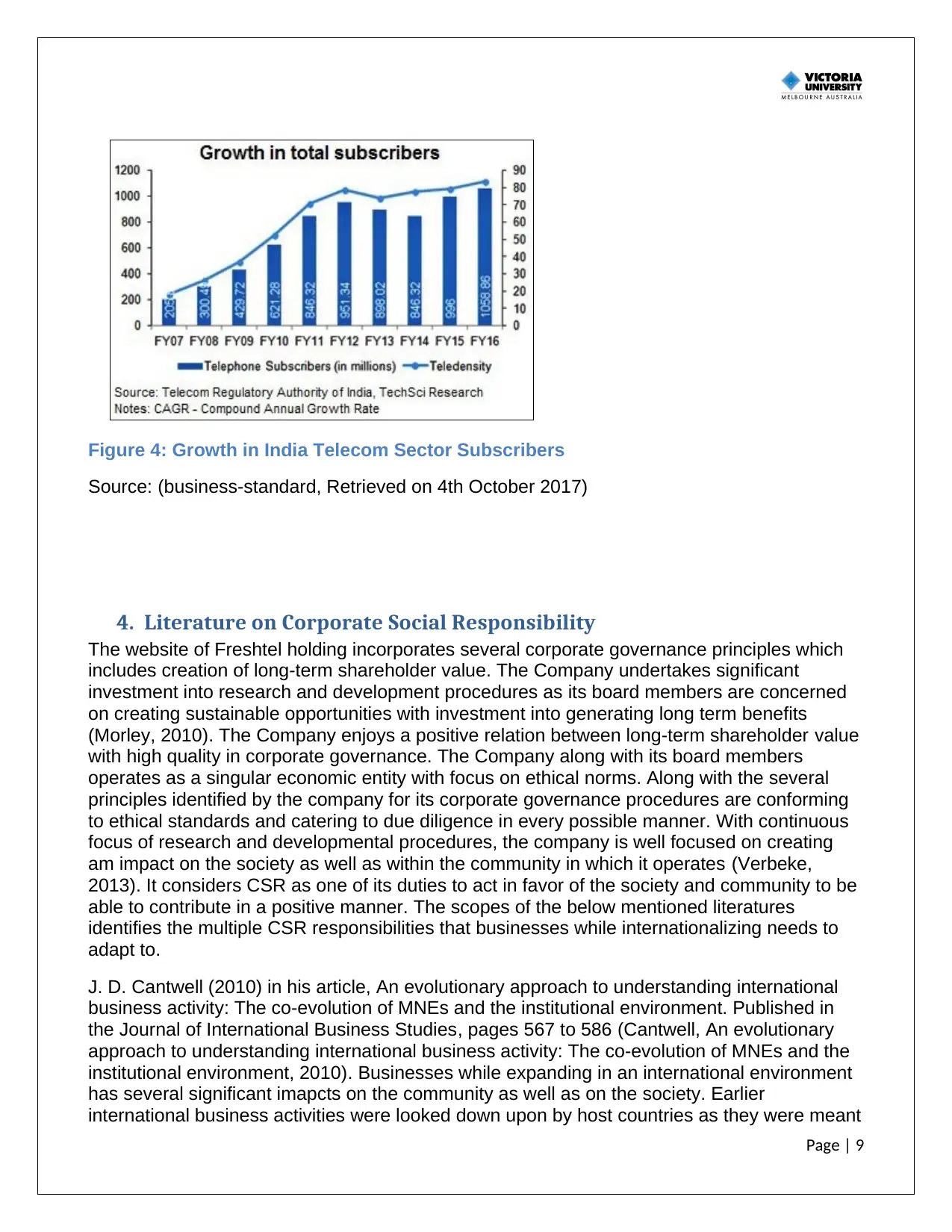
Figure 4: Growth in India Telecom Sector Subscribers
Source: (business-standard, Retrieved on 4th October 2017)
4. Literature on Corporate Social Responsibility
The website of Freshtel holding incorporates several corporate governance principles which
includes creation of long-term shareholder value. The Company undertakes significant
investment into research and development procedures as its board members are concerned
on creating sustainable opportunities with investment into generating long term benefits
(Morley, 2010). The Company enjoys a positive relation between long-term shareholder value
with high quality in corporate governance. The Company along with its board members
operates as a singular economic entity with focus on ethical norms. Along with the several
principles identified by the company for its corporate governance procedures are conforming
to ethical standards and catering to due diligence in every possible manner. With continuous
focus of research and developmental procedures, the company is well focused on creating
am impact on the society as well as within the community in which it operates (Verbeke,
2013). It considers CSR as one of its duties to act in favor of the society and community to be
able to contribute in a positive manner. The scopes of the below mentioned literatures
identifies the multiple CSR responsibilities that businesses while internationalizing needs to
adapt to.
J. D. Cantwell (2010) in his article, An evolutionary approach to understanding international
business activity: The co-evolution of MNEs and the institutional environment. Published in
the Journal of International Business Studies, pages 567 to 586 (Cantwell, An evolutionary
approach to understanding international business activity: The co-evolution of MNEs and the
institutional environment, 2010). Businesses while expanding in an international environment
has several significant imapcts on the community as well as on the society. Earlier
international business activities were looked down upon by host countries as they were meant
Page | 9
Source: (business-standard, Retrieved on 4th October 2017)
4. Literature on Corporate Social Responsibility
The website of Freshtel holding incorporates several corporate governance principles which
includes creation of long-term shareholder value. The Company undertakes significant
investment into research and development procedures as its board members are concerned
on creating sustainable opportunities with investment into generating long term benefits
(Morley, 2010). The Company enjoys a positive relation between long-term shareholder value
with high quality in corporate governance. The Company along with its board members
operates as a singular economic entity with focus on ethical norms. Along with the several
principles identified by the company for its corporate governance procedures are conforming
to ethical standards and catering to due diligence in every possible manner. With continuous
focus of research and developmental procedures, the company is well focused on creating
am impact on the society as well as within the community in which it operates (Verbeke,
2013). It considers CSR as one of its duties to act in favor of the society and community to be
able to contribute in a positive manner. The scopes of the below mentioned literatures
identifies the multiple CSR responsibilities that businesses while internationalizing needs to
adapt to.
J. D. Cantwell (2010) in his article, An evolutionary approach to understanding international
business activity: The co-evolution of MNEs and the institutional environment. Published in
the Journal of International Business Studies, pages 567 to 586 (Cantwell, An evolutionary
approach to understanding international business activity: The co-evolution of MNEs and the
institutional environment, 2010). Businesses while expanding in an international environment
has several significant imapcts on the community as well as on the society. Earlier
international business activities were looked down upon by host countries as they were meant
Page | 9
⊘ This is a preview!⊘
Do you want full access?
Subscribe today to unlock all pages.
Trusted by 1+ million students worldwide
to reap benefits only rather than creation of opportunities. In this endevour several
corporations are well known to have impacted negatively on host countries by exploiting
workers, lowering wage rates and so on. There is a limited amounts of benefits attached to
internationalisation of companies, hence traditional businesses did not lay much focus on
CSR activities. Y. S. Chandra (2009) article, The recognition of first time international
entrepreneurial opportunities: Evidence from firms in knowledge-based industries. In the
International Marketing Review, pages 30 to 61 (Chandra, 2009). Entrepreneurial endevours
in recent times recognises that in case of internationalisation of businesses it needs to create
benefits for host country as well. Entrepreneurs in recent times are diagnosing ways and
means they could create positive impacts on host countries thus, extending their CSR norms.
F. J. Contractor (2007) article, Is international business good for companies? The
evolutionary or multistage theory of internationalization vs. the transaction cost perspective.
Published in MIR: Management International Review, pages 453 to 475 (Contractor F. J.,
2007). The scope of this article recognises the ways in which internationalisation could yield
benefits for their own companies. In this article CSR norms with respect to companies are
analysed according to impacts they generate on their employees. Internationalising
companies often accommodate several employee engagement strategies for expatriates such
that they continue to retain their interests. F. J. Contractor (2007) article, Nature of the
relationship between international expansion and performance: The case of emerging market
firms. In the Journal of World Business, pages 401 to 417 (Contractor F. J., 2007). This article
recognise realtionship of international business with that of performanes of businesss which
reflects that greater that greater employee satisfaction more the performance of the company.
5. Research Entrepreneurship, Business Development or Corporate Social
Responsibility
Business developments are often coupled by means of exapnsion into larger areas or
forums. Entrepreneurship skills are applied onto business development or corporate
social responsibility such that the business can grow in a sustainble manner in the
future (Barton, 2011). Evaluation of several literatures and texts on corporate social
responsibility reflects that entrepreneurs take on priority CSR for betterment of the
organisation. Below are some more texts and articles that are taken into account for
the purpose of evaluation.
M. J. Dollinger (2008) in his book Entrepreneurship: Strategies and resources.
Published by Marsh Publications (Dollinger, 2008). This identifies scope of resources
and strategies in entrepreunial internationalisation. It evaluates resources and
strategies that are extended by entrepreneurs while expanding their businesses. They
consider impacts on the business that are internal as well as external impacts such
that they can easily divert their resources. It identifies the importance of feasibility
analysis for the corporation while internationalising. A. Kolk (2010) article, International
business, corporate social responsibility and sustainable development. In the
International business review, page number 119 to 125 (Kolk, 2010). The scope of this
analysis identifies the CSR challenges faced while incorporating sustainable features
Page | 10
corporations are well known to have impacted negatively on host countries by exploiting
workers, lowering wage rates and so on. There is a limited amounts of benefits attached to
internationalisation of companies, hence traditional businesses did not lay much focus on
CSR activities. Y. S. Chandra (2009) article, The recognition of first time international
entrepreneurial opportunities: Evidence from firms in knowledge-based industries. In the
International Marketing Review, pages 30 to 61 (Chandra, 2009). Entrepreneurial endevours
in recent times recognises that in case of internationalisation of businesses it needs to create
benefits for host country as well. Entrepreneurs in recent times are diagnosing ways and
means they could create positive impacts on host countries thus, extending their CSR norms.
F. J. Contractor (2007) article, Is international business good for companies? The
evolutionary or multistage theory of internationalization vs. the transaction cost perspective.
Published in MIR: Management International Review, pages 453 to 475 (Contractor F. J.,
2007). The scope of this article recognises the ways in which internationalisation could yield
benefits for their own companies. In this article CSR norms with respect to companies are
analysed according to impacts they generate on their employees. Internationalising
companies often accommodate several employee engagement strategies for expatriates such
that they continue to retain their interests. F. J. Contractor (2007) article, Nature of the
relationship between international expansion and performance: The case of emerging market
firms. In the Journal of World Business, pages 401 to 417 (Contractor F. J., 2007). This article
recognise realtionship of international business with that of performanes of businesss which
reflects that greater that greater employee satisfaction more the performance of the company.
5. Research Entrepreneurship, Business Development or Corporate Social
Responsibility
Business developments are often coupled by means of exapnsion into larger areas or
forums. Entrepreneurship skills are applied onto business development or corporate
social responsibility such that the business can grow in a sustainble manner in the
future (Barton, 2011). Evaluation of several literatures and texts on corporate social
responsibility reflects that entrepreneurs take on priority CSR for betterment of the
organisation. Below are some more texts and articles that are taken into account for
the purpose of evaluation.
M. J. Dollinger (2008) in his book Entrepreneurship: Strategies and resources.
Published by Marsh Publications (Dollinger, 2008). This identifies scope of resources
and strategies in entrepreunial internationalisation. It evaluates resources and
strategies that are extended by entrepreneurs while expanding their businesses. They
consider impacts on the business that are internal as well as external impacts such
that they can easily divert their resources. It identifies the importance of feasibility
analysis for the corporation while internationalising. A. Kolk (2010) article, International
business, corporate social responsibility and sustainable development. In the
International business review, page number 119 to 125 (Kolk, 2010). The scope of this
analysis identifies the CSR challenges faced while incorporating sustainable features
Page | 10
Paraphrase This Document
Need a fresh take? Get an instant paraphrase of this document with our AI Paraphraser
in businesses. CSR can provide significant benefits for the corporation towards
building a positive brand name and brand recognition in the market.
Y. Luo (2007) article, International expansion of emerging market enterprises: A
springboard perspective. In the Journal of international business studies, page number
481 to 498 (Luo, 2007). The scope of this article recognises article recognises benefits
that corporations can have in emerging markets and CSR norms that they apply. Often
corporations aim to only reap benefits from emerging markets due to cheap and readily
available resources. Thus, it becomes more difficult for them to apply CSR norms.
T. E. Nulty (2016) article, Some thoughts about Australian telecoms. In the Australian
Journal of Telecommunications and the Digital Economy, page number 11 (Nulty,
2016). Australian telecommunication companies are developing and expanding at a
rapid rate. M. W. Peng, 2008. An institution-based view of international business
strategy: A focus on emerging economies. Journal of international business studies,
920-936 (Peng, 2008). This journal reviews various business strategies that are
applied by international corporations while expanding in emerging markets. S. E.
Sakarya, 2007. Market selection for international expansion: Assessing opportunities in
emerging markets. International Marketing Review, 208-238 (Sakarya, 2007). This
article reviews ways and means which are applied for selecting a market for the
purpose of expansion. This article views the several benefits according to CSR which
might emerge from such expansions. D. W. Yiu, 2007. International venturing by
emerging economy firms: the effects of firm capabilities, home country networks, and
corporate entrepreneurship. Journal of International Business Studies, 519-540 (Yiu,
2007). Firms expands in international markets once they have access to wide
capabilities which they apply in emerging markets. This article views the several
capabilties that firm’s expand while internationalising to create a positive impact.
6. Business Case Definition
Nature of the business undertaken in this case is telecommunication sector in Australia, which
is planning to expand its operations into India. The business of Freshtel revolves around
wholesale of hardware and connectivity related products whereas Freshtel Pty Ltd has only
retail products for internet as well as telephony connections. The business is a highly
profitable venture in the Australian market and occupies a significant market share. The
business that is into retail production will divert its operations into India for catering to a large
number and segment of customers for broadening its business base.
The business case aim is to expand business operations also its CSR initiative. The
organisations mission statement is to provide a reliable uninterrupted service to Australian
customers. The business had been constantly bent on several research and developmental
related endeavors such that the society at large can be benefitted (Meredith Belbin, 2011).
While expanding its businesses into India, it will still continue to include R & D endeavors
such that it can benefit the Indian society and bring about new products as well as
Page | 11
building a positive brand name and brand recognition in the market.
Y. Luo (2007) article, International expansion of emerging market enterprises: A
springboard perspective. In the Journal of international business studies, page number
481 to 498 (Luo, 2007). The scope of this article recognises article recognises benefits
that corporations can have in emerging markets and CSR norms that they apply. Often
corporations aim to only reap benefits from emerging markets due to cheap and readily
available resources. Thus, it becomes more difficult for them to apply CSR norms.
T. E. Nulty (2016) article, Some thoughts about Australian telecoms. In the Australian
Journal of Telecommunications and the Digital Economy, page number 11 (Nulty,
2016). Australian telecommunication companies are developing and expanding at a
rapid rate. M. W. Peng, 2008. An institution-based view of international business
strategy: A focus on emerging economies. Journal of international business studies,
920-936 (Peng, 2008). This journal reviews various business strategies that are
applied by international corporations while expanding in emerging markets. S. E.
Sakarya, 2007. Market selection for international expansion: Assessing opportunities in
emerging markets. International Marketing Review, 208-238 (Sakarya, 2007). This
article reviews ways and means which are applied for selecting a market for the
purpose of expansion. This article views the several benefits according to CSR which
might emerge from such expansions. D. W. Yiu, 2007. International venturing by
emerging economy firms: the effects of firm capabilities, home country networks, and
corporate entrepreneurship. Journal of International Business Studies, 519-540 (Yiu,
2007). Firms expands in international markets once they have access to wide
capabilities which they apply in emerging markets. This article views the several
capabilties that firm’s expand while internationalising to create a positive impact.
6. Business Case Definition
Nature of the business undertaken in this case is telecommunication sector in Australia, which
is planning to expand its operations into India. The business of Freshtel revolves around
wholesale of hardware and connectivity related products whereas Freshtel Pty Ltd has only
retail products for internet as well as telephony connections. The business is a highly
profitable venture in the Australian market and occupies a significant market share. The
business that is into retail production will divert its operations into India for catering to a large
number and segment of customers for broadening its business base.
The business case aim is to expand business operations also its CSR initiative. The
organisations mission statement is to provide a reliable uninterrupted service to Australian
customers. The business had been constantly bent on several research and developmental
related endeavors such that the society at large can be benefitted (Meredith Belbin, 2011).
While expanding its businesses into India, it will still continue to include R & D endeavors
such that it can benefit the Indian society and bring about new products as well as
Page | 11
Stakeholder Analysis Matrix
Shareholders
Keep Investors Senior Management
Satisfied Manage Closely
High
Customers
Influence Employees
Staffs Governmental Authorities
Low Monitor Keep Informed Agencies
Low High
Interest
developments. Further CSR elements that will be incorporated into the business will be to
create employment in India rather than appointing expatriates in the country. The company
will aim at benefiting the Indian society while expanding by providing local employment,
training and development. It will aim at engaging employees such that there is higher
amounts of retention and lower levels of turnover in the company.
The expansion of the business into India will take an year to two years. While expanding it will
start up as a smaller enterprise and gradually with growing profits it will aim at expanding its
operations further. It can expand using joint venture model where size of the business will be
restricted to a smaller frame and then later grow to be a self-regulated enterprise (Johnson,
2009).
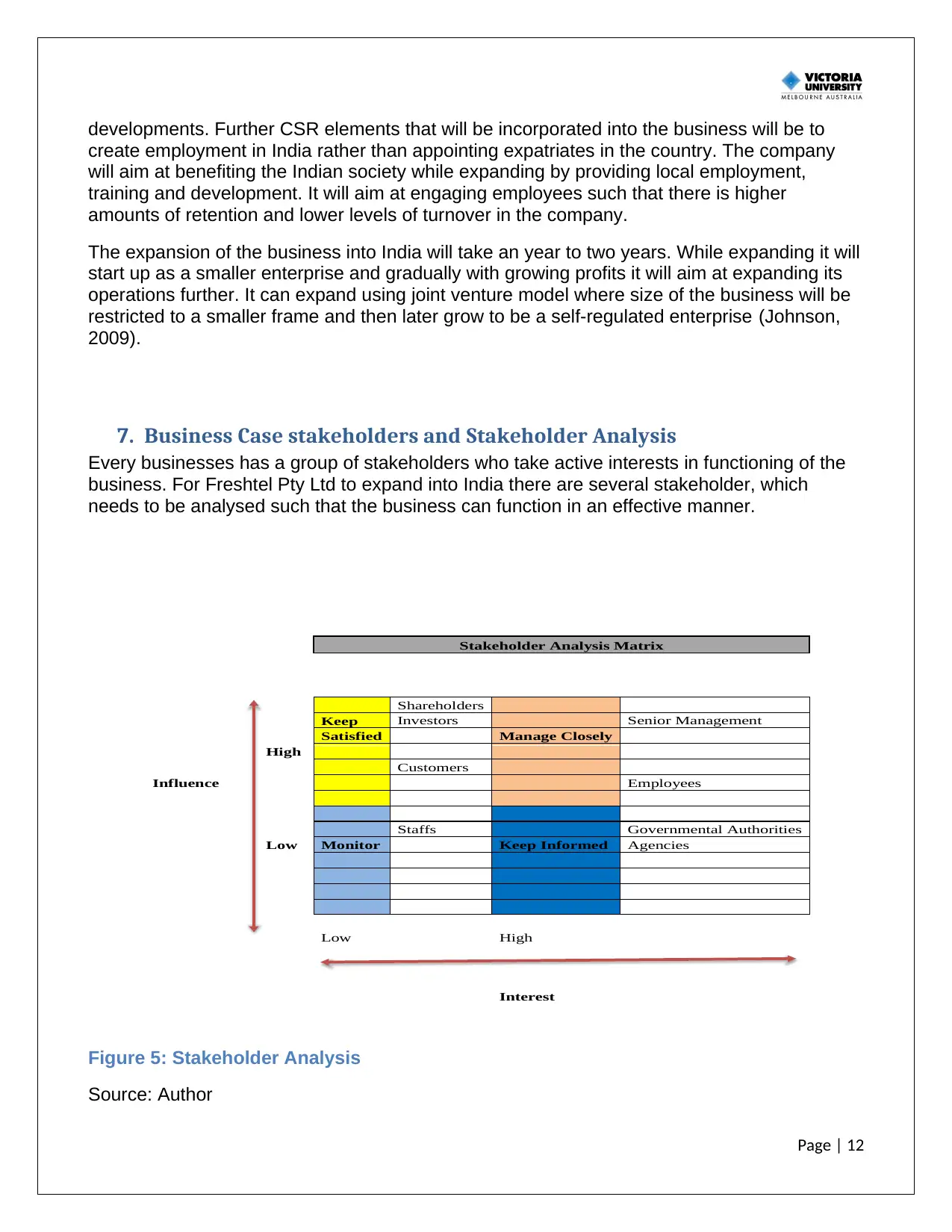
7. Business Case stakeholders and Stakeholder Analysis
Every businesses has a group of stakeholders who take active interests in functioning of the
business. For Freshtel Pty Ltd to expand into India there are several stakeholder, which
needs to be analysed such that the business can function in an effective manner.
Figure 5: Stakeholder Analysis
Source: Author
Page | 12
Shareholders
Keep Investors Senior Management
Satisfied Manage Closely
High
Customers
Influence Employees
Staffs Governmental Authorities
Low Monitor Keep Informed Agencies
Low High
Interest
developments. Further CSR elements that will be incorporated into the business will be to
create employment in India rather than appointing expatriates in the country. The company
will aim at benefiting the Indian society while expanding by providing local employment,
training and development. It will aim at engaging employees such that there is higher
amounts of retention and lower levels of turnover in the company.
The expansion of the business into India will take an year to two years. While expanding it will
start up as a smaller enterprise and gradually with growing profits it will aim at expanding its
operations further. It can expand using joint venture model where size of the business will be
restricted to a smaller frame and then later grow to be a self-regulated enterprise (Johnson,
2009).
7. Business Case stakeholders and Stakeholder Analysis
Every businesses has a group of stakeholders who take active interests in functioning of the
business. For Freshtel Pty Ltd to expand into India there are several stakeholder, which
needs to be analysed such that the business can function in an effective manner.
Figure 5: Stakeholder Analysis
Source: Author
Page | 12
⊘ This is a preview!⊘
Do you want full access?
Subscribe today to unlock all pages.
Trusted by 1+ million students worldwide

1 out of 30


Related Documents


Your All-in-One AI-Powered Toolkit for Academic Success.
+13062052269
info@desklib.com
Available 24*7 on WhatsApp / Email
![[object Object]](/_next/static/media/star-bottom.7253800d.svg)
Unlock your academic potential
Copyright © 2020–2026 A2Z Services. All Rights Reserved. Developed and managed by ZUCOL.