Data Analytics: Investigating Friendship and Religion on Happiness
VerifiedAdded on 2023/06/08
|19
|3853
|166
Essay
AI Summary
This paper explores the correlation between religion and friendship with achieving happiness using data analytics. It introduces the topic, presents a conceptual framework, details the research methodology (exploratory research design, primary and secondary data, questionnaire distribution, and statistical analysis using SPSS), and analyzes data collected from 1041 respondents in the United Kingdom using the World Value Survey wave online platform. The analysis includes tests for normality, linearity, multicollinearity, and homoscedasticity, as well as descriptive statistics, correlation, and regression analysis to test the hypotheses. The findings suggest a significant relationship between both friendship and religiosity with individual happiness. Desklib provides access to similar solved assignments and resources for students.
Data Analytics 1
DATA ANALYTICS
Name of the Student
University
Unit
Unit Code
State/ City
Date
DATA ANALYTICS
Name of the Student
University
Unit
Unit Code
State/ City
Date

Paraphrase This Document
Need a fresh take? Get an instant paraphrase of this document with our AI Paraphraser
1
Data Analytics
Table of Contents
1.0 Introduction............................................................................................................................2
2.0 Conceptual Framework...........................................................................................................3
3.0 Methodology...........................................................................................................................5
4.0 Data Analysis and Results..................................................................................................6
4.1 Description..........................................................................................................................6
5.0 Discussion and Conclusion...................................................................................................12
References..................................................................................................................................14
Appendix....................................................................................................................................15
Data Analytics
Table of Contents
1.0 Introduction............................................................................................................................2
2.0 Conceptual Framework...........................................................................................................3
3.0 Methodology...........................................................................................................................5
4.0 Data Analysis and Results..................................................................................................6
4.1 Description..........................................................................................................................6
5.0 Discussion and Conclusion...................................................................................................12
References..................................................................................................................................14
Appendix....................................................................................................................................15
2
1.0 Introduction
Precisely, what is happiness and how do we attain it? Is it part of a reward system or is
it a gift we offer to ourselves? The imperceptible state of merely being happy is difficult to find
and there are no GPS trackers or maps to assist us chart a course. Persons dialog about the
“Pursuit of Happiness”, yet in the real sense happiness is so hard to achieve and even when
attained, it appears to disappear faster than we would like. Happiness is not somewhere we
arrive; it is not something we achieve. The more you chase happiness, the less chance you have
to find it. Why? Since happiness is and all the time has been within ourselves; we simple ought
to come back to it; to that ordinary state that is happiness. Thinkers, activists and philosophers,
for example Aristotle, Aristippus, Jean Jacques Rousseau, Zhuangzi, Bertrand Russell and
Jeremy Benthan, have deliberated happiness and life gratification to be one of the peak aims of
human motivation. As stated by Bennett and Nikolaev (2016), happy persons are more
cooperative, more industrious and more devoted. Besides, happy persons are healthier, in
better physical shape, and heal faster when sick. To attain happiness, human try several routes
such as, gaining financial preeminence, entertainment, fame, assets etc.
Previous literatures have recognized a positive link between religiosity and friendship
with happiness. Happiness, and the happiness of other people, is presumed contagious. When
elucidating this, Jared Warren, a professor of positive psychology at Brigham Young
University, clarified how people associate with others. “We receive the moods and cognitive
charms of the individuals we use much time with,” (Demir and Davidson, 2012). The more the
time is spent with positive individuals, the higher the chances it will influence behaviors and
moods of a person. For instance a holiday spent with close friends is not only pleasant in the
moment, but also a source of brilliant reminiscences for many years to come. The upshot of
over 40 years of happiness study is that the quality and quantity of an individual’s social
networks is so closely correlated to personal happiness and well-being, the two can virtually be
equated (Demir, Tyra and Özen-Çıplak, 2011). Taniguchi (2014) also presumes that people
with a lot of friendships are less expected to experience low self-esteem loneliness, sadness,
1.0 Introduction
Precisely, what is happiness and how do we attain it? Is it part of a reward system or is
it a gift we offer to ourselves? The imperceptible state of merely being happy is difficult to find
and there are no GPS trackers or maps to assist us chart a course. Persons dialog about the
“Pursuit of Happiness”, yet in the real sense happiness is so hard to achieve and even when
attained, it appears to disappear faster than we would like. Happiness is not somewhere we
arrive; it is not something we achieve. The more you chase happiness, the less chance you have
to find it. Why? Since happiness is and all the time has been within ourselves; we simple ought
to come back to it; to that ordinary state that is happiness. Thinkers, activists and philosophers,
for example Aristotle, Aristippus, Jean Jacques Rousseau, Zhuangzi, Bertrand Russell and
Jeremy Benthan, have deliberated happiness and life gratification to be one of the peak aims of
human motivation. As stated by Bennett and Nikolaev (2016), happy persons are more
cooperative, more industrious and more devoted. Besides, happy persons are healthier, in
better physical shape, and heal faster when sick. To attain happiness, human try several routes
such as, gaining financial preeminence, entertainment, fame, assets etc.
Previous literatures have recognized a positive link between religiosity and friendship
with happiness. Happiness, and the happiness of other people, is presumed contagious. When
elucidating this, Jared Warren, a professor of positive psychology at Brigham Young
University, clarified how people associate with others. “We receive the moods and cognitive
charms of the individuals we use much time with,” (Demir and Davidson, 2012). The more the
time is spent with positive individuals, the higher the chances it will influence behaviors and
moods of a person. For instance a holiday spent with close friends is not only pleasant in the
moment, but also a source of brilliant reminiscences for many years to come. The upshot of
over 40 years of happiness study is that the quality and quantity of an individual’s social
networks is so closely correlated to personal happiness and well-being, the two can virtually be
equated (Demir, Tyra and Özen-Çıplak, 2011). Taniguchi (2014) also presumes that people
with a lot of friendships are less expected to experience low self-esteem loneliness, sadness,
⊘ This is a preview!⊘
Do you want full access?
Subscribe today to unlock all pages.

Trusted by 1+ million students worldwide
3
and complications with sleeping and eating.
Besides friendship, research works have also acknowledged a positive link between
religiosity and happiness. Gundlach and Opfinger (2013) for instance presumes that people
with religious orientation have the conviction that there is a high end point in the world, which
can improve their happiness. According to Levin (2013), religion stimulates happiness in
several ways. For instance, religious rituals, such as attending mosques, church, temple, etc.
increase relations and can increase social support. Powell and Pepper (2015) also explain that
the development of personal connection with God, stimulates happiness by decreasing stress
and improving approaches to manage stress (Sander, 2017). Also, a positive significant
relationship has been proved to exist between happiness and religious beliefs such as
supporting one another, helping the poor in the community, giving back to the community
among other things.
With the above discussion in mind, this paper seeks to expound on literature about
happiness by exploring the correlation between religion and friendship with achieving
happiness.
Aim of the Research: The relationship of friends and religion with happiness.
The first section of the paper introduces the topic of the study alongside the
background study. The subsequent sections are conceptual framework, the research
methodology section, analysis of data and the discussions and conclusions sections.
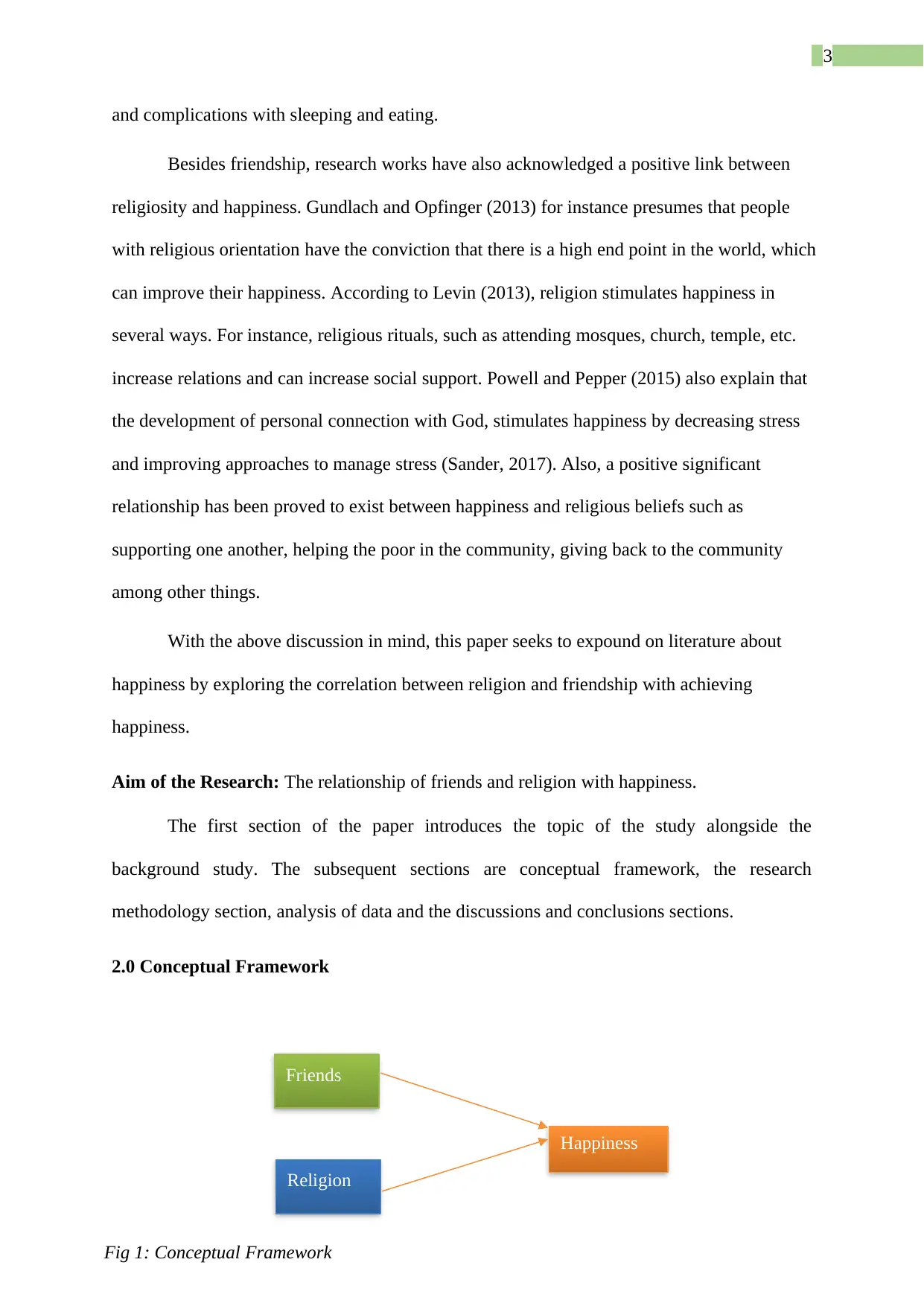
2.0 Conceptual Framework
Fig 1: Conceptual Framework
Happiness
Friends
Religion
and complications with sleeping and eating.
Besides friendship, research works have also acknowledged a positive link between
religiosity and happiness. Gundlach and Opfinger (2013) for instance presumes that people
with religious orientation have the conviction that there is a high end point in the world, which
can improve their happiness. According to Levin (2013), religion stimulates happiness in
several ways. For instance, religious rituals, such as attending mosques, church, temple, etc.
increase relations and can increase social support. Powell and Pepper (2015) also explain that
the development of personal connection with God, stimulates happiness by decreasing stress
and improving approaches to manage stress (Sander, 2017). Also, a positive significant
relationship has been proved to exist between happiness and religious beliefs such as
supporting one another, helping the poor in the community, giving back to the community
among other things.
With the above discussion in mind, this paper seeks to expound on literature about
happiness by exploring the correlation between religion and friendship with achieving
happiness.
Aim of the Research: The relationship of friends and religion with happiness.
The first section of the paper introduces the topic of the study alongside the
background study. The subsequent sections are conceptual framework, the research
methodology section, analysis of data and the discussions and conclusions sections.
2.0 Conceptual Framework
Fig 1: Conceptual Framework
Happiness
Friends
Religion
Paraphrase This Document
Need a fresh take? Get an instant paraphrase of this document with our AI Paraphraser
4
Some philosophers and psychologists have established that by pursuing happiness
through success and education at the cost of religiosity a strong social circle, one may be
misplaced. Helliwell and Huang (2013) defines friendship as an intentional interrelation
between two individuals over time that is envisioned to aid socio-emotional objectives of the
partakers, and may encompass erratic degrees and types of mutual assistance, companionship,
affection and intimacy (Taniguchi, 2014). As the Bennett and Nikolaev (2016) propose,
friendship is more about a qualitative relationship. Theoretical works in this field proposes that
persons hunt for and experience different necessities in their friendships (Demir and Davidson,
2012). According to Bennett and Nikolaev (2016), these provisions consist of but are not
constrained to help, intimacy, self-validation and companionship. Notably, empirical research
has steadily recognized that the quality of close and best friendships is related with happiness
(Taniguchi, 2014). For instance, Helliwell and Huang (2013) explain that one critical point to
attaining happiness is the quantity of close friends a person asserts to have. Demir and
Davidson (2012) expound that people have many and close friends and make clear
demarcations between close, best, and unplanned friendships (Demir, Tyra and Özen-Çıplak,
2018). However, the degree of happiness that is attained by a person is usually dependent on
the general eminence of the friendships which differs with the extent of friendship (Taniguchi,
2014). Otherwise stated, the closer the friendship, the more clearly higher degrees of happiness
are manifested by the participants (Helliwell and Huang, 2013).
From the above revelations about the correlation between happiness and friendship, our
first research hypothesis is developed and stated as follows:
Hypothesis 1: Friendship has no relationship with happiness.
In terms of the interdependence of happiness and religion, research advocates that
around the globe, more than 85 percent of people are connected or belong to a certain religious
group. In a longitudinal research, Abdel-Khalek (2012) evaluated the relationship between self-
rated religiosity, church attendance, and private prayer among 91 Caucasian-Americans and 246
Some philosophers and psychologists have established that by pursuing happiness
through success and education at the cost of religiosity a strong social circle, one may be
misplaced. Helliwell and Huang (2013) defines friendship as an intentional interrelation
between two individuals over time that is envisioned to aid socio-emotional objectives of the
partakers, and may encompass erratic degrees and types of mutual assistance, companionship,
affection and intimacy (Taniguchi, 2014). As the Bennett and Nikolaev (2016) propose,
friendship is more about a qualitative relationship. Theoretical works in this field proposes that
persons hunt for and experience different necessities in their friendships (Demir and Davidson,
2012). According to Bennett and Nikolaev (2016), these provisions consist of but are not
constrained to help, intimacy, self-validation and companionship. Notably, empirical research
has steadily recognized that the quality of close and best friendships is related with happiness
(Taniguchi, 2014). For instance, Helliwell and Huang (2013) explain that one critical point to
attaining happiness is the quantity of close friends a person asserts to have. Demir and
Davidson (2012) expound that people have many and close friends and make clear
demarcations between close, best, and unplanned friendships (Demir, Tyra and Özen-Çıplak,
2018). However, the degree of happiness that is attained by a person is usually dependent on
the general eminence of the friendships which differs with the extent of friendship (Taniguchi,
2014). Otherwise stated, the closer the friendship, the more clearly higher degrees of happiness
are manifested by the participants (Helliwell and Huang, 2013).
From the above revelations about the correlation between happiness and friendship, our
first research hypothesis is developed and stated as follows:
Hypothesis 1: Friendship has no relationship with happiness.
In terms of the interdependence of happiness and religion, research advocates that
around the globe, more than 85 percent of people are connected or belong to a certain religious
group. In a longitudinal research, Abdel-Khalek (2012) evaluated the relationship between self-
rated religiosity, church attendance, and private prayer among 91 Caucasian-Americans and 246
5
Mexican-Americans. The research findings revealed that church participation and attendance
had a significant positive relationship with happiness and life satisfaction for both populations.
This correlation was predominantly strong among the Caucasian sample. In addition, the survey
also established that higher frequency in worship participation attendance interrelated with less
severe symptoms of depression, higher degrees of happiness, higher life satisfaction, and lower
rates of present and lifetime drug abuse, as compared to those with less oftern or no worship
attendance.
A different longitudinal study by Abu Rahim (2013) established that people who turn
out to be more religious over time have long-term achievements in happiness and life
satisfaction and those who turn out to be less religious have long-term losses. Besides, Babinčák
and Parkanská, (2016) established that Buddhists, Roman Catholics and Protestants are more
satisfied with their lives and happier compared with other groups; Muslims, Hindus, Jews and
the non-religious were in between, while Orthodox Christians were established to have the
lowest rates of life satisfaction and happiness.
This leads us to the second objective of this research.
Hypothesis 2: There is no significant relationship between religiosity and happiness
3.0 Methodology
Research designs play a crucial role in gathering the relevant data for any particular
study. They help to gather, analyze, publicize and apply the generated research findings. This
research employed exploratory research design. According to Schoonenboom (2017),
exploratory research are carried out for a research problem that has not been researched more
clearly, envisioned to found priorities, develop operational descriptions and improving the
final research design. For this study, the researcher made use of both primary and secondary
data. For secondary data, secondary sources such as online peer reviewed journals,
periodicals and internet were applied as they are cheaper and readily available for use thus
reducing time and cost of data collection (D'Ippolito, 2012). For primary data, a questionnaire
was developed and distributed to the target participants to collect qualitative data on different
Mexican-Americans. The research findings revealed that church participation and attendance
had a significant positive relationship with happiness and life satisfaction for both populations.
This correlation was predominantly strong among the Caucasian sample. In addition, the survey
also established that higher frequency in worship participation attendance interrelated with less
severe symptoms of depression, higher degrees of happiness, higher life satisfaction, and lower
rates of present and lifetime drug abuse, as compared to those with less oftern or no worship
attendance.
A different longitudinal study by Abu Rahim (2013) established that people who turn
out to be more religious over time have long-term achievements in happiness and life
satisfaction and those who turn out to be less religious have long-term losses. Besides, Babinčák
and Parkanská, (2016) established that Buddhists, Roman Catholics and Protestants are more
satisfied with their lives and happier compared with other groups; Muslims, Hindus, Jews and
the non-religious were in between, while Orthodox Christians were established to have the
lowest rates of life satisfaction and happiness.
This leads us to the second objective of this research.
Hypothesis 2: There is no significant relationship between religiosity and happiness
3.0 Methodology
Research designs play a crucial role in gathering the relevant data for any particular
study. They help to gather, analyze, publicize and apply the generated research findings. This
research employed exploratory research design. According to Schoonenboom (2017),
exploratory research are carried out for a research problem that has not been researched more
clearly, envisioned to found priorities, develop operational descriptions and improving the
final research design. For this study, the researcher made use of both primary and secondary
data. For secondary data, secondary sources such as online peer reviewed journals,
periodicals and internet were applied as they are cheaper and readily available for use thus
reducing time and cost of data collection (D'Ippolito, 2012). For primary data, a questionnaire
was developed and distributed to the target participants to collect qualitative data on different
⊘ This is a preview!⊘
Do you want full access?
Subscribe today to unlock all pages.
Trusted by 1+ million students worldwide
6
parameters of the study variable i.e. happiness, friendship and religion.
For data collection, the world value survey wave online platform was recommended
for this study as it is cheaper in terms of the cost of the data collection and as its continence to
the respondents being an online tool (Schoonenboom, 2017); which respondents were invited
to participate in the survey through a link. A total of 1041 respondents of the United
Kingdom participants drawn from the group of individuals using random non-probability
sampling technique were surveyed. According to Cooper and Schindler (2014), in non-
probability sampling researchers make use of their verdict to pick the subjects to be involved
in the survey based on their cognizance of the phenomenon. Consistent with Lune and Berg
(2017), random sampling is one of the simplest techniques of gathering data from the entire
study population. The obtained responses were analyzed using descriptive statistics analysis
with the help of SPSS (version 22) and the outcomes of the survey presented using frequency
tables, charts and bars for reporting.
4.0 Data Analysis and Results
This section details various statistical analysis that were conducted.
4.1 Description
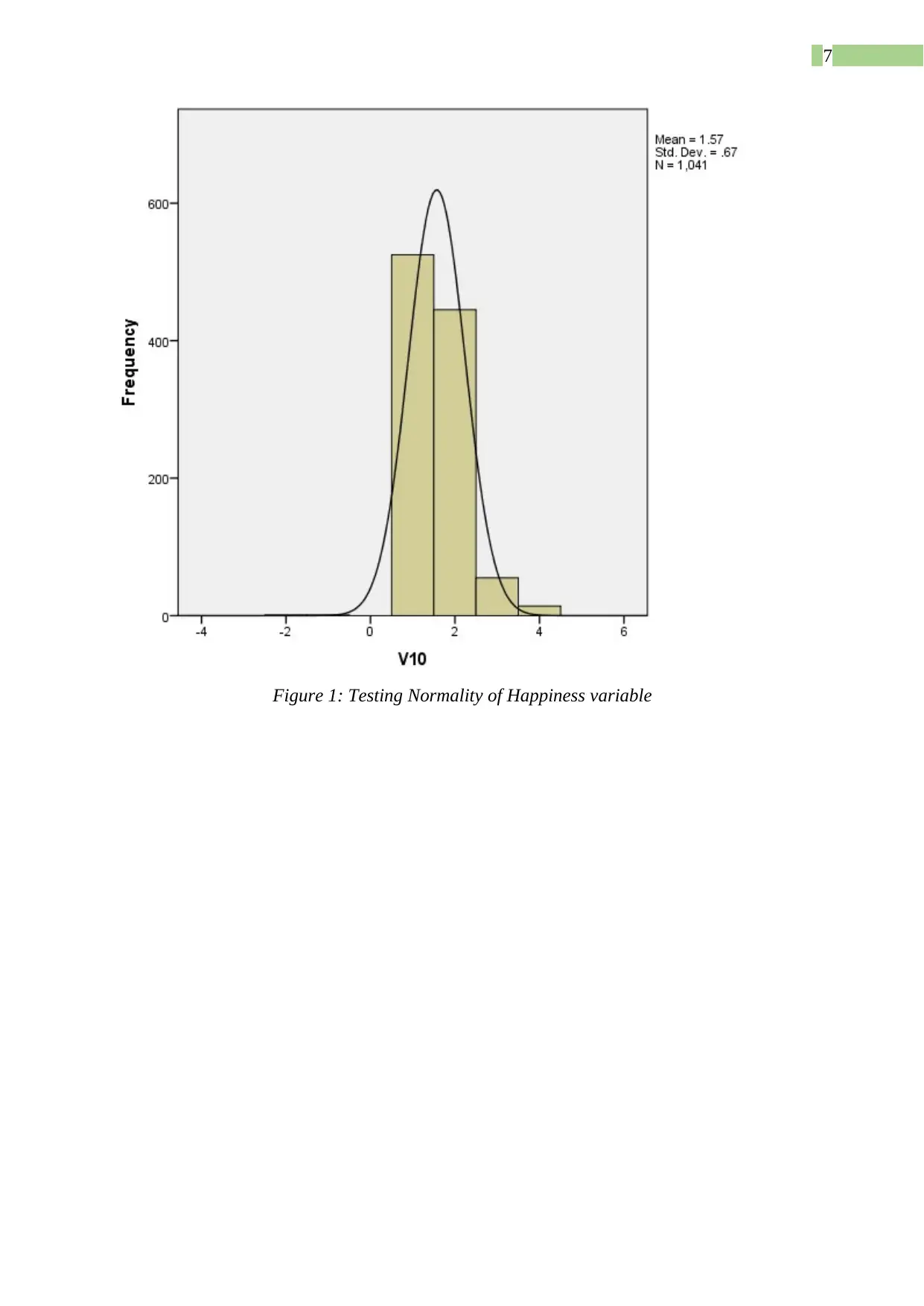
Before carrying out statistical data analysis, there researcher tested the data to see if it
followed statistical assumptions that include normality, linearity, multicollinearity and
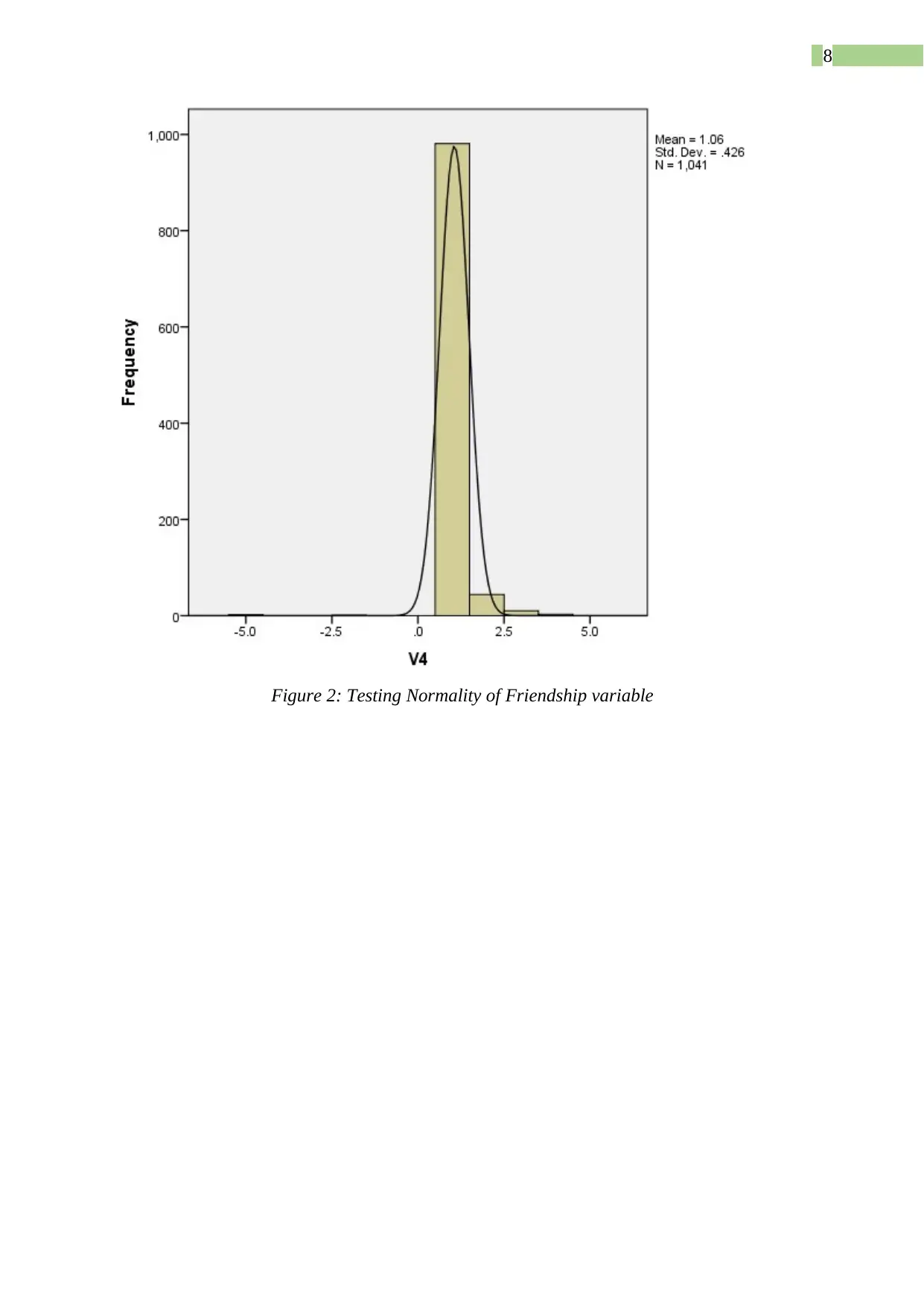
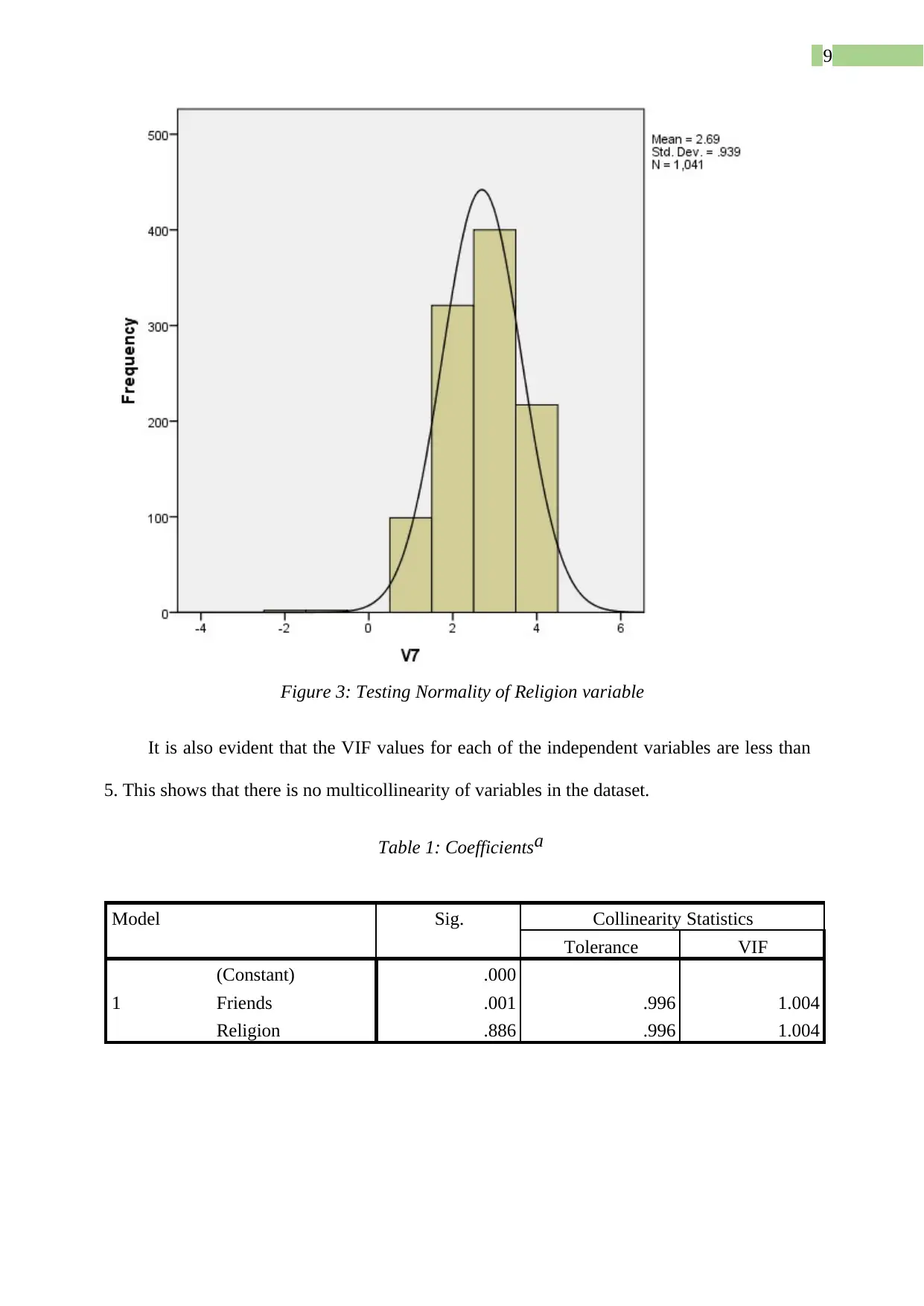
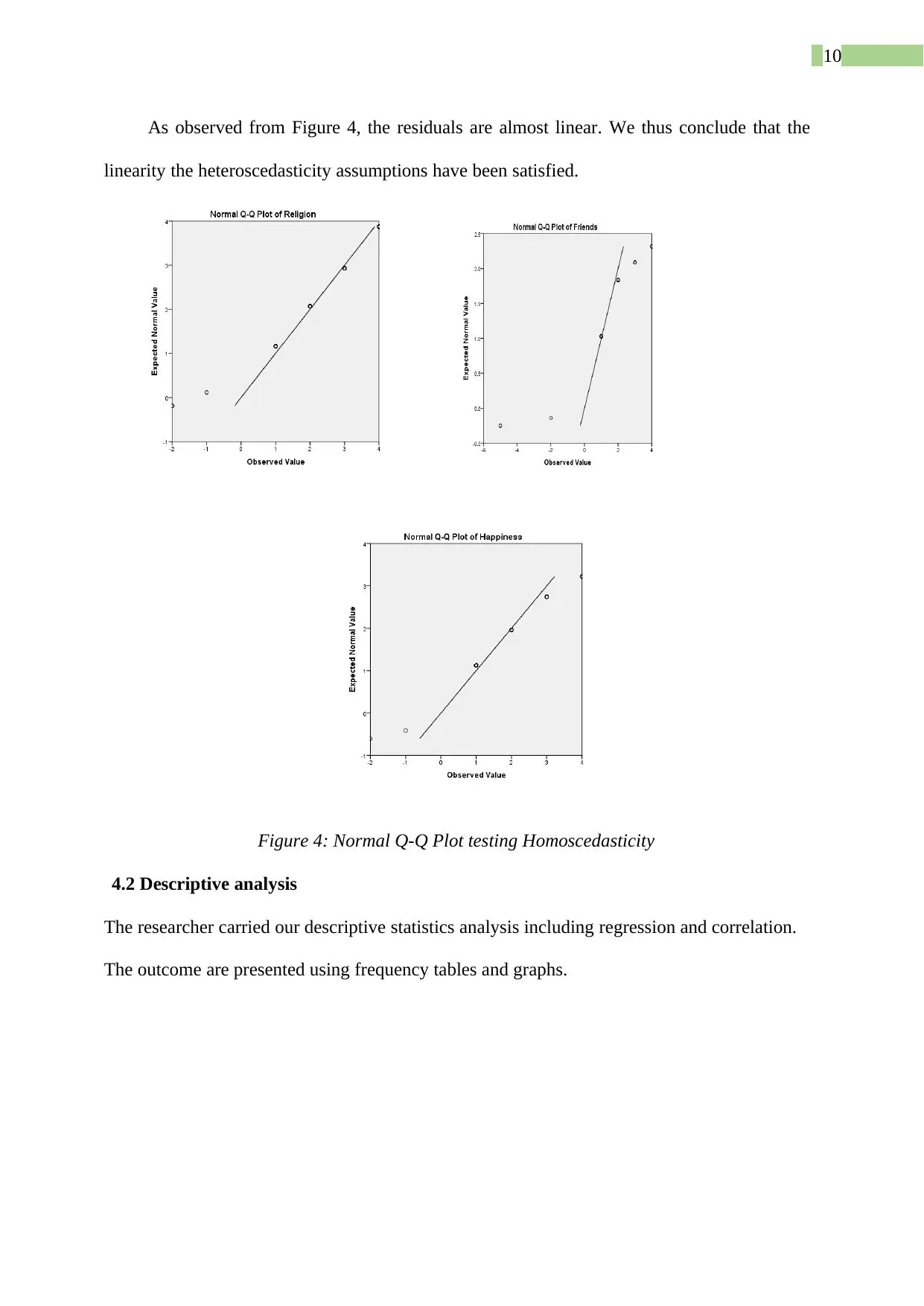
homoscedasticity. To test, the normality of the dataset, histogram were used. As shown by
the three charts, all the three variables are normally distributed; all follow a bell-shaped
distribution and are symmetric around the center.
parameters of the study variable i.e. happiness, friendship and religion.
For data collection, the world value survey wave online platform was recommended
for this study as it is cheaper in terms of the cost of the data collection and as its continence to
the respondents being an online tool (Schoonenboom, 2017); which respondents were invited
to participate in the survey through a link. A total of 1041 respondents of the United
Kingdom participants drawn from the group of individuals using random non-probability
sampling technique were surveyed. According to Cooper and Schindler (2014), in non-
probability sampling researchers make use of their verdict to pick the subjects to be involved
in the survey based on their cognizance of the phenomenon. Consistent with Lune and Berg
(2017), random sampling is one of the simplest techniques of gathering data from the entire
study population. The obtained responses were analyzed using descriptive statistics analysis
with the help of SPSS (version 22) and the outcomes of the survey presented using frequency
tables, charts and bars for reporting.
4.0 Data Analysis and Results
This section details various statistical analysis that were conducted.
4.1 Description
Before carrying out statistical data analysis, there researcher tested the data to see if it
followed statistical assumptions that include normality, linearity, multicollinearity and
homoscedasticity. To test, the normality of the dataset, histogram were used. As shown by
the three charts, all the three variables are normally distributed; all follow a bell-shaped
distribution and are symmetric around the center.
Paraphrase This Document
Need a fresh take? Get an instant paraphrase of this document with our AI Paraphraser
7
Figure 1: Testing Normality of Happiness variable
Figure 1: Testing Normality of Happiness variable
8
Figure 2: Testing Normality of Friendship variable
Figure 2: Testing Normality of Friendship variable
⊘ This is a preview!⊘
Do you want full access?
Subscribe today to unlock all pages.
Trusted by 1+ million students worldwide
9
Figure 3: Testing Normality of Religion variable
It is also evident that the VIF values for each of the independent variables are less than
5. This shows that there is no multicollinearity of variables in the dataset.
Table 1: Coefficientsa
Model Sig. Collinearity Statistics
Tolerance VIF
1
(Constant) .000
Friends .001 .996 1.004
Religion .886 .996 1.004
Figure 3: Testing Normality of Religion variable
It is also evident that the VIF values for each of the independent variables are less than
5. This shows that there is no multicollinearity of variables in the dataset.
Table 1: Coefficientsa
Model Sig. Collinearity Statistics
Tolerance VIF
1
(Constant) .000
Friends .001 .996 1.004
Religion .886 .996 1.004
Paraphrase This Document
Need a fresh take? Get an instant paraphrase of this document with our AI Paraphraser
10
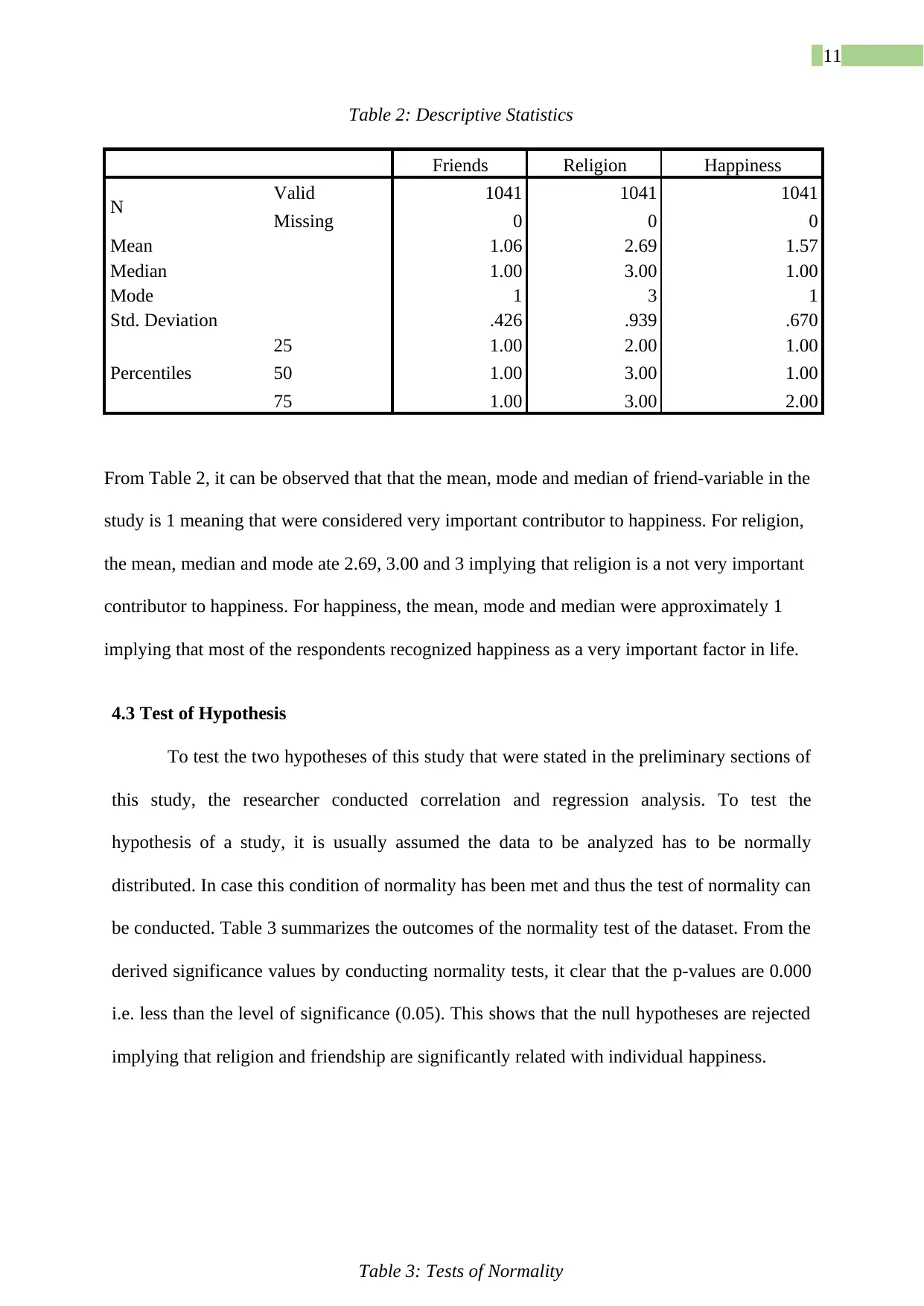
As observed from Figure 4, the residuals are almost linear. We thus conclude that the
linearity the heteroscedasticity assumptions have been satisfied.
Figure 4: Normal Q-Q Plot testing Homoscedasticity
4.2 Descriptive analysis
The researcher carried our descriptive statistics analysis including regression and correlation.
The outcome are presented using frequency tables and graphs.
As observed from Figure 4, the residuals are almost linear. We thus conclude that the
linearity the heteroscedasticity assumptions have been satisfied.
Figure 4: Normal Q-Q Plot testing Homoscedasticity
4.2 Descriptive analysis
The researcher carried our descriptive statistics analysis including regression and correlation.
The outcome are presented using frequency tables and graphs.
11
Table 2: Descriptive Statistics
Friends Religion Happiness
N Valid 1041 1041 1041
Missing 0 0 0
Mean 1.06 2.69 1.57
Median 1.00 3.00 1.00
Mode 1 3 1
Std. Deviation .426 .939 .670
Percentiles
25 1.00 2.00 1.00
50 1.00 3.00 1.00
75 1.00 3.00 2.00
From Table 2, it can be observed that that the mean, mode and median of friend-variable in the
study is 1 meaning that were considered very important contributor to happiness. For religion,
the mean, median and mode ate 2.69, 3.00 and 3 implying that religion is a not very important
contributor to happiness. For happiness, the mean, mode and median were approximately 1
implying that most of the respondents recognized happiness as a very important factor in life.
4.3 Test of Hypothesis
To test the two hypotheses of this study that were stated in the preliminary sections of
this study, the researcher conducted correlation and regression analysis. To test the
hypothesis of a study, it is usually assumed the data to be analyzed has to be normally
distributed. In case this condition of normality has been met and thus the test of normality can
be conducted. Table 3 summarizes the outcomes of the normality test of the dataset. From the
derived significance values by conducting normality tests, it clear that the p-values are 0.000
i.e. less than the level of significance (0.05). This shows that the null hypotheses are rejected
implying that religion and friendship are significantly related with individual happiness.
Table 3: Tests of Normality
Table 2: Descriptive Statistics
Friends Religion Happiness
N Valid 1041 1041 1041
Missing 0 0 0
Mean 1.06 2.69 1.57
Median 1.00 3.00 1.00
Mode 1 3 1
Std. Deviation .426 .939 .670
Percentiles
25 1.00 2.00 1.00
50 1.00 3.00 1.00
75 1.00 3.00 2.00
From Table 2, it can be observed that that the mean, mode and median of friend-variable in the
study is 1 meaning that were considered very important contributor to happiness. For religion,
the mean, median and mode ate 2.69, 3.00 and 3 implying that religion is a not very important
contributor to happiness. For happiness, the mean, mode and median were approximately 1
implying that most of the respondents recognized happiness as a very important factor in life.
4.3 Test of Hypothesis
To test the two hypotheses of this study that were stated in the preliminary sections of
this study, the researcher conducted correlation and regression analysis. To test the
hypothesis of a study, it is usually assumed the data to be analyzed has to be normally
distributed. In case this condition of normality has been met and thus the test of normality can
be conducted. Table 3 summarizes the outcomes of the normality test of the dataset. From the
derived significance values by conducting normality tests, it clear that the p-values are 0.000
i.e. less than the level of significance (0.05). This shows that the null hypotheses are rejected
implying that religion and friendship are significantly related with individual happiness.
Table 3: Tests of Normality
⊘ This is a preview!⊘
Do you want full access?
Subscribe today to unlock all pages.
Trusted by 1+ million students worldwide

1 out of 19


Your All-in-One AI-Powered Toolkit for Academic Success.
+13062052269
info@desklib.com
Available 24*7 on WhatsApp / Email
![[object Object]](/_next/static/media/star-bottom.7253800d.svg)
Unlock your academic potential
Copyright © 2020–2026 A2Z Services. All Rights Reserved. Developed and managed by ZUCOL.