Analysis of Fuel Post-Pay Policy: Acceptability and Strategies
VerifiedAdded on 2023/06/03
|30
|8153
|207
Report
AI Summary
This report examines the fuel post-payment policy, investigating its acceptability among stakeholders including customers, fuel suppliers, and station employees. The study, conducted in Alaska, utilized quantitative techniques such as descriptive and cross-sectional approaches to gather data through questionnaires. The report provides an overview of current gasoline infrastructure, the fuel post-payment policy system, and the research methodology. Findings reveal varying levels of acceptability among stakeholders, with suppliers generally more receptive due to potential profit gains. The report analyzes customer perceptions on monthly fuel consumption, supplier perspectives on the post-pay policy, and employee viewpoints. The study concludes that there are benefits from the fuel post-payment to all the stakeholders only when the policies are strengthened, and includes recommendations for future research and policy changes.
Running Head: Fuel post pay policy
Report: Fuel post pay policy
Name:
Academic Affiliation:
Date:
Report: Fuel post pay policy
Name:
Academic Affiliation:
Date:

Paraphrase This Document
Need a fresh take? Get an instant paraphrase of this document with our AI Paraphraser
Fuel post pay policy 2
Abstract
It is always human nature to make choices based on the available reasons, benefit,
availability, and variety. The choice of payment thus depends on the same reasons, thus fuel
payment methods such as prepayment, card, and post-payment all are determined by the same.
Fuel Post payment policy is not common among many fuel users, who always have problems of
inadequate money at the time of need thus cannot access the fuel. The aim of this project is to
study on the fuel post payment policy and determine the acceptability among the stakeholders.
Further, to recommend better strategies on how to strengthen the policy to increase the
acceptability rate. The study used quantitative technique’s; descriptive and cross-sectional study
to collect data. There was high acceptability among the fuel suppliers than the users; attributed to
high profit gain and expenditure respectively. The research concludes that there are imminent
benefits from the fuel post payment to all the stakeholders only when the policies are
strengthened.
Abstract
It is always human nature to make choices based on the available reasons, benefit,
availability, and variety. The choice of payment thus depends on the same reasons, thus fuel
payment methods such as prepayment, card, and post-payment all are determined by the same.
Fuel Post payment policy is not common among many fuel users, who always have problems of
inadequate money at the time of need thus cannot access the fuel. The aim of this project is to
study on the fuel post payment policy and determine the acceptability among the stakeholders.
Further, to recommend better strategies on how to strengthen the policy to increase the
acceptability rate. The study used quantitative technique’s; descriptive and cross-sectional study
to collect data. There was high acceptability among the fuel suppliers than the users; attributed to
high profit gain and expenditure respectively. The research concludes that there are imminent
benefits from the fuel post payment to all the stakeholders only when the policies are
strengthened.
Fuel post pay policy 3
Table of Contents
Introduction....................................................................................................................................................................4
Current Gasoline and fuel infrastructure....................................................................................................................5
Fuel Post-Payment Policy System overview...............................................................................................................6
Policy Consultation.....................................................................................................................................................6
Justification.....................................................................................................................................................................7
Research design and methods........................................................................................................................................7
Sampling......................................................................................................................................................................8
Quantitative Techniques.............................................................................................................................................9
Ethics Procedure.......................................................................................................................................................10
Results...........................................................................................................................................................................12
Customer’s acceptability...........................................................................................................................................12
Customer’s perception on the Monthly fuel consumption......................................................................................13
Fuel supplier’s perceptions on the fuel post pay policy...........................................................................................13
Acceptability of post-paid method.......................................................................................................................13
Supplier’s perception on the Fuel consumption.......................................................................................................14
Fuel stations employees’ perceptions on the post pay policy..................................................................................14
Analysis and Interpretation of Your Result...................................................................................................................14
Limitations of the study................................................................................................................................................19
Recommendations for future research or policy change based on feasible solutions................................................19
Conclusion.....................................................................................................................................................................20
Reference......................................................................................................................................................................22
Appendix: Questionnaire..............................................................................................................................................28
Introduction
Payments are part and parcel of our daily life. Every day we make payments in a different
context with different methods, however, cash has been the most common of payments since the
Table of Contents
Introduction....................................................................................................................................................................4
Current Gasoline and fuel infrastructure....................................................................................................................5
Fuel Post-Payment Policy System overview...............................................................................................................6
Policy Consultation.....................................................................................................................................................6
Justification.....................................................................................................................................................................7
Research design and methods........................................................................................................................................7
Sampling......................................................................................................................................................................8
Quantitative Techniques.............................................................................................................................................9
Ethics Procedure.......................................................................................................................................................10
Results...........................................................................................................................................................................12
Customer’s acceptability...........................................................................................................................................12
Customer’s perception on the Monthly fuel consumption......................................................................................13
Fuel supplier’s perceptions on the fuel post pay policy...........................................................................................13
Acceptability of post-paid method.......................................................................................................................13
Supplier’s perception on the Fuel consumption.......................................................................................................14
Fuel stations employees’ perceptions on the post pay policy..................................................................................14
Analysis and Interpretation of Your Result...................................................................................................................14
Limitations of the study................................................................................................................................................19
Recommendations for future research or policy change based on feasible solutions................................................19
Conclusion.....................................................................................................................................................................20
Reference......................................................................................................................................................................22
Appendix: Questionnaire..............................................................................................................................................28
Introduction
Payments are part and parcel of our daily life. Every day we make payments in a different
context with different methods, however, cash has been the most common of payments since the
⊘ This is a preview!⊘
Do you want full access?
Subscribe today to unlock all pages.

Trusted by 1+ million students worldwide
Fuel post pay policy 4
1900s between people and the organization (King, 2015). The shifts of the economy from the
agricultural to the industrialized state have resulted in higher incomes and more choices of
products to make (Shah & Attiq, 2016). The payments have thus changed from the cash, checks
credit cards and debit cards making product and purchase to be easy. The human being makes
choices based on different factors such as availability, cost, flexibility, duration, and state of the
economy among many others and it is human nature always to have a list of choices to choose
from. In the business world, the customer is the significant element that always keeps the
business organizations going, this has led to stiff competition among them(Hundre, Raj, Kumar
& Dileep, 2013). Each organization works on various strategies and policies to ensure that
customers are satisfied and keep on repurchasing from the same entity rather than going to a
substitute or alternative option.
Some of the adopted policies include the payment policies that determine the frequency
of the repurchasing of the customer. Every organization has a payment policy that governs their
customers; most of the business organizations work with pre-pay policies whereby a customer
has to pay for products before having the accessibility to use it (Lynch & Devine, 2017).
However, in some situations, the customer might not have cash or the payment card, at the point
of need to pay for a particular product or services, but can later have the cash. In such situations,
the customer might not have the freedom of accessing that particular product or service unless
the organizations’ payment services/policies can accommodate the customer’s situation; post-
payment policies (Chandran & Brahmachari, 2018). In other countries such as the United States,
post-payment methods are gaining entry into the system; the method is gaining attention due to
the growing technology that has the capability of catching the data of potential consumers.
1900s between people and the organization (King, 2015). The shifts of the economy from the
agricultural to the industrialized state have resulted in higher incomes and more choices of
products to make (Shah & Attiq, 2016). The payments have thus changed from the cash, checks
credit cards and debit cards making product and purchase to be easy. The human being makes
choices based on different factors such as availability, cost, flexibility, duration, and state of the
economy among many others and it is human nature always to have a list of choices to choose
from. In the business world, the customer is the significant element that always keeps the
business organizations going, this has led to stiff competition among them(Hundre, Raj, Kumar
& Dileep, 2013). Each organization works on various strategies and policies to ensure that
customers are satisfied and keep on repurchasing from the same entity rather than going to a
substitute or alternative option.
Some of the adopted policies include the payment policies that determine the frequency
of the repurchasing of the customer. Every organization has a payment policy that governs their
customers; most of the business organizations work with pre-pay policies whereby a customer
has to pay for products before having the accessibility to use it (Lynch & Devine, 2017).
However, in some situations, the customer might not have cash or the payment card, at the point
of need to pay for a particular product or services, but can later have the cash. In such situations,
the customer might not have the freedom of accessing that particular product or service unless
the organizations’ payment services/policies can accommodate the customer’s situation; post-
payment policies (Chandran & Brahmachari, 2018). In other countries such as the United States,
post-payment methods are gaining entry into the system; the method is gaining attention due to
the growing technology that has the capability of catching the data of potential consumers.
Paraphrase This Document
Need a fresh take? Get an instant paraphrase of this document with our AI Paraphraser
Fuel post pay policy 5
According to the research conducted by Bri-Mascarenhas & Post(2015) in on the impact
of fuel on poverty in the UK, prepayment meters was found out to be a most expensive method
of payment for fuel based on the unit rate of p/kWh than any other payment method and was
common among the low-income earners. The energy supply probe Ofgem indicates that there
was a difference of about $88 between the low-income earners and high-income earners who use
the pre-payment method of fueling.
Current Gasoline and fuel infrastructure
Fuel infrastructure is defined as all the fixed investments that are required for an efficient
fuel production, distribution, transmission, and dispensing system to support all the customers
and fuel-vehicle systems. In most of the gasoline and fuel infrastructure in the United States
entail refineries, pipelines, services stations, and terminals (Savoy & Salvendy, 2016).
Averagely, in the United States, there are about 160,000 fuels stations that supply over 380
billion gallons of gasoline each day. Currently, there about 0.7 fuel stations per 1,000 LD
vehicles and the value tends to decrease as many stations are closing down while the number of
vehicles increases each day. This is a clear indication that in the near future, there will be an
average of 0.5 fuels stations per 1000 vehicles in the US; this will reduce the service level among
the fuel stations.
The rising number of vehicles across the world especially in the United States tends to
cause congestion in the fuel dispensing stations resulting in complications (Baranzini & Carttini,
2017). One of the factors is that each driver is required to make cash payment for the dispensed
fuel that at times may end up paying high amount than the dispensed fuel (Yueyue et al., 2017).
The application of post-payment policy ensures the adoption of automated technological devices
that will capture the details of the customers and evaluate the ability of the customer to pay in the
According to the research conducted by Bri-Mascarenhas & Post(2015) in on the impact
of fuel on poverty in the UK, prepayment meters was found out to be a most expensive method
of payment for fuel based on the unit rate of p/kWh than any other payment method and was
common among the low-income earners. The energy supply probe Ofgem indicates that there
was a difference of about $88 between the low-income earners and high-income earners who use
the pre-payment method of fueling.
Current Gasoline and fuel infrastructure
Fuel infrastructure is defined as all the fixed investments that are required for an efficient
fuel production, distribution, transmission, and dispensing system to support all the customers
and fuel-vehicle systems. In most of the gasoline and fuel infrastructure in the United States
entail refineries, pipelines, services stations, and terminals (Savoy & Salvendy, 2016).
Averagely, in the United States, there are about 160,000 fuels stations that supply over 380
billion gallons of gasoline each day. Currently, there about 0.7 fuel stations per 1,000 LD
vehicles and the value tends to decrease as many stations are closing down while the number of
vehicles increases each day. This is a clear indication that in the near future, there will be an
average of 0.5 fuels stations per 1000 vehicles in the US; this will reduce the service level among
the fuel stations.
The rising number of vehicles across the world especially in the United States tends to
cause congestion in the fuel dispensing stations resulting in complications (Baranzini & Carttini,
2017). One of the factors is that each driver is required to make cash payment for the dispensed
fuel that at times may end up paying high amount than the dispensed fuel (Yueyue et al., 2017).
The application of post-payment policy ensures the adoption of automated technological devices
that will capture the details of the customers and evaluate the ability of the customer to pay in the
Fuel post pay policy 6
future. Features such as Radiofrequency Identification can be used to capture the bank and bio-
data of the customers
Fuel Post-Payment Policy System overview
Customers are always required to create an account with specific information that is
stored in the system database and always associated with a specific ID. The account is always
stored in the database and always shared among the fuel dispensing stations, so that in case of
any customer misbehavior, all the dispensing stations can be alerted through MySothe l database,
to take caution. Each of the vehicles is always associated with the predefined amount of fuel to
be dispensed for a particular period of time; for example for two weeks and when the predefined
amount of fuel is over, the amount dispensed is always deducted from the related balance.
Policy Consultation
Fuel suppliers, customers, and the workers will have to be consulted for their opinion if
the policy sounds favorable to improve the performance of the filling station (Manning, 2015).
Suppliers will be asked if they can offer to supply fuel and other required services for a certain
period and then payment be settled at later dates. Consequently, the workers will be consulted to
give their view if this policy will help to keep customers around because they are the ones that
interact with the customers frequently. Customers too should be consulted to seek their opinion if
they are flexible with this policy and how do they think it will help them (Levidow &
Papaioannou, 2016). From the literature reviewed, the policy should be adopted because
customers who can’t afford cash and credit card to get a great challenge to fuel their cars
although this will depend on every stakeholder’s view if they think the policy is good.
future. Features such as Radiofrequency Identification can be used to capture the bank and bio-
data of the customers
Fuel Post-Payment Policy System overview
Customers are always required to create an account with specific information that is
stored in the system database and always associated with a specific ID. The account is always
stored in the database and always shared among the fuel dispensing stations, so that in case of
any customer misbehavior, all the dispensing stations can be alerted through MySothe l database,
to take caution. Each of the vehicles is always associated with the predefined amount of fuel to
be dispensed for a particular period of time; for example for two weeks and when the predefined
amount of fuel is over, the amount dispensed is always deducted from the related balance.
Policy Consultation
Fuel suppliers, customers, and the workers will have to be consulted for their opinion if
the policy sounds favorable to improve the performance of the filling station (Manning, 2015).
Suppliers will be asked if they can offer to supply fuel and other required services for a certain
period and then payment be settled at later dates. Consequently, the workers will be consulted to
give their view if this policy will help to keep customers around because they are the ones that
interact with the customers frequently. Customers too should be consulted to seek their opinion if
they are flexible with this policy and how do they think it will help them (Levidow &
Papaioannou, 2016). From the literature reviewed, the policy should be adopted because
customers who can’t afford cash and credit card to get a great challenge to fuel their cars
although this will depend on every stakeholder’s view if they think the policy is good.
⊘ This is a preview!⊘
Do you want full access?
Subscribe today to unlock all pages.
Trusted by 1+ million students worldwide
Fuel post pay policy 7
Justification
Thus the objective of this study is to study the existing legal, regulatory and institutional
framework that brings issues in the fuel post-payment issues
Study applicable and adoptable tariffs for the fuel post-payment system
Compare the environmental implementation of the fuel-post payment system, in different
countries where it has been adopted. Post-pay policies thus should allow customers to receive
their services for a number of days for example 15 days and pay five days after the payment
statement is processed. The choice of this study is based on the rising fuel poverty across the
world especially in the UK, where it has been considered as the social ill (Davis, 2017). Many
households use fuel as a source of energy to prepare their foods and warm their homes, however,
they are unable to fully access the fuels due to large underlying poverty situation.
Through the introduction of Warm Homes and Energy Conversation Act 2000, requires
the government to eradicate the fuel poverty (McWilliams, 2017). Significant progress was made
since the fuel poverty dropped from 5.1 million to 1.2 million households, however; the rising of
domestic energy in England activated the rise of fuel poverty again to 5 million in 2004(Mayne,
Fawcett & Hyams, 2017). These policies can also be constituted by the fuel suppliers to enable
the customer to access the fuel whenever they need irrespective of the availability of cash at the
time of need (Rehfuess, Puzzolo, Stanistret, Pope & Bruce, 2014). These customers can later
arrange to pay the debt when the time is due and at the disposable of their cash. Through these
fuel-post pay policies, the fuel poverty thus will be dropped.
Research design and methods
The aim of the research is to determine the policy that will enable customers to access
fuel and pay later without any inconvenience to both the customer and the business operator. The
Justification
Thus the objective of this study is to study the existing legal, regulatory and institutional
framework that brings issues in the fuel post-payment issues
Study applicable and adoptable tariffs for the fuel post-payment system
Compare the environmental implementation of the fuel-post payment system, in different
countries where it has been adopted. Post-pay policies thus should allow customers to receive
their services for a number of days for example 15 days and pay five days after the payment
statement is processed. The choice of this study is based on the rising fuel poverty across the
world especially in the UK, where it has been considered as the social ill (Davis, 2017). Many
households use fuel as a source of energy to prepare their foods and warm their homes, however,
they are unable to fully access the fuels due to large underlying poverty situation.
Through the introduction of Warm Homes and Energy Conversation Act 2000, requires
the government to eradicate the fuel poverty (McWilliams, 2017). Significant progress was made
since the fuel poverty dropped from 5.1 million to 1.2 million households, however; the rising of
domestic energy in England activated the rise of fuel poverty again to 5 million in 2004(Mayne,
Fawcett & Hyams, 2017). These policies can also be constituted by the fuel suppliers to enable
the customer to access the fuel whenever they need irrespective of the availability of cash at the
time of need (Rehfuess, Puzzolo, Stanistret, Pope & Bruce, 2014). These customers can later
arrange to pay the debt when the time is due and at the disposable of their cash. Through these
fuel-post pay policies, the fuel poverty thus will be dropped.
Research design and methods
The aim of the research is to determine the policy that will enable customers to access
fuel and pay later without any inconvenience to both the customer and the business operator. The
Paraphrase This Document
Need a fresh take? Get an instant paraphrase of this document with our AI Paraphraser
Fuel post pay policy 8
research method is a systematic plan that ensures that a researcher collects the correct data for
the success of the study and always entails research design, sampling procedure, and size, data
collection and analysis.
Sampling
The united states are made up of 50 states thus simple random sampling was used to
select the state under study; Alaska. There are approximate of 147 gas and fuel stations
companies in Alaska, and a population of about 739,735 total over 3 million vehicles. The
Yamane’s formula was used to calculate the sample size for the study; n=N/ {1+N (e) 2} where
N: sample size
N: Total population for the city
e: precision
n= 3,000,000/ {1+3,000.000(0.05)2
=399.94
Thus the study used 400 participants who consisted of all the stakeholders; consumers,
fuel suppliers, and fuel stations employee (Huang & Boutros, 2016). The researcher used a
convenient sampling technique to approach the participants since it was the most applicable way
of helping the researcher to identify the most accessible subjects and was the least costly in terms
of efforts and time (Blue, Rajewicz, Daub & Yunker, 2018). The sampling size was calculated
through the use of the computed table based on the 95% level of certainty (Fugard & Potts,
2015). When approaching the customer's fuel usage history was obtained from the previous
household history and various petrol stations customers’ data (Bardsley, Buchs & Schnepf,
2017). The data did not include a customer who was out of the dispensing territory nor did it
research method is a systematic plan that ensures that a researcher collects the correct data for
the success of the study and always entails research design, sampling procedure, and size, data
collection and analysis.
Sampling
The united states are made up of 50 states thus simple random sampling was used to
select the state under study; Alaska. There are approximate of 147 gas and fuel stations
companies in Alaska, and a population of about 739,735 total over 3 million vehicles. The
Yamane’s formula was used to calculate the sample size for the study; n=N/ {1+N (e) 2} where
N: sample size
N: Total population for the city
e: precision
n= 3,000,000/ {1+3,000.000(0.05)2
=399.94
Thus the study used 400 participants who consisted of all the stakeholders; consumers,
fuel suppliers, and fuel stations employee (Huang & Boutros, 2016). The researcher used a
convenient sampling technique to approach the participants since it was the most applicable way
of helping the researcher to identify the most accessible subjects and was the least costly in terms
of efforts and time (Blue, Rajewicz, Daub & Yunker, 2018). The sampling size was calculated
through the use of the computed table based on the 95% level of certainty (Fugard & Potts,
2015). When approaching the customer's fuel usage history was obtained from the previous
household history and various petrol stations customers’ data (Bardsley, Buchs & Schnepf,
2017). The data did not include a customer who was out of the dispensing territory nor did it
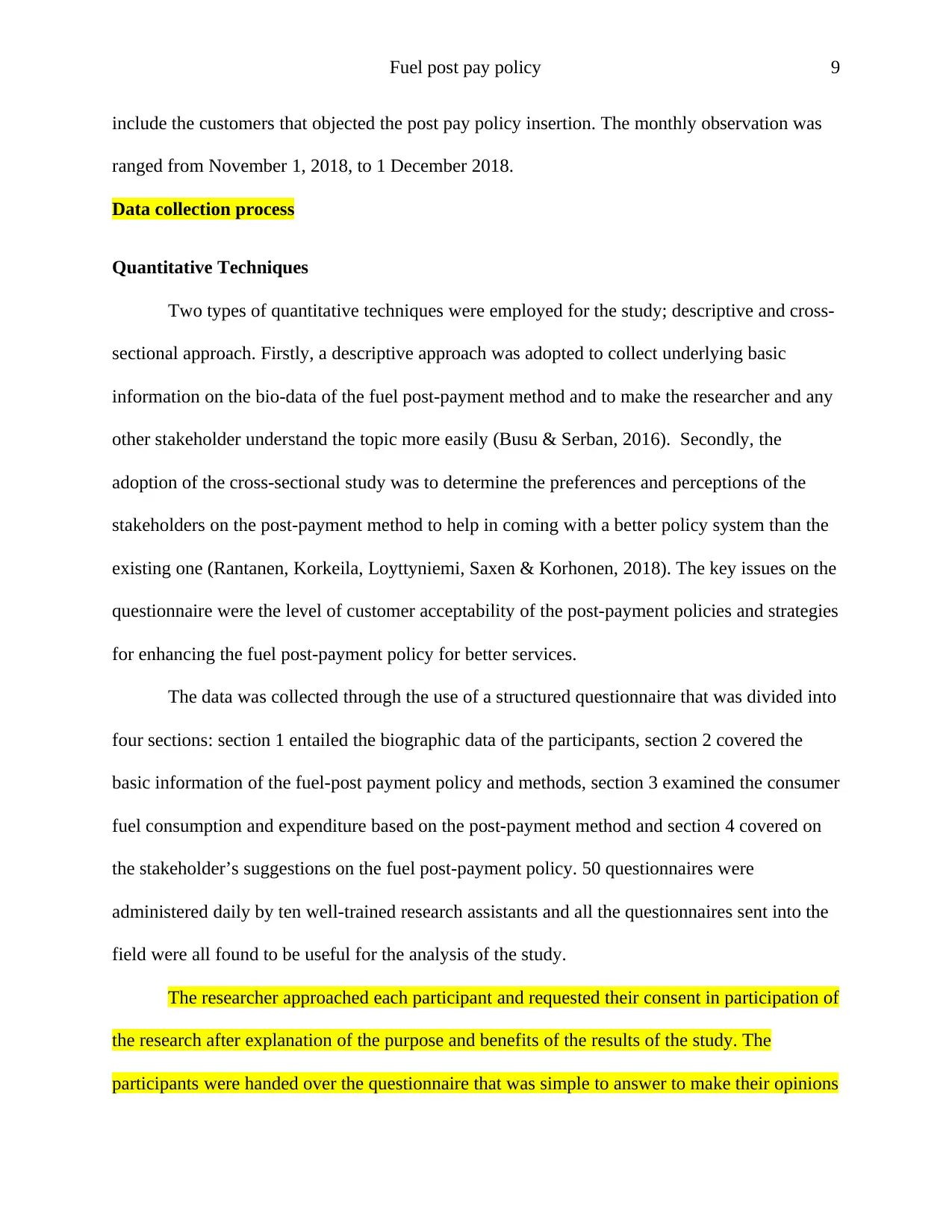
Fuel post pay policy 9
include the customers that objected the post pay policy insertion. The monthly observation was
ranged from November 1, 2018, to 1 December 2018.
Data collection process
Quantitative Techniques
Two types of quantitative techniques were employed for the study; descriptive and cross-
sectional approach. Firstly, a descriptive approach was adopted to collect underlying basic
information on the bio-data of the fuel post-payment method and to make the researcher and any
other stakeholder understand the topic more easily (Busu & Serban, 2016). Secondly, the
adoption of the cross-sectional study was to determine the preferences and perceptions of the
stakeholders on the post-payment method to help in coming with a better policy system than the
existing one (Rantanen, Korkeila, Loyttyniemi, Saxen & Korhonen, 2018). The key issues on the
questionnaire were the level of customer acceptability of the post-payment policies and strategies
for enhancing the fuel post-payment policy for better services.
The data was collected through the use of a structured questionnaire that was divided into
four sections: section 1 entailed the biographic data of the participants, section 2 covered the
basic information of the fuel-post payment policy and methods, section 3 examined the consumer
fuel consumption and expenditure based on the post-payment method and section 4 covered on
the stakeholder’s suggestions on the fuel post-payment policy. 50 questionnaires were
administered daily by ten well-trained research assistants and all the questionnaires sent into the
field were all found to be useful for the analysis of the study.
The researcher approached each participant and requested their consent in participation of
the research after explanation of the purpose and benefits of the results of the study. The
participants were handed over the questionnaire that was simple to answer to make their opinions
include the customers that objected the post pay policy insertion. The monthly observation was
ranged from November 1, 2018, to 1 December 2018.
Data collection process
Quantitative Techniques
Two types of quantitative techniques were employed for the study; descriptive and cross-
sectional approach. Firstly, a descriptive approach was adopted to collect underlying basic
information on the bio-data of the fuel post-payment method and to make the researcher and any
other stakeholder understand the topic more easily (Busu & Serban, 2016). Secondly, the
adoption of the cross-sectional study was to determine the preferences and perceptions of the
stakeholders on the post-payment method to help in coming with a better policy system than the
existing one (Rantanen, Korkeila, Loyttyniemi, Saxen & Korhonen, 2018). The key issues on the
questionnaire were the level of customer acceptability of the post-payment policies and strategies
for enhancing the fuel post-payment policy for better services.
The data was collected through the use of a structured questionnaire that was divided into
four sections: section 1 entailed the biographic data of the participants, section 2 covered the
basic information of the fuel-post payment policy and methods, section 3 examined the consumer
fuel consumption and expenditure based on the post-payment method and section 4 covered on
the stakeholder’s suggestions on the fuel post-payment policy. 50 questionnaires were
administered daily by ten well-trained research assistants and all the questionnaires sent into the
field were all found to be useful for the analysis of the study.
The researcher approached each participant and requested their consent in participation of
the research after explanation of the purpose and benefits of the results of the study. The
participants were handed over the questionnaire that was simple to answer to make their opinions
⊘ This is a preview!⊘
Do you want full access?
Subscribe today to unlock all pages.
Trusted by 1+ million students worldwide
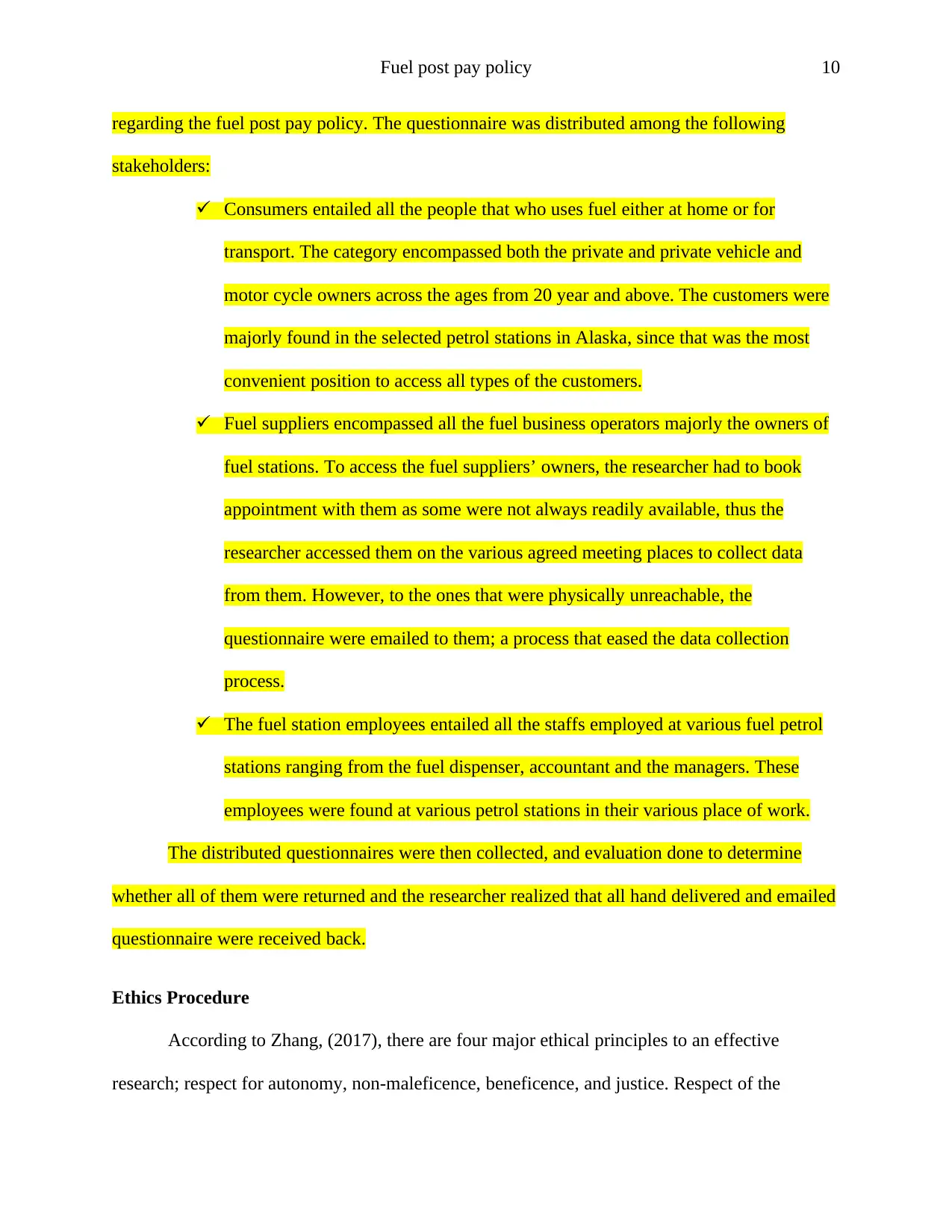
Fuel post pay policy 10
regarding the fuel post pay policy. The questionnaire was distributed among the following
stakeholders:
Consumers entailed all the people that who uses fuel either at home or for
transport. The category encompassed both the private and private vehicle and
motor cycle owners across the ages from 20 year and above. The customers were
majorly found in the selected petrol stations in Alaska, since that was the most
convenient position to access all types of the customers.
Fuel suppliers encompassed all the fuel business operators majorly the owners of
fuel stations. To access the fuel suppliers’ owners, the researcher had to book
appointment with them as some were not always readily available, thus the
researcher accessed them on the various agreed meeting places to collect data
from them. However, to the ones that were physically unreachable, the
questionnaire were emailed to them; a process that eased the data collection
process.
The fuel station employees entailed all the staffs employed at various fuel petrol
stations ranging from the fuel dispenser, accountant and the managers. These
employees were found at various petrol stations in their various place of work.
The distributed questionnaires were then collected, and evaluation done to determine
whether all of them were returned and the researcher realized that all hand delivered and emailed
questionnaire were received back.
Ethics Procedure
According to Zhang, (2017), there are four major ethical principles to an effective
research; respect for autonomy, non-maleficence, beneficence, and justice. Respect of the
regarding the fuel post pay policy. The questionnaire was distributed among the following
stakeholders:
Consumers entailed all the people that who uses fuel either at home or for
transport. The category encompassed both the private and private vehicle and
motor cycle owners across the ages from 20 year and above. The customers were
majorly found in the selected petrol stations in Alaska, since that was the most
convenient position to access all types of the customers.
Fuel suppliers encompassed all the fuel business operators majorly the owners of
fuel stations. To access the fuel suppliers’ owners, the researcher had to book
appointment with them as some were not always readily available, thus the
researcher accessed them on the various agreed meeting places to collect data
from them. However, to the ones that were physically unreachable, the
questionnaire were emailed to them; a process that eased the data collection
process.
The fuel station employees entailed all the staffs employed at various fuel petrol
stations ranging from the fuel dispenser, accountant and the managers. These
employees were found at various petrol stations in their various place of work.
The distributed questionnaires were then collected, and evaluation done to determine
whether all of them were returned and the researcher realized that all hand delivered and emailed
questionnaire were received back.
Ethics Procedure
According to Zhang, (2017), there are four major ethical principles to an effective
research; respect for autonomy, non-maleficence, beneficence, and justice. Respect of the
Paraphrase This Document
Need a fresh take? Get an instant paraphrase of this document with our AI Paraphraser
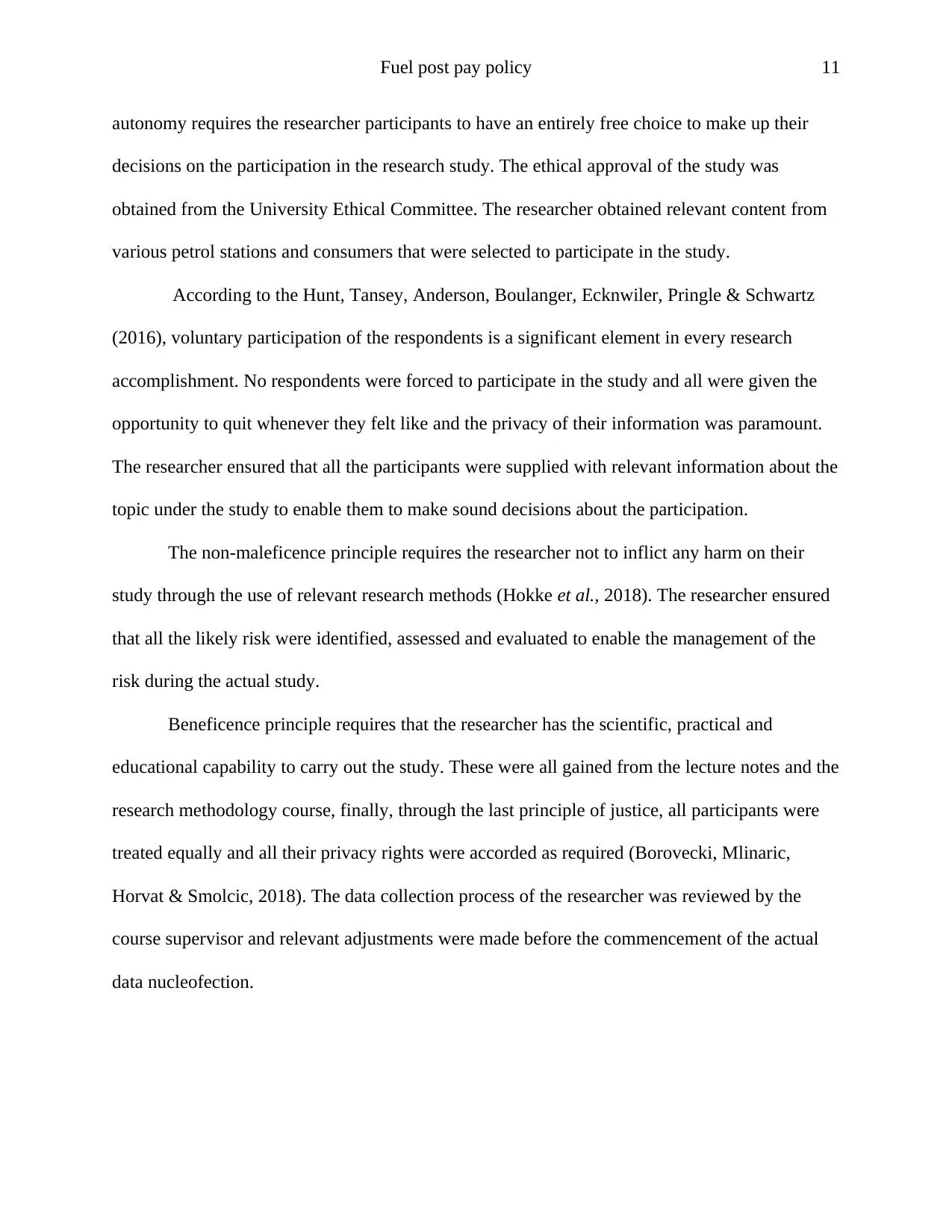
Fuel post pay policy 11
autonomy requires the researcher participants to have an entirely free choice to make up their
decisions on the participation in the research study. The ethical approval of the study was
obtained from the University Ethical Committee. The researcher obtained relevant content from
various petrol stations and consumers that were selected to participate in the study.
According to the Hunt, Tansey, Anderson, Boulanger, Ecknwiler, Pringle & Schwartz
(2016), voluntary participation of the respondents is a significant element in every research
accomplishment. No respondents were forced to participate in the study and all were given the
opportunity to quit whenever they felt like and the privacy of their information was paramount.
The researcher ensured that all the participants were supplied with relevant information about the
topic under the study to enable them to make sound decisions about the participation.
The non-maleficence principle requires the researcher not to inflict any harm on their
study through the use of relevant research methods (Hokke et al., 2018). The researcher ensured
that all the likely risk were identified, assessed and evaluated to enable the management of the
risk during the actual study.
Beneficence principle requires that the researcher has the scientific, practical and
educational capability to carry out the study. These were all gained from the lecture notes and the
research methodology course, finally, through the last principle of justice, all participants were
treated equally and all their privacy rights were accorded as required (Borovecki, Mlinaric,
Horvat & Smolcic, 2018). The data collection process of the researcher was reviewed by the
course supervisor and relevant adjustments were made before the commencement of the actual
data nucleofection.
autonomy requires the researcher participants to have an entirely free choice to make up their
decisions on the participation in the research study. The ethical approval of the study was
obtained from the University Ethical Committee. The researcher obtained relevant content from
various petrol stations and consumers that were selected to participate in the study.
According to the Hunt, Tansey, Anderson, Boulanger, Ecknwiler, Pringle & Schwartz
(2016), voluntary participation of the respondents is a significant element in every research
accomplishment. No respondents were forced to participate in the study and all were given the
opportunity to quit whenever they felt like and the privacy of their information was paramount.
The researcher ensured that all the participants were supplied with relevant information about the
topic under the study to enable them to make sound decisions about the participation.
The non-maleficence principle requires the researcher not to inflict any harm on their
study through the use of relevant research methods (Hokke et al., 2018). The researcher ensured
that all the likely risk were identified, assessed and evaluated to enable the management of the
risk during the actual study.
Beneficence principle requires that the researcher has the scientific, practical and
educational capability to carry out the study. These were all gained from the lecture notes and the
research methodology course, finally, through the last principle of justice, all participants were
treated equally and all their privacy rights were accorded as required (Borovecki, Mlinaric,
Horvat & Smolcic, 2018). The data collection process of the researcher was reviewed by the
course supervisor and relevant adjustments were made before the commencement of the actual
data nucleofection.
Fuel post pay policy 12
Results
In this section, the stakeholders’ perceptions on the fuel post pay policy are represented.
Most of the stakeholders majored their opinions on the acceptability, rate of consumptions,
monthly profits and reliability of debt payment.
Customer’s acceptability
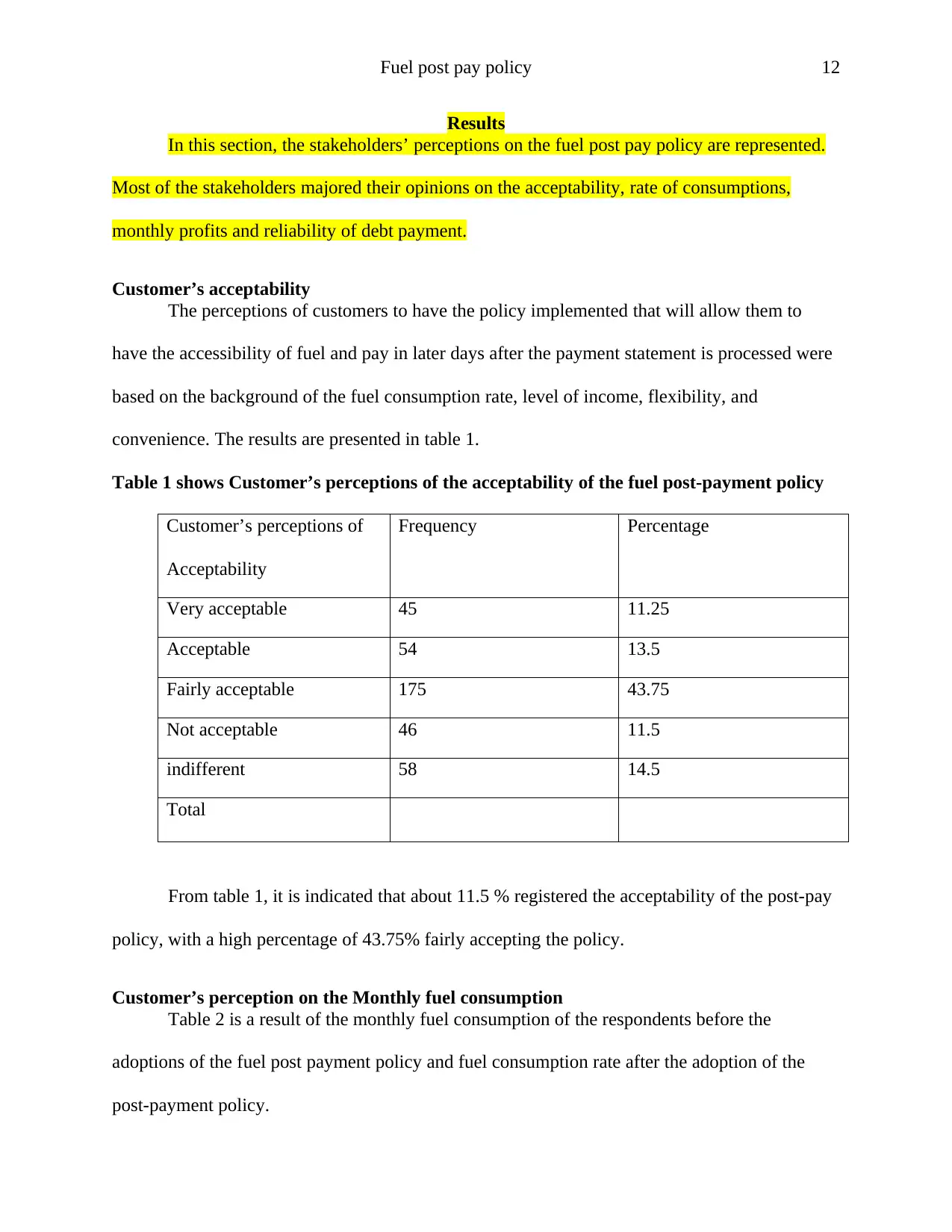
The perceptions of customers to have the policy implemented that will allow them to
have the accessibility of fuel and pay in later days after the payment statement is processed were
based on the background of the fuel consumption rate, level of income, flexibility, and
convenience. The results are presented in table 1.
Table 1 shows Customer’s perceptions of the acceptability of the fuel post-payment policy
Customer’s perceptions of
Acceptability
Frequency Percentage
Very acceptable 45 11.25
Acceptable 54 13.5
Fairly acceptable 175 43.75
Not acceptable 46 11.5
indifferent 58 14.5
Total
From table 1, it is indicated that about 11.5 % registered the acceptability of the post-pay
policy, with a high percentage of 43.75% fairly accepting the policy.
Customer’s perception on the Monthly fuel consumption
Table 2 is a result of the monthly fuel consumption of the respondents before the
adoptions of the fuel post payment policy and fuel consumption rate after the adoption of the
post-payment policy.
Results
In this section, the stakeholders’ perceptions on the fuel post pay policy are represented.
Most of the stakeholders majored their opinions on the acceptability, rate of consumptions,
monthly profits and reliability of debt payment.
Customer’s acceptability
The perceptions of customers to have the policy implemented that will allow them to
have the accessibility of fuel and pay in later days after the payment statement is processed were
based on the background of the fuel consumption rate, level of income, flexibility, and
convenience. The results are presented in table 1.
Table 1 shows Customer’s perceptions of the acceptability of the fuel post-payment policy
Customer’s perceptions of
Acceptability
Frequency Percentage
Very acceptable 45 11.25
Acceptable 54 13.5
Fairly acceptable 175 43.75
Not acceptable 46 11.5
indifferent 58 14.5
Total
From table 1, it is indicated that about 11.5 % registered the acceptability of the post-pay
policy, with a high percentage of 43.75% fairly accepting the policy.
Customer’s perception on the Monthly fuel consumption
Table 2 is a result of the monthly fuel consumption of the respondents before the
adoptions of the fuel post payment policy and fuel consumption rate after the adoption of the
post-payment policy.
⊘ This is a preview!⊘
Do you want full access?
Subscribe today to unlock all pages.
Trusted by 1+ million students worldwide

1 out of 30


Related Documents


Your All-in-One AI-Powered Toolkit for Academic Success.
+13062052269
info@desklib.com
Available 24*7 on WhatsApp / Email
![[object Object]](/_next/static/media/star-bottom.7253800d.svg)
Unlock your academic potential
Copyright © 2020–2026 A2Z Services. All Rights Reserved. Developed and managed by ZUCOL.