Functional Dependencies, Normalization, and ERD in Database Design

Verified

Added on  2024/07/01

|7
|469
|202
Homework Assignment
AI Summary
This assignment solution provides a detailed explanation of functional dependencies and normalization in database design. It covers the transformation of a database schema from 1NF to 2NF and finally to 3NF by removing partial and transitive dependencies. The solution includes examples of tables in each normal form, along with a relational schema defining primary and foreign keys, and an entity-relationship diagram (ERD) illustrating the relationships between the tables. Desklib offers this and many other solved assignments for students.
Document Page
Functional Dependencies
Functional dependencies in a schema are defined by when a single attribute represents a group of

attributes completely. These dependencies can be of many types that are a full functional

dependency, partial dependency, and transitive dependency. To represent and remove data

redundancy in the schema, normalization forms are used. These normalization forms are

represented as follows:

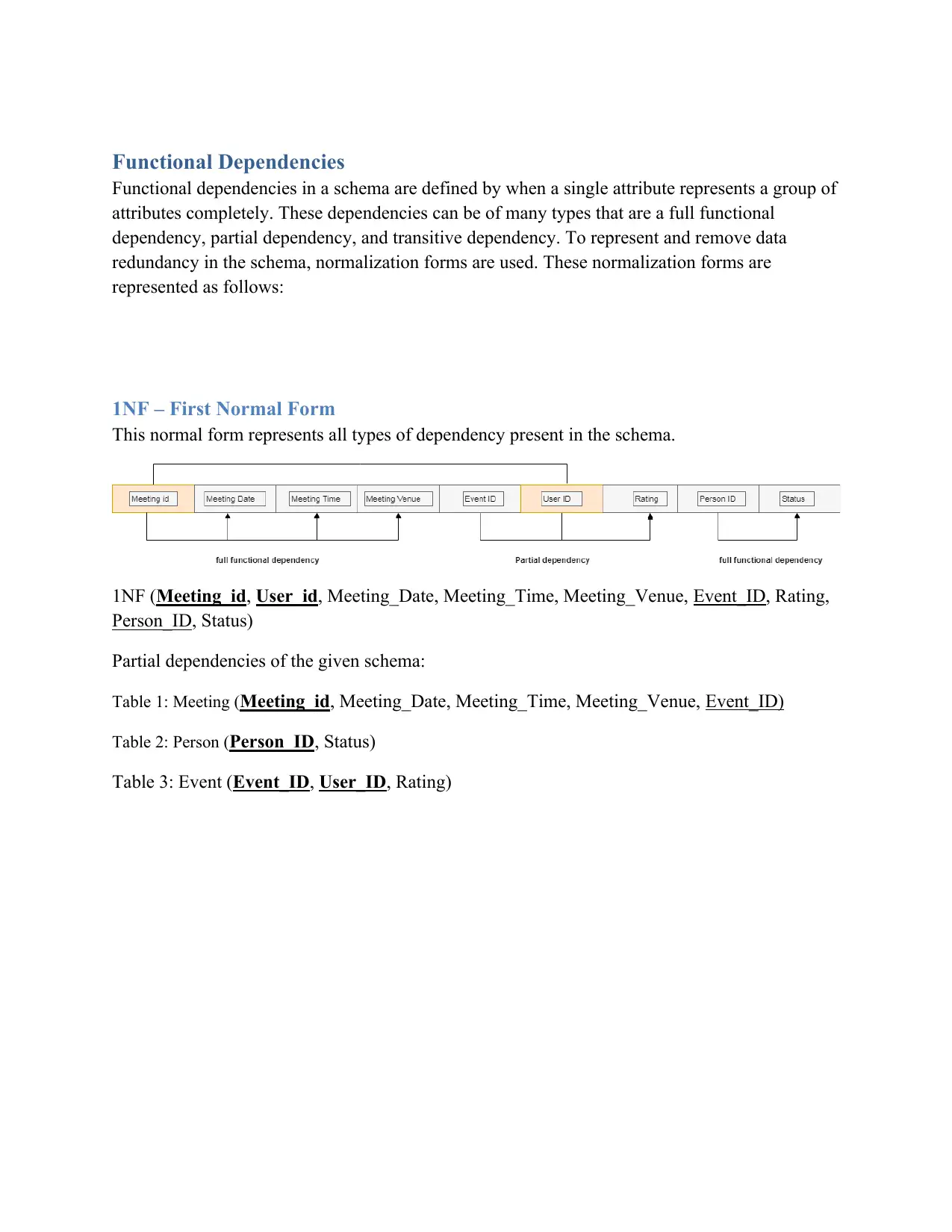
1NF – First Normal Form

This normal form represents all types of dependency present in the schema.

1NF (
Meeting_id, User_id, Meeting_Date, Meeting_Time, Meeting_Venue, Event_ID, Rating,
Person_ID
, Status)
Partial dependencies of the given schema:

Table 1: Meeting (
Meeting_id, Meeting_Date, Meeting_Time, Meeting_Venue, Event_ID)
Table 2: Person (
Person_ID, Status)
Table 3: Event (
Event_ID, User_ID, Rating)
tabler-icon-diamond-filled.svg

Paraphrase This Document

Need a fresh take? Get an instant paraphrase of this document with our AI Paraphraser
Document Page
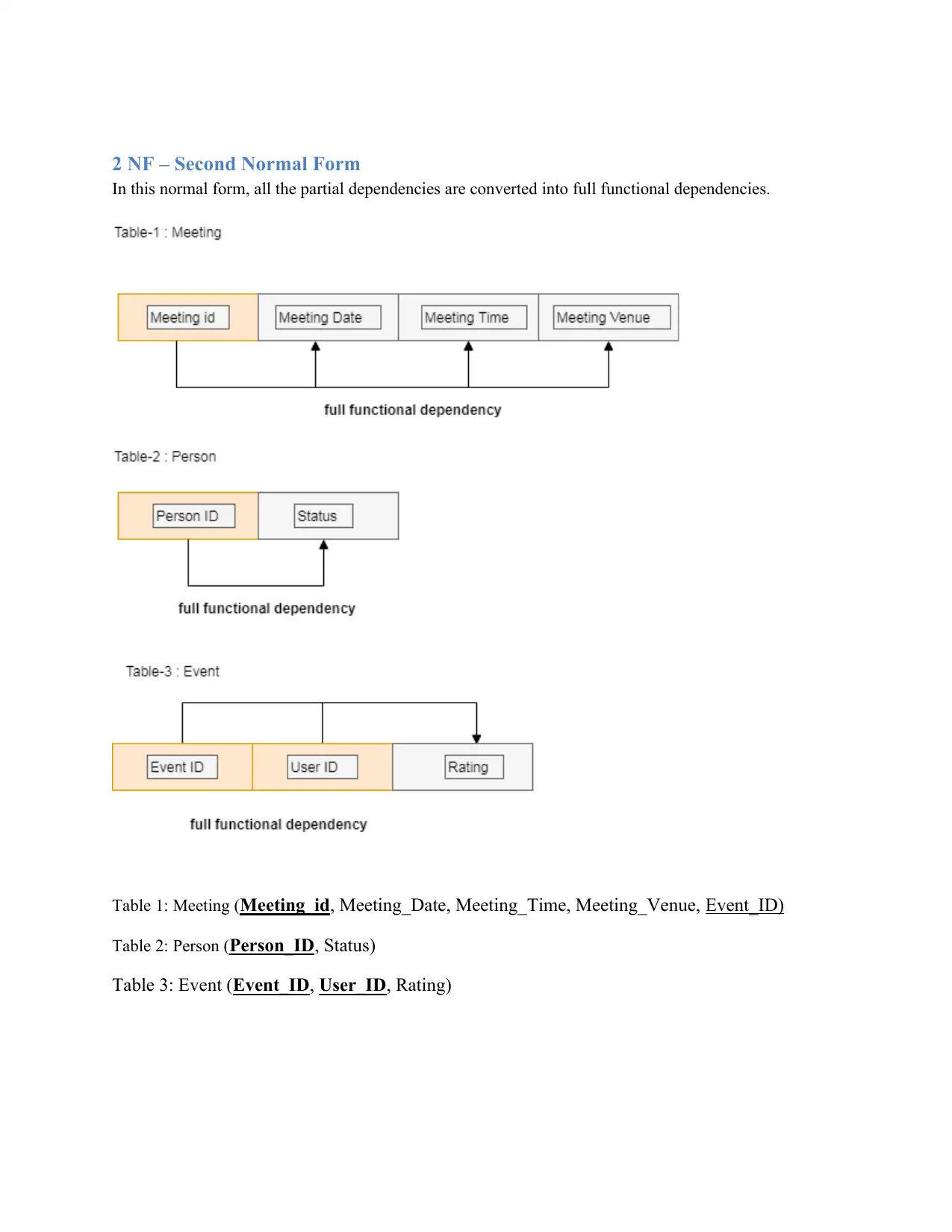
2 NF – Second Normal Form
In this normal form, all the partial dependencies are converted into full functional dependencies.

Table 1: Meeting (
Meeting_id, Meeting_Date, Meeting_Time, Meeting_Venue, Event_ID)
Table 2: Person (
Person_ID, Status)
Table 3: Event (
Event_ID, User_ID, Rating)
Document Page
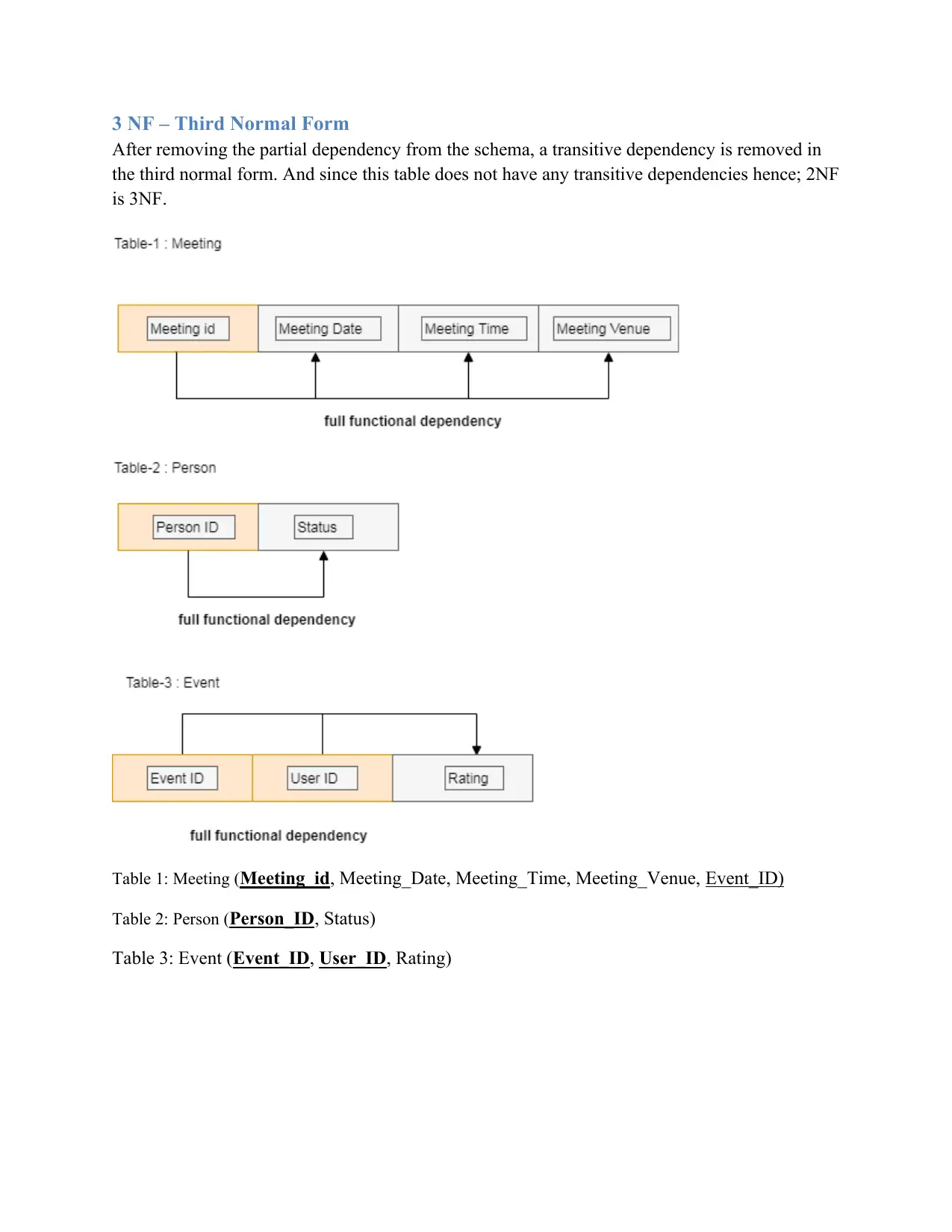
3 NF – Third Normal Form
After removing the partial dependency from the schema, a transitive dependency is removed in

the third normal form. And since this table does not have any transitive dependencies hence; 2NF

is 3NF.

Table 1: Meeting (
Meeting_id, Meeting_Date, Meeting_Time, Meeting_Venue, Event_ID)
Table 2: Person (
Person_ID, Status)
Table 3: Event (
Event_ID, User_ID, Rating)
Document Page
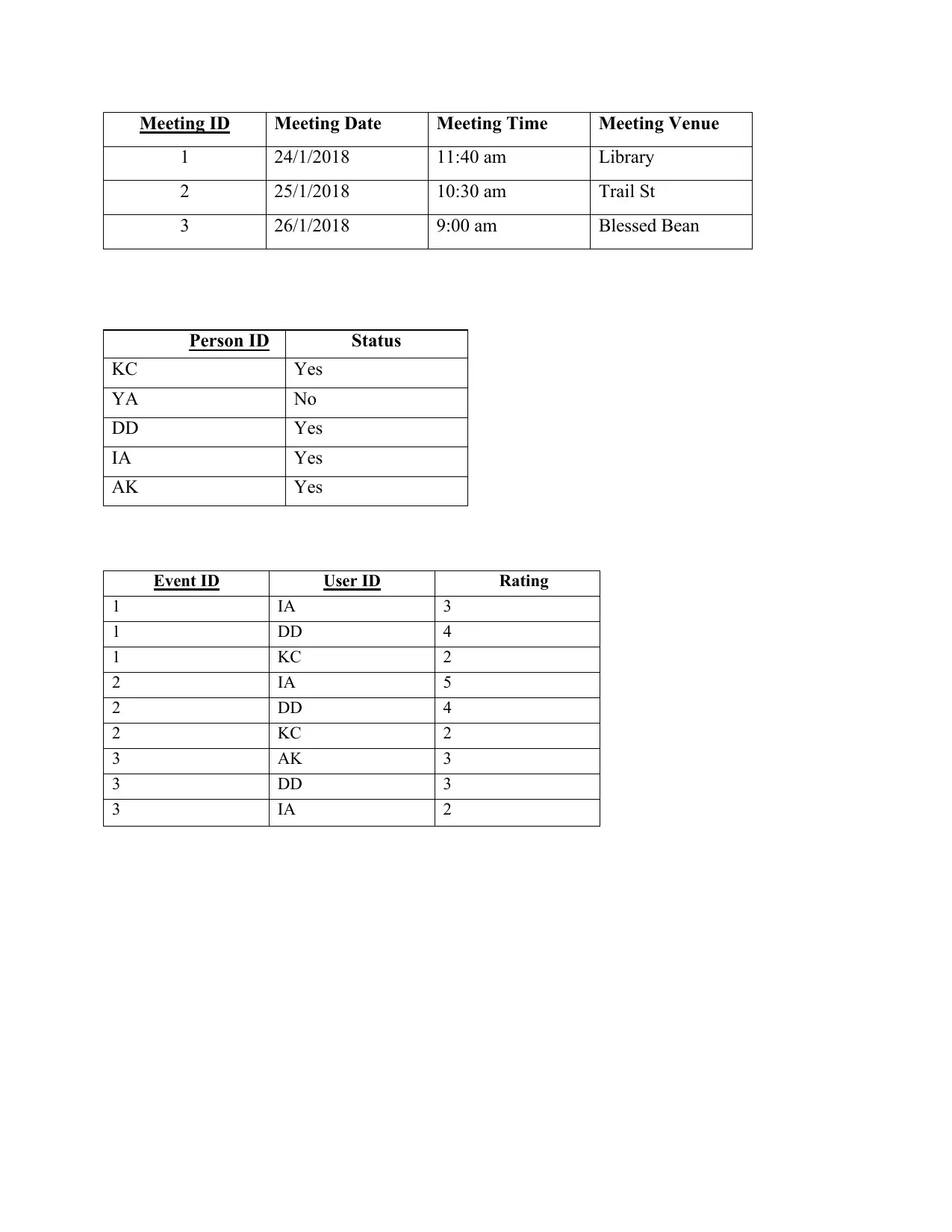
Meeting ID Meeting Date Meeting Time Meeting Venue
1
24/1/2018 11:40 am Library
2
25/1/2018 10:30 am Trail St
3
26/1/2018 9:00 am Blessed Bean
Event ID
User ID Rating
1
IA 3
1
DD 4
1
KC 2
2
IA 5
2
DD 4
2
KC 2
3
AK 3
3
DD 3
3
IA 2
Person ID
Status
KC
Yes
YA
No
DD
Yes
IA
Yes
AK
Yes
tabler-icon-diamond-filled.svg

Paraphrase This Document

Need a fresh take? Get an instant paraphrase of this document with our AI Paraphraser
Document Page
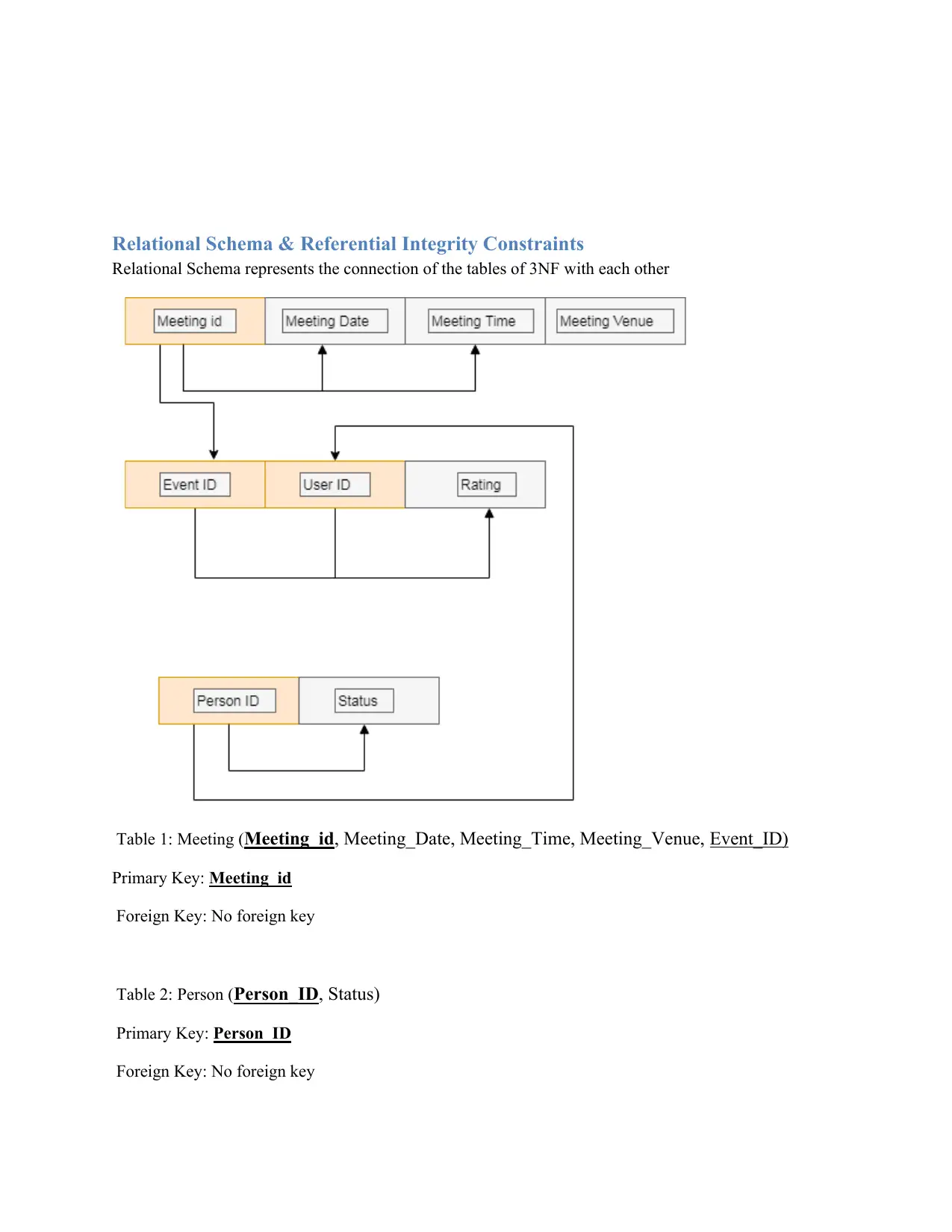
Relational Schema & Referential Integrity Constraints
Relational Schema represents the connection of the tables of 3NF with each other

Table 1: Meeting (
Meeting_id, Meeting_Date, Meeting_Time, Meeting_Venue, Event_ID)
Primary Key:
Meeting_id
Foreign Key: No foreign key

Table 2: Person (
Person_ID, Status)
Primary Key:
Person_ID
Foreign Key: No foreign key
Document Page
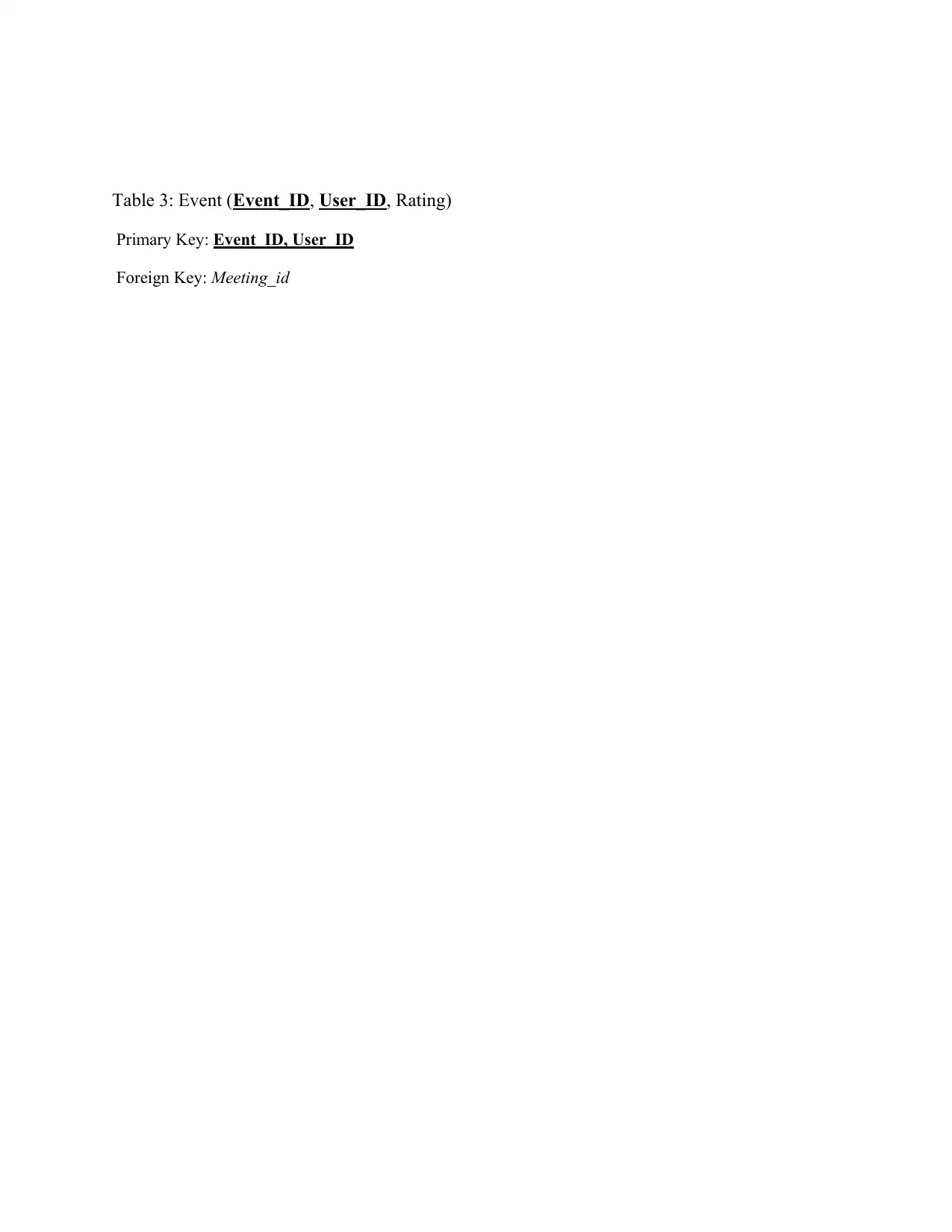
Table 3: Event (Event_ID, User_ID, Rating)
Primary Key:
Event_ID, User_ID
Foreign Key:
Meeting_id
Document Page
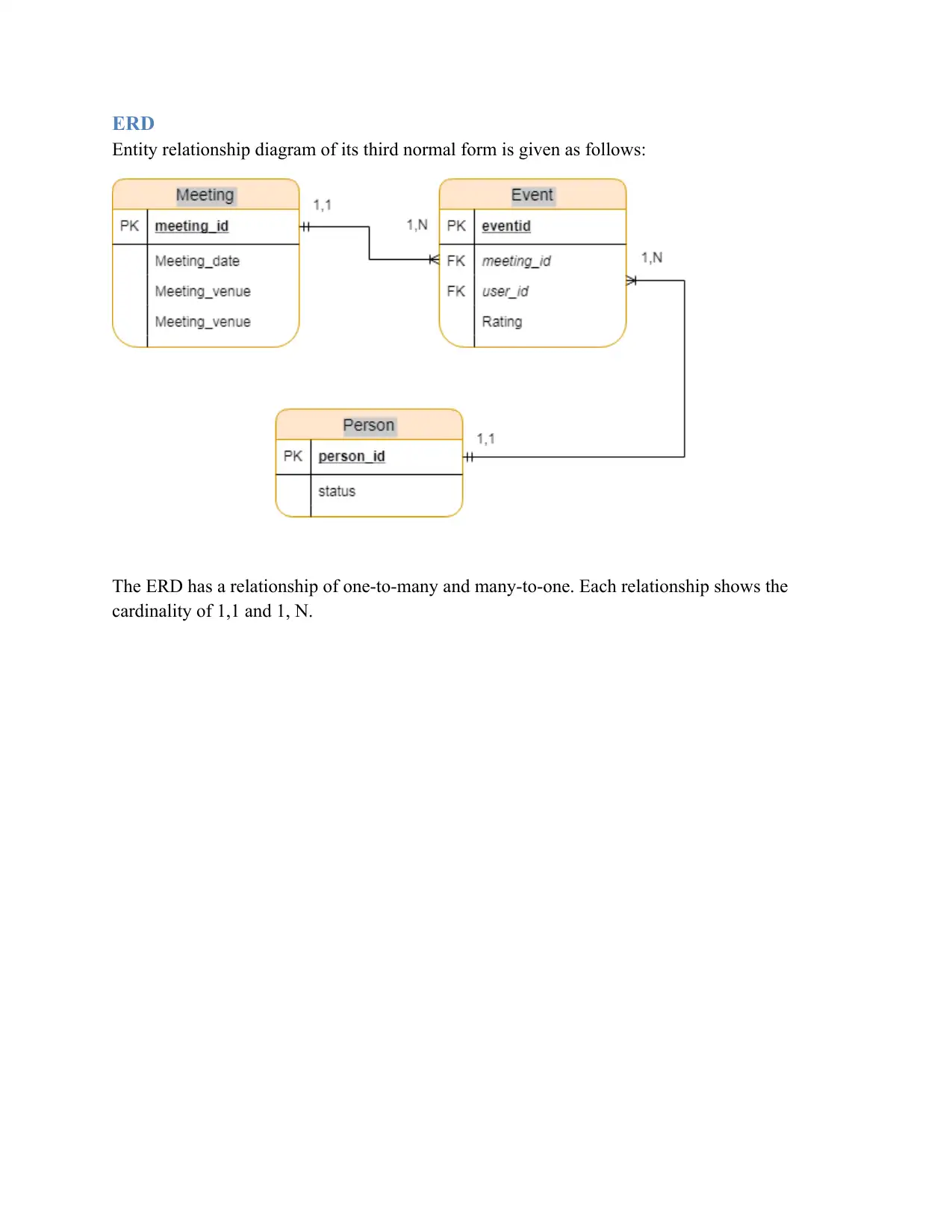
ERD
Entity relationship diagram of its third normal form is given as follows:

The ERD has a relationship of one-to-many and many-to-one. Each relationship shows the

cardinality of 1,1 and 1, N.
chevron_up_icon
1 out of 7
circle_padding
hide_on_mobile
zoom_out_icon
[object Object]