Finance Report: Investment and Fund Management Strategies
VerifiedAdded on 2020/01/23
|19
|5449
|164
Report
AI Summary
This comprehensive report on investment and fund management delves into various aspects of portfolio creation and analysis. It begins with an introduction to investment as a tool for increasing the value of money, emphasizing the importance of optimal investment strategies and the application of portfolio management concepts. The report then presents a detailed portfolio comprising investments in shares, bonds, mutual funds, and bank deposits, aiming for a balanced approach. It discusses active and passive investment strategies, highlighting the need for board approval for certain strategies. The report includes projections for the number of employees that can be employed using investment income, along with detailed analyses of investments in shares, commodities, real estate, and fixed deposits. It also covers investment policies requiring board approval, such as active and passive strategies, and outlines the procedures and processes necessary for successful fund operation. The report concludes with a comparison of in-house and external fund management options and provides a detailed breakdown of investment allocations and capital gains across different asset classes, offering valuable insights for finance students and professionals. The report includes detailed tables outlining investment amounts, capital gains, and projections for employee numbers.
INVESTMENT AND FUND
MANAGEMENT
MANAGEMENT

Paraphrase This Document
Need a fresh take? Get an instant paraphrase of this document with our AI Paraphraser
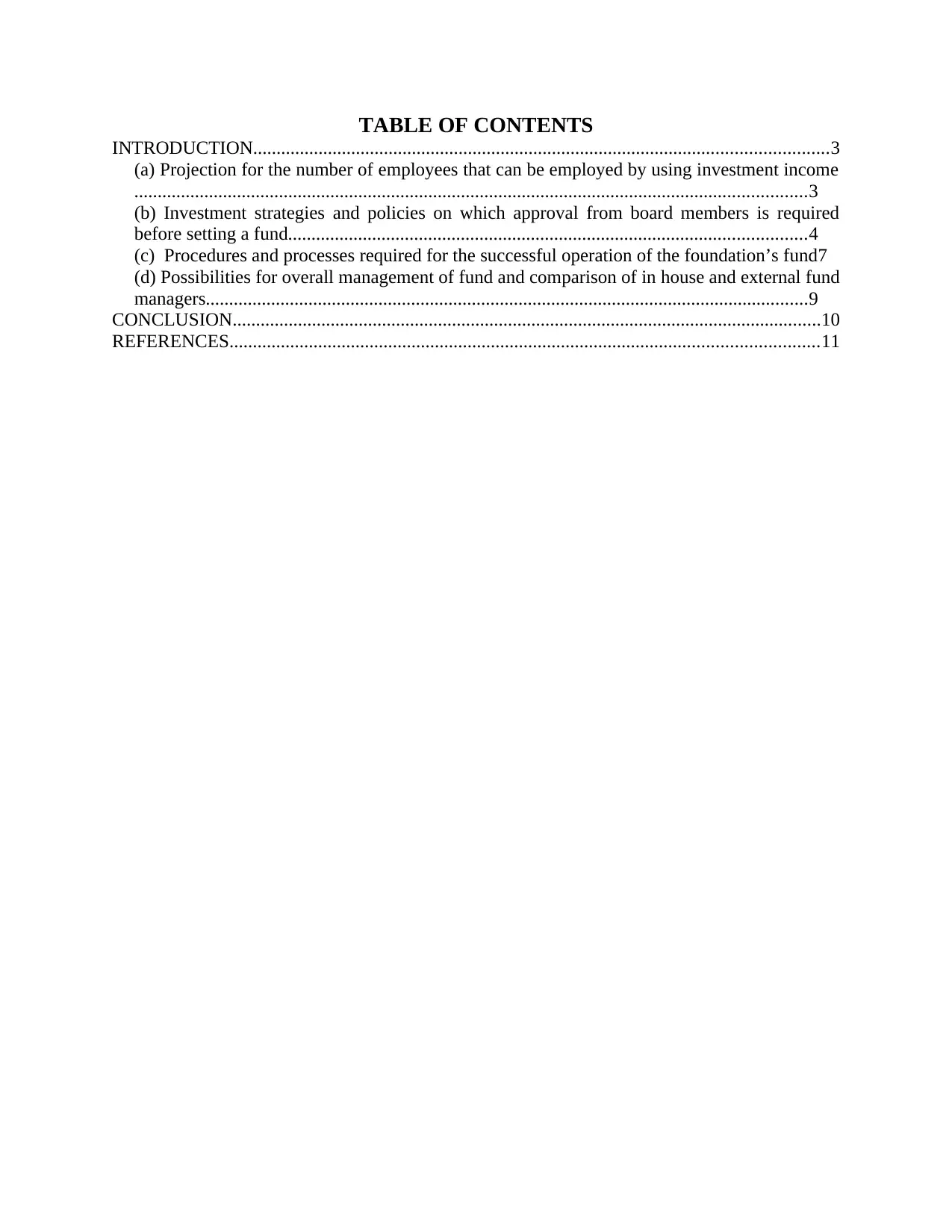
TABLE OF CONTENTS
INTRODUCTION...........................................................................................................................3
(a) Projection for the number of employees that can be employed by using investment income
................................................................................................................................................3
(b) Investment strategies and policies on which approval from board members is required
before setting a fund...............................................................................................................4
(c) Procedures and processes required for the successful operation of the foundation’s fund7
(d) Possibilities for overall management of fund and comparison of in house and external fund
managers.................................................................................................................................9
CONCLUSION..............................................................................................................................10
REFERENCES..............................................................................................................................11
INTRODUCTION...........................................................................................................................3
(a) Projection for the number of employees that can be employed by using investment income
................................................................................................................................................3
(b) Investment strategies and policies on which approval from board members is required
before setting a fund...............................................................................................................4
(c) Procedures and processes required for the successful operation of the foundation’s fund7
(d) Possibilities for overall management of fund and comparison of in house and external fund
managers.................................................................................................................................9
CONCLUSION..............................................................................................................................10
REFERENCES..............................................................................................................................11
INDEX OF TABLES
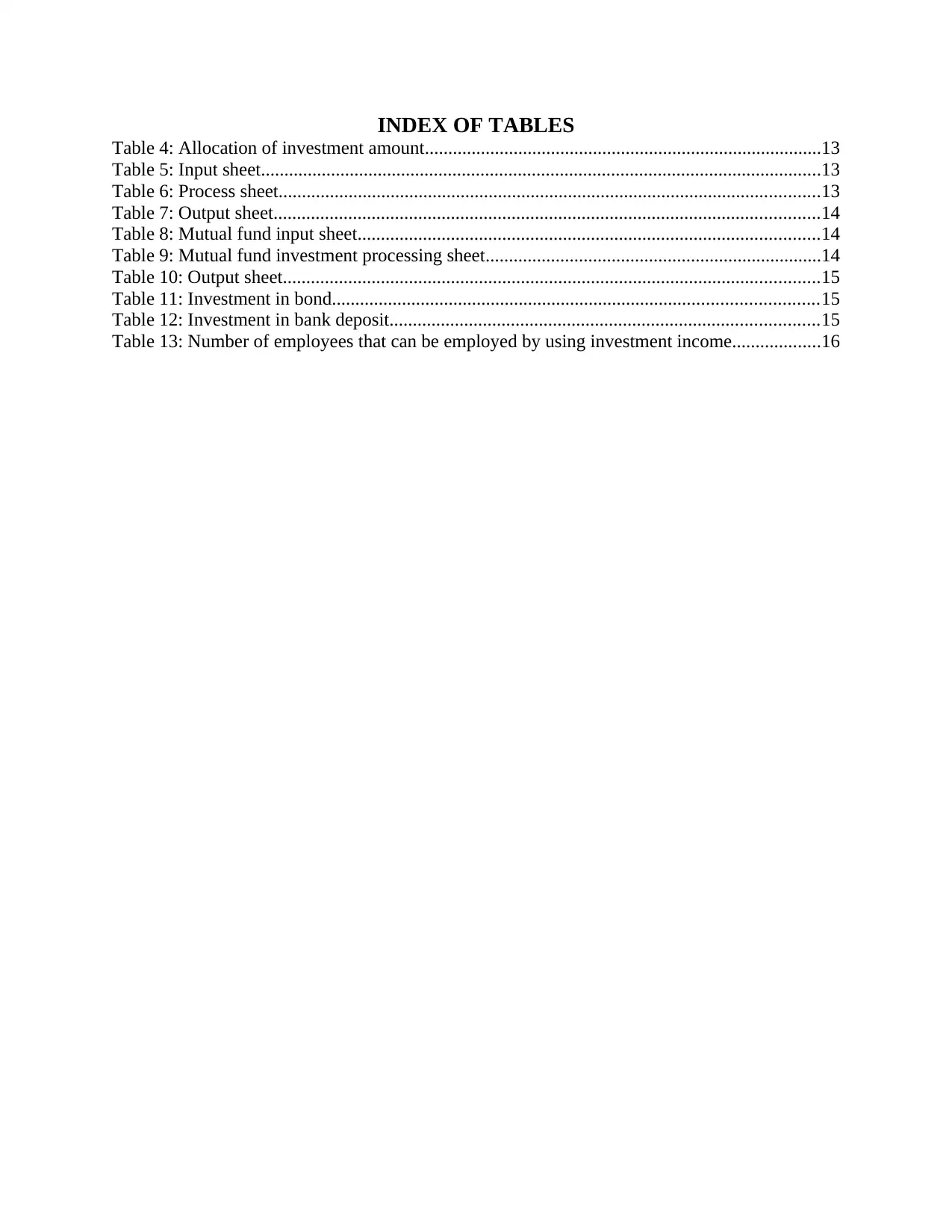
Table 4: Allocation of investment amount.....................................................................................13
Table 5: Input sheet........................................................................................................................13
Table 6: Process sheet....................................................................................................................13
Table 7: Output sheet.....................................................................................................................14
Table 8: Mutual fund input sheet...................................................................................................14
Table 9: Mutual fund investment processing sheet........................................................................14
Table 10: Output sheet...................................................................................................................15
Table 11: Investment in bond........................................................................................................15
Table 12: Investment in bank deposit............................................................................................15
Table 13: Number of employees that can be employed by using investment income...................16
Table 4: Allocation of investment amount.....................................................................................13
Table 5: Input sheet........................................................................................................................13
Table 6: Process sheet....................................................................................................................13
Table 7: Output sheet.....................................................................................................................14
Table 8: Mutual fund input sheet...................................................................................................14
Table 9: Mutual fund investment processing sheet........................................................................14
Table 10: Output sheet...................................................................................................................15
Table 11: Investment in bond........................................................................................................15
Table 12: Investment in bank deposit............................................................................................15
Table 13: Number of employees that can be employed by using investment income...................16
⊘ This is a preview!⊘
Do you want full access?
Subscribe today to unlock all pages.

Trusted by 1+ million students worldwide
INTRODUCTION
Investment is an instrument that is used to increase value of the money that remains in the
banks. Investment in any security possesses some risk or low return. Thus, it is necessary to
make an optimum investment and in this regard portfolio management concepts are discussed in
the report. Along with this, in the report portfolio is also created that comprised investment in
shares, bonds, mutual funds and bank deposits. In the report, full attempt is made to prepare a
balanced portfolio. Along with this investment strategies like active and passive strategy is also
discussed in detail. After that way of effective management of portfolio is also proposed in the
report. At the end of the report, some the ways are suggests that can be used for effective
management of portfolio.
Part B
(a) Projection for the number of employees that can be employed by using investment income
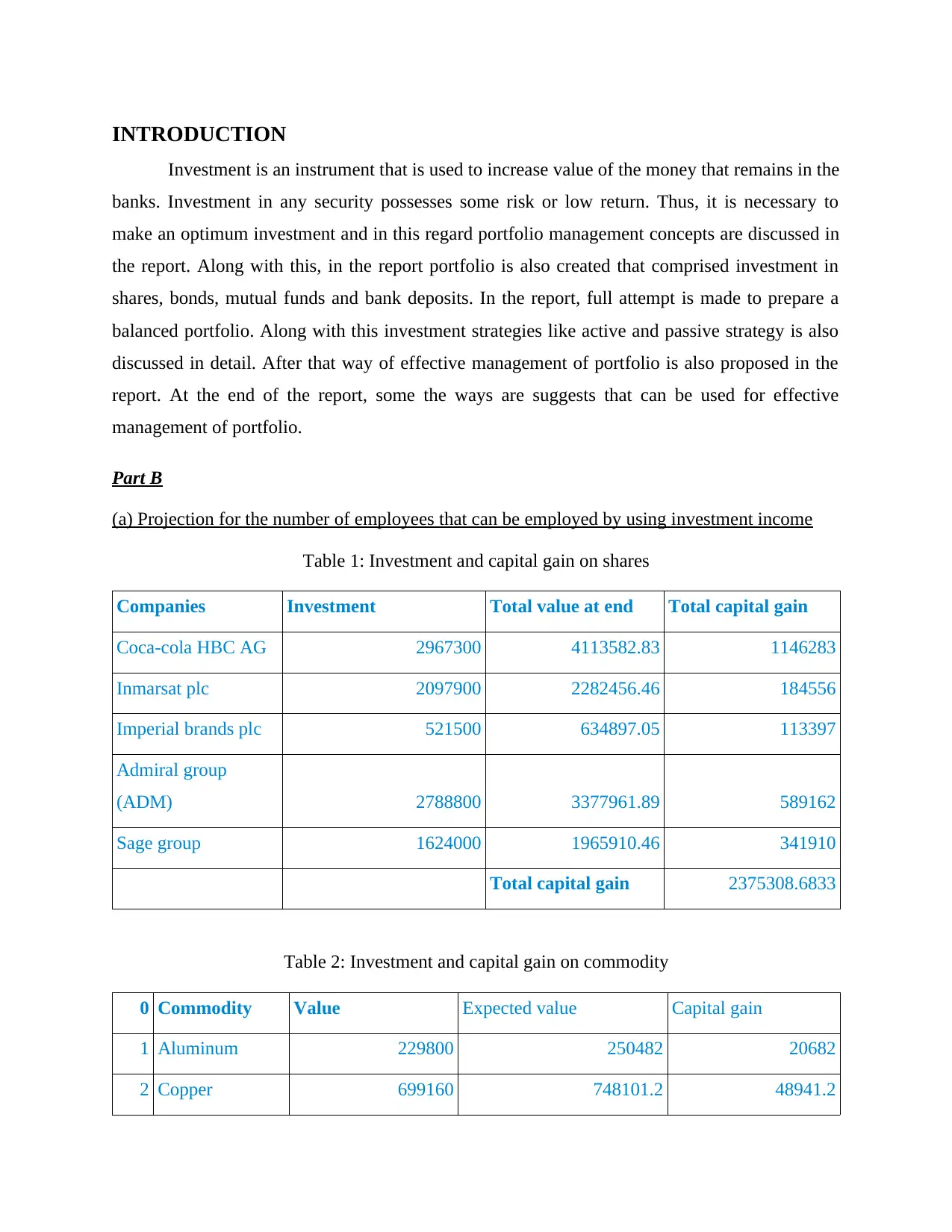
Table 1: Investment and capital gain on shares
Companies Investment Total value at end Total capital gain
Coca-cola HBC AG 2967300 4113582.83 1146283
Inmarsat plc 2097900 2282456.46 184556
Imperial brands plc 521500 634897.05 113397
Admiral group
(ADM) 2788800 3377961.89 589162
Sage group 1624000 1965910.46 341910
Total capital gain 2375308.6833
Table 2: Investment and capital gain on commodity
0 Commodity Value Expected value Capital gain
1 Aluminum 229800 250482 20682
2 Copper 699160 748101.2 48941.2
Investment is an instrument that is used to increase value of the money that remains in the
banks. Investment in any security possesses some risk or low return. Thus, it is necessary to
make an optimum investment and in this regard portfolio management concepts are discussed in
the report. Along with this, in the report portfolio is also created that comprised investment in
shares, bonds, mutual funds and bank deposits. In the report, full attempt is made to prepare a
balanced portfolio. Along with this investment strategies like active and passive strategy is also
discussed in detail. After that way of effective management of portfolio is also proposed in the
report. At the end of the report, some the ways are suggests that can be used for effective
management of portfolio.
Part B
(a) Projection for the number of employees that can be employed by using investment income
Table 1: Investment and capital gain on shares
Companies Investment Total value at end Total capital gain
Coca-cola HBC AG 2967300 4113582.83 1146283
Inmarsat plc 2097900 2282456.46 184556
Imperial brands plc 521500 634897.05 113397
Admiral group
(ADM) 2788800 3377961.89 589162
Sage group 1624000 1965910.46 341910
Total capital gain 2375308.6833
Table 2: Investment and capital gain on commodity
0 Commodity Value Expected value Capital gain
1 Aluminum 229800 250482 20682
2 Copper 699160 748101.2 48941.2
Paraphrase This Document
Need a fresh take? Get an instant paraphrase of this document with our AI Paraphraser
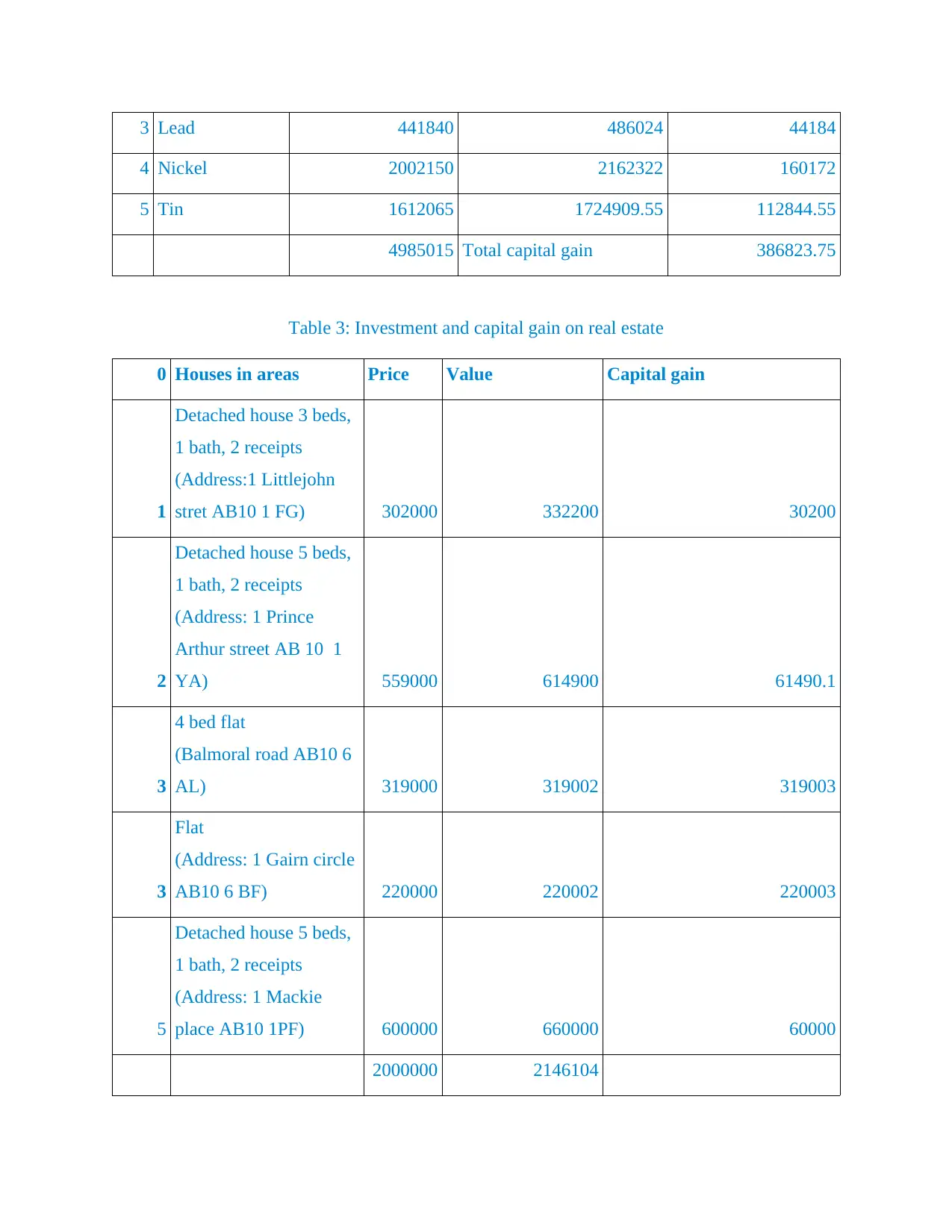
3 Lead 441840 486024 44184
4 Nickel 2002150 2162322 160172
5 Tin 1612065 1724909.55 112844.55
4985015 Total capital gain 386823.75
Table 3: Investment and capital gain on real estate
0 Houses in areas Price Value Capital gain
1
Detached house 3 beds,
1 bath, 2 receipts
(Address:1 Littlejohn
stret AB10 1 FG) 302000 332200 30200
2
Detached house 5 beds,
1 bath, 2 receipts
(Address: 1 Prince
Arthur street AB 10 1
YA) 559000 614900 61490.1
3
4 bed flat
(Balmoral road AB10 6
AL) 319000 319002 319003
3
Flat
(Address: 1 Gairn circle
AB10 6 BF) 220000 220002 220003
5
Detached house 5 beds,
1 bath, 2 receipts
(Address: 1 Mackie
place AB10 1PF) 600000 660000 60000
2000000 2146104
4 Nickel 2002150 2162322 160172
5 Tin 1612065 1724909.55 112844.55
4985015 Total capital gain 386823.75
Table 3: Investment and capital gain on real estate
0 Houses in areas Price Value Capital gain
1
Detached house 3 beds,
1 bath, 2 receipts
(Address:1 Littlejohn
stret AB10 1 FG) 302000 332200 30200
2
Detached house 5 beds,
1 bath, 2 receipts
(Address: 1 Prince
Arthur street AB 10 1
YA) 559000 614900 61490.1
3
4 bed flat
(Balmoral road AB10 6
AL) 319000 319002 319003
3
Flat
(Address: 1 Gairn circle
AB10 6 BF) 220000 220002 220003
5
Detached house 5 beds,
1 bath, 2 receipts
(Address: 1 Mackie
place AB10 1PF) 600000 660000 60000
2000000 2146104
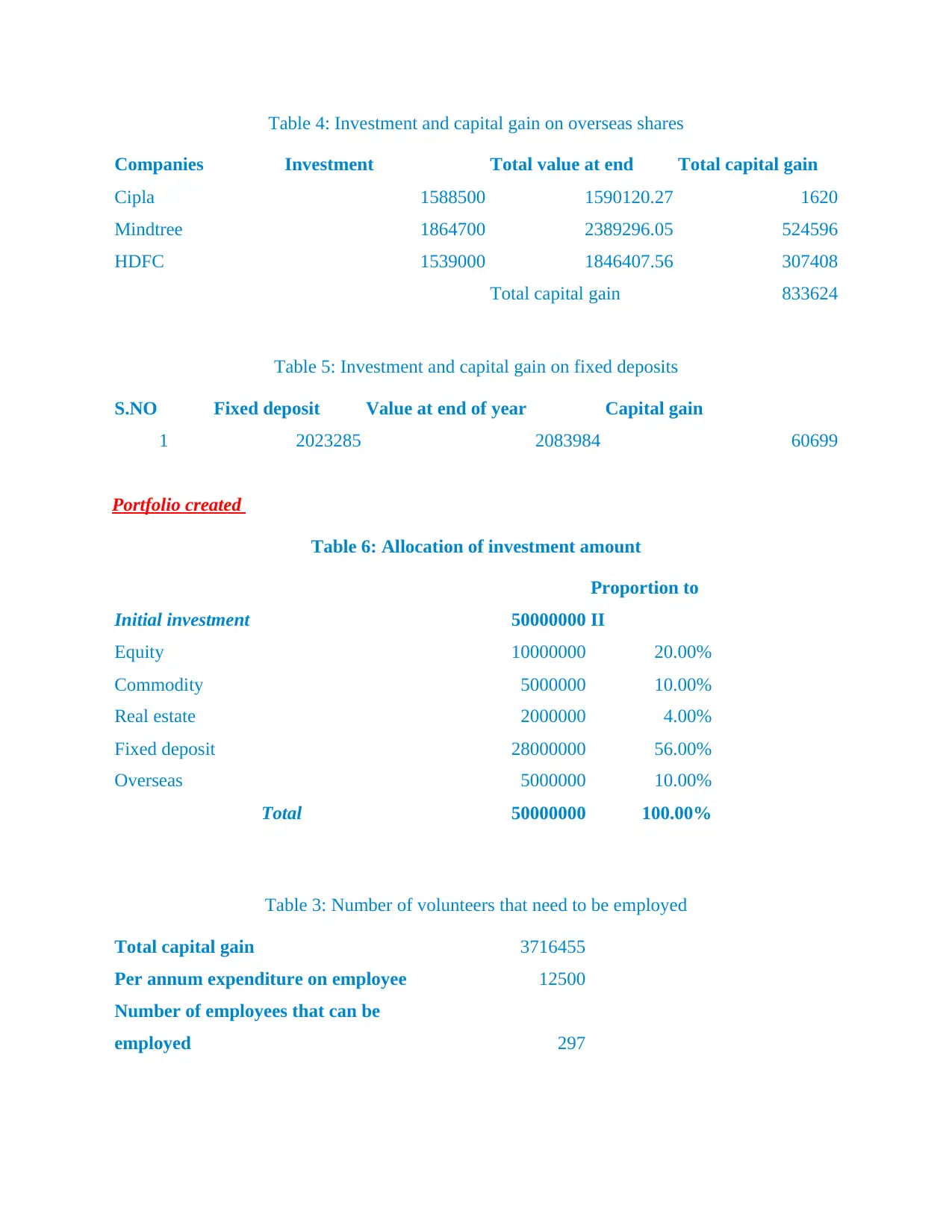
Table 4: Investment and capital gain on overseas shares
Companies Investment Total value at end Total capital gain
Cipla 1588500 1590120.27 1620
Mindtree 1864700 2389296.05 524596
HDFC 1539000 1846407.56 307408
Total capital gain 833624
Table 5: Investment and capital gain on fixed deposits
S.NO Fixed deposit Value at end of year Capital gain
1 2023285 2083984 60699
Portfolio created
Table 6: Allocation of investment amount
Initial investment 50000000
Proportion to
II
Equity 10000000 20.00%
Commodity 5000000 10.00%
Real estate 2000000 4.00%
Fixed deposit 28000000 56.00%
Overseas 5000000 10.00%
Total 50000000 100.00%
Table 3: Number of volunteers that need to be employed
Total capital gain 3716455
Per annum expenditure on employee 12500
Number of employees that can be
employed 297
Companies Investment Total value at end Total capital gain
Cipla 1588500 1590120.27 1620
Mindtree 1864700 2389296.05 524596
HDFC 1539000 1846407.56 307408
Total capital gain 833624
Table 5: Investment and capital gain on fixed deposits
S.NO Fixed deposit Value at end of year Capital gain
1 2023285 2083984 60699
Portfolio created
Table 6: Allocation of investment amount
Initial investment 50000000
Proportion to
II
Equity 10000000 20.00%
Commodity 5000000 10.00%
Real estate 2000000 4.00%
Fixed deposit 28000000 56.00%
Overseas 5000000 10.00%
Total 50000000 100.00%
Table 3: Number of volunteers that need to be employed
Total capital gain 3716455
Per annum expenditure on employee 12500
Number of employees that can be
employed 297
⊘ This is a preview!⊘
Do you want full access?
Subscribe today to unlock all pages.
Trusted by 1+ million students worldwide
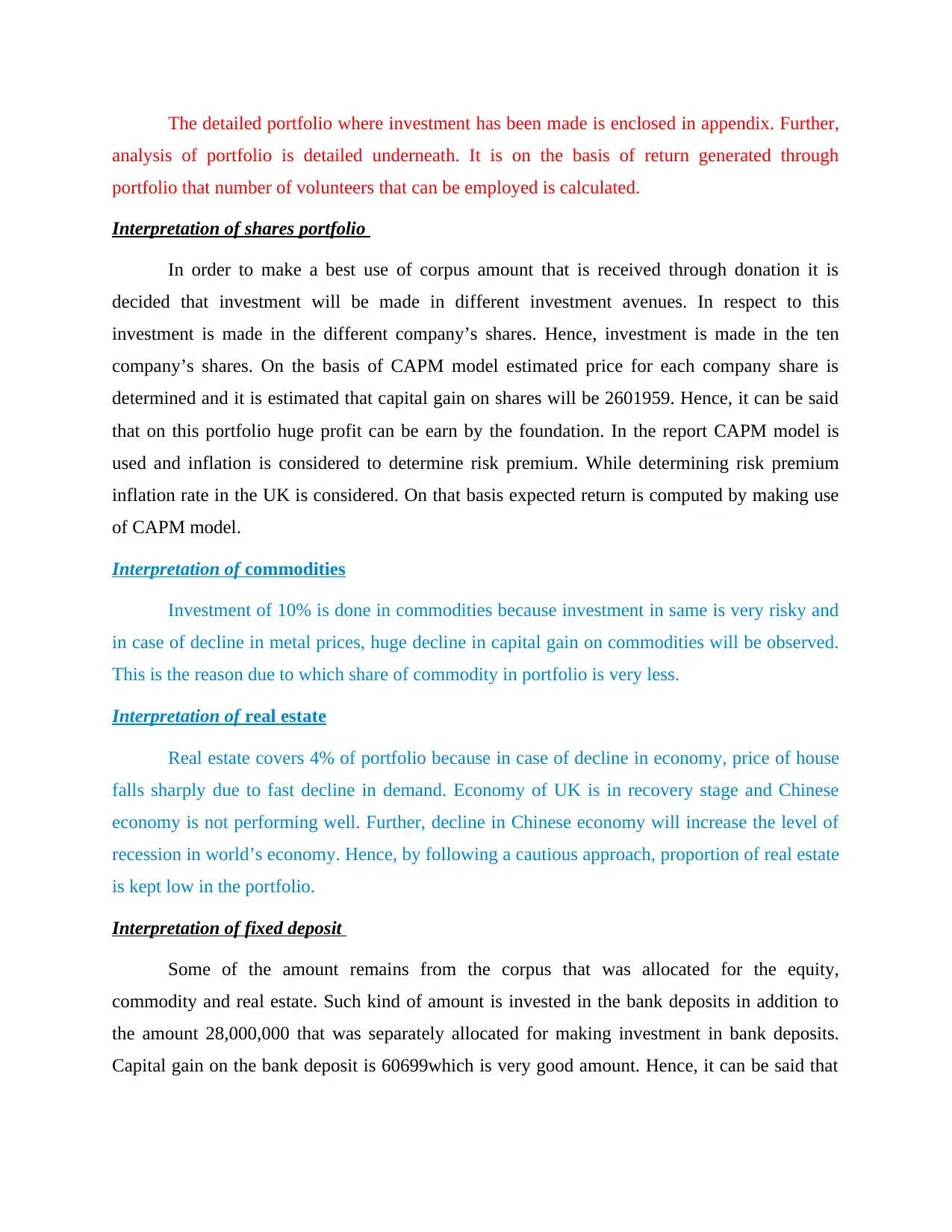
The detailed portfolio where investment has been made is enclosed in appendix. Further,
analysis of portfolio is detailed underneath. It is on the basis of return generated through
portfolio that number of volunteers that can be employed is calculated.
Interpretation of shares portfolio
In order to make a best use of corpus amount that is received through donation it is
decided that investment will be made in different investment avenues. In respect to this
investment is made in the different company’s shares. Hence, investment is made in the ten
company’s shares. On the basis of CAPM model estimated price for each company share is
determined and it is estimated that capital gain on shares will be 2601959. Hence, it can be said
that on this portfolio huge profit can be earn by the foundation. In the report CAPM model is
used and inflation is considered to determine risk premium. While determining risk premium
inflation rate in the UK is considered. On that basis expected return is computed by making use
of CAPM model.
Interpretation of commodities
Investment of 10% is done in commodities because investment in same is very risky and
in case of decline in metal prices, huge decline in capital gain on commodities will be observed.
This is the reason due to which share of commodity in portfolio is very less.
Interpretation of real estate
Real estate covers 4% of portfolio because in case of decline in economy, price of house
falls sharply due to fast decline in demand. Economy of UK is in recovery stage and Chinese
economy is not performing well. Further, decline in Chinese economy will increase the level of
recession in world’s economy. Hence, by following a cautious approach, proportion of real estate
is kept low in the portfolio.
Interpretation of fixed deposit
Some of the amount remains from the corpus that was allocated for the equity,
commodity and real estate. Such kind of amount is invested in the bank deposits in addition to
the amount 28,000,000 that was separately allocated for making investment in bank deposits.
Capital gain on the bank deposit is 60699which is very good amount. Hence, it can be said that
analysis of portfolio is detailed underneath. It is on the basis of return generated through
portfolio that number of volunteers that can be employed is calculated.
Interpretation of shares portfolio
In order to make a best use of corpus amount that is received through donation it is
decided that investment will be made in different investment avenues. In respect to this
investment is made in the different company’s shares. Hence, investment is made in the ten
company’s shares. On the basis of CAPM model estimated price for each company share is
determined and it is estimated that capital gain on shares will be 2601959. Hence, it can be said
that on this portfolio huge profit can be earn by the foundation. In the report CAPM model is
used and inflation is considered to determine risk premium. While determining risk premium
inflation rate in the UK is considered. On that basis expected return is computed by making use
of CAPM model.
Interpretation of commodities
Investment of 10% is done in commodities because investment in same is very risky and
in case of decline in metal prices, huge decline in capital gain on commodities will be observed.
This is the reason due to which share of commodity in portfolio is very less.
Interpretation of real estate
Real estate covers 4% of portfolio because in case of decline in economy, price of house
falls sharply due to fast decline in demand. Economy of UK is in recovery stage and Chinese
economy is not performing well. Further, decline in Chinese economy will increase the level of
recession in world’s economy. Hence, by following a cautious approach, proportion of real estate
is kept low in the portfolio.
Interpretation of fixed deposit
Some of the amount remains from the corpus that was allocated for the equity,
commodity and real estate. Such kind of amount is invested in the bank deposits in addition to
the amount 28,000,000 that was separately allocated for making investment in bank deposits.
Capital gain on the bank deposit is 60699which is very good amount. Hence, it can be said that
Paraphrase This Document
Need a fresh take? Get an instant paraphrase of this document with our AI Paraphraser
protection is also provided to the invested amount and portfolio is prepared in the balanced
manner.
Investment in overseas shares
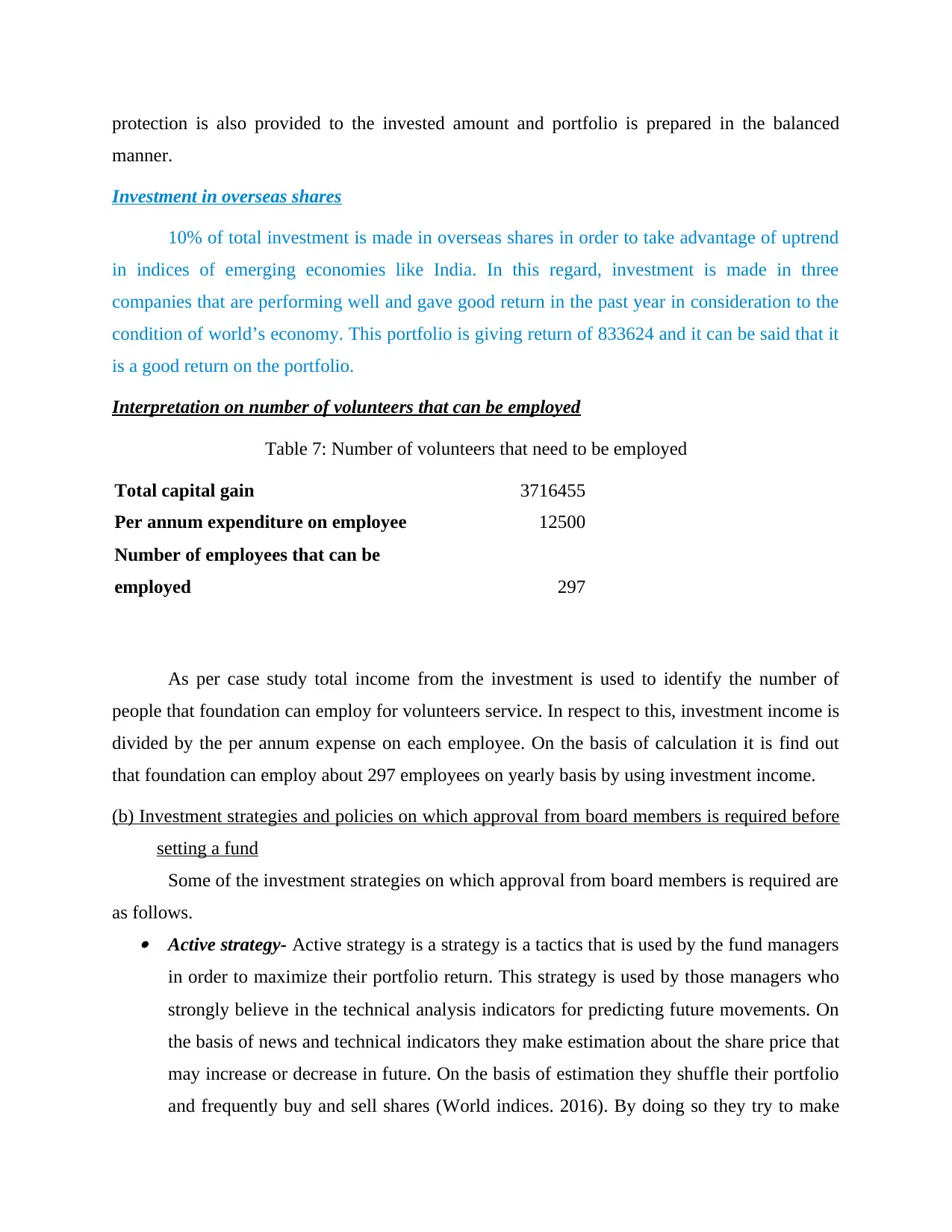
10% of total investment is made in overseas shares in order to take advantage of uptrend
in indices of emerging economies like India. In this regard, investment is made in three
companies that are performing well and gave good return in the past year in consideration to the
condition of world’s economy. This portfolio is giving return of 833624 and it can be said that it
is a good return on the portfolio.
Interpretation on number of volunteers that can be employed
Table 7: Number of volunteers that need to be employed
Total capital gain 3716455
Per annum expenditure on employee 12500
Number of employees that can be
employed 297
As per case study total income from the investment is used to identify the number of
people that foundation can employ for volunteers service. In respect to this, investment income is
divided by the per annum expense on each employee. On the basis of calculation it is find out
that foundation can employ about 297 employees on yearly basis by using investment income.
(b) Investment strategies and policies on which approval from board members is required before
setting a fund
Some of the investment strategies on which approval from board members is required are
as follows. Active strategy- Active strategy is a strategy is a tactics that is used by the fund managers
in order to maximize their portfolio return. This strategy is used by those managers who
strongly believe in the technical analysis indicators for predicting future movements. On
the basis of news and technical indicators they make estimation about the share price that
may increase or decrease in future. On the basis of estimation they shuffle their portfolio
and frequently buy and sell shares (World indices. 2016). By doing so they try to make
manner.
Investment in overseas shares
10% of total investment is made in overseas shares in order to take advantage of uptrend
in indices of emerging economies like India. In this regard, investment is made in three
companies that are performing well and gave good return in the past year in consideration to the
condition of world’s economy. This portfolio is giving return of 833624 and it can be said that it
is a good return on the portfolio.
Interpretation on number of volunteers that can be employed
Table 7: Number of volunteers that need to be employed
Total capital gain 3716455
Per annum expenditure on employee 12500
Number of employees that can be
employed 297
As per case study total income from the investment is used to identify the number of
people that foundation can employ for volunteers service. In respect to this, investment income is
divided by the per annum expense on each employee. On the basis of calculation it is find out
that foundation can employ about 297 employees on yearly basis by using investment income.
(b) Investment strategies and policies on which approval from board members is required before
setting a fund
Some of the investment strategies on which approval from board members is required are
as follows. Active strategy- Active strategy is a strategy is a tactics that is used by the fund managers
in order to maximize their portfolio return. This strategy is used by those managers who
strongly believe in the technical analysis indicators for predicting future movements. On
the basis of news and technical indicators they make estimation about the share price that
may increase or decrease in future. On the basis of estimation they shuffle their portfolio
and frequently buy and sell shares (World indices. 2016). By doing so they try to make
maximum use of the opportunities and mistiming chances of negative impact due to
correction in share price for short and long term. In mutual fund people fund manager
purchase number of shares of many companies and in that situation it is very difficult to
maximize portfolio return. Currently, stock market is more volatile and it is very difficult
to predict likely movement in the share price. In such a situation it is very difficult to
fulfill objective of profit maximization of the portfolio. Hence, in order to achieve
objective fund managers frequently buy and sale specific company shares. By doing so
fund managers manage to give good return to the investors (Top performers, star ratings,
most bought & sold funds: start your research here. 2016). But this strategy has its own
limitation and one of them is that due to some reason on the specific day share price fall
at a fast rate and in later days recovery of that fall in price happens. Now, if fund
managers on first day fall in price sell shares then he cannot take advantage of uptrend in
the shares price in next trading sessions. Hence, every time by using this strategy wise
decisions cannot be made by the fund managers. Wrong use of this strategy may lead to
negative return on the invested corpus. Hence, it is necessary for the fund manager to
obtain consent from the board of trustees before making an investment.
Passive investment strategy- This is opposite of an active investment strategy and under
this investment of long term is made in the shares. In other words, it can be said that
under this strategy fund managers makes a long term investment in the specific company
shares (Blomkvist, Kappen and Zander, 2014). They believe in the fundamental analysis
instead of technical analysis. They believe that investment must be made in those firms
whose fundamentals are strong. Thus, they make an investment in those company shares
whose fundamentals are strong and valuation of shares is correct. In other words, it can
be said that fund managers following this strategy always abstain from making
investment in the overvalued shares even they are traded at uptrend for long term. They
always prefer to make an investment in the shares that are undervalued. Hence, this
strategy is good for long term. The main limitation of this investment strategy is that
market does not always run by looking at the firm fundamental and there are many other
factors that influence shares price (Gould, 2015). Economic factor is one of the factors
that highly influenced shares price. Investor sentiments are another reason that also
influence shares price. Hence, movements in these variables strongly influence shares
correction in share price for short and long term. In mutual fund people fund manager
purchase number of shares of many companies and in that situation it is very difficult to
maximize portfolio return. Currently, stock market is more volatile and it is very difficult
to predict likely movement in the share price. In such a situation it is very difficult to
fulfill objective of profit maximization of the portfolio. Hence, in order to achieve
objective fund managers frequently buy and sale specific company shares. By doing so
fund managers manage to give good return to the investors (Top performers, star ratings,
most bought & sold funds: start your research here. 2016). But this strategy has its own
limitation and one of them is that due to some reason on the specific day share price fall
at a fast rate and in later days recovery of that fall in price happens. Now, if fund
managers on first day fall in price sell shares then he cannot take advantage of uptrend in
the shares price in next trading sessions. Hence, every time by using this strategy wise
decisions cannot be made by the fund managers. Wrong use of this strategy may lead to
negative return on the invested corpus. Hence, it is necessary for the fund manager to
obtain consent from the board of trustees before making an investment.
Passive investment strategy- This is opposite of an active investment strategy and under
this investment of long term is made in the shares. In other words, it can be said that
under this strategy fund managers makes a long term investment in the specific company
shares (Blomkvist, Kappen and Zander, 2014). They believe in the fundamental analysis
instead of technical analysis. They believe that investment must be made in those firms
whose fundamentals are strong. Thus, they make an investment in those company shares
whose fundamentals are strong and valuation of shares is correct. In other words, it can
be said that fund managers following this strategy always abstain from making
investment in the overvalued shares even they are traded at uptrend for long term. They
always prefer to make an investment in the shares that are undervalued. Hence, this
strategy is good for long term. The main limitation of this investment strategy is that
market does not always run by looking at the firm fundamental and there are many other
factors that influence shares price (Gould, 2015). Economic factor is one of the factors
that highly influenced shares price. Investor sentiments are another reason that also
influence shares price. Hence, movements in these variables strongly influence shares
⊘ This is a preview!⊘
Do you want full access?
Subscribe today to unlock all pages.
Trusted by 1+ million students worldwide
price. Hence, investment cannot make only on the basis of this strategy. So it can be said
that every investment strategy has some positive and negative points and it is not possible
to shift from one tactic to other strategy very easily. This is the reason due to which it is
necessary for the fund managers to discuss with the board of trustees before selecting any
investment strategy.
Investment policies refer to the document that is drafted between the portfolio managers
and client. Under this a document will be prepared in which there will be rules and regulations
related to the investment that will be made by the fund manager (Guan and Liang, 2014). These
rules and regulations are strictly followed by the fund manager while making an investment in
the securities. Under this document fund manager and board of trustees can determine the
investment strategy for earning maximum possible return.
Concepts Capital maintenance- It is a concept that state that firm earn profit when it recover its
capital amount. Hence, profit must be recognized only when entire invested amount is
recovered by the firm. Adequate income generation- Firm is earning good amount of return on the investment.
Its return percentage is 10% and it can be said that foundation is earning adequate income
on investment. Investment vehicles- Investment vehicles refers to the securities in which firm is making
investment. Here, shares, bonds, mutual funds and bank deposits are the investment
vehicles for foundation.
Risk assessment and analysis Systematic risk- It is a risk that cannot be controlled by the firm and by formulating
strategy it can reduce threat to some extent. Changes in economic environment and
company results are the some of the systematic risk that are out of control for the firm. Unsystematic risk- it is a risk that can be controlled by the firm by diversification of
investment. Fluctuation in shares price is one of good example of unsystematic risk. Beta- It is an instrument that is used to measure change in shares price in line to change
in index value. By using beta share price is anticipated by estimating change in index
value.
that every investment strategy has some positive and negative points and it is not possible
to shift from one tactic to other strategy very easily. This is the reason due to which it is
necessary for the fund managers to discuss with the board of trustees before selecting any
investment strategy.
Investment policies refer to the document that is drafted between the portfolio managers
and client. Under this a document will be prepared in which there will be rules and regulations
related to the investment that will be made by the fund manager (Guan and Liang, 2014). These
rules and regulations are strictly followed by the fund manager while making an investment in
the securities. Under this document fund manager and board of trustees can determine the
investment strategy for earning maximum possible return.
Concepts Capital maintenance- It is a concept that state that firm earn profit when it recover its
capital amount. Hence, profit must be recognized only when entire invested amount is
recovered by the firm. Adequate income generation- Firm is earning good amount of return on the investment.
Its return percentage is 10% and it can be said that foundation is earning adequate income
on investment. Investment vehicles- Investment vehicles refers to the securities in which firm is making
investment. Here, shares, bonds, mutual funds and bank deposits are the investment
vehicles for foundation.
Risk assessment and analysis Systematic risk- It is a risk that cannot be controlled by the firm and by formulating
strategy it can reduce threat to some extent. Changes in economic environment and
company results are the some of the systematic risk that are out of control for the firm. Unsystematic risk- it is a risk that can be controlled by the firm by diversification of
investment. Fluctuation in shares price is one of good example of unsystematic risk. Beta- It is an instrument that is used to measure change in shares price in line to change
in index value. By using beta share price is anticipated by estimating change in index
value.
Paraphrase This Document
Need a fresh take? Get an instant paraphrase of this document with our AI Paraphraser
Sharpe ratio- Like beta it also measure risk and it reflect the risk that an investor is
facing on per unit of standard deviation. Hence, both beta and Sharpe ratio are actively
used by the investors.
Ethical investment- It is a concept that state that on the basis of information received
from the company insiders’ investment must not be done. It is also known as insider
trading and if anyone is involved in it then regulatory authority take a strict action against
culprit.
(c) Procedures and processes required for the successful operation of the foundation’s fund
In order to operate fund in the proper manner it is necessary to prepare a procedure and
process that will be strictly followed for successful operation of the fund. Determination of benchmark- Like mutual fund firm can determine a benchmark for
making investment in the shares. If investment is made in those companies that are
component of the FTSE 100 then mentioned index can be used as benchmark for
evaluation of the foundation fund performance. Stock market changes time to time even
every single day huge fluctuation is observed in the shares and index value. If steps are
not taken on time then fund manager may face heavy loss in the investment. In order to
remain alert and to track areas of opportunity it is necessary to select specific index
(Horie, 2015). In the above given portfolio all companies of FTSE 100 are taken and due
to this reason this index is taken as benchmark to measure fund success. In next two
months suppose fund earn a return of 20% and index value increased by 30% then it
means that to some extent fund give a performance lower then market and it failed to
make best possible use of the available opportunity. On identification of this mistake fund
manager will reevaluate its portfolio and investment strategy and will find out
opportunities that it failed to identify. On evaluation he will come to know about the time
on which he must bring changes in his portfolio. By doing all this work portfolio manager
will get lots of valuable experience (Kaiser, El Arbi. and Ahlemann, 2015). He will use
same in order to generate good return on investment. Hence, determination of benchmark
is a first step that needs to be followed for effective management of portfolio. Evaluation of portfolio and statistics- After making an investment in the shares and
other securities time to time fund manager will evaluate changes in the values of index,
shares price and beta as well as Sharpe and Trenyor ratios. On that basis he will comes to
facing on per unit of standard deviation. Hence, both beta and Sharpe ratio are actively
used by the investors.
Ethical investment- It is a concept that state that on the basis of information received
from the company insiders’ investment must not be done. It is also known as insider
trading and if anyone is involved in it then regulatory authority take a strict action against
culprit.
(c) Procedures and processes required for the successful operation of the foundation’s fund
In order to operate fund in the proper manner it is necessary to prepare a procedure and
process that will be strictly followed for successful operation of the fund. Determination of benchmark- Like mutual fund firm can determine a benchmark for
making investment in the shares. If investment is made in those companies that are
component of the FTSE 100 then mentioned index can be used as benchmark for
evaluation of the foundation fund performance. Stock market changes time to time even
every single day huge fluctuation is observed in the shares and index value. If steps are
not taken on time then fund manager may face heavy loss in the investment. In order to
remain alert and to track areas of opportunity it is necessary to select specific index
(Horie, 2015). In the above given portfolio all companies of FTSE 100 are taken and due
to this reason this index is taken as benchmark to measure fund success. In next two
months suppose fund earn a return of 20% and index value increased by 30% then it
means that to some extent fund give a performance lower then market and it failed to
make best possible use of the available opportunity. On identification of this mistake fund
manager will reevaluate its portfolio and investment strategy and will find out
opportunities that it failed to identify. On evaluation he will come to know about the time
on which he must bring changes in his portfolio. By doing all this work portfolio manager
will get lots of valuable experience (Kaiser, El Arbi. and Ahlemann, 2015). He will use
same in order to generate good return on investment. Hence, determination of benchmark
is a first step that needs to be followed for effective management of portfolio. Evaluation of portfolio and statistics- After making an investment in the shares and
other securities time to time fund manager will evaluate changes in the values of index,
shares price and beta as well as Sharpe and Trenyor ratios. On that basis he will comes to
know about the market movement and trends in shares price. All these inputs will help
him in making change in its investment pattern and strategy. Hence, it can be said that
time to time evaluation of portfolio is necessary for successful operation of foundation
fund. Consultation with board of trustees- Fund manager must consult with the board of
trustees regarding performance of portfolio and condition of market. They can also give a
valuable suggestion to the fund managers. It is responsibility of the board of trustees to
makes sure that donation amount is invested at the right place and in legitimate way.
Hence, it becomes necessary for the fund manager to keep board of directors up to date
with the performance of portfolio and market conditions. By doing this foundation fund
can be managed in effective manner. Reevaluation of the fund performance at the end of investment tenure- As per case
study investment is made to make payment to volunteers. Amount that need to be paid to
each volunteer is given on per annum basis and this means that after the year again
foundation will need to make investment in order to make payment to volunteers for their
services (Klingebiel and Rammer, 2014). Thus, it can be said that portfolio create above
is for one year and after that new portfolio will be prepared to meet new need. In order to
make sure that newly created portfolio would perform better it is necessary to evaluate
portfolio performance at the end of the investment tenure. By doing so manager will
come to know about the mistakes that he committed in the investment. Hence, experience
of operation of current portfolio would be used to maximize return on the portfolio that
will be created in the next investment tenure.
Time weighted measure of return
HPR= ((MV1-MV0+D1-CF1)/MV0)
Where
MV0= Beginning market value
MV1= Ending market value
D1= Dividend flow
CF= Cash flow received at the period
ASTRAZENECA shares price
November 2015= 56
him in making change in its investment pattern and strategy. Hence, it can be said that
time to time evaluation of portfolio is necessary for successful operation of foundation
fund. Consultation with board of trustees- Fund manager must consult with the board of
trustees regarding performance of portfolio and condition of market. They can also give a
valuable suggestion to the fund managers. It is responsibility of the board of trustees to
makes sure that donation amount is invested at the right place and in legitimate way.
Hence, it becomes necessary for the fund manager to keep board of directors up to date
with the performance of portfolio and market conditions. By doing this foundation fund
can be managed in effective manner. Reevaluation of the fund performance at the end of investment tenure- As per case
study investment is made to make payment to volunteers. Amount that need to be paid to
each volunteer is given on per annum basis and this means that after the year again
foundation will need to make investment in order to make payment to volunteers for their
services (Klingebiel and Rammer, 2014). Thus, it can be said that portfolio create above
is for one year and after that new portfolio will be prepared to meet new need. In order to
make sure that newly created portfolio would perform better it is necessary to evaluate
portfolio performance at the end of the investment tenure. By doing so manager will
come to know about the mistakes that he committed in the investment. Hence, experience
of operation of current portfolio would be used to maximize return on the portfolio that
will be created in the next investment tenure.
Time weighted measure of return
HPR= ((MV1-MV0+D1-CF1)/MV0)
Where
MV0= Beginning market value
MV1= Ending market value
D1= Dividend flow
CF= Cash flow received at the period
ASTRAZENECA shares price
November 2015= 56
⊘ This is a preview!⊘
Do you want full access?
Subscribe today to unlock all pages.
Trusted by 1+ million students worldwide

1 out of 19


Related Documents


Your All-in-One AI-Powered Toolkit for Academic Success.
+13062052269
info@desklib.com
Available 24*7 on WhatsApp / Email
![[object Object]](/_next/static/media/star-bottom.7253800d.svg)
Unlock your academic potential
Copyright © 2020–2026 A2Z Services. All Rights Reserved. Developed and managed by ZUCOL.