BIOL 2P96 - Assay of Fungistatic Activity by Disc Diffusion Technique
VerifiedAdded on 2023/06/15
|26
|4370
|455
Practical Assignment
AI Summary
This study investigates the fungistatic activity of clove and peppermint essential oils against Botrytis sp. and Penicillium notatum fungi using a disc diffusion technique. Different concentrations of the oils (125 UL/L, 250 UL/L, 375 UL/L, and 500 UL/L) were tested, and the mycelium growth inhibition (MGI) was measured. ANOVA results indicated a significant antifungal effect of both oils, with higher concentrations generally leading to greater inhibition. The control plates showed no inhibition, leading to significant p-values when compared to treated plates. The findings suggest the potential of essential oils as organic alternatives to synthetic fungicides in food preservation, highlighting their ability to control fungal growth and reduce mycotoxin production. Desklib provides various study tools and solved assignments for students.
1 | P a g e
Assay of Fungistatic Activity by Disc
Diffusion Technique
Student Name: Student ID:
Unit Name: Unit ID:
Date Due: Professor Name:
Assay of Fungistatic Activity by Disc
Diffusion Technique
Student Name: Student ID:
Unit Name: Unit ID:
Date Due: Professor Name:

Paraphrase This Document
Need a fresh take? Get an instant paraphrase of this document with our AI Paraphraser
2 | P a g e
Abstract
The aim of this study was to analyse magnitude of positive significance of two
essential oils (EOs) on fungi growth. Clove oil and peppermint oil were used with 4 variant
of concentration along with a control against the Botrytis sp. and Penicillium Notatum fungus
cultures. Concentration level used for each kind of essential oils were 125 UL/L, 250 UL/L,
375 UL/L, 500 UL/L along with a control level i.e. where no oil was used for inhibition of
fungus growth. Each fungus was cultured on potato dextrose agar (PDA) plates. Levels of
mycotoxin with mean Mycelium growth inhibition (MGI) were taken into account.
Laboratory result showed us positive potential of EOs to control the fungi. Practical organic
application in inhibition of mycelium growth in food and beverages instead of synthetic
chemical were highly promising because of the fact that chemical additives generally have
adverse effect on health.
Abstract
The aim of this study was to analyse magnitude of positive significance of two
essential oils (EOs) on fungi growth. Clove oil and peppermint oil were used with 4 variant
of concentration along with a control against the Botrytis sp. and Penicillium Notatum fungus
cultures. Concentration level used for each kind of essential oils were 125 UL/L, 250 UL/L,
375 UL/L, 500 UL/L along with a control level i.e. where no oil was used for inhibition of
fungus growth. Each fungus was cultured on potato dextrose agar (PDA) plates. Levels of
mycotoxin with mean Mycelium growth inhibition (MGI) were taken into account.
Laboratory result showed us positive potential of EOs to control the fungi. Practical organic
application in inhibition of mycelium growth in food and beverages instead of synthetic
chemical were highly promising because of the fact that chemical additives generally have
adverse effect on health.
3 | P a g e
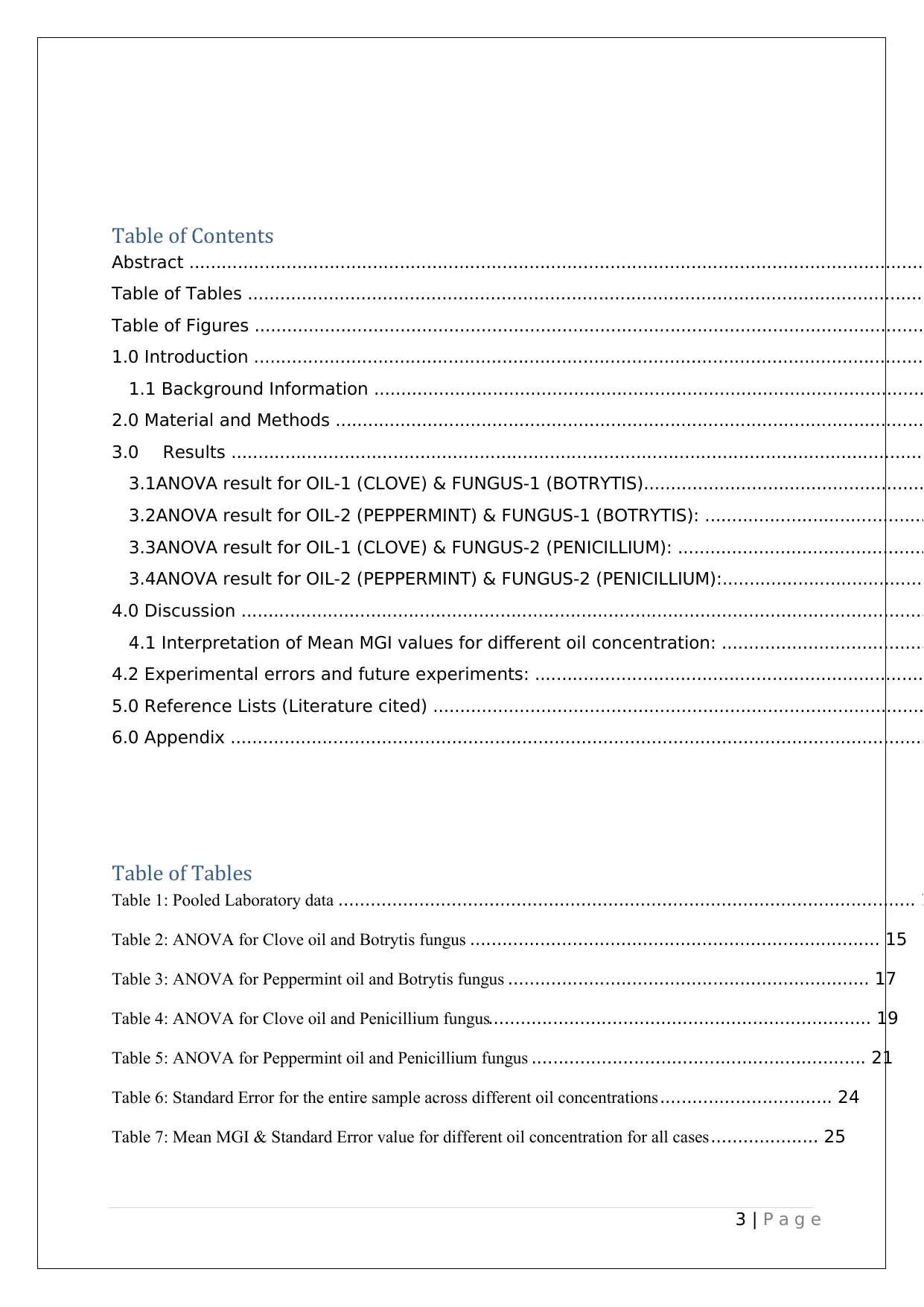
Table of Contents
Abstract .........................................................................................................................................
Table of Tables ..............................................................................................................................
Table of Figures ............................................................................................................................
1.0 Introduction .............................................................................................................................
1.1 Background Information ......................................................................................................
2.0 Material and Methods .............................................................................................................
3.0 Results .................................................................................................................................
3.1ANOVA result for OIL-1 (CLOVE) & FUNGUS-1 (BOTRYTIS)....................................................
3.2ANOVA result for OIL-2 (PEPPERMINT) & FUNGUS-1 (BOTRYTIS): .........................................
3.3ANOVA result for OIL-1 (CLOVE) & FUNGUS-2 (PENICILLIUM): ..............................................
3.4ANOVA result for OIL-2 (PEPPERMINT) & FUNGUS-2 (PENICILLIUM):......................................
4.0 Discussion ...............................................................................................................................
4.1 Interpretation of Mean MGI values for different oil concentration: ......................................
4.2 Experimental errors and future experiments: ........................................................................
5.0 Reference Lists (Literature cited) ...........................................................................................
6.0 Appendix .................................................................................................................................
Table of Tables
Table 1: Pooled Laboratory data ........................................................................................................... 1
Table 2: ANOVA for Clove oil and Botrytis fungus ............................................................................ 15
Table 3: ANOVA for Peppermint oil and Botrytis fungus ................................................................... 17
Table 4: ANOVA for Clove oil and Penicillium fungus....................................................................... 19
Table 5: ANOVA for Peppermint oil and Penicillium fungus .............................................................. 21
Table 6: Standard Error for the entire sample across different oil concentrations ................................ 24
Table 7: Mean MGI & Standard Error value for different oil concentration for all cases .................... 25
Table of Contents
Abstract .........................................................................................................................................
Table of Tables ..............................................................................................................................
Table of Figures ............................................................................................................................
1.0 Introduction .............................................................................................................................
1.1 Background Information ......................................................................................................
2.0 Material and Methods .............................................................................................................
3.0 Results .................................................................................................................................
3.1ANOVA result for OIL-1 (CLOVE) & FUNGUS-1 (BOTRYTIS)....................................................
3.2ANOVA result for OIL-2 (PEPPERMINT) & FUNGUS-1 (BOTRYTIS): .........................................
3.3ANOVA result for OIL-1 (CLOVE) & FUNGUS-2 (PENICILLIUM): ..............................................
3.4ANOVA result for OIL-2 (PEPPERMINT) & FUNGUS-2 (PENICILLIUM):......................................
4.0 Discussion ...............................................................................................................................
4.1 Interpretation of Mean MGI values for different oil concentration: ......................................
4.2 Experimental errors and future experiments: ........................................................................
5.0 Reference Lists (Literature cited) ...........................................................................................
6.0 Appendix .................................................................................................................................
Table of Tables
Table 1: Pooled Laboratory data ........................................................................................................... 1
Table 2: ANOVA for Clove oil and Botrytis fungus ............................................................................ 15
Table 3: ANOVA for Peppermint oil and Botrytis fungus ................................................................... 17
Table 4: ANOVA for Clove oil and Penicillium fungus....................................................................... 19
Table 5: ANOVA for Peppermint oil and Penicillium fungus .............................................................. 21
Table 6: Standard Error for the entire sample across different oil concentrations ................................ 24
Table 7: Mean MGI & Standard Error value for different oil concentration for all cases .................... 25
⊘ This is a preview!⊘
Do you want full access?
Subscribe today to unlock all pages.

Trusted by 1+ million students worldwide
4 | P a g e
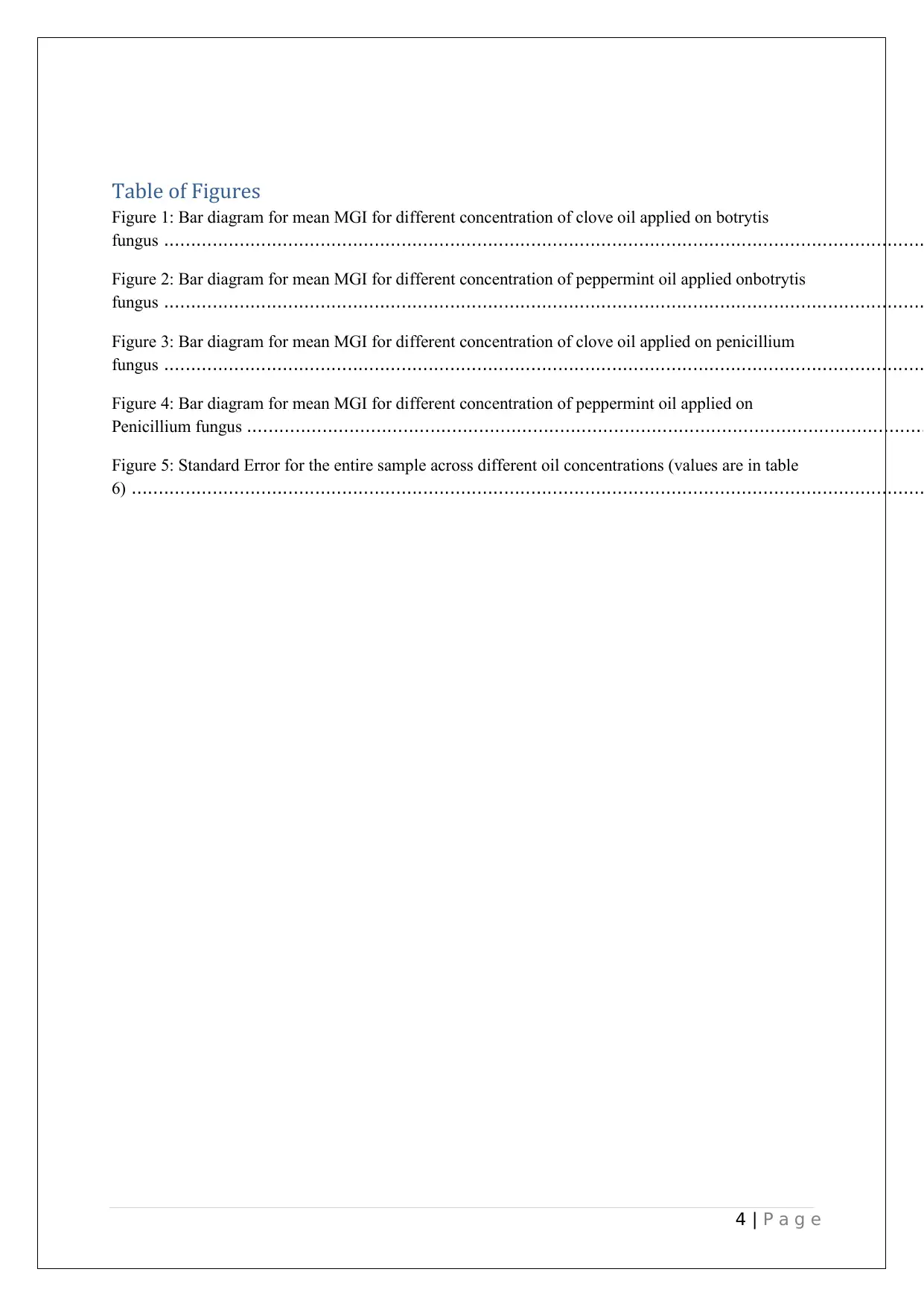
Table of Figures
Figure 1: Bar diagram for mean MGI for different concentration of clove oil applied on botrytis
fungus .............................................................................................................................................
Figure 2: Bar diagram for mean MGI for different concentration of peppermint oil applied onbotrytis
fungus .............................................................................................................................................
Figure 3: Bar diagram for mean MGI for different concentration of clove oil applied on penicillium
fungus .............................................................................................................................................
Figure 4: Bar diagram for mean MGI for different concentration of peppermint oil applied on
Penicillium fungus ..............................................................................................................................
Figure 5: Standard Error for the entire sample across different oil concentrations (values are in table
6) ...................................................................................................................................................
Table of Figures
Figure 1: Bar diagram for mean MGI for different concentration of clove oil applied on botrytis
fungus .............................................................................................................................................
Figure 2: Bar diagram for mean MGI for different concentration of peppermint oil applied onbotrytis
fungus .............................................................................................................................................
Figure 3: Bar diagram for mean MGI for different concentration of clove oil applied on penicillium
fungus .............................................................................................................................................
Figure 4: Bar diagram for mean MGI for different concentration of peppermint oil applied on
Penicillium fungus ..............................................................................................................................
Figure 5: Standard Error for the entire sample across different oil concentrations (values are in table
6) ...................................................................................................................................................
Paraphrase This Document
Need a fresh take? Get an instant paraphrase of this document with our AI Paraphraser
5 | P a g e
1.0 Introduction
Economic losses (Hocking, 1998) due to food spoilage and reduction in food quality
(Baratta,1998) has forced the usage of preservatives. The negative effects of the synthetic
preservatives especially sodium content has forced to fall for organic alternatives.The study
focussed on evaluating the antifungal activity of two fungi, based on two types of essential
oils (EOs). A laboratory experiment performed for analysing the fungi static activity of
essential oils (from plants extract) on varied fungal organism. Mycelium growth inhibition
(MGI) values recorded and studied for varied fungal organism as per application of different
concentration of essential oils. The synthetic fungicides used to control the growth of fungi
are not safe for indoor application or for food products. The adverse effects of these
additives on the health of living organisms have encouraged the use of antimicrobial plant
products.
For the purpose of this study, essential oils extracted from varied plants have been
used as Eugonel (73% pure extract from clove oil) and Menthol (50% pure active component
of peppermint oil). These oils are known to have antiviral, antifungal and antibacterial
properties as they slow down fungal growth by lowering mycotoxin production. The study
will conduct the antifungal analysis on botrytis and penicillium fungus.
1.1 Background Information
The study of antifungal properties of essential oils is due to the food safety and
longevity of fruits and packaged food items. In the situation of film-forming dispersions
when treated with 3% lemon essential oil, the properties of the strawberries such as acidity,
pH and soluble solid content were preserved throughout storage (Perdones, A., et al (2012)).
Earlier Matricaria chamomilla L. flower essential oil was used against Aspergillus Niger.
Remarkable inhibition of fungal growth was noticed. Positive effect of M. chamomilla L.
essential oil in preventing fungal growth was noticed. It helped in food storage in organic
1.0 Introduction
Economic losses (Hocking, 1998) due to food spoilage and reduction in food quality
(Baratta,1998) has forced the usage of preservatives. The negative effects of the synthetic
preservatives especially sodium content has forced to fall for organic alternatives.The study
focussed on evaluating the antifungal activity of two fungi, based on two types of essential
oils (EOs). A laboratory experiment performed for analysing the fungi static activity of
essential oils (from plants extract) on varied fungal organism. Mycelium growth inhibition
(MGI) values recorded and studied for varied fungal organism as per application of different
concentration of essential oils. The synthetic fungicides used to control the growth of fungi
are not safe for indoor application or for food products. The adverse effects of these
additives on the health of living organisms have encouraged the use of antimicrobial plant
products.
For the purpose of this study, essential oils extracted from varied plants have been
used as Eugonel (73% pure extract from clove oil) and Menthol (50% pure active component
of peppermint oil). These oils are known to have antiviral, antifungal and antibacterial
properties as they slow down fungal growth by lowering mycotoxin production. The study
will conduct the antifungal analysis on botrytis and penicillium fungus.
1.1 Background Information
The study of antifungal properties of essential oils is due to the food safety and
longevity of fruits and packaged food items. In the situation of film-forming dispersions
when treated with 3% lemon essential oil, the properties of the strawberries such as acidity,
pH and soluble solid content were preserved throughout storage (Perdones, A., et al (2012)).
Earlier Matricaria chamomilla L. flower essential oil was used against Aspergillus Niger.
Remarkable inhibition of fungal growth was noticed. Positive effect of M. chamomilla L.
essential oil in preventing fungal growth was noticed. It helped in food storage in organic
6 | P a g e
way (Tolouee, Marziyeh, et al (2010)). The extracts of M. piperita oil, Mentha spicata oil ,
Chamomilla oil, Ocimum basilicum oil also exhibited anti fungal properties and showed
prominent results (Soković, Marina, et al,2010). Based on the previous knowledge the
experiment was performed with two essential oils.
In this study or experiment, there are various null hypotheses were assumed.
0H : The concentration level of clove oil has no effect on the control of Botrytis fungal
growth.
Null hypothesis2: 0H : The concentration level of peppermint oil has no effect on the control
of Botrytis fungal growth.
Null hypothesis3: 0H : The concentration level of clove oil has no effect on the control of
penicillium fungal growth.
Null hypothesis4: 0H : The concentration level of peppermint oil has no effect on the control
of penicillium fungal growth.
The study was performed to determine the effect of essential oils on fungi growth.
Research for new antimicrobial agents from varied sources for combating microbial
resistance (Balouiri, Sadiki and Ibnsouda (2016)) is already in demand. Methods for in vitro
for analysing antimicrobial activity are a matter of interest. Hua, Xing, Selvaraj, Wang, Zhao,
Zhou, Liu and Liu (2014) article reviews role of essential oils as a form of bio control for
reducing fungal contamination of Ochratoxin A (OTA) (Hua,2014). Tian, Ban, Zeng, He,
Chen and Wang (2012) article analyses antifungal action from essential oil on Aspergillus
flavus (Tian, 2011). There are various previous studies performed in order to establish a
positive correlation of essential oils with inhibiting growth of fungi.
way (Tolouee, Marziyeh, et al (2010)). The extracts of M. piperita oil, Mentha spicata oil ,
Chamomilla oil, Ocimum basilicum oil also exhibited anti fungal properties and showed
prominent results (Soković, Marina, et al,2010). Based on the previous knowledge the
experiment was performed with two essential oils.
In this study or experiment, there are various null hypotheses were assumed.
0H : The concentration level of clove oil has no effect on the control of Botrytis fungal
growth.
Null hypothesis2: 0H : The concentration level of peppermint oil has no effect on the control
of Botrytis fungal growth.
Null hypothesis3: 0H : The concentration level of clove oil has no effect on the control of
penicillium fungal growth.
Null hypothesis4: 0H : The concentration level of peppermint oil has no effect on the control
of penicillium fungal growth.
The study was performed to determine the effect of essential oils on fungi growth.
Research for new antimicrobial agents from varied sources for combating microbial
resistance (Balouiri, Sadiki and Ibnsouda (2016)) is already in demand. Methods for in vitro
for analysing antimicrobial activity are a matter of interest. Hua, Xing, Selvaraj, Wang, Zhao,
Zhou, Liu and Liu (2014) article reviews role of essential oils as a form of bio control for
reducing fungal contamination of Ochratoxin A (OTA) (Hua,2014). Tian, Ban, Zeng, He,
Chen and Wang (2012) article analyses antifungal action from essential oil on Aspergillus
flavus (Tian, 2011). There are various previous studies performed in order to establish a
positive correlation of essential oils with inhibiting growth of fungi.
⊘ This is a preview!⊘
Do you want full access?
Subscribe today to unlock all pages.
Trusted by 1+ million students worldwide
7 | P a g e
In the experiment relative inhibition of treated colony as % of control (also called mycelial
growth inhibition or MGI = ([dc-dt]/dc) * 100.
Where dc = mean colony diameter for controls and dt = mean colony diameter for each
treatment.
2.0 Material and Methods
For the experiment purpose essential oil used is Clove oil and fungal organism used is
Botrytis sp. The following lab manual had been used for the purpose of materials and
methods related to the study (Hyldgaard, 2012). No changes were made to the scope of
following journal for the purpose of the study. Ciolfi, J. and Carpenter-Cleland, C. (2017).
Lab 4 Effect of Essential Oils on Fungal Growth. In BIOL 2P96 D3 2017FW Biology of
Fungi Lab Manual. St. Catharines; Brock University.
3.0 Results
3.1ANOVA result for OIL-1 (CLOVE) & FUNGUS-1 (BOTRYTIS)
The sampling mean for the sample was 79.64 where the standard error was 8.1332. Value of
the F-statistic = 5387.63 along with P-value for the ANOVA was less than 0.0001. Mean
MGI(s) for control plate was 0, 98.2 for 125 UL/L, 100 for 250 UL/L, 100 for 375 UL/L and
100 for 500 UL/L concentration of the oil. Standard errors for control plate were 0, 1.3565
for 125 UL/L, 0 for 250 UL/L, 0 for 375 UL/L and 0 for 500 UL/L concentration of the oil.
The control plate was the outlier and the data was skewed because of which large F value was
observed. Tukey HSD values were 2.57 for 5% level of significance and 3.22 for 1% level of
significance. Pair wise comparison between the mean MGI were insignificant for plates 2-5
In the experiment relative inhibition of treated colony as % of control (also called mycelial
growth inhibition or MGI = ([dc-dt]/dc) * 100.
Where dc = mean colony diameter for controls and dt = mean colony diameter for each
treatment.
2.0 Material and Methods
For the experiment purpose essential oil used is Clove oil and fungal organism used is
Botrytis sp. The following lab manual had been used for the purpose of materials and
methods related to the study (Hyldgaard, 2012). No changes were made to the scope of
following journal for the purpose of the study. Ciolfi, J. and Carpenter-Cleland, C. (2017).
Lab 4 Effect of Essential Oils on Fungal Growth. In BIOL 2P96 D3 2017FW Biology of
Fungi Lab Manual. St. Catharines; Brock University.
3.0 Results
3.1ANOVA result for OIL-1 (CLOVE) & FUNGUS-1 (BOTRYTIS)
The sampling mean for the sample was 79.64 where the standard error was 8.1332. Value of
the F-statistic = 5387.63 along with P-value for the ANOVA was less than 0.0001. Mean
MGI(s) for control plate was 0, 98.2 for 125 UL/L, 100 for 250 UL/L, 100 for 375 UL/L and
100 for 500 UL/L concentration of the oil. Standard errors for control plate were 0, 1.3565
for 125 UL/L, 0 for 250 UL/L, 0 for 375 UL/L and 0 for 500 UL/L concentration of the oil.
The control plate was the outlier and the data was skewed because of which large F value was
observed. Tukey HSD values were 2.57 for 5% level of significance and 3.22 for 1% level of
significance. Pair wise comparison between the mean MGI were insignificant for plates 2-5
Paraphrase This Document
Need a fresh take? Get an instant paraphrase of this document with our AI Paraphraser
8 | P a g e
whereas when compared with control plate the null hypothesis was rejected due to very small
(less than 0.01) p-values.
3.2ANOVA result for OIL-2 (PEPPERMINT) & FUNGUS-1 (BOTRYTIS):
The sampling mean for the sample was 75.88 where the standard error was 8.2864. Value of
the F-statistic = 47.02 along with P-value for the ANOVA was less than 0.0001. Mean
MGI(s) for control plate was 0, 81.2 for 125 UL/L, 98.2 for 250 UL/L, 100 for 375 UL/L and
100 for 500 UL/L concentration of the oil. Standard errors for control plate were 0, 13.9549
for 125 UL/L, 1.8 for 250 UL/L, 0 for 375 UL/L and 0 for 500 UL/L concentration of the oil.
The control plate was the outlier and the data was skewed. Tukey HSD values were 26.7 for
5% level of significance and 33.4 for 1% level of significance. Pair wise comparison between
the mean MGI were insignificant for plates 2-5 whereas when compared with control plate
the null hypothesis was rejected due to very small (less than 0.01) p-values.
3.3ANOVA result for OIL-1 (CLOVE) & FUNGUS-2 (PENICILLIUM):
The sampling mean for the sample was 75 where the standard error was 8.4459. Value of the
F-statistic = 35.38 along with P-value for the ANOVA was less than 0.0001. Mean MGI(s)
for control plate was 0, 75 for 125 UL/L, 100 for 250 UL/L, 100 for 375 UL/L and 100 for
500 UL/L concentration of the oil. Standard errors for control plate were 0, 15.2788 for 125
UL/L, 0 for 250 UL/L, 0 for 375 UL/L and 0 for 500 UL/L concentration of the oil.
Tukey HSD values were 30.89 for 5% level of significance and 38.65 for 1% level of
significance. Pair wise comparison between the mean MGI were insignificant for plates 2-5
whereas when compared with control plate the null hypothesis was rejected due to very small
(less than 0.01) p-values.
whereas when compared with control plate the null hypothesis was rejected due to very small
(less than 0.01) p-values.
3.2ANOVA result for OIL-2 (PEPPERMINT) & FUNGUS-1 (BOTRYTIS):
The sampling mean for the sample was 75.88 where the standard error was 8.2864. Value of
the F-statistic = 47.02 along with P-value for the ANOVA was less than 0.0001. Mean
MGI(s) for control plate was 0, 81.2 for 125 UL/L, 98.2 for 250 UL/L, 100 for 375 UL/L and
100 for 500 UL/L concentration of the oil. Standard errors for control plate were 0, 13.9549
for 125 UL/L, 1.8 for 250 UL/L, 0 for 375 UL/L and 0 for 500 UL/L concentration of the oil.
The control plate was the outlier and the data was skewed. Tukey HSD values were 26.7 for
5% level of significance and 33.4 for 1% level of significance. Pair wise comparison between
the mean MGI were insignificant for plates 2-5 whereas when compared with control plate
the null hypothesis was rejected due to very small (less than 0.01) p-values.
3.3ANOVA result for OIL-1 (CLOVE) & FUNGUS-2 (PENICILLIUM):
The sampling mean for the sample was 75 where the standard error was 8.4459. Value of the
F-statistic = 35.38 along with P-value for the ANOVA was less than 0.0001. Mean MGI(s)
for control plate was 0, 75 for 125 UL/L, 100 for 250 UL/L, 100 for 375 UL/L and 100 for
500 UL/L concentration of the oil. Standard errors for control plate were 0, 15.2788 for 125
UL/L, 0 for 250 UL/L, 0 for 375 UL/L and 0 for 500 UL/L concentration of the oil.
Tukey HSD values were 30.89 for 5% level of significance and 38.65 for 1% level of
significance. Pair wise comparison between the mean MGI were insignificant for plates 2-5
whereas when compared with control plate the null hypothesis was rejected due to very small
(less than 0.01) p-values.
9 | P a g e
3.4ANOVA result for OIL-2 (PEPPERMINT) & FUNGUS-2 (PENICILLIUM):
The sampling mean for the sample was 59.96 where the standard error was 7.6791. Value of
the F-statistic = 23.49 along with P-value for the ANOVA was less than 0.0001. Mean
MGI(s) for control plate was 0, 48.2 for 125 UL/L, 70 for 250 UL/L, 83.8 for 375 UL/L and
97.8 for 500 UL/L concentration of the oil. Standard errors for control plate were 0, 13.7419
for 125 UL/L, 7.9937 for 250 UL/L, 2.2 for 375 UL/L and 0 for 500 UL/L concentration of
the oil.
Tukey HSD values were 33.44 for 5% level of significance and 41.83 for 1% level of
significance. Pair wise comparison between the mean MGI of the control plate with other 4
concentrations ensured that the null hypothesis was rejected due to very small (less than 0.01)
p-values. Pair wise comparison of mean MGI score for 125 uL/L with 375 uL/L and 500uL/L
also gave p values less than 0.05 and 0.01 which showed that null hypothesis 4 was rejected.
4.0 Discussion
Botrytis Sp. and Penicillium Notatum are two kinds of fungi which are very important
in food and drug production.
The purpose of the laboratory experiment was to study the fungi static activity of two
essential oils namely clove oil (Eugonel) and peppermint oil (Menthol) against two fungi
Botrytis sp. and Penicillium Notatum (Sánchez-González, 2010).
Null hypothesis1: 0H : The concentration level of clove oil has no effect on the control of
Botrytis fungal growth.
Across the four different concentration levels and one control plate the overall
average MGI was 79.64 which indicated that on an average inhibition along the samples were
3.4ANOVA result for OIL-2 (PEPPERMINT) & FUNGUS-2 (PENICILLIUM):
The sampling mean for the sample was 59.96 where the standard error was 7.6791. Value of
the F-statistic = 23.49 along with P-value for the ANOVA was less than 0.0001. Mean
MGI(s) for control plate was 0, 48.2 for 125 UL/L, 70 for 250 UL/L, 83.8 for 375 UL/L and
97.8 for 500 UL/L concentration of the oil. Standard errors for control plate were 0, 13.7419
for 125 UL/L, 7.9937 for 250 UL/L, 2.2 for 375 UL/L and 0 for 500 UL/L concentration of
the oil.
Tukey HSD values were 33.44 for 5% level of significance and 41.83 for 1% level of
significance. Pair wise comparison between the mean MGI of the control plate with other 4
concentrations ensured that the null hypothesis was rejected due to very small (less than 0.01)
p-values. Pair wise comparison of mean MGI score for 125 uL/L with 375 uL/L and 500uL/L
also gave p values less than 0.05 and 0.01 which showed that null hypothesis 4 was rejected.
4.0 Discussion
Botrytis Sp. and Penicillium Notatum are two kinds of fungi which are very important
in food and drug production.
The purpose of the laboratory experiment was to study the fungi static activity of two
essential oils namely clove oil (Eugonel) and peppermint oil (Menthol) against two fungi
Botrytis sp. and Penicillium Notatum (Sánchez-González, 2010).
Null hypothesis1: 0H : The concentration level of clove oil has no effect on the control of
Botrytis fungal growth.
Across the four different concentration levels and one control plate the overall
average MGI was 79.64 which indicated that on an average inhibition along the samples were
⊘ This is a preview!⊘
Do you want full access?
Subscribe today to unlock all pages.
Trusted by 1+ million students worldwide
10 | P a g e
high. The concentration of 250uL/L, 375 uL/L and 500 uL/L completely (100%) inhibited the
Botrytis fungal growth. Standard error of 8.1332 implies that for 5% level of significance the
confidence interval for sampling mean is [71.5068, 87.7732].The F value of the ANOVA
clearly shows that calculated F value of 5387.63 which is extremely large and also p has
value less than 0.0001, which implies that the null hypothesis is rejected and it can be
concluded that clove oil has significant antifungal effect on Botrytis fungus.
Null hypothesis2: 0H : The concentration level of peppermint oil has no effect on the control
of Botrytis fungal growth.
Sampling average MGI was 75.88 and the concentrations of 375 uL/L and 500 uL/L
completely (100%) inhibited the Botrytis fungal growth whereas 125 uL/L and 250 uL/L
consistencies showed great positive result. Standard error of 8.2864 implies that for 5% level
of significance the confidence interval for sampling mean is [67.5936, 84.1664].The
calculated F value of 47.02 is sufficiently large and also p has value less than 0.0001, which
implies that the null hypothesis is rejected and it can be concluded that peppermint oil has
significantly positive antifungal effect on Botrytis fungus.
Null hypothesis3: 0H : The concentration level of clove oil has no effect on the control of
penicillium fungal growth.
Mean sampling MGI was 75 and the concentrations of 250 uL/L, 375 uL/L and 500
uL/L completely (100%) inhibited the Penicillium fungal growth. Standard error of 8.4459
implies that for 5% level of significance the accepting region for sampling mean is [66.5541,
83.4459].The ANOVA clearly shows that calculated F value of 35.38, which is sufficiently
large and also p has value less than 0.0001, hence the null hypothesis is rejected and it can be
concluded that clove oil has significantly positive antifungal effect on Penicillium fungus.
high. The concentration of 250uL/L, 375 uL/L and 500 uL/L completely (100%) inhibited the
Botrytis fungal growth. Standard error of 8.1332 implies that for 5% level of significance the
confidence interval for sampling mean is [71.5068, 87.7732].The F value of the ANOVA
clearly shows that calculated F value of 5387.63 which is extremely large and also p has
value less than 0.0001, which implies that the null hypothesis is rejected and it can be
concluded that clove oil has significant antifungal effect on Botrytis fungus.
Null hypothesis2: 0H : The concentration level of peppermint oil has no effect on the control
of Botrytis fungal growth.
Sampling average MGI was 75.88 and the concentrations of 375 uL/L and 500 uL/L
completely (100%) inhibited the Botrytis fungal growth whereas 125 uL/L and 250 uL/L
consistencies showed great positive result. Standard error of 8.2864 implies that for 5% level
of significance the confidence interval for sampling mean is [67.5936, 84.1664].The
calculated F value of 47.02 is sufficiently large and also p has value less than 0.0001, which
implies that the null hypothesis is rejected and it can be concluded that peppermint oil has
significantly positive antifungal effect on Botrytis fungus.
Null hypothesis3: 0H : The concentration level of clove oil has no effect on the control of
penicillium fungal growth.
Mean sampling MGI was 75 and the concentrations of 250 uL/L, 375 uL/L and 500
uL/L completely (100%) inhibited the Penicillium fungal growth. Standard error of 8.4459
implies that for 5% level of significance the accepting region for sampling mean is [66.5541,
83.4459].The ANOVA clearly shows that calculated F value of 35.38, which is sufficiently
large and also p has value less than 0.0001, hence the null hypothesis is rejected and it can be
concluded that clove oil has significantly positive antifungal effect on Penicillium fungus.
Paraphrase This Document
Need a fresh take? Get an instant paraphrase of this document with our AI Paraphraser
11 | P a g e
Null hypothesis4: 0H : The concentration level of peppermint oil has no effect on the control
of penicillium fungal growth.
Average MGI was 59.96 which indicate the fact that inhibition across the different
samples was satisfactory. In this case the mean MGI was the lowest. Here the result was very
interesting as increment in oil consistency of menthol extract from peppermint oil showed
gradual improvement in control of Penicillium fungus (Soylu, 2010). Standard error of
7.6791implies that for 5% level of significance the accepting region for sampling mean is
[52.2809, 67.6391].The ANOVA clearly shows that calculated F value of 23.49 which falls in
the critical region and also p has value less than 0.0001 which is less than 0.05, implies that
the null hypothesis is rejected and it can be concluded that peppermint oil has significantly
positive antifungal effect on Penicillium fungus.
4.1 Interpretation of Mean MGI values for different oil concentration:
From table 6 it was evident from mean MGI values of the sampling distribution that clove oil
with mean MGI scores 79.64 when inhibiting Botrytis fungus and 75.88 when inhibiting
Penicillium fungus was much more effective in controlling fungal growth than peppermint oil
with mean MGI scores 75 when inhibiting Botrytis fungus and 59.66 when inhibiting
Penicillium fungus under the current scope of experiment.
In addition, it is possible to conclude from mean MGI values that growth of Botrytis fungus
can be controlled more effectively than Penicillium fungus under the current scope of
experiment.
It was earlier observed that by using antimicrobial reagents on edible films microbiological
stability can be obtained. It also extended age of the food products and reduced the
probability of fungal growth on food outer surface as obtained p value was less than 0.05 in
Null hypothesis4: 0H : The concentration level of peppermint oil has no effect on the control
of penicillium fungal growth.
Average MGI was 59.96 which indicate the fact that inhibition across the different
samples was satisfactory. In this case the mean MGI was the lowest. Here the result was very
interesting as increment in oil consistency of menthol extract from peppermint oil showed
gradual improvement in control of Penicillium fungus (Soylu, 2010). Standard error of
7.6791implies that for 5% level of significance the accepting region for sampling mean is
[52.2809, 67.6391].The ANOVA clearly shows that calculated F value of 23.49 which falls in
the critical region and also p has value less than 0.0001 which is less than 0.05, implies that
the null hypothesis is rejected and it can be concluded that peppermint oil has significantly
positive antifungal effect on Penicillium fungus.
4.1 Interpretation of Mean MGI values for different oil concentration:
From table 6 it was evident from mean MGI values of the sampling distribution that clove oil
with mean MGI scores 79.64 when inhibiting Botrytis fungus and 75.88 when inhibiting
Penicillium fungus was much more effective in controlling fungal growth than peppermint oil
with mean MGI scores 75 when inhibiting Botrytis fungus and 59.66 when inhibiting
Penicillium fungus under the current scope of experiment.
In addition, it is possible to conclude from mean MGI values that growth of Botrytis fungus
can be controlled more effectively than Penicillium fungus under the current scope of
experiment.
It was earlier observed that by using antimicrobial reagents on edible films microbiological
stability can be obtained. It also extended age of the food products and reduced the
probability of fungal growth on food outer surface as obtained p value was less than 0.05 in
12 | P a g e
analysis of variance (Avila-Sosa,2012). The outcomes of this experiment also resembled the
very same fact.
4.2 Experimental errors and future experiments:
Considering the limited number of sample data and restricted number of fungus variety it can
be conclude that experiment outputs were still very productive in nature. It is also a matter of
fact that instead of 125 uL/L increases in magnitude of essential oil concentration gradual
increase may increase the probability of obtaining highly accurate and decisive statistical
data. Gradual increase in oil concentration will be highly recommendable, as it will create a
less skewed mean MGI graph for interpretation. Bigger diameter PDA plates can also be
considered given that the samples were studied for 7 days. The pooled data can also be
collected after every 2 days of incubation to distinguish the antifungal effect of both oils used
under varying concentration. Otherwise at higher concentration level the data becomes
indistinguishable due to 100% per cent inhibition of the fungus.
analysis of variance (Avila-Sosa,2012). The outcomes of this experiment also resembled the
very same fact.
4.2 Experimental errors and future experiments:
Considering the limited number of sample data and restricted number of fungus variety it can
be conclude that experiment outputs were still very productive in nature. It is also a matter of
fact that instead of 125 uL/L increases in magnitude of essential oil concentration gradual
increase may increase the probability of obtaining highly accurate and decisive statistical
data. Gradual increase in oil concentration will be highly recommendable, as it will create a
less skewed mean MGI graph for interpretation. Bigger diameter PDA plates can also be
considered given that the samples were studied for 7 days. The pooled data can also be
collected after every 2 days of incubation to distinguish the antifungal effect of both oils used
under varying concentration. Otherwise at higher concentration level the data becomes
indistinguishable due to 100% per cent inhibition of the fungus.
⊘ This is a preview!⊘
Do you want full access?
Subscribe today to unlock all pages.
Trusted by 1+ million students worldwide

1 out of 26


Your All-in-One AI-Powered Toolkit for Academic Success.
+13062052269
info@desklib.com
Available 24*7 on WhatsApp / Email
![[object Object]](/_next/static/media/star-bottom.7253800d.svg)
Unlock your academic potential
Copyright © 2020–2025 A2Z Services. All Rights Reserved. Developed and managed by ZUCOL.