Critical Thinking Essays: Future Economies and Social App Impacts
VerifiedAdded on 2021/06/15
|8
|1879
|42
Essay
AI Summary
This document presents two essays on critical thinking. The first essay analyzes the changes in future economies and their impact on the environment, discussing the correlation between income and environmental protection. It explores economic growth models, the Environmental Kuznets Curve, and predictions from PWC Global regarding global GDP shifts by 2050, highlighting the rise of emerging economies. The second essay examines the 'economy of love' and its influence on social app marketing, especially dating apps. It discusses how these apps optimize relationships, model human behavior through the 'Homo Economicus' concept, and leverage the release of oxytocin to foster user engagement and trust. The essay concludes by emphasizing the expanding role of the economy of love in the digital age, particularly through social apps.
Running head: ESSAYS ON CRITICAL THINKING
Essays on Critical Thinking
Name of the Student:
Name of the University:
Author Note:
Essays on Critical Thinking
Name of the Student:
Name of the University:
Author Note:

Paraphrase This Document
Need a fresh take? Get an instant paraphrase of this document with our AI Paraphraser
1ESSAYS ON CRITICAL THINKING
Assignment 1.
Future Environments And Future Economies
The paper elaborately describes the changes of the future economy and the impact of
the economy on the future environment. It also discusses the cognitive factors, responsible
for the future economic growth. It is important to mention that there is a strong correlation
between the income of a person and the extent to which the person takes environmental
protection measures. The environmental improvement is fastest when the economic growth is
positive1.
Th1e primary driving forces of the economic growth should be addressed well to
understand the economic growth. Let it be assumed that the production function Y be a linear
homogeneous function of the production function.
Thus, the relationship is expressed as, Y = f(L, τ, K, IMR) where,
L= labor input, τ = the state of technology, K = capital equipment, and IMR = access
to foreign resources22.
It is worth mentioning that, a controversial and robust relationship exists between
economic growth and environmental development. Increase in the increasing economic
activity needs energy and material inputs on a large scale. The environmental degradation
like waste accumulation, the presence of pollutants and the depletion of natural resources and
many more, would result in the decline of the welfare of human lives even if the income level
is rising that is, the economic activity will be at risk if the natural resources get wasted. It
should be noted that only a steady-state economy would save the environment as well as the
1 Panayotou, Theodore. "Economic growth and the environment." The environment in anthropology (2016):
140-148.
2 Krelle, Wilhelm, ed. The future of the world economy: economic growth and structural change. Springer
Science & Business Media, 2013.
Assignment 1.
Future Environments And Future Economies
The paper elaborately describes the changes of the future economy and the impact of
the economy on the future environment. It also discusses the cognitive factors, responsible
for the future economic growth. It is important to mention that there is a strong correlation
between the income of a person and the extent to which the person takes environmental
protection measures. The environmental improvement is fastest when the economic growth is
positive1.
Th1e primary driving forces of the economic growth should be addressed well to
understand the economic growth. Let it be assumed that the production function Y be a linear
homogeneous function of the production function.
Thus, the relationship is expressed as, Y = f(L, τ, K, IMR) where,
L= labor input, τ = the state of technology, K = capital equipment, and IMR = access
to foreign resources22.
It is worth mentioning that, a controversial and robust relationship exists between
economic growth and environmental development. Increase in the increasing economic
activity needs energy and material inputs on a large scale. The environmental degradation
like waste accumulation, the presence of pollutants and the depletion of natural resources and
many more, would result in the decline of the welfare of human lives even if the income level
is rising that is, the economic activity will be at risk if the natural resources get wasted. It
should be noted that only a steady-state economy would save the environment as well as the
1 Panayotou, Theodore. "Economic growth and the environment." The environment in anthropology (2016):
140-148.
2 Krelle, Wilhelm, ed. The future of the world economy: economic growth and structural change. Springer
Science & Business Media, 2013.
2ESSAYS ON CRITICAL THINKING
economic activity. A nations' economic growth will provide money to the country, and the
government can utilise that money to create parks, reserves and also can implement primary
policies for environment conservation. Thus, economic growth ensures the protection of the
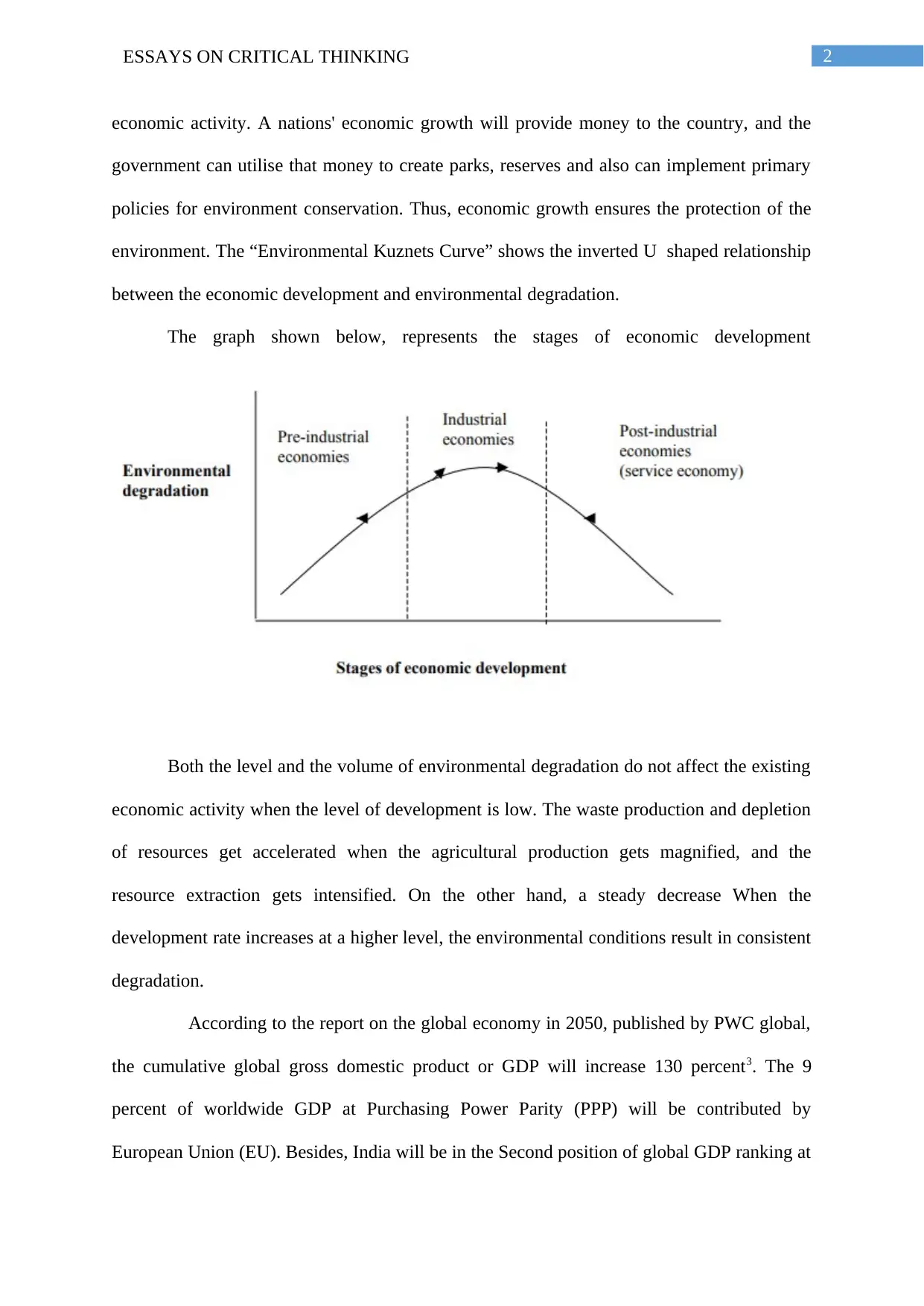
environment. The “Environmental Kuznets Curve” shows the inverted U shaped relationship
between the economic development and environmental degradation.
The graph shown below, represents the stages of economic development
Both the level and the volume of environmental degradation do not affect the existing
economic activity when the level of development is low. The waste production and depletion
of resources get accelerated when the agricultural production gets magnified, and the
resource extraction gets intensified. On the other hand, a steady decrease When the
development rate increases at a higher level, the environmental conditions result in consistent
degradation.
According to the report on the global economy in 2050, published by PWC global,
the cumulative global gross domestic product or GDP will increase 130 percent3. The 9
percent of worldwide GDP at Purchasing Power Parity (PPP) will be contributed by
European Union (EU). Besides, India will be in the Second position of global GDP ranking at
economic activity. A nations' economic growth will provide money to the country, and the
government can utilise that money to create parks, reserves and also can implement primary
policies for environment conservation. Thus, economic growth ensures the protection of the
environment. The “Environmental Kuznets Curve” shows the inverted U shaped relationship
between the economic development and environmental degradation.
The graph shown below, represents the stages of economic development
Both the level and the volume of environmental degradation do not affect the existing
economic activity when the level of development is low. The waste production and depletion
of resources get accelerated when the agricultural production gets magnified, and the
resource extraction gets intensified. On the other hand, a steady decrease When the
development rate increases at a higher level, the environmental conditions result in consistent
degradation.
According to the report on the global economy in 2050, published by PWC global,
the cumulative global gross domestic product or GDP will increase 130 percent3. The 9
percent of worldwide GDP at Purchasing Power Parity (PPP) will be contributed by
European Union (EU). Besides, India will be in the Second position of global GDP ranking at
⊘ This is a preview!⊘
Do you want full access?
Subscribe today to unlock all pages.

Trusted by 1+ million students worldwide
3ESSAYS ON CRITICAL THINKING
PPP which is ahead of US but just behind China where China will share 20 percent of the
worldwide GDP at PPP by 2050. The consistent improvement on technology-driven services
and products, the global economy may get doubled in 2050. Besides, the growth of emerging
market (E7) will be enhanced twice just like the advanced economies (G7). It will represent
six of the seven largest economies as emerging economies in 2050 where China will lead the
first position, India will be in the second position, and Indonesia will be in the fourth
position. Mexico may overtake The United Kingdom (UK), and the UK may go down to 10th
position by 2050. Similarly, Turkey and Vietnam will respectively leave France out of top ten
and Italy out of top twenty. It is suggested that the emerging economies should improve their
economic infrastructure to retain potentiality in long-term economic growth33.
The above discussion concludes that in the near future, the world’s economic scenario
and the environmental landscape will face drastic change. Within 2050, most of the world’s
present powerful economies will lose their position from the global rankings, and the seats
will be replaced by emerging economies of the developing countries like Indonesia and India.
Thus, the environmental constraints, affected by the pressures of population growth, low per
capita income and many more, need improvement to get a better socio-economic growth and
finally, the growth supersedes the environment.
3 'The World In 2050' (PwC, 2018) <https://www.pwc.com/gx/en/issues/economy/the-world-in-2050.html>
accessed 10 May 2018.
PPP which is ahead of US but just behind China where China will share 20 percent of the
worldwide GDP at PPP by 2050. The consistent improvement on technology-driven services
and products, the global economy may get doubled in 2050. Besides, the growth of emerging
market (E7) will be enhanced twice just like the advanced economies (G7). It will represent
six of the seven largest economies as emerging economies in 2050 where China will lead the
first position, India will be in the second position, and Indonesia will be in the fourth
position. Mexico may overtake The United Kingdom (UK), and the UK may go down to 10th
position by 2050. Similarly, Turkey and Vietnam will respectively leave France out of top ten
and Italy out of top twenty. It is suggested that the emerging economies should improve their
economic infrastructure to retain potentiality in long-term economic growth33.
The above discussion concludes that in the near future, the world’s economic scenario
and the environmental landscape will face drastic change. Within 2050, most of the world’s
present powerful economies will lose their position from the global rankings, and the seats
will be replaced by emerging economies of the developing countries like Indonesia and India.
Thus, the environmental constraints, affected by the pressures of population growth, low per
capita income and many more, need improvement to get a better socio-economic growth and
finally, the growth supersedes the environment.
3 'The World In 2050' (PwC, 2018) <https://www.pwc.com/gx/en/issues/economy/the-world-in-2050.html>
accessed 10 May 2018.
Paraphrase This Document
Need a fresh take? Get an instant paraphrase of this document with our AI Paraphraser
4ESSAYS ON CRITICAL THINKING
References
Krelle, Wilhelm, ed. The future of the world economy: economic growth and structural
change. Springer Science & Business Media, 2013.
Panayotou, Theodore. "Economic growth and the environment." The environment in
anthropology (2016): 140-148.
'The World In 2050' (PwC, 2018) <https://www.pwc.com/gx/en/issues/economy/the-world-
in-2050.html> accessed 10 May 2018.
References
Krelle, Wilhelm, ed. The future of the world economy: economic growth and structural
change. Springer Science & Business Media, 2013.
Panayotou, Theodore. "Economic growth and the environment." The environment in
anthropology (2016): 140-148.
'The World In 2050' (PwC, 2018) <https://www.pwc.com/gx/en/issues/economy/the-world-
in-2050.html> accessed 10 May 2018.
5ESSAYS ON CRITICAL THINKING
Assignment 2.
Social Apps: Economy Of Love
According to the theory of economy of love, the more one spreads love, the more love
one receives. Thus the economy of love indicates the perception to analyse anything using
one’s heart, not only one’s head4. This paper shows the critical analysis of the impact of the
economy of love on the marketing strategy of the social apps. Besides, it also shows how
human behaviour is modelled and human being is characterised as “Homo Economicus”.
“Homo Economicus” is a term that is used by economists to describe a figurative human
being who can make infinite rational commitments5.
The words “economy” and “love” rarely come in a single sentence. A critical aim of
the economy is to economise any waste even time too so that all the activity becomes
effectively purposive. Through the use of the dating apps, the romance and the love among
people is getting optimised. The era of social apps where the relationships, emotions and
social media go hand-in-hand, the love apps and the social apps are like hot money, and the
dating apps’ market will be emerging day by day until people look for love. According to a
report, the dating market is generating more than 1,281.2 million US dollars at the end of
20176. If someone wants to be joyous and fully engaged, then he or she can get it very
quickly through the use of social apps because the social apps have made a world where
everyone is given equal importance. The politics of hatred is being removed, and everyone is
getting closer with the help of social apps. This change is bringing a revolution in the society,
and the world is becoming a world of love7.
According to the perception of some economists, money can measure the preferences
and interests of human being and money can fathom the cost of love. People calculate the
costs and benefits while choosing their life partner8. It is worth mentioning that dating apps
are taking two people closer, connecting people more and helping people to be happy, to feel
more beautiful. The more a person involves himself in the social apps, the more he is
following the path of the economy of love, the more he is getting attachments from other
person and the more he is socialising himself. In the world of competitive relationships,
people try to fit in a relationship to be together harmoniously. The human behaviour is
aligned with the social apps now-a-days9. This generation is obsessed with finding love using
social apps. It is super easy to get connected with anyone instantly from any part of the world
with the help of social apps. Most of the social apps which help you to find your love are
4 Vitalevna, Grigoreva Olga, Yakovleva Elena Ljudvigovna, and Seliverstova Natalia Sergeevna. "Human
behavior in digital economy: the maim trends." (2017).
5 Morrison, Carey-Ann, Lynda Johnston, and Robyn Longhurst. "Critical geographies of love as spatial,
relational and political." Progress in Human Geography 37.4 (2013): 505-521.
6 Scharmer, C. Otto, and Katrin Kaufer. Leading from the emerging future: From ego-system to eco-system
economies. Berrett-Koehler Publishers, 2013.
7 McCulley, Paul, and Zoltan Pozsar. "Helicopter money: or how I stopped worrying and love fiscal-monetary
cooperation." Global Society of Fellows 7 (2013).
8 Fidrmuc, Jan, and Ariane Tichit. "How I learned to stop worrying and love the crisis." Economic Systems 37.4
(2013): 542-554.
9 Champ, Bruce, Scott Freeman, and Joseph Haslag. Modeling monetary economies. Cambridge University
Press, 2016.
Assignment 2.
Social Apps: Economy Of Love
According to the theory of economy of love, the more one spreads love, the more love
one receives. Thus the economy of love indicates the perception to analyse anything using
one’s heart, not only one’s head4. This paper shows the critical analysis of the impact of the
economy of love on the marketing strategy of the social apps. Besides, it also shows how
human behaviour is modelled and human being is characterised as “Homo Economicus”.
“Homo Economicus” is a term that is used by economists to describe a figurative human
being who can make infinite rational commitments5.
The words “economy” and “love” rarely come in a single sentence. A critical aim of
the economy is to economise any waste even time too so that all the activity becomes
effectively purposive. Through the use of the dating apps, the romance and the love among
people is getting optimised. The era of social apps where the relationships, emotions and
social media go hand-in-hand, the love apps and the social apps are like hot money, and the
dating apps’ market will be emerging day by day until people look for love. According to a
report, the dating market is generating more than 1,281.2 million US dollars at the end of
20176. If someone wants to be joyous and fully engaged, then he or she can get it very
quickly through the use of social apps because the social apps have made a world where
everyone is given equal importance. The politics of hatred is being removed, and everyone is
getting closer with the help of social apps. This change is bringing a revolution in the society,
and the world is becoming a world of love7.
According to the perception of some economists, money can measure the preferences
and interests of human being and money can fathom the cost of love. People calculate the
costs and benefits while choosing their life partner8. It is worth mentioning that dating apps
are taking two people closer, connecting people more and helping people to be happy, to feel
more beautiful. The more a person involves himself in the social apps, the more he is
following the path of the economy of love, the more he is getting attachments from other
person and the more he is socialising himself. In the world of competitive relationships,
people try to fit in a relationship to be together harmoniously. The human behaviour is
aligned with the social apps now-a-days9. This generation is obsessed with finding love using
social apps. It is super easy to get connected with anyone instantly from any part of the world
with the help of social apps. Most of the social apps which help you to find your love are
4 Vitalevna, Grigoreva Olga, Yakovleva Elena Ljudvigovna, and Seliverstova Natalia Sergeevna. "Human
behavior in digital economy: the maim trends." (2017).
5 Morrison, Carey-Ann, Lynda Johnston, and Robyn Longhurst. "Critical geographies of love as spatial,
relational and political." Progress in Human Geography 37.4 (2013): 505-521.
6 Scharmer, C. Otto, and Katrin Kaufer. Leading from the emerging future: From ego-system to eco-system
economies. Berrett-Koehler Publishers, 2013.
7 McCulley, Paul, and Zoltan Pozsar. "Helicopter money: or how I stopped worrying and love fiscal-monetary
cooperation." Global Society of Fellows 7 (2013).
8 Fidrmuc, Jan, and Ariane Tichit. "How I learned to stop worrying and love the crisis." Economic Systems 37.4
(2013): 542-554.
9 Champ, Bruce, Scott Freeman, and Joseph Haslag. Modeling monetary economies. Cambridge University
Press, 2016.
⊘ This is a preview!⊘
Do you want full access?
Subscribe today to unlock all pages.
Trusted by 1+ million students worldwide
6ESSAYS ON CRITICAL THINKING
cost-free. However, some social apps are paid. Thus there is enormous growth and income
opportunities out there in the business of social apps for tech-savvy entrepreneurs10.
The human beings can be understood as economic species. Oxytocin, also known as
the love hormone, is the primary factor for the unswerving attachment between two
individuals who are compassionate to each other about love. Oxytocin is the stimulant for
empathy, trust, generosity, and more. It acts as a social adhesive that adheres societies,
communities, and ultimately bonds the entire world by working as an economic lubricant,
enabling the engagement in all types of transactions. Thus, the oxytocin is released in the
brain of an individual when someone trusts him, and it also leads him to reciprocates trusts to
be trustworthy. Each social app is trying to be reliable to people to gain economic benefits.
Therefore, the founders of those social apps try to release oxytocin of people to be seen as
trustworthy so that people can feel thrilled to engage themselves in the social apps for
engagement11.
From the above discussion, one can conclude that the utilisation of the rule of
economy of love is expanding as the owners of the social apps are trying to engage people by
reciprocating faith. The fresh start for civil society, the beginning can be done holding the
path of the economy of love, and that can be done using social apps, more explicitly dating
apps which has brought people nearer, breaking all the barriers.
10 Gilpin, Robert. The political economy of international relations. Princeton University Press, 2016.
11 Kenney, Martin, and John Zysman. "The rise of the platform economy." Issues in Science and Technology
32.3 (2016): 61.
cost-free. However, some social apps are paid. Thus there is enormous growth and income
opportunities out there in the business of social apps for tech-savvy entrepreneurs10.
The human beings can be understood as economic species. Oxytocin, also known as
the love hormone, is the primary factor for the unswerving attachment between two
individuals who are compassionate to each other about love. Oxytocin is the stimulant for
empathy, trust, generosity, and more. It acts as a social adhesive that adheres societies,
communities, and ultimately bonds the entire world by working as an economic lubricant,
enabling the engagement in all types of transactions. Thus, the oxytocin is released in the
brain of an individual when someone trusts him, and it also leads him to reciprocates trusts to
be trustworthy. Each social app is trying to be reliable to people to gain economic benefits.
Therefore, the founders of those social apps try to release oxytocin of people to be seen as
trustworthy so that people can feel thrilled to engage themselves in the social apps for
engagement11.
From the above discussion, one can conclude that the utilisation of the rule of
economy of love is expanding as the owners of the social apps are trying to engage people by
reciprocating faith. The fresh start for civil society, the beginning can be done holding the
path of the economy of love, and that can be done using social apps, more explicitly dating
apps which has brought people nearer, breaking all the barriers.
10 Gilpin, Robert. The political economy of international relations. Princeton University Press, 2016.
11 Kenney, Martin, and John Zysman. "The rise of the platform economy." Issues in Science and Technology
32.3 (2016): 61.
Paraphrase This Document
Need a fresh take? Get an instant paraphrase of this document with our AI Paraphraser
7ESSAYS ON CRITICAL THINKING
References
Champ, Bruce, Scott Freeman, and Joseph Haslag. Modeling monetary economies.
Cambridge University Press, 2016.
Fidrmuc, Jan, and Ariane Tichit. "How I learned to stop worrying and love the crisis."
Economic Systems 37.4 (2013): 542-554.
Gilpin, Robert. The political economy of international relations. Princeton University Press,
2016.
Kenney, Martin, and John Zysman. "The rise of the platform economy." Issues in Science
and Technology 32.3 (2016): 61.
McCulley, Paul, and Zoltan Pozsar. "Helicopter money: or how I stopped worrying and love
fiscal-monetary cooperation." Global Society of Fellows 7 (2013).
Morrison, Carey-Ann, Lynda Johnston, and Robyn Longhurst. "Critical geographies of love
as spatial, relational and political." Progress in Human Geography 37.4 (2013): 505-521.
Scharmer, C. Otto, and Katrin Kaufer. Leading from the emerging future: From ego-system
to eco-system economies. Berrett-Koehler Publishers, 2013.
Vitalevna, Grigoreva Olga, Yakovleva Elena Ljudvigovna, and Seliverstova Natalia
Sergeevna. "Human behavior in digital economy: the maim trends." (2017).
References
Champ, Bruce, Scott Freeman, and Joseph Haslag. Modeling monetary economies.
Cambridge University Press, 2016.
Fidrmuc, Jan, and Ariane Tichit. "How I learned to stop worrying and love the crisis."
Economic Systems 37.4 (2013): 542-554.
Gilpin, Robert. The political economy of international relations. Princeton University Press,
2016.
Kenney, Martin, and John Zysman. "The rise of the platform economy." Issues in Science
and Technology 32.3 (2016): 61.
McCulley, Paul, and Zoltan Pozsar. "Helicopter money: or how I stopped worrying and love
fiscal-monetary cooperation." Global Society of Fellows 7 (2013).
Morrison, Carey-Ann, Lynda Johnston, and Robyn Longhurst. "Critical geographies of love
as spatial, relational and political." Progress in Human Geography 37.4 (2013): 505-521.
Scharmer, C. Otto, and Katrin Kaufer. Leading from the emerging future: From ego-system
to eco-system economies. Berrett-Koehler Publishers, 2013.
Vitalevna, Grigoreva Olga, Yakovleva Elena Ljudvigovna, and Seliverstova Natalia
Sergeevna. "Human behavior in digital economy: the maim trends." (2017).

1 out of 8


Related Documents


Your All-in-One AI-Powered Toolkit for Academic Success.
+13062052269
info@desklib.com
Available 24*7 on WhatsApp / Email
![[object Object]](/_next/static/media/star-bottom.7253800d.svg)
Unlock your academic potential
Copyright © 2020–2026 A2Z Services. All Rights Reserved. Developed and managed by ZUCOL.