Motivation Theories in Practice: A Tesco Case Study (FY021)

Verified

Added on  2023/06/12

|6
|1391
|442
Case Study
AI Summary
This case study examines Tesco's approach to enhancing employee motivation through the application of motivational theories. It focuses on two key theories: Maslow's Hierarchy of Needs and Herzberg's Two-Factor Theory. The analysis explores how Tesco can utilize these theories to improve employee performance, increase job satisfaction, and reduce turnover. Maslow's theory suggests fulfilling employees' physiological, safety, social, esteem, and self-actualization needs, while Herzberg's theory emphasizes motivators like achievement and recognition, and hygiene factors such as company policies and working conditions. The report concludes that a comprehensive understanding and implementation of these theories are crucial for Tesco to foster a motivated and productive workforce.
Document Page
A CASE STUDY
tabler-icon-diamond-filled.svg

Paraphrase This Document

Need a fresh take? Get an instant paraphrase of this document with our AI Paraphraser
Document Page
Table of Contents
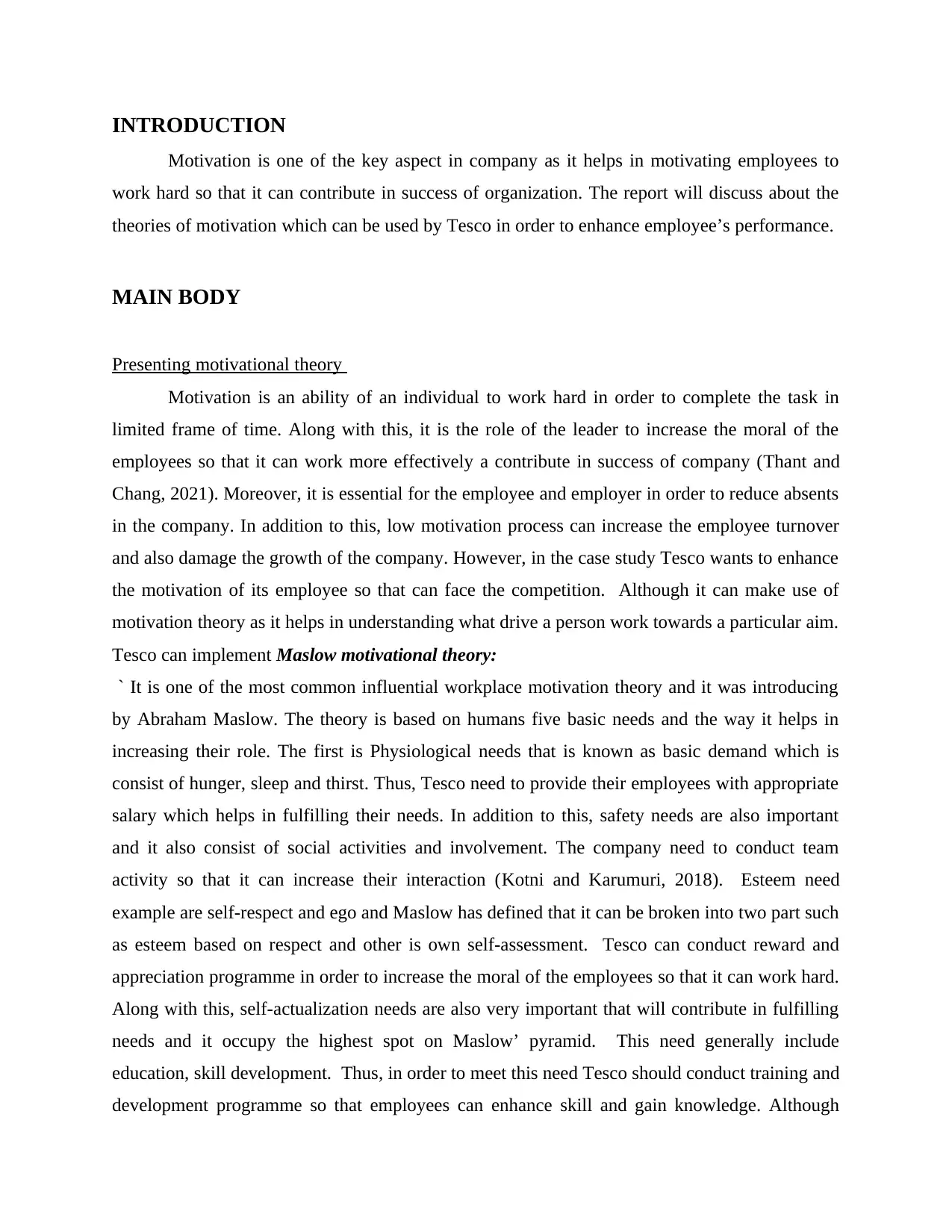
INTRODUCTION...........................................................................................................................3
MAIN BODY..................................................................................................................................3
Presenting motivational theory....................................................................................................3
CONCLUSION................................................................................................................................5
REFERENCES................................................................................................................................1
Document Page
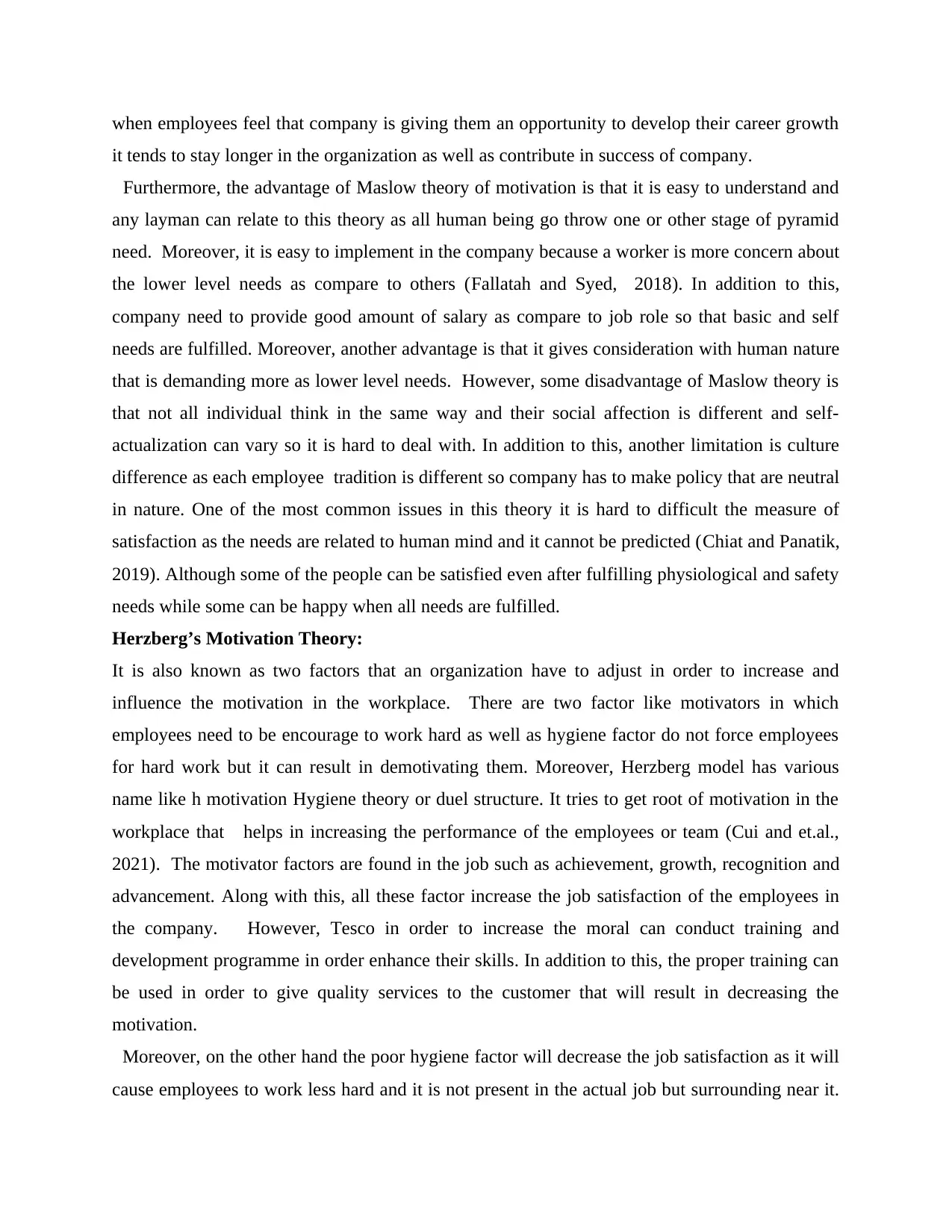
INTRODUCTION
Motivation is one of the key aspect in company as it helps in motivating employees to
work hard so that it can contribute in success of organization. The report will discuss about the
theories of motivation which can be used by Tesco in order to enhance employee’s performance.
MAIN BODY
Presenting motivational theory
Motivation is an ability of an individual to work hard in order to complete the task in
limited frame of time. Along with this, it is the role of the leader to increase the moral of the
employees so that it can work more effectively a contribute in success of company (Thant and
Chang, 2021). Moreover, it is essential for the employee and employer in order to reduce absents
in the company. In addition to this, low motivation process can increase the employee turnover
and also damage the growth of the company. However, in the case study Tesco wants to enhance
the motivation of its employee so that can face the competition. Although it can make use of
motivation theory as it helps in understanding what drive a person work towards a particular aim.
Tesco can implement Maslow motivational theory:
` It is one of the most common influential workplace motivation theory and it was introducing
by Abraham Maslow. The theory is based on humans five basic needs and the way it helps in
increasing their role. The first is Physiological needs that is known as basic demand which is
consist of hunger, sleep and thirst. Thus, Tesco need to provide their employees with appropriate
salary which helps in fulfilling their needs. In addition to this, safety needs are also important
and it also consist of social activities and involvement. The company need to conduct team
activity so that it can increase their interaction (Kotni and Karumuri, 2018). Esteem need
example are self-respect and ego and Maslow has defined that it can be broken into two part such
as esteem based on respect and other is own self-assessment. Tesco can conduct reward and
appreciation programme in order to increase the moral of the employees so that it can work hard.
Along with this, self-actualization needs are also very important that will contribute in fulfilling
needs and it occupy the highest spot on Maslow’ pyramid. This need generally include
education, skill development. Thus, in order to meet this need Tesco should conduct training and
development programme so that employees can enhance skill and gain knowledge. Although
Document Page
when employees feel that company is giving them an opportunity to develop their career growth
it tends to stay longer in the organization as well as contribute in success of company.
Furthermore, the advantage of Maslow theory of motivation is that it is easy to understand and
any layman can relate to this theory as all human being go throw one or other stage of pyramid
need. Moreover, it is easy to implement in the company because a worker is more concern about
the lower level needs as compare to others (Fallatah and Syed, 2018). In addition to this,
company need to provide good amount of salary as compare to job role so that basic and self
needs are fulfilled. Moreover, another advantage is that it gives consideration with human nature
that is demanding more as lower level needs. However, some disadvantage of Maslow theory is
that not all individual think in the same way and their social affection is different and self-
actualization can vary so it is hard to deal with. In addition to this, another limitation is culture
difference as each employee tradition is different so company has to make policy that are neutral
in nature. One of the most common issues in this theory it is hard to difficult the measure of
satisfaction as the needs are related to human mind and it cannot be predicted (Chiat and Panatik,
2019). Although some of the people can be satisfied even after fulfilling physiological and safety
needs while some can be happy when all needs are fulfilled.
Herzberg’s Motivation Theory:
It is also known as two factors that an organization have to adjust in order to increase and
influence the motivation in the workplace. There are two factor like motivators in which
employees need to be encourage to work hard as well as hygiene factor do not force employees
for hard work but it can result in demotivating them. Moreover, Herzberg model has various
name like h motivation Hygiene theory or duel structure. It tries to get root of motivation in the
workplace that helps in increasing the performance of the employees or team (Cui and et.al.,
2021). The motivator factors are found in the job such as achievement, growth, recognition and
advancement. Along with this, all these factor increase the job satisfaction of the employees in
the company. However, Tesco in order to increase the moral can conduct training and
development programme in order enhance their skills. In addition to this, the proper training can
be used in order to give quality services to the customer that will result in decreasing the
motivation.
Moreover, on the other hand the poor hygiene factor will decrease the job satisfaction as it will
cause employees to work less hard and it is not present in the actual job but surrounding near it.
tabler-icon-diamond-filled.svg

Paraphrase This Document

Need a fresh take? Get an instant paraphrase of this document with our AI Paraphraser
Document Page
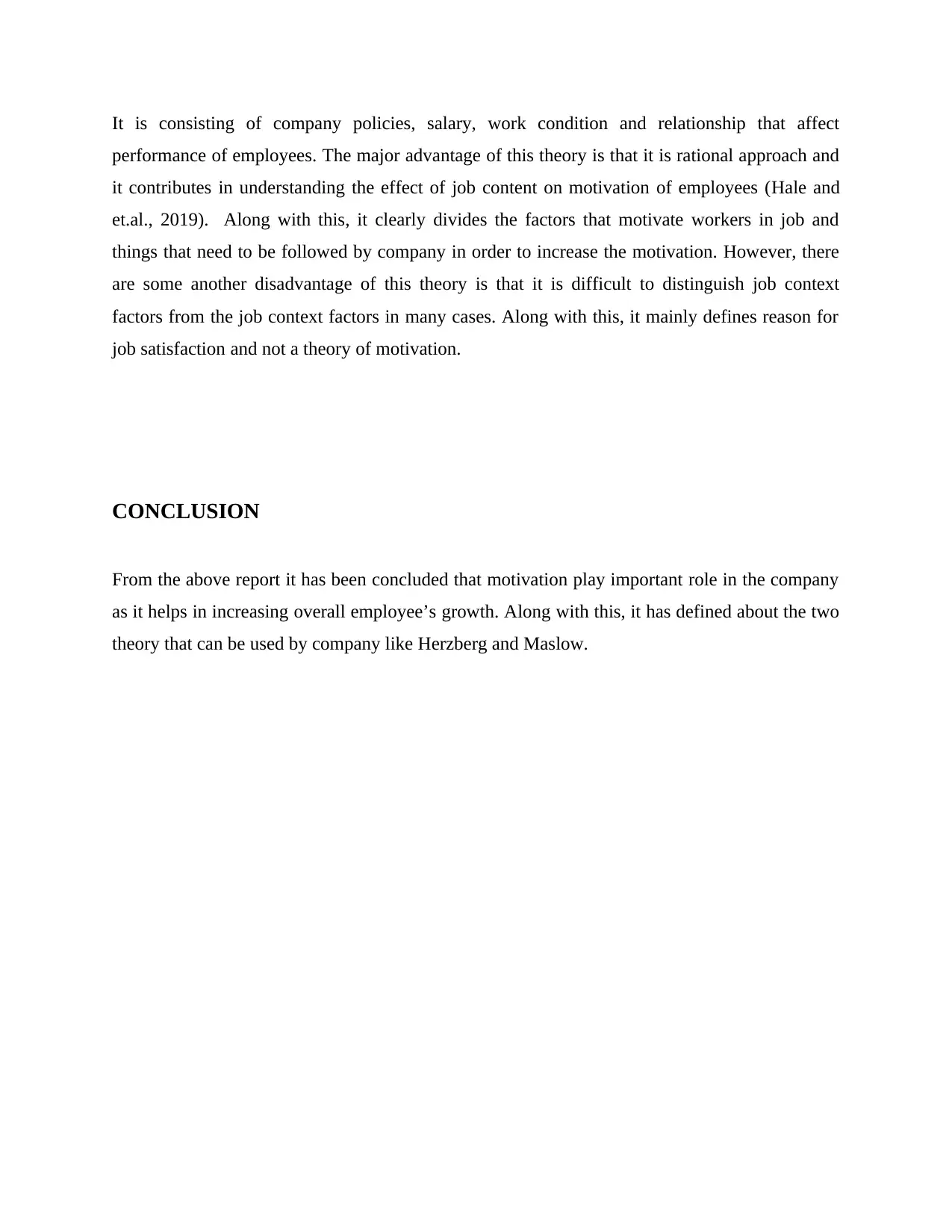
It is consisting of company policies, salary, work condition and relationship that affect
performance of employees. The major advantage of this theory is that it is rational approach and
it contributes in understanding the effect of job content on motivation of employees (Hale and
et.al., 2019). Along with this, it clearly divides the factors that motivate workers in job and
things that need to be followed by company in order to increase the motivation. However, there
are some another disadvantage of this theory is that it is difficult to distinguish job context
factors from the job context factors in many cases. Along with this, it mainly defines reason for
job satisfaction and not a theory of motivation.
CONCLUSION
From the above report it has been concluded that motivation play important role in the company
as it helps in increasing overall employee’s growth. Along with this, it has defined about the two
theory that can be used by company like Herzberg and Maslow.
Document Page
REFERENCES
Books and journals
Chiat, L. C. and Panatik, S. A., 2019. Perceptions of employee turnover intention by Herzberg’s
motivation-hygiene theory: A systematic literature review. Journal of Research in
Psychology. 1(2). pp.10-15.
Cui, L. and et.al., 2021. Predicting determinants of consumers' purchase motivation for electric
vehicles: An application of Maslow's hierarchy of needs model. Energy Policy. 151. p.112167.
Fallatah, R. H. M. and Syed, J., 2018. A critical review of Maslow’s hierarchy of
needs. employee motivation in Saudi Arabia, pp.19-59.
Hale, A. J. and et.al., 2019. Adapting Maslow's hierarchy of needs as a framework for resident
wellness. Teaching and learning in medicine. 31(1). pp.109-118.
Kotni, V. D. P. and Karumuri, V., 2018. Application of Herzberg two-factor theory model for
motivating retail salesforce. IUP Journal of Organizational Behavior. 17(1). pp.24-42.
Thant, Z. M. and Chang, Y., 2021. Determinants of public employee job satisfaction in
Myanmar: Focus on Herzberg’s two factor theory. Public Organization Review. 21(1). pp.157-
175.
1
chevron_up_icon
1 out of 6
circle_padding
hide_on_mobile
zoom_out_icon
[object Object]