Mental Health Nursing Assignment: Peter's GAD Case Study Analysis
VerifiedAdded on 2022/12/21
|12
|2511
|1
Homework Assignment
AI Summary
This assignment is a detailed analysis of a Generalized Anxiety Disorder (GAD) case study, focusing on a 45-year-old electrician named Peter. The paper addresses four key questions, starting with an explanation of GAD symptoms and their uniqueness compared to other anxiety disorders. It then explores the importance of empathy in therapeutic relationships, discussing techniques to build rapport and trust with the patient. The assignment outlines interview strategies, including communication skills and active listening, to effectively gather information from Peter. Finally, it examines the prescribed medication, Paroxetine, detailing its purpose, dosage, and potential side effects, while emphasizing the importance of patient education and adherence to the treatment plan. The assignment incorporates relevant research and references to support the analysis and recommendations.

STUDENT DETAILS
MENTAL-HEALTH NURSING
MENTAL-HEALTH NURSING

Paraphrase This Document
Need a fresh take? Get an instant paraphrase of this document with our AI Paraphraser
Mental Health 1
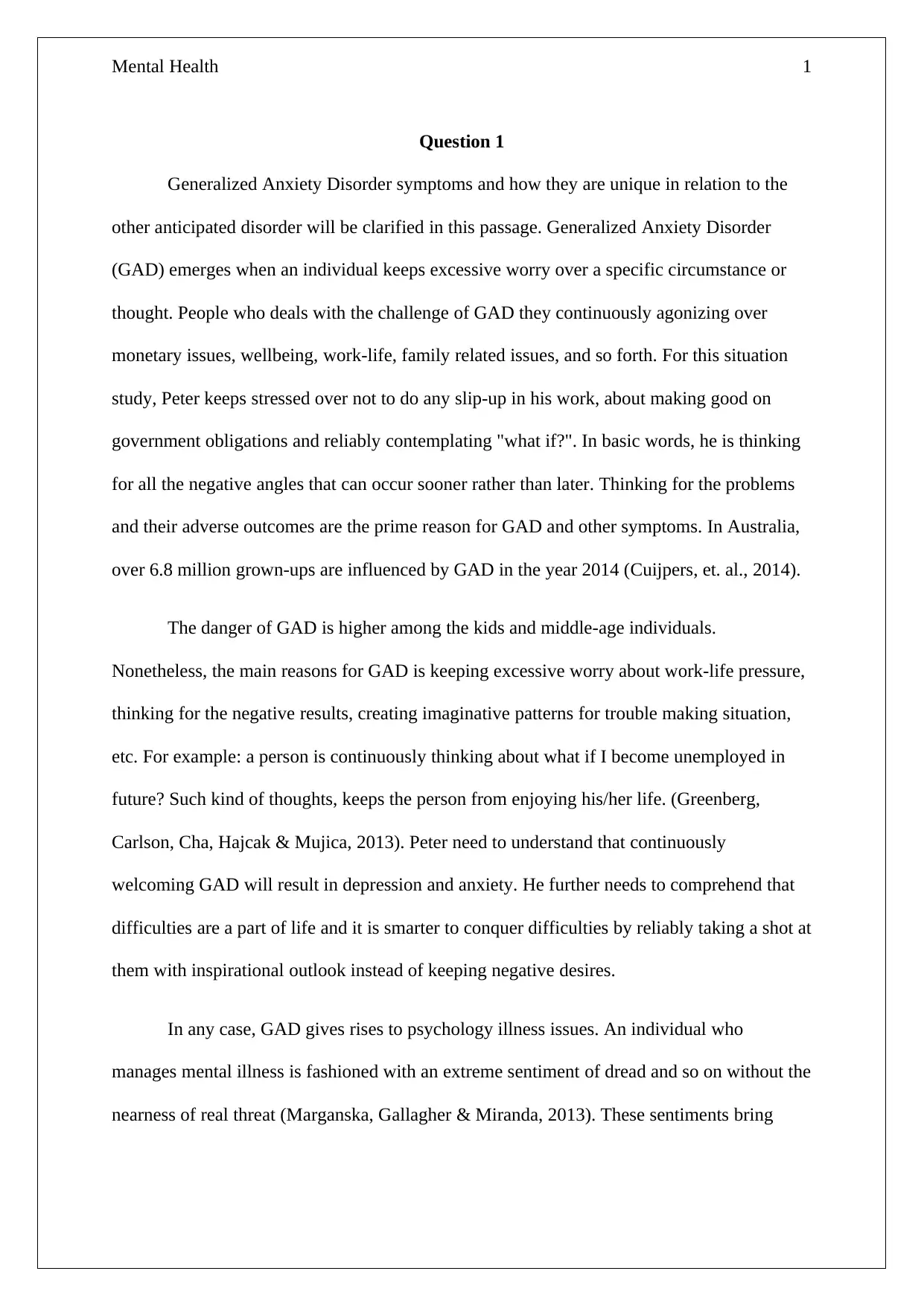
Question 1
Generalized Anxiety Disorder symptoms and how they are unique in relation to the
other anticipated disorder will be clarified in this passage. Generalized Anxiety Disorder
(GAD) emerges when an individual keeps excessive worry over a specific circumstance or
thought. People who deals with the challenge of GAD they continuously agonizing over
monetary issues, wellbeing, work-life, family related issues, and so forth. For this situation
study, Peter keeps stressed over not to do any slip-up in his work, about making good on
government obligations and reliably contemplating "what if?". In basic words, he is thinking
for all the negative angles that can occur sooner rather than later. Thinking for the problems
and their adverse outcomes are the prime reason for GAD and other symptoms. In Australia,
over 6.8 million grown-ups are influenced by GAD in the year 2014 (Cuijpers, et. al., 2014).
The danger of GAD is higher among the kids and middle-age individuals.
Nonetheless, the main reasons for GAD is keeping excessive worry about work-life pressure,
thinking for the negative results, creating imaginative patterns for trouble making situation,
etc. For example: a person is continuously thinking about what if I become unemployed in
future? Such kind of thoughts, keeps the person from enjoying his/her life. (Greenberg,
Carlson, Cha, Hajcak & Mujica, 2013). Peter need to understand that continuously
welcoming GAD will result in depression and anxiety. He further needs to comprehend that
difficulties are a part of life and it is smarter to conquer difficulties by reliably taking a shot at
them with inspirational outlook instead of keeping negative desires.
In any case, GAD gives rises to psychology illness issues. An individual who
manages mental illness is fashioned with an extreme sentiment of dread and so on without the
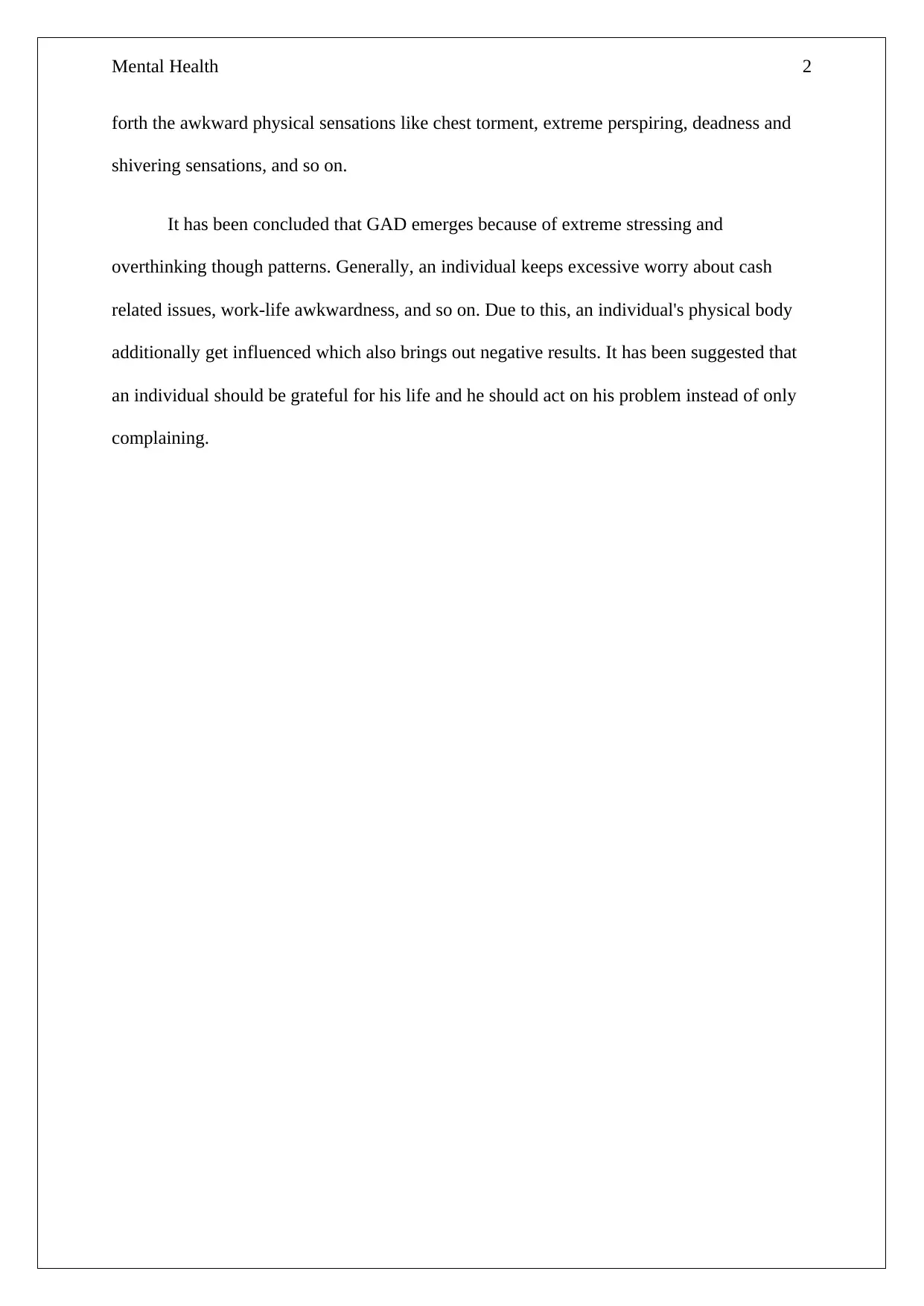
nearness of real threat (Marganska, Gallagher & Miranda, 2013). These sentiments bring
Question 1
Generalized Anxiety Disorder symptoms and how they are unique in relation to the
other anticipated disorder will be clarified in this passage. Generalized Anxiety Disorder
(GAD) emerges when an individual keeps excessive worry over a specific circumstance or
thought. People who deals with the challenge of GAD they continuously agonizing over
monetary issues, wellbeing, work-life, family related issues, and so forth. For this situation
study, Peter keeps stressed over not to do any slip-up in his work, about making good on
government obligations and reliably contemplating "what if?". In basic words, he is thinking
for all the negative angles that can occur sooner rather than later. Thinking for the problems
and their adverse outcomes are the prime reason for GAD and other symptoms. In Australia,
over 6.8 million grown-ups are influenced by GAD in the year 2014 (Cuijpers, et. al., 2014).
The danger of GAD is higher among the kids and middle-age individuals.
Nonetheless, the main reasons for GAD is keeping excessive worry about work-life pressure,
thinking for the negative results, creating imaginative patterns for trouble making situation,
etc. For example: a person is continuously thinking about what if I become unemployed in
future? Such kind of thoughts, keeps the person from enjoying his/her life. (Greenberg,
Carlson, Cha, Hajcak & Mujica, 2013). Peter need to understand that continuously
welcoming GAD will result in depression and anxiety. He further needs to comprehend that
difficulties are a part of life and it is smarter to conquer difficulties by reliably taking a shot at
them with inspirational outlook instead of keeping negative desires.
In any case, GAD gives rises to psychology illness issues. An individual who
manages mental illness is fashioned with an extreme sentiment of dread and so on without the
nearness of real threat (Marganska, Gallagher & Miranda, 2013). These sentiments bring
Mental Health 2
forth the awkward physical sensations like chest torment, extreme perspiring, deadness and
shivering sensations, and so on.
It has been concluded that GAD emerges because of extreme stressing and
overthinking though patterns. Generally, an individual keeps excessive worry about cash
related issues, work-life awkwardness, and so on. Due to this, an individual's physical body
additionally get influenced which also brings out negative results. It has been suggested that
an individual should be grateful for his life and he should act on his problem instead of only
complaining.
forth the awkward physical sensations like chest torment, extreme perspiring, deadness and
shivering sensations, and so on.
It has been concluded that GAD emerges because of extreme stressing and
overthinking though patterns. Generally, an individual keeps excessive worry about cash
related issues, work-life awkwardness, and so on. Due to this, an individual's physical body
additionally get influenced which also brings out negative results. It has been suggested that
an individual should be grateful for his life and he should act on his problem instead of only
complaining.
⊘ This is a preview!⊘
Do you want full access?
Subscribe today to unlock all pages.

Trusted by 1+ million students worldwide
Mental Health 3
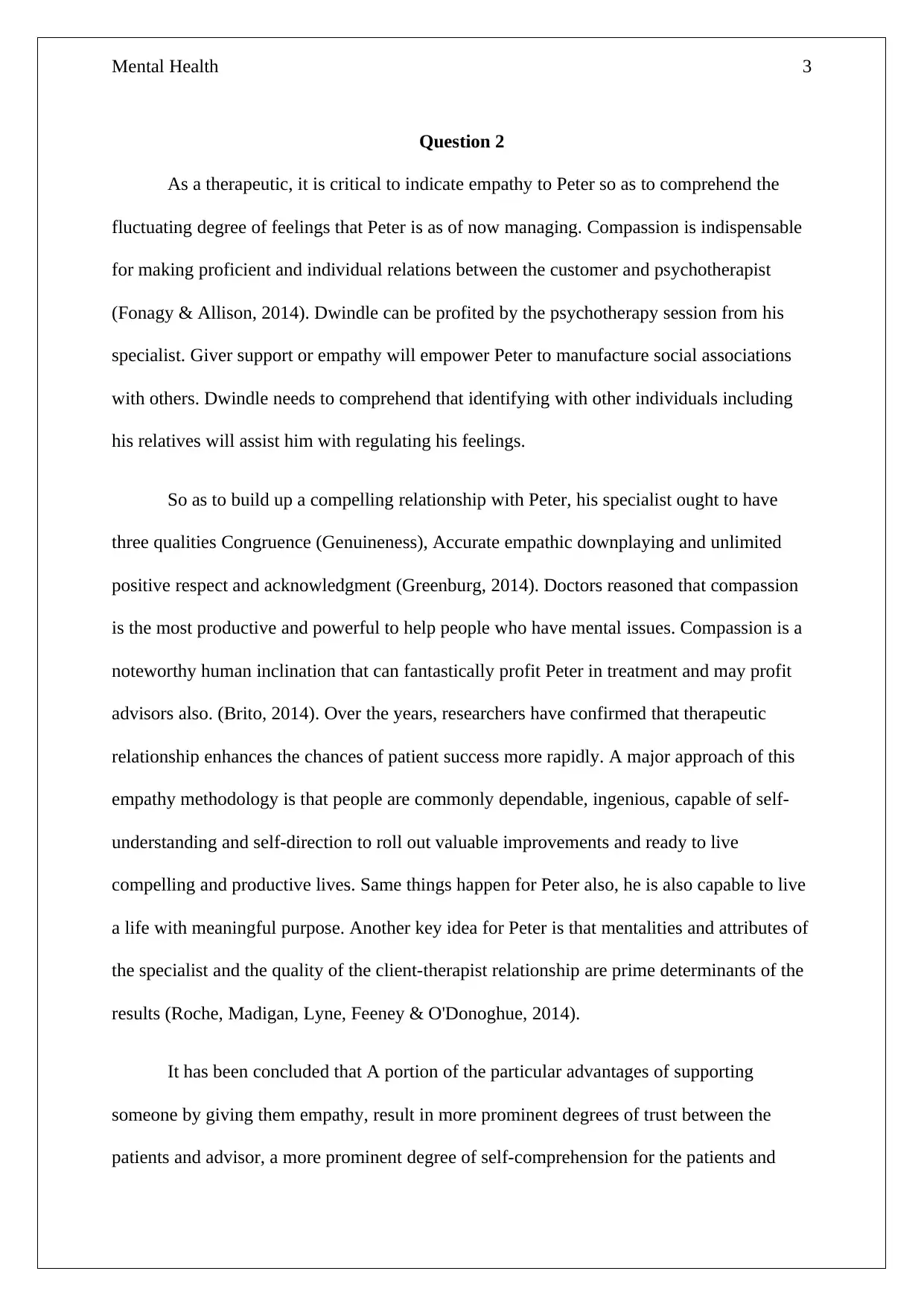
Question 2
As a therapeutic, it is critical to indicate empathy to Peter so as to comprehend the
fluctuating degree of feelings that Peter is as of now managing. Compassion is indispensable
for making proficient and individual relations between the customer and psychotherapist
(Fonagy & Allison, 2014). Dwindle can be profited by the psychotherapy session from his
specialist. Giver support or empathy will empower Peter to manufacture social associations
with others. Dwindle needs to comprehend that identifying with other individuals including
his relatives will assist him with regulating his feelings.
So as to build up a compelling relationship with Peter, his specialist ought to have
three qualities Congruence (Genuineness), Accurate empathic downplaying and unlimited
positive respect and acknowledgment (Greenburg, 2014). Doctors reasoned that compassion
is the most productive and powerful to help people who have mental issues. Compassion is a
noteworthy human inclination that can fantastically profit Peter in treatment and may profit
advisors also. (Brito, 2014). Over the years, researchers have confirmed that therapeutic
relationship enhances the chances of patient success more rapidly. A major approach of this
empathy methodology is that people are commonly dependable, ingenious, capable of self-
understanding and self-direction to roll out valuable improvements and ready to live
compelling and productive lives. Same things happen for Peter also, he is also capable to live
a life with meaningful purpose. Another key idea for Peter is that mentalities and attributes of
the specialist and the quality of the client-therapist relationship are prime determinants of the
results (Roche, Madigan, Lyne, Feeney & O'Donoghue, 2014).
It has been concluded that A portion of the particular advantages of supporting
someone by giving them empathy, result in more prominent degrees of trust between the
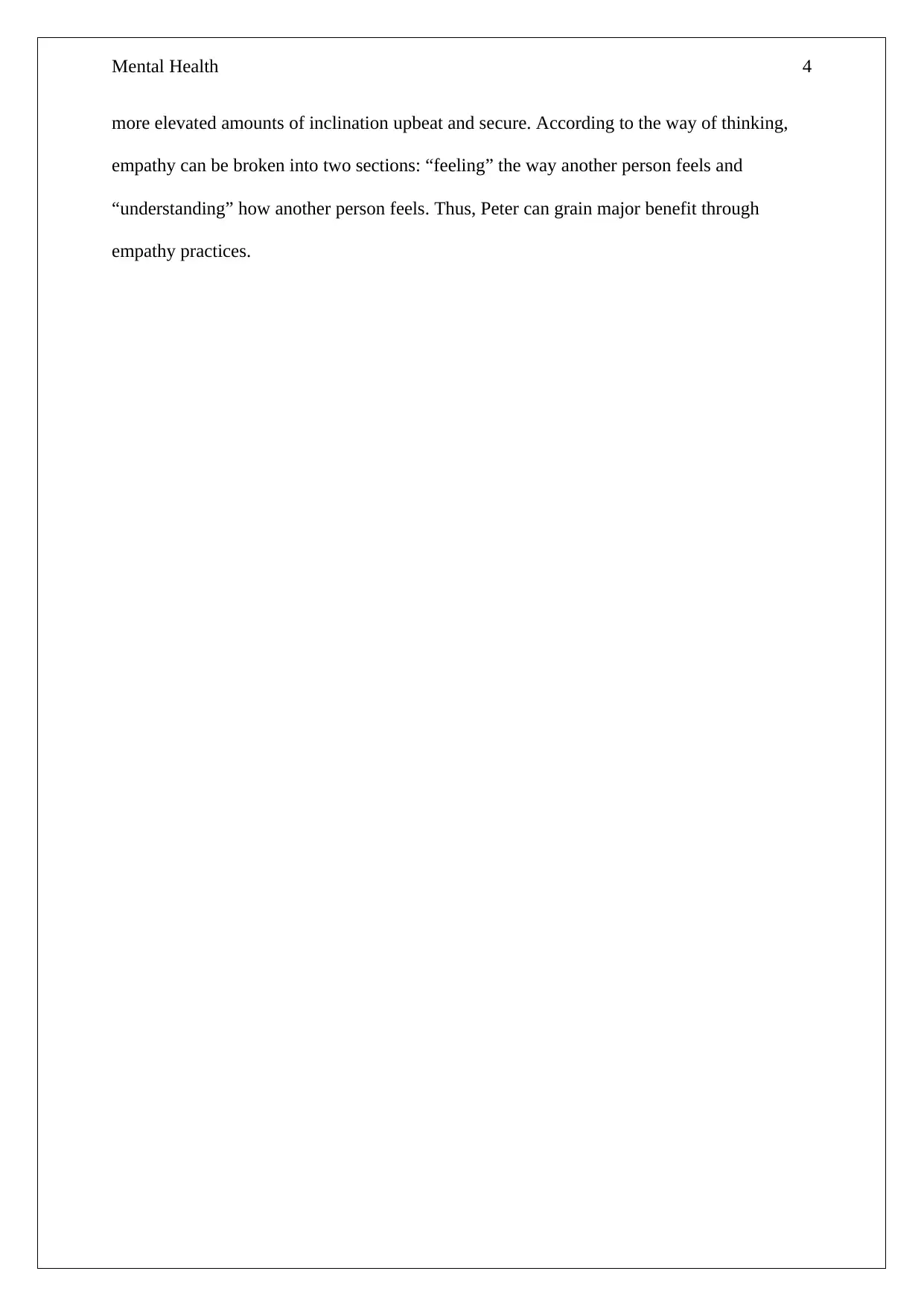
patients and advisor, a more prominent degree of self-comprehension for the patients and
Question 2
As a therapeutic, it is critical to indicate empathy to Peter so as to comprehend the
fluctuating degree of feelings that Peter is as of now managing. Compassion is indispensable
for making proficient and individual relations between the customer and psychotherapist
(Fonagy & Allison, 2014). Dwindle can be profited by the psychotherapy session from his
specialist. Giver support or empathy will empower Peter to manufacture social associations
with others. Dwindle needs to comprehend that identifying with other individuals including
his relatives will assist him with regulating his feelings.
So as to build up a compelling relationship with Peter, his specialist ought to have
three qualities Congruence (Genuineness), Accurate empathic downplaying and unlimited
positive respect and acknowledgment (Greenburg, 2014). Doctors reasoned that compassion
is the most productive and powerful to help people who have mental issues. Compassion is a
noteworthy human inclination that can fantastically profit Peter in treatment and may profit
advisors also. (Brito, 2014). Over the years, researchers have confirmed that therapeutic
relationship enhances the chances of patient success more rapidly. A major approach of this
empathy methodology is that people are commonly dependable, ingenious, capable of self-
understanding and self-direction to roll out valuable improvements and ready to live
compelling and productive lives. Same things happen for Peter also, he is also capable to live
a life with meaningful purpose. Another key idea for Peter is that mentalities and attributes of
the specialist and the quality of the client-therapist relationship are prime determinants of the
results (Roche, Madigan, Lyne, Feeney & O'Donoghue, 2014).
It has been concluded that A portion of the particular advantages of supporting
someone by giving them empathy, result in more prominent degrees of trust between the
patients and advisor, a more prominent degree of self-comprehension for the patients and
Paraphrase This Document
Need a fresh take? Get an instant paraphrase of this document with our AI Paraphraser
Mental Health 4
more elevated amounts of inclination upbeat and secure. According to the way of thinking,
empathy can be broken into two sections: “feeling” the way another person feels and
“understanding” how another person feels. Thus, Peter can grain major benefit through
empathy practices.
more elevated amounts of inclination upbeat and secure. According to the way of thinking,
empathy can be broken into two sections: “feeling” the way another person feels and
“understanding” how another person feels. Thus, Peter can grain major benefit through
empathy practices.
Mental Health 5
Question 3
In this segment, I am setting up myself for meeting with Peter. I will make techniques
and I will get ready inquiries ahead of time that I will ask Peter. As we realize that he is
experiencing GAD so I have to receive agreeable strategies for having a conversation with
himself. In the meeting with Peter, I might want to utilize the calm correspondence and
Empathy rehearses. I chose to think of Empathy rehearses after the exercises I gain from the
subsequent inquiry. I will speak with Peter by utilizing a cordial tone and a comforting grin
(Ohtake, Lazarus, Schillo & Rosen, 2013).
I will start the interview by asking basic questions to Peter for getting the overview of
his condition from himself. It is extremely important to understand that what Peter thinks for
his condition. I will start with “Tell me about yourself?”, “How would you describe your
condition?”, “What major challenges and problem you are facing?”. I think that soft spoken
communications skills and excellent question framing are the essential matter for workplace
success.
My participation in active listening is also essential because I need to pay attention on
the words of Peter. Acitve listening will help in giving close attention to the Peter’s words. it
appears to be on grounded, this is an aptitude that can be difficult to create and improve.
Anyone can be an attentive person by concentrating on the speaker, avoiding distractions like
mobile phones, workstations or other activities (Adam, Peters & Chipchase, 2013).
Peter is dealing with GAD, so I should adopt a friendly attitude during his interview. Peter
should consider me as his friend while his interview session, only then he will be able to
speak out all his desires and challenges that he is facing in his life. Thus, for establishing
friendly attitude I need to adopt small gestures like smiling more often, appreciating him on
his past achievements and motivating him (Fraker, Kales, Blazek, Kavanagh & Gitlin, 2014).
Question 3
In this segment, I am setting up myself for meeting with Peter. I will make techniques
and I will get ready inquiries ahead of time that I will ask Peter. As we realize that he is
experiencing GAD so I have to receive agreeable strategies for having a conversation with
himself. In the meeting with Peter, I might want to utilize the calm correspondence and
Empathy rehearses. I chose to think of Empathy rehearses after the exercises I gain from the
subsequent inquiry. I will speak with Peter by utilizing a cordial tone and a comforting grin
(Ohtake, Lazarus, Schillo & Rosen, 2013).
I will start the interview by asking basic questions to Peter for getting the overview of
his condition from himself. It is extremely important to understand that what Peter thinks for
his condition. I will start with “Tell me about yourself?”, “How would you describe your
condition?”, “What major challenges and problem you are facing?”. I think that soft spoken
communications skills and excellent question framing are the essential matter for workplace
success.
My participation in active listening is also essential because I need to pay attention on
the words of Peter. Acitve listening will help in giving close attention to the Peter’s words. it
appears to be on grounded, this is an aptitude that can be difficult to create and improve.
Anyone can be an attentive person by concentrating on the speaker, avoiding distractions like
mobile phones, workstations or other activities (Adam, Peters & Chipchase, 2013).
Peter is dealing with GAD, so I should adopt a friendly attitude during his interview. Peter
should consider me as his friend while his interview session, only then he will be able to
speak out all his desires and challenges that he is facing in his life. Thus, for establishing
friendly attitude I need to adopt small gestures like smiling more often, appreciating him on
his past achievements and motivating him (Fraker, Kales, Blazek, Kavanagh & Gitlin, 2014).
⊘ This is a preview!⊘
Do you want full access?
Subscribe today to unlock all pages.
Trusted by 1+ million students worldwide
Mental Health 6
Motivation is the effective method through which I can make Peter more positively and I will
try to change the outlook of Peter towards his life (Katie, Debra & Anthony, 2017).
It can be concluded that the interview can be challenging, even for the best
communicator. Reacting adequately means accomplishing a harmony between listening to
what Peter is asking and giving a very much considered reaction to his questions. For
establishing effective communication with Peter, I will take the use of soft communication
skills. It is also concluded that I should share inspirational and motivational quotes with Peter
for changing his outlook towards his life. However, I landed on the conclusion that Peter
should think for prosperity and happiness instead of welcoming negativity in his mind.
Motivation is the effective method through which I can make Peter more positively and I will
try to change the outlook of Peter towards his life (Katie, Debra & Anthony, 2017).
It can be concluded that the interview can be challenging, even for the best
communicator. Reacting adequately means accomplishing a harmony between listening to
what Peter is asking and giving a very much considered reaction to his questions. For
establishing effective communication with Peter, I will take the use of soft communication
skills. It is also concluded that I should share inspirational and motivational quotes with Peter
for changing his outlook towards his life. However, I landed on the conclusion that Peter
should think for prosperity and happiness instead of welcoming negativity in his mind.
Paraphrase This Document
Need a fresh take? Get an instant paraphrase of this document with our AI Paraphraser
Mental Health 7
Question 4
In this section, discussion will be made for regarding the medicine which is prescribed
to Peter. He is commenced with the Paroxetine 20mg PO medicine, it will help Peter in
improving his mood, appetite and sleep. Paroxetine is used by the people to treat their
depression, panic attacks, obsessive- compulsive disorder (OCD), anxiety disorder and post-
traumatic stress disorder (Johnson, et. al., 2013). This tablet will work by restoring the
balance of serotonin in Peter's brain.
Peter need to intake the medicine before meal, one tablet in a day. Taking a tablet
after the meal can reduce nausea. If Peter feels sleepy after taking this medicine then it is
suggested that he should take the medicine in the evening. Peter should also convey his
physician about the other prescribed drug and herbal products that he is using. It is also
suggested that Peter to take this tablet even after he started feeling well. Conditions may
become worse if he stops using the tablet without consulting with the doctor. Initially, he may
experience symptoms like mood swings, headache, tiredness and feelings similar to electric
shock. All this happens when the human brain changes his form by occurring of frequent
release of serotonin chemical in the brain (Belaise, Gatti, Chouinard & Chouinard, 2014).
Paroxetine is a particular serotonin (SSRI) drug also known as Paxil. It is used for the
treatment of tension issue, sadness, posttraumatic stress issue and indications of menopause,
among others. It was affirmed by the FDA in the mid-1990s and promoted by SmithKline
Beecham. The unique feature of this medication is that it is profoundly strong and specific in
its restraint of serotonin and has little impact on other neurotransmitters. Due to its intense
hindrance of serotonin paroxetine is bound to cause withdrawal impacts upon end. Paroxetine
is very much endured in many patients with a comparative antagonistic impact profile to
different individuals from its medication class (Tamaji, et. al., 2012).
Question 4
In this section, discussion will be made for regarding the medicine which is prescribed
to Peter. He is commenced with the Paroxetine 20mg PO medicine, it will help Peter in
improving his mood, appetite and sleep. Paroxetine is used by the people to treat their
depression, panic attacks, obsessive- compulsive disorder (OCD), anxiety disorder and post-
traumatic stress disorder (Johnson, et. al., 2013). This tablet will work by restoring the
balance of serotonin in Peter's brain.
Peter need to intake the medicine before meal, one tablet in a day. Taking a tablet
after the meal can reduce nausea. If Peter feels sleepy after taking this medicine then it is
suggested that he should take the medicine in the evening. Peter should also convey his
physician about the other prescribed drug and herbal products that he is using. It is also
suggested that Peter to take this tablet even after he started feeling well. Conditions may
become worse if he stops using the tablet without consulting with the doctor. Initially, he may
experience symptoms like mood swings, headache, tiredness and feelings similar to electric
shock. All this happens when the human brain changes his form by occurring of frequent
release of serotonin chemical in the brain (Belaise, Gatti, Chouinard & Chouinard, 2014).
Paroxetine is a particular serotonin (SSRI) drug also known as Paxil. It is used for the
treatment of tension issue, sadness, posttraumatic stress issue and indications of menopause,
among others. It was affirmed by the FDA in the mid-1990s and promoted by SmithKline
Beecham. The unique feature of this medication is that it is profoundly strong and specific in
its restraint of serotonin and has little impact on other neurotransmitters. Due to its intense
hindrance of serotonin paroxetine is bound to cause withdrawal impacts upon end. Paroxetine
is very much endured in many patients with a comparative antagonistic impact profile to
different individuals from its medication class (Tamaji, et. al., 2012).
Mental Health 8
It has been concluded that the use of this tablet will recover the mental health of Peter.
He needs to intake the medicine regularly and need to consult with his physician when he
noticed major changes in his physical state.
It has been concluded that the use of this tablet will recover the mental health of Peter.
He needs to intake the medicine regularly and need to consult with his physician when he
noticed major changes in his physical state.
⊘ This is a preview!⊘
Do you want full access?
Subscribe today to unlock all pages.
Trusted by 1+ million students worldwide
Mental Health 9
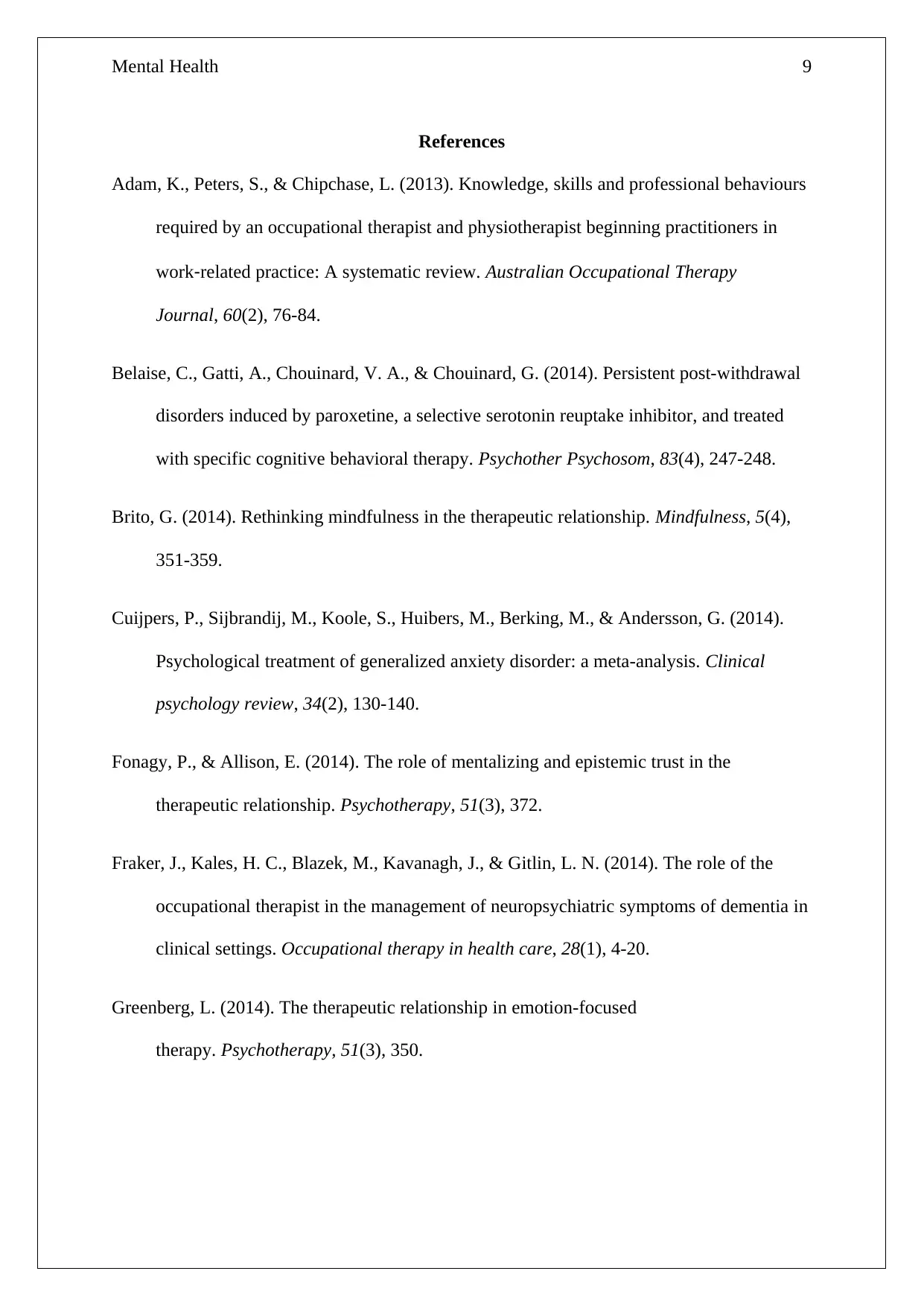
References
Adam, K., Peters, S., & Chipchase, L. (2013). Knowledge, skills and professional behaviours
required by an occupational therapist and physiotherapist beginning practitioners in
work‐related practice: A systematic review. Australian Occupational Therapy
Journal, 60(2), 76-84.
Belaise, C., Gatti, A., Chouinard, V. A., & Chouinard, G. (2014). Persistent post-withdrawal
disorders induced by paroxetine, a selective serotonin reuptake inhibitor, and treated
with specific cognitive behavioral therapy. Psychother Psychosom, 83(4), 247-248.
Brito, G. (2014). Rethinking mindfulness in the therapeutic relationship. Mindfulness, 5(4),
351-359.
Cuijpers, P., Sijbrandij, M., Koole, S., Huibers, M., Berking, M., & Andersson, G. (2014).
Psychological treatment of generalized anxiety disorder: a meta-analysis. Clinical
psychology review, 34(2), 130-140.
Fonagy, P., & Allison, E. (2014). The role of mentalizing and epistemic trust in the
therapeutic relationship. Psychotherapy, 51(3), 372.
Fraker, J., Kales, H. C., Blazek, M., Kavanagh, J., & Gitlin, L. N. (2014). The role of the
occupational therapist in the management of neuropsychiatric symptoms of dementia in
clinical settings. Occupational therapy in health care, 28(1), 4-20.
Greenberg, L. (2014). The therapeutic relationship in emotion-focused
therapy. Psychotherapy, 51(3), 350.
References
Adam, K., Peters, S., & Chipchase, L. (2013). Knowledge, skills and professional behaviours
required by an occupational therapist and physiotherapist beginning practitioners in
work‐related practice: A systematic review. Australian Occupational Therapy
Journal, 60(2), 76-84.
Belaise, C., Gatti, A., Chouinard, V. A., & Chouinard, G. (2014). Persistent post-withdrawal
disorders induced by paroxetine, a selective serotonin reuptake inhibitor, and treated
with specific cognitive behavioral therapy. Psychother Psychosom, 83(4), 247-248.
Brito, G. (2014). Rethinking mindfulness in the therapeutic relationship. Mindfulness, 5(4),
351-359.
Cuijpers, P., Sijbrandij, M., Koole, S., Huibers, M., Berking, M., & Andersson, G. (2014).
Psychological treatment of generalized anxiety disorder: a meta-analysis. Clinical
psychology review, 34(2), 130-140.
Fonagy, P., & Allison, E. (2014). The role of mentalizing and epistemic trust in the
therapeutic relationship. Psychotherapy, 51(3), 372.
Fraker, J., Kales, H. C., Blazek, M., Kavanagh, J., & Gitlin, L. N. (2014). The role of the
occupational therapist in the management of neuropsychiatric symptoms of dementia in
clinical settings. Occupational therapy in health care, 28(1), 4-20.
Greenberg, L. (2014). The therapeutic relationship in emotion-focused
therapy. Psychotherapy, 51(3), 350.
Paraphrase This Document
Need a fresh take? Get an instant paraphrase of this document with our AI Paraphraser
Mental Health 10
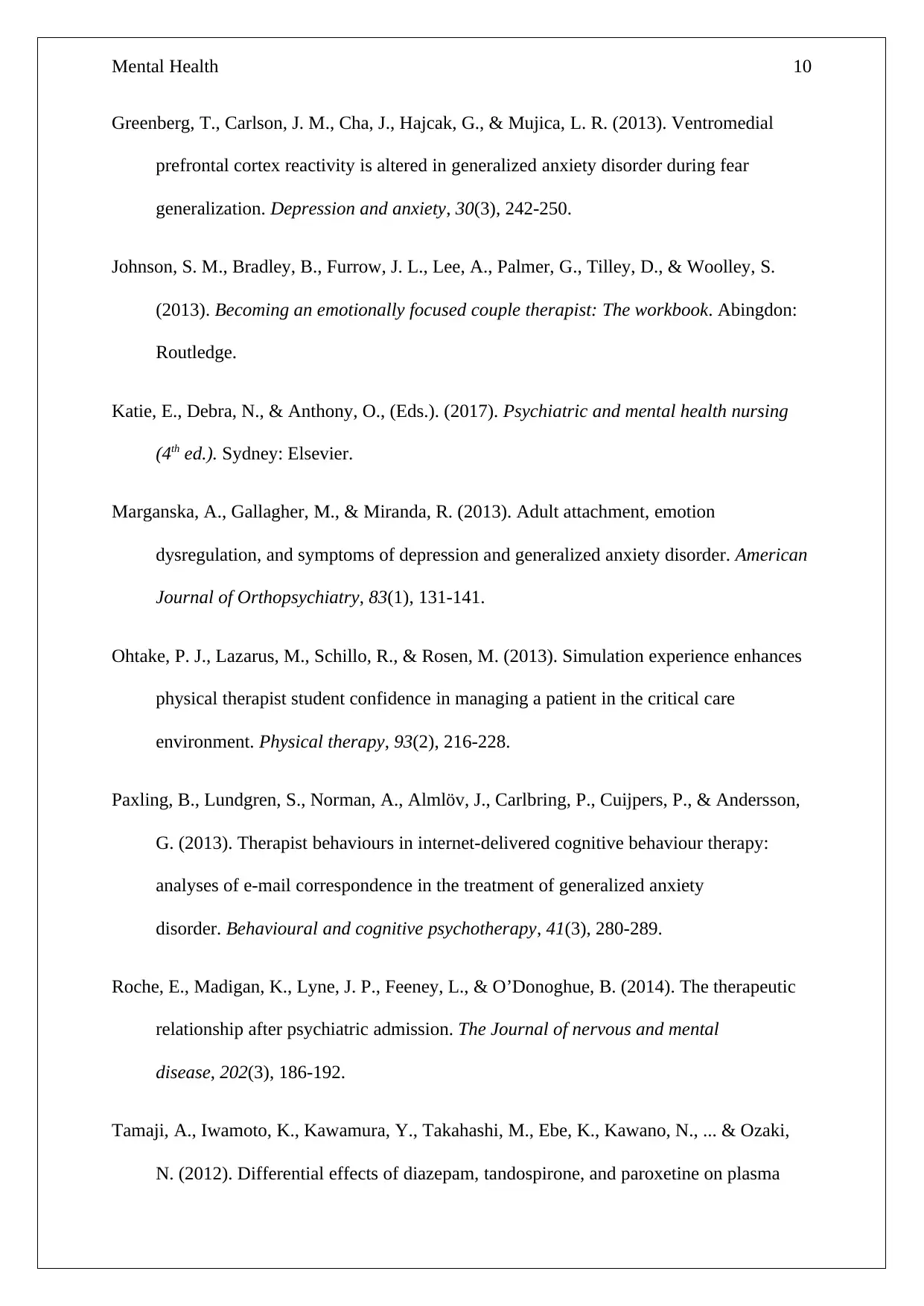
Greenberg, T., Carlson, J. M., Cha, J., Hajcak, G., & Mujica, L. R. (2013). Ventromedial
prefrontal cortex reactivity is altered in generalized anxiety disorder during fear
generalization. Depression and anxiety, 30(3), 242-250.
Johnson, S. M., Bradley, B., Furrow, J. L., Lee, A., Palmer, G., Tilley, D., & Woolley, S.
(2013). Becoming an emotionally focused couple therapist: The workbook. Abingdon:
Routledge.
Katie, E., Debra, N., & Anthony, O., (Eds.). (2017). Psychiatric and mental health nursing
(4th ed.). Sydney: Elsevier.
Marganska, A., Gallagher, M., & Miranda, R. (2013). Adult attachment, emotion
dysregulation, and symptoms of depression and generalized anxiety disorder. American
Journal of Orthopsychiatry, 83(1), 131-141.
Ohtake, P. J., Lazarus, M., Schillo, R., & Rosen, M. (2013). Simulation experience enhances
physical therapist student confidence in managing a patient in the critical care
environment. Physical therapy, 93(2), 216-228.
Paxling, B., Lundgren, S., Norman, A., Almlöv, J., Carlbring, P., Cuijpers, P., & Andersson,
G. (2013). Therapist behaviours in internet-delivered cognitive behaviour therapy:
analyses of e-mail correspondence in the treatment of generalized anxiety
disorder. Behavioural and cognitive psychotherapy, 41(3), 280-289.
Roche, E., Madigan, K., Lyne, J. P., Feeney, L., & O’Donoghue, B. (2014). The therapeutic
relationship after psychiatric admission. The Journal of nervous and mental
disease, 202(3), 186-192.
Tamaji, A., Iwamoto, K., Kawamura, Y., Takahashi, M., Ebe, K., Kawano, N., ... & Ozaki,
N. (2012). Differential effects of diazepam, tandospirone, and paroxetine on plasma
Greenberg, T., Carlson, J. M., Cha, J., Hajcak, G., & Mujica, L. R. (2013). Ventromedial
prefrontal cortex reactivity is altered in generalized anxiety disorder during fear
generalization. Depression and anxiety, 30(3), 242-250.
Johnson, S. M., Bradley, B., Furrow, J. L., Lee, A., Palmer, G., Tilley, D., & Woolley, S.
(2013). Becoming an emotionally focused couple therapist: The workbook. Abingdon:
Routledge.
Katie, E., Debra, N., & Anthony, O., (Eds.). (2017). Psychiatric and mental health nursing
(4th ed.). Sydney: Elsevier.
Marganska, A., Gallagher, M., & Miranda, R. (2013). Adult attachment, emotion
dysregulation, and symptoms of depression and generalized anxiety disorder. American
Journal of Orthopsychiatry, 83(1), 131-141.
Ohtake, P. J., Lazarus, M., Schillo, R., & Rosen, M. (2013). Simulation experience enhances
physical therapist student confidence in managing a patient in the critical care
environment. Physical therapy, 93(2), 216-228.
Paxling, B., Lundgren, S., Norman, A., Almlöv, J., Carlbring, P., Cuijpers, P., & Andersson,
G. (2013). Therapist behaviours in internet-delivered cognitive behaviour therapy:
analyses of e-mail correspondence in the treatment of generalized anxiety
disorder. Behavioural and cognitive psychotherapy, 41(3), 280-289.
Roche, E., Madigan, K., Lyne, J. P., Feeney, L., & O’Donoghue, B. (2014). The therapeutic
relationship after psychiatric admission. The Journal of nervous and mental
disease, 202(3), 186-192.
Tamaji, A., Iwamoto, K., Kawamura, Y., Takahashi, M., Ebe, K., Kawano, N., ... & Ozaki,
N. (2012). Differential effects of diazepam, tandospirone, and paroxetine on plasma
Mental Health 11
brain‐derived neurotrophic factor level under mental stress. Human
Psychopharmacology: Clinical and Experimental, 27(3), 329-333.
brain‐derived neurotrophic factor level under mental stress. Human
Psychopharmacology: Clinical and Experimental, 27(3), 329-333.
⊘ This is a preview!⊘
Do you want full access?
Subscribe today to unlock all pages.
Trusted by 1+ million students worldwide

1 out of 12


Related Documents


Your All-in-One AI-Powered Toolkit for Academic Success.
+13062052269
info@desklib.com
Available 24*7 on WhatsApp / Email
![[object Object]](/_next/static/media/star-bottom.7253800d.svg)
Unlock your academic potential
Copyright © 2020–2026 A2Z Services. All Rights Reserved. Developed and managed by ZUCOL.