University Game Design: Extempore to Reduce Plagiarism and Misconduct

Verified

Added on  2022/12/23

|2
|693
|23
Project
AI Summary
This project details the design of a game called "Extempore" aimed at reducing plagiarism and promoting academic integrity among university students. The game involves students speaking on topics related to plagiarism, enhancing their knowledge and communication skills. Students prepare for a minute using the internet, but must articulate their understanding in their own words. The project highlights the importance of academic integrity and the skills gained during game production, including analytical, communication, and cognitive skills. References from academic journals and books are included to support the concepts of plagiarism, academic misconduct, and strategies to avoid them. The game is designed to foster fairness, honesty, and professional development among students.
Document Page
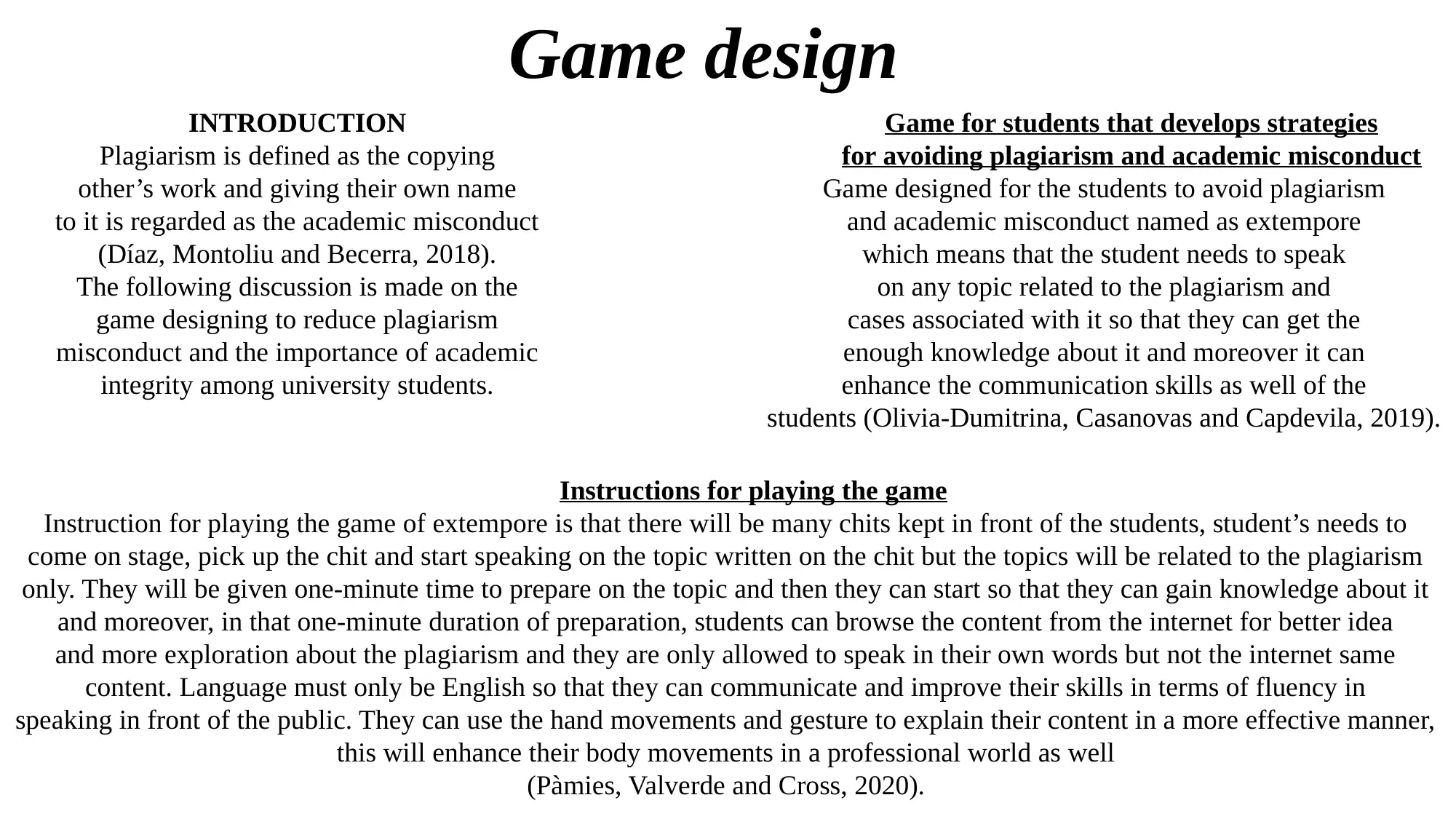
Game design
INTRODUCTION
Plagiarism is defined as the copying
other’s work and giving their own name
to it is regarded as the academic misconduct
(Díaz, Montoliu and Becerra, 2018).
The following discussion is made on the
game designing to reduce plagiarism
misconduct and the importance of academic
integrity among university students.
Game for students that develops strategies
for avoiding plagiarism and academic misconduct
Game designed for the students to avoid plagiarism
and academic misconduct named as extempore
which means that the student needs to speak
on any topic related to the plagiarism and
cases associated with it so that they can get the
enough knowledge about it and moreover it can
enhance the communication skills as well of the
students (Olivia-Dumitrina, Casanovas and Capdevila, 2019).
Instructions for playing the game
Instruction for playing the game of extempore is that there will be many chits kept in front of the students, student’s needs to
come on stage, pick up the chit and start speaking on the topic written on the chit but the topics will be related to the plagiarism
only. They will be given one-minute time to prepare on the topic and then they can start so that they can gain knowledge about it
and moreover, in that one-minute duration of preparation, students can browse the content from the internet for better idea
and more exploration about the plagiarism and they are only allowed to speak in their own words but not the internet same
content. Language must only be English so that they can communicate and improve their skills in terms of fluency in
speaking in front of the public. They can use the hand movements and gesture to explain their content in a more effective manner,
this will enhance their body movements in a professional world as well
(Pàmies, Valverde and Cross, 2020).
tabler-icon-diamond-filled.svg

Paraphrase This Document

Need a fresh take? Get an instant paraphrase of this document with our AI Paraphraser
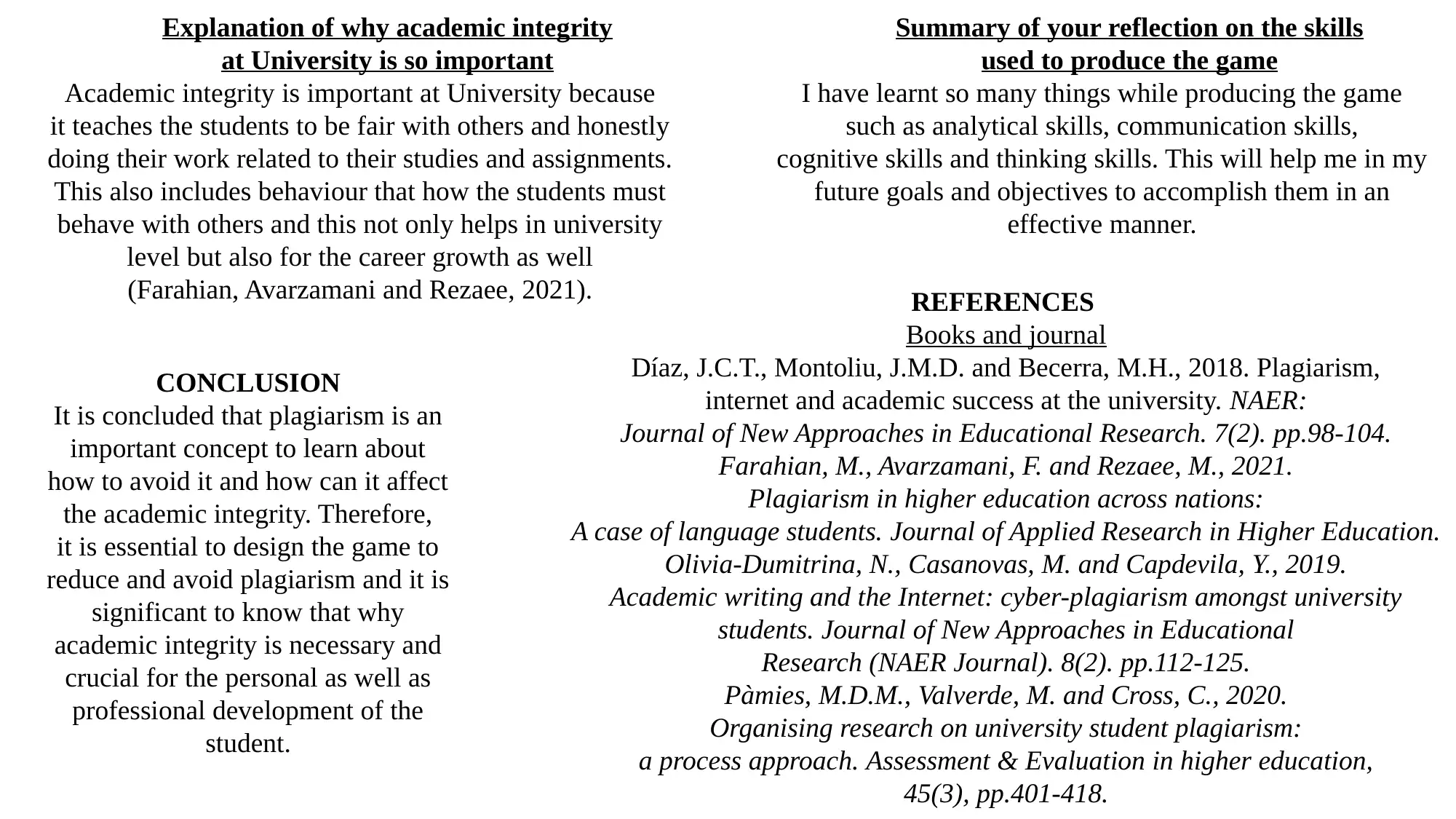
Document Page
Explanation of why academic integrity
at University is so important
Academic integrity is important at University because
it teaches the students to be fair with others and honestly
doing their work related to their studies and assignments.
This also includes behaviour that how the students must
behave with others and this not only helps in university
level but also for the career growth as well
(Farahian, Avarzamani and Rezaee, 2021).
Summary of your reflection on the skills
used to produce the game
I have learnt so many things while producing the game
such as analytical skills, communication skills,
cognitive skills and thinking skills. This will help me in my
future goals and objectives to accomplish them in an
effective manner.
CONCLUSION
It is concluded that plagiarism is an
important concept to learn about
how to avoid it and how can it affect
the academic integrity. Therefore,
it is essential to design the game to
reduce and avoid plagiarism and it is
significant to know that why
academic integrity is necessary and
crucial for the personal as well as
professional development of the
student.
REFERENCES
Books and journal
Díaz, J.C.T., Montoliu, J.M.D. and Becerra, M.H., 2018. Plagiarism,
internet and academic success at the university. NAER:
Journal of New Approaches in Educational Research. 7(2). pp.98-104.
Farahian, M., Avarzamani, F. and Rezaee, M., 2021.
Plagiarism in higher education across nations:
A case of language students. Journal of Applied Research in Higher Education.
Olivia-Dumitrina, N., Casanovas, M. and Capdevila, Y., 2019.
Academic writing and the Internet: cyber-plagiarism amongst university
students. Journal of New Approaches in Educational
Research (NAER Journal). 8(2). pp.112-125.
Pàmies, M.D.M., Valverde, M. and Cross, C., 2020.
Organising research on university student plagiarism:
a process approach. Assessment & Evaluation in higher education,
45(3), pp.401-418.
chevron_up_icon
1 out of 2
circle_padding
hide_on_mobile
zoom_out_icon
[object Object]