Designing a Game: Magnifying Plagiarism for Academic Integrity

Verified

Added on  2022/12/16

|3
|977
|107
Practical Assignment
AI Summary
This assignment delves into the creation of a game called 'Magnifying Plagiarism,' designed to promote academic integrity by helping students identify and understand plagiarism. The game uses a puzzle-based approach, presenting shuffled statements from a report and requiring players to arrange them correctly, assessing their understanding of plagiarism in the process. The assignment highlights the importance of academic integrity in fostering ethical behavior and preventing misconduct such as cheating and plagiarism. It also reflects on the challenges and skills involved in developing such an application, particularly in identifying appropriate sentences for plagiarism detection. The ultimate goal of the game is to enhance fair and honest academic standards within educational institutions by providing an engaging and effective tool for combating plagiarism.
Document Page
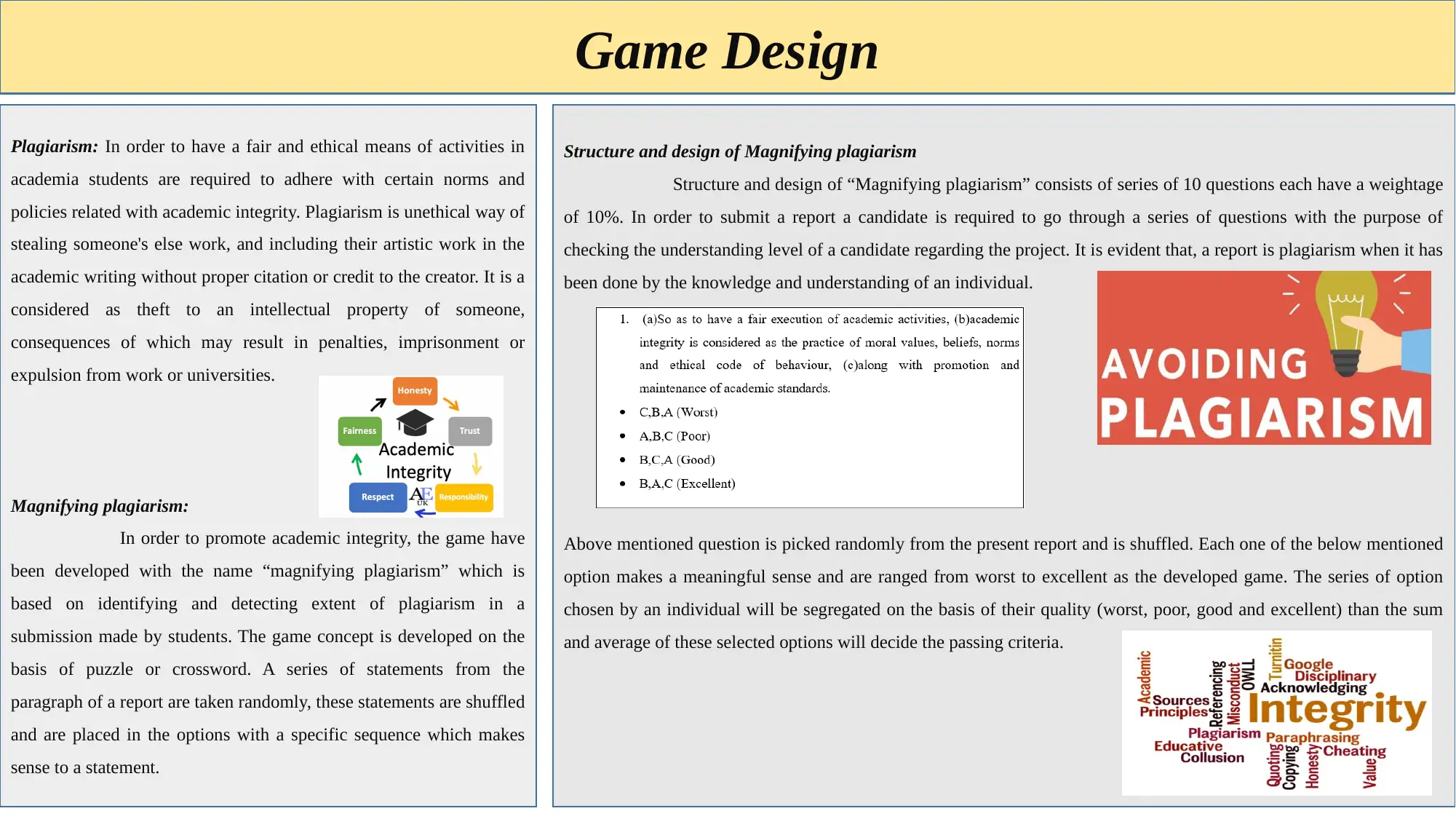
Game Design
Plagiarism: In order to have a fair and ethical means of activities in
academia students are required to adhere with certain norms and
policies related with academic integrity. Plagiarism is unethical way of
stealing someone's else work, and including their artistic work in the
academic writing without proper citation or credit to the creator. It is a
considered as theft to an intellectual property of someone,
consequences of which may result in penalties, imprisonment or
expulsion from work or universities.
Magnifying plagiarism:
In order to promote academic integrity, the game have
been developed with the name “magnifying plagiarism” which is
based on identifying and detecting extent of plagiarism in a
submission made by students. The game concept is developed on the
basis of puzzle or crossword. A series of statements from the
paragraph of a report are taken randomly, these statements are shuffled
and are placed in the options with a specific sequence which makes
sense to a statement.
Structure and design of Magnifying plagiarism
Structure and design of “Magnifying plagiarism” consists of series of 10 questions each have a weightage
of 10%. In order to submit a report a candidate is required to go through a series of questions with the purpose of
checking the understanding level of a candidate regarding the project. It is evident that, a report is plagiarism when it has
been done by the knowledge and understanding of an individual.
Above mentioned question is picked randomly from the present report and is shuffled. Each one of the below mentioned
option makes a meaningful sense and are ranged from worst to excellent as the developed game. The series of option
chosen by an individual will be segregated on the basis of their quality (worst, poor, good and excellent) than the sum
and average of these selected options will decide the passing criteria.
tabler-icon-diamond-filled.svg

Paraphrase This Document

Need a fresh take? Get an instant paraphrase of this document with our AI Paraphraser
Document Page
Game Design
Instructions for playing the game
Below mentioned information are the stated guidelines
to be followed by the candidates so as find the originality of their
prepared report and to ensure that is free from any unethical practices.
The game consists of series of 10 questions each having a
weightage of 10% of the total number of questions and are
supported by 3 or 4 options to support the view point of an
individual.
Each below mentioned options are grouped according to their
quality from worst, poor, good and excellent. The sum and average
of these options should be in range of 85-90%.
The game has an auto-generated questions which will be framed
randomly as per the stated information in the report.
While attempting these questions, a candidate will not be able to
access the report or presentation for the purpose of accurate and
effective evaluation of cognitive and analytical skills of a
candidate.
Once the test is done it will be submitted and delivered
automatically. The result process takes few minutes for which
candidate have to wait and is advised not to press F5 or refresh
button in the mid of processing, which might interrupt the process.
Importance of academic integrity
Academic integrity is regarded as the moral values, ethics and beliefs on individual in an academic premise. Academic
integrity is all about having honest and fair behavior of an individual which eliminates the use of unethical practices like
cheating, plagiarism, alteration of documents etc. so as to foster positive and ethical activities in academia. Academic
integrity plays a significant role in universities, institutions and individual as well.
Significant for academic institutions
Significant for new innovations and ideas
Significant for students
Reflection
It is imperative for the academic institutions to address the issue related with the academic misconduct especially with
the plagiarism which is most the common practice in the present environment. While developing an application which is
named as “magnifying plagiarism” various difficulties were addressed, along with new set of skills though. One of the
major hurdle in addressing the plagiarism is finding a right and appropriate form of sentences in order to detect
plagiarism in the assessment or presentation.
In brief, developing a “magnifying plagiarism” game have enabled and opened a path for wide array of opportunities
which will further lead in the eradication of academic misconduct from the institution and will help in enhancing the fair
and honest academic standards.
Document Page
Appendix
1.(a) the deliberate actions intended to have an unfair academic advantage for oneself, (b)Academic misconduct can be defined as, (c)or any other member of an Academic community.
ABC (Good)
BAC (Excellent)
CAB (Poor)
CBA (Worst)
2. (b) plagiarism is a fabrication or alteration of another author's ideas, opinions, thoughts or (c) belief which are presented by a writer in their presentation, intentionally or (a)
unintentionally with or without consent of creators, to have an original work.
BCA (Excellent)
ACB (Worst)
CBA (Poor)
CAB (Good)
3.(a)Consequences of plagiarism are penalties, expulsion or suspension from work or, (c)universities and are regarded as the violation of academic integrity, (b)and ethics of journalist
ABC (Good)
ACB (Excellent)
CAB (Poor)
BCA (Worst)
chevron_up_icon
1 out of 3
circle_padding
hide_on_mobile
zoom_out_icon
[object Object]