Game Design Introduction: Promoting Academic Integrity Awareness

Verified

Added on  2023/06/18

|2
|728
|389
Practical Assignment
AI Summary
This assignment solution details the design of a game intended to educate students about academic integrity and misconduct. The game, structured as a quiz, divides students into teams and presents them with questions related to academic integrity. The game consists of five rounds, each with 20 questions, and includes a time limit for answering, as well as negative marking for incorrect answers. Unanswered questions are transferred to other teams, adding a competitive element. The design incorporates problem-solving, academic, and research skills, ensuring that the questions are relevant and comprehensive. The document also includes references to support the game's content and objectives, aiming to foster a deeper understanding of academic honesty among students.
Document Page
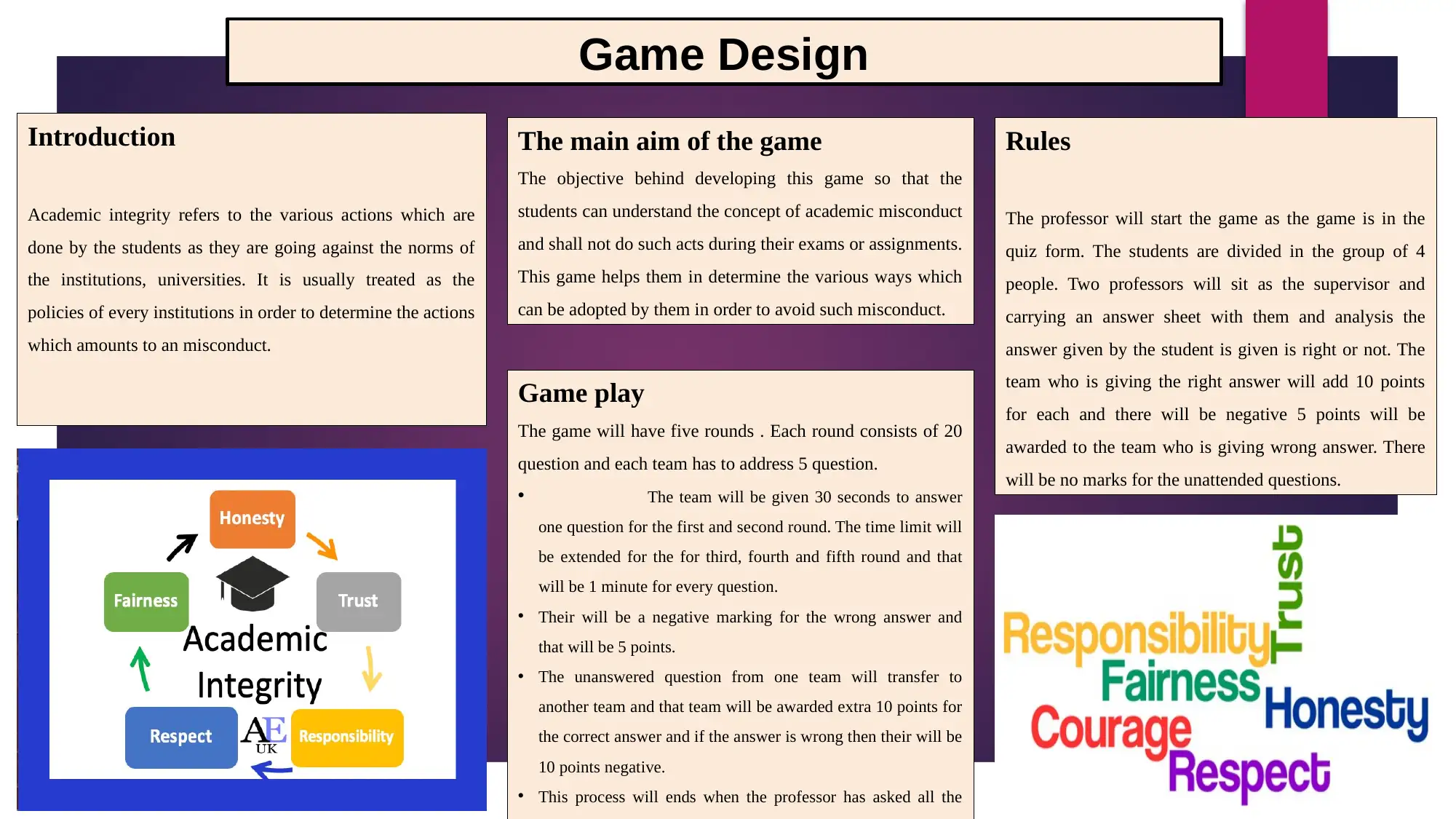
Introduction
Academic integrity refers to the various actions which are
done by the students as they are going against the norms of
the institutions, universities. It is usually treated as the
policies of every institutions in order to determine the actions
which amounts to an misconduct.
Game Design
Rules
The professor will start the game as the game is in the
quiz form. The students are divided in the group of 4
people. Two professors will sit as the supervisor and
carrying an answer sheet with them and analysis the
answer given by the student is given is right or not. The
team who is giving the right answer will add 10 points
for each and there will be negative 5 points will be
awarded to the team who is giving wrong answer. There
will be no marks for the unattended questions.
The main aim of the game
The objective behind developing this game so that the
students can understand the concept of academic misconduct
and shall not do such acts during their exams or assignments.
This game helps them in determine the various ways which
can be adopted by them in order to avoid such misconduct.
Game play
The game will have five rounds . Each round consists of 20
question and each team has to address 5 question.
The team will be given 30 seconds to answer
one question for the first and second round. The time limit will
be extended for the for third, fourth and fifth round and that
will be 1 minute for every question.
Their will be a negative marking for the wrong answer and
that will be 5 points.
The unanswered question from one team will transfer to
another team and that team will be awarded extra 10 points for
the correct answer and if the answer is wrong then their will be
10 points negative.
This process will ends when the professor has asked all the
tabler-icon-diamond-filled.svg

Paraphrase This Document

Need a fresh take? Get an instant paraphrase of this document with our AI Paraphraser
Document Page
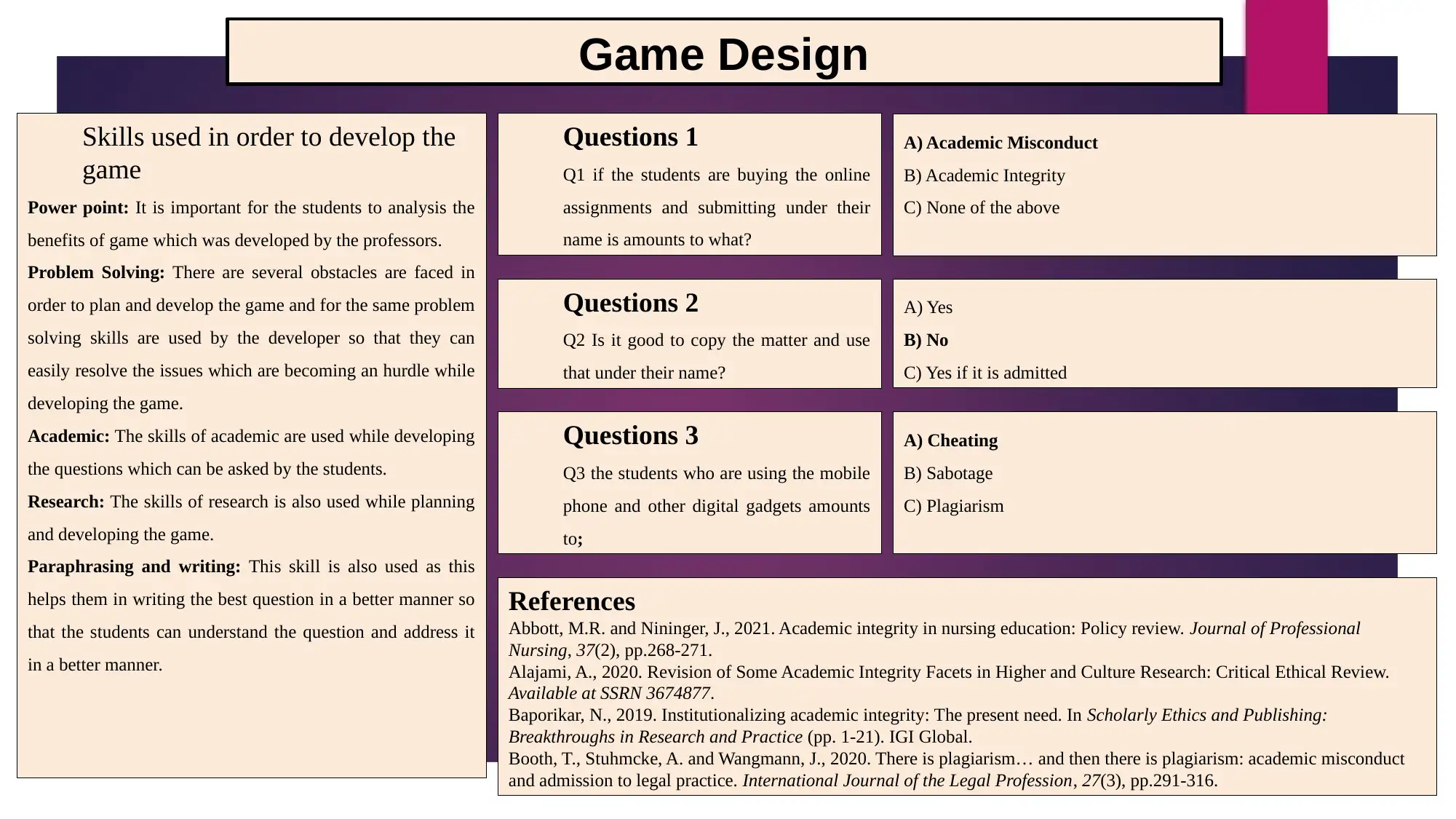
Skills used in order to develop the
game
Power point: It is important for the students to analysis the
benefits of game which was developed by the professors.
Problem Solving: There are several obstacles are faced in
order to plan and develop the game and for the same problem
solving skills are used by the developer so that they can
easily resolve the issues which are becoming an hurdle while
developing the game.
Academic: The skills of academic are used while developing
the questions which can be asked by the students.
Research: The skills of research is also used while planning
and developing the game.
Paraphrasing and writing: This skill is also used as this
helps them in writing the best question in a better manner so
that the students can understand the question and address it
in a better manner.
Game Design
A) Academic Misconduct
B) Academic Integrity
C) None of the above
Questions 1
Q1 if the students are buying the online
assignments and submitting under their
name is amounts to what?
Questions 2
Q2 Is it good to copy the matter and use
that under their name?
Questions 3
Q3 the students who are using the mobile
phone and other digital gadgets amounts
to;
A) Yes
B) No
C) Yes if it is admitted
A) Cheating
B) Sabotage
C) Plagiarism
References
Abbott, M.R. and Nininger, J., 2021. Academic integrity in nursing education: Policy review. Journal of Professional
Nursing, 37(2), pp.268-271.
Alajami, A., 2020. Revision of Some Academic Integrity Facets in Higher and Culture Research: Critical Ethical Review.
Available at SSRN 3674877.
Baporikar, N., 2019. Institutionalizing academic integrity: The present need. In Scholarly Ethics and Publishing:
Breakthroughs in Research and Practice (pp. 1-21). IGI Global.
Booth, T., Stuhmcke, A. and Wangmann, J., 2020. There is plagiarism… and then there is plagiarism: academic misconduct
and admission to legal practice. International Journal of the Legal Profession, 27(3), pp.291-316.
chevron_up_icon
1 out of 2
circle_padding
hide_on_mobile
zoom_out_icon
[object Object]