Comparative Analysis of Motion Capture Techniques in Games

Verified

Added on  2019/10/01

|5
|609
|442
Report
AI Summary
This report analyzes two research papers (RP1 and RP2) related to motion capture techniques in game development. RP1 focuses on controlling character motions, discussing the use of motion graphs and the limitations of the current approach. RP2 addresses the need for flexible and realistic avatar motions, exploring the use of a motion database. The report highlights the strengths and weaknesses of each paper, including the lack of practical application in RP2 and the need for parameterizable motions in RP1. The analysis includes critical evaluations of the methodologies, findings, and research gaps, addressing questions about the research's applicability, techniques used, and the challenges faced by researchers. The report concludes by summarizing the contributions of each paper and suggesting potential areas for future research in motion capture and avatar animation within the gaming industry. The report explores the techniques used, their limitations and potential future advancements.

Document Page
OPPONENTS RP1 & RP2
tabler-icon-diamond-filled.svg

Paraphrase This Document

Need a fresh take? Get an instant paraphrase of this document with our AI Paraphraser
Document Page
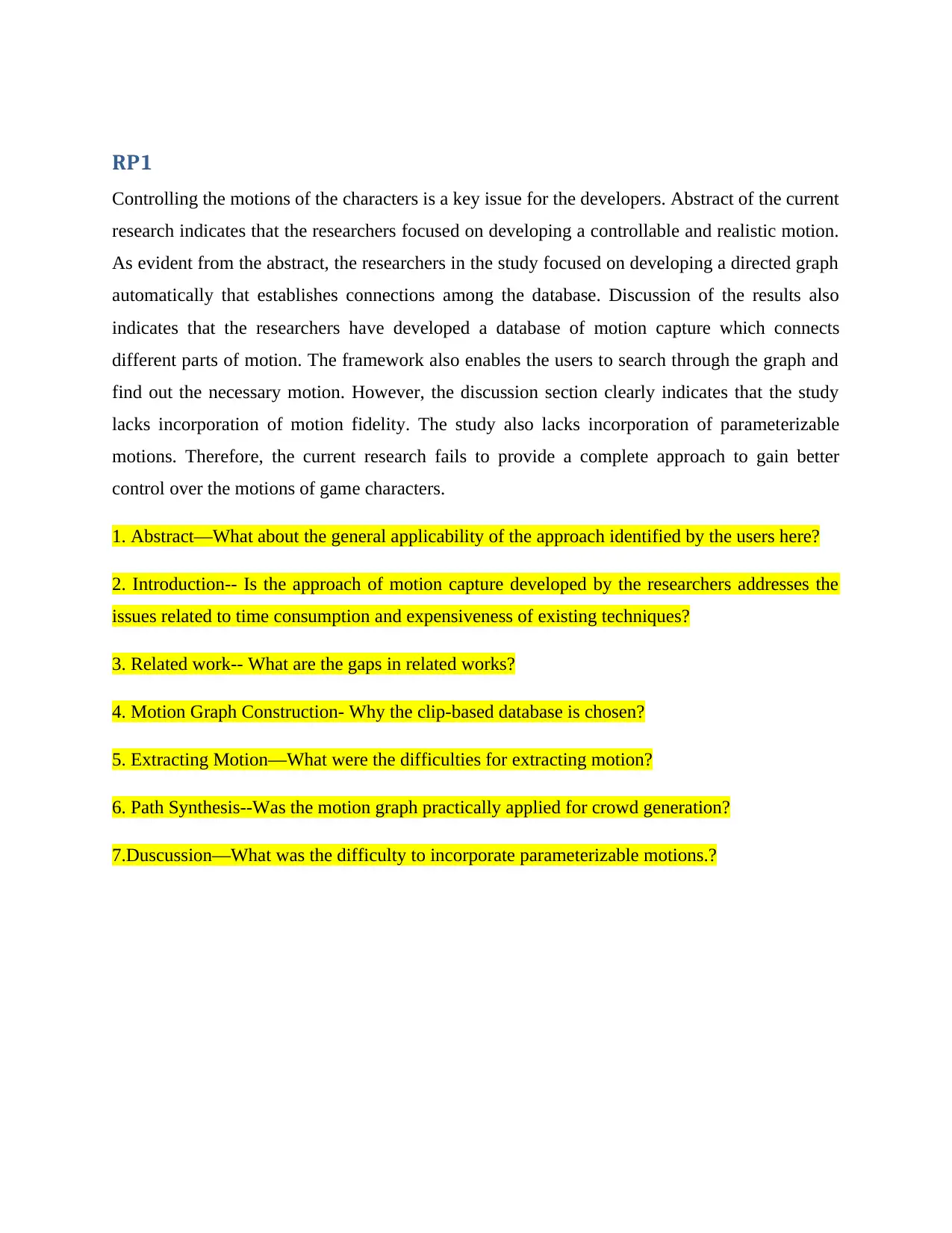
RP1
Controlling the motions of the characters is a key issue for the developers. Abstract of the current
research indicates that the researchers focused on developing a controllable and realistic motion.
As evident from the abstract, the researchers in the study focused on developing a directed graph
automatically that establishes connections among the database. Discussion of the results also
indicates that the researchers have developed a database of motion capture which connects
different parts of motion. The framework also enables the users to search through the graph and
find out the necessary motion. However, the discussion section clearly indicates that the study
lacks incorporation of motion fidelity. The study also lacks incorporation of parameterizable
motions. Therefore, the current research fails to provide a complete approach to gain better
control over the motions of game characters.
1. Abstract—What about the general applicability of the approach identified by the users here?
2. Introduction-- Is the approach of motion capture developed by the researchers addresses the
issues related to time consumption and expensiveness of existing techniques?
3. Related work-- What are the gaps in related works?
4. Motion Graph Construction- Why the clip-based database is chosen?
5. Extracting Motion—What were the difficulties for extracting motion?
6. Path Synthesis--Was the motion graph practically applied for crowd generation?
7.Duscussion—What was the difficulty to incorporate parameterizable motions.?
Document Page
References
Kovar, L., Gleicher, M., & Pighin, F. (2008, August). Motion graphs. In ACM SIGGRAPH 2008
classes (p. 51). ACM.
Document Page
RP2
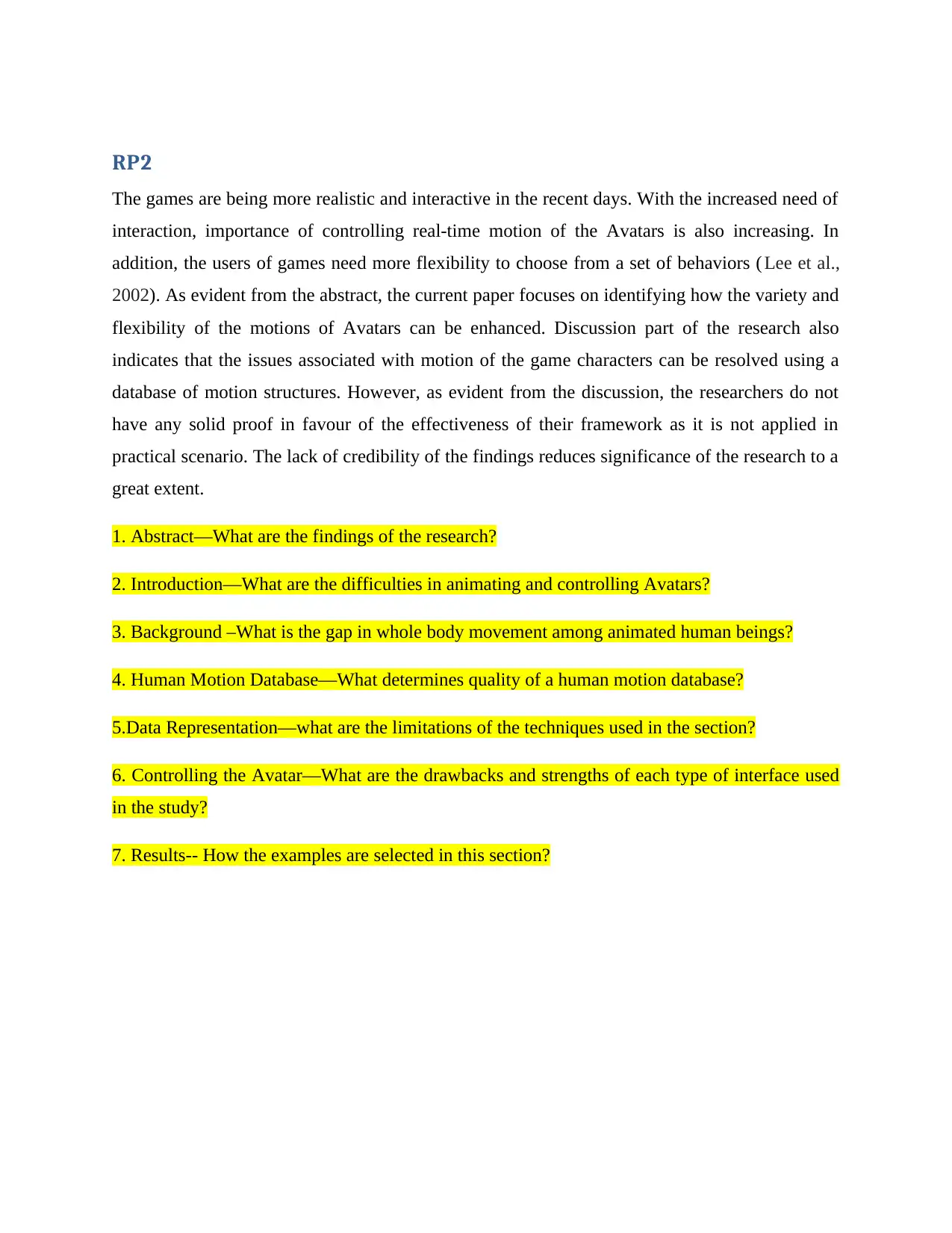
The games are being more realistic and interactive in the recent days. With the increased need of
interaction, importance of controlling real-time motion of the Avatars is also increasing. In
addition, the users of games need more flexibility to choose from a set of behaviors ( Lee et al.,
2002). As evident from the abstract, the current paper focuses on identifying how the variety and
flexibility of the motions of Avatars can be enhanced. Discussion part of the research also
indicates that the issues associated with motion of the game characters can be resolved using a
database of motion structures. However, as evident from the discussion, the researchers do not
have any solid proof in favour of the effectiveness of their framework as it is not applied in
practical scenario. The lack of credibility of the findings reduces significance of the research to a
great extent.
1. Abstract—What are the findings of the research?
2. Introduction—What are the difficulties in animating and controlling Avatars?
3. Background –What is the gap in whole body movement among animated human beings?
4. Human Motion Database—What determines quality of a human motion database?
5.Data Representation—what are the limitations of the techniques used in the section?
6. Controlling the Avatar—What are the drawbacks and strengths of each type of interface used
in the study?
7. Results-- How the examples are selected in this section?
tabler-icon-diamond-filled.svg

Paraphrase This Document

Need a fresh take? Get an instant paraphrase of this document with our AI Paraphraser
Document Page
References
Lee, J., Chai, J., Reitsma, P. S., Hodgins, J. K., & Pollard, N. S. (2002, July). Interactive control
of avatars animated with human motion data. In ACM Transactions on Graphics (ToG)(Vol. 21,
No. 3, pp. 491-500). ACM.
chevron_up_icon
1 out of 5
circle_padding
hide_on_mobile
zoom_out_icon
[object Object]