Game Theory Exercise: Analysis of Economic Behaviors and Principles

Verified

Added on  2023/04/20

|7
|1192
|233
Homework Assignment
AI Summary
This assignment solution provides a detailed analysis of a game theory exercise, addressing questions related to credible commitment, Nash equilibrium, cognitive biases, and risk aversion. The solution explores how employers assess credibility, the concept of "talk is cheap," and the application of Nash equilibrium in decision-making. It also examines cognitive biases such as self-interest and availability heuristics, and their impact on economic behavior. Furthermore, the assignment delves into the influence of human behavior on economic models, the comparison between midterm and end-term exams, and the calculation of expected value in lottery scenarios. Finally, the solution analyzes the factors influencing lottery ticket purchases, including price and probability of winning. The assignment references relevant economic literature and provides a comprehensive understanding of game theory principles.
Document Page
Running head: GAME THEORY EXERCISE
1
Game Theory Exercise Paper
Student's Name
Professor's Name
Affiliation
Date
tabler-icon-diamond-filled.svg

Paraphrase This Document

Need a fresh take? Get an instant paraphrase of this document with our AI Paraphraser
Document Page
GAME THEORY EXERCISE
2
Game Theory Exercise
Question 1
Part a
The concept of credible commitment stems from a situation where individuals are unable to fulfil
their goals/objective because they are incapable of making credible promises. The graduate is
better able to showcase credibility because he/she has demonstrated commitment to a given
objective. The person with no degree/diploma is considered by the employer to be less credible
because his /her commitment to graduating is significantly diminished (therefore his/her promise
is not considered credible). The employer is therefore inclined to favour recruiting the graduate
over the non-graduate.
Part b
Talk is cheap: it is easy for an individual to claim he/she is going to graduate from college than it
is for that same person to actually get a degree or diploma in a given field. Employers prefer to
recruit people who can "walk the talk" i.e. actual graduates.
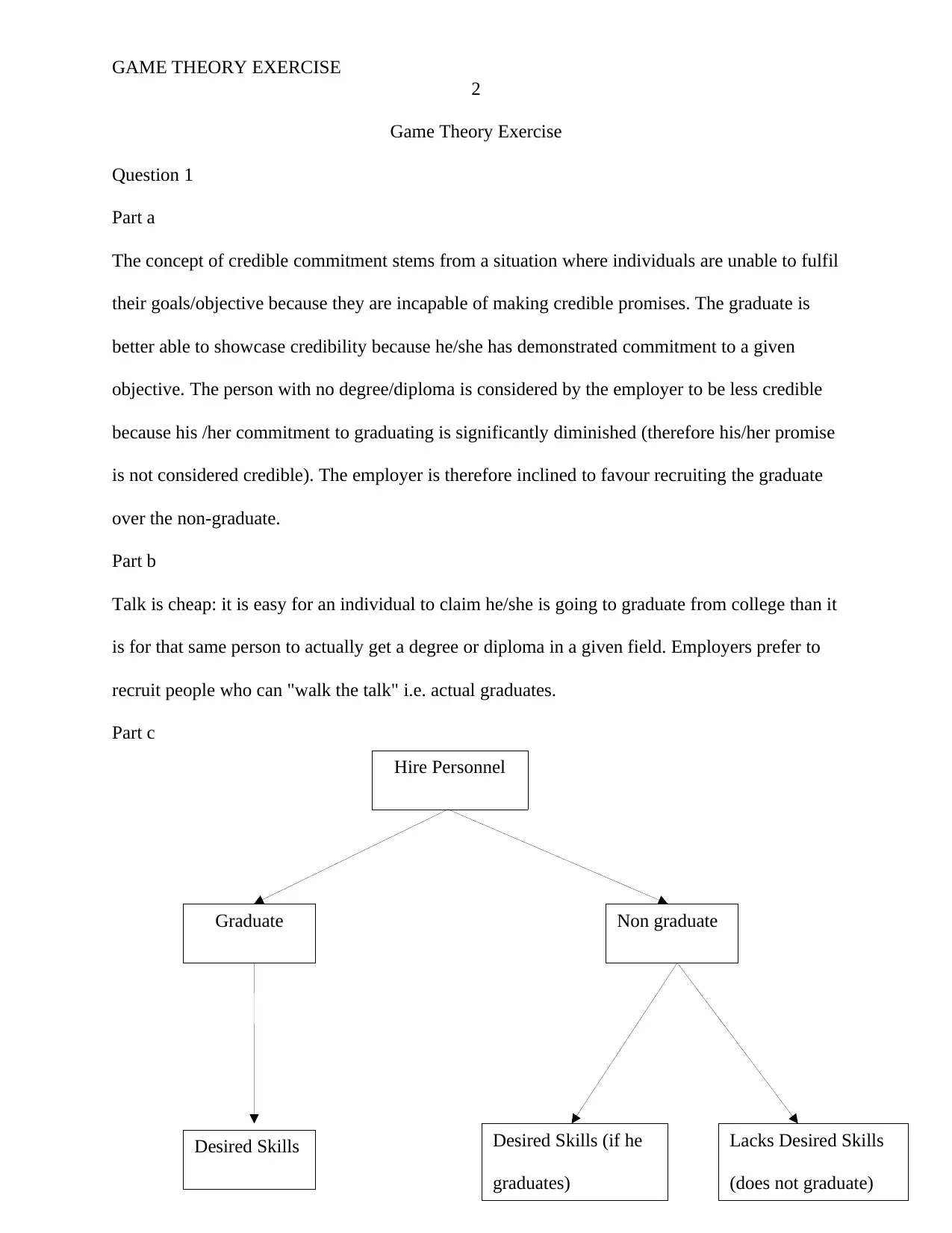
Part c
Graduate Non graduate
Desired Skills Desired Skills (if he
graduates)
Lacks Desired Skills
(does not graduate)
Hire Personnel
Document Page
GAME THEORY EXERCISE
3
Question 2
Part a
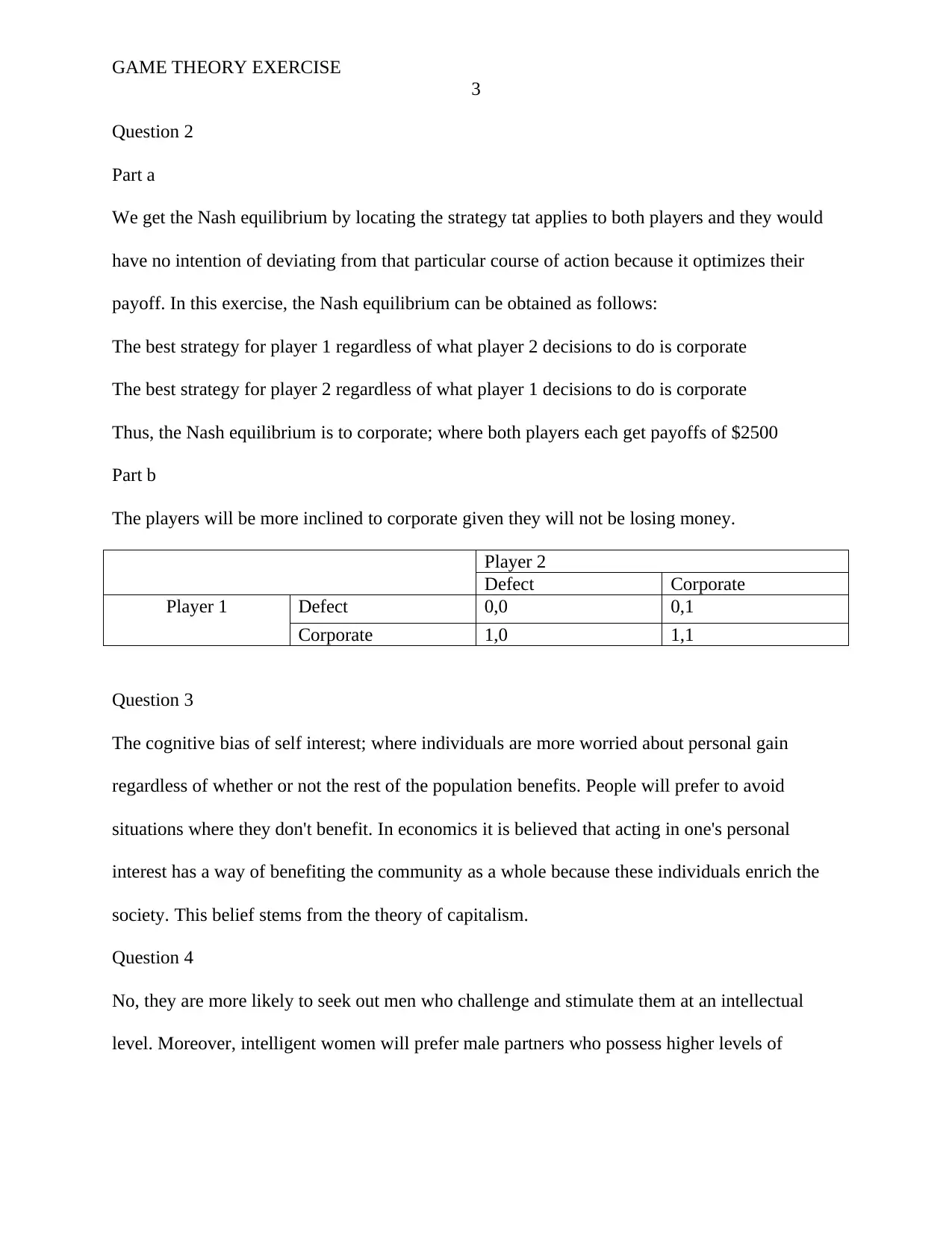
We get the Nash equilibrium by locating the strategy tat applies to both players and they would
have no intention of deviating from that particular course of action because it optimizes their
payoff. In this exercise, the Nash equilibrium can be obtained as follows:
The best strategy for player 1 regardless of what player 2 decisions to do is corporate
The best strategy for player 2 regardless of what player 1 decisions to do is corporate
Thus, the Nash equilibrium is to corporate; where both players each get payoffs of $2500
Part b
The players will be more inclined to corporate given they will not be losing money.
Player 2
Defect Corporate
Player 1 Defect 0,0 0,1
Corporate 1,0 1,1
Question 3
The cognitive bias of self interest; where individuals are more worried about personal gain
regardless of whether or not the rest of the population benefits. People will prefer to avoid
situations where they don't benefit. In economics it is believed that acting in one's personal
interest has a way of benefiting the community as a whole because these individuals enrich the
society. This belief stems from the theory of capitalism.
Question 4
No, they are more likely to seek out men who challenge and stimulate them at an intellectual
level. Moreover, intelligent women will prefer male partners who possess higher levels of
Document Page
GAME THEORY EXERCISE
4
intellect because this is associated with manliness. In addition, most men are intimidated by
women who are smarter than them.
Question 5
Economic behaviour is directly linked and associated to human behavior. However, in
special situation economic behaviour is influenced by institutional forces. Nevertheless, a long-
term look at economic outcomes reveals that the processes involved are influenced by human
decisions. For a traditional understanding of economic behavior, economists have always
proposed a given statement that acts as the starting point behind every economic decision. For
instance, people will prioritize benefit and gain without taking into consideration the
consequences of their actions. This can be demonstrated in a situation where a person
accumulates considerable credit card debt buying unnecessary items because they are ignorant of
future implications (Goodwin, et al. , 2017).
However, in some situations economic models are not utilized or helpful in discerning a
given economic behavior. As such, steps need to be taken to revise and improve existing models
to account for changes in human behavior which has caused a change in economic behavior. We
cannot eliminate economic models altogether because they are informative and useful in
predicting market changes. Therefore, revision of traditional economic models will give rise to
new models that are sensitive to modern needs of consumers. In addition, most economists are
proposing for the diversion of economic behavior from psychology to a more science based
study that is centered on physics concepts and principles (Stankovic, 2009).
Question 6
Te midterm exams are designed to test the student's ability to recall recently learnt concepts and
ideas to the best of his/her understanding; On the other hand, end term exams assess the student's
tabler-icon-diamond-filled.svg

Paraphrase This Document

Need a fresh take? Get an instant paraphrase of this document with our AI Paraphraser
Document Page
GAME THEORY EXERCISE
5
understanding of concepts learnt throughout the semester. The midterm exams offer a higher
payoff to students (60%) because they are more demanding and challenging; testing the
individual's commitment to passing a particular course. The final exams offer a lower payoff
(40%) because the student is aided in the provision of answers, and moreover it is designed to
ensure that students achieve a given percentage in their overall score.
Question 7
Availability heuristic is used to refer to a situation were unnecessary attention or priority is
placed on information because it is vivid or readily attainable.
Risk aversion is used to refer to a situation when an individual prefers offers that are void of any
risk or are not linked to any negative consequences.
Question 8
Part a
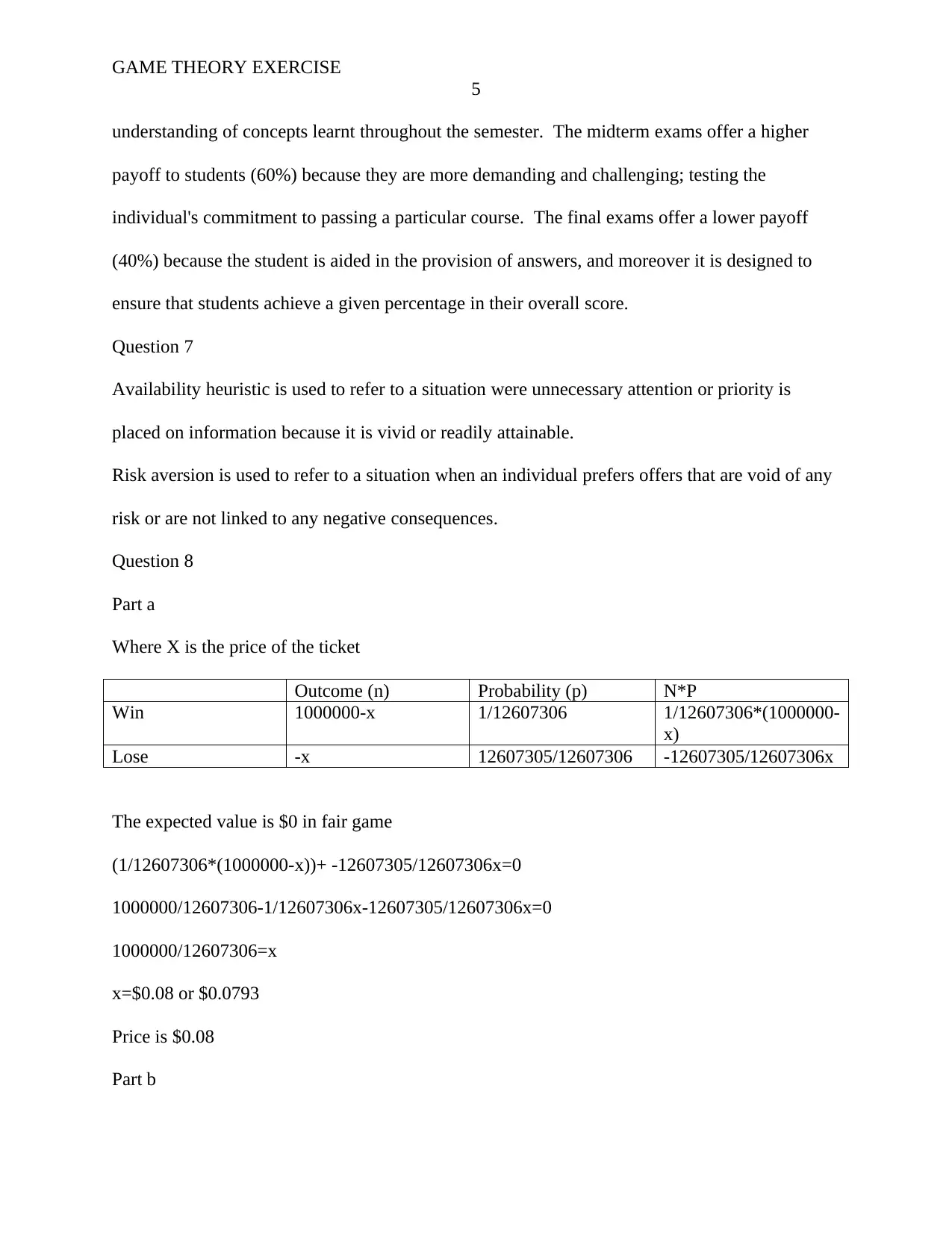
Where X is the price of the ticket
Outcome (n) Probability (p) N*P
Win 1000000-x 1/12607306 1/12607306*(1000000-
x)
Lose -x 12607305/12607306 -12607305/12607306x
The expected value is $0 in fair game
(1/12607306*(1000000-x))+ -12607305/12607306x=0
1000000/12607306-1/12607306x-12607305/12607306x=0
1000000/12607306=x
x=$0.08 or $0.0793
Price is $0.08
Part b
Document Page
GAME THEORY EXERCISE
6
Te concept is the same as in part a so we can simply do
Probability * outcome
1/606*200
Price =200/606
Price=$0.33
Part c
The million dollar jackpot lottery tickets are cheaper; however people would opt to buy the more
expensive $200 lottery tickets because their chances of winning are significantly higher. In this
scenario the price of the tickets is considered less important compared to the probability of
winning. Buying the $200 lottery tickets optimizes both risk and loss aversion because a person
will procure far fewer tickets to stand a good chance of winning the price money.
Document Page
GAME THEORY EXERCISE
7
References
Goodwin, N., Harris, J., Nelson, J., Rajkarnikar, P. J., Roach, B., & Torras, M. (2017). Chapter
7: Economic Behavior and Rationality. In N. Goodwin, J. Harris, J. Nelson, P. J.
Rajkarnikar, B. Roach, & M. Torras, Microeconomics in Context, Fourth Edition (pp. 1-
25). Abingdon: Routledge.
Stankovic, T. (2009). Strategy and Credible Commitment: A game theoretic analysis of the
conflict in Afghanistan. Oslo : University of Oslo.
chevron_up_icon
1 out of 7
circle_padding
hide_on_mobile
zoom_out_icon
[object Object]