Economics Assignment: Nash Equilibrium and Subgame Perfect Equilibrium

Verified

Added on  2019/09/13

|3
|601
|168
Homework Assignment
AI Summary
This assignment solution explores key concepts in game theory. It begins by defining and illustrating the Nash equilibrium through a specific game scenario, determining the conditions for a unique equilibrium. The solution then analyzes another game, identifying the Nash equilibrium based on the players' best responses. Finally, the assignment delves into extensive-form games, defining subgames and explaining the concept of subgame perfect equilibrium, illustrating the concept through reduced-form analysis. The solution provides a clear understanding of the key concepts and their application in various game scenarios.

Document Page
game theory
[Document subtitle]
tabler-icon-diamond-filled.svg

Paraphrase This Document

Need a fresh take? Get an instant paraphrase of this document with our AI Paraphraser
Document Page
1
Solution 2)
A Nash equilibrium is the outcome of a game that took place when all the players in the game take their
best move and best response strategy. When a game has only one solution, it is a unique Nash
equilibrium.
In the given problem, suppose there are two players, A and B
PLAYER B
PLAYER
A
L R
U 3,-2 5,10
D X,6 -2,4
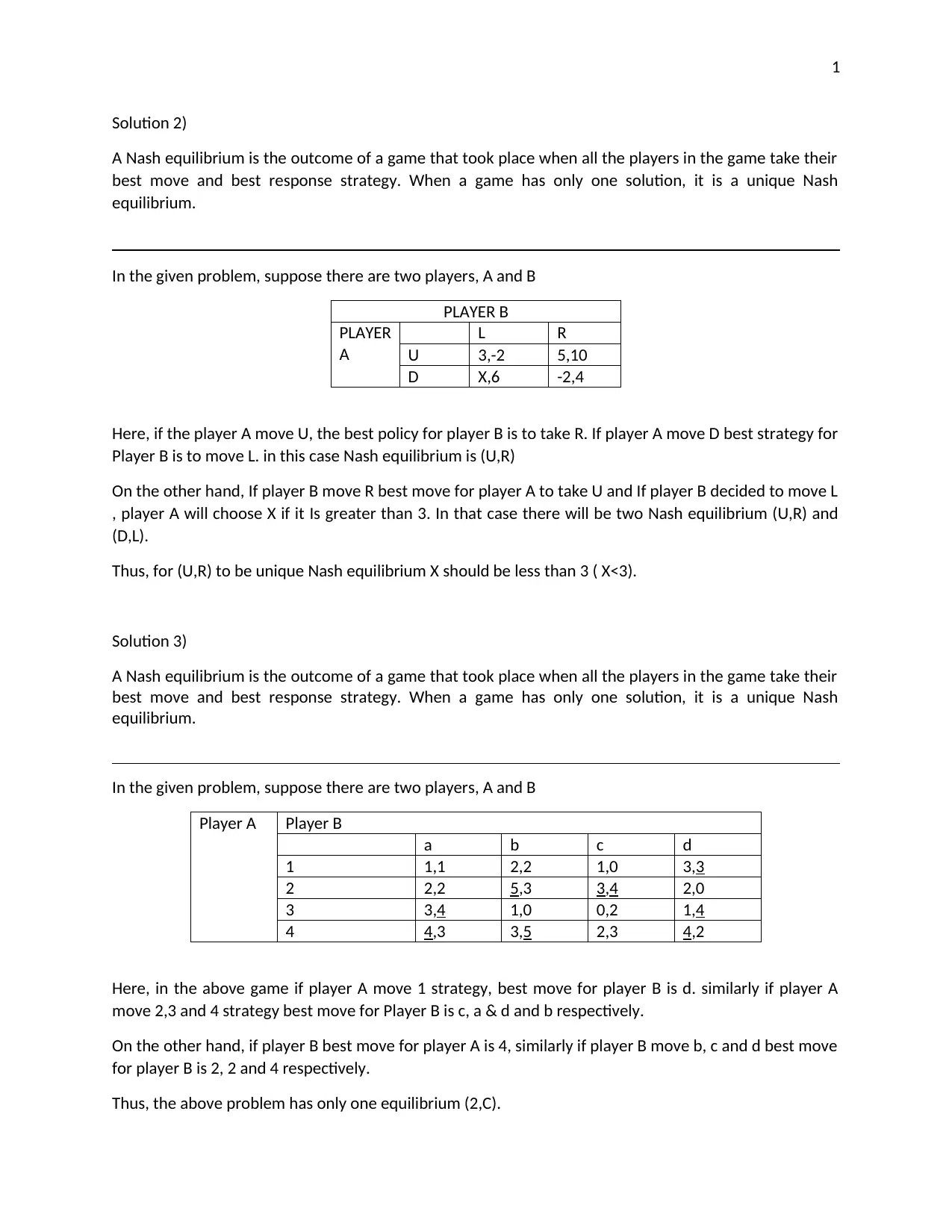
Here, if the player A move U, the best policy for player B is to take R. If player A move D best strategy for
Player B is to move L. in this case Nash equilibrium is (U,R)
On the other hand, If player B move R best move for player A to take U and If player B decided to move L
, player A will choose X if it Is greater than 3. In that case there will be two Nash equilibrium (U,R) and
(D,L).
Thus, for (U,R) to be unique Nash equilibrium X should be less than 3 ( X<3).
Solution 3)
A Nash equilibrium is the outcome of a game that took place when all the players in the game take their
best move and best response strategy. When a game has only one solution, it is a unique Nash
equilibrium.
In the given problem, suppose there are two players, A and B
Player A Player B
a b c d
1 1,1 2,2 1,0 3,3
2 2,2 5,3 3,4 2,0
3 3,4 1,0 0,2 1,4
4 4,3 3,5 2,3 4,2
Here, in the above game if player A move 1 strategy, best move for player B is d. similarly if player A
move 2,3 and 4 strategy best move for Player B is c, a & d and b respectively.
On the other hand, if player B best move for player A is 4, similarly if player B move b, c and d best move
for player B is 2, 2 and 4 respectively.
Thus, the above problem has only one equilibrium (2,C).
Document Page
2
Solution 4)
An extensive-form game has contain a part that is a smaller game, such a small game that is inserted in a
larger game is called a sub-game.
A Nash equilibrium can be sub-game perfect only if there is only it is a Nash equilibrium in every sub-
game of the game.
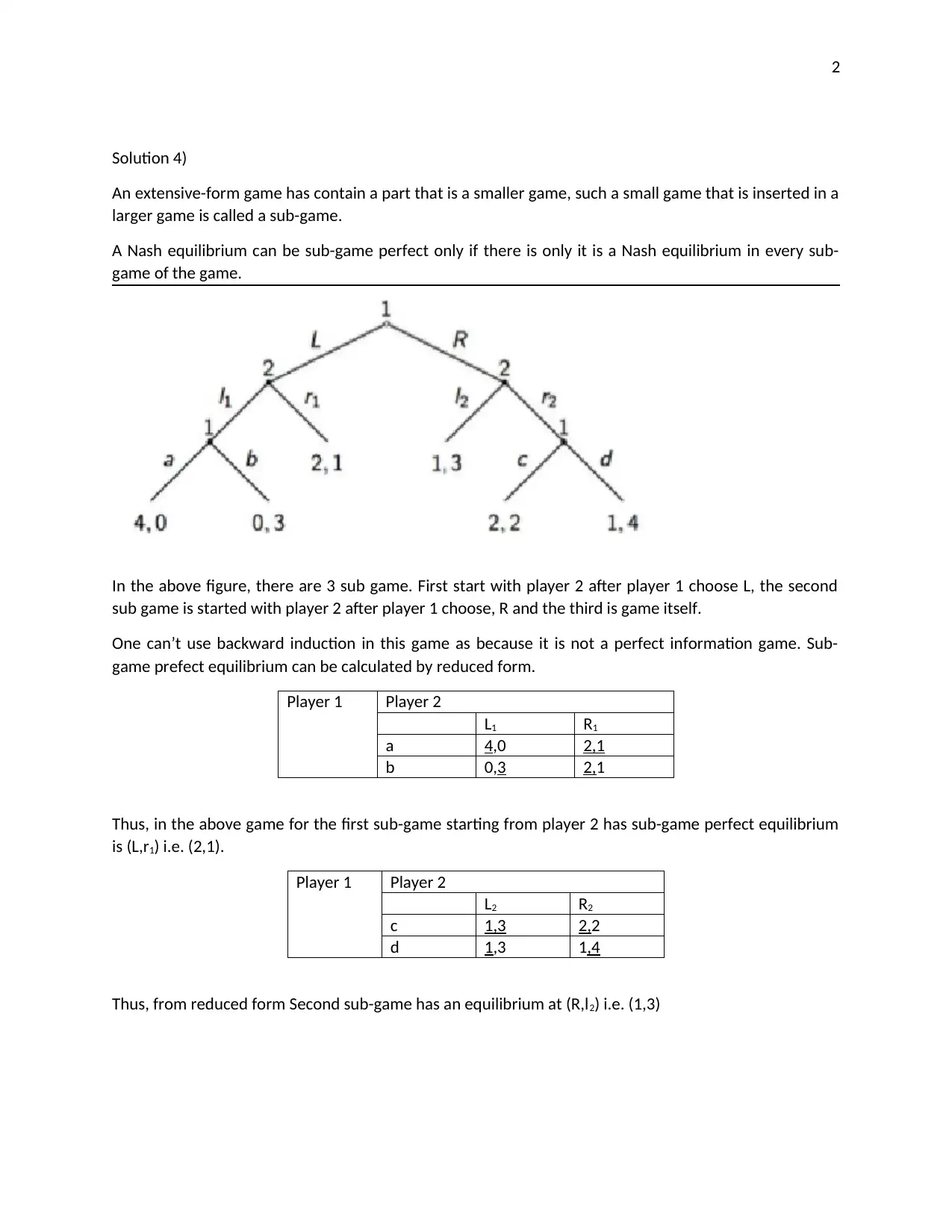
In the above figure, there are 3 sub game. First start with player 2 after player 1 choose L, the second
sub game is started with player 2 after player 1 choose, R and the third is game itself.
One can’t use backward induction in this game as because it is not a perfect information game. Sub-
game prefect equilibrium can be calculated by reduced form.
Player 1 Player 2
L1 R1
a 4,0 2,1
b 0,3 2,1
Thus, in the above game for the first sub-game starting from player 2 has sub-game perfect equilibrium
is (L,r1) i.e. (2,1).
Player 1 Player 2
L2 R2
c 1,3 2,2
d 1,3 1,4
Thus, from reduced form Second sub-game has an equilibrium at (R,l2) i.e. (1,3)
chevron_up_icon
1 out of 3
circle_padding
hide_on_mobile
zoom_out_icon
[object Object]