Critical Analysis of Gamification in Education: Two Academic Articles
VerifiedAdded on  2022/09/16
|6
|1337
|39
Homework Assignment
AI Summary
This assignment critically analyzes the concept of gamification in education by examining two academic articles. The first article, by Nah et al. (2014), reviews the literature on gamification, highlighting design elements like points, badges, and leaderboards, and their impact on learner outcomes such as engagement and motivation. The second article, by Kiryakova et al. (2014), introduces gamification as a modern pedagogical trend, discussing the differences between serious games and gamification and identifying software tools used in educational institutions, such as Kahoot and ClassDojo. The assignment emphasizes the importance of incorporating game mechanics to enhance student involvement and learning, and the use of LMS platforms for monitoring student progress. Both articles contribute to understanding how gamification can be effectively implemented to improve educational outcomes.

SOCIOLOGY
SOCIOLOGY
University Name
Name of course
Author Note
SOCIOLOGY
University Name
Name of course
Author Note
Paraphrase This Document
Need a fresh take? Get an instant paraphrase of this document with our AI Paraphraser

SOCIOLOGY
Gamifiction in Education
Gamification can be illustrated as the use of game design and gameplay to boost game
environments through increased involvement, engagement, commitment and competitiveness
(Caponetto, Earp & Ott, 2014). Such strategies may include scores, leading tables, direct
contests even advertisements, and are available in diverse sectors such as personal wellness,
shopping and education (Dicheva et al., 2015). Gamification among students is one of the most
common and favourite learning trends worldwide. Games can help in constructed learning or, to
put it simply, knowledge gathered from immersive experience. Gamification in education is an
innovation strategy for inspiring and engaging students by integrating features of game design
into educational context (Huang & Soman, 2013). The current review of gamification aims to
provide a more objective perspective on research in this field, by concentrating upon empirical
evidence and not over potential, views or desires, with the increasing popularity of gamification
but its mixed performance in educational setting.
The thesis statement of this paper argues over the critical explanation of the importance of
gamification in education as well as its impact over the outcomes of the learners through the
discussion of two articles.
Nah, F. F. H., Zeng, Q., Telaprolu, V. R., Ayyappa, A. P., & Eschenbrenner, B. (2014, June).
Gamification of education: a review of literature. In International conference on hci in
business (pp. 401-409). Springer, Cham.
Gamification corresponds to the implementation of elements for non-game design in a range of
environments, which include education. Multiple elements were used to boost user involvement
in gamification. Instances include points, emblems, leaderboards and tales. Educational
Gamifiction in Education
Gamification can be illustrated as the use of game design and gameplay to boost game
environments through increased involvement, engagement, commitment and competitiveness
(Caponetto, Earp & Ott, 2014). Such strategies may include scores, leading tables, direct
contests even advertisements, and are available in diverse sectors such as personal wellness,
shopping and education (Dicheva et al., 2015). Gamification among students is one of the most
common and favourite learning trends worldwide. Games can help in constructed learning or, to
put it simply, knowledge gathered from immersive experience. Gamification in education is an
innovation strategy for inspiring and engaging students by integrating features of game design
into educational context (Huang & Soman, 2013). The current review of gamification aims to
provide a more objective perspective on research in this field, by concentrating upon empirical
evidence and not over potential, views or desires, with the increasing popularity of gamification
but its mixed performance in educational setting.
The thesis statement of this paper argues over the critical explanation of the importance of
gamification in education as well as its impact over the outcomes of the learners through the
discussion of two articles.
Nah, F. F. H., Zeng, Q., Telaprolu, V. R., Ayyappa, A. P., & Eschenbrenner, B. (2014, June).
Gamification of education: a review of literature. In International conference on hci in
business (pp. 401-409). Springer, Cham.
Gamification corresponds to the implementation of elements for non-game design in a range of
environments, which include education. Multiple elements were used to boost user involvement
in gamification. Instances include points, emblems, leaderboards and tales. Educational

SOCIOLOGY
establishments are involved in educational gamification by building spirited learning
environments for enhancing learner participation and optimizing learning outcomes. The aim of
this research study is to conduct analysis of the gamification literature in educational and
learning contexts. The researcher of this article conducted secondary data analysis by reviewing
the design elements for Gamifiction together with the probable learning outcomes. This synthesis
of literature contributes to the identification and the understanding of the role and importance of
gamification in the educational context. Some of the prominent game designs with sustainable
learner outcomes includes experiences points, challenges and leaders boards as design elements
with participation and engagement as learner outcomes. Furthermore the design of on boarding,
replay and customization in gamification results in productive learning experiences as learner
outcomes as per the research study. The learner outcomes of sense of accomplishment,
engagement as well as increased performance due to motivation are in line with the game design
of storytelling, achievement, feedback and leader boards. Based on the gamification principle, a
number of applications have been developed. Corporations as well as educational institutions
spend time and resources in gamification to inspire and empower pupils (Nah et al., 2014). The
strength of this article is that the researchers identified eight design elements of game. Which are
used in the learning and educational context. These are level or stages, points, badges, prize or
rewards, leadboards, storyline, progressbars and feedback. There have been a number of
gamified programs on the marketplace to allow users learn different techniques. Games based on
geolocation such as "QuizeRo" have demonstrated an interest among the users through
motivation to investigate areas as well as to learn about different destinations. The data collected
for this research study are reliable and this paper conducted a literature review on education
gamification and described different elements of game design for use in gamification of
establishments are involved in educational gamification by building spirited learning
environments for enhancing learner participation and optimizing learning outcomes. The aim of
this research study is to conduct analysis of the gamification literature in educational and
learning contexts. The researcher of this article conducted secondary data analysis by reviewing
the design elements for Gamifiction together with the probable learning outcomes. This synthesis
of literature contributes to the identification and the understanding of the role and importance of
gamification in the educational context. Some of the prominent game designs with sustainable
learner outcomes includes experiences points, challenges and leaders boards as design elements
with participation and engagement as learner outcomes. Furthermore the design of on boarding,
replay and customization in gamification results in productive learning experiences as learner
outcomes as per the research study. The learner outcomes of sense of accomplishment,
engagement as well as increased performance due to motivation are in line with the game design
of storytelling, achievement, feedback and leader boards. Based on the gamification principle, a
number of applications have been developed. Corporations as well as educational institutions
spend time and resources in gamification to inspire and empower pupils (Nah et al., 2014). The
strength of this article is that the researchers identified eight design elements of game. Which are
used in the learning and educational context. These are level or stages, points, badges, prize or
rewards, leadboards, storyline, progressbars and feedback. There have been a number of
gamified programs on the marketplace to allow users learn different techniques. Games based on
geolocation such as "QuizeRo" have demonstrated an interest among the users through
motivation to investigate areas as well as to learn about different destinations. The data collected
for this research study are reliable and this paper conducted a literature review on education
gamification and described different elements of game design for use in gamification of
⊘ This is a preview!⊘
Do you want full access?
Subscribe today to unlock all pages.

Trusted by 1+ million students worldwide

SOCIOLOGY
education. The gamification of education has risen in popularity, but systematic studies are in the
infancy to determine and measure the effect of education.
Kiryakova, G., Angelova, N., & Yordanova, L. (2014). Gamification in education. Proceedings
of 9th International Balkan Education and Science Conference.
Today's students seem to be digital natives with an innovative profile. They have evolved with
emerging technology and diverse ways of learning, a modern approach to the learning process
and higher education and learning requirements. Teachers face new challenges and have been
faced with critical problems related to adjusting the education process to both the requirements,
interests as well as expectations of the learners. This study by the researcher introduced
gamification as one of the modern pedagogical trends and paradigm in educational context for
the implementation of active learning among the students. Gamification is incorporated into
non-gaming practices through game elements and strategic thought. The research study discussed
the differences and the similarities among serious games and gamification. The application of
game mechanics increases learning abilities by 40%. Game techniques contribute to greater
involvement and encouragement for consumers to participate in programs and processes
(Kiryakova, Angelova & Yordanova, 2014). Game mechanics are common to consumers since
most of them play various games or continue to play. Developing an effective e-learning strategy
requires an in-depth study of current requirements and available technical resources. The key
stages of the strategy include: identifying the attributes of the beginner and developing content
and gamification practices. The strength of this research article is that the authors discussed and
identified the tools of software that are appropriate and used for gamification in majority of the
educational institutions. Some of the most commonly used tool of gamification are Kahoot,
education. The gamification of education has risen in popularity, but systematic studies are in the
infancy to determine and measure the effect of education.
Kiryakova, G., Angelova, N., & Yordanova, L. (2014). Gamification in education. Proceedings
of 9th International Balkan Education and Science Conference.
Today's students seem to be digital natives with an innovative profile. They have evolved with
emerging technology and diverse ways of learning, a modern approach to the learning process
and higher education and learning requirements. Teachers face new challenges and have been
faced with critical problems related to adjusting the education process to both the requirements,
interests as well as expectations of the learners. This study by the researcher introduced
gamification as one of the modern pedagogical trends and paradigm in educational context for
the implementation of active learning among the students. Gamification is incorporated into
non-gaming practices through game elements and strategic thought. The research study discussed
the differences and the similarities among serious games and gamification. The application of
game mechanics increases learning abilities by 40%. Game techniques contribute to greater
involvement and encouragement for consumers to participate in programs and processes
(Kiryakova, Angelova & Yordanova, 2014). Game mechanics are common to consumers since
most of them play various games or continue to play. Developing an effective e-learning strategy
requires an in-depth study of current requirements and available technical resources. The key
stages of the strategy include: identifying the attributes of the beginner and developing content
and gamification practices. The strength of this research article is that the authors discussed and
identified the tools of software that are appropriate and used for gamification in majority of the
educational institutions. Some of the most commonly used tool of gamification are Kahoot,
Paraphrase This Document
Need a fresh take? Get an instant paraphrase of this document with our AI Paraphraser

SOCIOLOGY
Socrative, Duolingo, ClassDojo and add on BadgeStack. LMS is popularly used for monitoring
the learning process and for providing a wide range of online courses with learning tools and
events. LMS allow Web 2.0 resources to be incorporated, enhancing their functionality and
reacting to evolving educational and cooperation paradigms between all learning participants.
LMS are an acceptable gaming platform as they provide resources to control the performance
and progress of students automatically. Information on the hours spent on watching or
communicating with subject matter can be retrieved. The reaserch study identified how
gamification in education can be applied in different ways. The system featured automated data
analysis as well as tracking and completion and conditioning are the backbone of students
'development as discussed in this study.
Socrative, Duolingo, ClassDojo and add on BadgeStack. LMS is popularly used for monitoring
the learning process and for providing a wide range of online courses with learning tools and
events. LMS allow Web 2.0 resources to be incorporated, enhancing their functionality and
reacting to evolving educational and cooperation paradigms between all learning participants.
LMS are an acceptable gaming platform as they provide resources to control the performance
and progress of students automatically. Information on the hours spent on watching or
communicating with subject matter can be retrieved. The reaserch study identified how
gamification in education can be applied in different ways. The system featured automated data
analysis as well as tracking and completion and conditioning are the backbone of students
'development as discussed in this study.

SOCIOLOGY
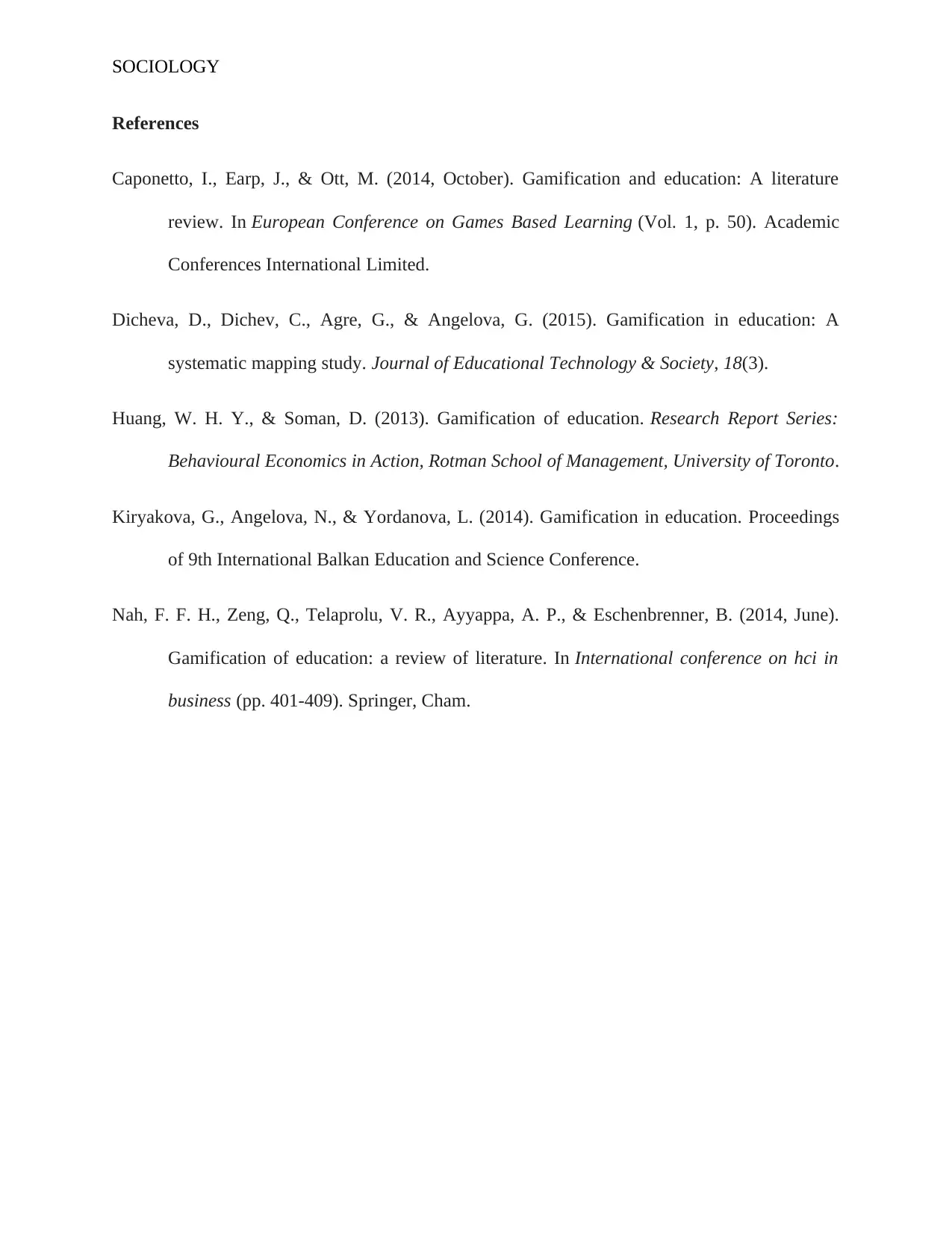
References
Caponetto, I., Earp, J., & Ott, M. (2014, October). Gamification and education: A literature
review. In European Conference on Games Based Learning (Vol. 1, p. 50). Academic
Conferences International Limited.
Dicheva, D., Dichev, C., Agre, G., & Angelova, G. (2015). Gamification in education: A
systematic mapping study. Journal of Educational Technology & Society, 18(3).
Huang, W. H. Y., & Soman, D. (2013). Gamification of education. Research Report Series:
Behavioural Economics in Action, Rotman School of Management, University of Toronto.
Kiryakova, G., Angelova, N., & Yordanova, L. (2014). Gamification in education. Proceedings
of 9th International Balkan Education and Science Conference.
Nah, F. F. H., Zeng, Q., Telaprolu, V. R., Ayyappa, A. P., & Eschenbrenner, B. (2014, June).
Gamification of education: a review of literature. In International conference on hci in
business (pp. 401-409). Springer, Cham.
References
Caponetto, I., Earp, J., & Ott, M. (2014, October). Gamification and education: A literature
review. In European Conference on Games Based Learning (Vol. 1, p. 50). Academic
Conferences International Limited.
Dicheva, D., Dichev, C., Agre, G., & Angelova, G. (2015). Gamification in education: A
systematic mapping study. Journal of Educational Technology & Society, 18(3).
Huang, W. H. Y., & Soman, D. (2013). Gamification of education. Research Report Series:
Behavioural Economics in Action, Rotman School of Management, University of Toronto.
Kiryakova, G., Angelova, N., & Yordanova, L. (2014). Gamification in education. Proceedings
of 9th International Balkan Education and Science Conference.
Nah, F. F. H., Zeng, Q., Telaprolu, V. R., Ayyappa, A. P., & Eschenbrenner, B. (2014, June).
Gamification of education: a review of literature. In International conference on hci in
business (pp. 401-409). Springer, Cham.
⊘ This is a preview!⊘
Do you want full access?
Subscribe today to unlock all pages.

Trusted by 1+ million students worldwide
1 out of 6
Related Documents
Your All-in-One AI-Powered Toolkit for Academic Success.
 +13062052269
info@desklib.com
Available 24*7 on WhatsApp / Email
Unlock your academic potential
Copyright © 2020–2025 A2Z Services. All Rights Reserved. Developed and managed by ZUCOL.