Principles of Gamification and its Application in Education Report
VerifiedAdded on 2023/04/19
|64
|24654
|343
Report
AI Summary
This report investigates the principles of gamification and its practical applications within educational environments. It begins with an introduction outlining the research's background, problem statement, research questions, and purpose. The literature review explores gamification definitions, psychological effects, and real-world applications, including educational settings and training. The methodology section details the use of Q methodology, involving quantitative data from students and qualitative data from professors. Data analysis focuses on identifying students' perceptions of gamification and prominent elements like dynamics, mechanics, points, badges, and leaderboards. The findings indicate a positive student perspective on gamification, emphasizing the importance of process logic, emotions, advancement structures, and achievement elements. The report concludes with recommendations for implementing gamification in education to enhance student engagement and learning outcomes. The report also includes a table of contents, a list of tables, and appendices with supporting data and frameworks.
Principles of Gamification and their
Practical Application in Education
Environments
Practical Application in Education
Environments

Paraphrase This Document
Need a fresh take? Get an instant paraphrase of this document with our AI Paraphraser
Abstract:
Introduction
This research will be based the use of digital games for the purpose of digital learning in the
education system. The introduction part will provide with a background of this research.
Problem statement will be highlighted followed by the purpose of this research. In the next
sections, the methodology part will be highlighted which will indicate the methods of data
collection and analysis. In the next sections, the results and analysis will be provided based
on the data collection that will be conducted for this research. This chapter will end with the
conclusions and the discussion. The discussion part will also include the future research that
will be conducted after this research. This research will thus help in providing an overview of
the problems of digital learning games and the suitable methods that can solve the problems.
Literature Review
This chapter, we focus specifically on digital instances of gamification in line with the
purposes of the volume. This chapter also will focus on introducing basic terms and
psychological effects of popular gamification tools of today’s world. There are many sites
now that use gamification on even the most basic activities. Even things like completing your
profile can be gamified. There are also things outside of computer world that can be
gamified. The databases used for this research were the Science Direct, IEEE Xplore, and
Springer, using as keywords the terms "Gamification Education" and "Gamification
Framework", with a total of 612 articles being found. From these articles, the title, abstract
and keywords were analyzed and, after that, a screening was done using as a reference an
adaptation of the systematic mapping process.
Methodology
An exploratory research was carried out, consisting of the study of material already
elaborated so as to have a greater familiarity with the problem, with a view to the
improvement of ideas or the discovery of intuitions. The intension of this rerearch to
determine students’ views about the gamification of educational processes, Q methodology,
which contains an arrangement of quantitative and qualitative data collection processes, was
used.
1
Introduction
This research will be based the use of digital games for the purpose of digital learning in the
education system. The introduction part will provide with a background of this research.
Problem statement will be highlighted followed by the purpose of this research. In the next
sections, the methodology part will be highlighted which will indicate the methods of data
collection and analysis. In the next sections, the results and analysis will be provided based
on the data collection that will be conducted for this research. This chapter will end with the
conclusions and the discussion. The discussion part will also include the future research that
will be conducted after this research. This research will thus help in providing an overview of
the problems of digital learning games and the suitable methods that can solve the problems.
Literature Review
This chapter, we focus specifically on digital instances of gamification in line with the
purposes of the volume. This chapter also will focus on introducing basic terms and
psychological effects of popular gamification tools of today’s world. There are many sites
now that use gamification on even the most basic activities. Even things like completing your
profile can be gamified. There are also things outside of computer world that can be
gamified. The databases used for this research were the Science Direct, IEEE Xplore, and
Springer, using as keywords the terms "Gamification Education" and "Gamification
Framework", with a total of 612 articles being found. From these articles, the title, abstract
and keywords were analyzed and, after that, a screening was done using as a reference an
adaptation of the systematic mapping process.
Methodology
An exploratory research was carried out, consisting of the study of material already
elaborated so as to have a greater familiarity with the problem, with a view to the
improvement of ideas or the discovery of intuitions. The intension of this rerearch to
determine students’ views about the gamification of educational processes, Q methodology,
which contains an arrangement of quantitative and qualitative data collection processes, was
used.
1
In case of primary data, quantitative data is collective the participants of the study consisted
of 34 sophomores in elementary mathematics education in Faculty of Education, London who
volunteered to participate in the Q methodology implementation.
The qualitative data is collected from interviews conducted with professors from different
areas of research of the Digital Systems and Media program at the King's College London, in
order to have their opinion on the structure of the framework, as well as suggestions for
improving it.
In case of secondary data collection, after the screening, 145 articles were selected, which
went through a new screening involving the reading of the abstracts, introduction and
conclusion, to again apply the previous inclusion and exclusion criteria, resulting in a subset
of 110 primary studies.
Data Analysis
This chapter will focus on introducing basic terms and psychological effects of popular
gamification tools of today’s world. The present research, conducted with Q
methodology, aimed to determine how the gamification of the educational process is
perceived by students and whether the students’ views unify around a common
ground regarding the concept of gamification, and to highlight the prominent
elements of gamification.
Conclusion and Reccomendation
This research proposes a procedure for the gamification of the educational processes
according to findings. According to the findings, the participants have a collective
positive thought about the educational gamification procedure. The prominent
elements of this process are logic of the process, emotions towards the procedure,
advancement structure, achievement points, and badges. Therefore, it can be asserted
that dynamics and mechanics, like the invisible part of an iceberg, have a greater
importance in the procedure, though components are in the public eye. In other
words, the use of components alone without the dynamics and the mechanics cannot
be considered as gamification
2
of 34 sophomores in elementary mathematics education in Faculty of Education, London who
volunteered to participate in the Q methodology implementation.
The qualitative data is collected from interviews conducted with professors from different
areas of research of the Digital Systems and Media program at the King's College London, in
order to have their opinion on the structure of the framework, as well as suggestions for
improving it.
In case of secondary data collection, after the screening, 145 articles were selected, which
went through a new screening involving the reading of the abstracts, introduction and
conclusion, to again apply the previous inclusion and exclusion criteria, resulting in a subset
of 110 primary studies.
Data Analysis
This chapter will focus on introducing basic terms and psychological effects of popular
gamification tools of today’s world. The present research, conducted with Q
methodology, aimed to determine how the gamification of the educational process is
perceived by students and whether the students’ views unify around a common
ground regarding the concept of gamification, and to highlight the prominent
elements of gamification.
Conclusion and Reccomendation
This research proposes a procedure for the gamification of the educational processes
according to findings. According to the findings, the participants have a collective
positive thought about the educational gamification procedure. The prominent
elements of this process are logic of the process, emotions towards the procedure,
advancement structure, achievement points, and badges. Therefore, it can be asserted
that dynamics and mechanics, like the invisible part of an iceberg, have a greater
importance in the procedure, though components are in the public eye. In other
words, the use of components alone without the dynamics and the mechanics cannot
be considered as gamification
2
⊘ This is a preview!⊘
Do you want full access?
Subscribe today to unlock all pages.

Trusted by 1+ million students worldwide
Table of Contents
List of Table...............................................................................................................................4
Chapter 1: Introduction:.............................................................................................................5
1.1 Background of the research:.............................................................................................5
1.2 Problems statement:.........................................................................................................6
1.3 Research Questions..........................................................................................................7
1.4 Purpose of the research:...................................................................................................7
1.5 Perspective:......................................................................................................................8
1.6 Delimitations....................................................................................................................8
1.7 Definitions:.......................................................................................................................8
1.8 Frame of reference:..........................................................................................................8
1.9 Methodology:...................................................................................................................9
1.9.1 Research design:........................................................................................................9
1.9.2 Data collection:.........................................................................................................9
1.9.2 Data analysis:............................................................................................................9
1.9.3 Results/Empirical findings:.......................................................................................9
1.9.4 Analysis:..................................................................................................................10
1.10 Structure of the Research.............................................................................................10
1.11 Conclusions:.................................................................................................................10
Chapter 2: Literature Review...................................................................................................11
2.1 Introduction....................................................................................................................11
2.2 Gamification: Definition and Delineation......................................................................12
2.3 Mechanisms of Influence...............................................................................................13
2.4 Applications in the Real World......................................................................................15
2.4.1 Educational Applications of Gamification..............................................................15
2.4.2 Gamification in training..........................................................................................17
2.5 Perspectives on Gamification.........................................................................................18
2.6 Prospects for Future Research........................................................................................19
2.7 Related work..................................................................................................................21
2.8 Conclusion and Recommendations................................................................................23
Chapter 3: Research Methodology...........................................................................................25
3.1 Introduction....................................................................................................................25
3.2 Conceptual Framework for Gamification......................................................................25
3
List of Table...............................................................................................................................4
Chapter 1: Introduction:.............................................................................................................5
1.1 Background of the research:.............................................................................................5
1.2 Problems statement:.........................................................................................................6
1.3 Research Questions..........................................................................................................7
1.4 Purpose of the research:...................................................................................................7
1.5 Perspective:......................................................................................................................8
1.6 Delimitations....................................................................................................................8
1.7 Definitions:.......................................................................................................................8
1.8 Frame of reference:..........................................................................................................8
1.9 Methodology:...................................................................................................................9
1.9.1 Research design:........................................................................................................9
1.9.2 Data collection:.........................................................................................................9
1.9.2 Data analysis:............................................................................................................9
1.9.3 Results/Empirical findings:.......................................................................................9
1.9.4 Analysis:..................................................................................................................10
1.10 Structure of the Research.............................................................................................10
1.11 Conclusions:.................................................................................................................10
Chapter 2: Literature Review...................................................................................................11
2.1 Introduction....................................................................................................................11
2.2 Gamification: Definition and Delineation......................................................................12
2.3 Mechanisms of Influence...............................................................................................13
2.4 Applications in the Real World......................................................................................15
2.4.1 Educational Applications of Gamification..............................................................15
2.4.2 Gamification in training..........................................................................................17
2.5 Perspectives on Gamification.........................................................................................18
2.6 Prospects for Future Research........................................................................................19
2.7 Related work..................................................................................................................21
2.8 Conclusion and Recommendations................................................................................23
Chapter 3: Research Methodology...........................................................................................25
3.1 Introduction....................................................................................................................25
3.2 Conceptual Framework for Gamification......................................................................25
3
Paraphrase This Document
Need a fresh take? Get an instant paraphrase of this document with our AI Paraphraser
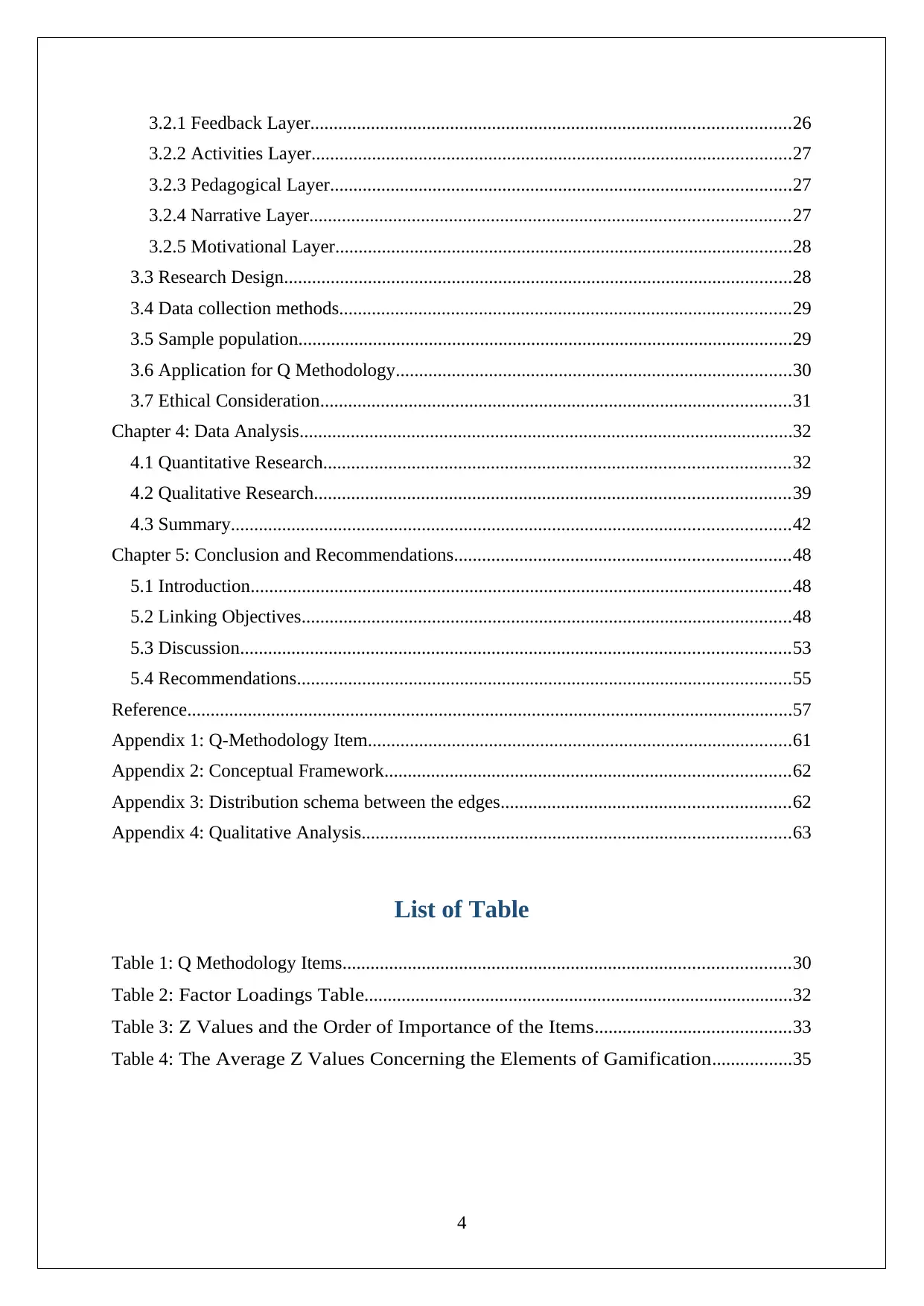
3.2.1 Feedback Layer.......................................................................................................26
3.2.2 Activities Layer.......................................................................................................27
3.2.3 Pedagogical Layer...................................................................................................27
3.2.4 Narrative Layer.......................................................................................................27
3.2.5 Motivational Layer..................................................................................................28
3.3 Research Design.............................................................................................................28
3.4 Data collection methods.................................................................................................29
3.5 Sample population..........................................................................................................29
3.6 Application for Q Methodology.....................................................................................30
3.7 Ethical Consideration.....................................................................................................31
Chapter 4: Data Analysis..........................................................................................................32
4.1 Quantitative Research....................................................................................................32
4.2 Qualitative Research......................................................................................................39
4.3 Summary........................................................................................................................42
Chapter 5: Conclusion and Recommendations........................................................................48
5.1 Introduction....................................................................................................................48
5.2 Linking Objectives.........................................................................................................48
5.3 Discussion......................................................................................................................53
5.4 Recommendations..........................................................................................................55
Reference..................................................................................................................................57
Appendix 1: Q-Methodology Item...........................................................................................61
Appendix 2: Conceptual Framework.......................................................................................62
Appendix 3: Distribution schema between the edges..............................................................62
Appendix 4: Qualitative Analysis............................................................................................63
List of Table
Table 1: Q Methodology Items................................................................................................30
Table 2 : Factor Loadings Table............................................................................................32
Table 3 : Z Values and the Order of Importance of the Items..........................................33
Table 4 : The Average Z Values Concerning the Elements of Gamification.................35
4
3.2.2 Activities Layer.......................................................................................................27
3.2.3 Pedagogical Layer...................................................................................................27
3.2.4 Narrative Layer.......................................................................................................27
3.2.5 Motivational Layer..................................................................................................28
3.3 Research Design.............................................................................................................28
3.4 Data collection methods.................................................................................................29
3.5 Sample population..........................................................................................................29
3.6 Application for Q Methodology.....................................................................................30
3.7 Ethical Consideration.....................................................................................................31
Chapter 4: Data Analysis..........................................................................................................32
4.1 Quantitative Research....................................................................................................32
4.2 Qualitative Research......................................................................................................39
4.3 Summary........................................................................................................................42
Chapter 5: Conclusion and Recommendations........................................................................48
5.1 Introduction....................................................................................................................48
5.2 Linking Objectives.........................................................................................................48
5.3 Discussion......................................................................................................................53
5.4 Recommendations..........................................................................................................55
Reference..................................................................................................................................57
Appendix 1: Q-Methodology Item...........................................................................................61
Appendix 2: Conceptual Framework.......................................................................................62
Appendix 3: Distribution schema between the edges..............................................................62
Appendix 4: Qualitative Analysis............................................................................................63
List of Table
Table 1: Q Methodology Items................................................................................................30
Table 2 : Factor Loadings Table............................................................................................32
Table 3 : Z Values and the Order of Importance of the Items..........................................33
Table 4 : The Average Z Values Concerning the Elements of Gamification.................35
4
Chapter 1: Introduction:
1.1 Background of the research:
In the recent years, use of digital games for the purpose of learning has become highly
popular among the students. With the help of digital games, it has been possible to the
lecturers to provide their students with advanced learning methods in which students are able
to visualize the environment which are required for their learning purpose (Clark, Tanner-
Smith & Killingsworth, 2016). Digital games are created on the basis of different subjects
and through which students are required to play those to understand the concepts of the
education. For example, in case of management studies, students can play these games which
help them to learn about different processes in organizations such as operation management,
supply chain management and others. According to author Kuhn (2018), these are also
considered as serious games as these games help the students to get engaged with their
studies effectively. With the help of virtual characters, they can use different techniques to
complete various tasks which are part of their education courses. Often these are considered
as the simulation techniques which can be highly beneficial in the process of learning about
different educational environment. Students playing these games are provided with different
goals and challenges which they need to tackle in the process of completing the stages of the
games successfully. They can also view the status of the results of the games which they can
make use to learn different techniques in the process of real world learning. With the help of
technologies such as augmented and virtual realities, the features of these games have been
enhanced in the recent years (Cabero Almenara & Barroso, 2016). The advance of
information and communication technologies significantly affected the current view of
pedagogical approaches used in the teaching-learning process, promoting the transformation
of repetitive and behavioral approaches to adaptive approaches that includes active
participation and collaboration between students. Because of this, the traditional model of
teaching, based on a unique approach for all cases, is no longer appropriate to meet the
growing needs of students, since the learning process does not follow this linear method. As a
way to oppose the problems mentioned, several educational approaches and support tools
were developed to increase the engagement of students regarding the process of learning,
creating a large field of research dedicated to educational games, which are not often used in
classrooms due to obstacles related to the high cost of development, use of resources and the
difficulty of balancing pedagogical and entertainment objectives. In this context,
5
1.1 Background of the research:
In the recent years, use of digital games for the purpose of learning has become highly
popular among the students. With the help of digital games, it has been possible to the
lecturers to provide their students with advanced learning methods in which students are able
to visualize the environment which are required for their learning purpose (Clark, Tanner-
Smith & Killingsworth, 2016). Digital games are created on the basis of different subjects
and through which students are required to play those to understand the concepts of the
education. For example, in case of management studies, students can play these games which
help them to learn about different processes in organizations such as operation management,
supply chain management and others. According to author Kuhn (2018), these are also
considered as serious games as these games help the students to get engaged with their
studies effectively. With the help of virtual characters, they can use different techniques to
complete various tasks which are part of their education courses. Often these are considered
as the simulation techniques which can be highly beneficial in the process of learning about
different educational environment. Students playing these games are provided with different
goals and challenges which they need to tackle in the process of completing the stages of the
games successfully. They can also view the status of the results of the games which they can
make use to learn different techniques in the process of real world learning. With the help of
technologies such as augmented and virtual realities, the features of these games have been
enhanced in the recent years (Cabero Almenara & Barroso, 2016). The advance of
information and communication technologies significantly affected the current view of
pedagogical approaches used in the teaching-learning process, promoting the transformation
of repetitive and behavioral approaches to adaptive approaches that includes active
participation and collaboration between students. Because of this, the traditional model of
teaching, based on a unique approach for all cases, is no longer appropriate to meet the
growing needs of students, since the learning process does not follow this linear method. As a
way to oppose the problems mentioned, several educational approaches and support tools
were developed to increase the engagement of students regarding the process of learning,
creating a large field of research dedicated to educational games, which are not often used in
classrooms due to obstacles related to the high cost of development, use of resources and the
difficulty of balancing pedagogical and entertainment objectives. In this context,
5
⊘ This is a preview!⊘
Do you want full access?
Subscribe today to unlock all pages.
Trusted by 1+ million students worldwide
gamification, usually defined as the use of game design elements in contexts that are not
games, enters as a simple low cost alternative to motivate students that are increasingly
unmotivated with the current educational system. To contribute to the development of
motivational ludic pedagogical approaches in the higher education, this work aims to develop
a conceptual framework, characterized as a non-formal structure with diverse ideas and
concepts that culminate in a series of reasons to adopt the points presented, grounded in
concepts used in different frameworks, models and case studies to guide the use of
gamification for education in the higher education. This research will analyze the different of
these digital games and these can help in enhancing the education systems for the students.
Let us take look at most common and used things in gamification. It is a so called triad with
an acronym – PBL. This acronym stands for Points, badges and leader-boards and it is
heavily associated with gamification. Some people even go as far as not considering
something as gamified unless it contains all of these elements. Points are the smallest
currency you earn for doing some predefined actions – like visiting a website, voting in a poll
or taking part in some activity. As one can accumulate these points, one can either spend
them in various ways, for example for extra privileges or virtual items. These points can also
help you to level up – meaning to gain a level. As levels increase you might get access to
some special areas or activities. On the second place – badges, these are usually an award that
serves no other purpose than to show you have accomplished something. They are a sort of
an achievement, and many times come with an exclusive fancy image. This can be to a
certain degree dangerous, because it leads people away from intrinsic motivation towards
extrinsic, and this kind of motivation does not last long. Leader-boards are rankings of
players depending on some criteria - it can be level leader-board, activity leader-board or
some other kind of leader-board. These rankings are very powerful motivators for people who
like competition. These PBLs can take various form and they are successfully used all around
the internet with new and old websites trying to adapt something from this schematic every
day. On the other hand, the users can start to lose interest, mainly in badges, when every
websites tries to drown them in activities to do with associated badges to earn.
1.2 Problems statement:
Proper application of these digital games for the purpose of learning is still a concern as the
educational institutes face challenges to get adapted with the modern technologies which
result in ineffective learning for the students.
6
games, enters as a simple low cost alternative to motivate students that are increasingly
unmotivated with the current educational system. To contribute to the development of
motivational ludic pedagogical approaches in the higher education, this work aims to develop
a conceptual framework, characterized as a non-formal structure with diverse ideas and
concepts that culminate in a series of reasons to adopt the points presented, grounded in
concepts used in different frameworks, models and case studies to guide the use of
gamification for education in the higher education. This research will analyze the different of
these digital games and these can help in enhancing the education systems for the students.
Let us take look at most common and used things in gamification. It is a so called triad with
an acronym – PBL. This acronym stands for Points, badges and leader-boards and it is
heavily associated with gamification. Some people even go as far as not considering
something as gamified unless it contains all of these elements. Points are the smallest
currency you earn for doing some predefined actions – like visiting a website, voting in a poll
or taking part in some activity. As one can accumulate these points, one can either spend
them in various ways, for example for extra privileges or virtual items. These points can also
help you to level up – meaning to gain a level. As levels increase you might get access to
some special areas or activities. On the second place – badges, these are usually an award that
serves no other purpose than to show you have accomplished something. They are a sort of
an achievement, and many times come with an exclusive fancy image. This can be to a
certain degree dangerous, because it leads people away from intrinsic motivation towards
extrinsic, and this kind of motivation does not last long. Leader-boards are rankings of
players depending on some criteria - it can be level leader-board, activity leader-board or
some other kind of leader-board. These rankings are very powerful motivators for people who
like competition. These PBLs can take various form and they are successfully used all around
the internet with new and old websites trying to adapt something from this schematic every
day. On the other hand, the users can start to lose interest, mainly in badges, when every
websites tries to drown them in activities to do with associated badges to earn.
1.2 Problems statement:
Proper application of these digital games for the purpose of learning is still a concern as the
educational institutes face challenges to get adapted with the modern technologies which
result in ineffective learning for the students.
6
Paraphrase This Document
Need a fresh take? Get an instant paraphrase of this document with our AI Paraphraser
1.3 Research Questions
The research questions are pointed below
What are the principles of gamification?
How the practical uses of gamification influence the performance of the student in
Educational Environment?
What are the features needs to considered in application of Gamification in
educational environment to improve overall performance?
1.4 Purpose of the research:
The problems that lie in the application of these digital learning games are the basically the
efficient techniques that can be used by the students which can differ according to the choice
of the games. Universities or education institutes often fail to provide their students with the
effective games which can help them to enhance their learning processes. Along with this,
often teachers do not have the skills or knowledge to help their students to get adapted with
the new technologies that are required to play these games. Another problem lies in the fact
that many of the existing games are not efficient or useful enough to help the students learn
their subjects with efficiency. Games bring to mind fun and having a good time. Even the
thought of the word game puts smiles on people's faces. Several definitions have been made
regarding the concept of game as “an adaptation process,” “a bridge between the real and
imagined,” or “a social enterprise.” It is a significant element of human life, especially at
early ages. In fact, the findings of developmental psychology, educational psychology, and
psychology of learning reveal that the games are the most important occupation of a child
during this period of life (Koçyiğit, Tuğluk, & Kök, 2007). Although there is a prevailing
belief that games are specific to children, games are in fact played by people of all ages at all
periods of life. Examples include javelin played by the ancestors of Turks, chess played for
centuries, and football, the most popular game of the contemporary world. Johan Huizinga
draws attention with Homo Ludens to humans who play, not the ones who think. In his book,
Huizinga (1949) highlights the cultural aspect of games and their position in the evolution of
culture. As technology rapidly develops, games play an active role in the change and renewal
processes of social structures.
This research will analyze these problems through various literature based on the subject and
also make use of those to identify the suitable processes which can help in mitigating these
problems to perfection.
7
The research questions are pointed below
What are the principles of gamification?
How the practical uses of gamification influence the performance of the student in
Educational Environment?
What are the features needs to considered in application of Gamification in
educational environment to improve overall performance?
1.4 Purpose of the research:
The problems that lie in the application of these digital learning games are the basically the
efficient techniques that can be used by the students which can differ according to the choice
of the games. Universities or education institutes often fail to provide their students with the
effective games which can help them to enhance their learning processes. Along with this,
often teachers do not have the skills or knowledge to help their students to get adapted with
the new technologies that are required to play these games. Another problem lies in the fact
that many of the existing games are not efficient or useful enough to help the students learn
their subjects with efficiency. Games bring to mind fun and having a good time. Even the
thought of the word game puts smiles on people's faces. Several definitions have been made
regarding the concept of game as “an adaptation process,” “a bridge between the real and
imagined,” or “a social enterprise.” It is a significant element of human life, especially at
early ages. In fact, the findings of developmental psychology, educational psychology, and
psychology of learning reveal that the games are the most important occupation of a child
during this period of life (Koçyiğit, Tuğluk, & Kök, 2007). Although there is a prevailing
belief that games are specific to children, games are in fact played by people of all ages at all
periods of life. Examples include javelin played by the ancestors of Turks, chess played for
centuries, and football, the most popular game of the contemporary world. Johan Huizinga
draws attention with Homo Ludens to humans who play, not the ones who think. In his book,
Huizinga (1949) highlights the cultural aspect of games and their position in the evolution of
culture. As technology rapidly develops, games play an active role in the change and renewal
processes of social structures.
This research will analyze these problems through various literature based on the subject and
also make use of those to identify the suitable processes which can help in mitigating these
problems to perfection.
7
1.5 Perspective:
The problems that have been identified for this research will be analyzed through the
perspectives of different authors and their articles and journals. With the help of secondary
resources, it will be possible to collect data based on the perspectives on the problems and the
effective methods which can help in solving these problems.
1.6 Delimitations:
This research will collect primary and secondary data and therefore, the real world
perspectives of these problems will be analyzed. This research will also analyze the scientific
data based on the secondary resources. Moreover, the perspectives of the students or the
faculties of the educational institutes will not be the part of the methodology that will be
applied for this research. The delimitation of this study is based on the limited data that will
be used as the part of this research on digital games for learning.
1.7 Definitions:
In this research, the concept will be based on the modern digital learning methods which are
used as the games. In the modern concepts of learning, digital games are highly innovative
and beneficial for the students as they help them to perceive the real world experience which
is not present in the traditional modes of learning (Gros, 2015). In this regard, the definition
of the concept of gamification is highly effective and provides the principles by which these
games are used by the educational institutes for the purpose of education.
1.8 Frame of reference:
This theory is based on the design of investigation as this will investigate the main problems
associated with the application of digital games and the processes by which different steps
and strategies can be used to mitigate the problems with effectiveness. In this process, the
theory will focus on the issues that the students and teachers face while utilizing the digital
learning games and the processes that they can apply to mitigate the problems for
implementing the effective learning process.
The theory that will be used in this research will be used to interpret the data that will be
helpful in the aspect of finding different processes ore strategies which can be used for the
purpose of effective application of digital learning games in the education.
8
The problems that have been identified for this research will be analyzed through the
perspectives of different authors and their articles and journals. With the help of secondary
resources, it will be possible to collect data based on the perspectives on the problems and the
effective methods which can help in solving these problems.
1.6 Delimitations:
This research will collect primary and secondary data and therefore, the real world
perspectives of these problems will be analyzed. This research will also analyze the scientific
data based on the secondary resources. Moreover, the perspectives of the students or the
faculties of the educational institutes will not be the part of the methodology that will be
applied for this research. The delimitation of this study is based on the limited data that will
be used as the part of this research on digital games for learning.
1.7 Definitions:
In this research, the concept will be based on the modern digital learning methods which are
used as the games. In the modern concepts of learning, digital games are highly innovative
and beneficial for the students as they help them to perceive the real world experience which
is not present in the traditional modes of learning (Gros, 2015). In this regard, the definition
of the concept of gamification is highly effective and provides the principles by which these
games are used by the educational institutes for the purpose of education.
1.8 Frame of reference:
This theory is based on the design of investigation as this will investigate the main problems
associated with the application of digital games and the processes by which different steps
and strategies can be used to mitigate the problems with effectiveness. In this process, the
theory will focus on the issues that the students and teachers face while utilizing the digital
learning games and the processes that they can apply to mitigate the problems for
implementing the effective learning process.
The theory that will be used in this research will be used to interpret the data that will be
helpful in the aspect of finding different processes ore strategies which can be used for the
purpose of effective application of digital learning games in the education.
8
⊘ This is a preview!⊘
Do you want full access?
Subscribe today to unlock all pages.
Trusted by 1+ million students worldwide

1.9 Methodology:
1.9.1 Research design:
The philosophy that will be used for conducting this research will be positivism one as the
focus will be on finding relevant data or information which can help in developing suitable
strategies to make use of the application of digital games with success. The research approach
will be deductive one as well (Antwi & Hamza, 2015). This is because with the help of the
data, the main hypothesis for this research will be deducted to receive the relevant data that
will useful to generate proper findings. Qualitative approach will be used for this research in
the process of collecting detailed perspectives which will be highly useful in the purpose of
analysis in the later stages of this research (Connelly, 2016). Quantitative approach will be
used as well which will help in collecting the data which will based on numeric data and this
will help in conducting proper analysis with that of the qualitative data.
1.9.2 Data collection:
In the method of data collection, primary and secondary resources will be used and in this
process, relevant and useful data will be collected from various articles and journals which
will be based on this topic. As discussed above, the methods of data collection will be
qualitative as well as quantitative one and this will be helpful in the process of collecting the
relevant findings.
1.9.2 Data analysis:
The data analysis of the research will be conducted with the help of proper sampling of data
that will be collected from the secondary resources. The data that will be collected will be
sampled separately by dividing the quantitative and qualitative data. These data will be
compared in the process of generating proper findings of this research.
1.9.3 Results/Empirical findings:
The result of the data collection and analysis is based on the problems that arrive during the
proper application of the digital gaming processes in the education. The problems lie from the
fact that in many educational institutes, proper infrastructures and facilities are not available
to implement the digital games efficiently and secondly, the teachers and the students do not
possess the required skills or knowledge to utilize these advanced methods of learning with
success.
9
1.9.1 Research design:
The philosophy that will be used for conducting this research will be positivism one as the
focus will be on finding relevant data or information which can help in developing suitable
strategies to make use of the application of digital games with success. The research approach
will be deductive one as well (Antwi & Hamza, 2015). This is because with the help of the
data, the main hypothesis for this research will be deducted to receive the relevant data that
will useful to generate proper findings. Qualitative approach will be used for this research in
the process of collecting detailed perspectives which will be highly useful in the purpose of
analysis in the later stages of this research (Connelly, 2016). Quantitative approach will be
used as well which will help in collecting the data which will based on numeric data and this
will help in conducting proper analysis with that of the qualitative data.
1.9.2 Data collection:
In the method of data collection, primary and secondary resources will be used and in this
process, relevant and useful data will be collected from various articles and journals which
will be based on this topic. As discussed above, the methods of data collection will be
qualitative as well as quantitative one and this will be helpful in the process of collecting the
relevant findings.
1.9.2 Data analysis:
The data analysis of the research will be conducted with the help of proper sampling of data
that will be collected from the secondary resources. The data that will be collected will be
sampled separately by dividing the quantitative and qualitative data. These data will be
compared in the process of generating proper findings of this research.
1.9.3 Results/Empirical findings:
The result of the data collection and analysis is based on the problems that arrive during the
proper application of the digital gaming processes in the education. The problems lie from the
fact that in many educational institutes, proper infrastructures and facilities are not available
to implement the digital games efficiently and secondly, the teachers and the students do not
possess the required skills or knowledge to utilize these advanced methods of learning with
success.
9
Paraphrase This Document
Need a fresh take? Get an instant paraphrase of this document with our AI Paraphraser
1.9.4 Analysis:
By conducting the analysis on the collected data, it has been found that most of the collected
secondary resources focus on the efficient use of the digital education games. In the last few
years, the usefulness of these games have evolved and improved with the help of modern
technologies, however, in most of the scenarios, educational institutes have failed to utilize
these games with significance and this has brought in many constraints in the process of
application of these games for the students and the teachers.
1.10 Structure of the Research
This dissertation is divided into 5 chapters namely Introduction, Literature Review, Research
Methodology, Data Collection and Analysis, and Conclusions and Recommendations. This
structure is based on ideal dissertation structure and is the most effective for this study as it
covers a broad topic such as impact of gamification.
1.11 Conclusions:
This chapter is the introductory part of this research and provided a background of the
research. The research problem has been also derived in this chapter. The purpose of this
research has been highlighted followed by the perspectives for conducting this research. The
methodology part helped in finding the methods by which research will be conducted in this
study. In this process, the methods of data collection and analysis have been also highlighted.
In the next sections, the results and analysis of the collected data have been highlighted in
brief which will be discussed in details in the next chapters of this research.
The findings of this research will help in conducting future researches based on this topic. In
this process, the future research will be conducted on how the strategies that would be
derived from the findings will be useful in the process of making the process of digital games
useful for the students. The analysis that will be conducted will be based on the data that will
be useful in deriving proper findings of the research followed by the methods by which the
application of these games can be highly effective for the educational institutes which use the
digital learning methods for the students.
10
By conducting the analysis on the collected data, it has been found that most of the collected
secondary resources focus on the efficient use of the digital education games. In the last few
years, the usefulness of these games have evolved and improved with the help of modern
technologies, however, in most of the scenarios, educational institutes have failed to utilize
these games with significance and this has brought in many constraints in the process of
application of these games for the students and the teachers.
1.10 Structure of the Research
This dissertation is divided into 5 chapters namely Introduction, Literature Review, Research
Methodology, Data Collection and Analysis, and Conclusions and Recommendations. This
structure is based on ideal dissertation structure and is the most effective for this study as it
covers a broad topic such as impact of gamification.
1.11 Conclusions:
This chapter is the introductory part of this research and provided a background of the
research. The research problem has been also derived in this chapter. The purpose of this
research has been highlighted followed by the perspectives for conducting this research. The
methodology part helped in finding the methods by which research will be conducted in this
study. In this process, the methods of data collection and analysis have been also highlighted.
In the next sections, the results and analysis of the collected data have been highlighted in
brief which will be discussed in details in the next chapters of this research.
The findings of this research will help in conducting future researches based on this topic. In
this process, the future research will be conducted on how the strategies that would be
derived from the findings will be useful in the process of making the process of digital games
useful for the students. The analysis that will be conducted will be based on the data that will
be useful in deriving proper findings of the research followed by the methods by which the
application of these games can be highly effective for the educational institutes which use the
digital learning methods for the students.
10
Chapter 2: Literature Review
2.1 Introduction
Gamification can be well-defined as the application of gaming mechanics, such as points or
achievements, in non-game contexts (Deterding et al., 2011a; 2011b). By applying gaming
elements in such contexts, users’ motivation and subsequent behaviors are directed toward
desirable user–machine interactions. While the term’s origins date back to the early 2000s
(Werbach and Hunter, 2012), gamification did not gain widespread attention within
professional and academic circles until close to a decade later, when it became apparent that
game principles and techniques were growing increasingly popular in various social,
academic and professional settings; the term first appeared in Google trend indexing in late
2010 (Google, 2015). The following year, Gartner, a research and advisory firm, expected
that over 70 percent of Global 2000 companies would incorporate gamification in at least one
process by the year 2014 (Gartner, 2011) and Markets and Markets, a market research firm,
forecast that the gamification market would total $5.5 billion annually by 2018 (2011).
However, the next year brought a more dismal outlook, with Gartner predicting that 80
percent of gamified applications would flounder by 2014, failing to meet the business goals
for which they were developed. While research into the effectiveness of gamification in
meeting business and societal goals has produced mixed findings (for example, Domínguez et
al., 2013), the method has clearly maintained popularity; in 2014, Training Industry, Inc., a
market intelligence firm, estimated the revenue for gamification-related training services to
be $274 million globally (Training Industry, Inc., 2015). Further evidence comes from the
plethora of gamification examples found in business, educational and social settings. For
example, it is not uncommon to find gaming elements incorporated into popular social
networking applications (for example, Facebook, LinkedIn, Twitter). Moreover, gamification
has been applied in academic settings ranging from pre-kindergarten through post-
baccalaureate education (Caponetto et al., 2014). Common workplace contexts in which
gamification has been used include organizational training and development initiatives,
employee selection programs and employee engagement programs (DuVernet and Popp,
2014).
Gamification has established a diverse reviews; while some strongly praise its significance as
a renewed approach to stimulating individuals’ creativity, learning and other productive
behaviors (for example, Burke, 2013; 2014), others criticize the technique, highlighting the
11
2.1 Introduction
Gamification can be well-defined as the application of gaming mechanics, such as points or
achievements, in non-game contexts (Deterding et al., 2011a; 2011b). By applying gaming
elements in such contexts, users’ motivation and subsequent behaviors are directed toward
desirable user–machine interactions. While the term’s origins date back to the early 2000s
(Werbach and Hunter, 2012), gamification did not gain widespread attention within
professional and academic circles until close to a decade later, when it became apparent that
game principles and techniques were growing increasingly popular in various social,
academic and professional settings; the term first appeared in Google trend indexing in late
2010 (Google, 2015). The following year, Gartner, a research and advisory firm, expected
that over 70 percent of Global 2000 companies would incorporate gamification in at least one
process by the year 2014 (Gartner, 2011) and Markets and Markets, a market research firm,
forecast that the gamification market would total $5.5 billion annually by 2018 (2011).
However, the next year brought a more dismal outlook, with Gartner predicting that 80
percent of gamified applications would flounder by 2014, failing to meet the business goals
for which they were developed. While research into the effectiveness of gamification in
meeting business and societal goals has produced mixed findings (for example, Domínguez et
al., 2013), the method has clearly maintained popularity; in 2014, Training Industry, Inc., a
market intelligence firm, estimated the revenue for gamification-related training services to
be $274 million globally (Training Industry, Inc., 2015). Further evidence comes from the
plethora of gamification examples found in business, educational and social settings. For
example, it is not uncommon to find gaming elements incorporated into popular social
networking applications (for example, Facebook, LinkedIn, Twitter). Moreover, gamification
has been applied in academic settings ranging from pre-kindergarten through post-
baccalaureate education (Caponetto et al., 2014). Common workplace contexts in which
gamification has been used include organizational training and development initiatives,
employee selection programs and employee engagement programs (DuVernet and Popp,
2014).
Gamification has established a diverse reviews; while some strongly praise its significance as
a renewed approach to stimulating individuals’ creativity, learning and other productive
behaviors (for example, Burke, 2013; 2014), others criticize the technique, highlighting the
11
⊘ This is a preview!⊘
Do you want full access?
Subscribe today to unlock all pages.
Trusted by 1+ million students worldwide

1 out of 64


Related Documents


Your All-in-One AI-Powered Toolkit for Academic Success.
+13062052269
info@desklib.com
Available 24*7 on WhatsApp / Email
![[object Object]](/_next/static/media/star-bottom.7253800d.svg)
Unlock your academic potential
Copyright © 2020–2026 A2Z Services. All Rights Reserved. Developed and managed by ZUCOL.