Gas Turbine Engine Report: Combustion, Efficiency, and System Overview

Verified

Added on  2023/06/03

|5
|938
|431
Report
AI Summary
This report delves into the intricacies of gas turbine engines, addressing key aspects such as combustor flame stability, the relationship between thermal efficiency and operating temperatures, and the design of turbine blades for high-temperature operation. It explains how combustors maintain a stable flame despite high air velocity and air/fuel ratios, detailing the roles of primary and secondary air. The report further explores the correlation between thermal efficiency and operating temperatures, highlighting the importance of high input and output temperatures. It also discusses the protective measures, such as aluminide coatings, used to prevent turbine blade degradation. Furthermore, the report provides an overview of essential systems, including the lubrication system responsible for oil supply to moving parts, the cooling airflow system utilizing secondary air to manage engine temperature, and bearing supports that ensure proper division of load. This analysis offers a comprehensive understanding of the critical components and processes within gas turbine engines.
Document Page
Running Head: GAS TURBINE ENGINE 1
Title
Author’s name
Institutional affiliation
tabler-icon-diamond-filled.svg

Paraphrase This Document

Need a fresh take? Get an instant paraphrase of this document with our AI Paraphraser
Document Page
GAS TURBINE ENGINE 2
Gas Turbine Engine
Why the combustors are able to maintain a stable flame in a stream of high velocity air
without blowing out, when A/F ratios are in the order of 70 to 100:1. Given that this is
the case, how is combustion initiated and maintained?
For the working of the combustor, there is a need for the high-pressure air. The compression
systems facilitate the feeding of high-pressure air in the combustion engine. In the combustor,
heating is always the main process taking place. The combustor facilitates the heating of the
high-pressure air at a constant pressure. With air/ fuel ratio of 70:100, the amount is not large
hence can be considered as moderate. Heat is released by the combustor to facilitate the ignition.
The release is done in a manner that will facilitate the expansion and acceleration of the air. The
result will be a smooth and stable heated gas, a condition that will be seen at the starting and
operating conditions. Maintaining the combustion process, primary air is used. It is done by
pumping the primary air in the primary zone of the cans in the combustor. Controlling the flame
pattern is also ensured, the secondary air does the role. The air will then have to be transferred to
the turbine after heating. The process takes place through the nozzle guide vanes. However, the
case is different with scramjet engine as the air will be fed directly into the nozzle (Grinstein,
2016).
How does thermal efficiency vary with operating temperatures? How does the design of
turbine blades enable higher combustion temperatures to be used without degradation of
the blades?
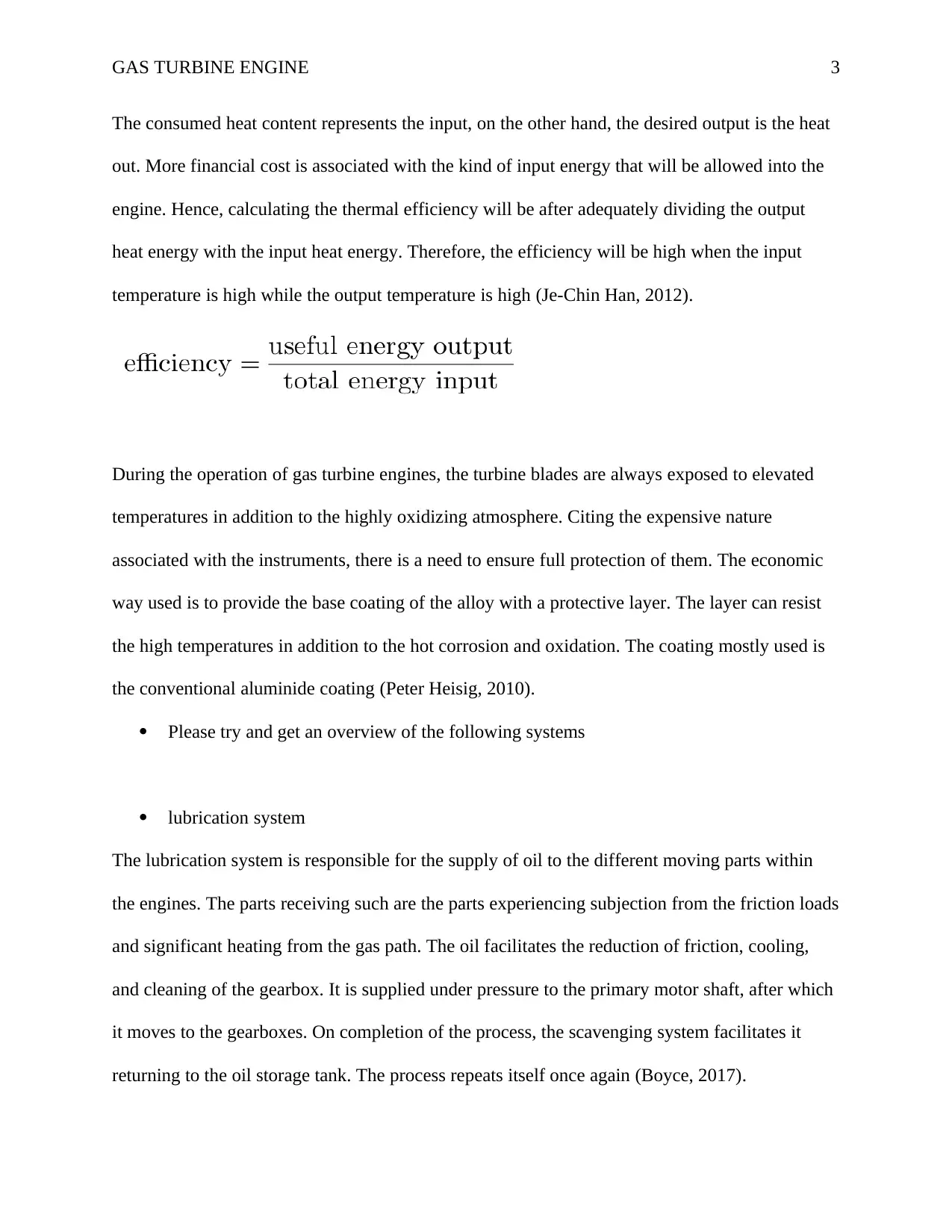
In the calculation of energy conversion efficiency, one has to attain the ration of the useful
output of a device, and in the input, it is always done in energy terms. Thermal efficiency also
displays variation with operating temperatures, that do come as the result of the heat changes.
Document Page
GAS TURBINE ENGINE 3
The consumed heat content represents the input, on the other hand, the desired output is the heat
out. More financial cost is associated with the kind of input energy that will be allowed into the
engine. Hence, calculating the thermal efficiency will be after adequately dividing the output
heat energy with the input heat energy. Therefore, the efficiency will be high when the input
temperature is high while the output temperature is high (Je-Chin Han, 2012).
During the operation of gas turbine engines, the turbine blades are always exposed to elevated
temperatures in addition to the highly oxidizing atmosphere. Citing the expensive nature
associated with the instruments, there is a need to ensure full protection of them. The economic
way used is to provide the base coating of the alloy with a protective layer. The layer can resist
the high temperatures in addition to the hot corrosion and oxidation. The coating mostly used is
the conventional aluminide coating (Peter Heisig, 2010).
Please try and get an overview of the following systems
lubrication system
The lubrication system is responsible for the supply of oil to the different moving parts within
the engines. The parts receiving such are the parts experiencing subjection from the friction loads
and significant heating from the gas path. The oil facilitates the reduction of friction, cooling,
and cleaning of the gearbox. It is supplied under pressure to the primary motor shaft, after which
it moves to the gearboxes. On completion of the process, the scavenging system facilitates it
returning to the oil storage tank. The process repeats itself once again (Boyce, 2017).
Document Page
GAS TURBINE ENGINE 4
Cooling airflow system
The secondary air does it. When the engine is set to work, there will be a rise in temperature,
expansion of metals will be experienced and the clearances of the blades will be minimum.
Hence the application of cooling air. Secondary cooling is primarily used in the burner cans.
Bearing supports
The bearing support mainly includes the in radial sequence that comes from a centre outward.
The inner ring defines the central bore. There is too the middle ring that consists of the array of
internal slots and an outer ray including the variety of external slots. The positioning, sizing, and
shaping of the inner and outer slots are always to ensure that there is the proper division of the
middle ring and outer web resulting into an array of tangentially-extending beams in addition to
the outer ring and the radially–extending outer and inner struts.
References
tabler-icon-diamond-filled.svg

Paraphrase This Document

Need a fresh take? Get an instant paraphrase of this document with our AI Paraphraser
Document Page
GAS TURBINE ENGINE 5
Boyce, M. P. (2017). Gas Turbine Engineering Handbook. Amsterdam: Elsevier.
Grinstein, F. F. (2016). Coarse Grained Simulation and Turbulent Mixing. Cambridge :
Cambridge University Press.
Je-Chin Han, S. D. (2012). Gas Turbine Heat Transfer and Cooling Technology. Florida:
CRC Press.
Peter Heisig, P. J. (2010). Modelling and Management of Engineering Processes. New
York: Springer Science & Business Media.
chevron_up_icon
1 out of 5
circle_padding
hide_on_mobile
zoom_out_icon
[object Object]