TLH 334 Gastronomy Essay: Globalisation, Food, and Cultural Identity
VerifiedAdded on 2023/06/18
|12
|4088
|67
Essay
AI Summary
This essay critically evaluates globalisation and its effects on food and beverage consumption, including the key aspects of homogenisation and heterogenization. It discusses the impact of globalisation on cultural identity in the 21st century, addressing issues related to food and borders, and food mobility or migration. The essay further explores the positive and negative impacts of globalisation on organisations and economies, highlighting both the opportunities and challenges businesses face in a globalised world. It also examines the role of homogenisation in improving food quality and heterogenization in enhancing cultural diversity, ultimately providing a comprehensive overview of the complex interplay between globalisation, food, and culture.

TLH 334 Gastronomy

Paraphrase This Document
Need a fresh take? Get an instant paraphrase of this document with our AI Paraphraser
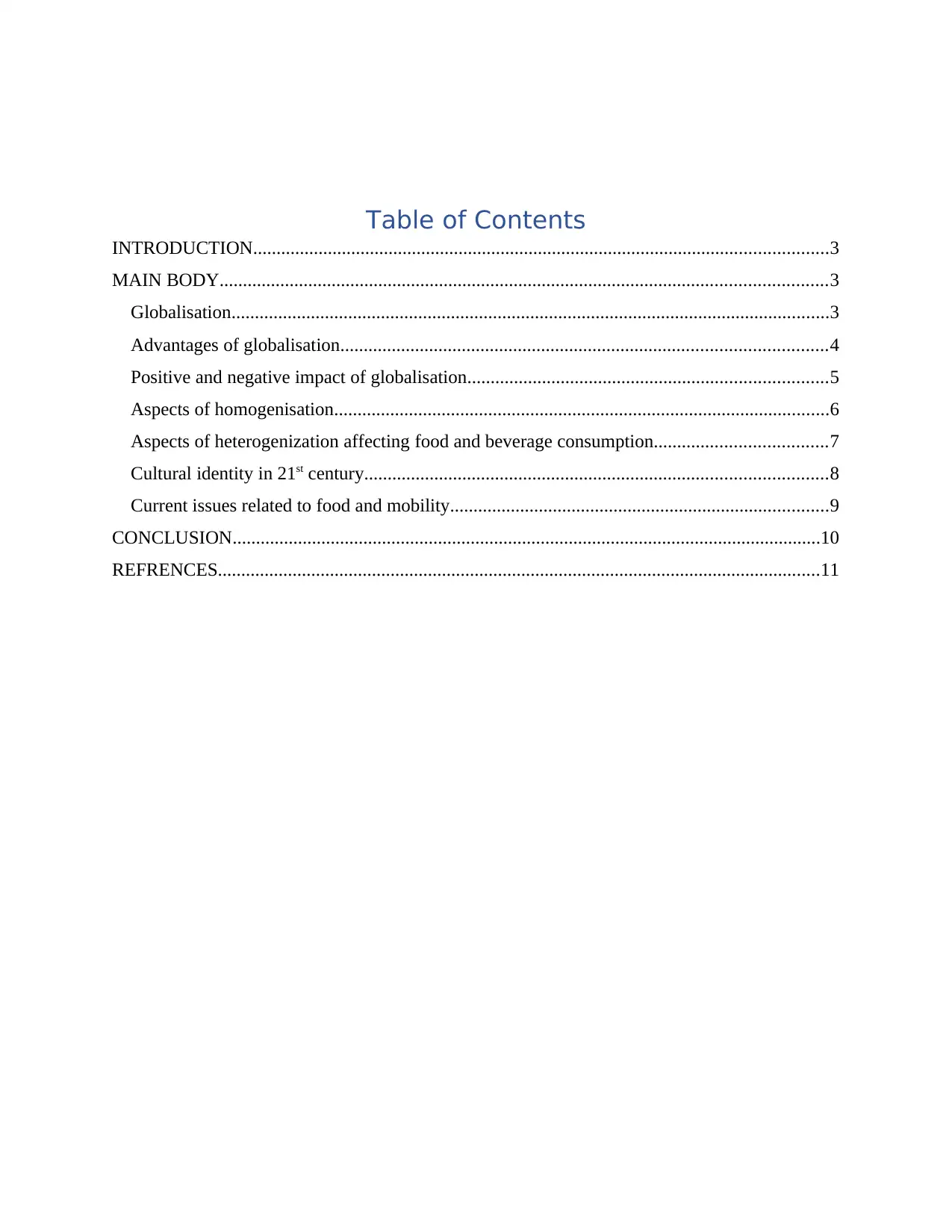
Table of Contents
INTRODUCTION...........................................................................................................................3
MAIN BODY..................................................................................................................................3
Globalisation................................................................................................................................3
Advantages of globalisation........................................................................................................4
Positive and negative impact of globalisation.............................................................................5
Aspects of homogenisation..........................................................................................................6
Aspects of heterogenization affecting food and beverage consumption.....................................7
Cultural identity in 21st century...................................................................................................8
Current issues related to food and mobility.................................................................................9
CONCLUSION..............................................................................................................................10
REFRENCES.................................................................................................................................11
INTRODUCTION...........................................................................................................................3
MAIN BODY..................................................................................................................................3
Globalisation................................................................................................................................3
Advantages of globalisation........................................................................................................4
Positive and negative impact of globalisation.............................................................................5
Aspects of homogenisation..........................................................................................................6
Aspects of heterogenization affecting food and beverage consumption.....................................7
Cultural identity in 21st century...................................................................................................8
Current issues related to food and mobility.................................................................................9
CONCLUSION..............................................................................................................................10
REFRENCES.................................................................................................................................11
INTRODUCTION
Gastronomy refers to study of food and culture with a focus on cuisine. This helps in
identifying cooking techniques, nutritional facts, applications of taste and smell. Gastronomy
plays a crucial role in culture as food is significant to tourist experience but gastronomy is more
important (de Albuquerque Meneguel, Mundet and Aulet, 2019). The report examines, critical
evaluation on globalisation, aspects of homogenisation and heterogenisation which affect food
and beverage consumption. Food and borders and current issues related to food and mobility or
migration is discussed. Cultural identity in the 21st century is described. Positive and negative
impact of globalisation is discussed and different aspects which affect food and beverage culture.
MAIN BODY
Globalisation
Globalisation means the process by which world is becoming interconnected as a result of
increased trade and cultural exchange. Globalisation help in increasing production of goods and
services. Nowadays, there are many changes in the world’s economies, cultures and populations.
It describes growing trade in goods and services, technology, people, information, culture and
flow of investment. Globalisation helps in interaction and integration between people,
government and different companies worldwide. Organisations are making new technologies
which help in making new and innovative products, better communication facility (Oyekola,
2018). With the increase in global interactions, there is growth in culture of country,
international trade, exchange of ideas, beliefs, growth in economy.
Nowadays, competition is increasing among companies and all want to make good quality
products by using new technology. Globalisation promotes and increases interaction among
different people across the world. With the help of technology people can communicate with
each other across the world. It is beneficial for companies as they can trade easily and expand
business in other countries. There are three type of globalisation such as, economic globalisation,
political and cultural globalisation. Economic globalisation focuses on integration of
international financial market and coordination of financial exchange. Multinational companies
can operate their business in two or more countries. Political globalisation helps in covering
national policies which helps in bringing countries together politically, economically and
culturally (Hammudeh and et.al., 2020).
Gastronomy refers to study of food and culture with a focus on cuisine. This helps in
identifying cooking techniques, nutritional facts, applications of taste and smell. Gastronomy
plays a crucial role in culture as food is significant to tourist experience but gastronomy is more
important (de Albuquerque Meneguel, Mundet and Aulet, 2019). The report examines, critical
evaluation on globalisation, aspects of homogenisation and heterogenisation which affect food
and beverage consumption. Food and borders and current issues related to food and mobility or
migration is discussed. Cultural identity in the 21st century is described. Positive and negative
impact of globalisation is discussed and different aspects which affect food and beverage culture.
MAIN BODY
Globalisation
Globalisation means the process by which world is becoming interconnected as a result of
increased trade and cultural exchange. Globalisation help in increasing production of goods and
services. Nowadays, there are many changes in the world’s economies, cultures and populations.
It describes growing trade in goods and services, technology, people, information, culture and
flow of investment. Globalisation helps in interaction and integration between people,
government and different companies worldwide. Organisations are making new technologies
which help in making new and innovative products, better communication facility (Oyekola,
2018). With the increase in global interactions, there is growth in culture of country,
international trade, exchange of ideas, beliefs, growth in economy.
Nowadays, competition is increasing among companies and all want to make good quality
products by using new technology. Globalisation promotes and increases interaction among
different people across the world. With the help of technology people can communicate with
each other across the world. It is beneficial for companies as they can trade easily and expand
business in other countries. There are three type of globalisation such as, economic globalisation,
political and cultural globalisation. Economic globalisation focuses on integration of
international financial market and coordination of financial exchange. Multinational companies
can operate their business in two or more countries. Political globalisation helps in covering
national policies which helps in bringing countries together politically, economically and
culturally (Hammudeh and et.al., 2020).
⊘ This is a preview!⊘
Do you want full access?
Subscribe today to unlock all pages.

Trusted by 1+ million students worldwide
Cultural globalisation focuses on technological and societal factors that are causing
culture. This type of globalisation includes, increasing communication, changes in technology,
better transportation. These are three type of globalisation which focuses on interaction and
integration among different countries so that trade can be done easily. It is beneficial for growth
and development of company because they can use new technology and trade of goods and
services can be done in different countries. There are some areas in which globalisation works
like, internet and communication technology, IoT and artificial intelligence, block chain,
transportation and manufacturing (Xu and Li, 2021).
Globalisation helps in interacting with people in different country and an organisation can
expand its business in international market. This help in growth of economy and with the use of
new technology better products can be made. Globalisation provides different ways to business,
provide access to natural resources and labour markets. There are some restrictions on trade, but
globalisation provides opportunities to expand business and there are no restrictions. It is easy
for companies to do work and trade in international market to earn more profit.
Advantages of globalisation
There are some advantages of globalisation:
Access to new cultures- Globalisation helps in access to new culture as it makes easier to do
business in international market. Access to new culture includes, food, movies, music and other
things. People can adopt different styles or they can travel to other countries. With the help of
globalisation, trade of goods and services can be done easily and people can eat different variety
of food items (Peters and Vellas, 2019). So, globalisation helps in adopting new culture and
tradition, eat variety of food products as trade can be done.
Lower cost of products- globalisation allows companies or firms to make low cost products so
that it will be easy in attracting customers and increase sales of firm. This lead to increase global
competition and sellers sell their products at low price. When good quality products are available
at low prices then more people are attracted and it helps in generating more revenue. It is
important to make products at low cost so that competition increases in market. This is beneficial
for bot developing and developed countries.
Access to new talent- Globalisation provide opportunities to expand their business in
international market. It helps in providing access to new market as an organisation enter into new
market they get many ideas and find new talent. This is beneficial in growth and development of
culture. This type of globalisation includes, increasing communication, changes in technology,
better transportation. These are three type of globalisation which focuses on interaction and
integration among different countries so that trade can be done easily. It is beneficial for growth
and development of company because they can use new technology and trade of goods and
services can be done in different countries. There are some areas in which globalisation works
like, internet and communication technology, IoT and artificial intelligence, block chain,
transportation and manufacturing (Xu and Li, 2021).
Globalisation helps in interacting with people in different country and an organisation can
expand its business in international market. This help in growth of economy and with the use of
new technology better products can be made. Globalisation provides different ways to business,
provide access to natural resources and labour markets. There are some restrictions on trade, but
globalisation provides opportunities to expand business and there are no restrictions. It is easy
for companies to do work and trade in international market to earn more profit.
Advantages of globalisation
There are some advantages of globalisation:
Access to new cultures- Globalisation helps in access to new culture as it makes easier to do
business in international market. Access to new culture includes, food, movies, music and other
things. People can adopt different styles or they can travel to other countries. With the help of
globalisation, trade of goods and services can be done easily and people can eat different variety
of food items (Peters and Vellas, 2019). So, globalisation helps in adopting new culture and
tradition, eat variety of food products as trade can be done.
Lower cost of products- globalisation allows companies or firms to make low cost products so
that it will be easy in attracting customers and increase sales of firm. This lead to increase global
competition and sellers sell their products at low price. When good quality products are available
at low prices then more people are attracted and it helps in generating more revenue. It is
important to make products at low cost so that competition increases in market. This is beneficial
for bot developing and developed countries.
Access to new talent- Globalisation provide opportunities to expand their business in
international market. It helps in providing access to new market as an organisation enter into new
market they get many ideas and find new talent. This is beneficial in growth and development of
Paraphrase This Document
Need a fresh take? Get an instant paraphrase of this document with our AI Paraphraser
company and different ways can be find out to expand business. When a firm enter in new
market they find people having knowledge and skills better than people in their current market.
So, globalisation provide opportunity to firms so that they can find talented people and make
good quality products. This help in attracting more customers and increases revenue of an
organisation.
International recruiting- It means managers of an organisation can recruit people for
international market who are having better knowledge and skills to complete work. They are
having better ideas which help in growth and development of company. International recruiting
help in selecting best candidate for firm and make good plans so that more revenue can be
generated (Michalewska-Pawlak, 2021). It is beneficial for company to recruit people from
international market as they are having better ideas and help in entering into foreign markets.
Access to new market- Globalisation help in providing access to new market for companies
where they can run business smoothly. Mangers want to expand business in foreign markets so
that more revenue can be generated and it help in creating good image in market. For growth of
company, globalisation provides different ways by which a firm can enter into new market.
Globalisation help businesses by providing new customers and innovative ways to attract them.
This lead to increasing sales of company and more revenue can be generated.
Spread of technology and innovation- Nowadays, competition is increasing so to attract
customers, new technology is being used by managers of firms. This help in earning more
revenue by satisfying needs of customers. Globalisation provide new and innovative ways to
managers to increase their sales and earn more profit. Customers want innovative products and to
satisfy need of consumers, managers should make good quality products.
Higher standards of living across the globe – Globalisation helps in development of the
economy as well as of nation. It provides opportunity to firms so that they can expand their
business in international market and profit can be earned. It has higher standards of living across
the world. It is beneficial for managers to generate new ideas and apply new technology to make
new products. This help in attracting more people and profit can be earned (Szczepaniak, 2018).
Positive and negative impact of globalisation
Globalisation has positive as well as negative impact on organisation, economy and there
are some challenges. Some benefits of globalisation are, access to new cultures, lower cost of
market they find people having knowledge and skills better than people in their current market.
So, globalisation provide opportunity to firms so that they can find talented people and make
good quality products. This help in attracting more customers and increases revenue of an
organisation.
International recruiting- It means managers of an organisation can recruit people for
international market who are having better knowledge and skills to complete work. They are
having better ideas which help in growth and development of company. International recruiting
help in selecting best candidate for firm and make good plans so that more revenue can be
generated (Michalewska-Pawlak, 2021). It is beneficial for company to recruit people from
international market as they are having better ideas and help in entering into foreign markets.
Access to new market- Globalisation help in providing access to new market for companies
where they can run business smoothly. Mangers want to expand business in foreign markets so
that more revenue can be generated and it help in creating good image in market. For growth of
company, globalisation provides different ways by which a firm can enter into new market.
Globalisation help businesses by providing new customers and innovative ways to attract them.
This lead to increasing sales of company and more revenue can be generated.
Spread of technology and innovation- Nowadays, competition is increasing so to attract
customers, new technology is being used by managers of firms. This help in earning more
revenue by satisfying needs of customers. Globalisation provide new and innovative ways to
managers to increase their sales and earn more profit. Customers want innovative products and to
satisfy need of consumers, managers should make good quality products.
Higher standards of living across the globe – Globalisation helps in development of the
economy as well as of nation. It provides opportunity to firms so that they can expand their
business in international market and profit can be earned. It has higher standards of living across
the world. It is beneficial for managers to generate new ideas and apply new technology to make
new products. This help in attracting more people and profit can be earned (Szczepaniak, 2018).
Positive and negative impact of globalisation
Globalisation has positive as well as negative impact on organisation, economy and there
are some challenges. Some benefits of globalisation are, access to new cultures, lower cost of
products, access to new talent, new technology and innovation, provide access to new market
where companies can more revenue by satisfying needs of customers. Globalisation helps in
improving productivity of company and employees. By using new technology better products
can be prepared. This help in attracting more people and revenue can be generated. Globalisation
has improved access to technology, better communication facilities are provided. It creates job
opportunities for people and suggest companies to make low cost products because it helps in
increasing competition. When an organisation wants to expand their business in international
market then they are having many opportunities (ORUMA and AMAH). Globalisation helps in
development of nation as well as of economy. It is important to apply new technology so that
good quality products can be made and more revenue can be generated.
Disadvantages of globalisation are, it causes job displacement, increases potential global
recessions, lack of local business. Globalisation has unequal economic growth and exploits
cheaper labour markets. Some adverse effects of globalisation on developed countries are, job
insecurity, price instability and fluctuation in currency. These are some disadvantages of
globalisation which may affect performance of an organisation.
There are some globalisation changes that business operation has to face are, global
communication challenges, expectation of international employee, supporting foreign customers,
marketing and communication changes. These are some challenges which is faced by
organisations, managers have to find creative solutions and make plans so that goals and
objectives can be achieved (Stanojevic and Kotlica, 2018). Globalisation has positive and
negative impact on organisation and better plans can be made. When an organisation wants to
expand their business in foreign market then they should make plans so that more revenue can be
generated. Managers have to face these challenges and find innovative solution which is
beneficial in growth of company.
Aspects of homogenisation
Homogenisation is the process of reducing substance such as, milk. It involves forcing
milk into small openings thus, breaking fat globules. In the food and beverage industry,
homogenization is for milk, it is also used in manufacturing of sauces, sweeteners, baby food,
dairy products, egg products and other products (Mesa and et.al., 2020). The process of
homogenization plays a crucial role in food and beverage industry is that it provides high quality
of food and satisfy needs of customers by providing good quality products. Homogenization
where companies can more revenue by satisfying needs of customers. Globalisation helps in
improving productivity of company and employees. By using new technology better products
can be prepared. This help in attracting more people and revenue can be generated. Globalisation
has improved access to technology, better communication facilities are provided. It creates job
opportunities for people and suggest companies to make low cost products because it helps in
increasing competition. When an organisation wants to expand their business in international
market then they are having many opportunities (ORUMA and AMAH). Globalisation helps in
development of nation as well as of economy. It is important to apply new technology so that
good quality products can be made and more revenue can be generated.
Disadvantages of globalisation are, it causes job displacement, increases potential global
recessions, lack of local business. Globalisation has unequal economic growth and exploits
cheaper labour markets. Some adverse effects of globalisation on developed countries are, job
insecurity, price instability and fluctuation in currency. These are some disadvantages of
globalisation which may affect performance of an organisation.
There are some globalisation changes that business operation has to face are, global
communication challenges, expectation of international employee, supporting foreign customers,
marketing and communication changes. These are some challenges which is faced by
organisations, managers have to find creative solutions and make plans so that goals and
objectives can be achieved (Stanojevic and Kotlica, 2018). Globalisation has positive and
negative impact on organisation and better plans can be made. When an organisation wants to
expand their business in foreign market then they should make plans so that more revenue can be
generated. Managers have to face these challenges and find innovative solution which is
beneficial in growth of company.
Aspects of homogenisation
Homogenisation is the process of reducing substance such as, milk. It involves forcing
milk into small openings thus, breaking fat globules. In the food and beverage industry,
homogenization is for milk, it is also used in manufacturing of sauces, sweeteners, baby food,
dairy products, egg products and other products (Mesa and et.al., 2020). The process of
homogenization plays a crucial role in food and beverage industry is that it provides high quality
of food and satisfy needs of customers by providing good quality products. Homogenization
⊘ This is a preview!⊘
Do you want full access?
Subscribe today to unlock all pages.
Trusted by 1+ million students worldwide
process includes, reducing a substance which results in improve product quality and taste,
appearance, texture, and good quality products are provided. It is important to focus on quality of
products so that customers can be satisfied and helps in increasing sales of company. For
accomplishing goals and objectives, company has to provide good quality products and satisfy
needs of customers. It is essential for food and beverage industry to manufacture good quality
dairy products.
Homogenization is beneficial for consumer because it improves shelf life, contributes to
spoilage prevention, enhances flavour and mouthfeel, helps in preventing products from
separation of layers which may be harmful for food products. This process helps in reducing
unwanted substance which is not good for health. Benefits of homogenization in food and
beverage industry are, it improves flavour and colour, bioavailability and good quality of food
items is manufactured so that it is not harmful for anyone (Levy, Okun and Shpigelman, 2020).
There are some advantages of homogenization products in food and beverage industry is it
improves food processing outcomes, aims at providing good quality of food products which is
not harmful for health of people. Homogenization process extends shelf life, it is highly effective
as a food preservation method. It has high quality particle size reduction equipment.
Homogenization process is important in food and beverage industry because it helps in
reducing substances which may be harmful for heath of people. It is essential to provide good
quality food to customers so that they can stay safe and healthy. Homogenization process helps
in improving quality of food items and better products are provided to customers to increase
sales of an organisation and it is beneficial for health of a person (Sevenich and Mathys, 2018).
Homogenization process helps in reducing harmful substances that may affect health of people.
Aspects of heterogenization affecting food and beverage consumption
Heterogenization is a process that tends to see things in positive way. It is the act of
making something diverse or additional information is being gathered. There are some
advantages of heterogenization process such as, it helps in increasing learning opportunities,
broad mind ness and enhances cultural diversity. For growth and development of an
organisation, it is important to provide good quality products and there must be more
opportunities. These advantages help in making good products and enhances cultural diversity
(Xie and Wang, 2020).
appearance, texture, and good quality products are provided. It is important to focus on quality of
products so that customers can be satisfied and helps in increasing sales of company. For
accomplishing goals and objectives, company has to provide good quality products and satisfy
needs of customers. It is essential for food and beverage industry to manufacture good quality
dairy products.
Homogenization is beneficial for consumer because it improves shelf life, contributes to
spoilage prevention, enhances flavour and mouthfeel, helps in preventing products from
separation of layers which may be harmful for food products. This process helps in reducing
unwanted substance which is not good for health. Benefits of homogenization in food and
beverage industry are, it improves flavour and colour, bioavailability and good quality of food
items is manufactured so that it is not harmful for anyone (Levy, Okun and Shpigelman, 2020).
There are some advantages of homogenization products in food and beverage industry is it
improves food processing outcomes, aims at providing good quality of food products which is
not harmful for health of people. Homogenization process extends shelf life, it is highly effective
as a food preservation method. It has high quality particle size reduction equipment.
Homogenization process is important in food and beverage industry because it helps in
reducing substances which may be harmful for heath of people. It is essential to provide good
quality food to customers so that they can stay safe and healthy. Homogenization process helps
in improving quality of food items and better products are provided to customers to increase
sales of an organisation and it is beneficial for health of a person (Sevenich and Mathys, 2018).
Homogenization process helps in reducing harmful substances that may affect health of people.
Aspects of heterogenization affecting food and beverage consumption
Heterogenization is a process that tends to see things in positive way. It is the act of
making something diverse or additional information is being gathered. There are some
advantages of heterogenization process such as, it helps in increasing learning opportunities,
broad mind ness and enhances cultural diversity. For growth and development of an
organisation, it is important to provide good quality products and there must be more
opportunities. These advantages help in making good products and enhances cultural diversity
(Xie and Wang, 2020).
Paraphrase This Document
Need a fresh take? Get an instant paraphrase of this document with our AI Paraphraser
There are some disadvantages of heterogenization process such as, it destroys local and
traditional culture and sometimes leads to homogenization. It may affect working of an
organisation and lead to decrease in learning opportunities. It is important to focus on increase
learning opportunities and enhance cultural diversity. It focuses on increasing ways by which
people can learn new things and get better opportunities in future. It is important to enhance
cultural diversity and treat every person equally. Advantage of heterogenization is that it opens
to ideas and values of different country which help in introducing to new learning. This is a way
by which new things can be learned and help in getting more opportunities.
Cultural identity in 21st century
Cultural identity refers to identify cultures and beliefs within food and beverage industry.
It is important to focus on choice of customers so that their needs can be satisfied and it will help
in generating more profit. For growth and development of an organisation it is essential to
provide good quality products to customers and make plans to accomplish goals and objectives.
Religion plays a crucial role in influencing choice or selection of food which is consumed in
societies (Ramli and et.al., 2019). In a country, people are from different background and there is
difference in culture and tradition. So, they select food items according to their religion and
managers of food industry has to identify needs of consumers. It is the responsibility of managers
to provide good quality products to customers so that their needs can be satisfied.
Cultural identity is a part of person’s perception and related to nationality, religion,
locality, generation or any kind of culture. Nowadays, people want new and unique food items,
promotion of restaurant should be done in creative way. This helps in increasing sales of
company and more revenue can be generated (Neuman, 2019). For growth and development of
firm it is important to provide good quality of food which is safe and healthy for consumers.
Some examples of culture identity are, norms, language, rituals, festivals, food, etc. It is essential
to focus on need of customers and try to satisfy their needs of customers. Sometimes, culture
influences decision of people because customers are fond of eating traditional food and they
want restaurants must provide good quality of food. In certain cases, culture lead to restriction
such as, exclusion of meat and milk.
Food plays a crucial role in society and it is an important part of cultural heritage and
national identity. It helps in connecting people to different places, their culture, tradition, values
and enjoy food items. People from different culture eat different type of food items, they prefer
traditional culture and sometimes leads to homogenization. It may affect working of an
organisation and lead to decrease in learning opportunities. It is important to focus on increase
learning opportunities and enhance cultural diversity. It focuses on increasing ways by which
people can learn new things and get better opportunities in future. It is important to enhance
cultural diversity and treat every person equally. Advantage of heterogenization is that it opens
to ideas and values of different country which help in introducing to new learning. This is a way
by which new things can be learned and help in getting more opportunities.
Cultural identity in 21st century
Cultural identity refers to identify cultures and beliefs within food and beverage industry.
It is important to focus on choice of customers so that their needs can be satisfied and it will help
in generating more profit. For growth and development of an organisation it is essential to
provide good quality products to customers and make plans to accomplish goals and objectives.
Religion plays a crucial role in influencing choice or selection of food which is consumed in
societies (Ramli and et.al., 2019). In a country, people are from different background and there is
difference in culture and tradition. So, they select food items according to their religion and
managers of food industry has to identify needs of consumers. It is the responsibility of managers
to provide good quality products to customers so that their needs can be satisfied.
Cultural identity is a part of person’s perception and related to nationality, religion,
locality, generation or any kind of culture. Nowadays, people want new and unique food items,
promotion of restaurant should be done in creative way. This helps in increasing sales of
company and more revenue can be generated (Neuman, 2019). For growth and development of
firm it is important to provide good quality of food which is safe and healthy for consumers.
Some examples of culture identity are, norms, language, rituals, festivals, food, etc. It is essential
to focus on need of customers and try to satisfy their needs of customers. Sometimes, culture
influences decision of people because customers are fond of eating traditional food and they
want restaurants must provide good quality of food. In certain cases, culture lead to restriction
such as, exclusion of meat and milk.
Food plays a crucial role in society and it is an important part of cultural heritage and
national identity. It helps in connecting people to different places, their culture, tradition, values
and enjoy food items. People from different culture eat different type of food items, they prefer
this because it helps them in connecting with other country. Food is one of the important part in
religion. Managers of restaurant should provide good quality of food items to customers to
satisfy their needs and this help in earning more profit. It is important to focus on choice of
people and on the basis of that products should be made (Giacosa, Ferraris and Monge, 2017).
For accomplishing goals and objectives of restaurant, it is essential to provide food which is
healthy and safe for customers, satisfy their needs. So, culture may affect food industry because
people want new and different food items
Current issues related to food and mobility
There are some issues related to food industry which is faced by managers and they try to
solve problems so that needs of customers can be satisfied. Foe achieving goals and objectives,
managers identify choice of people and according to that products are made. This helps in
accomplishing targets and more revenue can be generated. Some current issues in food industry
are:
Rise of health consciousness among customers
After pandemic choice of consumer changes and they want good quality of food which is
safe and healthy for them. It is the responsibility of managers to provide food items which is
healthy because after covid-19 people want healthy products which helps in boosting immunity.
Nowadays, people become health conscious and they want good quality of food items. People
are eating food items from which immunity level increases (Mialon and Mialon, 2018). To
satisfy needs of customers, managers should make plans for providing healthy food products to
people. This is an issue in food industry which is faced by managers.
Avoid use of plastic bag
Nowadays, people are avoiding use of plastic bag and using paper bag which is safe for
health. It is an issue in food industry because when packing food items plastic bags are used and
it is not safe for health of people. Managers of restaurant should not use plastic bags for packing
food material. This is an issue because most of the restaurants are using plastic bags and they
should not use it as plastic bags are not good for health of people. So, managers of hotels should
avoid plastic bags and use paper bags for pacing food items.
Rise of natural and organic products
Another issue which is faced by managers in food industry is that rise of natural and
organic products. After pandemic people demand for natural products which is safe and healthy
religion. Managers of restaurant should provide good quality of food items to customers to
satisfy their needs and this help in earning more profit. It is important to focus on choice of
people and on the basis of that products should be made (Giacosa, Ferraris and Monge, 2017).
For accomplishing goals and objectives of restaurant, it is essential to provide food which is
healthy and safe for customers, satisfy their needs. So, culture may affect food industry because
people want new and different food items
Current issues related to food and mobility
There are some issues related to food industry which is faced by managers and they try to
solve problems so that needs of customers can be satisfied. Foe achieving goals and objectives,
managers identify choice of people and according to that products are made. This helps in
accomplishing targets and more revenue can be generated. Some current issues in food industry
are:
Rise of health consciousness among customers
After pandemic choice of consumer changes and they want good quality of food which is
safe and healthy for them. It is the responsibility of managers to provide food items which is
healthy because after covid-19 people want healthy products which helps in boosting immunity.
Nowadays, people become health conscious and they want good quality of food items. People
are eating food items from which immunity level increases (Mialon and Mialon, 2018). To
satisfy needs of customers, managers should make plans for providing healthy food products to
people. This is an issue in food industry which is faced by managers.
Avoid use of plastic bag
Nowadays, people are avoiding use of plastic bag and using paper bag which is safe for
health. It is an issue in food industry because when packing food items plastic bags are used and
it is not safe for health of people. Managers of restaurant should not use plastic bags for packing
food material. This is an issue because most of the restaurants are using plastic bags and they
should not use it as plastic bags are not good for health of people. So, managers of hotels should
avoid plastic bags and use paper bags for pacing food items.
Rise of natural and organic products
Another issue which is faced by managers in food industry is that rise of natural and
organic products. After pandemic people demand for natural products which is safe and healthy
⊘ This is a preview!⊘
Do you want full access?
Subscribe today to unlock all pages.
Trusted by 1+ million students worldwide
for customers. People are demanding for organic products which help in boosting immunity and
want good quality food products. Managers should use fresh vegetables and do not use artificial
fragrances, colorants, preservatives and other harmful things.
Increasing competition and online shopping mode
Nowadays, competition is increasing and people want good quality food products which is safe
and healthy. It is important to satisfy needs of customers by providing them good services at
reasonable price. People are avoiding offline stores and they want home delivery service. This is
easy way for customers because they can place order from anywhere (Rejeb and et.al., 2020). It
is an issue for managers because they have to provide home delivery services to customers and
satisfy their needs. To gain competitive advantage in market, managers should identify choice of
customers and on the basis of that products should be made.
CONCLUSION
From the above discussion it can be concluded that, globalisation is the process which increases
trade and cultural exchange. There are some advantages of globalisation such as, access to new
market, access to new technology, new talent, new cultures, spread of technology and
innovation, lower cost of production. Homogenisation is the process of reducing substance and it
plays a crucial role in food industry. Cultural identity in 21st century has been discussed which
includes food items which is provided according to need of customers. Further, some issues
which is related to food industry are, avoid plastic bags, rise of natural and organic products,
increasing competition has been discussed.
want good quality food products. Managers should use fresh vegetables and do not use artificial
fragrances, colorants, preservatives and other harmful things.
Increasing competition and online shopping mode
Nowadays, competition is increasing and people want good quality food products which is safe
and healthy. It is important to satisfy needs of customers by providing them good services at
reasonable price. People are avoiding offline stores and they want home delivery service. This is
easy way for customers because they can place order from anywhere (Rejeb and et.al., 2020). It
is an issue for managers because they have to provide home delivery services to customers and
satisfy their needs. To gain competitive advantage in market, managers should identify choice of
customers and on the basis of that products should be made.
CONCLUSION
From the above discussion it can be concluded that, globalisation is the process which increases
trade and cultural exchange. There are some advantages of globalisation such as, access to new
market, access to new technology, new talent, new cultures, spread of technology and
innovation, lower cost of production. Homogenisation is the process of reducing substance and it
plays a crucial role in food industry. Cultural identity in 21st century has been discussed which
includes food items which is provided according to need of customers. Further, some issues
which is related to food industry are, avoid plastic bags, rise of natural and organic products,
increasing competition has been discussed.
Paraphrase This Document
Need a fresh take? Get an instant paraphrase of this document with our AI Paraphraser
REFRENCES
Books and Journals
de Albuquerque Meneguel, C. R., Mundet, L. and Aulet, S., 2019. The role of a high-quality
restaurant in stimulating the creation and development of gastronomy
tourism. International Journal of Hospitality Management. 83. pp.220-228.
Giacosa, E., Ferraris, A. and Monge, F., 2017. How to strengthen the business model of an
Italian family food business. British Food Journal.
Hammudeh, S., and et.al., 2020. Nonlinear relationship between economic growth and nuances
of globalisation with income stratification: Roles of financial development and
governance. Economic Systems. 44(3). p.100761.
Levy, R., Okun, Z. and Shpigelman, A., 2020. High-pressure homogenization: Principles and
applications beyond microbial inactivation. Food Engineering Reviews. pp.1-19.
Mesa, J., and et.al., 2020. High homogenization pressures to improve food quality, functionality
and sustainability. Molecules. 25(14). p.3305.
Mialon, M. and Mialon, J., 2018. Analysis of corporate political activity strategies of the food
industry: evidence from France. Public health nutrition. 21(18). pp.3407-3421.
Michalewska-Pawlak, M., 2021. Impact of Globalisation Processes on Regional Development
Management in the European Union. Horyzonty Polityki. 12(39). pp.25-39.
Neuman, N., 2019. On the engagement with social theory in food studies: cultural symbols and
social practices. Food, Culture & Society. 22(1). pp.78-94.
ORUMA, O. and AMAH, E. GLOBALISATION AND TECHNOLOGY: IMPLICATIONS IN
NIGERIA. African Journal of Business and Economic Development| ISSN. 2782.
p.7658.
Oyekola, I. A., 2018. Culture and globalisation.
Peters, M. and Vellas, F., 2019. Globalisation, innovation, and tourism. In Handbook of
Globalisation and Tourism. Edward Elgar Publishing.
Books and Journals
de Albuquerque Meneguel, C. R., Mundet, L. and Aulet, S., 2019. The role of a high-quality
restaurant in stimulating the creation and development of gastronomy
tourism. International Journal of Hospitality Management. 83. pp.220-228.
Giacosa, E., Ferraris, A. and Monge, F., 2017. How to strengthen the business model of an
Italian family food business. British Food Journal.
Hammudeh, S., and et.al., 2020. Nonlinear relationship between economic growth and nuances
of globalisation with income stratification: Roles of financial development and
governance. Economic Systems. 44(3). p.100761.
Levy, R., Okun, Z. and Shpigelman, A., 2020. High-pressure homogenization: Principles and
applications beyond microbial inactivation. Food Engineering Reviews. pp.1-19.
Mesa, J., and et.al., 2020. High homogenization pressures to improve food quality, functionality
and sustainability. Molecules. 25(14). p.3305.
Mialon, M. and Mialon, J., 2018. Analysis of corporate political activity strategies of the food
industry: evidence from France. Public health nutrition. 21(18). pp.3407-3421.
Michalewska-Pawlak, M., 2021. Impact of Globalisation Processes on Regional Development
Management in the European Union. Horyzonty Polityki. 12(39). pp.25-39.
Neuman, N., 2019. On the engagement with social theory in food studies: cultural symbols and
social practices. Food, Culture & Society. 22(1). pp.78-94.
ORUMA, O. and AMAH, E. GLOBALISATION AND TECHNOLOGY: IMPLICATIONS IN
NIGERIA. African Journal of Business and Economic Development| ISSN. 2782.
p.7658.
Oyekola, I. A., 2018. Culture and globalisation.
Peters, M. and Vellas, F., 2019. Globalisation, innovation, and tourism. In Handbook of
Globalisation and Tourism. Edward Elgar Publishing.
Ramli, A. M., and et.al., 2019. The Significant of Food Heritage Endorsement in Building Food
Identity. Environment-Behaviour Proceedings Journal. 4(12). pp.231-238.
Rejeb, A., and et.al., 2020. Blockchain technology in the food industry: A review of potentials,
challenges and future research directions. Logistics. 4(4). p.27.
Sevenich, R. and Mathys, A., 2018. Continuous versus discontinuous ultra‐high‐pressure systems
for food sterilization with focus on ultra‐high‐pressure homogenization and high‐
pressure thermal sterilization: a review. Comprehensive reviews in food science and
food safety. 17(3). pp.646-662.
Stanojevic, N. and Kotlica, S., 2018. Globalisation and Methodology of Researches in
International Trade. Industrija. 46(2).
Szczepaniak, I., 2018. Comparative advantages in Polish export to the European Union—food
products vs selected groups of non-food products. Oeconomia Copernicana. 9(2).
pp.287-308.
Xie, W. and Wang, H., 2020. Synthesis of heterogenized polyoxometalate-based ionic liquids
with Brönsted-Lewis acid sites: A magnetically recyclable catalyst for biodiesel
production from low-quality oils. Journal of Industrial and Engineering Chemistry. 87.
pp.162-172.
Xu, Y. and Li, D., 2021. Cultural industries in emerging economies under the background of
economic globalisation and information networks. International Journal of Technology
Management. 85(2-4). pp.333-347.
Identity. Environment-Behaviour Proceedings Journal. 4(12). pp.231-238.
Rejeb, A., and et.al., 2020. Blockchain technology in the food industry: A review of potentials,
challenges and future research directions. Logistics. 4(4). p.27.
Sevenich, R. and Mathys, A., 2018. Continuous versus discontinuous ultra‐high‐pressure systems
for food sterilization with focus on ultra‐high‐pressure homogenization and high‐
pressure thermal sterilization: a review. Comprehensive reviews in food science and
food safety. 17(3). pp.646-662.
Stanojevic, N. and Kotlica, S., 2018. Globalisation and Methodology of Researches in
International Trade. Industrija. 46(2).
Szczepaniak, I., 2018. Comparative advantages in Polish export to the European Union—food
products vs selected groups of non-food products. Oeconomia Copernicana. 9(2).
pp.287-308.
Xie, W. and Wang, H., 2020. Synthesis of heterogenized polyoxometalate-based ionic liquids
with Brönsted-Lewis acid sites: A magnetically recyclable catalyst for biodiesel
production from low-quality oils. Journal of Industrial and Engineering Chemistry. 87.
pp.162-172.
Xu, Y. and Li, D., 2021. Cultural industries in emerging economies under the background of
economic globalisation and information networks. International Journal of Technology
Management. 85(2-4). pp.333-347.
⊘ This is a preview!⊘
Do you want full access?
Subscribe today to unlock all pages.
Trusted by 1+ million students worldwide

1 out of 12


Related Documents


Your All-in-One AI-Powered Toolkit for Academic Success.
+13062052269
info@desklib.com
Available 24*7 on WhatsApp / Email
![[object Object]](/_next/static/media/star-bottom.7253800d.svg)
Unlock your academic potential
Copyright © 2020–2026 A2Z Services. All Rights Reserved. Developed and managed by ZUCOL.