Research into the Causes of Project Failures at GE South Africa
VerifiedAdded on 2022/10/11
|15
|4151
|37
Report
AI Summary
This report is a literature study analyzing the causes of project failures within General Electric (GE) South Africa's power services department. The study examines project management principles, defining project success criteria based on scope, cost, and time. It identifies key causes of failure, including poor planning, unclear scope, scope creep, poor communication, and lack of leadership support. The report further explores project communication management and defines project success in terms of its impact on organizational performance and customer businesses. It concludes by suggesting ways to prevent project failures, such as proper planning, regular progress tracking, and effective communication. The report provides an in-depth analysis of the challenges faced by GE South Africa's power services department and offers insights into improving project outcomes. The report also discusses the project success factors, and the impact of the failures on the organization's performance and customer's businesses.
Running head: RESEARCH PROPOSAL
RESEARCH INTO THE CAUSES OF PROJECTS FAILURES IN GENERAL
ELECTRIC SOUTH AFRICA’S POWER SERVICES DEPARTMENT
RESEARCH INTO THE CAUSES OF PROJECTS FAILURES IN GENERAL
ELECTRIC SOUTH AFRICA’S POWER SERVICES DEPARTMENT

Paraphrase This Document
Need a fresh take? Get an instant paraphrase of this document with our AI Paraphraser
1RESEARCH PROPOSAL
Table of Contents
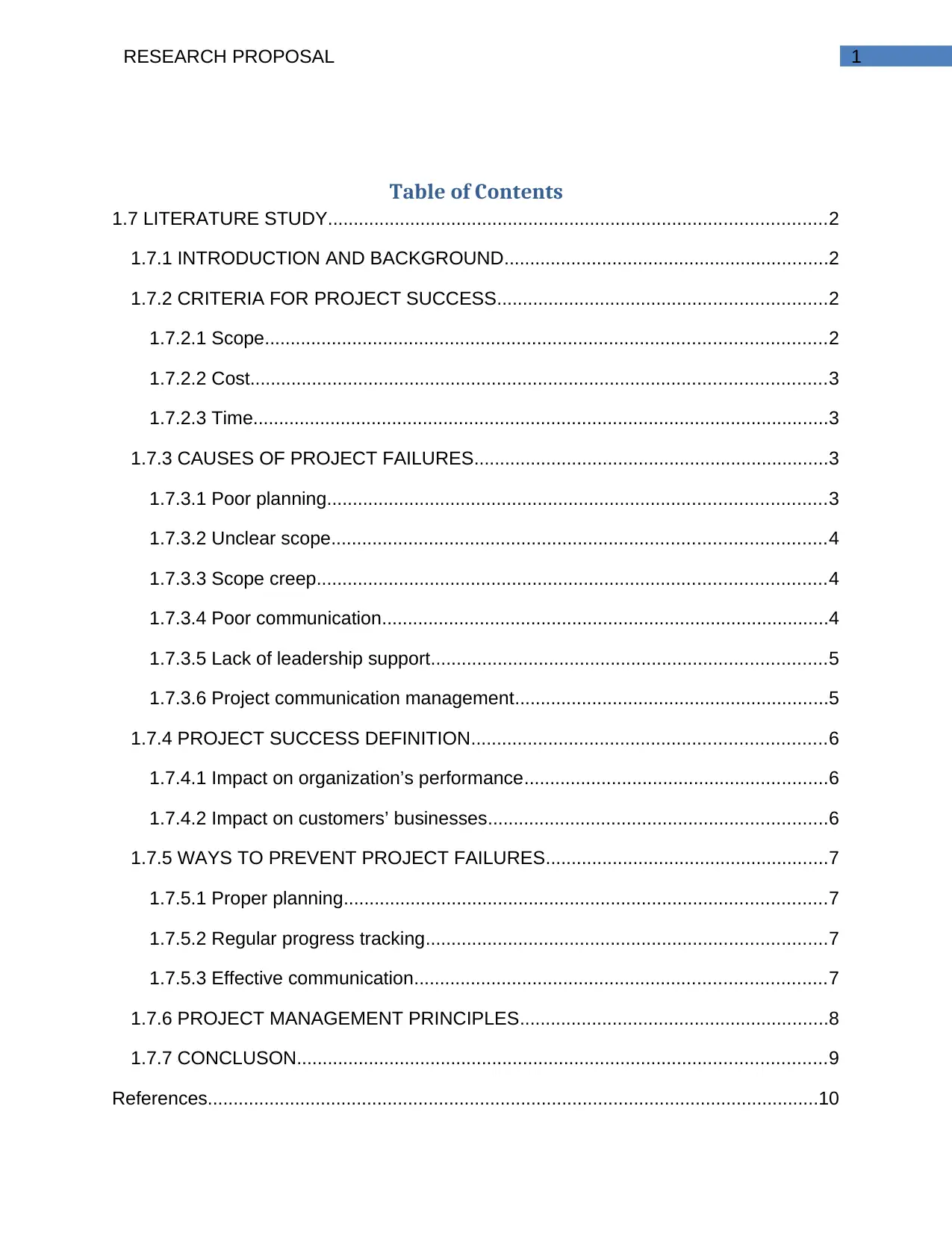
1.7 LITERATURE STUDY.................................................................................................2
1.7.1 INTRODUCTION AND BACKGROUND...............................................................2
1.7.2 CRITERIA FOR PROJECT SUCCESS................................................................2
1.7.2.1 Scope.............................................................................................................2
1.7.2.2 Cost................................................................................................................3
1.7.2.3 Time................................................................................................................3
1.7.3 CAUSES OF PROJECT FAILURES.....................................................................3
1.7.3.1 Poor planning.................................................................................................3
1.7.3.2 Unclear scope................................................................................................4
1.7.3.3 Scope creep...................................................................................................4
1.7.3.4 Poor communication.......................................................................................4
1.7.3.5 Lack of leadership support.............................................................................5
1.7.3.6 Project communication management.............................................................5
1.7.4 PROJECT SUCCESS DEFINITION.....................................................................6
1.7.4.1 Impact on organization’s performance...........................................................6
1.7.4.2 Impact on customers’ businesses..................................................................6
1.7.5 WAYS TO PREVENT PROJECT FAILURES.......................................................7
1.7.5.1 Proper planning..............................................................................................7
1.7.5.2 Regular progress tracking..............................................................................7
1.7.5.3 Effective communication................................................................................7
1.7.6 PROJECT MANAGEMENT PRINCIPLES............................................................8
1.7.7 CONCLUSON.......................................................................................................9
References.......................................................................................................................10
Table of Contents
1.7 LITERATURE STUDY.................................................................................................2
1.7.1 INTRODUCTION AND BACKGROUND...............................................................2
1.7.2 CRITERIA FOR PROJECT SUCCESS................................................................2
1.7.2.1 Scope.............................................................................................................2
1.7.2.2 Cost................................................................................................................3
1.7.2.3 Time................................................................................................................3
1.7.3 CAUSES OF PROJECT FAILURES.....................................................................3
1.7.3.1 Poor planning.................................................................................................3
1.7.3.2 Unclear scope................................................................................................4
1.7.3.3 Scope creep...................................................................................................4
1.7.3.4 Poor communication.......................................................................................4
1.7.3.5 Lack of leadership support.............................................................................5
1.7.3.6 Project communication management.............................................................5
1.7.4 PROJECT SUCCESS DEFINITION.....................................................................6
1.7.4.1 Impact on organization’s performance...........................................................6
1.7.4.2 Impact on customers’ businesses..................................................................6
1.7.5 WAYS TO PREVENT PROJECT FAILURES.......................................................7
1.7.5.1 Proper planning..............................................................................................7
1.7.5.2 Regular progress tracking..............................................................................7
1.7.5.3 Effective communication................................................................................7
1.7.6 PROJECT MANAGEMENT PRINCIPLES............................................................8
1.7.7 CONCLUSON.......................................................................................................9
References.......................................................................................................................10

2RESEARCH PROPOSAL
⊘ This is a preview!⊘
Do you want full access?
Subscribe today to unlock all pages.

Trusted by 1+ million students worldwide
3RESEARCH PROPOSAL
1.7 LITERATURE STUDY
1.7.1 INTRODUCTION AND BACKGROUND
The literature study is reflected on the causes of the project failures at the General
Electric (GE) South Africa's power services department. In this project work, there is an
analysis of project failures using project management principles. General Electric is
being committed to support the sustainable development of the African region using
advanced technologies and power services. South Africa has critical growth in
technological solutions in the power generation sector (Serra and Kunc 2015). General
Electric South Africa's power services departments are facing issues while they are
working in the power generation project plan. The study discussed the criteria for the
project success as well as causes of the project failures. After identifying the project
failures, the power service department also found ways to prevent project failures.
1.7.2 CRITERIA FOR PROJECT SUCCESS
General Electric South Africa's power station project is successful in South Africa. The
three major factors for project success are project scope meets with its intended
requirements, cost, and time.
1.7.2.1 Scope
The main power services project requirements are increased and maintained with the
existing power supply. General Electric South Africa's power project has a standardized
design, technical as well as project specifications. Svejvig and Andersen (2015)
mentioned that in order to get success, the project is meeting with its intended project
requirements. GE is being focused on local innovation in power services department,
build customer's abilities, partnerships, and others. There is availability of the
consultancy companies as well as contracting firms to implement the project as per its
requirements (Camilleri 2016). The power services of GE are focused on lightning in
South Africa, with higher performance of power supply team.
1.7 LITERATURE STUDY
1.7.1 INTRODUCTION AND BACKGROUND
The literature study is reflected on the causes of the project failures at the General
Electric (GE) South Africa's power services department. In this project work, there is an
analysis of project failures using project management principles. General Electric is
being committed to support the sustainable development of the African region using
advanced technologies and power services. South Africa has critical growth in
technological solutions in the power generation sector (Serra and Kunc 2015). General
Electric South Africa's power services departments are facing issues while they are
working in the power generation project plan. The study discussed the criteria for the
project success as well as causes of the project failures. After identifying the project
failures, the power service department also found ways to prevent project failures.
1.7.2 CRITERIA FOR PROJECT SUCCESS
General Electric South Africa's power station project is successful in South Africa. The
three major factors for project success are project scope meets with its intended
requirements, cost, and time.
1.7.2.1 Scope
The main power services project requirements are increased and maintained with the
existing power supply. General Electric South Africa's power project has a standardized
design, technical as well as project specifications. Svejvig and Andersen (2015)
mentioned that in order to get success, the project is meeting with its intended project
requirements. GE is being focused on local innovation in power services department,
build customer's abilities, partnerships, and others. There is availability of the
consultancy companies as well as contracting firms to implement the project as per its
requirements (Camilleri 2016). The power services of GE are focused on lightning in
South Africa, with higher performance of power supply team.
Paraphrase This Document
Need a fresh take? Get an instant paraphrase of this document with our AI Paraphraser
4RESEARCH PROPOSAL
1.7.2.2 Cost
Meredith, Mantel Jr, and Shafer (2017) illustrated that project financing is being tied in
advance with proper flow of the funds for the power station implementation in South
Africa. The cost of this project is on a budget as the financial commitment of this
particular project is based on factors such as the involvement of resources, materials,
labor costs, and others. GE is the larger segment of the thermal power division, which is
being represented with 20% of its total revenues (Demirkesen and Ozorhon 2017).
There is a profit margin of 19.4%; the power services division is one of the highest
sectors in the organization.
1.7.2.3 Time
Time is one of the key significant critical success factors in the power service project of
GE as all the projects under the company were delivered on scheduled time. All the
projects have realistic project time estimation for project success. Lock (2017)
discussed that there is clear documentation of the milestones as well as deliverables.
Nguyen and Mohamed (2018) stated that all the project resource resources are being
provided in detail with all its roles as well as responsibilities. The project manager
prepared a proper schedule for the power generation projects.
1.7.3 CAUSES OF PROJECT FAILURES
This section detailed on the various causes of project failures of the General Electric
project in South Africa. It is required to review delay factors identified by the project
manager while conducting work in the project plan. The identified factors are poor
project planning; unclear project scope causes scope creep, poor communication and
lack of the leadership support (Kendrick 2015). The details of each project failure
causes are provided as below:
1.7.3.1 Poor planning
Hornstein (2015) mentioned that planning is a key significant part of project
management, and the project manager is responsible for planning the project work.
Young (2016) argued that there is no clear vision of the project workload, team
management, and execution of project tasks. In order to meet with project objectives, it
is required for supplying power and electricity among African urban areas. As project
1.7.2.2 Cost
Meredith, Mantel Jr, and Shafer (2017) illustrated that project financing is being tied in
advance with proper flow of the funds for the power station implementation in South
Africa. The cost of this project is on a budget as the financial commitment of this
particular project is based on factors such as the involvement of resources, materials,
labor costs, and others. GE is the larger segment of the thermal power division, which is
being represented with 20% of its total revenues (Demirkesen and Ozorhon 2017).
There is a profit margin of 19.4%; the power services division is one of the highest
sectors in the organization.
1.7.2.3 Time
Time is one of the key significant critical success factors in the power service project of
GE as all the projects under the company were delivered on scheduled time. All the
projects have realistic project time estimation for project success. Lock (2017)
discussed that there is clear documentation of the milestones as well as deliverables.
Nguyen and Mohamed (2018) stated that all the project resource resources are being
provided in detail with all its roles as well as responsibilities. The project manager
prepared a proper schedule for the power generation projects.
1.7.3 CAUSES OF PROJECT FAILURES
This section detailed on the various causes of project failures of the General Electric
project in South Africa. It is required to review delay factors identified by the project
manager while conducting work in the project plan. The identified factors are poor
project planning; unclear project scope causes scope creep, poor communication and
lack of the leadership support (Kendrick 2015). The details of each project failure
causes are provided as below:
1.7.3.1 Poor planning
Hornstein (2015) mentioned that planning is a key significant part of project
management, and the project manager is responsible for planning the project work.
Young (2016) argued that there is no clear vision of the project workload, team
management, and execution of project tasks. In order to meet with project objectives, it
is required for supplying power and electricity among African urban areas. As project
5RESEARCH PROPOSAL
planning is poor, it may fail and not meet with the client's expectations. Schwalbe (2015)
discussed that there is poor project planning of power generation project due to in-
defined work breakdown structure and non-availability of project resources. Theletsane
(2018) mentioned that other causes of the project breakdown are poor scheduling as
well as lack of support from project sponsor. Therefore, the success of the project is
mainly based on the project manager plus its respective team members.
1.7.3.2 Unclear scope
The power generation project is mainly based on the innovation of electricity in South
Africa. Strahorn (2015) stated that in order to meet with its project goals; the
organization is required to meet with its resource requirements. The resource quantity is
based on the size as well as the project scope. As there is a shortage of project
resources and required power generated materials, the project scope is not meet.
Kerzner (2017) discussed that the project manager is required to appoint technical
staffs those know the power services. Due to lack of manager's motivation, the project
work may fail to meet with its scope. Harrison and Lock (2017) argued that there is poor
risk management in the project influences project management. Therefore the project
may fail. The result is that the project will run slow.
1.7.3.3 Scope creep
The critical project tasks are not assigned to the right people; therefore, some of the
project scopes are not meet due to their lack of technical skills. It causes scope creep.
Cleden (2017) discussed that all the project stakeholder's expectations are not meet as
sometimes they have new demands during the project work. In the middle of the project,
new project consultants are introduced, which causes a change in project scope. It is
caused because of miscommunication (Walker 2015). Hence, the project may be failed.
In order to meet with the request of the project stakeholders and their new demands, it
is required to manage project scope by managing change requests.
1.7.3.4 Poor communication
Nicholas and Steyn (2017) stated that due to lack of communication among the project
team members as well as project manager, it is difficult to express concern of project. It
is also difficult to provide suggestions on the implementation plan of power station
planning is poor, it may fail and not meet with the client's expectations. Schwalbe (2015)
discussed that there is poor project planning of power generation project due to in-
defined work breakdown structure and non-availability of project resources. Theletsane
(2018) mentioned that other causes of the project breakdown are poor scheduling as
well as lack of support from project sponsor. Therefore, the success of the project is
mainly based on the project manager plus its respective team members.
1.7.3.2 Unclear scope
The power generation project is mainly based on the innovation of electricity in South
Africa. Strahorn (2015) stated that in order to meet with its project goals; the
organization is required to meet with its resource requirements. The resource quantity is
based on the size as well as the project scope. As there is a shortage of project
resources and required power generated materials, the project scope is not meet.
Kerzner (2017) discussed that the project manager is required to appoint technical
staffs those know the power services. Due to lack of manager's motivation, the project
work may fail to meet with its scope. Harrison and Lock (2017) argued that there is poor
risk management in the project influences project management. Therefore the project
may fail. The result is that the project will run slow.
1.7.3.3 Scope creep
The critical project tasks are not assigned to the right people; therefore, some of the
project scopes are not meet due to their lack of technical skills. It causes scope creep.
Cleden (2017) discussed that all the project stakeholder's expectations are not meet as
sometimes they have new demands during the project work. In the middle of the project,
new project consultants are introduced, which causes a change in project scope. It is
caused because of miscommunication (Walker 2015). Hence, the project may be failed.
In order to meet with the request of the project stakeholders and their new demands, it
is required to manage project scope by managing change requests.
1.7.3.4 Poor communication
Nicholas and Steyn (2017) stated that due to lack of communication among the project
team members as well as project manager, it is difficult to express concern of project. It
is also difficult to provide suggestions on the implementation plan of power station
⊘ This is a preview!⊘
Do you want full access?
Subscribe today to unlock all pages.
Trusted by 1+ million students worldwide
6RESEARCH PROPOSAL
project. Marchewka (2016) mentioned that as there is poor project communication, the
users are not engaged in the project to provide suggestion in addition to feedback to
guide the work. Failure to the engagement of the members in communication leads to
improper project result, and the project may fail to meet the client's expectations.
Bondarenko et al. (2017) stated that the project communication plan will help to interact
with each other so that they can discuss the project issues and provide suggestions on
them.
1.7.3.5 Lack of leadership support
Peltier (2016) discussed that leadership is critical to the success and failure point of the
project. The project manager is the leader of the entire project team. Lientz and Rea
(20160 mentioned that people at the management level are being responsible for
making sure that the project can get success. Due to the lack of support from the project
manager and another management level, the project work cannot be able to meet with
its goal and objectives. When the project leader has not motivated the team to work,
then the project will be out of control. Binder (2016) argued that the project manager, as
a leader, should motivate and support the team to meet with its project goals. At the
time, the project manager is denial on their leadership would not be able to gain value
with following from their members.
1.7.3.6 Project communication management
Young (2016) mentioned that the project manager should require developing a project
communication management with a timely and weekly meeting with the project team
members to discuss the performance of power services or generation project.
Appointment of right staffs in the project required with experience so that they can
interact with each other (Hornstein 2015). Lack of communication management in
power generation project is caused when there is no formal document of weekly
meetings as well as communicational points conversed in the meeting. Bondarouk and
Brewster (2016) stated that the communication management problem is solved by
planning weekly meetings among the manager and members to discuss the project-
related work. Ramazani and Jergeas (2015) stated that in the meetings, there will be a
sharing of each other ideas and suggestions.
project. Marchewka (2016) mentioned that as there is poor project communication, the
users are not engaged in the project to provide suggestion in addition to feedback to
guide the work. Failure to the engagement of the members in communication leads to
improper project result, and the project may fail to meet the client's expectations.
Bondarenko et al. (2017) stated that the project communication plan will help to interact
with each other so that they can discuss the project issues and provide suggestions on
them.
1.7.3.5 Lack of leadership support
Peltier (2016) discussed that leadership is critical to the success and failure point of the
project. The project manager is the leader of the entire project team. Lientz and Rea
(20160 mentioned that people at the management level are being responsible for
making sure that the project can get success. Due to the lack of support from the project
manager and another management level, the project work cannot be able to meet with
its goal and objectives. When the project leader has not motivated the team to work,
then the project will be out of control. Binder (2016) argued that the project manager, as
a leader, should motivate and support the team to meet with its project goals. At the
time, the project manager is denial on their leadership would not be able to gain value
with following from their members.
1.7.3.6 Project communication management
Young (2016) mentioned that the project manager should require developing a project
communication management with a timely and weekly meeting with the project team
members to discuss the performance of power services or generation project.
Appointment of right staffs in the project required with experience so that they can
interact with each other (Hornstein 2015). Lack of communication management in
power generation project is caused when there is no formal document of weekly
meetings as well as communicational points conversed in the meeting. Bondarouk and
Brewster (2016) stated that the communication management problem is solved by
planning weekly meetings among the manager and members to discuss the project-
related work. Ramazani and Jergeas (2015) stated that in the meetings, there will be a
sharing of each other ideas and suggestions.
Paraphrase This Document
Need a fresh take? Get an instant paraphrase of this document with our AI Paraphraser
7RESEARCH PROPOSAL
1.7.4 PROJECT SUCCESS DEFINITION
The success of the project plan is measured before as well as after finishing the project
work. Banihashemi et al. (2017) stated that project success is defined as achieving
project objectives in schedule and the budget. Proper time and budget estimation are
helping to satisfy stakeholder's expectations plus learning from their project
experiences. The project manager should require building good relationships with the
internal as well as external project team members so that they can get success in the
power generation projects in South Africa. The project manager is mainly responsible
for project success (Zwikael, Chih and Meredith 2018). They should focus on the project
planning so that there should be a positive impact on an organization's performance and
customer's businesses.
1.7.4.1 Impact on organization’s performance
Kerzner (2018) discussed that incomplete, poor design and insufficient power
generation plant is a problem of scope creep as well as changes in the project
specifications. Those project failure factors lead to a massive impact on the
organization's performance that the project may fail. The documentation of entire project
work should be inadequate, and the project manager is not able to track its progress.
When all the team members are not interacted with each other, then there is poor
business performance. They are not able to meet with its project objectives (Costantino,
Di Gravio and Nonino 2015). Lack of leadership has a negative impact on the
organization's performance.
1.7.4.2 Impact on customers’ businesses
When there is a lack of leadership support, then it provides an impact on customer's
business so that their business may fail. Dwivedi et al. (2015) mentioned that poor
planning of power services project leads to an inaccurate estimate of cost plus time, due
to which the project manager is not able to complete the work on scheduled time. Little
communication between customer and management team causes the project behind its
scope, causes scope creep (Nicholas and Steyn 2017). There is poor management of
the stakeholder's expectations so that the customers are not getting their required
request from the business organization. Strahorn (2015) mentioned that from the
1.7.4 PROJECT SUCCESS DEFINITION
The success of the project plan is measured before as well as after finishing the project
work. Banihashemi et al. (2017) stated that project success is defined as achieving
project objectives in schedule and the budget. Proper time and budget estimation are
helping to satisfy stakeholder's expectations plus learning from their project
experiences. The project manager should require building good relationships with the
internal as well as external project team members so that they can get success in the
power generation projects in South Africa. The project manager is mainly responsible
for project success (Zwikael, Chih and Meredith 2018). They should focus on the project
planning so that there should be a positive impact on an organization's performance and
customer's businesses.
1.7.4.1 Impact on organization’s performance
Kerzner (2018) discussed that incomplete, poor design and insufficient power
generation plant is a problem of scope creep as well as changes in the project
specifications. Those project failure factors lead to a massive impact on the
organization's performance that the project may fail. The documentation of entire project
work should be inadequate, and the project manager is not able to track its progress.
When all the team members are not interacted with each other, then there is poor
business performance. They are not able to meet with its project objectives (Costantino,
Di Gravio and Nonino 2015). Lack of leadership has a negative impact on the
organization's performance.
1.7.4.2 Impact on customers’ businesses
When there is a lack of leadership support, then it provides an impact on customer's
business so that their business may fail. Dwivedi et al. (2015) mentioned that poor
planning of power services project leads to an inaccurate estimate of cost plus time, due
to which the project manager is not able to complete the work on scheduled time. Little
communication between customer and management team causes the project behind its
scope, causes scope creep (Nicholas and Steyn 2017). There is poor management of
the stakeholder's expectations so that the customers are not getting their required
request from the business organization. Strahorn (2015) mentioned that from the
8RESEARCH PROPOSAL
contractor, there will be financial losses faced by the project manager when there is
improper project planning. The stronger relationship among the customer's experience
and a manager will lead them to involve in the project work. The customer's acquisition
cost is higher for the business.
1.7.5 WAYS TO PREVENT PROJECT FAILURES
1.7.5.1 Proper planning
In GE power generation projects, the project manager should require proper project
planning so that they can identify as well as meet with their project stakeholders. Joslin
and Müller (2015) illustrated that they should prioritize the project goals as well as
define project deliverables. The project schedule is created by following all the project
success factors (Banihashemi et al. 2017). The project risks are identified so that it
would mitigate on time before it will provide any negative influence on project success.
All the project stakeholders should present with the final plan so that they can
understand the objectives as well as goals of the project plan.
1.7.5.2 Regular progress tracking
The project manager should track the project work so that it can meet with project goals.
Project tracking is required so that they can analyze if the project can move in the right
direction. It is a way to achieve project targets. Zwikael, Chih, and Meredith (2018)
discussed that regular project tracking leads to overcome with improper scope in
addition to scope creep. Girard and Girard (2015) mentioned that the management of
project work will enable the employees for tracking work progress. Tracking will help to
schedule the project work accurately to make the project up-to-date.
1.7.5.3 Effective communication
Kerzner (2017) stated that effective communication plan makes sure that the
organizational members should aware of the project plan. The communication plan is
included with the main understanding purpose of the project, which will help the
manager to identify the project goals. The plan will set standards of when the
communication is to be taken place. For daily communication, meetings are to be
scheduled so that all the project participants are to be updated on project progress
contractor, there will be financial losses faced by the project manager when there is
improper project planning. The stronger relationship among the customer's experience
and a manager will lead them to involve in the project work. The customer's acquisition
cost is higher for the business.
1.7.5 WAYS TO PREVENT PROJECT FAILURES
1.7.5.1 Proper planning
In GE power generation projects, the project manager should require proper project
planning so that they can identify as well as meet with their project stakeholders. Joslin
and Müller (2015) illustrated that they should prioritize the project goals as well as
define project deliverables. The project schedule is created by following all the project
success factors (Banihashemi et al. 2017). The project risks are identified so that it
would mitigate on time before it will provide any negative influence on project success.
All the project stakeholders should present with the final plan so that they can
understand the objectives as well as goals of the project plan.
1.7.5.2 Regular progress tracking
The project manager should track the project work so that it can meet with project goals.
Project tracking is required so that they can analyze if the project can move in the right
direction. It is a way to achieve project targets. Zwikael, Chih, and Meredith (2018)
discussed that regular project tracking leads to overcome with improper scope in
addition to scope creep. Girard and Girard (2015) mentioned that the management of
project work will enable the employees for tracking work progress. Tracking will help to
schedule the project work accurately to make the project up-to-date.
1.7.5.3 Effective communication
Kerzner (2017) stated that effective communication plan makes sure that the
organizational members should aware of the project plan. The communication plan is
included with the main understanding purpose of the project, which will help the
manager to identify the project goals. The plan will set standards of when the
communication is to be taken place. For daily communication, meetings are to be
scheduled so that all the project participants are to be updated on project progress
⊘ This is a preview!⊘
Do you want full access?
Subscribe today to unlock all pages.
Trusted by 1+ million students worldwide
9RESEARCH PROPOSAL
(Khan and Ghalib 2016). The plan is used to increase constancy of how the power
generation project is to be handled by taking feedback from the senior members of the
project.
1.7.6 PROJECT MANAGEMENT PRINCIPLES
Kerzner (2018) discussed that following are a list of the project management principles
which are used to manage failures of the project plan such as:
Principle 1: Project objectives and goals
It is the first principle of the project management which can determine the project
accomplishment and develop the entire structure of the project plan. SMART project
goals are developed regarding the innovational design of power generation project
(Walker 2015). The goal is to increase electricity usage by 50% over the next three
years before the project starts.
Principle 2: Budgeting
Piercy (2018) stated that once the project goal, as well as objective, is determined, the
project can accomplish its mission. The main constraint in the project work is the
budget. Before started working in the project work, the project manager is required an
approved budget to consider with highest priorities (Marchewka 2016). The budget will
play a main role in the project scope.
Principle 3: Scheduling
The other constraint in the project is time; therefore, it is required to estimate the
project. The project schedule is required to focus on project activities (Zwikael, Chih and
Meredith 2018). The principle of project management is required to make sure that the
project team should complete the work in scheduled timeframe vital to the project plan.
Principles 4: Determined team responsibilities
Kerzner (2018) discussed that it is required to define the responsibilities of the project
team y creating a project team checklist to determine whether the project is at best
(Khan and Ghalib 2016). The plan is used to increase constancy of how the power
generation project is to be handled by taking feedback from the senior members of the
project.
1.7.6 PROJECT MANAGEMENT PRINCIPLES
Kerzner (2018) discussed that following are a list of the project management principles
which are used to manage failures of the project plan such as:
Principle 1: Project objectives and goals
It is the first principle of the project management which can determine the project
accomplishment and develop the entire structure of the project plan. SMART project
goals are developed regarding the innovational design of power generation project
(Walker 2015). The goal is to increase electricity usage by 50% over the next three
years before the project starts.
Principle 2: Budgeting
Piercy (2018) stated that once the project goal, as well as objective, is determined, the
project can accomplish its mission. The main constraint in the project work is the
budget. Before started working in the project work, the project manager is required an
approved budget to consider with highest priorities (Marchewka 2016). The budget will
play a main role in the project scope.
Principle 3: Scheduling
The other constraint in the project is time; therefore, it is required to estimate the
project. The project schedule is required to focus on project activities (Zwikael, Chih and
Meredith 2018). The principle of project management is required to make sure that the
project team should complete the work in scheduled timeframe vital to the project plan.
Principles 4: Determined team responsibilities
Kerzner (2018) discussed that it is required to define the responsibilities of the project
team y creating a project team checklist to determine whether the project is at best
Paraphrase This Document
Need a fresh take? Get an instant paraphrase of this document with our AI Paraphraser
10RESEARCH PROPOSAL
practice. The project tasks are mapped out and linked to determine if the project is
completed on scheduled time.
Principles 5: Define project milestones
Bondarouk and Brewster (2016) mentioned that milestones would help the project team
members to complete the work on time. It will help to increase team morality by the
achievement of the project goals as well as objectives. It will provide with a completed
time of each project phases (Young 2016).
Principles 6: Managing change in project
Szabo and Csontos (2016) stated that the disruption faced by the project team
members is business goals. The project team members are responsible for making
changes in work when anything unexpected things are happened (Demirkesen and
Ozorhon 2017). In order to reduce the impact of work in project progress, the team
member should be ready in adapting and keeping the entire project work on the right
track.
1.7.7 CONCLUSON
It is concluded that to get success in project, the project manager is required to identify
the critical success factors such as scope, time as well as budget. The project team
should require an understanding of success, as well as failure factors, are required to
determine if the power generation project can get success or not. The factors which are
causing project failures are poor project planning, lack of leadership support, scope
creep, and lack of communication. The organization is considered a level of customers
plus user involvement contribution to get project success as well as failure. The project
manager is required to increase project probability by taking preventive measures to
manage project failure factors. The project is followed by project management principles
so that they can manage project failures by identifying project goals as well as
objectives. Mainly, the project manager should focus on project time as well as budget
aspects.
practice. The project tasks are mapped out and linked to determine if the project is
completed on scheduled time.
Principles 5: Define project milestones
Bondarouk and Brewster (2016) mentioned that milestones would help the project team
members to complete the work on time. It will help to increase team morality by the
achievement of the project goals as well as objectives. It will provide with a completed
time of each project phases (Young 2016).
Principles 6: Managing change in project
Szabo and Csontos (2016) stated that the disruption faced by the project team
members is business goals. The project team members are responsible for making
changes in work when anything unexpected things are happened (Demirkesen and
Ozorhon 2017). In order to reduce the impact of work in project progress, the team
member should be ready in adapting and keeping the entire project work on the right
track.
1.7.7 CONCLUSON
It is concluded that to get success in project, the project manager is required to identify
the critical success factors such as scope, time as well as budget. The project team
should require an understanding of success, as well as failure factors, are required to
determine if the power generation project can get success or not. The factors which are
causing project failures are poor project planning, lack of leadership support, scope
creep, and lack of communication. The organization is considered a level of customers
plus user involvement contribution to get project success as well as failure. The project
manager is required to increase project probability by taking preventive measures to
manage project failure factors. The project is followed by project management principles
so that they can manage project failures by identifying project goals as well as
objectives. Mainly, the project manager should focus on project time as well as budget
aspects.
11RESEARCH PROPOSAL
References
Banihashemi, S., Hosseini, M.R., Golizadeh, H. and Sankaran, S., 2017. Critical
success factors (CSFs) for integration of sustainability into construction project
management practices in developing countries. International Journal of Project
Management, 35(6), pp.1103-1119.
Binder, J., 2016. Global project management: communication, collaboration and
management across borders. Routledge.
Bondarenko, T.G., Isaeva, E.A., Orekhov, S.A. and Soltakhanov, A.U., 2017.
Optimization of the company strategic management system in the context of economic
instability. European Research Studies, 20(2), p.3.
Bondarouk, T. and Brewster, C., 2016. Conceptualising the future of HRM and
technology research. The International Journal of Human Resource
Management, 27(21), pp.2652-2671.
Camilleri, E., 2016. Project success: critical factors and behaviours. Routledge.
Cleden, D., 2017. Managing project uncertainty. Routledge.
Costantino, F., Di Gravio, G. and Nonino, F., 2015. Project selection in project portfolio
management: An artificial neural network model based on critical success
factors. International Journal of Project Management, 33(8), pp.1744-1754.
Demirkesen, S. and Ozorhon, B., 2017. Impact of integration management on
construction project management performance. International Journal of Project
Management, 35(8), pp.1639-1654.
Dwivedi, Y.K., Wastell, D., Laumer, S., Henriksen, H.Z., Myers, M.D., Bunker, D.,
Elbanna, A., Ravishankar, M.N. and Srivastava, S.C., 2015. Research on information
systems failures and successes: Status update and future directions. Information
Systems Frontiers, 17(1), pp.143-157.
References
Banihashemi, S., Hosseini, M.R., Golizadeh, H. and Sankaran, S., 2017. Critical
success factors (CSFs) for integration of sustainability into construction project
management practices in developing countries. International Journal of Project
Management, 35(6), pp.1103-1119.
Binder, J., 2016. Global project management: communication, collaboration and
management across borders. Routledge.
Bondarenko, T.G., Isaeva, E.A., Orekhov, S.A. and Soltakhanov, A.U., 2017.
Optimization of the company strategic management system in the context of economic
instability. European Research Studies, 20(2), p.3.
Bondarouk, T. and Brewster, C., 2016. Conceptualising the future of HRM and
technology research. The International Journal of Human Resource
Management, 27(21), pp.2652-2671.
Camilleri, E., 2016. Project success: critical factors and behaviours. Routledge.
Cleden, D., 2017. Managing project uncertainty. Routledge.
Costantino, F., Di Gravio, G. and Nonino, F., 2015. Project selection in project portfolio
management: An artificial neural network model based on critical success
factors. International Journal of Project Management, 33(8), pp.1744-1754.
Demirkesen, S. and Ozorhon, B., 2017. Impact of integration management on
construction project management performance. International Journal of Project
Management, 35(8), pp.1639-1654.
Dwivedi, Y.K., Wastell, D., Laumer, S., Henriksen, H.Z., Myers, M.D., Bunker, D.,
Elbanna, A., Ravishankar, M.N. and Srivastava, S.C., 2015. Research on information
systems failures and successes: Status update and future directions. Information
Systems Frontiers, 17(1), pp.143-157.
⊘ This is a preview!⊘
Do you want full access?
Subscribe today to unlock all pages.
Trusted by 1+ million students worldwide

1 out of 15


Your All-in-One AI-Powered Toolkit for Academic Success.
+13062052269
info@desklib.com
Available 24*7 on WhatsApp / Email
![[object Object]](/_next/static/media/star-bottom.7253800d.svg)
Unlock your academic potential
Copyright © 2020–2026 A2Z Services. All Rights Reserved. Developed and managed by ZUCOL.