Research Proposal: Motivation and Job Satisfaction in the Workplace
VerifiedAdded on 2022/11/14
|16
|3961
|118
Report
AI Summary
This research proposal, authored by Jia Hao Teng, delves into the critical issue of employee turnover, particularly among Generation Y (Gen Y) employees in the Malaysian workplace. The study aims to analyze the relationship between motivation and job satisfaction within this demographic, recognizing Gen Y's changing expectations and its significance as a key workforce pillar. The proposal outlines objectives to identify Gen Y's core values, understand their career expectations, and assess the impact of motivation and job satisfaction on organizational performance. A literature review explores motivation theories and job satisfaction across different age groups. The methodology employs a descriptive research design with a deductive approach, utilizing interviews to gather data. The proposal concludes with a research timeframe and a comprehensive list of references, setting the stage for a detailed investigation into enhancing Gen Y employee retention and productivity.
Jia Hao, Teng
B00773958
Research Proposal
Word count: 2463 words
B00773958
Research Proposal
Word count: 2463 words

Paraphrase This Document
Need a fresh take? Get an instant paraphrase of this document with our AI Paraphraser
1
Research proposal
Table of Contents
Introduction...................................................................................................................2
Research background...............................................................................................2
Aim and objectives....................................................................................................3
Literature review...........................................................................................................3
Motivation for Gen Y in the workplace......................................................................3
Job satisfaction among different age groups within the workplace..........................4
Motivation theory.......................................................................................................6
Methodology and Findings...........................................................................................7
Research Timeframe..................................................................................................10
References.................................................................................................................13
Research proposal
Table of Contents
Introduction...................................................................................................................2
Research background...............................................................................................2
Aim and objectives....................................................................................................3
Literature review...........................................................................................................3
Motivation for Gen Y in the workplace......................................................................3
Job satisfaction among different age groups within the workplace..........................4
Motivation theory.......................................................................................................6
Methodology and Findings...........................................................................................7
Research Timeframe..................................................................................................10
References.................................................................................................................13
2
Research proposal
Research title: Motivation and job satisfaction for Generation Y in workplace
Introduction
According to Bader, Hashim and Zaharim (2013), employee turnover is the main
challenge for any organization, which needs to be dealt with for smooth business
functioning. This issue had been described as acute and unprecedented within the
recent workforce, the Gen Y or the young individuals. (Yusoff, 2013; Sujansky &
Ferri-Reed, 2009). The high turnover of Gen Y has raise a concern of Human
Resource within the Asian Pacific region. Gen Y employee in Malaysia have the
shortest job tenure compared to the Gen X and baby boomer. The average job
tenure of Gen Y is eighteen months, compared to the other generation which is four
year (Sheahan,2008). Considering the statement of Deci and Ryan (2014), the
demographic of workforce in Malaysia has changed; Gen Y will be the main pillar of
workforce in the coming years. The research proposal is prepared to discuss about
the motivation of Gen Y in the workplace. Motivation has always been a major factor
that has enabled influence on the employees to perform to their potential. This could
help them acquire satisfaction with the job roles and responsibilities that have been
assigned to them (Van der Walt and De Klerk, 2014). As stated by Bergheim et al.
(2015), a proper link or relationship is formed between motivation and job
satisfaction, which also ensures better business functioning along with enhanced
capability of the organisation to generate higher revenue and attain competitive
advantage in business as well.
Research background
The background of research highlights the importance of motivation for the
Gen Y in the workplace of the organisation. The background of research also
presents an idea about how the companies can manage to keep the workforce
motivated, encouraged as well as raise the level of job satisfaction at work. This
would promote better management of innovation, creativity and acqusitions of
knowledge among the members of the organisation of Gen Y (Raziq and
Maulabakhsh 2015). This research study could help organisations to gain insightful
information related to the life priorities of Gen Y that help to make effective strategies
for retention and recruitment of Gen Y.
Research proposal
Research title: Motivation and job satisfaction for Generation Y in workplace
Introduction
According to Bader, Hashim and Zaharim (2013), employee turnover is the main
challenge for any organization, which needs to be dealt with for smooth business
functioning. This issue had been described as acute and unprecedented within the
recent workforce, the Gen Y or the young individuals. (Yusoff, 2013; Sujansky &
Ferri-Reed, 2009). The high turnover of Gen Y has raise a concern of Human
Resource within the Asian Pacific region. Gen Y employee in Malaysia have the
shortest job tenure compared to the Gen X and baby boomer. The average job
tenure of Gen Y is eighteen months, compared to the other generation which is four
year (Sheahan,2008). Considering the statement of Deci and Ryan (2014), the
demographic of workforce in Malaysia has changed; Gen Y will be the main pillar of
workforce in the coming years. The research proposal is prepared to discuss about
the motivation of Gen Y in the workplace. Motivation has always been a major factor
that has enabled influence on the employees to perform to their potential. This could
help them acquire satisfaction with the job roles and responsibilities that have been
assigned to them (Van der Walt and De Klerk, 2014). As stated by Bergheim et al.
(2015), a proper link or relationship is formed between motivation and job
satisfaction, which also ensures better business functioning along with enhanced
capability of the organisation to generate higher revenue and attain competitive
advantage in business as well.
Research background
The background of research highlights the importance of motivation for the
Gen Y in the workplace of the organisation. The background of research also
presents an idea about how the companies can manage to keep the workforce
motivated, encouraged as well as raise the level of job satisfaction at work. This
would promote better management of innovation, creativity and acqusitions of
knowledge among the members of the organisation of Gen Y (Raziq and
Maulabakhsh 2015). This research study could help organisations to gain insightful
information related to the life priorities of Gen Y that help to make effective strategies
for retention and recruitment of Gen Y.
⊘ This is a preview!⊘
Do you want full access?
Subscribe today to unlock all pages.

Trusted by 1+ million students worldwide
3
Research proposal
Aim and objectives
Aim of research
The aim of the research project is to analyse the relationship between
motivation for Gen Y in the workplace, and the satisfaction among them regarding
their job roles and responsibilities.
Research objectives
• Identify the core values of Gen Y in order to provide motivation
• To understand Gen Y’s expectations of their careers
• Analyse the impact of motivation and job satisfaction toward the
performance of organisation in Malaysia
• Provide recommendation for organisation to improve motivation in order to
improve job satisfaction and retention
Literature review
Motivation for Gen Y in the workplace
The current workforce in Malaysia consists of three different group of
employees including baby boomers, that born between the years of 1946 and 1964
Gen X who born between the years 1965 and 1979 and Gen Y (Lamm &
Meeks,2009), however the definition of each generation is not consistent throughout
the literatures. According to Macdonald and Levy (2016), Gen Y is largely influenced
the relationship between the motivation and satisfied at job among the employees in
the workplace. It has also been found that while the motivation has been much
stronger among the older individuals rather than the young individuals. The older
individuals are more inclined towards fulfilling job roles and also towards various job
Research proposal
Aim and objectives
Aim of research
The aim of the research project is to analyse the relationship between
motivation for Gen Y in the workplace, and the satisfaction among them regarding
their job roles and responsibilities.
Research objectives
• Identify the core values of Gen Y in order to provide motivation
• To understand Gen Y’s expectations of their careers
• Analyse the impact of motivation and job satisfaction toward the
performance of organisation in Malaysia
• Provide recommendation for organisation to improve motivation in order to
improve job satisfaction and retention
Literature review
Motivation for Gen Y in the workplace
The current workforce in Malaysia consists of three different group of
employees including baby boomers, that born between the years of 1946 and 1964
Gen X who born between the years 1965 and 1979 and Gen Y (Lamm &
Meeks,2009), however the definition of each generation is not consistent throughout
the literatures. According to Macdonald and Levy (2016), Gen Y is largely influenced
the relationship between the motivation and satisfied at job among the employees in
the workplace. It has also been found that while the motivation has been much
stronger among the older individuals rather than the young individuals. The older
individuals are more inclined towards fulfilling job roles and also towards various job
Paraphrase This Document
Need a fresh take? Get an instant paraphrase of this document with our AI Paraphraser
4
Research proposal
roles that seem challenging and also could offer them an enriching experience
(Macdonald and Levy 2016). On the other hand, the young employees demand for
more career growth scopes and opportunities along with good numbers of rewards
and benefits that could be both monetary and non-monetary. As stated by Deci and
Ryan (2014), the motivation level among the young employees increase and also
their willingness to remain satisfied with the job furthermore. Moreover, it has also
been found that with the right career scopes and opportunities provided and with the
reward management system, it has become much convenient to raise the level of
satisfaction among the customers. This could make them encouraged and motivated
toward the achievement of business goals and objectives much more
comprehensively too (Gaki et al. 2013).
It has also been found, according to Bergheim et al. (2015), about the
significance of motivation at work and retention of employees who are kind of aged
and it has further increased with the growing attention for the scientific studies with
different sets of aims and objectives as well. Moreover, the relationship between the
age, job satisfaction and motivation has been evident, which has also resulted in
making the older employees more committed and potentially perform within the
workplace than the young aged employees (Bergheim et al. 2015). Still, there has
been evidence, as stated by Li et al. (2014), regarding the more scopes and
advancement opportunities in their career for the younger employees, which tend to
be more higher than the older employees who are also provided with certain
amounts of scopes and opportunities related to the employment (Li et al. 2014).
Job satisfaction among different age group in the workplace
As stated by Gayathiri et al. (2013), the evaluation of work values, beliefs and
principles has been necessary for strongly correlating the various job with the skills
and competences possessed by the individuals. Due to this, the characteristics and
Research proposal
roles that seem challenging and also could offer them an enriching experience
(Macdonald and Levy 2016). On the other hand, the young employees demand for
more career growth scopes and opportunities along with good numbers of rewards
and benefits that could be both monetary and non-monetary. As stated by Deci and
Ryan (2014), the motivation level among the young employees increase and also
their willingness to remain satisfied with the job furthermore. Moreover, it has also
been found that with the right career scopes and opportunities provided and with the
reward management system, it has become much convenient to raise the level of
satisfaction among the customers. This could make them encouraged and motivated
toward the achievement of business goals and objectives much more
comprehensively too (Gaki et al. 2013).
It has also been found, according to Bergheim et al. (2015), about the
significance of motivation at work and retention of employees who are kind of aged
and it has further increased with the growing attention for the scientific studies with
different sets of aims and objectives as well. Moreover, the relationship between the
age, job satisfaction and motivation has been evident, which has also resulted in
making the older employees more committed and potentially perform within the
workplace than the young aged employees (Bergheim et al. 2015). Still, there has
been evidence, as stated by Li et al. (2014), regarding the more scopes and
advancement opportunities in their career for the younger employees, which tend to
be more higher than the older employees who are also provided with certain
amounts of scopes and opportunities related to the employment (Li et al. 2014).
Job satisfaction among different age group in the workplace
As stated by Gayathiri et al. (2013), the evaluation of work values, beliefs and
principles has been necessary for strongly correlating the various job with the skills
and competences possessed by the individuals. Due to this, the characteristics and
5
Research proposal
features of the job have also been related to the satisfaction of employees with their
job roles within the workplace (Gayathiri et al. 2013). Also stated by Sypniewska
(2014), that the work content, corporate culture, working environment and conditions
along with the social and labour relations, employment conditions have proved to be
vital for motivating the workforce and reduce the workload. With the proper job roles
allocated to the rightly skilled and qualified employees, it has also become much
easier and convenient to keep them motivated, as they have understood their job
roles perfectly and felt satisfied and interested to commit to the organization
(Sypniewska 2014). Considering the age factor has been a major function
associated with the relationship between work motivation and job satisfaction too. In
terms of job satisfaction, as stated by Scheibe and Zacher (2013), the learning goals
and objectives are quite attractive for the younger individuals when compared to the
older employees at work while the regulations of emotions and maintaining positive
experience and skills at work have been found more for the older employees rather
than the young employees, which could be further explored while collection of data.
The need for power and autonomy has also been more profound and
applicable for the older aged employees when compared to the young employees
whereas the older employees seem to have more generativity motives and behaviors
than the young employees within the workplace (Scheibe and Zacher 2013). While
the older employees seem to be more motivated, it is also a fact that when provided
with the right career growth scopes and opportunities and with the fulfilment of their
needs in terms of wages, benefits and non-monetary rewards, the young employees
have also acquired the desired level of motivation and encouragement to perform to
their potential (Ertas 2015). As understood from the statements made by Singh and
Jain (2013), regarding the differences in age, the young employees possessed the
need
Research proposal
features of the job have also been related to the satisfaction of employees with their
job roles within the workplace (Gayathiri et al. 2013). Also stated by Sypniewska
(2014), that the work content, corporate culture, working environment and conditions
along with the social and labour relations, employment conditions have proved to be
vital for motivating the workforce and reduce the workload. With the proper job roles
allocated to the rightly skilled and qualified employees, it has also become much
easier and convenient to keep them motivated, as they have understood their job
roles perfectly and felt satisfied and interested to commit to the organization
(Sypniewska 2014). Considering the age factor has been a major function
associated with the relationship between work motivation and job satisfaction too. In
terms of job satisfaction, as stated by Scheibe and Zacher (2013), the learning goals
and objectives are quite attractive for the younger individuals when compared to the
older employees at work while the regulations of emotions and maintaining positive
experience and skills at work have been found more for the older employees rather
than the young employees, which could be further explored while collection of data.
The need for power and autonomy has also been more profound and
applicable for the older aged employees when compared to the young employees
whereas the older employees seem to have more generativity motives and behaviors
than the young employees within the workplace (Scheibe and Zacher 2013). While
the older employees seem to be more motivated, it is also a fact that when provided
with the right career growth scopes and opportunities and with the fulfilment of their
needs in terms of wages, benefits and non-monetary rewards, the young employees
have also acquired the desired level of motivation and encouragement to perform to
their potential (Ertas 2015). As understood from the statements made by Singh and
Jain (2013), regarding the differences in age, the young employees possessed the
need
⊘ This is a preview!⊘
Do you want full access?
Subscribe today to unlock all pages.
Trusted by 1+ million students worldwide
6
Research proposal
for self-regulation, which has been quite lower, though it has supported the
acqusitions of more scopes and opportunities for gaining better control over work,
when compared to the younger workers too. When considered overall regardless of
the age of employees within the workplace, it has also been found that the lack of
proper management of diversity often reduced the level of skills, created lesser
motivation and also reduced the level of satisfaction among employees with their job
roles and responsibilities (Singh and Jain 2013). Deery (2008) also stated about the
significance of human resources’ management has been brought into view, which
also could help in managing people recruitment and selection within the workplace
for Gen Y, thereby, promote age diversity and foster the development of a good
culture too.
Motivation theory
According to Bader et al. (2013), the theory of motivation has been of
significance, because every employee, whether older or young, have several needs
at different levels of their life cycle. Considering the Maslow’s hierarchy of needs
theory (Maslow 1962) the needs at various levels include the physiological needs,
safety needs, social needs, esteem needs and self-actualisation needs. The
physiological needs include the food, water, air, shelter, etc. That are basic
necessities of every individuals while the good working conditions at work and also
the company’s approach to keep them safe and healthy have been considered as
safety needs. With their safety needs fulfilled, the employees have managed to
remain more dedicated towards the organisation, thereby, performed to their
potential for achieving the business goals and even advance in their career much
more comprehensively (Bader et al. 2013). Job security and wages provided, also
contribute to job satisfaction and motivation of employees within the workplace while
the social needs include love and sense of belonging. All these could be achieved by
the employees through social
Research proposal
for self-regulation, which has been quite lower, though it has supported the
acqusitions of more scopes and opportunities for gaining better control over work,
when compared to the younger workers too. When considered overall regardless of
the age of employees within the workplace, it has also been found that the lack of
proper management of diversity often reduced the level of skills, created lesser
motivation and also reduced the level of satisfaction among employees with their job
roles and responsibilities (Singh and Jain 2013). Deery (2008) also stated about the
significance of human resources’ management has been brought into view, which
also could help in managing people recruitment and selection within the workplace
for Gen Y, thereby, promote age diversity and foster the development of a good
culture too.
Motivation theory
According to Bader et al. (2013), the theory of motivation has been of
significance, because every employee, whether older or young, have several needs
at different levels of their life cycle. Considering the Maslow’s hierarchy of needs
theory (Maslow 1962) the needs at various levels include the physiological needs,
safety needs, social needs, esteem needs and self-actualisation needs. The
physiological needs include the food, water, air, shelter, etc. That are basic
necessities of every individuals while the good working conditions at work and also
the company’s approach to keep them safe and healthy have been considered as
safety needs. With their safety needs fulfilled, the employees have managed to
remain more dedicated towards the organisation, thereby, performed to their
potential for achieving the business goals and even advance in their career much
more comprehensively (Bader et al. 2013). Job security and wages provided, also
contribute to job satisfaction and motivation of employees within the workplace while
the social needs include love and sense of belonging. All these could be achieved by
the employees through social
Paraphrase This Document
Need a fresh take? Get an instant paraphrase of this document with our AI Paraphraser
7
Research proposal
interaction with the employees, irrespective of their ages. This would support
cooperative teamwork and also ensure maintenance of a good work life balance too
(Lee et al. 2015). According to Bergheim et al. (2015), with the achievement of a
higher position within the organisation, the employees could meet their esteem
needs and at the same time, manage better flexibility, autonomy and power while
controlling the job activities. Because of the application of theory, the organisations
have managed to assess the different kinds of needs that are to be met for raising
the level of satisfaction of employees with their job and keep them motivated and
encouraged as a whole (Nuttin 2014).
Methodology and Findings
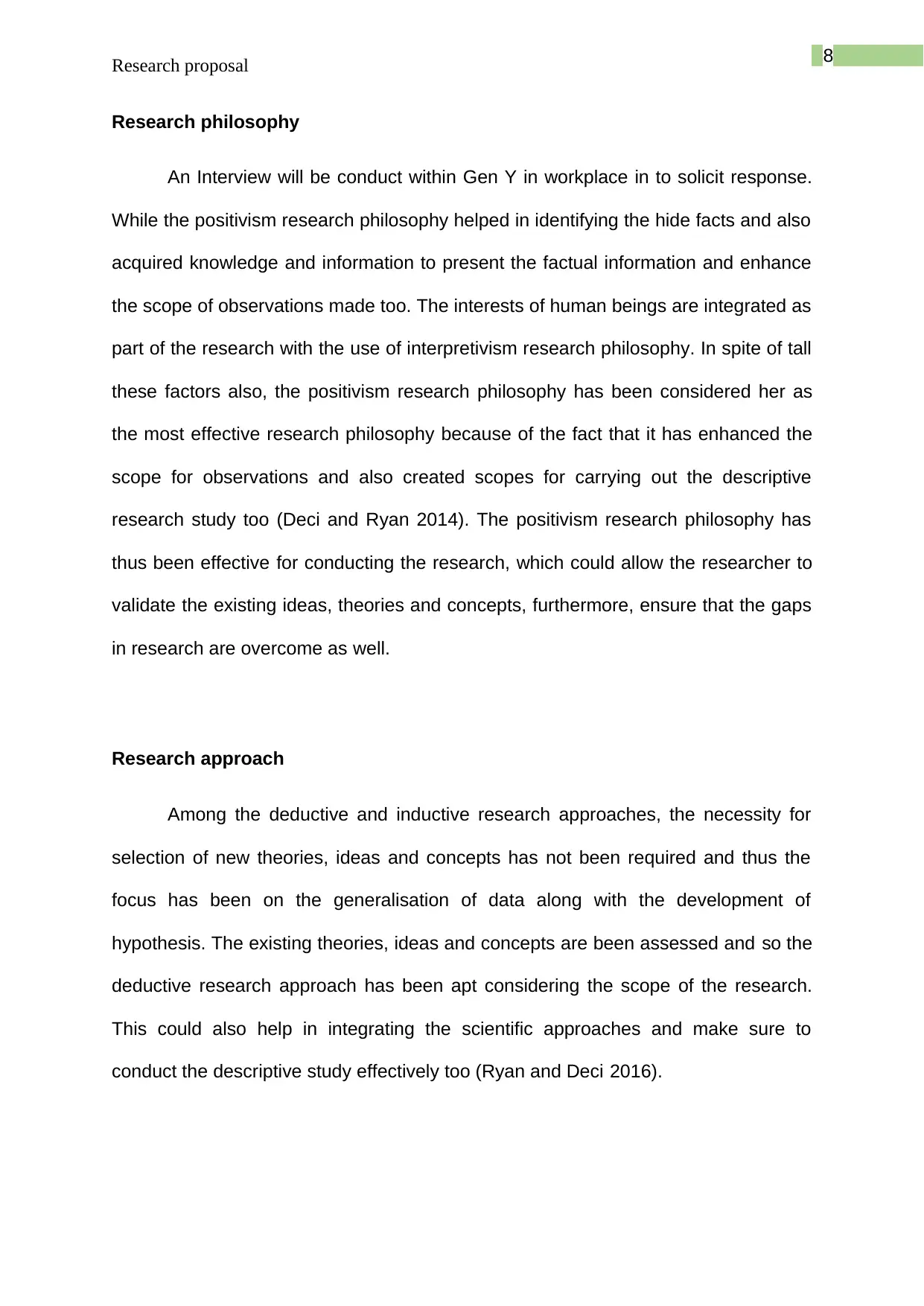
The proposed framework for identifying the factors influencing the turnover of Gen Y is
adapted from Deery (2008) that focused on the hospitality industry have been modify and
apply on the research.
Figure 1: Framework for identifying the factors influencing the turnover of Gen Y
Research proposal
interaction with the employees, irrespective of their ages. This would support
cooperative teamwork and also ensure maintenance of a good work life balance too
(Lee et al. 2015). According to Bergheim et al. (2015), with the achievement of a
higher position within the organisation, the employees could meet their esteem
needs and at the same time, manage better flexibility, autonomy and power while
controlling the job activities. Because of the application of theory, the organisations
have managed to assess the different kinds of needs that are to be met for raising
the level of satisfaction of employees with their job and keep them motivated and
encouraged as a whole (Nuttin 2014).
Methodology and Findings
The proposed framework for identifying the factors influencing the turnover of Gen Y is
adapted from Deery (2008) that focused on the hospitality industry have been modify and
apply on the research.
Figure 1: Framework for identifying the factors influencing the turnover of Gen Y
8
Research proposal
Research philosophy
An Interview will be conduct within Gen Y in workplace in to solicit response.
While the positivism research philosophy helped in identifying the hide facts and also
acquired knowledge and information to present the factual information and enhance
the scope of observations made too. The interests of human beings are integrated as
part of the research with the use of interpretivism research philosophy. In spite of tall
these factors also, the positivism research philosophy has been considered her as
the most effective research philosophy because of the fact that it has enhanced the
scope for observations and also created scopes for carrying out the descriptive
research study too (Deci and Ryan 2014). The positivism research philosophy has
thus been effective for conducting the research, which could allow the researcher to
validate the existing ideas, theories and concepts, furthermore, ensure that the gaps
in research are overcome as well.
Research approach
Among the deductive and inductive research approaches, the necessity for
selection of new theories, ideas and concepts has not been required and thus the
focus has been on the generalisation of data along with the development of
hypothesis. The existing theories, ideas and concepts are been assessed and so the
deductive research approach has been apt considering the scope of the research.
This could also help in integrating the scientific approaches and make sure to
conduct the descriptive study effectively too (Ryan and Deci 2016).
Research proposal
Research philosophy
An Interview will be conduct within Gen Y in workplace in to solicit response.
While the positivism research philosophy helped in identifying the hide facts and also
acquired knowledge and information to present the factual information and enhance
the scope of observations made too. The interests of human beings are integrated as
part of the research with the use of interpretivism research philosophy. In spite of tall
these factors also, the positivism research philosophy has been considered her as
the most effective research philosophy because of the fact that it has enhanced the
scope for observations and also created scopes for carrying out the descriptive
research study too (Deci and Ryan 2014). The positivism research philosophy has
thus been effective for conducting the research, which could allow the researcher to
validate the existing ideas, theories and concepts, furthermore, ensure that the gaps
in research are overcome as well.
Research approach
Among the deductive and inductive research approaches, the necessity for
selection of new theories, ideas and concepts has not been required and thus the
focus has been on the generalisation of data along with the development of
hypothesis. The existing theories, ideas and concepts are been assessed and so the
deductive research approach has been apt considering the scope of the research.
This could also help in integrating the scientific approaches and make sure to
conduct the descriptive study effectively too (Ryan and Deci 2016).
⊘ This is a preview!⊘
Do you want full access?
Subscribe today to unlock all pages.
Trusted by 1+ million students worldwide
9
Research proposal
Research design
According to Cleary, Horsfall and Hayter (2014), among the exploratory,
explanatory and descriptive research designs, the descriptive research design has
been the most suitable because of the assessment of research components in much
more details while at the same time, allowed the researcher to fill the missing gaps in
the literature. No prior assumptions of conclusions are made to expect what might
happen in the future, rather emphasized on the concepts of ‘what’ and ‘why’. Due to
this, it has not been unpredictable like the other two research designs and this has
also linked the research variables together, i.e., the age differences across
employees and its relation to the job satisfaction and motivation within the workplace
(Etikan, Musa and Alkassim 2016). Thus, the descriptive research design has been
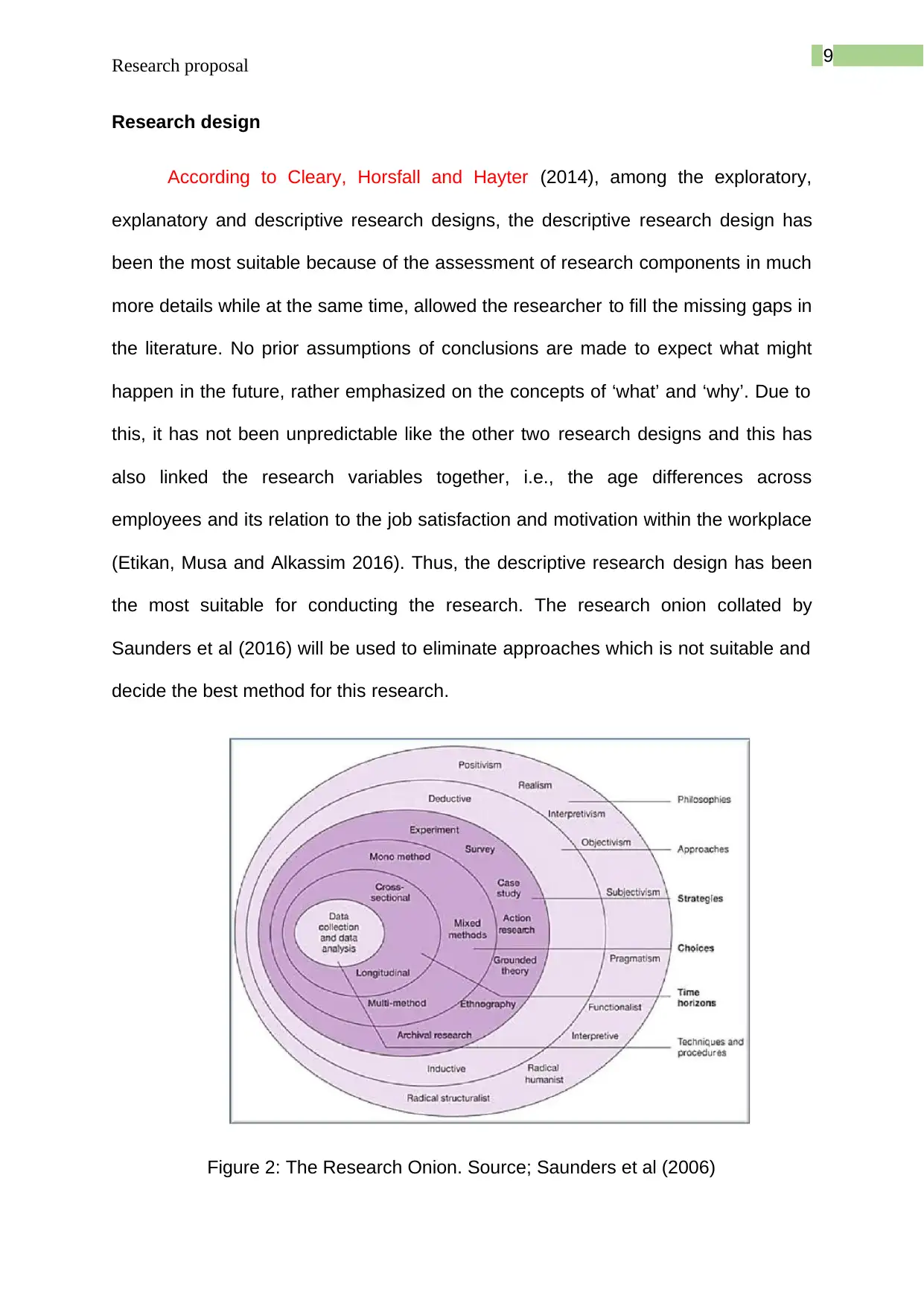
the most suitable for conducting the research. The research onion collated by
Saunders et al (2016) will be used to eliminate approaches which is not suitable and
decide the best method for this research.
Figure 2: The Research Onion. Source; Saunders et al (2006)
Research proposal
Research design
According to Cleary, Horsfall and Hayter (2014), among the exploratory,
explanatory and descriptive research designs, the descriptive research design has
been the most suitable because of the assessment of research components in much
more details while at the same time, allowed the researcher to fill the missing gaps in
the literature. No prior assumptions of conclusions are made to expect what might
happen in the future, rather emphasized on the concepts of ‘what’ and ‘why’. Due to
this, it has not been unpredictable like the other two research designs and this has
also linked the research variables together, i.e., the age differences across
employees and its relation to the job satisfaction and motivation within the workplace
(Etikan, Musa and Alkassim 2016). Thus, the descriptive research design has been
the most suitable for conducting the research. The research onion collated by
Saunders et al (2016) will be used to eliminate approaches which is not suitable and
decide the best method for this research.
Figure 2: The Research Onion. Source; Saunders et al (2006)
Paraphrase This Document
Need a fresh take? Get an instant paraphrase of this document with our AI Paraphraser
10
Research proposal
Sampling technique
The research being qualitative, requires collection of qualitative data and
information that are presented in the form of responses of managers during the
interview session. The samples have been chosen as 50 customers and 5 managers
of the organization. In order to conduct the research, the non-probability convenience
sampling technique has been used for arranging a suitable time for the managers,
based on their time schedule and then they are called in for the interview session,
where their responses have been recorded and treated as such without any bias
(Cleary, Horsfall and Hayter 2014). By asking certain questions related to the
satisfaction at job and motivation within the workplace for Gen Y, the managers
made sure to present their views and opinions, which were considered as vital
qualitative data and information required during the research. The interview session
has been conducted by. Due to the varied opinions and responses from each of this
groups, it has become easy for selecting the convenience sampling technique as the
most appropriate and relevant considering the research study (Setia, 2016).
Data collection
The research data and information must be collected mostly in the form of
qualitative data, acquired in the form of responses and opinions of the managers
who were interviewed. With the help of interviewing the Gen Y’s individuals, the
probable responses would be acquired, which should be considered as qualitative
data and information required during the research. The secondary data and
information have been collected from secondary sources including journals, articles,
websites and newspapers along with annual reports containing relevant information
and data about the organisation (Cleary et al., 2014).
Research proposal
Sampling technique
The research being qualitative, requires collection of qualitative data and
information that are presented in the form of responses of managers during the
interview session. The samples have been chosen as 50 customers and 5 managers
of the organization. In order to conduct the research, the non-probability convenience
sampling technique has been used for arranging a suitable time for the managers,
based on their time schedule and then they are called in for the interview session,
where their responses have been recorded and treated as such without any bias
(Cleary, Horsfall and Hayter 2014). By asking certain questions related to the
satisfaction at job and motivation within the workplace for Gen Y, the managers
made sure to present their views and opinions, which were considered as vital
qualitative data and information required during the research. The interview session
has been conducted by. Due to the varied opinions and responses from each of this
groups, it has become easy for selecting the convenience sampling technique as the
most appropriate and relevant considering the research study (Setia, 2016).
Data collection
The research data and information must be collected mostly in the form of
qualitative data, acquired in the form of responses and opinions of the managers
who were interviewed. With the help of interviewing the Gen Y’s individuals, the
probable responses would be acquired, which should be considered as qualitative
data and information required during the research. The secondary data and
information have been collected from secondary sources including journals, articles,
websites and newspapers along with annual reports containing relevant information
and data about the organisation (Cleary et al., 2014).
11
Research proposal
Data analysis
As there is no need to collect quantitative data and information, the qualitative
data and information have been acquired in the form of responses from the
managers of the organization, who were interviewed. The analysis of qualitative data
and information has been done with the help of presenting the responses of
managers, based on the questions, in the question answer format. The thematic
analysis could be proposed here considering the scope of research and its efficiency
in achieving the goals and objectives perfectly.
Reliability and validity
The reliability and validity of the research has been maintained with the help
of using authentic articles, journals and from websites that contain information about
the company and also about how the human resources have been managed. The
validity of research has been maintained by making sure that the responses are
provided without any bias, which should maintain the validity and reliability too
(Palinkas et al. 2015).
Ethical considerations
None of the respondents should be forced to take part in the research while
the respondents were informed about the purpose of the research. The data and
information must be kept confidential to prevent unauthorized access and prevent
loss of important data and information while the research should be done for
academic purposes only and not to draw any types of commercial benefits.
Research proposal
Data analysis
As there is no need to collect quantitative data and information, the qualitative
data and information have been acquired in the form of responses from the
managers of the organization, who were interviewed. The analysis of qualitative data
and information has been done with the help of presenting the responses of
managers, based on the questions, in the question answer format. The thematic
analysis could be proposed here considering the scope of research and its efficiency
in achieving the goals and objectives perfectly.
Reliability and validity
The reliability and validity of the research has been maintained with the help
of using authentic articles, journals and from websites that contain information about
the company and also about how the human resources have been managed. The
validity of research has been maintained by making sure that the responses are
provided without any bias, which should maintain the validity and reliability too
(Palinkas et al. 2015).
Ethical considerations
None of the respondents should be forced to take part in the research while
the respondents were informed about the purpose of the research. The data and
information must be kept confidential to prevent unauthorized access and prevent
loss of important data and information while the research should be done for
academic purposes only and not to draw any types of commercial benefits.
⊘ This is a preview!⊘
Do you want full access?
Subscribe today to unlock all pages.
Trusted by 1+ million students worldwide

1 out of 16


Related Documents


Your All-in-One AI-Powered Toolkit for Academic Success.
+13062052269
info@desklib.com
Available 24*7 on WhatsApp / Email
![[object Object]](/_next/static/media/star-bottom.7253800d.svg)
Unlock your academic potential
Copyright © 2020–2026 A2Z Services. All Rights Reserved. Developed and managed by ZUCOL.