Analysis of Cholesterol Levels and Gender Differences: RMIT

Verified

Added on  2022/12/27

|1
|1132
|99
Report
AI Summary
This report presents a study on the relationship between gender and cholesterol levels. The study aimed to determine if there were significant differences in cholesterol levels between male and female participants. The methodology involved selecting a sample of 50 participants from each gender, collecting data on age, smoking status, and cholesterol levels through blood samples. Statistical analyses, including descriptive statistics, normality tests, variance homogeneity tests, and two-sample t-tests, were performed to compare the mean cholesterol levels. The results indicated that male Islanders had significantly higher cholesterol levels than female Islanders. The study acknowledged limitations such as a limited sample size and the exclusion of factors like BMI and fasting status. The report concludes by emphasizing the importance of understanding gender-specific cholesterol variations for health monitoring and the prevention of cardiovascular diseases. The findings are supported by references to similar studies and statistical evidence. This study is available on Desklib for students.
Document Page
5. Discussion
The present study found that cholesterol levels
were influenced by gender. The test results in
this study showed statistically significant
evidence of a difference in mean cholesterol
levels between male and female Islanders, in
which male Islanders tended to have higher
cholesterol than females. This finding matched
the results of a similar study conducted by
Seidell et al (1991) [2]
To accurately examine the influence of sex on
cholesterol levels, participants in the study were
carefully selected. Some factors that were known
to affect cholesterol levels such as ages, physical
exercise and smoking, were considered and
adjusted during sample selection. Stratified
sampling allowed the sample to be
representative for all Islanders on island 1.
However, there were some limitations in the
study. First of all, due to restriction in human
resources, the sample size was limited.
Secondly, some influencing factors such as BMI,
fasting before test, was not considered in the
study. In future research, the sample size should
be increased to achieve better accuracy and
precision. The research should be carefully
designed to adjust effects of all other factors that
may affect cholesterol levels in the final results
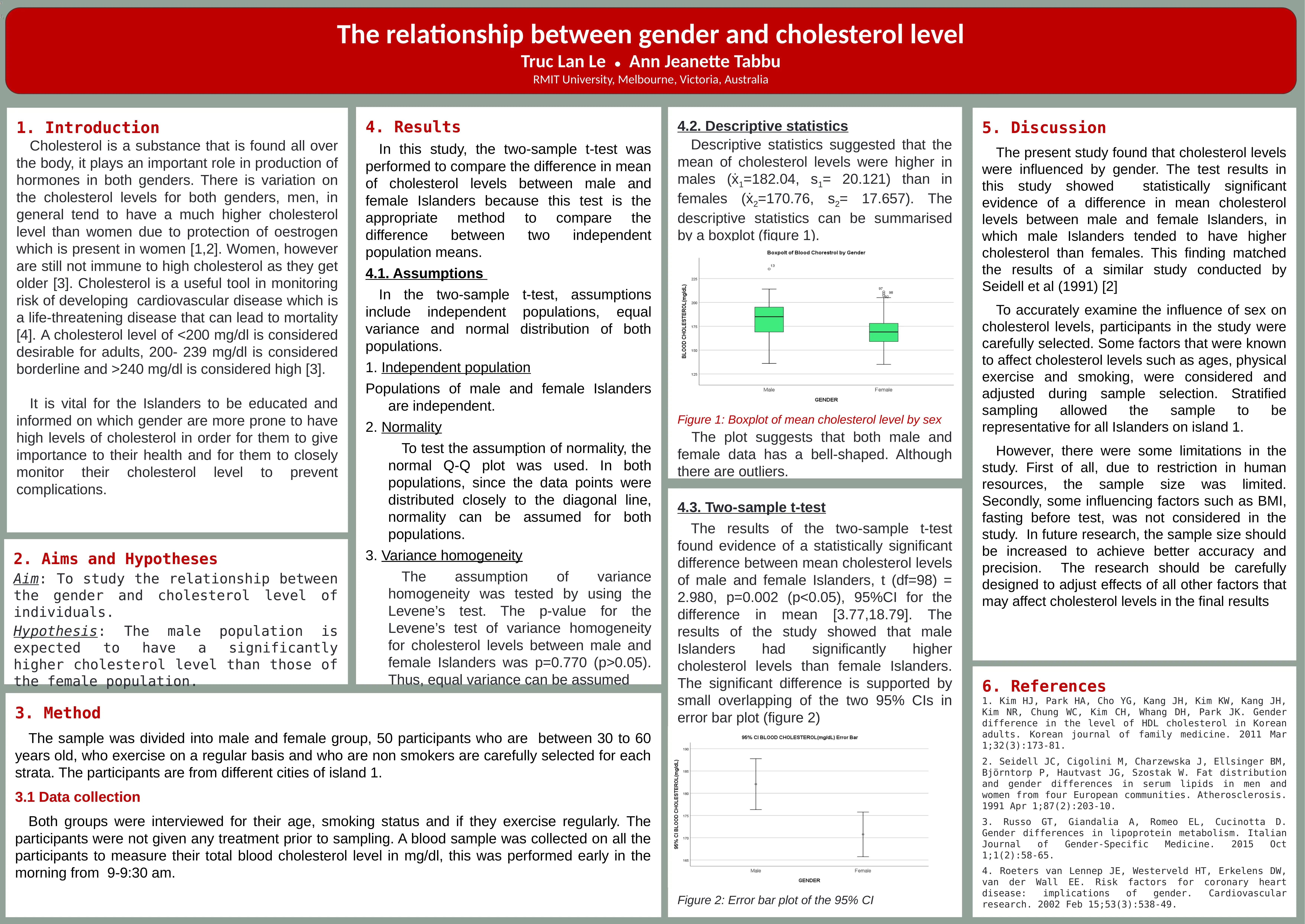
4.2. Descriptive statistics
Descriptive statistics suggested that the
mean of cholesterol levels were higher in
males (ẋ1=182.04, s1= 20.121) than in
females (ẋ2=170.76, s2= 17.657). The
descriptive statistics can be summarised
by a boxplot (figure 1).
Figure 1: Boxplot of mean cholesterol level by sex
The plot suggests that both male and
female data has a bell-shaped. Although
there are outliers.
2. Aims and Hypotheses
Aim: To study the relationship between
the gender and cholesterol level of
individuals.
Hypothesis: The male population is
expected to have a significantly
higher cholesterol level than those of
the female population.
1. Introduction
Cholesterol is a substance that is found all over
the body, it plays an important role in production of
hormones in both genders. There is variation on
the cholesterol levels for both genders, men, in
general tend to have a much higher cholesterol
level than women due to protection of oestrogen
which is present in women [1,2]. Women, however
are still not immune to high cholesterol as they get
older [3]. Cholesterol is a useful tool in monitoring
risk of developing cardiovascular disease which is
a life-threatening disease that can lead to mortality
[4]. A cholesterol level of <200 mg/dl is considered
desirable for adults, 200- 239 mg/dl is considered
borderline and >240 mg/dl is considered high [3].
It is vital for the Islanders to be educated and
informed on which gender are more prone to have
high levels of cholesterol in order for them to give
importance to their health and for them to closely
monitor their cholesterol level to prevent
complications.
3. Method
The sample was divided into male and female group, 50 participants who are between 30 to 60
years old, who exercise on a regular basis and who are non smokers are carefully selected for each
strata. The participants are from different cities of island 1.
3.1 Data collection
Both groups were interviewed for their age, smoking status and if they exercise regularly. The
participants were not given any treatment prior to sampling. A blood sample was collected on all the
participants to measure their total blood cholesterol level in mg/dl, this was performed early in the
morning from 9-9:30 am.
6. References
1. Kim HJ, Park HA, Cho YG, Kang JH, Kim KW, Kang JH,
Kim NR, Chung WC, Kim CH, Whang DH, Park JK. Gender
difference in the level of HDL cholesterol in Korean
adults. Korean journal of family medicine. 2011 Mar
1;32(3):173-81.
2. Seidell JC, Cigolini M, Charzewska J, Ellsinger BM,
Björntorp P, Hautvast JG, Szostak W. Fat distribution
and gender differences in serum lipids in men and
women from four European communities. Atherosclerosis.
1991 Apr 1;87(2):203-10.
3. Russo GT, Giandalia A, Romeo EL, Cucinotta D.
Gender differences in lipoprotein metabolism. Italian
Journal of Gender-Specific Medicine. 2015 Oct
1;1(2):58-65.
4. Roeters van Lennep JE, Westerveld HT, Erkelens DW,
van der Wall EE. Risk factors for coronary heart
disease: implications of gender. Cardiovascular
research. 2002 Feb 15;53(3):538-49.
4. Results
In this study, the two-sample t-test was
performed to compare the difference in mean
of cholesterol levels between male and
female Islanders because this test is the
appropriate method to compare the
difference between two independent
population means.
4.1. Assumptions
In the two-sample t-test, assumptions
include independent populations, equal
variance and normal distribution of both
populations.
1. Independent population
Populations of male and female Islanders
are independent.
2. Normality
To test the assumption of normality, the
normal Q-Q plot was used. In both
populations, since the data points were
distributed closely to the diagonal line,
normality can be assumed for both
populations.
3. Variance homogeneity
The assumption of variance
homogeneity was tested by using the
Levene’s test. The p-value for the
Levene’s test of variance homogeneity
for cholesterol levels between male and
female Islanders was p=0.770 (p>0.05).
Thus, equal variance can be assumed
4.3. Two-sample t-test
The results of the two-sample t-test
found evidence of a statistically significant
difference between mean cholesterol levels
of male and female Islanders, t (df=98) =
2.980, p=0.002 (p<0.05), 95%CI for the
difference in mean [3.77,18.79]. The
results of the study showed that male
Islanders had significantly higher
cholesterol levels than female Islanders.
The significant difference is supported by
small overlapping of the two 95% CIs in
error bar plot (figure 2)
Figure 2: Error bar plot of the 95% CI
The relationship between gender and cholesterol level
Truc Lan Le Ann Jeanette Tabbu
RMIT University, Melbourne, Victoria, Australia
tabler-icon-diamond-filled.svg

Paraphrase This Document

Need a fresh take? Get an instant paraphrase of this document with our AI Paraphraser
[object Object]