The Bystander Effect: Exploring Gender's Impact on Helping Behavior
VerifiedAdded on 2021/05/31
|10
|2350
|367
Report
AI Summary
This report investigates the bystander effect, focusing on the influence of gender on helping behavior. It begins with a literature review, examining previous studies on the topic, including Koon (2013), Leone et al. (2016), and Manthey (2017), which explore gendered responses to situations requiring intervention. The report then presents findings from both secondary and primary research, including a survey of 40 participants, highlighting differences in perception and action between males and females in emergency scenarios. The conclusion summarizes these findings, emphasizing the impact of physical strength, helping nature, and attractiveness of victims on bystander behavior. Recommendations are provided to promote proactive intervention and address socio-cultural barriers, alongside limitations of the study. The report aims to understand the factors influencing bystander intervention and how gender plays a critical role in the decision-making process during critical situations.
Running head: THE BYSTANDER EFFECT
THE BYSTANDER EFFECT
Name of the Student:
Name of the University:
Author Note:
THE BYSTANDER EFFECT
Name of the Student:
Name of the University:
Author Note:

Paraphrase This Document
Need a fresh take? Get an instant paraphrase of this document with our AI Paraphraser
THE BYSTANDER EFFECT 1
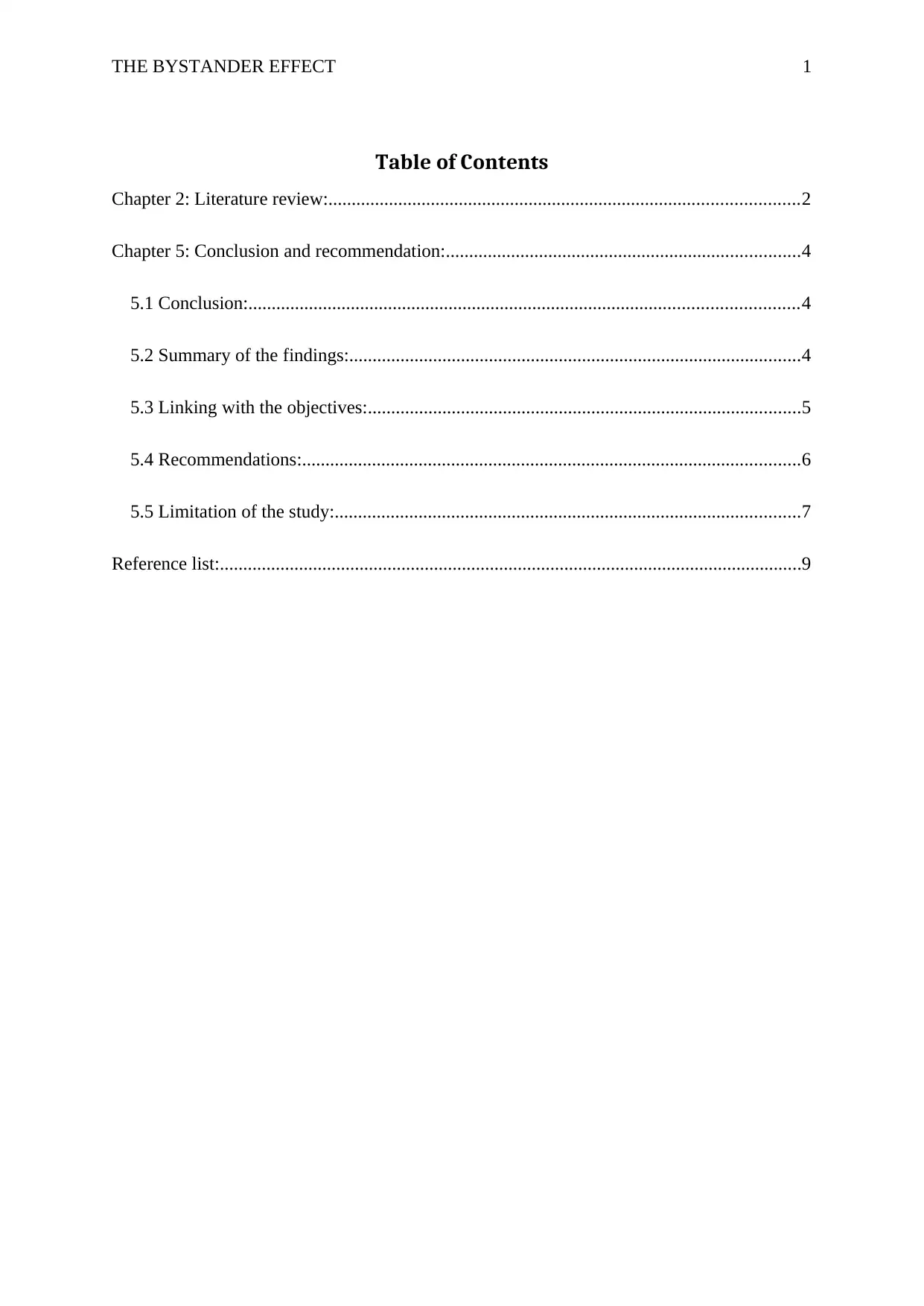
Table of Contents
Chapter 2: Literature review:.....................................................................................................2
Chapter 5: Conclusion and recommendation:............................................................................4
5.1 Conclusion:......................................................................................................................4
5.2 Summary of the findings:.................................................................................................4
5.3 Linking with the objectives:.............................................................................................5
5.4 Recommendations:...........................................................................................................6
5.5 Limitation of the study:....................................................................................................7
Reference list:.............................................................................................................................9
Table of Contents
Chapter 2: Literature review:.....................................................................................................2
Chapter 5: Conclusion and recommendation:............................................................................4
5.1 Conclusion:......................................................................................................................4
5.2 Summary of the findings:.................................................................................................4
5.3 Linking with the objectives:.............................................................................................5
5.4 Recommendations:...........................................................................................................6
5.5 Limitation of the study:....................................................................................................7
Reference list:.............................................................................................................................9
THE BYSTANDER EFFECT 2
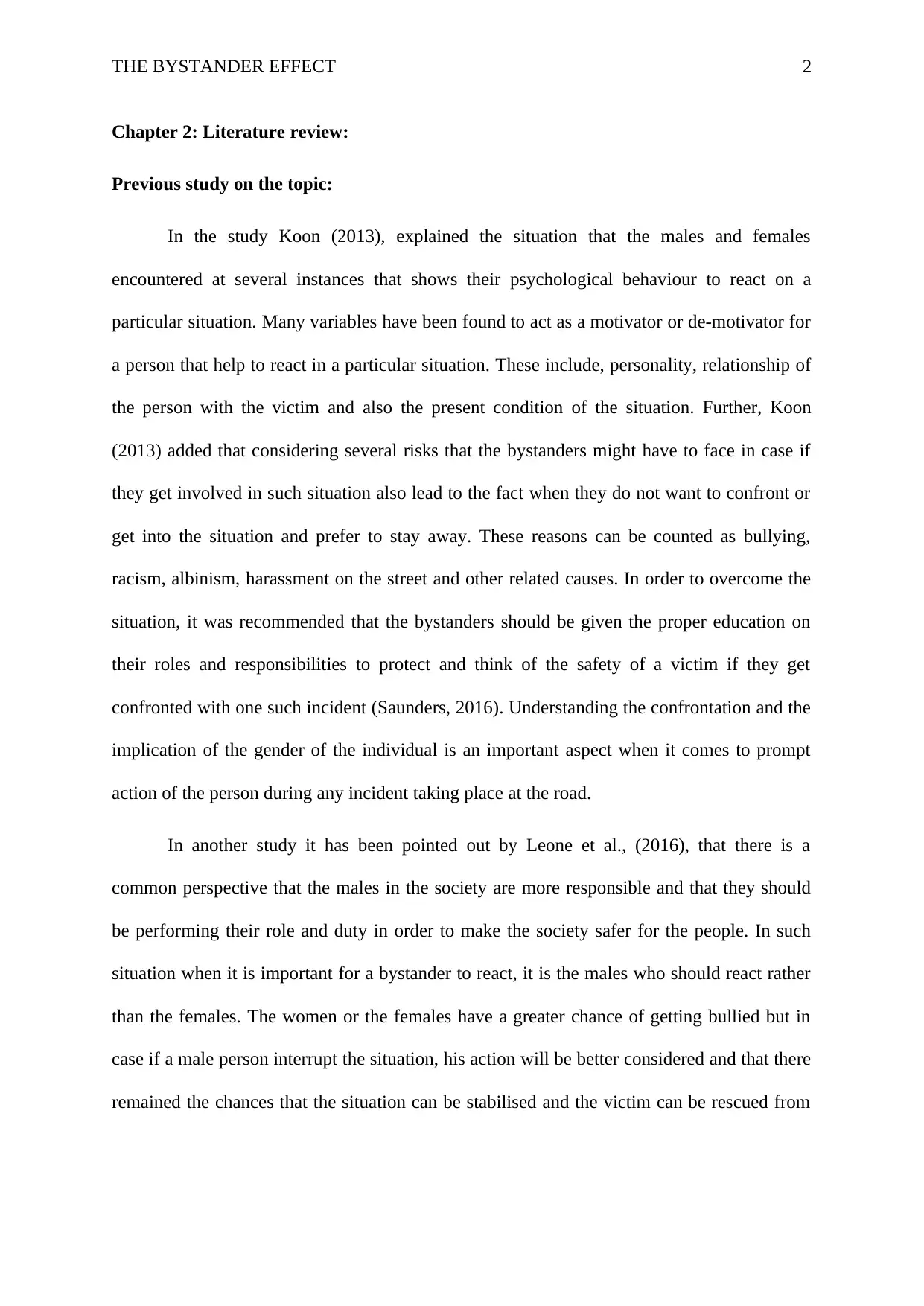
Chapter 2: Literature review:
Previous study on the topic:
In the study Koon (2013), explained the situation that the males and females
encountered at several instances that shows their psychological behaviour to react on a
particular situation. Many variables have been found to act as a motivator or de-motivator for
a person that help to react in a particular situation. These include, personality, relationship of
the person with the victim and also the present condition of the situation. Further, Koon
(2013) added that considering several risks that the bystanders might have to face in case if
they get involved in such situation also lead to the fact when they do not want to confront or
get into the situation and prefer to stay away. These reasons can be counted as bullying,
racism, albinism, harassment on the street and other related causes. In order to overcome the
situation, it was recommended that the bystanders should be given the proper education on
their roles and responsibilities to protect and think of the safety of a victim if they get
confronted with one such incident (Saunders, 2016). Understanding the confrontation and the
implication of the gender of the individual is an important aspect when it comes to prompt
action of the person during any incident taking place at the road.
In another study it has been pointed out by Leone et al., (2016), that there is a
common perspective that the males in the society are more responsible and that they should
be performing their role and duty in order to make the society safer for the people. In such
situation when it is important for a bystander to react, it is the males who should react rather
than the females. The women or the females have a greater chance of getting bullied but in
case if a male person interrupt the situation, his action will be better considered and that there
remained the chances that the situation can be stabilised and the victim can be rescued from
Chapter 2: Literature review:
Previous study on the topic:
In the study Koon (2013), explained the situation that the males and females
encountered at several instances that shows their psychological behaviour to react on a
particular situation. Many variables have been found to act as a motivator or de-motivator for
a person that help to react in a particular situation. These include, personality, relationship of
the person with the victim and also the present condition of the situation. Further, Koon
(2013) added that considering several risks that the bystanders might have to face in case if
they get involved in such situation also lead to the fact when they do not want to confront or
get into the situation and prefer to stay away. These reasons can be counted as bullying,
racism, albinism, harassment on the street and other related causes. In order to overcome the
situation, it was recommended that the bystanders should be given the proper education on
their roles and responsibilities to protect and think of the safety of a victim if they get
confronted with one such incident (Saunders, 2016). Understanding the confrontation and the
implication of the gender of the individual is an important aspect when it comes to prompt
action of the person during any incident taking place at the road.
In another study it has been pointed out by Leone et al., (2016), that there is a
common perspective that the males in the society are more responsible and that they should
be performing their role and duty in order to make the society safer for the people. In such
situation when it is important for a bystander to react, it is the males who should react rather
than the females. The women or the females have a greater chance of getting bullied but in
case if a male person interrupt the situation, his action will be better considered and that there
remained the chances that the situation can be stabilised and the victim can be rescued from
⊘ This is a preview!⊘
Do you want full access?
Subscribe today to unlock all pages.

Trusted by 1+ million students worldwide
THE BYSTANDER EFFECT 3
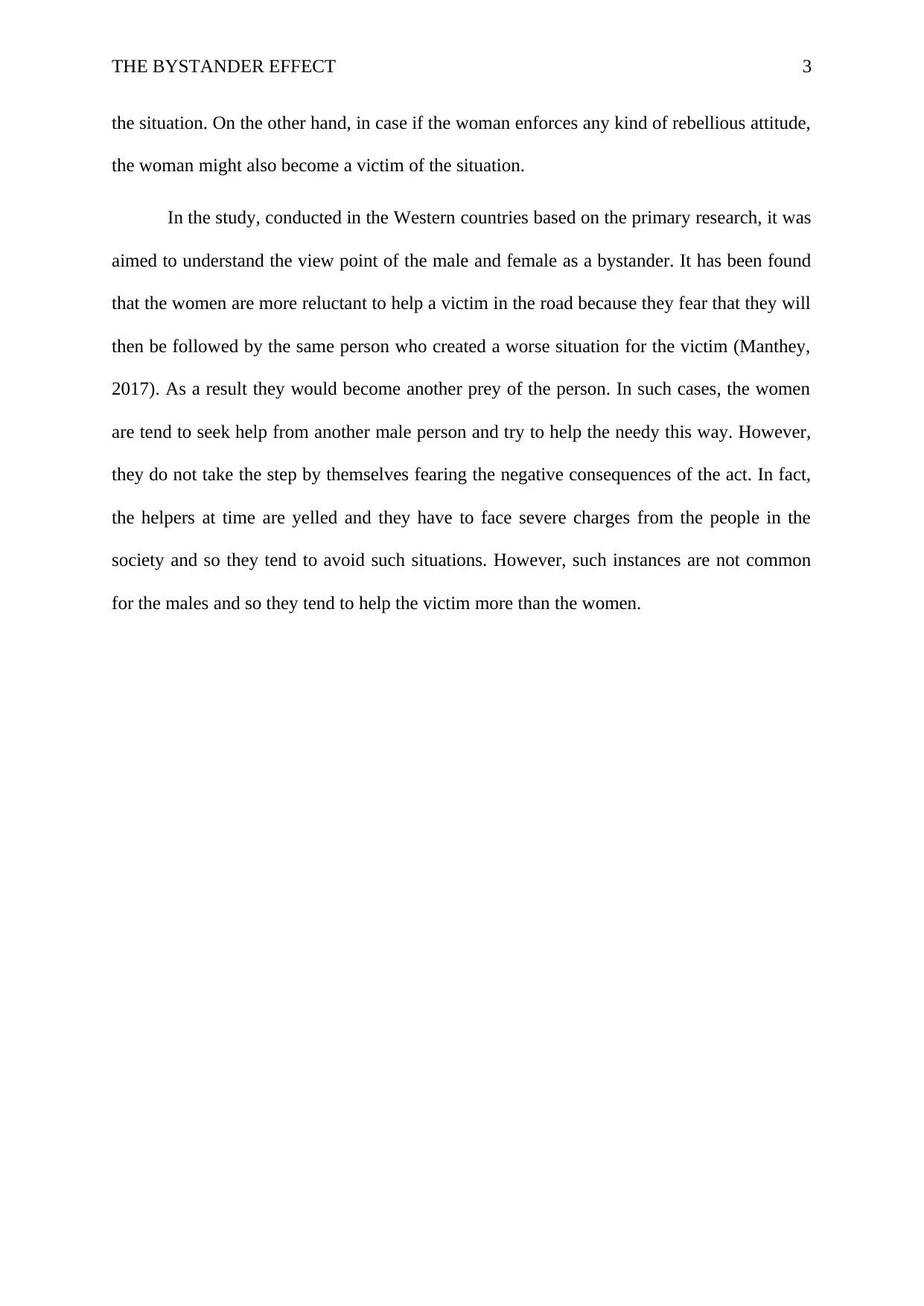
the situation. On the other hand, in case if the woman enforces any kind of rebellious attitude,
the woman might also become a victim of the situation.
In the study, conducted in the Western countries based on the primary research, it was
aimed to understand the view point of the male and female as a bystander. It has been found
that the women are more reluctant to help a victim in the road because they fear that they will
then be followed by the same person who created a worse situation for the victim (Manthey,
2017). As a result they would become another prey of the person. In such cases, the women
are tend to seek help from another male person and try to help the needy this way. However,
they do not take the step by themselves fearing the negative consequences of the act. In fact,
the helpers at time are yelled and they have to face severe charges from the people in the
society and so they tend to avoid such situations. However, such instances are not common
for the males and so they tend to help the victim more than the women.
the situation. On the other hand, in case if the woman enforces any kind of rebellious attitude,
the woman might also become a victim of the situation.
In the study, conducted in the Western countries based on the primary research, it was
aimed to understand the view point of the male and female as a bystander. It has been found
that the women are more reluctant to help a victim in the road because they fear that they will
then be followed by the same person who created a worse situation for the victim (Manthey,
2017). As a result they would become another prey of the person. In such cases, the women
are tend to seek help from another male person and try to help the needy this way. However,
they do not take the step by themselves fearing the negative consequences of the act. In fact,
the helpers at time are yelled and they have to face severe charges from the people in the
society and so they tend to avoid such situations. However, such instances are not common
for the males and so they tend to help the victim more than the women.
Paraphrase This Document
Need a fresh take? Get an instant paraphrase of this document with our AI Paraphraser
THE BYSTANDER EFFECT 4
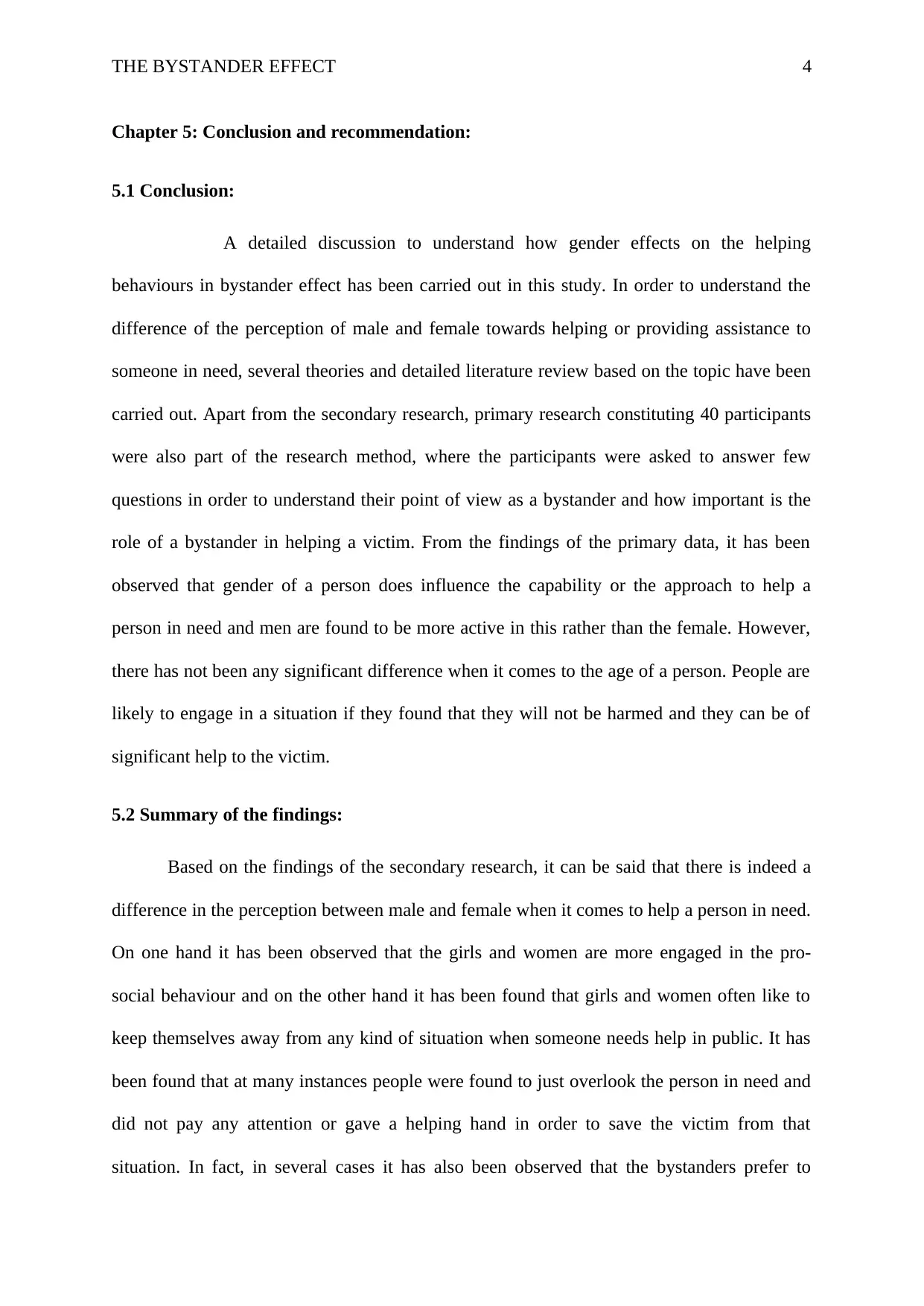
Chapter 5: Conclusion and recommendation:
5.1 Conclusion:
A detailed discussion to understand how gender effects on the helping
behaviours in bystander effect has been carried out in this study. In order to understand the
difference of the perception of male and female towards helping or providing assistance to
someone in need, several theories and detailed literature review based on the topic have been
carried out. Apart from the secondary research, primary research constituting 40 participants
were also part of the research method, where the participants were asked to answer few
questions in order to understand their point of view as a bystander and how important is the
role of a bystander in helping a victim. From the findings of the primary data, it has been
observed that gender of a person does influence the capability or the approach to help a
person in need and men are found to be more active in this rather than the female. However,
there has not been any significant difference when it comes to the age of a person. People are
likely to engage in a situation if they found that they will not be harmed and they can be of
significant help to the victim.
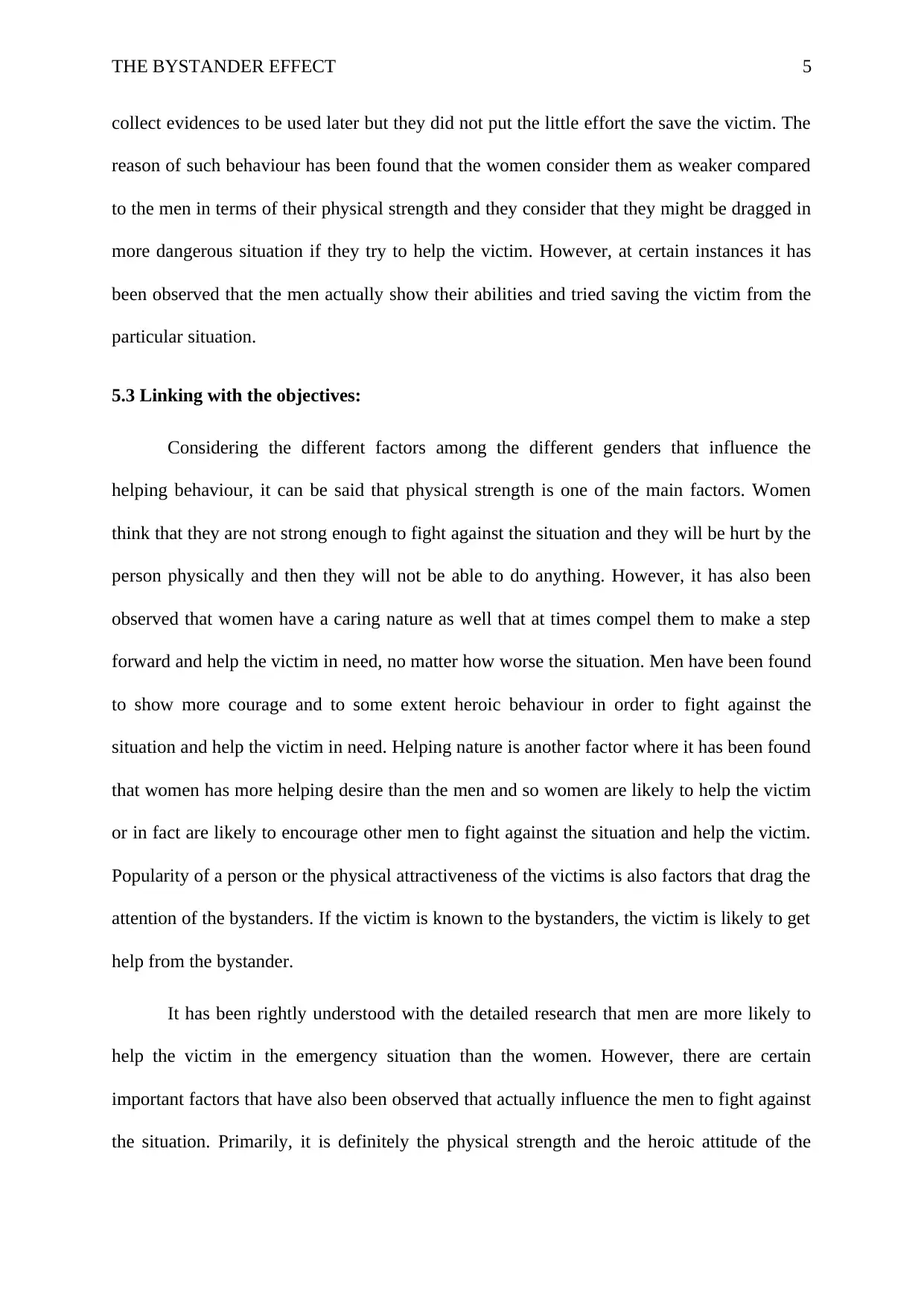
5.2 Summary of the findings:
Based on the findings of the secondary research, it can be said that there is indeed a
difference in the perception between male and female when it comes to help a person in need.
On one hand it has been observed that the girls and women are more engaged in the pro-
social behaviour and on the other hand it has been found that girls and women often like to
keep themselves away from any kind of situation when someone needs help in public. It has
been found that at many instances people were found to just overlook the person in need and
did not pay any attention or gave a helping hand in order to save the victim from that
situation. In fact, in several cases it has also been observed that the bystanders prefer to
Chapter 5: Conclusion and recommendation:
5.1 Conclusion:
A detailed discussion to understand how gender effects on the helping
behaviours in bystander effect has been carried out in this study. In order to understand the
difference of the perception of male and female towards helping or providing assistance to
someone in need, several theories and detailed literature review based on the topic have been
carried out. Apart from the secondary research, primary research constituting 40 participants
were also part of the research method, where the participants were asked to answer few
questions in order to understand their point of view as a bystander and how important is the
role of a bystander in helping a victim. From the findings of the primary data, it has been
observed that gender of a person does influence the capability or the approach to help a
person in need and men are found to be more active in this rather than the female. However,
there has not been any significant difference when it comes to the age of a person. People are
likely to engage in a situation if they found that they will not be harmed and they can be of
significant help to the victim.
5.2 Summary of the findings:
Based on the findings of the secondary research, it can be said that there is indeed a
difference in the perception between male and female when it comes to help a person in need.
On one hand it has been observed that the girls and women are more engaged in the pro-
social behaviour and on the other hand it has been found that girls and women often like to
keep themselves away from any kind of situation when someone needs help in public. It has
been found that at many instances people were found to just overlook the person in need and
did not pay any attention or gave a helping hand in order to save the victim from that
situation. In fact, in several cases it has also been observed that the bystanders prefer to
THE BYSTANDER EFFECT 5
collect evidences to be used later but they did not put the little effort the save the victim. The
reason of such behaviour has been found that the women consider them as weaker compared
to the men in terms of their physical strength and they consider that they might be dragged in
more dangerous situation if they try to help the victim. However, at certain instances it has
been observed that the men actually show their abilities and tried saving the victim from the
particular situation.
5.3 Linking with the objectives:
Considering the different factors among the different genders that influence the
helping behaviour, it can be said that physical strength is one of the main factors. Women
think that they are not strong enough to fight against the situation and they will be hurt by the
person physically and then they will not be able to do anything. However, it has also been
observed that women have a caring nature as well that at times compel them to make a step
forward and help the victim in need, no matter how worse the situation. Men have been found
to show more courage and to some extent heroic behaviour in order to fight against the
situation and help the victim in need. Helping nature is another factor where it has been found
that women has more helping desire than the men and so women are likely to help the victim
or in fact are likely to encourage other men to fight against the situation and help the victim.
Popularity of a person or the physical attractiveness of the victims is also factors that drag the
attention of the bystanders. If the victim is known to the bystanders, the victim is likely to get
help from the bystander.
It has been rightly understood with the detailed research that men are more likely to
help the victim in the emergency situation than the women. However, there are certain
important factors that have also been observed that actually influence the men to fight against
the situation. Primarily, it is definitely the physical strength and the heroic attitude of the
collect evidences to be used later but they did not put the little effort the save the victim. The
reason of such behaviour has been found that the women consider them as weaker compared
to the men in terms of their physical strength and they consider that they might be dragged in
more dangerous situation if they try to help the victim. However, at certain instances it has
been observed that the men actually show their abilities and tried saving the victim from the
particular situation.
5.3 Linking with the objectives:
Considering the different factors among the different genders that influence the
helping behaviour, it can be said that physical strength is one of the main factors. Women
think that they are not strong enough to fight against the situation and they will be hurt by the
person physically and then they will not be able to do anything. However, it has also been
observed that women have a caring nature as well that at times compel them to make a step
forward and help the victim in need, no matter how worse the situation. Men have been found
to show more courage and to some extent heroic behaviour in order to fight against the
situation and help the victim in need. Helping nature is another factor where it has been found
that women has more helping desire than the men and so women are likely to help the victim
or in fact are likely to encourage other men to fight against the situation and help the victim.
Popularity of a person or the physical attractiveness of the victims is also factors that drag the
attention of the bystanders. If the victim is known to the bystanders, the victim is likely to get
help from the bystander.
It has been rightly understood with the detailed research that men are more likely to
help the victim in the emergency situation than the women. However, there are certain
important factors that have also been observed that actually influence the men to fight against
the situation. Primarily, it is definitely the physical strength and the heroic attitude of the
⊘ This is a preview!⊘
Do you want full access?
Subscribe today to unlock all pages.
Trusted by 1+ million students worldwide
THE BYSTANDER EFFECT 6
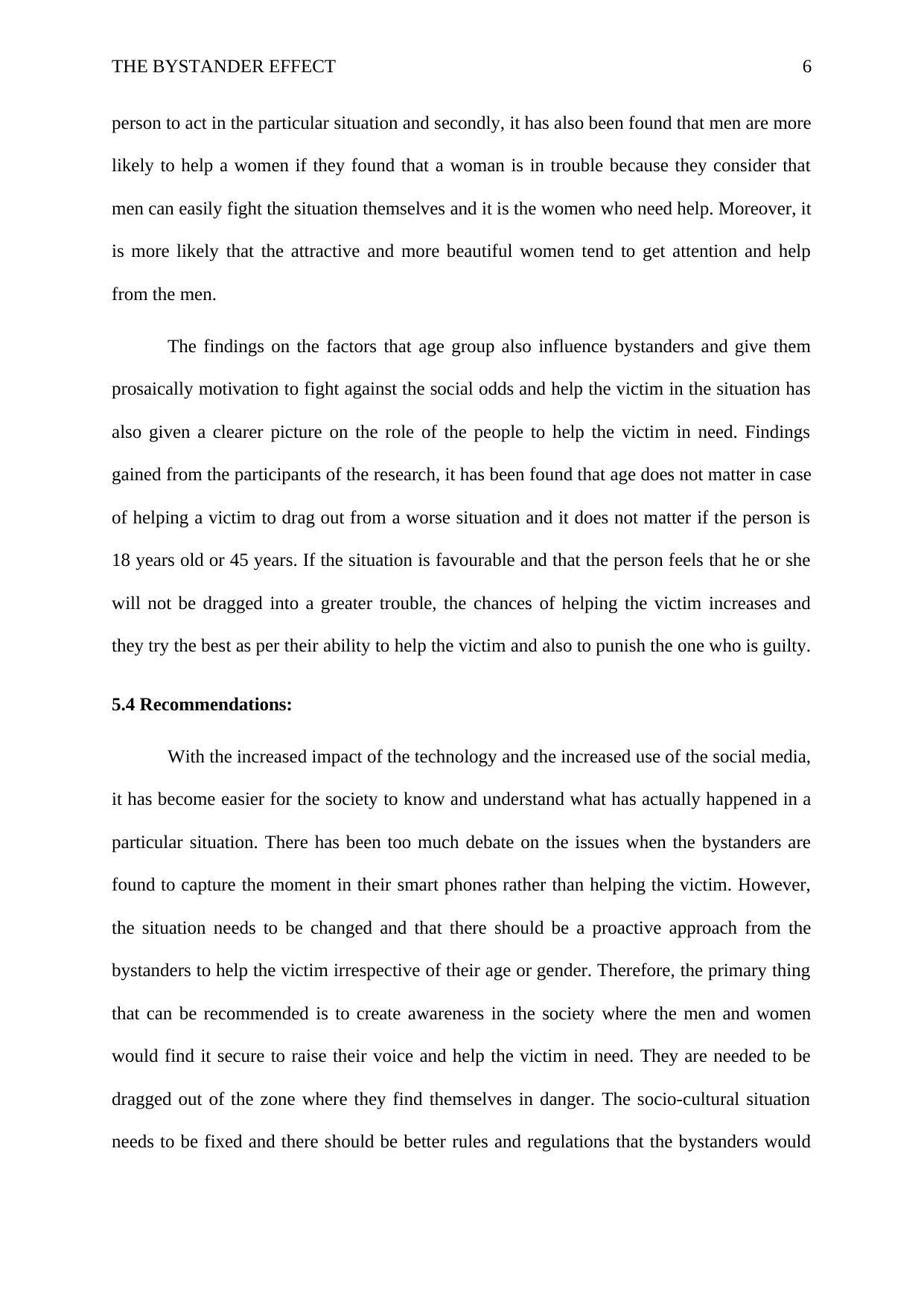
person to act in the particular situation and secondly, it has also been found that men are more
likely to help a women if they found that a woman is in trouble because they consider that
men can easily fight the situation themselves and it is the women who need help. Moreover, it
is more likely that the attractive and more beautiful women tend to get attention and help
from the men.
The findings on the factors that age group also influence bystanders and give them
prosaically motivation to fight against the social odds and help the victim in the situation has
also given a clearer picture on the role of the people to help the victim in need. Findings
gained from the participants of the research, it has been found that age does not matter in case
of helping a victim to drag out from a worse situation and it does not matter if the person is
18 years old or 45 years. If the situation is favourable and that the person feels that he or she
will not be dragged into a greater trouble, the chances of helping the victim increases and
they try the best as per their ability to help the victim and also to punish the one who is guilty.
5.4 Recommendations:
With the increased impact of the technology and the increased use of the social media,
it has become easier for the society to know and understand what has actually happened in a
particular situation. There has been too much debate on the issues when the bystanders are
found to capture the moment in their smart phones rather than helping the victim. However,
the situation needs to be changed and that there should be a proactive approach from the
bystanders to help the victim irrespective of their age or gender. Therefore, the primary thing
that can be recommended is to create awareness in the society where the men and women
would find it secure to raise their voice and help the victim in need. They are needed to be
dragged out of the zone where they find themselves in danger. The socio-cultural situation
needs to be fixed and there should be better rules and regulations that the bystanders would
person to act in the particular situation and secondly, it has also been found that men are more
likely to help a women if they found that a woman is in trouble because they consider that
men can easily fight the situation themselves and it is the women who need help. Moreover, it
is more likely that the attractive and more beautiful women tend to get attention and help
from the men.
The findings on the factors that age group also influence bystanders and give them
prosaically motivation to fight against the social odds and help the victim in the situation has
also given a clearer picture on the role of the people to help the victim in need. Findings
gained from the participants of the research, it has been found that age does not matter in case
of helping a victim to drag out from a worse situation and it does not matter if the person is
18 years old or 45 years. If the situation is favourable and that the person feels that he or she
will not be dragged into a greater trouble, the chances of helping the victim increases and
they try the best as per their ability to help the victim and also to punish the one who is guilty.
5.4 Recommendations:
With the increased impact of the technology and the increased use of the social media,
it has become easier for the society to know and understand what has actually happened in a
particular situation. There has been too much debate on the issues when the bystanders are
found to capture the moment in their smart phones rather than helping the victim. However,
the situation needs to be changed and that there should be a proactive approach from the
bystanders to help the victim irrespective of their age or gender. Therefore, the primary thing
that can be recommended is to create awareness in the society where the men and women
would find it secure to raise their voice and help the victim in need. They are needed to be
dragged out of the zone where they find themselves in danger. The socio-cultural situation
needs to be fixed and there should be better rules and regulations that the bystanders would
Paraphrase This Document
Need a fresh take? Get an instant paraphrase of this document with our AI Paraphraser
THE BYSTANDER EFFECT 7
be rather rewarded if they help the victim in need because people have a thinking that if they
get involved in the situation, they might get into more difficult situation.
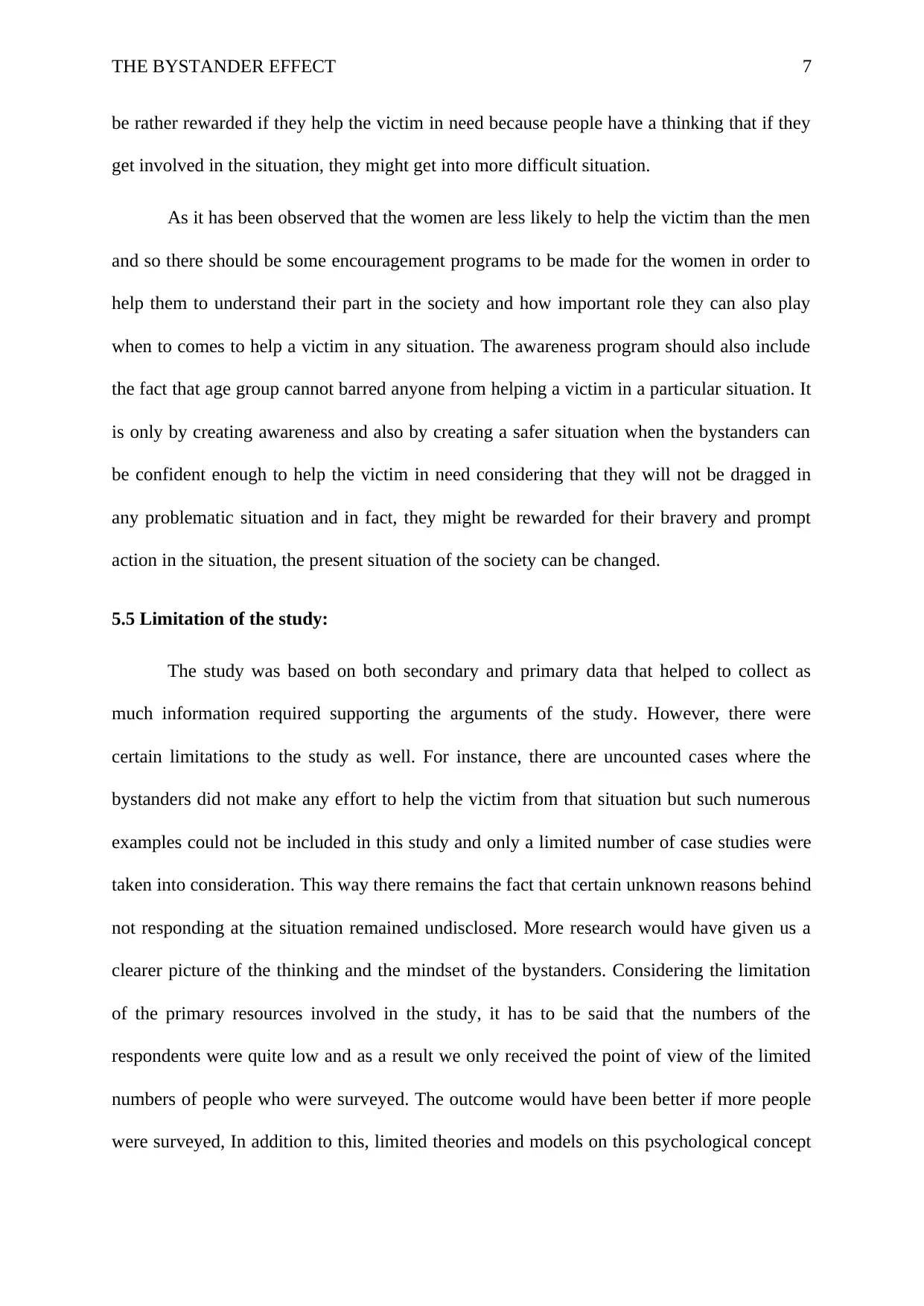
As it has been observed that the women are less likely to help the victim than the men
and so there should be some encouragement programs to be made for the women in order to
help them to understand their part in the society and how important role they can also play
when to comes to help a victim in any situation. The awareness program should also include
the fact that age group cannot barred anyone from helping a victim in a particular situation. It
is only by creating awareness and also by creating a safer situation when the bystanders can
be confident enough to help the victim in need considering that they will not be dragged in
any problematic situation and in fact, they might be rewarded for their bravery and prompt
action in the situation, the present situation of the society can be changed.
5.5 Limitation of the study:
The study was based on both secondary and primary data that helped to collect as
much information required supporting the arguments of the study. However, there were
certain limitations to the study as well. For instance, there are uncounted cases where the
bystanders did not make any effort to help the victim from that situation but such numerous
examples could not be included in this study and only a limited number of case studies were
taken into consideration. This way there remains the fact that certain unknown reasons behind
not responding at the situation remained undisclosed. More research would have given us a
clearer picture of the thinking and the mindset of the bystanders. Considering the limitation
of the primary resources involved in the study, it has to be said that the numbers of the
respondents were quite low and as a result we only received the point of view of the limited
numbers of people who were surveyed. The outcome would have been better if more people
were surveyed, In addition to this, limited theories and models on this psychological concept
be rather rewarded if they help the victim in need because people have a thinking that if they
get involved in the situation, they might get into more difficult situation.
As it has been observed that the women are less likely to help the victim than the men
and so there should be some encouragement programs to be made for the women in order to
help them to understand their part in the society and how important role they can also play
when to comes to help a victim in any situation. The awareness program should also include
the fact that age group cannot barred anyone from helping a victim in a particular situation. It
is only by creating awareness and also by creating a safer situation when the bystanders can
be confident enough to help the victim in need considering that they will not be dragged in
any problematic situation and in fact, they might be rewarded for their bravery and prompt
action in the situation, the present situation of the society can be changed.
5.5 Limitation of the study:
The study was based on both secondary and primary data that helped to collect as
much information required supporting the arguments of the study. However, there were
certain limitations to the study as well. For instance, there are uncounted cases where the
bystanders did not make any effort to help the victim from that situation but such numerous
examples could not be included in this study and only a limited number of case studies were
taken into consideration. This way there remains the fact that certain unknown reasons behind
not responding at the situation remained undisclosed. More research would have given us a
clearer picture of the thinking and the mindset of the bystanders. Considering the limitation
of the primary resources involved in the study, it has to be said that the numbers of the
respondents were quite low and as a result we only received the point of view of the limited
numbers of people who were surveyed. The outcome would have been better if more people
were surveyed, In addition to this, limited theories and models on this psychological concept
THE BYSTANDER EFFECT 8
has also been a limitation of the study. In case if more time was allotted, an in depth and
detailed research could have been conducted that would have enhanced the outcome of the
research.
has also been a limitation of the study. In case if more time was allotted, an in depth and
detailed research could have been conducted that would have enhanced the outcome of the
research.
⊘ This is a preview!⊘
Do you want full access?
Subscribe today to unlock all pages.
Trusted by 1+ million students worldwide
THE BYSTANDER EFFECT 9
Reference list:
Koon, J. A. (2013). Masculinity and bystander helping behavior: a study of the relationship
between conformity to masculine norms and bystander interventions.
Leone, R. M., Parrott, D. J., Swartout, K. M., & Tharp, A. T. (2016). Masculinity and
bystander attitudes: Moderating effects of masculine gender role stress. Psychology of
violence, 6(1), 82.
Manthey, H. (2017). The Bystander Effect: Psychological Consequences for the Victims with
focus on the Basic Psychological Needs Psychological bulletin, 137(4), 517.
Saunders, R. K. (2016). The Biased Bystander: How Homophobia Affects Intervention in
Physical Fights. West Virginia University.
Reference list:
Koon, J. A. (2013). Masculinity and bystander helping behavior: a study of the relationship
between conformity to masculine norms and bystander interventions.
Leone, R. M., Parrott, D. J., Swartout, K. M., & Tharp, A. T. (2016). Masculinity and
bystander attitudes: Moderating effects of masculine gender role stress. Psychology of
violence, 6(1), 82.
Manthey, H. (2017). The Bystander Effect: Psychological Consequences for the Victims with
focus on the Basic Psychological Needs Psychological bulletin, 137(4), 517.
Saunders, R. K. (2016). The Biased Bystander: How Homophobia Affects Intervention in
Physical Fights. West Virginia University.

1 out of 10


Related Documents


Your All-in-One AI-Powered Toolkit for Academic Success.
+13062052269
info@desklib.com
Available 24*7 on WhatsApp / Email
![[object Object]](/_next/static/media/star-bottom.7253800d.svg)
Unlock your academic potential
Copyright © 2020–2026 A2Z Services. All Rights Reserved. Developed and managed by ZUCOL.