Research Proposal: Gender Perception and Leadership in the Workplace
VerifiedAdded on 2023/04/26
|35
|9312
|379
Project
AI Summary
This research proposal investigates the perceptions held by male employees towards female employees within the context of stereotypical male leadership roles in the workplace. The proposal comprises two components: a literature review that examines existing research on gender differences, social power, social role theory, and leadership, and a research design proposal outlining the research questions, objectives, methodology, and data analysis plan. The literature review explores the differences between male and female employees, French and Raven's taxonomy of social power, the social role theory of gender differences, and the impact of gender on leadership. It highlights the existing gender gap and biases in the corporate world. The research design proposal outlines a qualitative research approach, including the research philosophy, approach, design, strategy, sampling technique, data collection process, and data analysis methods. Ethical considerations, validity, and reliability are also addressed, along with a Gantt chart outlining the project timeline.
Running head: PROPOSAL
Perceptions Held by Male Employees toward Female Employees: How the Workplace Adopts
Stereotypical Male Leadership Roles
Name of the Student:
Name of the University:
Author’s Note:
Perceptions Held by Male Employees toward Female Employees: How the Workplace Adopts
Stereotypical Male Leadership Roles
Name of the Student:
Name of the University:
Author’s Note:

Paraphrase This Document
Need a fresh take? Get an instant paraphrase of this document with our AI Paraphraser
1PROPOSAL
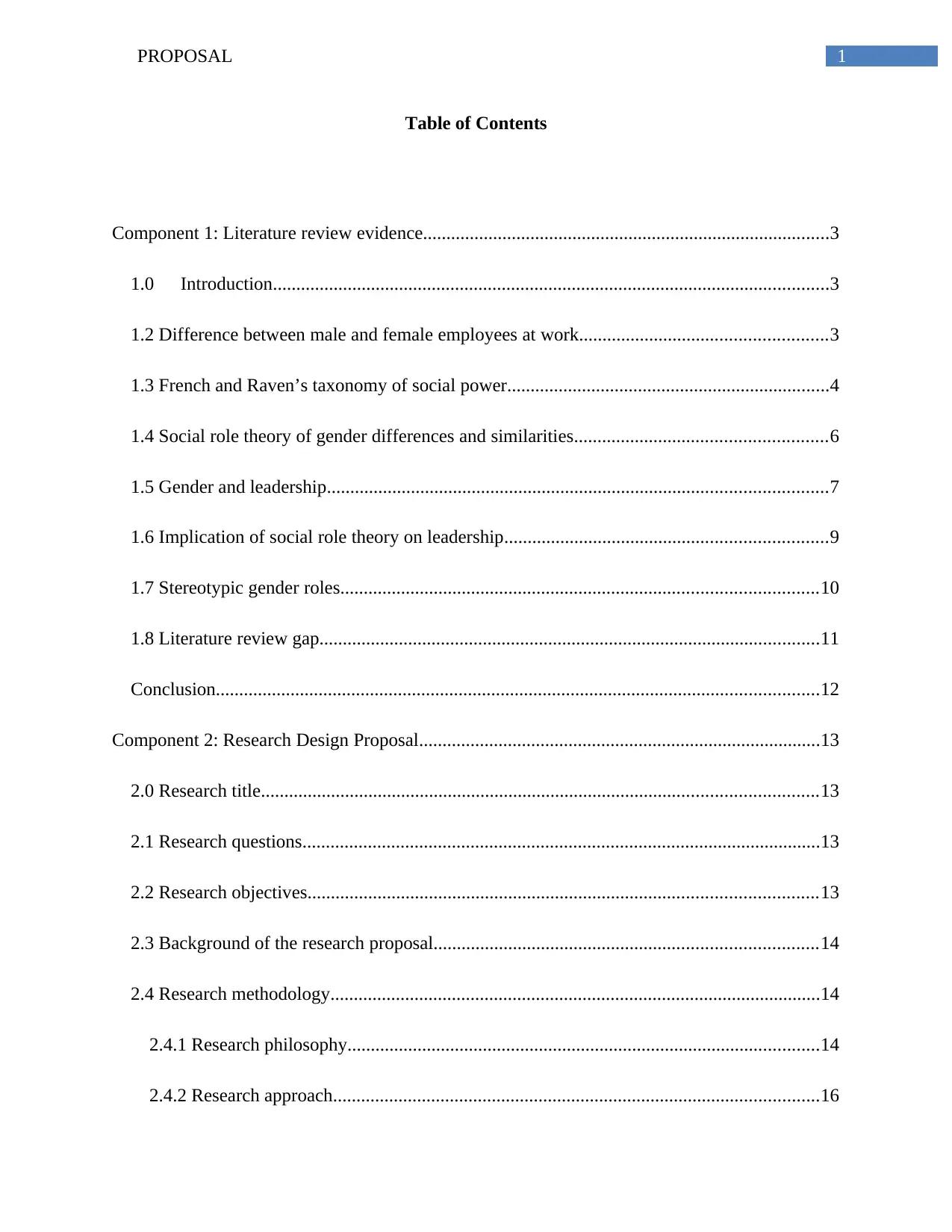
Table of Contents
Component 1: Literature review evidence.......................................................................................3
1.0 Introduction.......................................................................................................................3
1.2 Difference between male and female employees at work.....................................................3
1.3 French and Raven’s taxonomy of social power.....................................................................4
1.4 Social role theory of gender differences and similarities......................................................6
1.5 Gender and leadership...........................................................................................................7
1.6 Implication of social role theory on leadership.....................................................................9
1.7 Stereotypic gender roles......................................................................................................10
1.8 Literature review gap...........................................................................................................11
Conclusion.................................................................................................................................12
Component 2: Research Design Proposal......................................................................................13
2.0 Research title.......................................................................................................................13
2.1 Research questions...............................................................................................................13
2.2 Research objectives.............................................................................................................13
2.3 Background of the research proposal..................................................................................14
2.4 Research methodology.........................................................................................................14
2.4.1 Research philosophy.....................................................................................................14
2.4.2 Research approach........................................................................................................16
Table of Contents
Component 1: Literature review evidence.......................................................................................3
1.0 Introduction.......................................................................................................................3
1.2 Difference between male and female employees at work.....................................................3
1.3 French and Raven’s taxonomy of social power.....................................................................4
1.4 Social role theory of gender differences and similarities......................................................6
1.5 Gender and leadership...........................................................................................................7
1.6 Implication of social role theory on leadership.....................................................................9
1.7 Stereotypic gender roles......................................................................................................10
1.8 Literature review gap...........................................................................................................11
Conclusion.................................................................................................................................12
Component 2: Research Design Proposal......................................................................................13
2.0 Research title.......................................................................................................................13
2.1 Research questions...............................................................................................................13
2.2 Research objectives.............................................................................................................13
2.3 Background of the research proposal..................................................................................14
2.4 Research methodology.........................................................................................................14
2.4.1 Research philosophy.....................................................................................................14
2.4.2 Research approach........................................................................................................16
2PROPOSAL
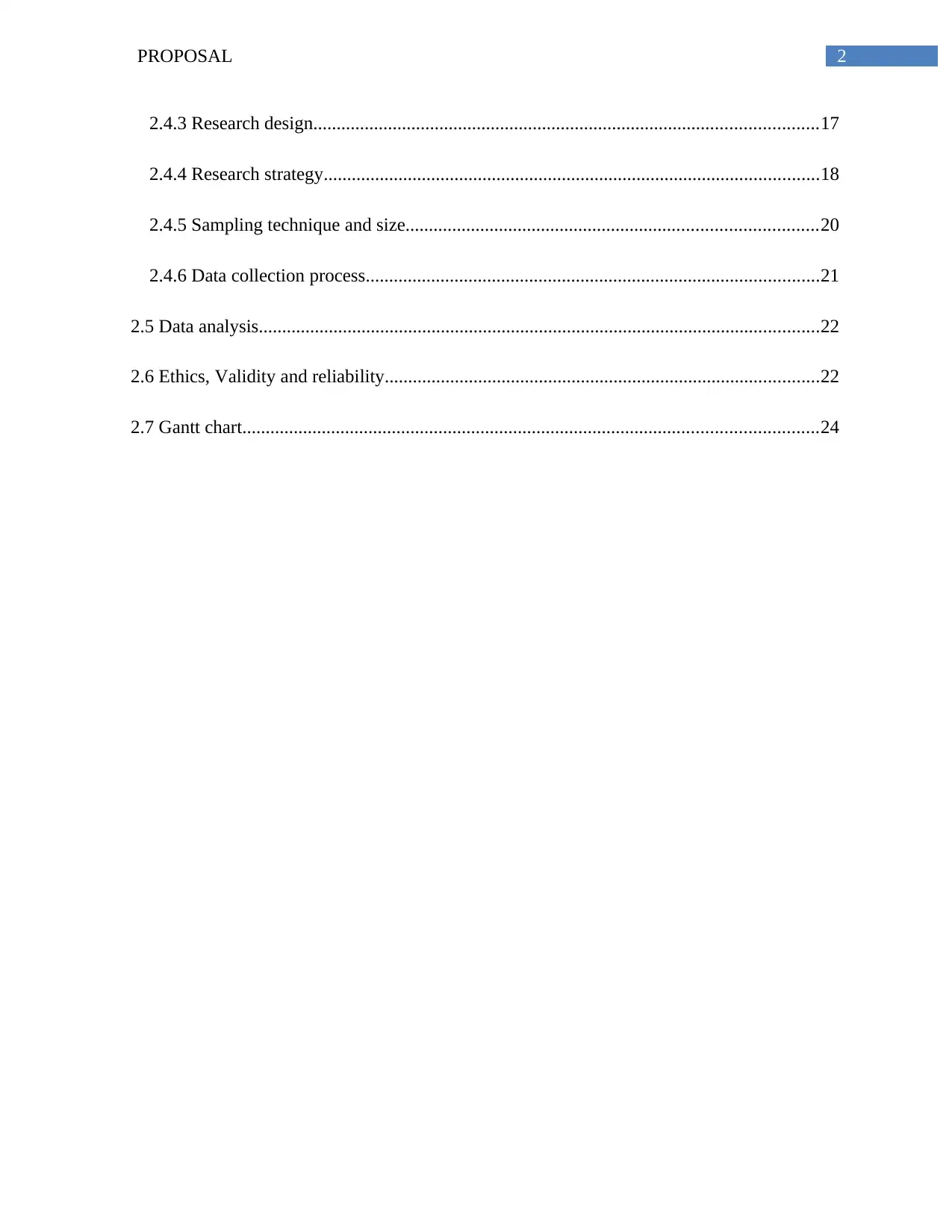
2.4.3 Research design............................................................................................................17
2.4.4 Research strategy..........................................................................................................18
2.4.5 Sampling technique and size........................................................................................20
2.4.6 Data collection process.................................................................................................21
2.5 Data analysis........................................................................................................................22
2.6 Ethics, Validity and reliability.............................................................................................22
2.7 Gantt chart...........................................................................................................................24
2.4.3 Research design............................................................................................................17
2.4.4 Research strategy..........................................................................................................18
2.4.5 Sampling technique and size........................................................................................20
2.4.6 Data collection process.................................................................................................21
2.5 Data analysis........................................................................................................................22
2.6 Ethics, Validity and reliability.............................................................................................22
2.7 Gantt chart...........................................................................................................................24
⊘ This is a preview!⊘
Do you want full access?
Subscribe today to unlock all pages.

Trusted by 1+ million students worldwide
3PROPOSAL
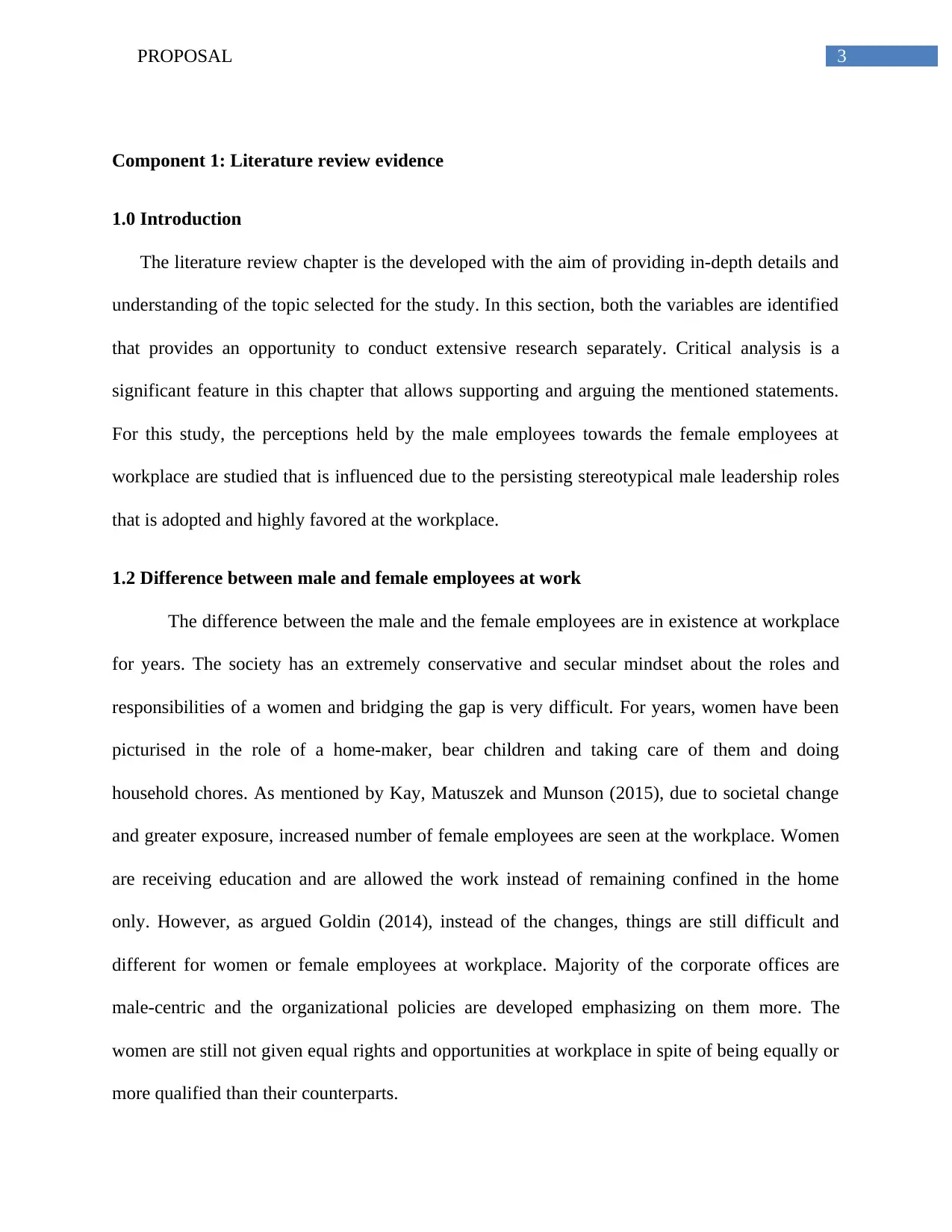
Component 1: Literature review evidence
1.0 Introduction
The literature review chapter is the developed with the aim of providing in-depth details and
understanding of the topic selected for the study. In this section, both the variables are identified
that provides an opportunity to conduct extensive research separately. Critical analysis is a
significant feature in this chapter that allows supporting and arguing the mentioned statements.
For this study, the perceptions held by the male employees towards the female employees at
workplace are studied that is influenced due to the persisting stereotypical male leadership roles
that is adopted and highly favored at the workplace.
1.2 Difference between male and female employees at work
The difference between the male and the female employees are in existence at workplace
for years. The society has an extremely conservative and secular mindset about the roles and
responsibilities of a women and bridging the gap is very difficult. For years, women have been
picturised in the role of a home-maker, bear children and taking care of them and doing
household chores. As mentioned by Kay, Matuszek and Munson (2015), due to societal change
and greater exposure, increased number of female employees are seen at the workplace. Women
are receiving education and are allowed the work instead of remaining confined in the home
only. However, as argued Goldin (2014), instead of the changes, things are still difficult and
different for women or female employees at workplace. Majority of the corporate offices are
male-centric and the organizational policies are developed emphasizing on them more. The
women are still not given equal rights and opportunities at workplace in spite of being equally or
more qualified than their counterparts.
Component 1: Literature review evidence
1.0 Introduction
The literature review chapter is the developed with the aim of providing in-depth details and
understanding of the topic selected for the study. In this section, both the variables are identified
that provides an opportunity to conduct extensive research separately. Critical analysis is a
significant feature in this chapter that allows supporting and arguing the mentioned statements.
For this study, the perceptions held by the male employees towards the female employees at
workplace are studied that is influenced due to the persisting stereotypical male leadership roles
that is adopted and highly favored at the workplace.
1.2 Difference between male and female employees at work
The difference between the male and the female employees are in existence at workplace
for years. The society has an extremely conservative and secular mindset about the roles and
responsibilities of a women and bridging the gap is very difficult. For years, women have been
picturised in the role of a home-maker, bear children and taking care of them and doing
household chores. As mentioned by Kay, Matuszek and Munson (2015), due to societal change
and greater exposure, increased number of female employees are seen at the workplace. Women
are receiving education and are allowed the work instead of remaining confined in the home
only. However, as argued Goldin (2014), instead of the changes, things are still difficult and
different for women or female employees at workplace. Majority of the corporate offices are
male-centric and the organizational policies are developed emphasizing on them more. The
women are still not given equal rights and opportunities at workplace in spite of being equally or
more qualified than their counterparts.
Paraphrase This Document
Need a fresh take? Get an instant paraphrase of this document with our AI Paraphraser
4PROPOSAL
Gender differences are highly prevalent at workplace. As mentioned by Caliskan, Bryson
and Narayanan (2017), increased pay difference is noticed between the male and the female
employees at workplace. This gender biasness makes it difficult for the women to mark their
place in the corporate world. For example, in spite of being more qualified and skillful than some
men at workplace, women are still paid much less. However, as argued by Koch, D’mello and
Sackett (2015), corporate organizations are changing and ensuring that the gap between the male
and the female employees are mitigated. It can be said that the distinctive approach of men and
women towards work is the primary reason of the existing gender gap at workplace. For
example, it has been seen that men prefers considering the hierarchical approach whereas women
tends to focus on relationships more in their work. As a result, women get more emotionally
involved that is said to divert them from achieving the organizational goals and objectives.
An estimated 49% of the global labor force are women whereas men comprises of 75%
thereby, highlighting the increased gender gap at workplace. As mentioned by Benson (2014),
women find a harder time in looking for a job than men, as they are considered to be less
efficient in the corporate world compared to men. However, a woman possesses the right to
freedom to work by dignity, safety, choice and fairness and is an intrinsic human welfare. Thus,
guaranteeing women to have an equal right to employment as men is important. Bridging the
gender gap at workplace is beneficial from an economic perspective, as this allows boosting the
global economy. Reports suggest that 70% women prefer to work in paid jobs along with taking
care of families (Munsch 2016).
1.3 French and Raven’s taxonomy of social power
Both French and Raven address five sources of power that provides an opportunity for an
individual to influence others. This theory explains power as the method used by the leaders for
Gender differences are highly prevalent at workplace. As mentioned by Caliskan, Bryson
and Narayanan (2017), increased pay difference is noticed between the male and the female
employees at workplace. This gender biasness makes it difficult for the women to mark their
place in the corporate world. For example, in spite of being more qualified and skillful than some
men at workplace, women are still paid much less. However, as argued by Koch, D’mello and
Sackett (2015), corporate organizations are changing and ensuring that the gap between the male
and the female employees are mitigated. It can be said that the distinctive approach of men and
women towards work is the primary reason of the existing gender gap at workplace. For
example, it has been seen that men prefers considering the hierarchical approach whereas women
tends to focus on relationships more in their work. As a result, women get more emotionally
involved that is said to divert them from achieving the organizational goals and objectives.
An estimated 49% of the global labor force are women whereas men comprises of 75%
thereby, highlighting the increased gender gap at workplace. As mentioned by Benson (2014),
women find a harder time in looking for a job than men, as they are considered to be less
efficient in the corporate world compared to men. However, a woman possesses the right to
freedom to work by dignity, safety, choice and fairness and is an intrinsic human welfare. Thus,
guaranteeing women to have an equal right to employment as men is important. Bridging the
gender gap at workplace is beneficial from an economic perspective, as this allows boosting the
global economy. Reports suggest that 70% women prefer to work in paid jobs along with taking
care of families (Munsch 2016).
1.3 French and Raven’s taxonomy of social power
Both French and Raven address five sources of power that provides an opportunity for an
individual to influence others. This theory explains power as the method used by the leaders for
5PROPOSAL
influencing the subordinates irrespective of the gender. According to Westaby, Pfaff and
Redding (2014), an individual with power is said to be a leader that has expertise in specific area
that can be used for influencing other people because other people are dependent on the power.
Thus, the power of the expert is not limited to the rank and title of the male and female
employees and approves the decisions and suggestions of the leaders having significant
knowledge and expertise in a field that is more than others. The current workplace is male
dominated and considers that the male employees are more powerful socially that makes them
capable of influencing and convincing others. However, as argued by Sindic and Condor (2014),
in order to be an influential leader, it is necessary that others trusts the influencer and believing
that the leader have fair knowledge about the knowledge that is being shared. The social norm
that men are more powerful when it comes to working outside has resulted in the setback for the
female employees and is a influence of male stereotypical roles at workplace.
According to the theory of taxonomy of social power, legitimate power is also a result of
distinctive perception male employees hold towards the female employees. According to Akers
(2017), the perception is a result of the power the individual holds in terms of the organizational
title and the organizational authority. For example, the Chief Executive Officer has more power
than the clerk in an organization. Thus, the CEO has more power to influence and make a stand
compared to the clerk. However, argued by Buss (2014), the legitimate power has different base
and cultural values that affect the process of influence. For example, if the Chief Executive
Officer of an organization is male, the leadership roles and the influence is supposedly male
centric. Understanding the female perspective under such circumstance is hardly noticed, as the
male representative sitting in an authorized position in the organization fails to consider the
counterpart. Among the other cultural values, gender, intelligence and age are characteristics that
influencing the subordinates irrespective of the gender. According to Westaby, Pfaff and
Redding (2014), an individual with power is said to be a leader that has expertise in specific area
that can be used for influencing other people because other people are dependent on the power.
Thus, the power of the expert is not limited to the rank and title of the male and female
employees and approves the decisions and suggestions of the leaders having significant
knowledge and expertise in a field that is more than others. The current workplace is male
dominated and considers that the male employees are more powerful socially that makes them
capable of influencing and convincing others. However, as argued by Sindic and Condor (2014),
in order to be an influential leader, it is necessary that others trusts the influencer and believing
that the leader have fair knowledge about the knowledge that is being shared. The social norm
that men are more powerful when it comes to working outside has resulted in the setback for the
female employees and is a influence of male stereotypical roles at workplace.
According to the theory of taxonomy of social power, legitimate power is also a result of
distinctive perception male employees hold towards the female employees. According to Akers
(2017), the perception is a result of the power the individual holds in terms of the organizational
title and the organizational authority. For example, the Chief Executive Officer has more power
than the clerk in an organization. Thus, the CEO has more power to influence and make a stand
compared to the clerk. However, argued by Buss (2014), the legitimate power has different base
and cultural values that affect the process of influence. For example, if the Chief Executive
Officer of an organization is male, the leadership roles and the influence is supposedly male
centric. Understanding the female perspective under such circumstance is hardly noticed, as the
male representative sitting in an authorized position in the organization fails to consider the
counterpart. Among the other cultural values, gender, intelligence and age are characteristics that
⊘ This is a preview!⊘
Do you want full access?
Subscribe today to unlock all pages.
Trusted by 1+ million students worldwide
6PROPOSAL
affect the perception held by the male employees about the female employees. Accepting the
social structure also influences the perceptions held by the male employees about the female
employees but in this case the question arises whether the person accepts or rejects the social
culture of male are more efficient in the corporate world compared to women.
1.4 Social role theory of gender differences and similarities
This theory aim towards explaining gender as a social construct and the existing female
and male stereotypes tend to explain how gender works through socialization followed by
answering what has led to the existing gender stereotypes. Thus, the social theory of sex
differences and similarities makes an effort to understand the root from where male and female
stereotypical images have originated. The origin is tracked by exploring the interaction between
the social roles and gender roles. For example, some of the social roles are limited to one gender
only, such as the female chief executive officers are less compared to the male chief executive
officers. The persisting gap between the male and the female individuals and increased
influenced of male dominated society for prolonged period has resulted in male stereotypical
leadership roles at workplace. This social theory was developed 1980 for understanding the
existing difference between the male and the female employees (Chemers 2014).
According to Abrams and Killen (2014), stereotypes are defined as the inappropriate
portrayal of groups in terms of power and authority. The theory takes into consideration the
social psychology that humans have the tendency to confirm to the expectations and behave
accordingly. Thus, when the society expects something different in terms of the behavior of men
and women, the existing beliefs highlights the actual differences in the social behavior through
the process of socialization. However, as criticized by Winlow and Hall (2015), the expectations
expressed through the gender-appropriate behavior highlights that men and women have
affect the perception held by the male employees about the female employees. Accepting the
social structure also influences the perceptions held by the male employees about the female
employees but in this case the question arises whether the person accepts or rejects the social
culture of male are more efficient in the corporate world compared to women.
1.4 Social role theory of gender differences and similarities
This theory aim towards explaining gender as a social construct and the existing female
and male stereotypes tend to explain how gender works through socialization followed by
answering what has led to the existing gender stereotypes. Thus, the social theory of sex
differences and similarities makes an effort to understand the root from where male and female
stereotypical images have originated. The origin is tracked by exploring the interaction between
the social roles and gender roles. For example, some of the social roles are limited to one gender
only, such as the female chief executive officers are less compared to the male chief executive
officers. The persisting gap between the male and the female individuals and increased
influenced of male dominated society for prolonged period has resulted in male stereotypical
leadership roles at workplace. This social theory was developed 1980 for understanding the
existing difference between the male and the female employees (Chemers 2014).
According to Abrams and Killen (2014), stereotypes are defined as the inappropriate
portrayal of groups in terms of power and authority. The theory takes into consideration the
social psychology that humans have the tendency to confirm to the expectations and behave
accordingly. Thus, when the society expects something different in terms of the behavior of men
and women, the existing beliefs highlights the actual differences in the social behavior through
the process of socialization. However, as criticized by Winlow and Hall (2015), the expectations
expressed through the gender-appropriate behavior highlights that men and women have
Paraphrase This Document
Need a fresh take? Get an instant paraphrase of this document with our AI Paraphraser
7PROPOSAL
distinctive social roles and status in the society. In spite of the societal and technological
advancements, the society is still unable to forget the age old picture and social role for the
women. It is still hard to believe for the society that the women are not efficient enough to suit
themselves in the corporate world and are capable to performing better than the male
counterparts. The theory focuses on the historical sexual division of gender and labor hierarchy
as the principle reason of why the two genders have different social levels, status and roles to
fulfill (Haslam et al. 2014). It can be said that observing male performing male typical roles such
as providers and the females performing female specific roles such as home makers for
prolonged period has resulted in the distinctive beliefs about sexes in the society. Therefore, it
can be inferred that the evaluating the impact of social structural factors can explain the reasons
wy gender differs and stereotypical thought exists.
1.5 Gender and leadership
Increased competition has been noticed in the business environment that has resulted in
the necessity of gaining competitive advantage for surviving the tough and fierce market. As a
result, it is important for the business organizations to capitalize on the strengths of all the
members within the organization for remaining highly competitive. According to Ho et al.
(2015), the leaders of the business organizations must ensure that the strengths of all the
employees are used equally for organizational benefit. It has been seen that the business
organizations headed by a female leader has manifested better organizational values. As opined
by Paustian-Underdahl, Walker and Woehr (2014), having representatives from both the genders
of the business at the top management of the business organizations helps in ensuring a balanced
ratio thereby, improving the value of the organization.
distinctive social roles and status in the society. In spite of the societal and technological
advancements, the society is still unable to forget the age old picture and social role for the
women. It is still hard to believe for the society that the women are not efficient enough to suit
themselves in the corporate world and are capable to performing better than the male
counterparts. The theory focuses on the historical sexual division of gender and labor hierarchy
as the principle reason of why the two genders have different social levels, status and roles to
fulfill (Haslam et al. 2014). It can be said that observing male performing male typical roles such
as providers and the females performing female specific roles such as home makers for
prolonged period has resulted in the distinctive beliefs about sexes in the society. Therefore, it
can be inferred that the evaluating the impact of social structural factors can explain the reasons
wy gender differs and stereotypical thought exists.
1.5 Gender and leadership
Increased competition has been noticed in the business environment that has resulted in
the necessity of gaining competitive advantage for surviving the tough and fierce market. As a
result, it is important for the business organizations to capitalize on the strengths of all the
members within the organization for remaining highly competitive. According to Ho et al.
(2015), the leaders of the business organizations must ensure that the strengths of all the
employees are used equally for organizational benefit. It has been seen that the business
organizations headed by a female leader has manifested better organizational values. As opined
by Paustian-Underdahl, Walker and Woehr (2014), having representatives from both the genders
of the business at the top management of the business organizations helps in ensuring a balanced
ratio thereby, improving the value of the organization.
8PROPOSAL
However, as argued by Girod et al. (2016), the aforementioned relationship needs to be
implemented cautiously, as presence of representatives of both genders does not certain
improved organizational value. An estimated 49% of the global labor force are women whereas
men comprises of 75% thereby, highlighting the increased gender gap at workplace. Countries
need to practice and support gender equality at workplace, as this helps in boosting the economy
of the country. For example, 47% of the women in Norway are employed out of which 36%
work as a leader ad 20% as top leaders thereby, signifying that Norway is a country facilitating
gender equality at workplace. However, some division of the leadership position still highlights
gender inequality.
According to Bolman and Deal (2017), it has been seen that the male and the female
employees do not have equal opportunities when it comes to their contribution towards
leadership roles. It can be seen that the female leaders can fall as victims of the existing
incongruity between the male and the female leadership roles. As a result, the females at the
workplace are perceived less positively when it comes to assigning leadership roles and
positions. As a result, analyzing the leadership behavior is less preferred when a female is a
leader. The prejudice and discrimination that forces a women to reach professional height and
leadership positions are often described as the idea of “glass ceiling.” However, as argued by
Dunn, Gerlach and Hyle (2014), it is the culture and time that has generated multiple roles
related to gender, family and work that has created the gap between the male and the female
workers. Irrespective of the leadership behavior both the male and the female leaders seem to be
less stereotypical.
However, as argued by Girod et al. (2016), the aforementioned relationship needs to be
implemented cautiously, as presence of representatives of both genders does not certain
improved organizational value. An estimated 49% of the global labor force are women whereas
men comprises of 75% thereby, highlighting the increased gender gap at workplace. Countries
need to practice and support gender equality at workplace, as this helps in boosting the economy
of the country. For example, 47% of the women in Norway are employed out of which 36%
work as a leader ad 20% as top leaders thereby, signifying that Norway is a country facilitating
gender equality at workplace. However, some division of the leadership position still highlights
gender inequality.
According to Bolman and Deal (2017), it has been seen that the male and the female
employees do not have equal opportunities when it comes to their contribution towards
leadership roles. It can be seen that the female leaders can fall as victims of the existing
incongruity between the male and the female leadership roles. As a result, the females at the
workplace are perceived less positively when it comes to assigning leadership roles and
positions. As a result, analyzing the leadership behavior is less preferred when a female is a
leader. The prejudice and discrimination that forces a women to reach professional height and
leadership positions are often described as the idea of “glass ceiling.” However, as argued by
Dunn, Gerlach and Hyle (2014), it is the culture and time that has generated multiple roles
related to gender, family and work that has created the gap between the male and the female
workers. Irrespective of the leadership behavior both the male and the female leaders seem to be
less stereotypical.
⊘ This is a preview!⊘
Do you want full access?
Subscribe today to unlock all pages.
Trusted by 1+ million students worldwide
9PROPOSAL
1.6 Implication of social role theory on leadership
According to the social theory on leadership mentioned in the previous section, it can be
said that the social theory infers that less number of women are present in the senior
management. As mentioned by Ferreira and Gyourko (2014), violating the stereotypical
expectation are often considered to be unfavorable because the individuals are casual to select
the occupation that fail to conform to the agentic and communal roles. This finding thereby,
explains the gender gap or separation of the labor market in the corporate world. As a result, a
woman with adequate qualities of being a manager such as confidence and competence are not
accepted or considered in a male dominated workplace. However, a woman is allowed to
perform well and excel in a female dominated occupation, such as nursing because the
occupation is associated with females and in this case a female is allowed to perform better than
male counterparts (Schuh et al. 2014). Therefore, the idea of female self-concept provides an
opportunity for women to highlights more subordinate roles and behaviors for confirming their
perceived hierarchical gender-status. As a result, potential limitations are arises for females in
the workplace.
As mentioned by Newman (2014), the females are still considered unfit and not as
efficient as males in the workplace due to the stereotypical thought process that still exist. It is
seen that women have to manage both house and work simultaneously. This ignites the thought
that women may not be able to give their best, due to their divided concentration for managing
both the lives. The roles and responsibilities of a woman in a society has influenced and
strengthened the stereotypical thought and gender biasness in the work culture.
However, as opined by Hall (2014), the fact that women are physically less fit than men
also flourishes the stereotypical thought existing in the corporate culture. It is seen that men are
1.6 Implication of social role theory on leadership
According to the social theory on leadership mentioned in the previous section, it can be
said that the social theory infers that less number of women are present in the senior
management. As mentioned by Ferreira and Gyourko (2014), violating the stereotypical
expectation are often considered to be unfavorable because the individuals are casual to select
the occupation that fail to conform to the agentic and communal roles. This finding thereby,
explains the gender gap or separation of the labor market in the corporate world. As a result, a
woman with adequate qualities of being a manager such as confidence and competence are not
accepted or considered in a male dominated workplace. However, a woman is allowed to
perform well and excel in a female dominated occupation, such as nursing because the
occupation is associated with females and in this case a female is allowed to perform better than
male counterparts (Schuh et al. 2014). Therefore, the idea of female self-concept provides an
opportunity for women to highlights more subordinate roles and behaviors for confirming their
perceived hierarchical gender-status. As a result, potential limitations are arises for females in
the workplace.
As mentioned by Newman (2014), the females are still considered unfit and not as
efficient as males in the workplace due to the stereotypical thought process that still exist. It is
seen that women have to manage both house and work simultaneously. This ignites the thought
that women may not be able to give their best, due to their divided concentration for managing
both the lives. The roles and responsibilities of a woman in a society has influenced and
strengthened the stereotypical thought and gender biasness in the work culture.
However, as opined by Hall (2014), the fact that women are physically less fit than men
also flourishes the stereotypical thought existing in the corporate culture. It is seen that men are
Paraphrase This Document
Need a fresh take? Get an instant paraphrase of this document with our AI Paraphraser
10PROPOSAL
physically fit due to which they are considered suitable in the corporate world, as physical fitness
is linked with work efficiency, better determination and increased ability to handle pressure
thereby, achieving organizational success. As women are less fit physically then men, it is linked
with the stereotypical perception that men hold against women being unfit for the corporate
place. However, as argued by Reuben, Wiswall and Zafar (2017), women are not lagging behind
compared to men in any circumstances, even physically. Women are giving their mind and soul
to their roles and responsibilities and are getting highly successfully at workplace compared to
men.
1.7 Stereotypic gender roles
Two distinctive gender roles have emerged based on their socially identified sexual
orientation. The society has stereotypical gender roles for men and women due to the age old
though process that is still continuing. The stereotypical gender roles are encountered in
occupational as well as family settings. As mentioned by Doka and Martin (2014), the
dominating behavior of a women is a result of the societal requirement that has led to the
stereotypical female perceptions. As a result, when the women highlight domestic and communal
behaviors for fulfilling their social roles satisfactorily, it is considered under female job roles.
Similar concept is applicable for men, fulfilling specific roles for prolonged period in the society
has resulted in development of stereotypical gender roles in the society. The above-mentioned
social role theory criticizes that existing stereotypical gender roles control the behavior in two
distinctive ways. The expectation forming the gender roles describes how men and women
should ideally behave and the behavior of the men and women simultaneously. The idea is
derived by referring to descriptive and injuctive norms signifying that expectation is derived
from observations indicating what are done and what should be done (Lindsey 2015). The
physically fit due to which they are considered suitable in the corporate world, as physical fitness
is linked with work efficiency, better determination and increased ability to handle pressure
thereby, achieving organizational success. As women are less fit physically then men, it is linked
with the stereotypical perception that men hold against women being unfit for the corporate
place. However, as argued by Reuben, Wiswall and Zafar (2017), women are not lagging behind
compared to men in any circumstances, even physically. Women are giving their mind and soul
to their roles and responsibilities and are getting highly successfully at workplace compared to
men.
1.7 Stereotypic gender roles
Two distinctive gender roles have emerged based on their socially identified sexual
orientation. The society has stereotypical gender roles for men and women due to the age old
though process that is still continuing. The stereotypical gender roles are encountered in
occupational as well as family settings. As mentioned by Doka and Martin (2014), the
dominating behavior of a women is a result of the societal requirement that has led to the
stereotypical female perceptions. As a result, when the women highlight domestic and communal
behaviors for fulfilling their social roles satisfactorily, it is considered under female job roles.
Similar concept is applicable for men, fulfilling specific roles for prolonged period in the society
has resulted in development of stereotypical gender roles in the society. The above-mentioned
social role theory criticizes that existing stereotypical gender roles control the behavior in two
distinctive ways. The expectation forming the gender roles describes how men and women
should ideally behave and the behavior of the men and women simultaneously. The idea is
derived by referring to descriptive and injuctive norms signifying that expectation is derived
from observations indicating what are done and what should be done (Lindsey 2015). The
11PROPOSAL
influence on others is an important part in understanding the power of descriptive norms. For
example, if a woman sees another woman behave in a particular way in a situation, she is likely
to behave in the same way. In this case, the behavior of a man and a woman in a particular
situation situation is different due to difference in perspectives and societal roles.
Over the years, the corporate culture and environment has seen many changes in terms of
men and women. Previously, working women in the society was a taboo and that women were
only considered as individuals suitable for staying at home and doing household chores. It took
fair amount of time for breaking the social taboo and for women to come out and make a place in
the corporate world. According to Croft et al. (2014), with the changes over the year, women has
made a place in the corporate world. Women has been successful in showing their efficiency and
capability at workplace and has gained more popularity and success compared to men. However,
as argued by Haines, Deaux and Lofaro (2016), instead of proving the ability in the corporate
world, the image of maintaining house and being there still exists. It is due to the existence of
these stereotypical thoughts women are not given equal opportunities as men in the workplace in
terms of organizational position, designation, roles and responsibilities. Additionally, the male
dominated work culture also restricts the opportunity for women to flourish, as they are not give
equal opportunities as men are given.
1.8 Literature review gap
Theories used in this chapter for understanding the stereotypical male leadership roles
hold certain limitations. Under all situations, the behaviors of the entire male and the female
employees are not controlled by stereotypes. It has been seen that the managers applying the
stereotypical image during the recruitment process have the ability to accommodate their
stereotypical images. As a result, the managers are unlikely to perceive men as more competent
influence on others is an important part in understanding the power of descriptive norms. For
example, if a woman sees another woman behave in a particular way in a situation, she is likely
to behave in the same way. In this case, the behavior of a man and a woman in a particular
situation situation is different due to difference in perspectives and societal roles.
Over the years, the corporate culture and environment has seen many changes in terms of
men and women. Previously, working women in the society was a taboo and that women were
only considered as individuals suitable for staying at home and doing household chores. It took
fair amount of time for breaking the social taboo and for women to come out and make a place in
the corporate world. According to Croft et al. (2014), with the changes over the year, women has
made a place in the corporate world. Women has been successful in showing their efficiency and
capability at workplace and has gained more popularity and success compared to men. However,
as argued by Haines, Deaux and Lofaro (2016), instead of proving the ability in the corporate
world, the image of maintaining house and being there still exists. It is due to the existence of
these stereotypical thoughts women are not given equal opportunities as men in the workplace in
terms of organizational position, designation, roles and responsibilities. Additionally, the male
dominated work culture also restricts the opportunity for women to flourish, as they are not give
equal opportunities as men are given.
1.8 Literature review gap
Theories used in this chapter for understanding the stereotypical male leadership roles
hold certain limitations. Under all situations, the behaviors of the entire male and the female
employees are not controlled by stereotypes. It has been seen that the managers applying the
stereotypical image during the recruitment process have the ability to accommodate their
stereotypical images. As a result, the managers are unlikely to perceive men as more competent
⊘ This is a preview!⊘
Do you want full access?
Subscribe today to unlock all pages.
Trusted by 1+ million students worldwide

1 out of 35


Related Documents


Your All-in-One AI-Powered Toolkit for Academic Success.
+13062052269
info@desklib.com
Available 24*7 on WhatsApp / Email
![[object Object]](/_next/static/media/star-bottom.7253800d.svg)
Unlock your academic potential
Copyright © 2020–2026 A2Z Services. All Rights Reserved. Developed and managed by ZUCOL.