Candidate Genes Expression for Herbicide Resistance in Erigeron

Verified

Added on  2023/06/04

|2
|570
|448
Report
AI Summary
This report investigates the genetic mechanisms behind glyphosate resistance in Erigeron bonariensis (hairy fleabane), an agricultural weed prevalent in California's Central Valley. The study focuses on candidate genes, including EPSPS, ABC M10, and ABC M11, previously implicated in glyphosate resistance in a related species, E. canadensis. Through quantitative PCR (qPCR) analysis of leaf samples collected from glyphosate-treated and untreated plants across various wild populations, the research aims to determine if these genes are involved in the glyphosate resistance response in E. bonariensis, and whether there is variation in gene expression among different populations. Preliminary results suggest the involvement of glycophosate in inhibiting the synthesis of aromatic amino acids along with sulfonylurea, blocking the biosynthesis of branched amino acids, and phosphinothricin inhibiting glutamine biosynthesis. Future RNA-Seq analysis is planned to identify other potentially differentially regulated genes. Ultimately, this research seeks to provide fundamental data about the genetic basis of herbicide resistance, which could inform alternative weed control strategies.
Document Page
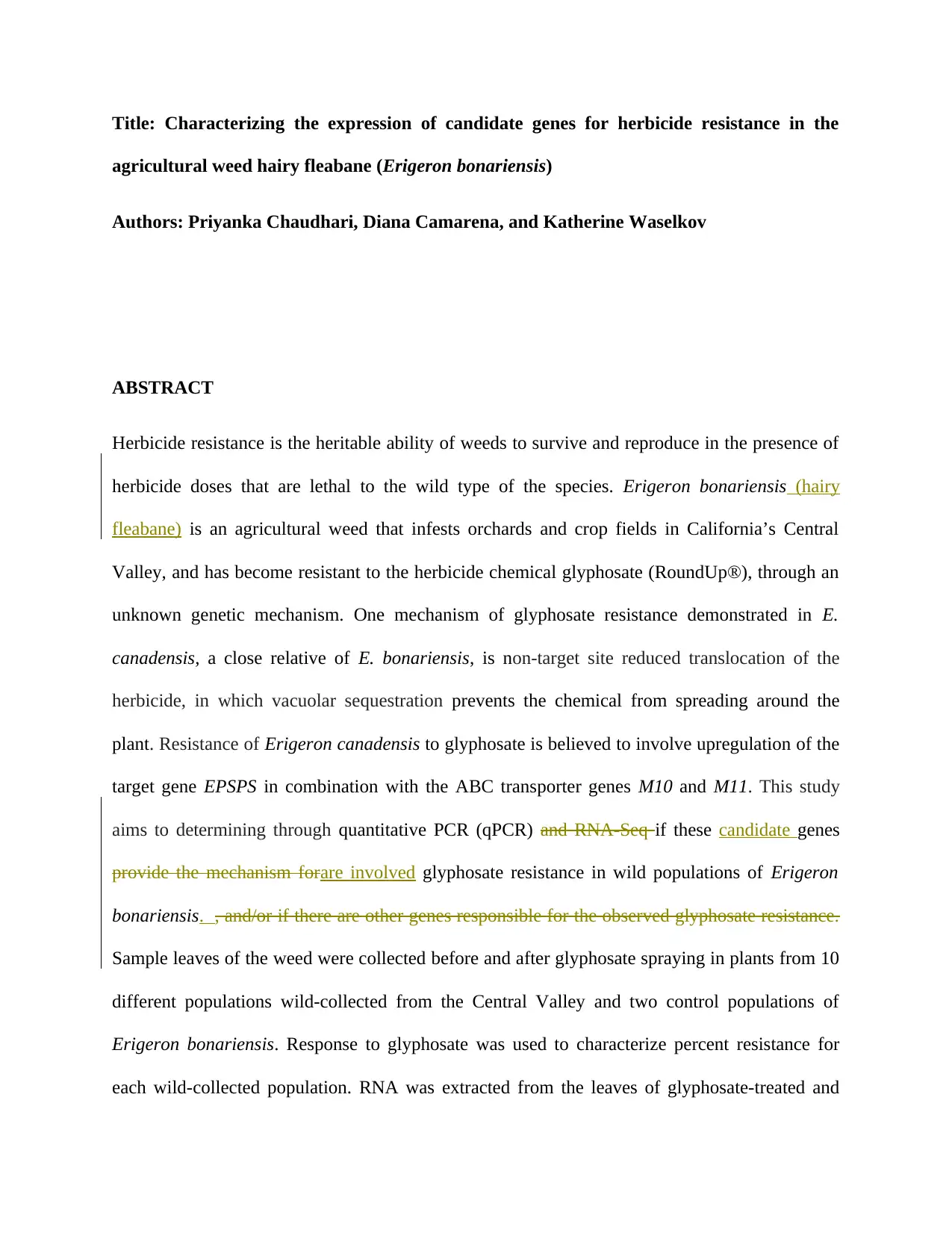
Title: Characterizing the expression of candidate genes for herbicide resistance in the
agricultural weed hairy fleabane (Erigeron bonariensis)
Authors: Priyanka Chaudhari, Diana Camarena, and Katherine Waselkov
ABSTRACT
Herbicide resistance is the heritable ability of weeds to survive and reproduce in the presence of
herbicide doses that are lethal to the wild type of the species. Erigeron bonariensis (hairy
fleabane) is an agricultural weed that infests orchards and crop fields in California’s Central
Valley, and has become resistant to the herbicide chemical glyphosate (RoundUp®), through an
unknown genetic mechanism. One mechanism of glyphosate resistance demonstrated in E.
canadensis, a close relative of E. bonariensis, is non-target site reduced translocation of the
herbicide, in which vacuolar sequestration prevents the chemical from spreading around the
plant. Resistance of Erigeron canadensis to glyphosate is believed to involve upregulation of the
target gene EPSPS in combination with the ABC transporter genes M10 and M11. This study
aims to determining through quantitative PCR (qPCR) and RNA-Seq if these candidate genes
provide the mechanism forare involved glyphosate resistance in wild populations of Erigeron
bonariensis. , and/or if there are other genes responsible for the observed glyphosate resistance.
Sample leaves of the weed were collected before and after glyphosate spraying in plants from 10
different populations wild-collected from the Central Valley and two control populations of
Erigeron bonariensis. Response to glyphosate was used to characterize percent resistance for
each wild-collected population. RNA was extracted from the leaves of glyphosate-treated and
tabler-icon-diamond-filled.svg

Paraphrase This Document

Need a fresh take? Get an instant paraphrase of this document with our AI Paraphraser
Document Page
untreated individuals, and used for cDNA synthesis. Quantitative PCR primers were designed for
the E. bonariensis orthologues of the E. canadensis genes EPSPS, ABC M10, and ABC M11,
and pre- and post-spraying expression levels of each gene (relative to the housekeeping gene
actin) are currently being analyzed through qPCR. So far, results based on complete data
collection from populations 1, 2, 9, and 5 suggest… Preliminary results of the studies show that
glycophosate which is responsible for inhibiting the synthesis of the aromatic amino acids along
with sulfonylurea. This is responsible for blocking the biosynthesis of branched amino acids
along with phosphinothricin which is responsible for inhibiting glutamine biosynthesis. When
treating with M10, the average NT for control was seen to be 1.578, with M11 it was 1.11 and
with EPSPS it was 1.31. For the test sample with 1 X concentration, with target gene M10 it is
2.11, with M11 it is 1.71 and with EPSPS it is 1.355. For 2 X concentration the values involve
with M10 3.23, with M11 it is 2.85 and with EPSPS it is 1.94. This experiment will establish
whether the same candidate genes are involved in the glyphosate resistance response in E.
bonariensis compared to its relative, and whether there is variation in candidate gene expression
among E. bonariensis populations. Future RNA-Seq analysis via Illumina HiSeq may reveal
other genes that are differentially up- or down-regulated in resistant populations of E.
bonariensis after glyphosate exposure. Determination of the genetic basis of herbicide resistance
will provide fundamental data about parallel evolution in response to strong selection pressures,
and help suggest alternative mechanisms for field control of this weed.
chevron_up_icon
1 out of 2
circle_padding
hide_on_mobile
zoom_out_icon
[object Object]