MGT704 Global Business: General Dynamics Cross-border Strategy Report
VerifiedAdded on 2023/06/03
|11
|4211
|436
Report
AI Summary
This report provides a comprehensive analysis of General Dynamics Corporation's cross-border strategy, focusing on its approach to global business management. It begins with an overview of the company, its structure, and its key business segments, followed by an identification and evaluation of the strategies adopted for international growth, particularly in emerging markets. The report examines the company's strategic alliances, highlighting partnerships and their benefits. It also assesses General Dynamics' resources and capabilities, including its values, mission, and ethical considerations. The analysis delves into problem identification, including industry-based, resource-based, and institution-based considerations, as well as a stakeholder view of the firm. The report concludes with a summary of findings and recommendations for the company's cross-border strategy. The analysis uses relevant frameworks to provide a deep understanding of the key issues, interrelationships, and implications of General Dynamics' global expansion efforts.
0
Running Head: MGT704
Global Business Management
Student Name:
Student ID:
Subject:
Running Head: MGT704
Global Business Management
Student Name:
Student ID:
Subject:

Paraphrase This Document
Need a fresh take? Get an instant paraphrase of this document with our AI Paraphraser
1
Cross-border strategy report
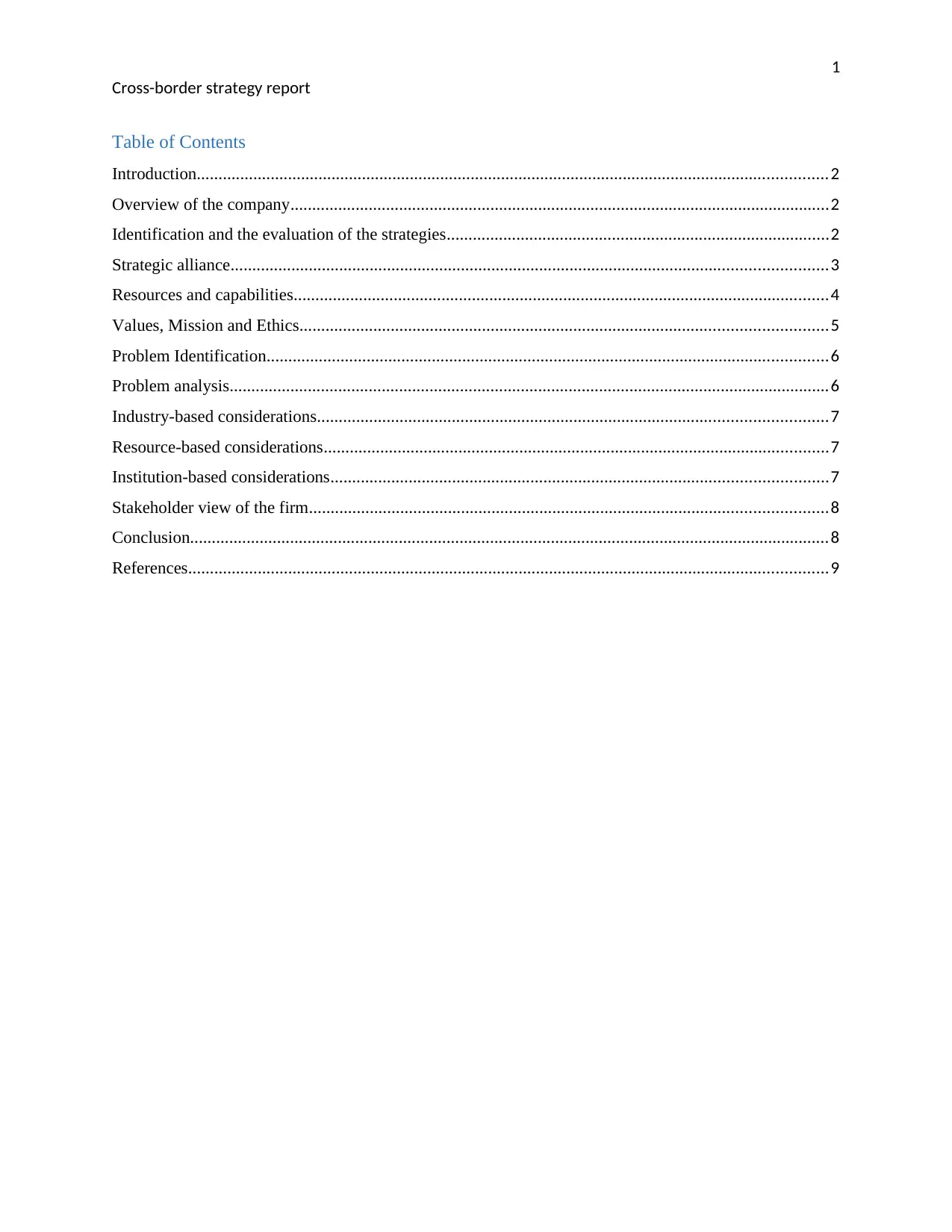
Table of Contents
Introduction.................................................................................................................................................2
Overview of the company............................................................................................................................2
Identification and the evaluation of the strategies........................................................................................2
Strategic alliance.........................................................................................................................................3
Resources and capabilities...........................................................................................................................4
Values, Mission and Ethics.........................................................................................................................5
Problem Identification.................................................................................................................................6
Problem analysis..........................................................................................................................................6
Industry-based considerations.....................................................................................................................7
Resource-based considerations....................................................................................................................7
Institution-based considerations..................................................................................................................7
Stakeholder view of the firm.......................................................................................................................8
Conclusion...................................................................................................................................................8
References...................................................................................................................................................9
Cross-border strategy report
Table of Contents
Introduction.................................................................................................................................................2
Overview of the company............................................................................................................................2
Identification and the evaluation of the strategies........................................................................................2
Strategic alliance.........................................................................................................................................3
Resources and capabilities...........................................................................................................................4
Values, Mission and Ethics.........................................................................................................................5
Problem Identification.................................................................................................................................6
Problem analysis..........................................................................................................................................6
Industry-based considerations.....................................................................................................................7
Resource-based considerations....................................................................................................................7
Institution-based considerations..................................................................................................................7
Stakeholder view of the firm.......................................................................................................................8
Conclusion...................................................................................................................................................8
References...................................................................................................................................................9
2
Cross-border strategy report
Introduction
The paper will introduce the overview of the company along with its identification and
evaluation of different strategies that are adopted by the companies to gain profit. The adoption
of the strategies will help the firm to work adequately. It provides a view of the strategic alliance
partners of the company that will prove to be beneficial for the organization. It presents the
values, vision, mission, and ethics of the company to satisfy the needs of the customers by
developing new technologies within the firm. It also provides with the organizational resources
and capabilities that are generated for providing convenience to the customers. It focuses upon
the view of the stakeholders for the company.
Overview of the company
General Dynamics Corporation (GD), is an American corporation that is founded on February 7,
1899. It is the defense multinational corporation and aerospace that is formed by the divestitures
and mergers (Iftikhar, Musa, Alam, Su'ud & Ali, 2018, May). As per the revenue of 2012, it is
considered to be the world's fifth-largest defense contractor. The company has its headquarters in
West Falls Church, in Fairfax Country, Virginia. The company comprises four major segments
of business they are aerospace, information systems technology, combat systems, and marine
systems. In 2017 the total revenue of the company is estimated at US$30.973 billion and the net
income by US$2.912 billion. The total number of employees that are employed by the company
to date is around 98,600 (Beske, Land & Seuring, 2014). The products that are manufactured by
the company are IT systems, control and communications and command, watercraft, munitions,
weapon systems, fighter jets, combat vehicles, and business jets.
Identification and the evaluation of the strategies
General Dynamics Corporations (GD), has adopted the federal IT strategy for the significant
growth opportunity of the firm. Low single digit growth can be obtained from the IT services
that optimize funding stability. The IT services business of around $4.4 billion of the 60% to
70% of the Falls Church-based company focuses upon the intelligence customers and defense
department (Bloom, Floetotto, Jaimovich, Saporta‐Eksten & Terry, 2018). GD finds a growth
opportunity about the emerging economies with the big organizations that manufacture business
jets, tanks and submarines. Since the year 2013, from the IT services GD has faced the fall in the
Cross-border strategy report
Introduction
The paper will introduce the overview of the company along with its identification and
evaluation of different strategies that are adopted by the companies to gain profit. The adoption
of the strategies will help the firm to work adequately. It provides a view of the strategic alliance
partners of the company that will prove to be beneficial for the organization. It presents the
values, vision, mission, and ethics of the company to satisfy the needs of the customers by
developing new technologies within the firm. It also provides with the organizational resources
and capabilities that are generated for providing convenience to the customers. It focuses upon
the view of the stakeholders for the company.
Overview of the company
General Dynamics Corporation (GD), is an American corporation that is founded on February 7,
1899. It is the defense multinational corporation and aerospace that is formed by the divestitures
and mergers (Iftikhar, Musa, Alam, Su'ud & Ali, 2018, May). As per the revenue of 2012, it is
considered to be the world's fifth-largest defense contractor. The company has its headquarters in
West Falls Church, in Fairfax Country, Virginia. The company comprises four major segments
of business they are aerospace, information systems technology, combat systems, and marine
systems. In 2017 the total revenue of the company is estimated at US$30.973 billion and the net
income by US$2.912 billion. The total number of employees that are employed by the company
to date is around 98,600 (Beske, Land & Seuring, 2014). The products that are manufactured by
the company are IT systems, control and communications and command, watercraft, munitions,
weapon systems, fighter jets, combat vehicles, and business jets.
Identification and the evaluation of the strategies
General Dynamics Corporations (GD), has adopted the federal IT strategy for the significant
growth opportunity of the firm. Low single digit growth can be obtained from the IT services
that optimize funding stability. The IT services business of around $4.4 billion of the 60% to
70% of the Falls Church-based company focuses upon the intelligence customers and defense
department (Bloom, Floetotto, Jaimovich, Saporta‐Eksten & Terry, 2018). GD finds a growth
opportunity about the emerging economies with the big organizations that manufacture business
jets, tanks and submarines. Since the year 2013, from the IT services GD has faced the fall in the
⊘ This is a preview!⊘
Do you want full access?
Subscribe today to unlock all pages.

Trusted by 1+ million students worldwide
3
Cross-border strategy report
revenue from $4.7 billion to the figure of last year by $4.4 billion. GD comprises of different
major business levels such as functional-level strategy, corporate-level strategy, and business-
level strategy. The functional-level strategy states that how the firm manages its business-level
strategy (Coşar, Guner & Tybout, 2016). The business-level strategy describes the way how the
organization competes. The decisions that are taken in this level showcases the amount that is
spent on different activities such as development, advertising, and product research.
The compensation plan has been executed by General Dynamics that presents the lack of
understanding of the stock price, market forces and relationship between the long-lasting
business strategies (Michaelson, Pratt, Grant & Dunn, 2014). The adoption of the business
strategies results into better investments in the future, improves the productivity, increases the
returns, decreases the risk on returns and presents the view of the defense market (Helfat &
Martin, 2015). The business strategies have been successfully adopted by GD. The firm has
developed its financial condition, in which the cash balance is estimated at $500 million. The
company tends to build a reliable, focused and efficient defense company. The business strategy
of GD addresses the program that presents the military that is constantly emphasizing. This
involves the requirement for the warfighters and to exchange the resources that are lost in
Afghanistan and Iraq (Kuppuswamy & Bayus, 2018).
Strategic alliance
The strategic alliance is considered to an agreement for business among two or more independent
organizations to work together based on the common goal. The alliances are divided into two
major categories they are equity-based and contractual (Wirtz, Pistoia, Ullrich & Göttel, 2016). It
is considered to be the compromise among the pure solutions of the organization that lasts for
long and pure market transaction that appears for a short period. The IT Strategic alliance
partners of GD have introduced capabilities and new models of digital business that are
influencing the technology landscape. The models and capabilities are changing with the
engagement of the government with the citizens, and it supports the warfighters (Yeung & Coe,
2015). GD has built a strategic alliance with Aeronautics Defense Systems, LTD. The alliance
helps GD’s tactical and ordnance systems to provide unmanned aerial systems technologies of
Aeronautics that includes the Unmanned Multi-Application System (UMAS), within the selected
global consumers and U.S. market.
Cross-border strategy report
revenue from $4.7 billion to the figure of last year by $4.4 billion. GD comprises of different
major business levels such as functional-level strategy, corporate-level strategy, and business-
level strategy. The functional-level strategy states that how the firm manages its business-level
strategy (Coşar, Guner & Tybout, 2016). The business-level strategy describes the way how the
organization competes. The decisions that are taken in this level showcases the amount that is
spent on different activities such as development, advertising, and product research.
The compensation plan has been executed by General Dynamics that presents the lack of
understanding of the stock price, market forces and relationship between the long-lasting
business strategies (Michaelson, Pratt, Grant & Dunn, 2014). The adoption of the business
strategies results into better investments in the future, improves the productivity, increases the
returns, decreases the risk on returns and presents the view of the defense market (Helfat &
Martin, 2015). The business strategies have been successfully adopted by GD. The firm has
developed its financial condition, in which the cash balance is estimated at $500 million. The
company tends to build a reliable, focused and efficient defense company. The business strategy
of GD addresses the program that presents the military that is constantly emphasizing. This
involves the requirement for the warfighters and to exchange the resources that are lost in
Afghanistan and Iraq (Kuppuswamy & Bayus, 2018).
Strategic alliance
The strategic alliance is considered to an agreement for business among two or more independent
organizations to work together based on the common goal. The alliances are divided into two
major categories they are equity-based and contractual (Wirtz, Pistoia, Ullrich & Göttel, 2016). It
is considered to be the compromise among the pure solutions of the organization that lasts for
long and pure market transaction that appears for a short period. The IT Strategic alliance
partners of GD have introduced capabilities and new models of digital business that are
influencing the technology landscape. The models and capabilities are changing with the
engagement of the government with the citizens, and it supports the warfighters (Yeung & Coe,
2015). GD has built a strategic alliance with Aeronautics Defense Systems, LTD. The alliance
helps GD’s tactical and ordnance systems to provide unmanned aerial systems technologies of
Aeronautics that includes the Unmanned Multi-Application System (UMAS), within the selected
global consumers and U.S. market.
Paraphrase This Document
Need a fresh take? Get an instant paraphrase of this document with our AI Paraphraser
4
Cross-border strategy report
Aeronautics and GD developed strategic cooperation that brought both the companies together
(Teece, 2014). This alliance is the proof of the commercial and technological profits that the
alliance4 could produce among the U.S. and Israel industries. Exciting opportunities could be
generated through this alliance as it leverages the GD’s expertise to system integration that
comprises of high standard technology leader within the market of the international crewless
vehicle. GD aims to build a successful team with Aeronautics to grab their products and
capabilities to execute within the market (Prajogo, 2016).
Resources and capabilities
The resource of GD comprises of management of the security incident and public safety that
relies upon the limited data communication and legacy land mobile radio. The mission system of
GD offers an internship position in different fields of engineering that includes mechanical
engineering, software engineering, systems engineering and many more (Davcik & Sharma,
2016). The mission systems of GD combines the capabilities and resources of GD's advanced
information systems that offer mission-based operations support, integration and systems
development. The C4 systems of GD were considered to be the leading integrator of information
technology and systems and secure communications. The organization brings together the
capabilities and diverse talents of GD’s C4 systems and advanced information systems (Rao &
Tilt, 2016). The company aims to deliver and innovate values to its customers that have a
combination of expertise and talent of the people that are determined to be the difference in the
strategies. The resources that are included in GD are as follows:
Networking for soldiers,
Afloat networks and mission systems for sailors,
Support for cyber operations, data encryption, and highest level network
Payloads for airborne systems and satellites
Deep space antennas that peers within the longest reach of the universe
The capabilities that are included in GD are as follows:
Platform and networking integration
Satellite and radio communications
Operational support, defense products, and cybersecurity
Cross-border strategy report
Aeronautics and GD developed strategic cooperation that brought both the companies together
(Teece, 2014). This alliance is the proof of the commercial and technological profits that the
alliance4 could produce among the U.S. and Israel industries. Exciting opportunities could be
generated through this alliance as it leverages the GD’s expertise to system integration that
comprises of high standard technology leader within the market of the international crewless
vehicle. GD aims to build a successful team with Aeronautics to grab their products and
capabilities to execute within the market (Prajogo, 2016).
Resources and capabilities
The resource of GD comprises of management of the security incident and public safety that
relies upon the limited data communication and legacy land mobile radio. The mission system of
GD offers an internship position in different fields of engineering that includes mechanical
engineering, software engineering, systems engineering and many more (Davcik & Sharma,
2016). The mission systems of GD combines the capabilities and resources of GD's advanced
information systems that offer mission-based operations support, integration and systems
development. The C4 systems of GD were considered to be the leading integrator of information
technology and systems and secure communications. The organization brings together the
capabilities and diverse talents of GD’s C4 systems and advanced information systems (Rao &
Tilt, 2016). The company aims to deliver and innovate values to its customers that have a
combination of expertise and talent of the people that are determined to be the difference in the
strategies. The resources that are included in GD are as follows:
Networking for soldiers,
Afloat networks and mission systems for sailors,
Support for cyber operations, data encryption, and highest level network
Payloads for airborne systems and satellites
Deep space antennas that peers within the longest reach of the universe
The capabilities that are included in GD are as follows:
Platform and networking integration
Satellite and radio communications
Operational support, defense products, and cybersecurity
5
Cross-border strategy report
Space electronics, reconnaissance systems, and sensors, surveillance, and intelligence
Platform computing and weapon control systems, mission management and planning
systems
Information systems of open architecture
Values, Mission and Ethics
Every organization comprises of some values, mission, ethics, and vision. In the same way, GD
also has some mission system that states that the talented employees of GD are concentrated
towards the engineering technologies that makes easy for the first responders, intelligence
analysts, airmen, coast guard, marines, sailors and soldiers to focus towards the mission (Schilke,
2014). The vision of GD is to reinvent the bounds of innovation to fulfill the mission of the
customers.
On the other hand, the mission of the company is to create new techniques by alliancing with its
communities, suppliers, teammates, and customers to rapidly supply the critical solutions of a
full spectrum of the mission. While the organization's values are entirely based upon the
components that determine and drives of how to execute the business systematically (Dunning,
2015). It upholds the support of the community, practices of sustainable business, good corporate
citizenship and commitment to excellence. The priority of GD is to focus upon its customers to
fulfill their needs. GD makes it easy for the users to operate the technologies in a much
convenient way without any difficulties.
The company's Human Centered approach based on the user experience helps the experts to
develop the technologies to generate more pleasant experience for the customers or users by
taming the technology complexity (Bouncken, Gast, Kraus & Bogers, 2015). By reducing the
waste, developing the processes and innovations the company constantly pursue excellence. The
company presents an outstanding commitment by providing systems to the customers, highly
reliable and high-quality products. This is because the company is the leading provider of
mission-critical systems. GD comprise of constant development of the deeply embedded culture
(Wilden & Gudergan, 2015). This culture, in turn, drives towards constant shared commitment
that focuses upon the change in the future. The company aims to find new ways to execute the
things more effectively, in a better way and faster as well as to deliver less expensive products to
its customers. The ethics of GD is the difference in the moral nature. The employees of the
Cross-border strategy report
Space electronics, reconnaissance systems, and sensors, surveillance, and intelligence
Platform computing and weapon control systems, mission management and planning
systems
Information systems of open architecture
Values, Mission and Ethics
Every organization comprises of some values, mission, ethics, and vision. In the same way, GD
also has some mission system that states that the talented employees of GD are concentrated
towards the engineering technologies that makes easy for the first responders, intelligence
analysts, airmen, coast guard, marines, sailors and soldiers to focus towards the mission (Schilke,
2014). The vision of GD is to reinvent the bounds of innovation to fulfill the mission of the
customers.
On the other hand, the mission of the company is to create new techniques by alliancing with its
communities, suppliers, teammates, and customers to rapidly supply the critical solutions of a
full spectrum of the mission. While the organization's values are entirely based upon the
components that determine and drives of how to execute the business systematically (Dunning,
2015). It upholds the support of the community, practices of sustainable business, good corporate
citizenship and commitment to excellence. The priority of GD is to focus upon its customers to
fulfill their needs. GD makes it easy for the users to operate the technologies in a much
convenient way without any difficulties.
The company's Human Centered approach based on the user experience helps the experts to
develop the technologies to generate more pleasant experience for the customers or users by
taming the technology complexity (Bouncken, Gast, Kraus & Bogers, 2015). By reducing the
waste, developing the processes and innovations the company constantly pursue excellence. The
company presents an outstanding commitment by providing systems to the customers, highly
reliable and high-quality products. This is because the company is the leading provider of
mission-critical systems. GD comprise of constant development of the deeply embedded culture
(Wilden & Gudergan, 2015). This culture, in turn, drives towards constant shared commitment
that focuses upon the change in the future. The company aims to find new ways to execute the
things more effectively, in a better way and faster as well as to deliver less expensive products to
its customers. The ethics of GD is the difference in the moral nature. The employees of the
⊘ This is a preview!⊘
Do you want full access?
Subscribe today to unlock all pages.
Trusted by 1+ million students worldwide
6
Cross-border strategy report
company are entirely dedicated to the ethical values of the community. Every member of the
company follows the rules and regulations of the firm behaves as per the values. Thus, according
to the communities, employees, customers, and shareholders the company is considered to be the
best stewards of investment (Zoogah, Noe & Shenkar, 2015). The ethical values of GD are based
on the five elements they are, value creation, alignment, humanity, trust, and honesty.
Problem Identification
Like most of the defense organization, GD also comprises of the factors related to international
fears. To justify the present situation, the operating income of the company has not increased
much. Over the past two years, there has been a significant decrease in the cash flow statement
of the net income. For the past five years, the earnings and revenues have not shown any growth
based on the defense and aerospace systems (Albers, Wohlgezogen & Zajac, 2016). Due to the
pending Department of defense office Inspector General (DOD IG) investigation, the company is
facing various problems that could result in debarment. The continental early warning system
(CEWS) is an issue as it does not follows the procurement rules and violates the regulations.
Problem analysis
The mission system of GD opens up the problem manager for the IT services that are supported
by the intelligence and defense systems and services. The role of the IT infrastructure is to solve
the technical problems to coordinate the activities and processes. It focuses on avoidance of the
incident, analysis of the cause and problem identification (Galpin, Whitttington & Bell, 2015).
The problem manager will have a close relationship with the management team and technicians
of the IT services. Also, it will coordinate with the process managers such as the change manager
and incident manager to focus on the problems. The needed follow-ups of the problems that
include process communications and changes.
It understands the company’s constraints, risks, challenges, opportunities, metrics, processes,
policies, systems and information’s. It evaluates, investigates and improves the organizational
systems, processes, technologies, and information of GD. It captures, analyzes, identifies and
investigates the business information, process and system and various other forms of detailed
requirements and specifications (Galpin, Whitttington & Bell, 2015). With the help of the
identification, completion of the error resolution task and analysis of the cause the life cycle of
the problems could be managed. It communicates effectively with the IT management based on
Cross-border strategy report
company are entirely dedicated to the ethical values of the community. Every member of the
company follows the rules and regulations of the firm behaves as per the values. Thus, according
to the communities, employees, customers, and shareholders the company is considered to be the
best stewards of investment (Zoogah, Noe & Shenkar, 2015). The ethical values of GD are based
on the five elements they are, value creation, alignment, humanity, trust, and honesty.
Problem Identification
Like most of the defense organization, GD also comprises of the factors related to international
fears. To justify the present situation, the operating income of the company has not increased
much. Over the past two years, there has been a significant decrease in the cash flow statement
of the net income. For the past five years, the earnings and revenues have not shown any growth
based on the defense and aerospace systems (Albers, Wohlgezogen & Zajac, 2016). Due to the
pending Department of defense office Inspector General (DOD IG) investigation, the company is
facing various problems that could result in debarment. The continental early warning system
(CEWS) is an issue as it does not follows the procurement rules and violates the regulations.
Problem analysis
The mission system of GD opens up the problem manager for the IT services that are supported
by the intelligence and defense systems and services. The role of the IT infrastructure is to solve
the technical problems to coordinate the activities and processes. It focuses on avoidance of the
incident, analysis of the cause and problem identification (Galpin, Whitttington & Bell, 2015).
The problem manager will have a close relationship with the management team and technicians
of the IT services. Also, it will coordinate with the process managers such as the change manager
and incident manager to focus on the problems. The needed follow-ups of the problems that
include process communications and changes.
It understands the company’s constraints, risks, challenges, opportunities, metrics, processes,
policies, systems and information’s. It evaluates, investigates and improves the organizational
systems, processes, technologies, and information of GD. It captures, analyzes, identifies and
investigates the business information, process and system and various other forms of detailed
requirements and specifications (Galpin, Whitttington & Bell, 2015). With the help of the
identification, completion of the error resolution task and analysis of the cause the life cycle of
the problems could be managed. It communicates effectively with the IT management based on
Paraphrase This Document
Need a fresh take? Get an instant paraphrase of this document with our AI Paraphraser
7
Cross-border strategy report
the status, trends, issues, and awareness. Thus this good help in developing the revenues of GD
that has decreased in the past five years. The cash flow statement of GD would be increased by
the use of the problem manager.
Industry-based considerations
The concentration ratio of GD has increased from 2015 to 2016 and from 2016 to 2017. Thus the
ratio of GD in the year 2017 is estimated by $6,187 million. In 2017 the company's revenue is
recorded by the vital services and products. GD is considered to be the market leader about the
defense and aerospace industry (Kleynjans & Hudon, 2016). Thus, the revenue of GD in 2017 is
estimated at $2.5 million for the wheel combat vehicles. It is observed that the revenues of GD in
the year 2017 have shown a considerable increase as compared to the last two years.
Resource-based considerations
The total revenue of GD is estimated at $7,535 million that has been declined with the value of
Zacks Consensus that estimates at $7,543 million by 0.1%. From the Aerospace segmentation,
the revenues generated around $1,825 million by 12.0%. Thus, the operating profits are
estimated at $346 million by 21.2%. Based on the combat system the segment's revenues
increased by 11.9% to $1,440 million (Rey & Bastons, 2018). Hence the operating profits are
estimated at 9.3% to $224 million. The revenues of the information technology and systems
generated $2,236 million to 4.2%. Therefore, the value of the operating profits is increased by
4.7% to $247 million.
Institution-based considerations
GD competes against the large system and platform integration contractors and also with the
small firms that are specialized in the specific capability of technologies. Globally GD competes
with the contractors of international defense. The rival of GD is Huntington Ingalls Industries
that is considered to be the primary competitor of the company. The antitrust policy has evolved
from the Supreme Court cases that play a significant role in maintaining the efficient markets
and promoting the financial prosperity of GD (Chell, Spence, Perrini & Harris, 2016). As per the
earnings is concerned the growth rate of GD in the year 2017 is estimated at 8.73%. The report
of GD states that the earnings of 2018 showed continuous operations of $2.65 per share defeating
the Zacks Consensus whose value is estimated at $2.47 by 7.3%.
Cross-border strategy report
the status, trends, issues, and awareness. Thus this good help in developing the revenues of GD
that has decreased in the past five years. The cash flow statement of GD would be increased by
the use of the problem manager.
Industry-based considerations
The concentration ratio of GD has increased from 2015 to 2016 and from 2016 to 2017. Thus the
ratio of GD in the year 2017 is estimated by $6,187 million. In 2017 the company's revenue is
recorded by the vital services and products. GD is considered to be the market leader about the
defense and aerospace industry (Kleynjans & Hudon, 2016). Thus, the revenue of GD in 2017 is
estimated at $2.5 million for the wheel combat vehicles. It is observed that the revenues of GD in
the year 2017 have shown a considerable increase as compared to the last two years.
Resource-based considerations
The total revenue of GD is estimated at $7,535 million that has been declined with the value of
Zacks Consensus that estimates at $7,543 million by 0.1%. From the Aerospace segmentation,
the revenues generated around $1,825 million by 12.0%. Thus, the operating profits are
estimated at $346 million by 21.2%. Based on the combat system the segment's revenues
increased by 11.9% to $1,440 million (Rey & Bastons, 2018). Hence the operating profits are
estimated at 9.3% to $224 million. The revenues of the information technology and systems
generated $2,236 million to 4.2%. Therefore, the value of the operating profits is increased by
4.7% to $247 million.
Institution-based considerations
GD competes against the large system and platform integration contractors and also with the
small firms that are specialized in the specific capability of technologies. Globally GD competes
with the contractors of international defense. The rival of GD is Huntington Ingalls Industries
that is considered to be the primary competitor of the company. The antitrust policy has evolved
from the Supreme Court cases that play a significant role in maintaining the efficient markets
and promoting the financial prosperity of GD (Chell, Spence, Perrini & Harris, 2016). As per the
earnings is concerned the growth rate of GD in the year 2017 is estimated at 8.73%. The report
of GD states that the earnings of 2018 showed continuous operations of $2.65 per share defeating
the Zacks Consensus whose value is estimated at $2.47 by 7.3%.
8
Cross-border strategy report
Stakeholder view of the firm
The stakeholders of GD based on the other institutions is 47.18%, 39.17% for the mutual fund
holders and 13.04% for individual stakeholders. The role of the stakeholders in GD is to
emphasize the visions of the company (Malbašić, Rey & Potočan, 2015). Such factors that seem
to be challenging for the stakeholders in various ways. With the help of the communication, the
task of the stakeholders in the organization becomes more complex. The stakeholders of GD
attempts to solve the problems of the organization in an organized way. The stakeholders of GD
has the power to make decisions based on the project, but that must be appropriate. The GD’s
stakeholders are divided into four major categories they are confronting stakeholders, indifferent
stakeholders, facilitating peripheral stakeholders and agents of the steering team (Ebrahim,
Battilana & Mair, 2014). This categorization of the stakeholders helps to organize the project for
the evolution of the particular project. The stakeholder of the firm organizes the functions and
structures of GD. It is the responsibility of the stakeholder to rationalize the structures of the
project of the organization systematically. The dynamics of the stakeholder of GD is based on
the sociology of the adequate actions of the company. The stakeholders depend upon its
investments that have been done in the company and expects to get a good increase (Reamer &
Nimmagadda, 2017).
Conclusion
The paper concludes by describing the strategies of the organization to get the global opportunity
for growth based on the emerging economies. It provided a brief identification and description of
the strategies that are adopted by the firm to increase its sales within the market. The strategic
alliance is also discussed that presented the strategic partner of the organization. It focused upon
the various problems of the company and the tools and techniques to solve the problems
systematically. The financial condition of the company is also provided based on the
considerations. It presented the view of the stakeholder of GD along with its importance and role
in the organization. Thus, it is observed that GD has created a problem manager to identify the
problems and solve them.
Cross-border strategy report
Stakeholder view of the firm
The stakeholders of GD based on the other institutions is 47.18%, 39.17% for the mutual fund
holders and 13.04% for individual stakeholders. The role of the stakeholders in GD is to
emphasize the visions of the company (Malbašić, Rey & Potočan, 2015). Such factors that seem
to be challenging for the stakeholders in various ways. With the help of the communication, the
task of the stakeholders in the organization becomes more complex. The stakeholders of GD
attempts to solve the problems of the organization in an organized way. The stakeholders of GD
has the power to make decisions based on the project, but that must be appropriate. The GD’s
stakeholders are divided into four major categories they are confronting stakeholders, indifferent
stakeholders, facilitating peripheral stakeholders and agents of the steering team (Ebrahim,
Battilana & Mair, 2014). This categorization of the stakeholders helps to organize the project for
the evolution of the particular project. The stakeholder of the firm organizes the functions and
structures of GD. It is the responsibility of the stakeholder to rationalize the structures of the
project of the organization systematically. The dynamics of the stakeholder of GD is based on
the sociology of the adequate actions of the company. The stakeholders depend upon its
investments that have been done in the company and expects to get a good increase (Reamer &
Nimmagadda, 2017).
Conclusion
The paper concludes by describing the strategies of the organization to get the global opportunity
for growth based on the emerging economies. It provided a brief identification and description of
the strategies that are adopted by the firm to increase its sales within the market. The strategic
alliance is also discussed that presented the strategic partner of the organization. It focused upon
the various problems of the company and the tools and techniques to solve the problems
systematically. The financial condition of the company is also provided based on the
considerations. It presented the view of the stakeholder of GD along with its importance and role
in the organization. Thus, it is observed that GD has created a problem manager to identify the
problems and solve them.
⊘ This is a preview!⊘
Do you want full access?
Subscribe today to unlock all pages.
Trusted by 1+ million students worldwide
9
Cross-border strategy report
References
Albers, S., Wohlgezogen, F., & Zajac, E. J. (2016). Strategic alliance structures: An organization
design perspective. Journal of Management, 42(3), 582-614.
Beske, P., Land, A., & Seuring, S. (2014). Sustainable supply chain management practices and
dynamic capabilities in the food industry: A critical analysis of the
literature. International Journal of Production Economics, 152, 131-143.
Bloom, N., Floetotto, M., Jaimovich, N., Saporta‐Eksten, I., & Terry, S. J. (2018). Really
uncertain business cycles. Econometrica, 86(3), 1031-1065.
Bouncken, R. B., Gast, J., Kraus, S., & Bogers, M. (2015). Coopetition: a systematic review,
synthesis, and future research directions. Review of Managerial Science, 9(3), 577-601.
Chell, E., Spence, L. J., Perrini, F., & Harris, J. D. (2016). Social entrepreneurship and business
ethics: Does social equal ethical? Journal of business ethics, 133(4), 619-625.
Coşar, A. K., Guner, N., & Tybout, J. (2016). Firm dynamics, job turnover, and wage
distributions in an open economy. American Economic Review, 106(3), 625-63.
Davcik, N. S., & Sharma, P. (2016). Marketing resources, performance, and competitive
advantage: A review and future research directions. Journal of Business
Research, 69(12), 5547-5552.
Dunning, J. H. (2015). Reappraising the eclectic paradigm in an age of alliance capitalism.
In The Eclectic Paradigm (pp. 111-142). Palgrave Macmillan, London.
Ebrahim, A., Battilana, J., & Mair, J. (2014). The governance of social enterprises: Mission drift
and accountability challenges in hybrid organizations. Research in Organizational
Behavior, 34, 81-100.
Galpin, T., Whitttington, J. L., & Bell, G. (2015). Is your sustainability strategy sustainable?
Creating a culture of sustainability. Corporate Governance, 15(1), 1-17.
Helfat, C. E., & Martin, J. A. (2015). Dynamic managerial capabilities: Review and assessment
of managerial impact on strategic change. Journal of Management, 41(5), 1281-1312.
Iftikhar, A., Musa, S., Alam, M., Su'ud, M. M., & Ali, S. M. (2018, May). A survey of soft
computing applications in global software development. In Innovative Research and
Development (ICIRD), 2018 IEEE International Conference on (pp. 1-4). IEEE.
Kleynjans, L., & Hudon, M. (2016). A study of codes of ethics for Mexican microfinance
institutions. Journal of business ethics, 134(3), 397-412.
Cross-border strategy report
References
Albers, S., Wohlgezogen, F., & Zajac, E. J. (2016). Strategic alliance structures: An organization
design perspective. Journal of Management, 42(3), 582-614.
Beske, P., Land, A., & Seuring, S. (2014). Sustainable supply chain management practices and
dynamic capabilities in the food industry: A critical analysis of the
literature. International Journal of Production Economics, 152, 131-143.
Bloom, N., Floetotto, M., Jaimovich, N., Saporta‐Eksten, I., & Terry, S. J. (2018). Really
uncertain business cycles. Econometrica, 86(3), 1031-1065.
Bouncken, R. B., Gast, J., Kraus, S., & Bogers, M. (2015). Coopetition: a systematic review,
synthesis, and future research directions. Review of Managerial Science, 9(3), 577-601.
Chell, E., Spence, L. J., Perrini, F., & Harris, J. D. (2016). Social entrepreneurship and business
ethics: Does social equal ethical? Journal of business ethics, 133(4), 619-625.
Coşar, A. K., Guner, N., & Tybout, J. (2016). Firm dynamics, job turnover, and wage
distributions in an open economy. American Economic Review, 106(3), 625-63.
Davcik, N. S., & Sharma, P. (2016). Marketing resources, performance, and competitive
advantage: A review and future research directions. Journal of Business
Research, 69(12), 5547-5552.
Dunning, J. H. (2015). Reappraising the eclectic paradigm in an age of alliance capitalism.
In The Eclectic Paradigm (pp. 111-142). Palgrave Macmillan, London.
Ebrahim, A., Battilana, J., & Mair, J. (2014). The governance of social enterprises: Mission drift
and accountability challenges in hybrid organizations. Research in Organizational
Behavior, 34, 81-100.
Galpin, T., Whitttington, J. L., & Bell, G. (2015). Is your sustainability strategy sustainable?
Creating a culture of sustainability. Corporate Governance, 15(1), 1-17.
Helfat, C. E., & Martin, J. A. (2015). Dynamic managerial capabilities: Review and assessment
of managerial impact on strategic change. Journal of Management, 41(5), 1281-1312.
Iftikhar, A., Musa, S., Alam, M., Su'ud, M. M., & Ali, S. M. (2018, May). A survey of soft
computing applications in global software development. In Innovative Research and
Development (ICIRD), 2018 IEEE International Conference on (pp. 1-4). IEEE.
Kleynjans, L., & Hudon, M. (2016). A study of codes of ethics for Mexican microfinance
institutions. Journal of business ethics, 134(3), 397-412.
Paraphrase This Document
Need a fresh take? Get an instant paraphrase of this document with our AI Paraphraser
10
Cross-border strategy report
Kuppuswamy, V., & Bayus, B. L. (2018). Crowdfunding creative ideas: The dynamics of project
backers. In The Economics of Crowdfunding (pp. 151-182). Palgrave Macmillan, Cham.
Malbašić, I., Rey, C., & Potočan, V. (2015). Balanced organizational values: From theory to
practice. Journal of Business Ethics, 130(2), 437-446.
Michaelson, C., Pratt, M. G., Grant, A. M., & Dunn, C. P. (2014). Meaningful work: Connecting
business ethics and organization studies. Journal of Business Ethics, 121(1), 77-90.
Prajogo, D. I. (2016). The strategic fit between innovation strategies and business environment in
delivering business performance. International Journal of Production Economics, 171,
241-249.
Rao, K., & Tilt, C. (2016). Board composition and corporate social responsibility: The role of
diversity, gender, strategy and decision making. Journal of Business Ethics, 138(2), 327-
347.
Reamer, F. G., & Nimmagadda, J. (2017). Social work ethics in India: A call for the
development of indigenized ethical standards. International Social Work, 60(1), 182-195.
Rey, C., & Bastons, M. (2018). Three dimensions of effective mission implementation. Long
Range Planning, 51(4), 580-585.
Schilke, O. (2014). On the contingent value of dynamic capabilities for competitive advantage:
The nonlinear moderating effect of environmental dynamism. Strategic management
journal, 35(2), 179-203.
Teece, D. J. (2014). A dynamic capabilities-based entrepreneurial theory of the multinational
enterprise. Journal of International Business Studies, 45(1), 8-37.
Wilden, R., & Gudergan, S. P. (2015). The impact of dynamic capabilities on operational
marketing and technological capabilities: investigating the role of environmental
turbulence. Journal of the Academy of Marketing Science, 43(2), 181-199.
Wirtz, B. W., Pistoia, A., Ullrich, S., & Göttel, V. (2016). Business models: Origin, development
and future research perspectives. Long range planning, 49(1), 36-54.
Yeung, H. W. C., & Coe, N. (2015). Toward a dynamic theory of global production
networks. Economic Geography, 91(1), 29-58.
Zoogah, D. B., Noe, R. A., & Shenkar, O. (2015). Shared mental model, team communication
and collective self-efficacy: an investigation of strategic alliance team
effectiveness. International Journal of Strategic Business Alliances, 4(4), 244-270.
Cross-border strategy report
Kuppuswamy, V., & Bayus, B. L. (2018). Crowdfunding creative ideas: The dynamics of project
backers. In The Economics of Crowdfunding (pp. 151-182). Palgrave Macmillan, Cham.
Malbašić, I., Rey, C., & Potočan, V. (2015). Balanced organizational values: From theory to
practice. Journal of Business Ethics, 130(2), 437-446.
Michaelson, C., Pratt, M. G., Grant, A. M., & Dunn, C. P. (2014). Meaningful work: Connecting
business ethics and organization studies. Journal of Business Ethics, 121(1), 77-90.
Prajogo, D. I. (2016). The strategic fit between innovation strategies and business environment in
delivering business performance. International Journal of Production Economics, 171,
241-249.
Rao, K., & Tilt, C. (2016). Board composition and corporate social responsibility: The role of
diversity, gender, strategy and decision making. Journal of Business Ethics, 138(2), 327-
347.
Reamer, F. G., & Nimmagadda, J. (2017). Social work ethics in India: A call for the
development of indigenized ethical standards. International Social Work, 60(1), 182-195.
Rey, C., & Bastons, M. (2018). Three dimensions of effective mission implementation. Long
Range Planning, 51(4), 580-585.
Schilke, O. (2014). On the contingent value of dynamic capabilities for competitive advantage:
The nonlinear moderating effect of environmental dynamism. Strategic management
journal, 35(2), 179-203.
Teece, D. J. (2014). A dynamic capabilities-based entrepreneurial theory of the multinational
enterprise. Journal of International Business Studies, 45(1), 8-37.
Wilden, R., & Gudergan, S. P. (2015). The impact of dynamic capabilities on operational
marketing and technological capabilities: investigating the role of environmental
turbulence. Journal of the Academy of Marketing Science, 43(2), 181-199.
Wirtz, B. W., Pistoia, A., Ullrich, S., & Göttel, V. (2016). Business models: Origin, development
and future research perspectives. Long range planning, 49(1), 36-54.
Yeung, H. W. C., & Coe, N. (2015). Toward a dynamic theory of global production
networks. Economic Geography, 91(1), 29-58.
Zoogah, D. B., Noe, R. A., & Shenkar, O. (2015). Shared mental model, team communication
and collective self-efficacy: an investigation of strategic alliance team
effectiveness. International Journal of Strategic Business Alliances, 4(4), 244-270.

1 out of 11


Related Documents


Your All-in-One AI-Powered Toolkit for Academic Success.
+13062052269
info@desklib.com
Available 24*7 on WhatsApp / Email
![[object Object]](/_next/static/media/star-bottom.7253800d.svg)
Unlock your academic potential
Copyright © 2020–2026 A2Z Services. All Rights Reserved. Developed and managed by ZUCOL.