Genetic Discrimination in Gattaca: Nature vs. Nurture Debate

Verified

Added on  2022/08/11

|5
|1126
|51
Essay
AI Summary
This essay provides an analysis of genetic discrimination as depicted in the movie Gattaca. The paper explores the themes of eugenics and the societal implications of genetic determinism, focusing on the struggles of the protagonist, Vincent Freeman, who faces discrimination due to his natural birth. It examines the core message of the film, particularly the line "There is no gene in the human spirit," and its implications on the nature versus nurture debate. The essay further discusses the importance of determination and motivation in overcoming genetic disadvantages, as illustrated by Vincent's journey. The analysis includes references to the movie's plot, character development, and the broader context of scientific advancements and ethical considerations surrounding genetic engineering. The essay concludes by emphasizing the significance of individual will and the limitations of genetic predispositions in determining success.
Document Page
1Running head: GENETIC DISCRIMINATION
GENETIC DISCRIMINATION
Name of the Student
Name of the University
Author note
tabler-icon-diamond-filled.svg

Paraphrase This Document

Need a fresh take? Get an instant paraphrase of this document with our AI Paraphraser
Document Page
2GENETIC DISCRIMINATION
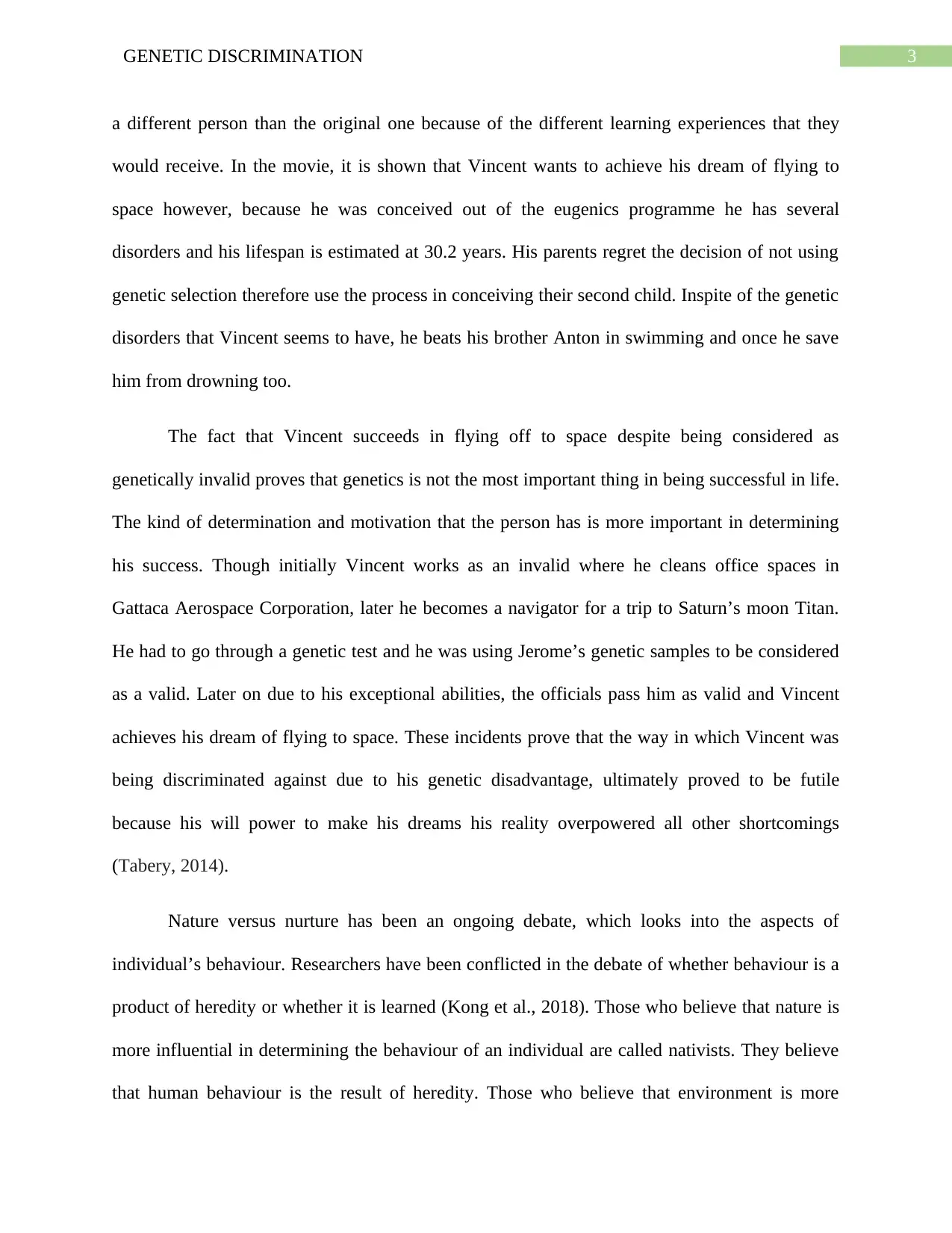
The aim of this paper is to discuss the viewpoint on the genetic disadvantages with
respect to the movie Gattaca. The meaning of the line “There is no gene in the human spirit” is
analysed through the struggles of Vincent, in the movie Gattaca, where he tries to overcome his
struggles of perceived genetic disadvantages. The paper further analyses the debate surrounding
the importance of nature versus nurture in the development of a human being. Whether a person
would be successful or not depends on genetic heredity of the person or the surroundings of the
individual, is an ongoing topic of discussion, which is further analysed here.
The movie Gattaca is a science fiction movie that was directed by Andrew Niccol. Ethan
Hawke and Uma Thurman are the lead roles in the movie with Jude law, Ernest Borgnine, Loren
Dean, Alan Arkin and Gore Vidal staring in supporting characters. The movie is about a
biotechnological vision of the future of the society through the process of eugenics (Muller &
Dalzotto, 2018). This process includes conceiving of the potential children through a selective
process where it is ensured that the best hereditary attributes of the parents are possessed by their
children. The movie is centered around the character of Vincent Freeman that is played by Ethan
Hawke (Kendal, 2015). He was not conceived through the eugenics programme, therefore
struggles due to genetic discrimination, and achieve his dream of going to space. The movie
attracts the attention of the viewers to the reproductive technologies that encourage eugenics and
the consequences of its usage on the society.
“There is no gene in the human spirit.” This line used in the film means that any kind of
hereditary could not modify the soul or spirit of the person. A person can inherit traits like
height, looks, intelligence to a certain extent while the learning experiences that the person
receives is different for each individual and shapes them in a particular way (Gildersleeve &
Crowden, 2019). This means that even if a person creates a clone of himself, the clone would be
Document Page
3GENETIC DISCRIMINATION
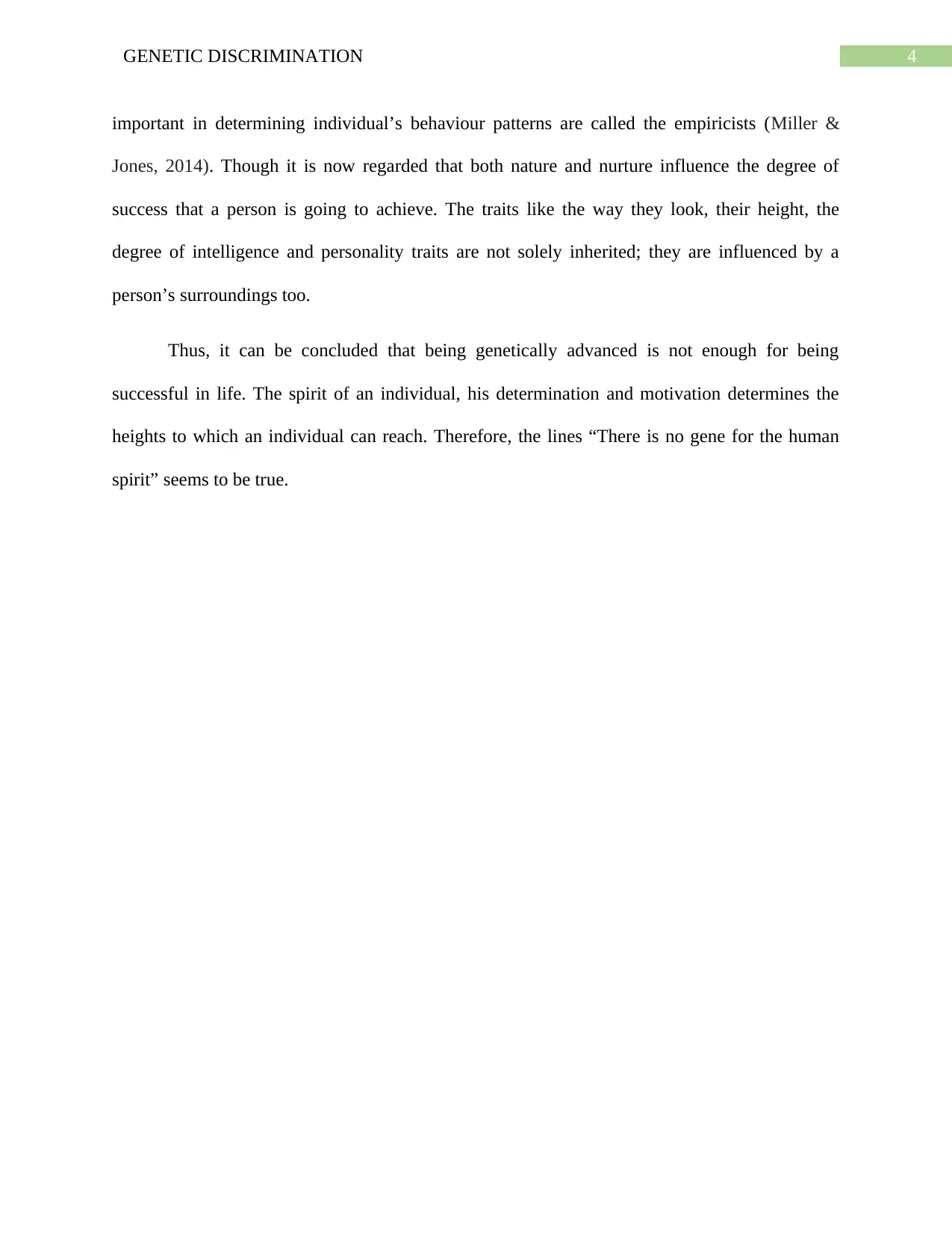
a different person than the original one because of the different learning experiences that they
would receive. In the movie, it is shown that Vincent wants to achieve his dream of flying to
space however, because he was conceived out of the eugenics programme he has several
disorders and his lifespan is estimated at 30.2 years. His parents regret the decision of not using
genetic selection therefore use the process in conceiving their second child. Inspite of the genetic
disorders that Vincent seems to have, he beats his brother Anton in swimming and once he save
him from drowning too.
The fact that Vincent succeeds in flying off to space despite being considered as
genetically invalid proves that genetics is not the most important thing in being successful in life.
The kind of determination and motivation that the person has is more important in determining
his success. Though initially Vincent works as an invalid where he cleans office spaces in
Gattaca Aerospace Corporation, later he becomes a navigator for a trip to Saturn’s moon Titan.
He had to go through a genetic test and he was using Jerome’s genetic samples to be considered
as a valid. Later on due to his exceptional abilities, the officials pass him as valid and Vincent
achieves his dream of flying to space. These incidents prove that the way in which Vincent was
being discriminated against due to his genetic disadvantage, ultimately proved to be futile
because his will power to make his dreams his reality overpowered all other shortcomings
(Tabery, 2014).
Nature versus nurture has been an ongoing debate, which looks into the aspects of
individual’s behaviour. Researchers have been conflicted in the debate of whether behaviour is a
product of heredity or whether it is learned (Kong et al., 2018). Those who believe that nature is
more influential in determining the behaviour of an individual are called nativists. They believe
that human behaviour is the result of heredity. Those who believe that environment is more
Document Page
4GENETIC DISCRIMINATION
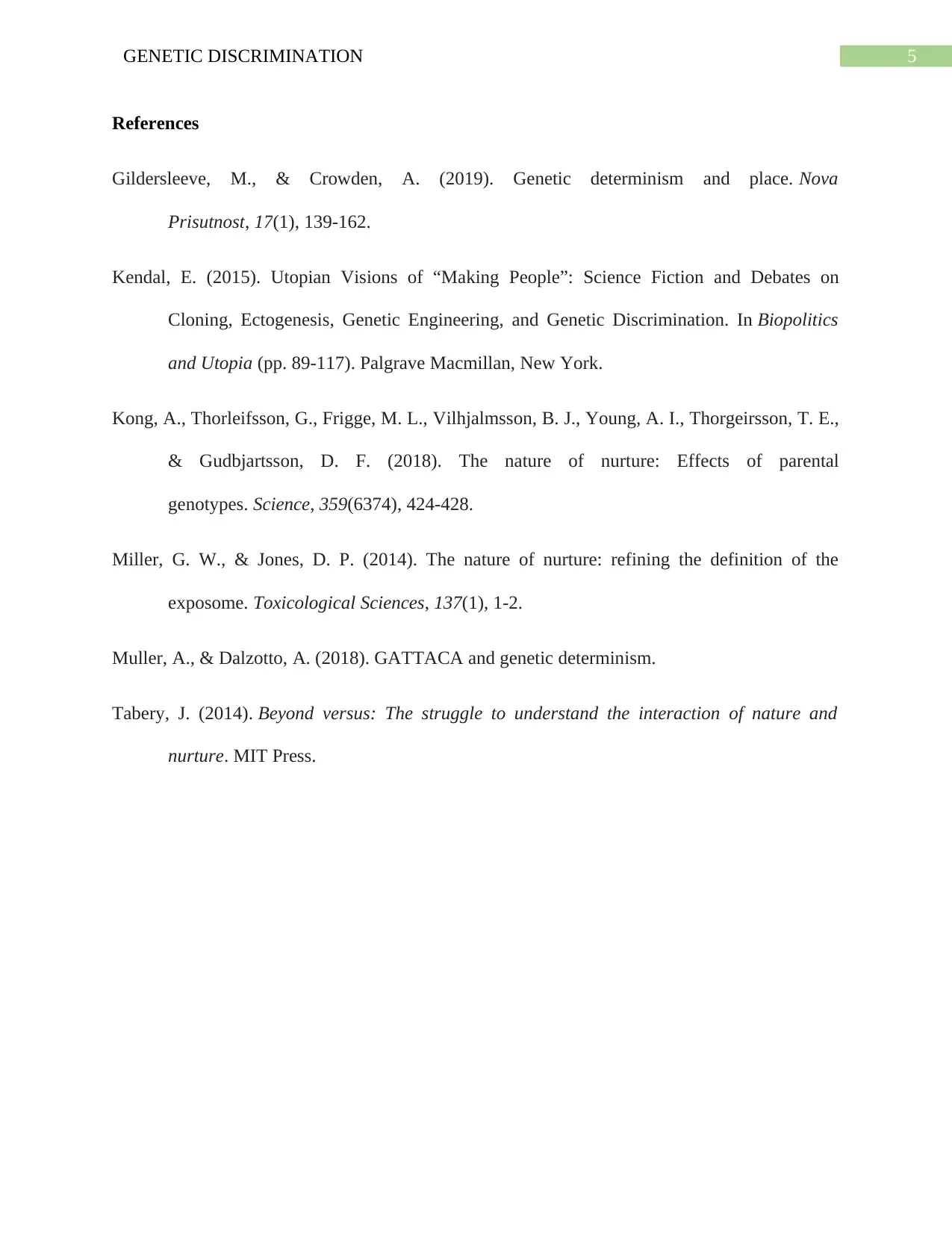
important in determining individual’s behaviour patterns are called the empiricists (Miller &
Jones, 2014). Though it is now regarded that both nature and nurture influence the degree of
success that a person is going to achieve. The traits like the way they look, their height, the
degree of intelligence and personality traits are not solely inherited; they are influenced by a
person’s surroundings too.
Thus, it can be concluded that being genetically advanced is not enough for being
successful in life. The spirit of an individual, his determination and motivation determines the
heights to which an individual can reach. Therefore, the lines “There is no gene for the human
spirit” seems to be true.
tabler-icon-diamond-filled.svg

Paraphrase This Document

Need a fresh take? Get an instant paraphrase of this document with our AI Paraphraser
Document Page
5GENETIC DISCRIMINATION
References
Gildersleeve, M., & Crowden, A. (2019). Genetic determinism and place. Nova
Prisutnost, 17(1), 139-162.
Kendal, E. (2015). Utopian Visions of “Making People”: Science Fiction and Debates on
Cloning, Ectogenesis, Genetic Engineering, and Genetic Discrimination. In Biopolitics
and Utopia (pp. 89-117). Palgrave Macmillan, New York.
Kong, A., Thorleifsson, G., Frigge, M. L., Vilhjalmsson, B. J., Young, A. I., Thorgeirsson, T. E.,
& Gudbjartsson, D. F. (2018). The nature of nurture: Effects of parental
genotypes. Science, 359(6374), 424-428.
Miller, G. W., & Jones, D. P. (2014). The nature of nurture: refining the definition of the
exposome. Toxicological Sciences, 137(1), 1-2.
Muller, A., & Dalzotto, A. (2018). GATTACA and genetic determinism.
Tabery, J. (2014). Beyond versus: The struggle to understand the interaction of nature and
nurture. MIT Press.
chevron_up_icon
1 out of 5
circle_padding
hide_on_mobile
zoom_out_icon
[object Object]