Construction of Genogram and Ecomap for Family Nursing Assessment

Verified

Added on  2022/11/25

|8
|1304
|236
Report
AI Summary
This report delves into the construction and application of genograms and ecomaps within the context of family nursing. The report begins with an introduction to genograms, explaining their role in visualizing family relationships, medical history, and psychological factors, and ecomaps, which illustrate the various systems impacting an individual's life. The report then highlights the relevance of these tools in family nursing, emphasizing their use in comprehensive assessments and interventions. The construction process of both genograms and ecomaps is discussed, with examples provided. The report underscores the value of these tools in understanding family dynamics, assessing social support networks, and facilitating discussions about family structure. Finally, the report includes a constructed genogram and ecomap, along with cited references to support the information provided.
Document Page
Running head: CONSTRUCTION OF GENOGRAM AND ECOMAP
CONSTRUCTION OF GENOGRAM AND ECOMAP
Name of the Student
Name of the University
Author’s Note
tabler-icon-diamond-filled.svg

Paraphrase This Document

Need a fresh take? Get an instant paraphrase of this document with our AI Paraphraser
Document Page
1Running head: CONSTRUCTION OF GENOGRAM AND ECOMAP
Introduction
Genogram construction and ecomapping are essential tools to follow the genetical,
physiological and emotional connections and interrelations that runs in a family (DeMaria,
Twist & Weeks, 2017). Focused genograms are intergenerational evaluation of individuals on
the basis of their families. A genogram illustrates family relationships along with the medical
history of an individual pictorially (Alexander, Callaghan & Fellin, 2018). Genogram is a
comprehensive, scientifically evidenced family tree which allows visualization of hereditary
patterns in addition to psychological factors which might punctuate various relationships
(Rempel, Neufeld & Kushner, 2017). Genogram is generally used in medical and nursing
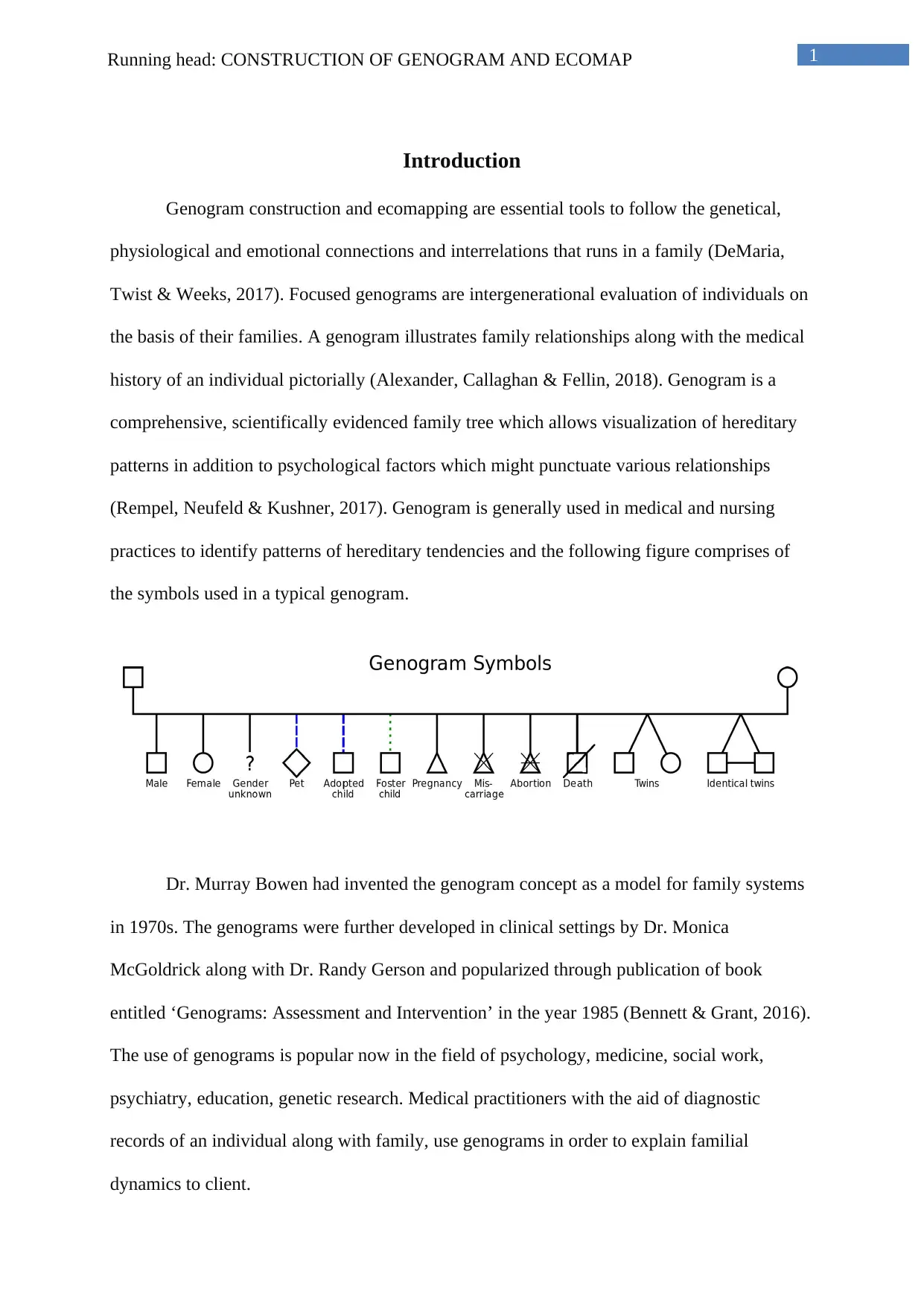
practices to identify patterns of hereditary tendencies and the following figure comprises of
the symbols used in a typical genogram.
Dr. Murray Bowen had invented the genogram concept as a model for family systems
in 1970s. The genograms were further developed in clinical settings by Dr. Monica
McGoldrick along with Dr. Randy Gerson and popularized through publication of book
entitled ‘Genograms: Assessment and Intervention’ in the year 1985 (Bennett & Grant, 2016).
The use of genograms is popular now in the field of psychology, medicine, social work,
psychiatry, education, genetic research. Medical practitioners with the aid of diagnostic
records of an individual along with family, use genograms in order to explain familial
dynamics to client.
Document Page
2Running head: CONSTRUCTION OF GENOGRAM AND ECOMAP
An ecomap is the graphical illustration which represents all the systems which are at
play within the life of the concerned individual. The ecomaps are required during counseling
sessions of individual and takes into account the family and social work along with
professional life (Libbon et al., 2017). Often, the ecomaps are used to portray the social life of
the life during session and acts as a quick reference file. The ecomap or ecological map was
first developed by Dr. Hartman in the year 1975 as tool to depict the ecological system of an
individual (Goldberg, Lagomasino & Fatoyinbo, 2018).
The client is at center of eco-map and the various connection and influential systems
surround the client along with Family and social in addition with professional
connections.
Straight lines mean good relationship.
Curvy lines or red lines highlights stressful relationship
Pointing arrows to client highlight’s systems that primarily has an influence on the
client
Pointing arrows to a systems illustrates that client has substantial influences on that
system.
Arrows that point in both directions depict relationships which effect and influence
each other.
Relevance of Genogram in family nursing
1. Genogram is the tool which is used by the nurses in order to construct a
comprehensive and holistic representation of a client in relation to the social
environment (Rempel, Neufeld & Kushner, 2017).
2. Genogram serves as both assessment tool along with being an aid for different
interventions (Souza et al., 2016).
Document Page
3Running head: CONSTRUCTION OF GENOGRAM AND ECOMAP
3. A genogram serves as an organized visual method of the gathering, revealing, along
with communicating several information for the client along with being a
comprehensive medium to aid health-care professionals in knowing their client’s
better (Goldberg, Lagomasino & Fatoyinbo, 2018).
Relevance of Ecomap in family nursing
1. The capability of the client to enthusiastically participate during the construction of
ecomap serves as an assessment tool about the sensory perception function along with
the analysis of the client’s memory aptitude, various functional communication in
addition with the fine motor skills along with the behavioral domains and socializing
interest of the client (Butler, 2018)..
2. The necessity for social support is vital for the maintenance of physiological as well as
health along with being important for disease management.
3. Ecomaps provide visual means of the facilitation of discussions around structure and
the strength of social network of the client (Libbon et al., 2017).
4. Ecomapping assisted the client to recognize and acknowledge the members of
network, inspect the strength of every relationship surrounding the client in addition to
ascertaining the nurturing sources and distinguishing the strenuous relationships.
Limitations arise when the client fails to quantify the relationships and recognize the
effect of the system on the client (Souza et al., 2016).
5. Ecomaps provide visual representations of the supportive care networks along with
capturing strategic information through the use of various symbols, thereby expressing
the relationships and communication links which might be imperfectly portrayed in
words.
tabler-icon-diamond-filled.svg

Paraphrase This Document

Need a fresh take? Get an instant paraphrase of this document with our AI Paraphraser
Document Page
4Running head: CONSTRUCTION OF GENOGRAM AND ECOMAP
Genogram
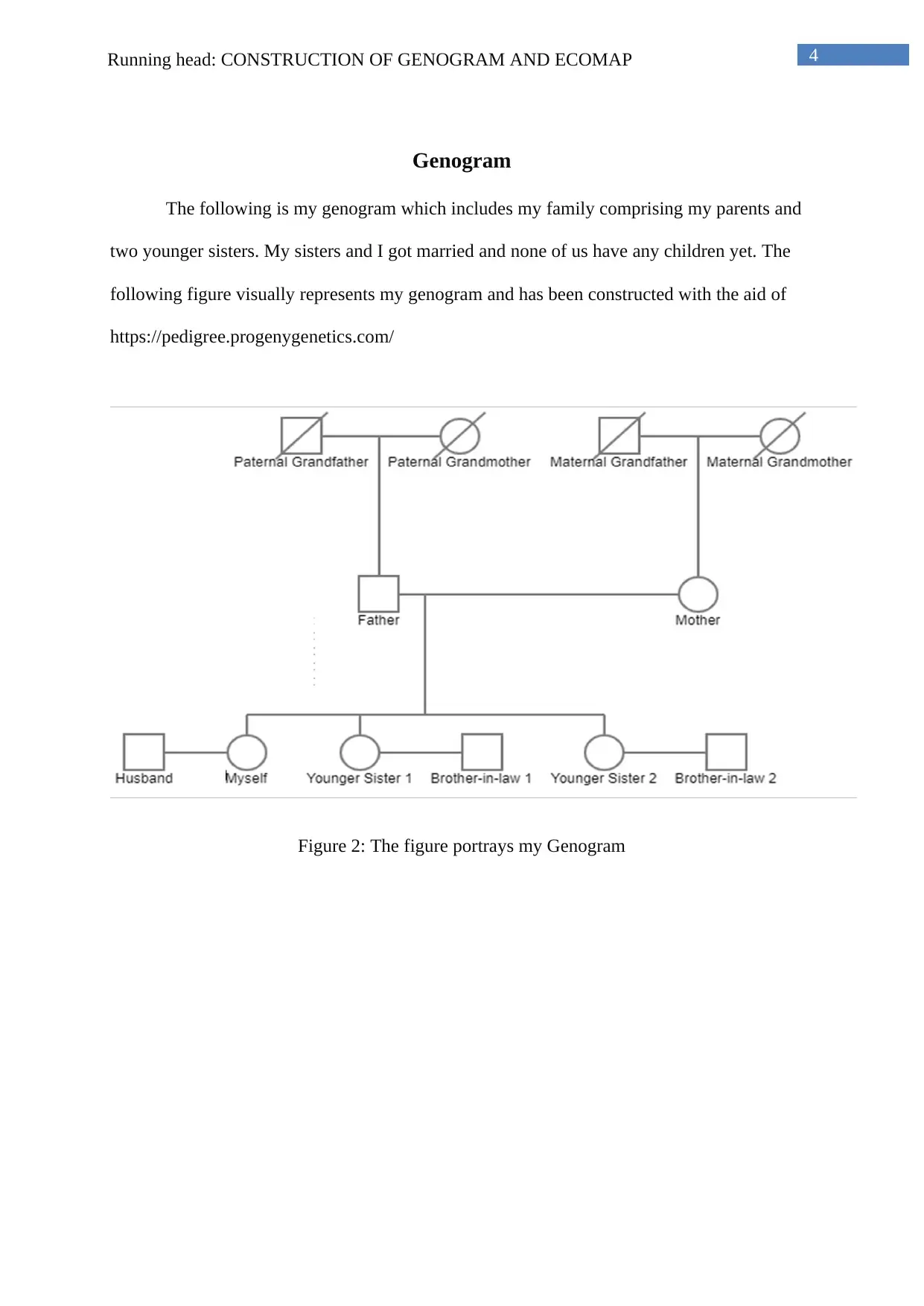
The following is my genogram which includes my family comprising my parents and
two younger sisters. My sisters and I got married and none of us have any children yet. The
following figure visually represents my genogram and has been constructed with the aid of
https://pedigree.progenygenetics.com/
Figure 2: The figure portrays my Genogram
Document Page
5Running head: CONSTRUCTION OF GENOGRAM AND ECOMAP
Ecomap
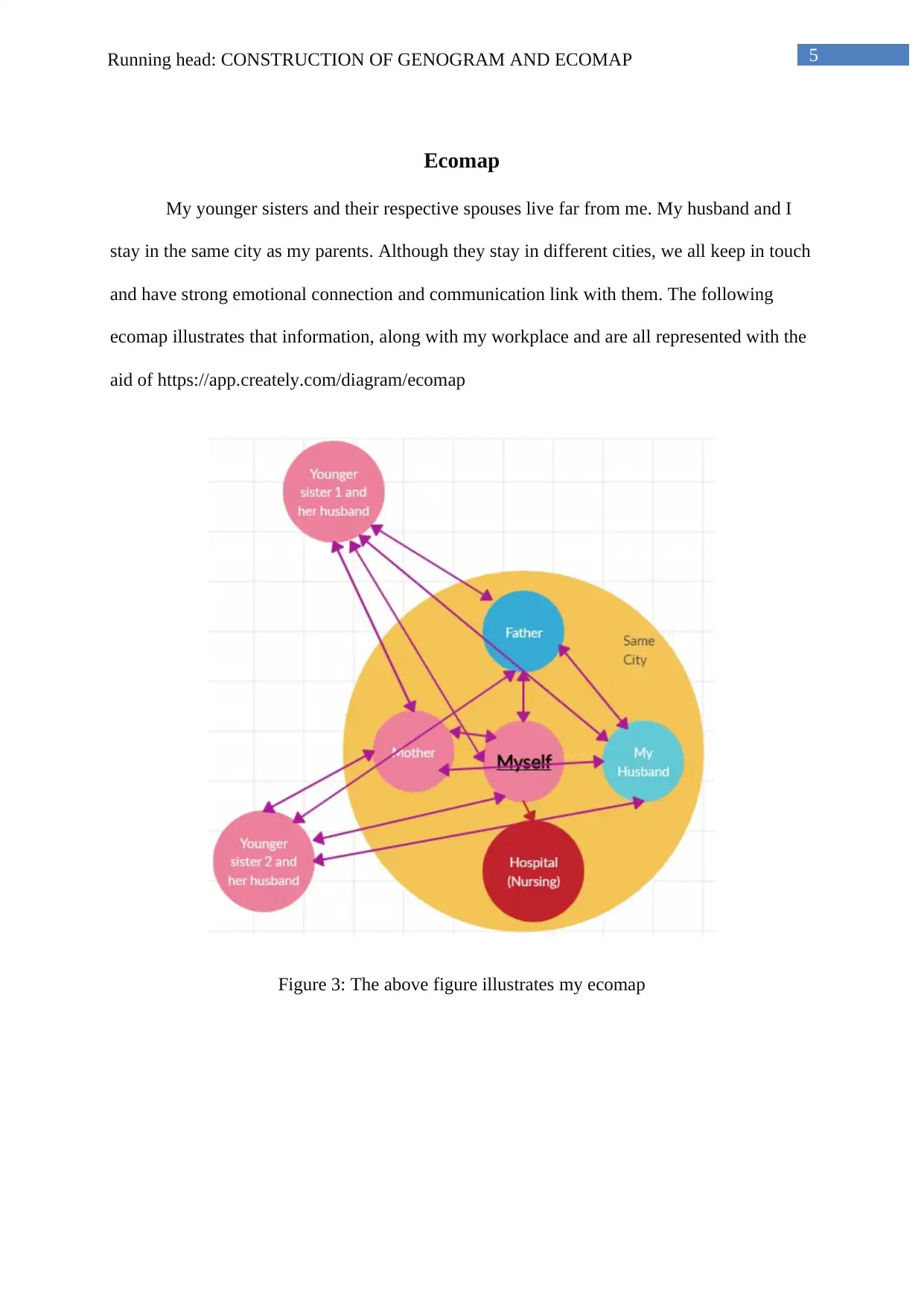
My younger sisters and their respective spouses live far from me. My husband and I
stay in the same city as my parents. Although they stay in different cities, we all keep in touch
and have strong emotional connection and communication link with them. The following
ecomap illustrates that information, along with my workplace and are all represented with the
aid of https://app.creately.com/diagram/ecomap
Figure 3: The above figure illustrates my ecomap
Document Page
6Running head: CONSTRUCTION OF GENOGRAM AND ECOMAP
References
Alexander, J. H., Callaghan, J. E., & Fellin, L. C. (2018). Genograms in research:
participants’ reflections of the genogram process. Qualitative Research in Psychology,
1-21. Available at https://dspace.stir.ac.uk/handle/1893/28304
Bennett, J., & Grant, N. S. (2016). Using an ecomap as a tool for qualitative data collection in
organizations. New Horizons in Adult Education and Human Resource
Development, 28(2), 1-13. DOI: 10.1002/nha3.20134
Butler, J. F. (2018). The family diagram and genogram: Comparisons and contrasts. The
American Journal of Family Therapy, 36(3), 169-180. DOI:
10.1080/01926180701291055
DeMaria, R., Twist, M. L., & Weeks, G. R. (2017). Focused genograms: Intergenerational
assessment of individuals, couples, and families. Routledge. Available at
https://www.amazon.com/Focused-Genograms-Intergenerational-Assessment-
Individuals/dp/0876308817
Goldberg, L., Lagomasino, D., & Fatoyinbo, T. (2018, December). EcoMap: A Decision-
Support Tool to Monitor Global Mangrove Vulnerability and its Drivers. In AGU Fall
Meeting Abstracts. Available at
http://adsabs.harvard.edu/abs/2018AGUFMPA23A07G
Libbon, R., Triana, J., Heru, A., & Berman, E. (2019). Family Skills for the Resident
Toolbox: the 10-min Genogram, Ecomap, and Prescribing Homework. Academic
Psychiatry, 1-5. DOI: 10.1007/s40596-019-01054-6
tabler-icon-diamond-filled.svg

Paraphrase This Document

Need a fresh take? Get an instant paraphrase of this document with our AI Paraphraser
Document Page
7Running head: CONSTRUCTION OF GENOGRAM AND ECOMAP
Rempel, G. R., Neufeld, A., & Kushner, K. E. (2017). Interactive use of genograms and
ecomaps in family caregiving research. Journal of Family Nursing, 13(4), 403-419.
DOI: doi/abs/10.1177/1074840707307917
Souza, Í. P. D., Bellato, R., Araújo, L. F. S. D., & Almeida, K. B. B. D. (2016). Genogram
and Eco-map as tools for understanding family care in chronic illness of the
young. Texto & Contexto-Enfermagem, 25(4). DOI:10.1590/0104-
07072016001530015
chevron_up_icon
1 out of 8
circle_padding
hide_on_mobile
zoom_out_icon
[object Object]