Tourism Marketing: Approaches, Evaluation, and Application Report
VerifiedAdded on 2021/02/22
|10
|3047
|120
Report
AI Summary
This report provides a comprehensive analysis of tourism marketing, beginning with a critical evaluation of traditional, generic marketing approaches. It examines the limitations of these methods, including their focus on visitation and mass media channels. The report then delves into contemporary geographical theoretical approaches, such as human geography, cultural geography, and ecotourism, discussing their advantages and disadvantages. Finally, it explores the application of these contemporary approaches through specific marketing initiatives employed by organizations like Thomas Cook, Jet2Holidays, and Trailfinders. The report highlights how these companies utilize target marketing, destination marketing, and ecotourism principles to attract tourists and promote sustainable practices.

INDIVIDUAL
REPORT
REPORT

Paraphrase This Document
Need a fresh take? Get an instant paraphrase of this document with our AI Paraphraser
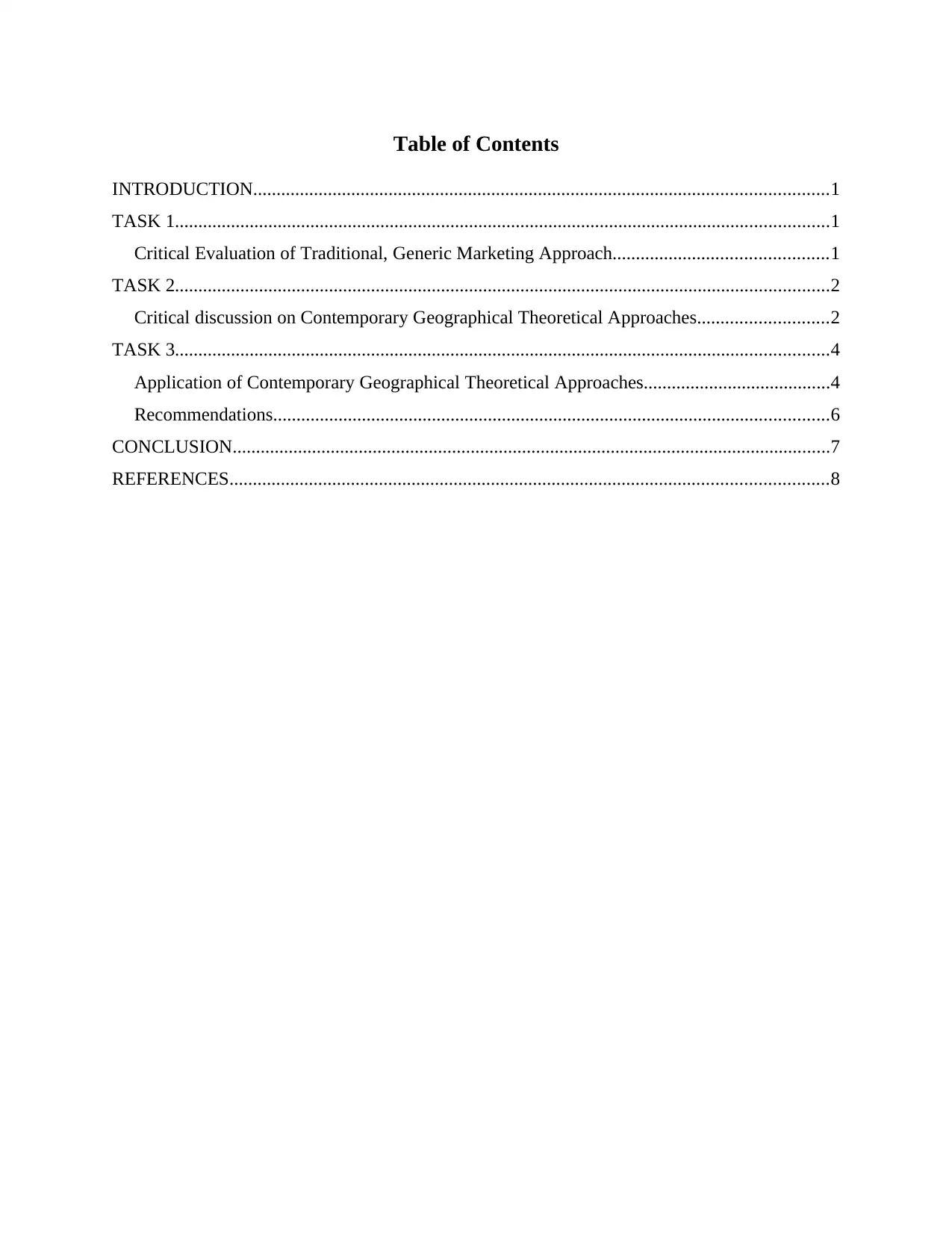
Table of Contents
INTRODUCTION...........................................................................................................................1
TASK 1............................................................................................................................................1
Critical Evaluation of Traditional, Generic Marketing Approach..............................................1
TASK 2............................................................................................................................................2
Critical discussion on Contemporary Geographical Theoretical Approaches............................2
TASK 3............................................................................................................................................4
Application of Contemporary Geographical Theoretical Approaches........................................4
Recommendations.......................................................................................................................6
CONCLUSION................................................................................................................................7
REFERENCES................................................................................................................................8
INTRODUCTION...........................................................................................................................1
TASK 1............................................................................................................................................1
Critical Evaluation of Traditional, Generic Marketing Approach..............................................1
TASK 2............................................................................................................................................2
Critical discussion on Contemporary Geographical Theoretical Approaches............................2
TASK 3............................................................................................................................................4
Application of Contemporary Geographical Theoretical Approaches........................................4
Recommendations.......................................................................................................................6
CONCLUSION................................................................................................................................7
REFERENCES................................................................................................................................8
INTRODUCTION
Tourism refers to the activity associated with travelling to different places for the purpose
of exploring locations, leisure activities as well as business purposes. It is a highly adopted
activity amongst individuals and is laying down a firm basis for marketing initiatives (Rogerson,
2017). The report below is based on the tourism industry and includes a detailed and critical
evaluation of traditional, generic marketing approaches for tourism. Moreover, it also includes
explanation and critical discussion of contemporary geographical theoretical approaches to
tourism and their applicability by using examples of marketing initiatives in tourism
organisations.
TASK 1
Critical Evaluation of Traditional, Generic Marketing Approach
Tourism Marketing means promoting different places of tourist attractions, several
activities associated with it, destinations, etc. Global tourism organisations have always been
effective in marketing their destinations and attracting tourists from all over the world through
adopting standard, generic marketing approach to tourism. Below is the critical evaluation of this
approach which includes methods and channels that are discussed as under:
Marketing Methods
Focus on Visitations:
One of the vastly used methods of traditional, generic approach which is adopted by the
industry is enhancing the visitation on destinations. The marketing has been aligned effectively
towards developing a consistency of recurring customers. This approach is quite useful when it
comes to places with unique tourist attractions, such as Big Ben and London Eye in the UK.
However, this approach fails miserably in taking into account several environmental, socio-
cultural and geographical characteristics, that might hinder the industry to attract more visitors
from other countries (Fernández-Morales and et. al., 2016).
Limiting Tourism Development:
The traditional, generic marketing approach emphasises effectively on tourism
development in their places of attractions. However, apart from development of those areas, the
industry fails to focus on sustainability of the overall destination, which prevents the location to
gather more responses even after appropriate marketing.
1
Tourism refers to the activity associated with travelling to different places for the purpose
of exploring locations, leisure activities as well as business purposes. It is a highly adopted
activity amongst individuals and is laying down a firm basis for marketing initiatives (Rogerson,
2017). The report below is based on the tourism industry and includes a detailed and critical
evaluation of traditional, generic marketing approaches for tourism. Moreover, it also includes
explanation and critical discussion of contemporary geographical theoretical approaches to
tourism and their applicability by using examples of marketing initiatives in tourism
organisations.
TASK 1
Critical Evaluation of Traditional, Generic Marketing Approach
Tourism Marketing means promoting different places of tourist attractions, several
activities associated with it, destinations, etc. Global tourism organisations have always been
effective in marketing their destinations and attracting tourists from all over the world through
adopting standard, generic marketing approach to tourism. Below is the critical evaluation of this
approach which includes methods and channels that are discussed as under:
Marketing Methods
Focus on Visitations:
One of the vastly used methods of traditional, generic approach which is adopted by the
industry is enhancing the visitation on destinations. The marketing has been aligned effectively
towards developing a consistency of recurring customers. This approach is quite useful when it
comes to places with unique tourist attractions, such as Big Ben and London Eye in the UK.
However, this approach fails miserably in taking into account several environmental, socio-
cultural and geographical characteristics, that might hinder the industry to attract more visitors
from other countries (Fernández-Morales and et. al., 2016).
Limiting Tourism Development:
The traditional, generic marketing approach emphasises effectively on tourism
development in their places of attractions. However, apart from development of those areas, the
industry fails to focus on sustainability of the overall destination, which prevents the location to
gather more responses even after appropriate marketing.
1
⊘ This is a preview!⊘
Do you want full access?
Subscribe today to unlock all pages.

Trusted by 1+ million students worldwide
Marketing Channels
Mass Media:
The first and most used channel in traditional, generic marketing approach is mass media.
It includes local and national newspapers, televisions as well as radio advertisements.
Organisations in the industry globally, focus on these methods to attract masses. While these
allow tourism organisations to send their message to a wider customer group, they also incur
huge investment from the organisation. Moreover, they usually tend to fail in terms of attracting
their target market (Li and et. al., 2017). In addition to this, they provide a very limited insight on
the destination and fail to convey an appropriate imagery even after using several methods like
newspapers and television advertising.
Out Of Home (OOH) Marketing:
Another widely used category in traditional, generic approach to tourism is use of
billboards, street furniture, transit and alternative outdoors. It is a highly useful technique which
is associated with enhancing the familiarity of individuals in context with several unfamiliar
destinations. Transit advertising involves taxi, airport and rail displays, whereas alternative
outdoors include stadiums and arenas. While it is informative in its way, there are high chances
of missing out target marketing of the desired segment as people tend to ignore these displays too
often (Orchiston and Higham, 2016).
While the traditional, generic approach to tourism encourages the organisations to focus
on marketing themselves, it is a serious need for these companies as well as the overall industry
to focus on exploring the variety of ways which could help them attracting their target markets.
Moreover, there is also an arising need for organisations to emphasise on sustainability and
innovation in their marketing methods in order to enhance the scope of tourism marketing.
TASK 2
Critical discussion on Contemporary Geographical Theoretical Approaches
Apart from traditional, generic approach, there are several contemporary geographical
theoretical approaches which are highly adopted by the tourism organisations in the current
market. Since travel and tourism is a diverse activity, it is highly necessary for organisation
adopting these approaches to effectively implement them in their marketing practices.
2
Mass Media:
The first and most used channel in traditional, generic marketing approach is mass media.
It includes local and national newspapers, televisions as well as radio advertisements.
Organisations in the industry globally, focus on these methods to attract masses. While these
allow tourism organisations to send their message to a wider customer group, they also incur
huge investment from the organisation. Moreover, they usually tend to fail in terms of attracting
their target market (Li and et. al., 2017). In addition to this, they provide a very limited insight on
the destination and fail to convey an appropriate imagery even after using several methods like
newspapers and television advertising.
Out Of Home (OOH) Marketing:
Another widely used category in traditional, generic approach to tourism is use of
billboards, street furniture, transit and alternative outdoors. It is a highly useful technique which
is associated with enhancing the familiarity of individuals in context with several unfamiliar
destinations. Transit advertising involves taxi, airport and rail displays, whereas alternative
outdoors include stadiums and arenas. While it is informative in its way, there are high chances
of missing out target marketing of the desired segment as people tend to ignore these displays too
often (Orchiston and Higham, 2016).
While the traditional, generic approach to tourism encourages the organisations to focus
on marketing themselves, it is a serious need for these companies as well as the overall industry
to focus on exploring the variety of ways which could help them attracting their target markets.
Moreover, there is also an arising need for organisations to emphasise on sustainability and
innovation in their marketing methods in order to enhance the scope of tourism marketing.
TASK 2
Critical discussion on Contemporary Geographical Theoretical Approaches
Apart from traditional, generic approach, there are several contemporary geographical
theoretical approaches which are highly adopted by the tourism organisations in the current
market. Since travel and tourism is a diverse activity, it is highly necessary for organisation
adopting these approaches to effectively implement them in their marketing practices.
2
Paraphrase This Document
Need a fresh take? Get an instant paraphrase of this document with our AI Paraphraser
Following is the critical discussion on contemporary geographical theoretical approaches
to tourism:
Human Geographical Approach:
One of the major approaches adopted within the industry is this aspect. It refers to the
marketing adopted by organisations which solely focuses on the study of people, along with their
cultures, economies, communities, etc. The focus of organisations in this approach related with
studying patterns of social interactions amongst people (Font and McCabe, 2017). It is quite
advantageous for tourism companies to follow this approach as it is the means through which
organisations could undergo analysis of several fields within this methods like Cultures,
Economies, Histories, Heritages and so forth, to develop several marketing strategies which fits
the kind. Several major techniques are adopted within the industry to satisfy human geographical
approach. For example, the institutional technique within the same is associated with emphasis
on institutions like travel agencies. Another technique is sociological one, that is related to focus
on tourism behaviour by examining their habits, social status, customs, etc.
This approach is very useful for the industry to appropriately examine and analyse the
human perspective, which is essential to formulate and channelise appropriate marketing
methods towards acquiring their attention. However, its application is quite ineffective when it
comes with taking several other aspects into consideration. For instance, human geographical
approach is not much reliable as human perspectives tend to change effectively with time and
evolution. Thus, firms adopting the approach for marketing their destinations would be required
to revise their methods periodically, to suit the needs of individuals.
Cultural Geographical Approach:
Organisations adopting this approach focuses primarily on cultural aspects within
individuals. There are several activities which are performed by organisations in this approach
such as differentiating cultures on the basis of ideas, languages, practices, attitudes, etc.
Moreover, the marketing activities performed by these organisations under this approach also
encompasses of a brief and enhanced study of cultural ecology as well as landscapes. All the
perspectives associated with marketing using this approach is channelised on enhancement of
importance of cultures prevailing in different localities and increase in cultural tourism (Ali and
et. al., 2016).
3
to tourism:
Human Geographical Approach:
One of the major approaches adopted within the industry is this aspect. It refers to the
marketing adopted by organisations which solely focuses on the study of people, along with their
cultures, economies, communities, etc. The focus of organisations in this approach related with
studying patterns of social interactions amongst people (Font and McCabe, 2017). It is quite
advantageous for tourism companies to follow this approach as it is the means through which
organisations could undergo analysis of several fields within this methods like Cultures,
Economies, Histories, Heritages and so forth, to develop several marketing strategies which fits
the kind. Several major techniques are adopted within the industry to satisfy human geographical
approach. For example, the institutional technique within the same is associated with emphasis
on institutions like travel agencies. Another technique is sociological one, that is related to focus
on tourism behaviour by examining their habits, social status, customs, etc.
This approach is very useful for the industry to appropriately examine and analyse the
human perspective, which is essential to formulate and channelise appropriate marketing
methods towards acquiring their attention. However, its application is quite ineffective when it
comes with taking several other aspects into consideration. For instance, human geographical
approach is not much reliable as human perspectives tend to change effectively with time and
evolution. Thus, firms adopting the approach for marketing their destinations would be required
to revise their methods periodically, to suit the needs of individuals.
Cultural Geographical Approach:
Organisations adopting this approach focuses primarily on cultural aspects within
individuals. There are several activities which are performed by organisations in this approach
such as differentiating cultures on the basis of ideas, languages, practices, attitudes, etc.
Moreover, the marketing activities performed by these organisations under this approach also
encompasses of a brief and enhanced study of cultural ecology as well as landscapes. All the
perspectives associated with marketing using this approach is channelised on enhancement of
importance of cultures prevailing in different localities and increase in cultural tourism (Ali and
et. al., 2016).
3
The biggest advantage of using this theoretical approach is that it helps individuals in
understanding culture of other locations which effectively helps them make sense of the world
around them. Moreover, it also helps in establishing appropriate and effective relationships
between different nations and people belonging to different backgrounds. However, there are
several drawbacks too, which are associated with cultural geographical approach. For example,
not every culture follows practices that are acceptable by each and every individual around them.
Thus, there are high chances of a negative perception been developed in minds of tourists.
Moreover, this approach also poses a serious threat to the cultural places and monuments through
heavy footfall, which might risk in their sustainability and well-being.
Ecotourism Approach:
Within this approach, organisations tend to focus appropriately on environmental and
ecological factors to market their destinations. Moreover, the biggest factor of focus in context
with this approach is sustainability. The main emphasis within this approach is preserving the
natural resources to every extent whole providing tourism benefits to individuals. The marketing
perspective followed by organisations tend to focus on ecologically responsible tourism, which
encourages the scope of development in tourism (Yousaf and et. al., 2018).
The most favourable aspect which is associated with this approach is that it helps in
preservation of the destination's natural resources and habitat, which allows tourists to even
enjoy the landscapes, without tampering with the nature. However, there are certain risks
associated with this approach. For instance, it is a direct threat to indigenous cultures, which
might fail the marketing efforts of organisations as people might perceive it as a threat to
freedom of cultural expressions.
TASK 3
Application of Contemporary Geographical Theoretical Approaches
It is highly essential that organisations within the tourism sector apply the theoretical
approaches which helps them in marketing their destinations to an appropriate level and to a
wider extent. There are several marketing initiatives, which are being utilised by organisations
which help them in implementing these approaches in a better context amongst the customers.
The application of contemporary geographical theoretical approaches, with examples of
marketing initiatives are discussed effectively below:
4
understanding culture of other locations which effectively helps them make sense of the world
around them. Moreover, it also helps in establishing appropriate and effective relationships
between different nations and people belonging to different backgrounds. However, there are
several drawbacks too, which are associated with cultural geographical approach. For example,
not every culture follows practices that are acceptable by each and every individual around them.
Thus, there are high chances of a negative perception been developed in minds of tourists.
Moreover, this approach also poses a serious threat to the cultural places and monuments through
heavy footfall, which might risk in their sustainability and well-being.
Ecotourism Approach:
Within this approach, organisations tend to focus appropriately on environmental and
ecological factors to market their destinations. Moreover, the biggest factor of focus in context
with this approach is sustainability. The main emphasis within this approach is preserving the
natural resources to every extent whole providing tourism benefits to individuals. The marketing
perspective followed by organisations tend to focus on ecologically responsible tourism, which
encourages the scope of development in tourism (Yousaf and et. al., 2018).
The most favourable aspect which is associated with this approach is that it helps in
preservation of the destination's natural resources and habitat, which allows tourists to even
enjoy the landscapes, without tampering with the nature. However, there are certain risks
associated with this approach. For instance, it is a direct threat to indigenous cultures, which
might fail the marketing efforts of organisations as people might perceive it as a threat to
freedom of cultural expressions.
TASK 3
Application of Contemporary Geographical Theoretical Approaches
It is highly essential that organisations within the tourism sector apply the theoretical
approaches which helps them in marketing their destinations to an appropriate level and to a
wider extent. There are several marketing initiatives, which are being utilised by organisations
which help them in implementing these approaches in a better context amongst the customers.
The application of contemporary geographical theoretical approaches, with examples of
marketing initiatives are discussed effectively below:
4
⊘ This is a preview!⊘
Do you want full access?
Subscribe today to unlock all pages.
Trusted by 1+ million students worldwide
Human Geographical Approach:
There are several marketing approaches, which helps companies in applying this
approach in their operations associated with marketing their destinations. The biggest example of
the same is Thomas Cook. The marketing initiative used by the firm is Target Marketing, where
the company emphasises on marketing their destinations as per the social beliefs and attitudes of
individuals in different geographical locations (Yoo and Gretzel, 2016). For instance, in places
like UK, it uses Social Media to gather attention of the social masses, where as in India, it uses
newspapers and brochures means to market their offerings. It is a highly effective approach
which allows the organisation to specifically target the customers, for their locations using
methods that are preferred by the social masses of that location specifically. However, this
restricts them to diversify their strategies in order to provide attention to destinations, rather than
the behavioural aspects of individuals.
Cultural Geographical Approach:
As discussed above, culture comes into play in this approach and the marketing is
focused on enhancing the familiarity of cultures amongst people. Jet2Holidays is a tour operating
organisation in the UK which is practising Destination Marketing as a marketing initiative to
ensure that people affiliate themselves with practices and beliefs of other cultures. For the same,
it uses compelling videos as a medium to attract tourists from all over the world. The best aspect
associated with this initiative is that it allows an integration that could be expanded around the
world where people from different backgrounds could visit one another and experience enriched
cultural practices as part of their tourism (Wachowiak, 2016).
However, this initiative is still limited onto developing a positive and appropriate
perspective towards the tourism destinations being marketed by the organisation.
Ecotourism Approach:
In order to get sustainability in business, by concerning on above approaches, Trailfinders
that also deal in travel sector, has applied the concept of Ecotourism approach. This would have
considered as an effective tool for sustainable development at market area, where competition is
almost much high than other sectors. As it involves conservation strategies, therefore, applying
the given approach, Trailfinders has concerned more on giving more contribution on
conservation of biodiversity, alternate source of livelihood for welfare of local community. For
this purpose, to protect natural resources, it involves entire stakeholders of company like
5
There are several marketing approaches, which helps companies in applying this
approach in their operations associated with marketing their destinations. The biggest example of
the same is Thomas Cook. The marketing initiative used by the firm is Target Marketing, where
the company emphasises on marketing their destinations as per the social beliefs and attitudes of
individuals in different geographical locations (Yoo and Gretzel, 2016). For instance, in places
like UK, it uses Social Media to gather attention of the social masses, where as in India, it uses
newspapers and brochures means to market their offerings. It is a highly effective approach
which allows the organisation to specifically target the customers, for their locations using
methods that are preferred by the social masses of that location specifically. However, this
restricts them to diversify their strategies in order to provide attention to destinations, rather than
the behavioural aspects of individuals.
Cultural Geographical Approach:
As discussed above, culture comes into play in this approach and the marketing is
focused on enhancing the familiarity of cultures amongst people. Jet2Holidays is a tour operating
organisation in the UK which is practising Destination Marketing as a marketing initiative to
ensure that people affiliate themselves with practices and beliefs of other cultures. For the same,
it uses compelling videos as a medium to attract tourists from all over the world. The best aspect
associated with this initiative is that it allows an integration that could be expanded around the
world where people from different backgrounds could visit one another and experience enriched
cultural practices as part of their tourism (Wachowiak, 2016).
However, this initiative is still limited onto developing a positive and appropriate
perspective towards the tourism destinations being marketed by the organisation.
Ecotourism Approach:
In order to get sustainability in business, by concerning on above approaches, Trailfinders
that also deal in travel sector, has applied the concept of Ecotourism approach. This would have
considered as an effective tool for sustainable development at market area, where competition is
almost much high than other sectors. As it involves conservation strategies, therefore, applying
the given approach, Trailfinders has concerned more on giving more contribution on
conservation of biodiversity, alternate source of livelihood for welfare of local community. For
this purpose, to protect natural resources, it involves entire stakeholders of company like
5
Paraphrase This Document
Need a fresh take? Get an instant paraphrase of this document with our AI Paraphraser
investors, government institutions, tour operators, ecotourists and more, within planning,
implementing and monitoring different phases for promoting the ecotourism (Park and et. al.,
2016). Recognising the nature as a central element for increasing tourist experience, this
company has also provided proper training to guides and marketing team related to
interpretations of natural history. Under this training, they have been trained to must ensure that
limited number of groups will visit the area and wildlife will not be harassed as well. Along with
this, marketing team is mainly responsible for encourage its clients or visitors to concern on
reducing the wastage and do not throw the same on road or any visiting places. Tourists are also
educated about culture and buy products from local communities for their development. These
business practices have helped in getting new marketing opportunities to get sustainability at
marketplace. By taking ecotourism as marketing initiatives, Trailfinders has also provided
awareness among people about its contribution for protecting environment and wildlife from
harmful effects of tourism. All these things help this travel agency in becoming more profitable
at tourism industry. But to get more sustainability, this company also needs to concern on
applying marketing initiatives for promoting business more efficiently. The major problem that
face by this firm is creating the right structures at workplace for working together and paying
attention for all aspects related to product quality. Along with this, marketing team also needs to
concern on strengthening the messages of promoting the ecotourism messages and products
(Huang and et. al., 2016).
All these approaches are effectively linked with marketing practices being adopted by
these organisations. This is because marketing in the current organisational context is associated
with enhanced and effective emphasis on the human, cultural and ecological terms, that allows
the companies to attract individuals with different perspectives to visit their destinations and
experience appropriate benefits related to the same.
Recommendations
In order to appropriately enhance the practise towards this approach, Thomas Cook must
effectively widen their research towards including the behavioural patterns of individuals
on the basis of which they would be marketing their destinations. This would enhance
their application of Human Geographical Approach and would allow them to diversify
their strategy (Moutinho and Vargas-Sanchez, 2018).
6
implementing and monitoring different phases for promoting the ecotourism (Park and et. al.,
2016). Recognising the nature as a central element for increasing tourist experience, this
company has also provided proper training to guides and marketing team related to
interpretations of natural history. Under this training, they have been trained to must ensure that
limited number of groups will visit the area and wildlife will not be harassed as well. Along with
this, marketing team is mainly responsible for encourage its clients or visitors to concern on
reducing the wastage and do not throw the same on road or any visiting places. Tourists are also
educated about culture and buy products from local communities for their development. These
business practices have helped in getting new marketing opportunities to get sustainability at
marketplace. By taking ecotourism as marketing initiatives, Trailfinders has also provided
awareness among people about its contribution for protecting environment and wildlife from
harmful effects of tourism. All these things help this travel agency in becoming more profitable
at tourism industry. But to get more sustainability, this company also needs to concern on
applying marketing initiatives for promoting business more efficiently. The major problem that
face by this firm is creating the right structures at workplace for working together and paying
attention for all aspects related to product quality. Along with this, marketing team also needs to
concern on strengthening the messages of promoting the ecotourism messages and products
(Huang and et. al., 2016).
All these approaches are effectively linked with marketing practices being adopted by
these organisations. This is because marketing in the current organisational context is associated
with enhanced and effective emphasis on the human, cultural and ecological terms, that allows
the companies to attract individuals with different perspectives to visit their destinations and
experience appropriate benefits related to the same.
Recommendations
In order to appropriately enhance the practise towards this approach, Thomas Cook must
effectively widen their research towards including the behavioural patterns of individuals
on the basis of which they would be marketing their destinations. This would enhance
their application of Human Geographical Approach and would allow them to diversify
their strategy (Moutinho and Vargas-Sanchez, 2018).
6
In context with developing a positive perspective amongst individuals of other cultural
backgrounds, Jet2Holidays must ensure that their destination marketing sends a culturally
accepted and integrated message through their visuals and advertisements (Bottler and et.
al., 2017).
Trailfinders must adopt sustainable marketing as an initiative that would allow them to
market ecological destinations and help in encouraging employees in working towards
the same (Tsui and Balli, 2017).
CONCLUSION
It has been concluded from this report that tourism is considered as the most advantage
sector that helps in developing economy of a country more faster. By applying different-different
approaches like human geographical, cultural geographical and ecotourism, company that deals
in travel industry contributes more effort in raising global awareness, via marketing initiatives.
For this purpose, they also concerns on educating people towards protection of cultural and
natural heritages. Moreover, they also apply environmental friendly practices and reduces the
negative impact of tourism on nature, local communities and ecosystem. Along with this, for
promotional the ecotourism, marketing department also concerns on strengthening their
messages and enhancing product development.
7
backgrounds, Jet2Holidays must ensure that their destination marketing sends a culturally
accepted and integrated message through their visuals and advertisements (Bottler and et.
al., 2017).
Trailfinders must adopt sustainable marketing as an initiative that would allow them to
market ecological destinations and help in encouraging employees in working towards
the same (Tsui and Balli, 2017).
CONCLUSION
It has been concluded from this report that tourism is considered as the most advantage
sector that helps in developing economy of a country more faster. By applying different-different
approaches like human geographical, cultural geographical and ecotourism, company that deals
in travel industry contributes more effort in raising global awareness, via marketing initiatives.
For this purpose, they also concerns on educating people towards protection of cultural and
natural heritages. Moreover, they also apply environmental friendly practices and reduces the
negative impact of tourism on nature, local communities and ecosystem. Along with this, for
promotional the ecotourism, marketing department also concerns on strengthening their
messages and enhancing product development.
7
⊘ This is a preview!⊘
Do you want full access?
Subscribe today to unlock all pages.
Trusted by 1+ million students worldwide
REFERENCES
Books and Journals
Ali, F., and et. al., 2016. Influence of experiences on memories, satisfaction and behavioral
intentions: A study of creative tourism. Journal of Travel & Tourism Marketing. 33(1).
pp.85-100.
Bottler, P., and et. al., 2017. Marketing for hospitality and tourism.
Fernández-Morales, A., and et. al., 2016. Seasonal concentration of tourism demand:
Decomposition analysis and marketing implications. Tourism Management. 56. pp.172-
190.
Font, X. and McCabe, S., 2017. Sustainability and marketing in tourism: its contexts, paradoxes,
approaches, challenges and potential. Journal of Sustainable Tourism. 25(7). pp.869-883.
Huang, Y. C., and et. al., 2016. Exploring the implications of virtual reality technology in
tourism marketing: An integrated research framework. International Journal of Tourism
Research. 18(2). pp.116-128.
Li, Y., and et. al., 2017. The concept of smart tourism in the context of tourism information
services. Tourism Management. 58. pp.293-300.
Moutinho, L. and Vargas-Sanchez, A. eds., 2018. Strategic Management in Tourism, CABI
Tourism Texts. Cabi.
Orchiston, C. and Higham, J. E. S., 2016. Knowledge management and tourism recovery (de)
marketing: The Christchurch earthquakes 2010–2011. Current Issues in Tourism. 19(1).
pp.64-84.
Park, S. B., and et. al., 2016. Using Twitter data for cruise tourism marketing and research.
Journal of Travel & Tourism Marketing. 33(6). pp.885-898.
Rogerson, C. M., 2017. Creative industries and urban tourism: South African perspectives. In
Urban Tourism in the Developing World (pp. 167-184). Routledge.
Tsui, W. H. K. and Balli, F., 2017. International arrivals forecasting for Australian airports and
the impact of tourism marketing expenditure. Tourism Economics. 23(2). pp.403-428.
Wachowiak, H. ed., 2016. Tourism and borders: contemporary issues, policies and international
research. Routledge.
Yoo, K. H. and Gretzel, U., 2016. Web 2.0: ew Rules for Tourism Marketing.
Yousaf, S. and et. al., 2018. Halal culinary and tourism marketing strategies on government
websites: A preliminary analysis. Tourism Management. 68. pp.423-443.
8
Books and Journals
Ali, F., and et. al., 2016. Influence of experiences on memories, satisfaction and behavioral
intentions: A study of creative tourism. Journal of Travel & Tourism Marketing. 33(1).
pp.85-100.
Bottler, P., and et. al., 2017. Marketing for hospitality and tourism.
Fernández-Morales, A., and et. al., 2016. Seasonal concentration of tourism demand:
Decomposition analysis and marketing implications. Tourism Management. 56. pp.172-
190.
Font, X. and McCabe, S., 2017. Sustainability and marketing in tourism: its contexts, paradoxes,
approaches, challenges and potential. Journal of Sustainable Tourism. 25(7). pp.869-883.
Huang, Y. C., and et. al., 2016. Exploring the implications of virtual reality technology in
tourism marketing: An integrated research framework. International Journal of Tourism
Research. 18(2). pp.116-128.
Li, Y., and et. al., 2017. The concept of smart tourism in the context of tourism information
services. Tourism Management. 58. pp.293-300.
Moutinho, L. and Vargas-Sanchez, A. eds., 2018. Strategic Management in Tourism, CABI
Tourism Texts. Cabi.
Orchiston, C. and Higham, J. E. S., 2016. Knowledge management and tourism recovery (de)
marketing: The Christchurch earthquakes 2010–2011. Current Issues in Tourism. 19(1).
pp.64-84.
Park, S. B., and et. al., 2016. Using Twitter data for cruise tourism marketing and research.
Journal of Travel & Tourism Marketing. 33(6). pp.885-898.
Rogerson, C. M., 2017. Creative industries and urban tourism: South African perspectives. In
Urban Tourism in the Developing World (pp. 167-184). Routledge.
Tsui, W. H. K. and Balli, F., 2017. International arrivals forecasting for Australian airports and
the impact of tourism marketing expenditure. Tourism Economics. 23(2). pp.403-428.
Wachowiak, H. ed., 2016. Tourism and borders: contemporary issues, policies and international
research. Routledge.
Yoo, K. H. and Gretzel, U., 2016. Web 2.0: ew Rules for Tourism Marketing.
Yousaf, S. and et. al., 2018. Halal culinary and tourism marketing strategies on government
websites: A preliminary analysis. Tourism Management. 68. pp.423-443.
8

1 out of 10


Related Documents


Your All-in-One AI-Powered Toolkit for Academic Success.
+13062052269
info@desklib.com
Available 24*7 on WhatsApp / Email
![[object Object]](/_next/static/media/star-bottom.7253800d.svg)
Unlock your academic potential
Copyright © 2020–2026 A2Z Services. All Rights Reserved. Developed and managed by ZUCOL.