SIT718: Real World Analytics Assessment Task 2 - Problem Solving
VerifiedAdded on 2023/01/13
|12
|1047
|35
Project
AI Summary
This assignment analyzes the behavior and performance of AGL.AX, an Australian publicly listed company, using historical stock data from March to May 2018. The analysis focuses on applying the Geometric Brownian Motion (GBM) model to simulate stock price movements and forecast future values. The student calculates drift and volatility, examines the distribution of stock returns, and compares predicted stock prices with actual values. The project includes R code for data manipulation, visualization, and GBM implementation. The student finds that the GBM model's parameters are not consistent over different time periods, and the predicted stock price on June 15th differs from the actual price. The assignment highlights the challenges and limitations of using GBM for stock price prediction. The solution also contains references and an appendix with data and R code.
SIT718 Real World Analytics Assessment
Task 2: Problem Solving
Name of the Student
Name of the University
Task 2: Problem Solving
Name of the Student
Name of the University
Paraphrase This Document
Need a fresh take? Get an instant paraphrase of this document with our AI Paraphraser

Table of Contents
Question 1:............................................................................................................................................3
Question 2:............................................................................................................................................3
Question 3:............................................................................................................................................3
Question 4:............................................................................................................................................4
Question 5:............................................................................................................................................5
Question 6:............................................................................................................................................5
Question 7:............................................................................................................................................5
Reference:.............................................................................................................................................6
Appendix:..............................................................................................................................................7
Data:..................................................................................................................................................7
R code:...............................................................................................................................................7
Question 1:............................................................................................................................................3
Question 2:............................................................................................................................................3
Question 3:............................................................................................................................................3
Question 4:............................................................................................................................................4
Question 5:............................................................................................................................................5
Question 6:............................................................................................................................................5
Question 7:............................................................................................................................................5
Reference:.............................................................................................................................................6
Appendix:..............................................................................................................................................7
Data:..................................................................................................................................................7
R code:...............................................................................................................................................7

Question 1:
To conduct this study, the expert has considered AGL vitality constrained (AGL.AX), which
is an open recorded organization. This association for the most part engaged with age just as
retailing of gas and power. The organization is working this business both in business just as
private commercial market.
Question 2:
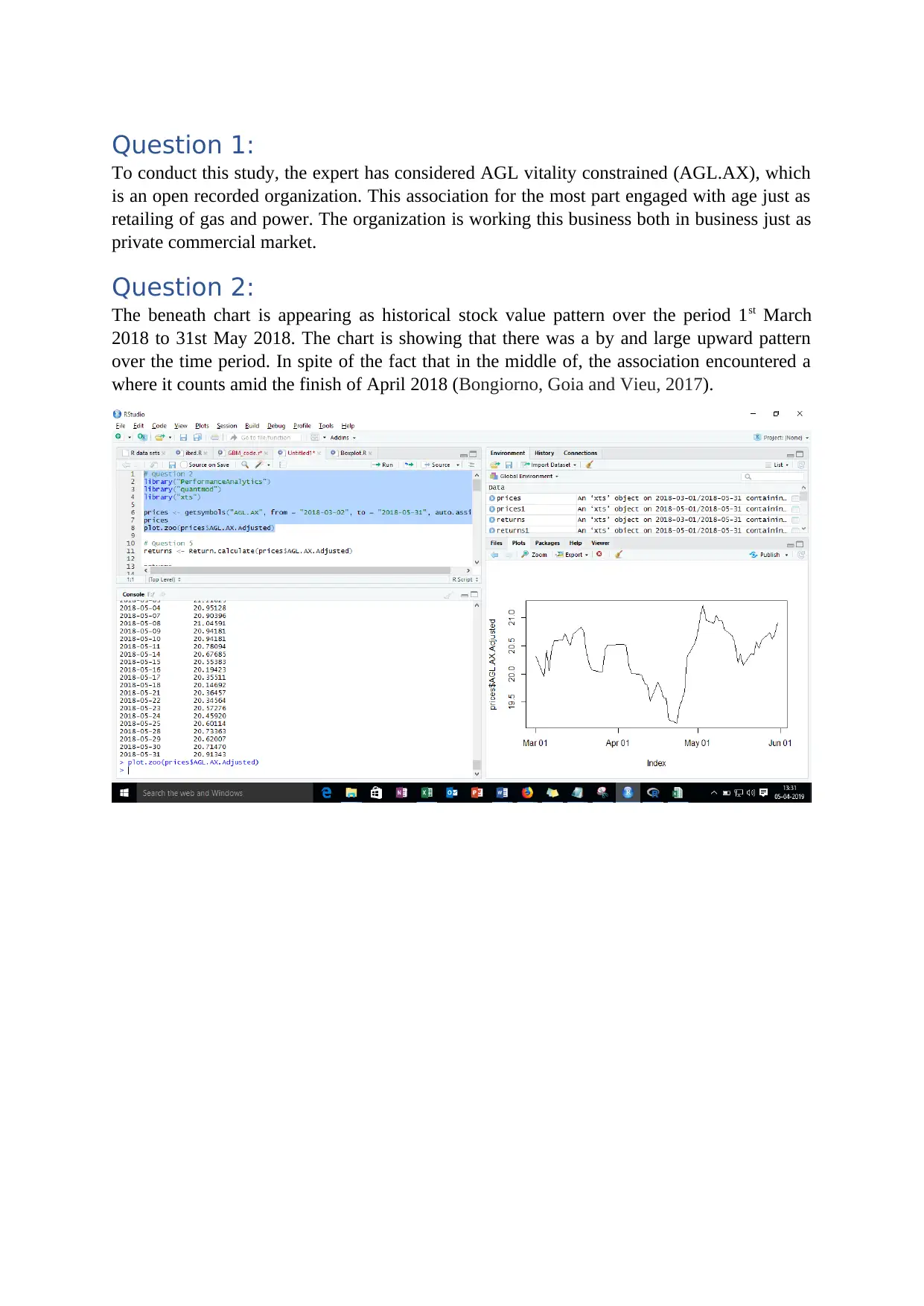
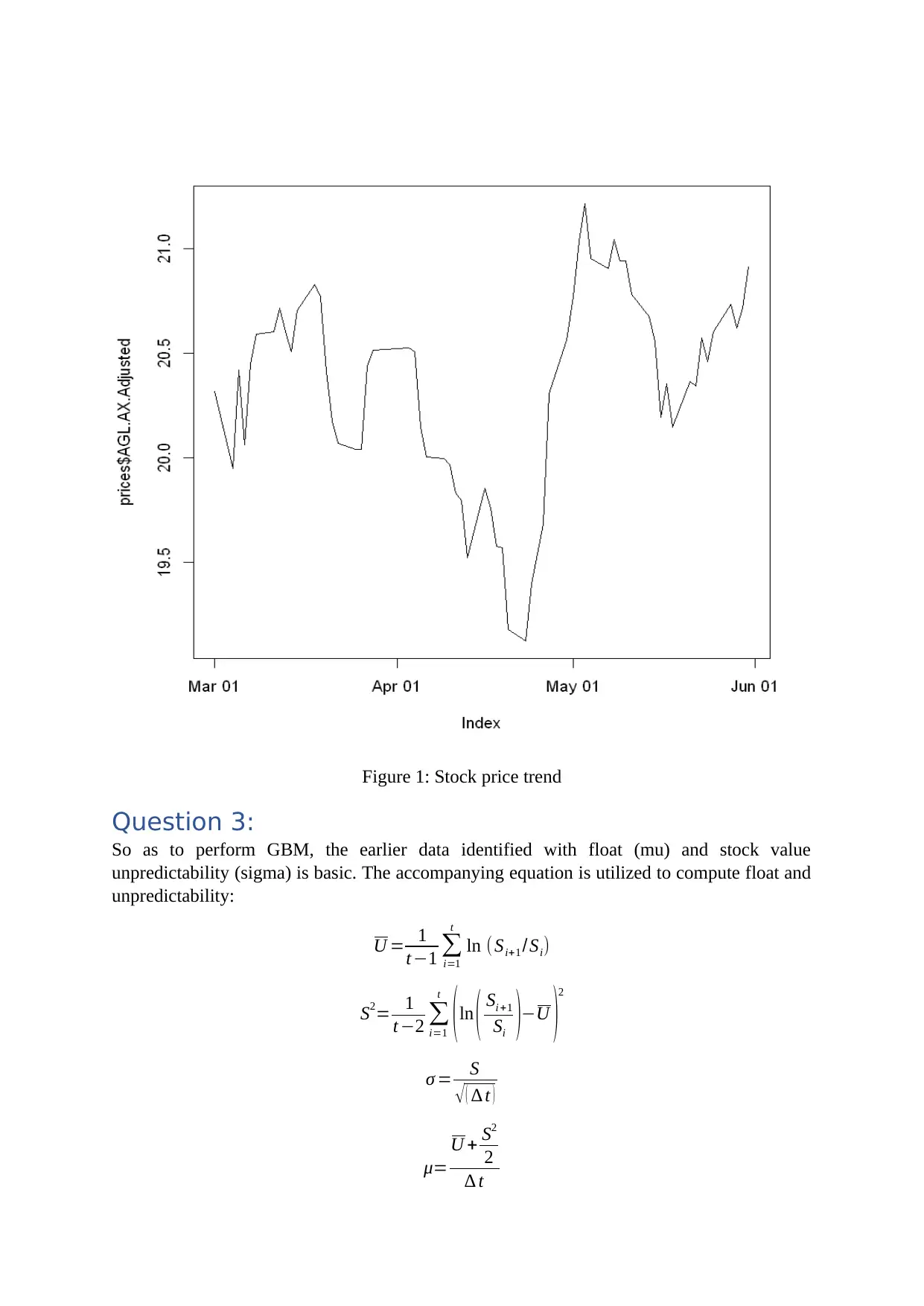
The beneath chart is appearing as historical stock value pattern over the period 1st March
2018 to 31st May 2018. The chart is showing that there was a by and large upward pattern
over the time period. In spite of the fact that in the middle of, the association encountered a
where it counts amid the finish of April 2018 (Bongiorno, Goia and Vieu, 2017).
To conduct this study, the expert has considered AGL vitality constrained (AGL.AX), which
is an open recorded organization. This association for the most part engaged with age just as
retailing of gas and power. The organization is working this business both in business just as
private commercial market.
Question 2:
The beneath chart is appearing as historical stock value pattern over the period 1st March
2018 to 31st May 2018. The chart is showing that there was a by and large upward pattern
over the time period. In spite of the fact that in the middle of, the association encountered a
where it counts amid the finish of April 2018 (Bongiorno, Goia and Vieu, 2017).
⊘ This is a preview!⊘
Do you want full access?
Subscribe today to unlock all pages.

Trusted by 1+ million students worldwide

Figure 1: Stock price trend
Question 3:
So as to perform GBM, the earlier data identified with float (mu) and stock value
unpredictability (sigma) is basic. The accompanying equation is utilized to compute float and
unpredictability:
U = 1
t−1 ∑
i=1
t
ln ( Si+1 /Si)
S2= 1
t −2 ∑
i=1
t
( ln ( Si +1
Si )−U )
2
σ = S
√ ( ∆ t )
μ=
U + S2
2
∆ t
Question 3:
So as to perform GBM, the earlier data identified with float (mu) and stock value
unpredictability (sigma) is basic. The accompanying equation is utilized to compute float and
unpredictability:
U = 1
t−1 ∑
i=1
t
ln ( Si+1 /Si)
S2= 1
t −2 ∑
i=1
t
( ln ( Si +1
Si )−U )
2
σ = S
√ ( ∆ t )
μ=
U + S2
2
∆ t
Paraphrase This Document
Need a fresh take? Get an instant paraphrase of this document with our AI Paraphraser

Question 4:
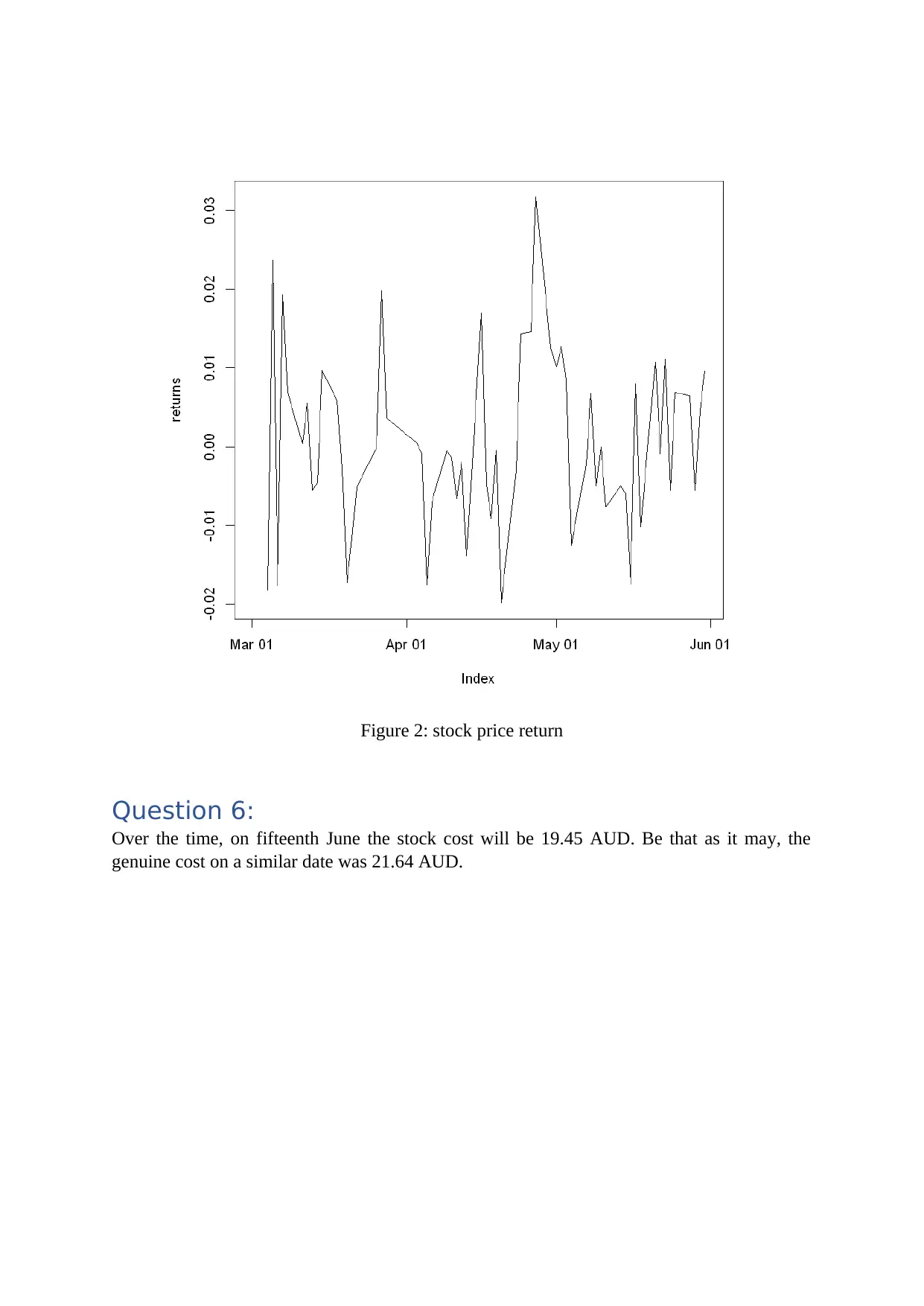
The primary criteria for GBM is that the stock cost has float rate of zero and change of 1.
This implies, the stock value return must pursue standard ordinary dispersion (Rao, 2015).
Here, the dissemination of stock value return did not pursue the standard typical circulation,
which is upheld by the underneath diagram (Kin, Hasan, and Hamdan, 2017):
Question 5:
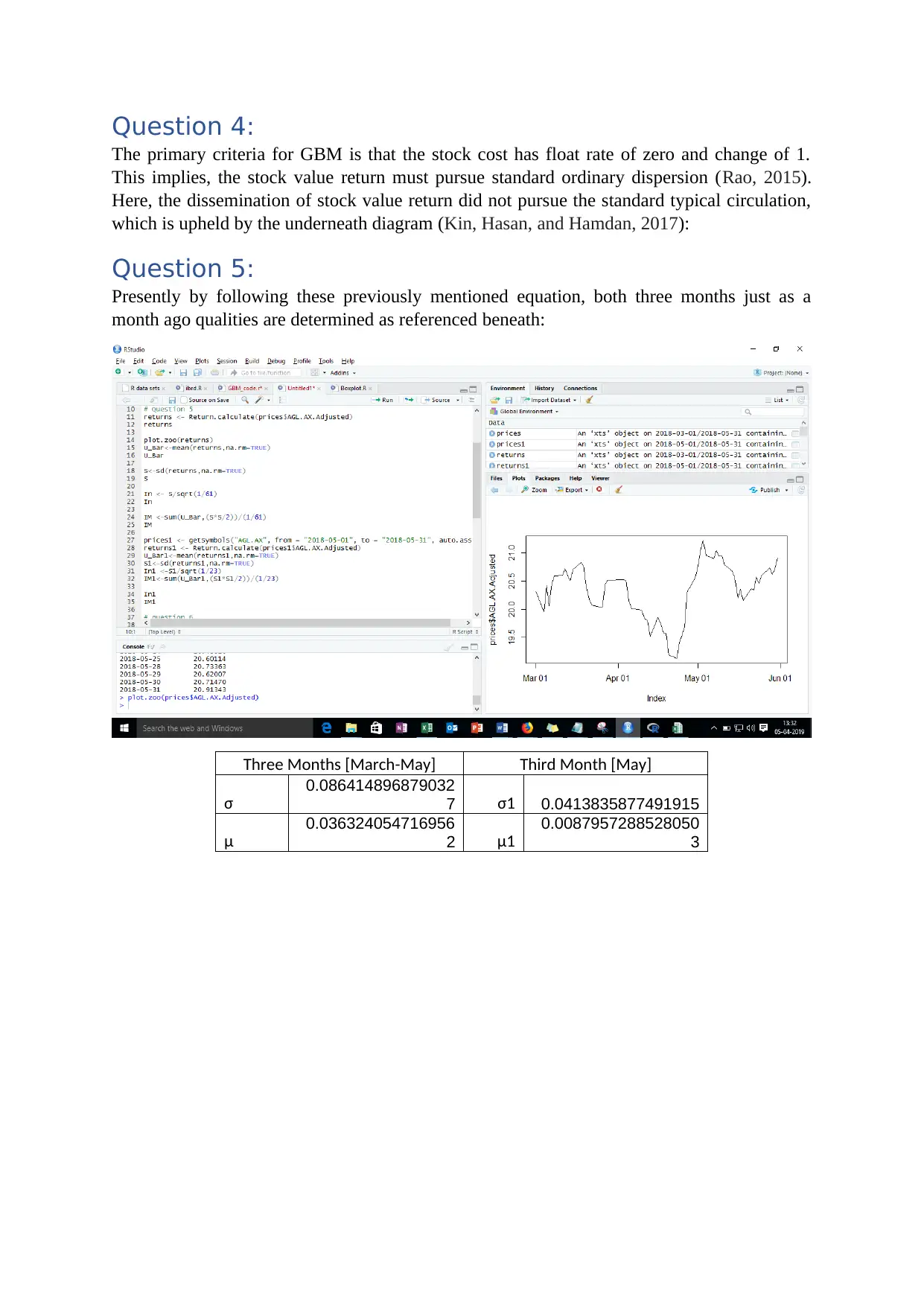
Presently by following these previously mentioned equation, both three months just as a
month ago qualities are determined as referenced beneath:
Three Months [March-May] Third Month [May]
σ
0.086414896879032
7 σ1 0.0413835877491915
μ
0.036324054716956
2 μ1
0.0087957288528050
3
The primary criteria for GBM is that the stock cost has float rate of zero and change of 1.
This implies, the stock value return must pursue standard ordinary dispersion (Rao, 2015).
Here, the dissemination of stock value return did not pursue the standard typical circulation,
which is upheld by the underneath diagram (Kin, Hasan, and Hamdan, 2017):
Question 5:
Presently by following these previously mentioned equation, both three months just as a
month ago qualities are determined as referenced beneath:
Three Months [March-May] Third Month [May]
σ
0.086414896879032
7 σ1 0.0413835877491915
μ
0.036324054716956
2 μ1
0.0087957288528050
3

Figure 2: stock price return
Question 6:
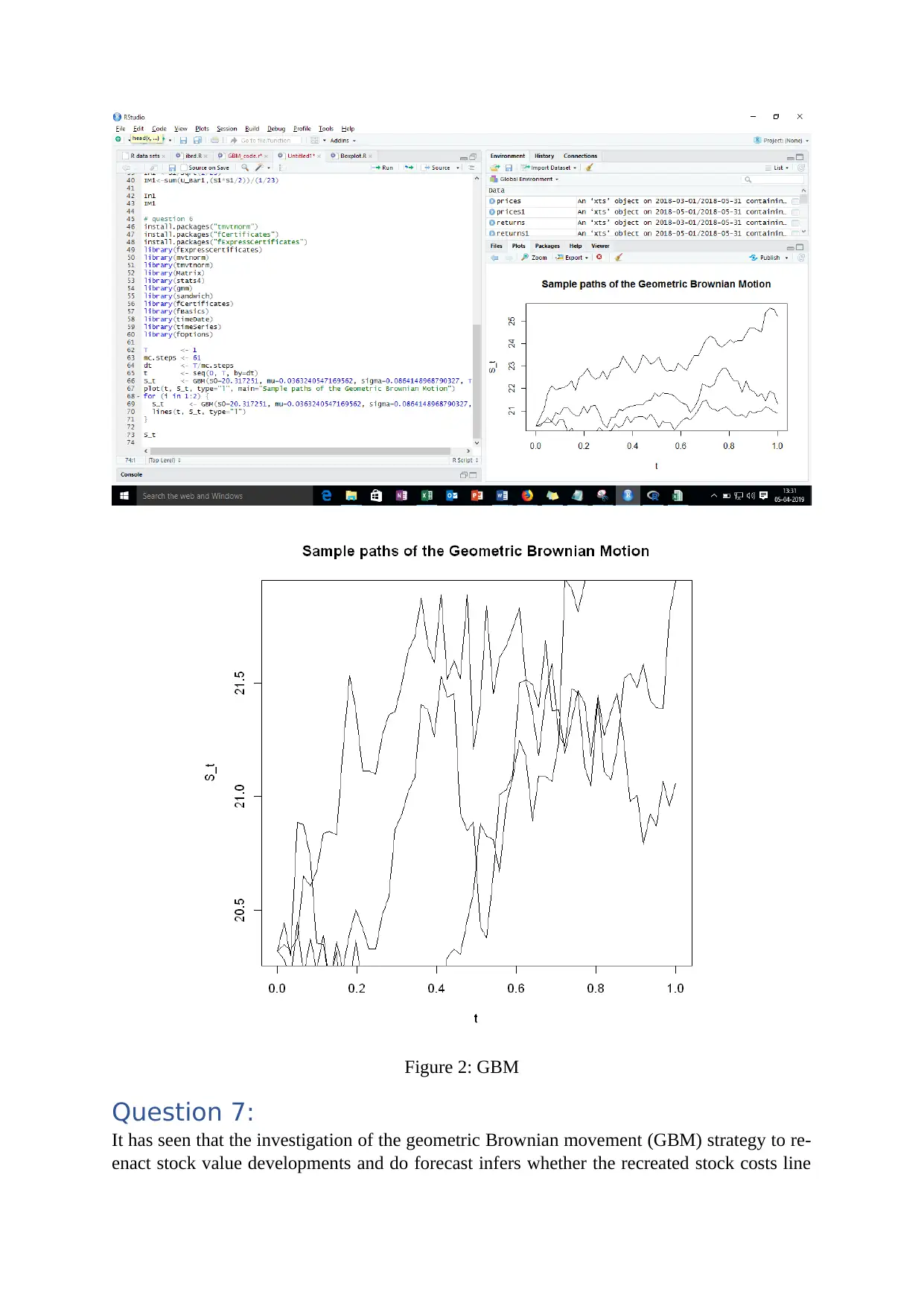
Over the time, on fifteenth June the stock cost will be 19.45 AUD. Be that as it may, the
genuine cost on a similar date was 21.64 AUD.
Question 6:
Over the time, on fifteenth June the stock cost will be 19.45 AUD. Be that as it may, the
genuine cost on a similar date was 21.64 AUD.
⊘ This is a preview!⊘
Do you want full access?
Subscribe today to unlock all pages.

Trusted by 1+ million students worldwide

Figure 2: GBM
Question 7:
It has seen that the investigation of the geometric Brownian movement (GBM) strategy to re-
enact stock value developments and do forecast infers whether the recreated stock costs line
Question 7:
It has seen that the investigation of the geometric Brownian movement (GBM) strategy to re-
enact stock value developments and do forecast infers whether the recreated stock costs line
Paraphrase This Document
Need a fresh take? Get an instant paraphrase of this document with our AI Paraphraser

up with real stock returns (Ramos et al. 2019). There was a decrease of unpredictability of
stock just as float esteem when the time span diminished to one moth from three months.
Notwithstanding, it has seen that the parameter was not steady after some time.
stock just as float esteem when the time span diminished to one moth from three months.
Notwithstanding, it has seen that the parameter was not steady after some time.

Reference:
Bongiorno, E.G., Goia, A. and Vieu, P., 2017. On the Geometric Brownian Motion
assumption for financial time series. In Functional Statistics and Related Fields (pp. 59-65).
Springer, Cham.
Kin, T.Y., Hasan, S.A. and Hamdan, N., 2017. Article 7 Forecasting the Financial Times
Stock Exchange Bursa Malaysia Kuala Lumpur Composite Index Using Geometric Brownian
Motion. Computing Research & Innovation (CRINN) Vol 2, October 2017, p.67.
Ramos, A.L., Mazzinghy, D.B., Barbosa, V.D.S.B., Oliveira, M.M. and Silva, G.R.D., 2019.
Evaluation of an iron ore price forecast using a geometric Brownian motion model. REM-
International Engineering Journal, 72(1), pp.9-15.
Rao, B.P., 2015. Option pricing for processes driven by mixed fractional Brownian motion
with superimposed jumps. Probability in the Engineering and Informational Sciences, 29(4),
pp.589-596.
Bongiorno, E.G., Goia, A. and Vieu, P., 2017. On the Geometric Brownian Motion
assumption for financial time series. In Functional Statistics and Related Fields (pp. 59-65).
Springer, Cham.
Kin, T.Y., Hasan, S.A. and Hamdan, N., 2017. Article 7 Forecasting the Financial Times
Stock Exchange Bursa Malaysia Kuala Lumpur Composite Index Using Geometric Brownian
Motion. Computing Research & Innovation (CRINN) Vol 2, October 2017, p.67.
Ramos, A.L., Mazzinghy, D.B., Barbosa, V.D.S.B., Oliveira, M.M. and Silva, G.R.D., 2019.
Evaluation of an iron ore price forecast using a geometric Brownian motion model. REM-
International Engineering Journal, 72(1), pp.9-15.
Rao, B.P., 2015. Option pricing for processes driven by mixed fractional Brownian motion
with superimposed jumps. Probability in the Engineering and Informational Sciences, 29(4),
pp.589-596.
⊘ This is a preview!⊘
Do you want full access?
Subscribe today to unlock all pages.

Trusted by 1+ million students worldwide

Appendix:
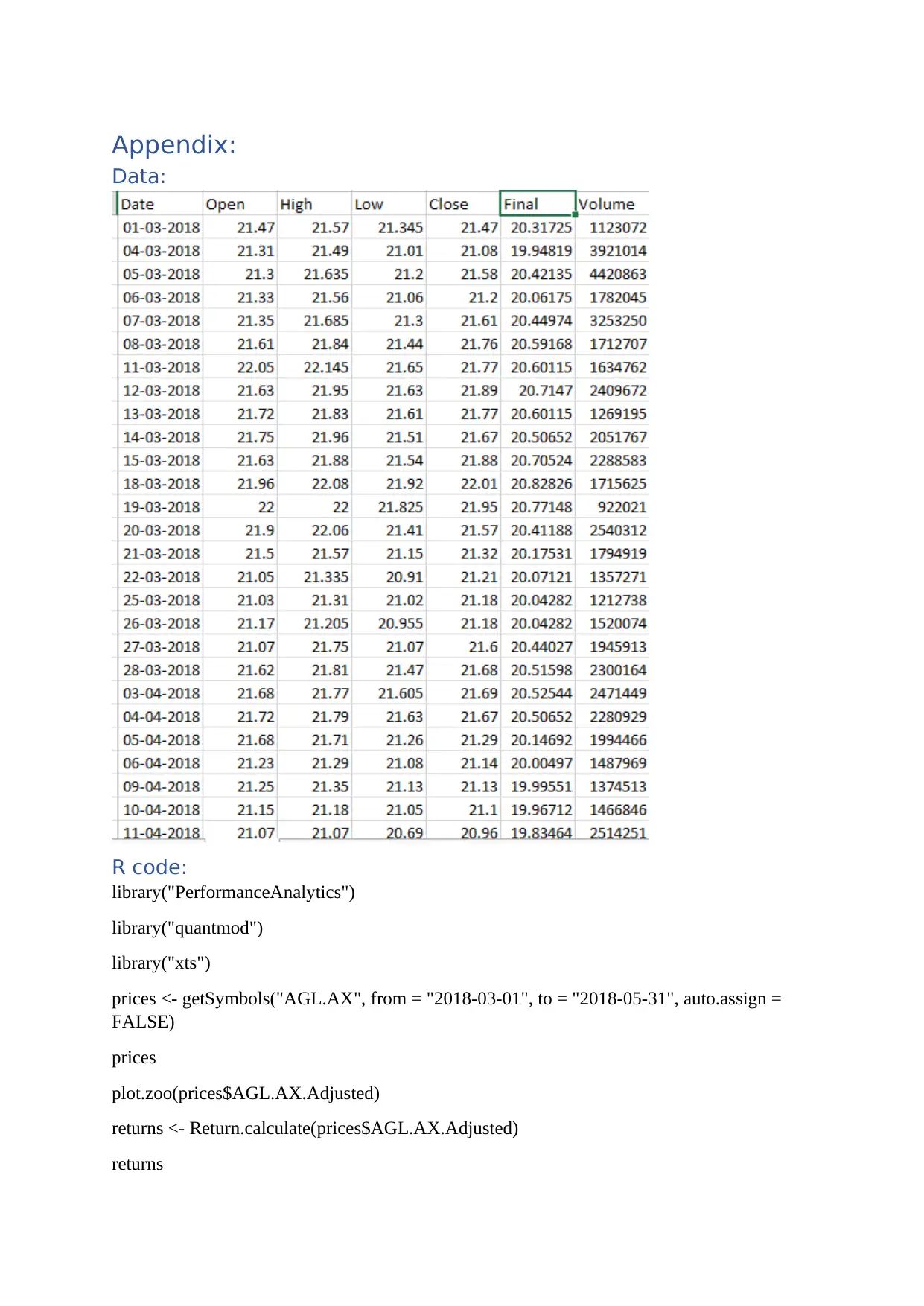
Data:
R code:
library("PerformanceAnalytics")
library("quantmod")
library("xts")
prices <- getSymbols("AGL.AX", from = "2018-03-01", to = "2018-05-31", auto.assign =
FALSE)
prices
plot.zoo(prices$AGL.AX.Adjusted)
returns <- Return.calculate(prices$AGL.AX.Adjusted)
returns
Data:
R code:
library("PerformanceAnalytics")
library("quantmod")
library("xts")
prices <- getSymbols("AGL.AX", from = "2018-03-01", to = "2018-05-31", auto.assign =
FALSE)
prices
plot.zoo(prices$AGL.AX.Adjusted)
returns <- Return.calculate(prices$AGL.AX.Adjusted)
returns
Paraphrase This Document
Need a fresh take? Get an instant paraphrase of this document with our AI Paraphraser

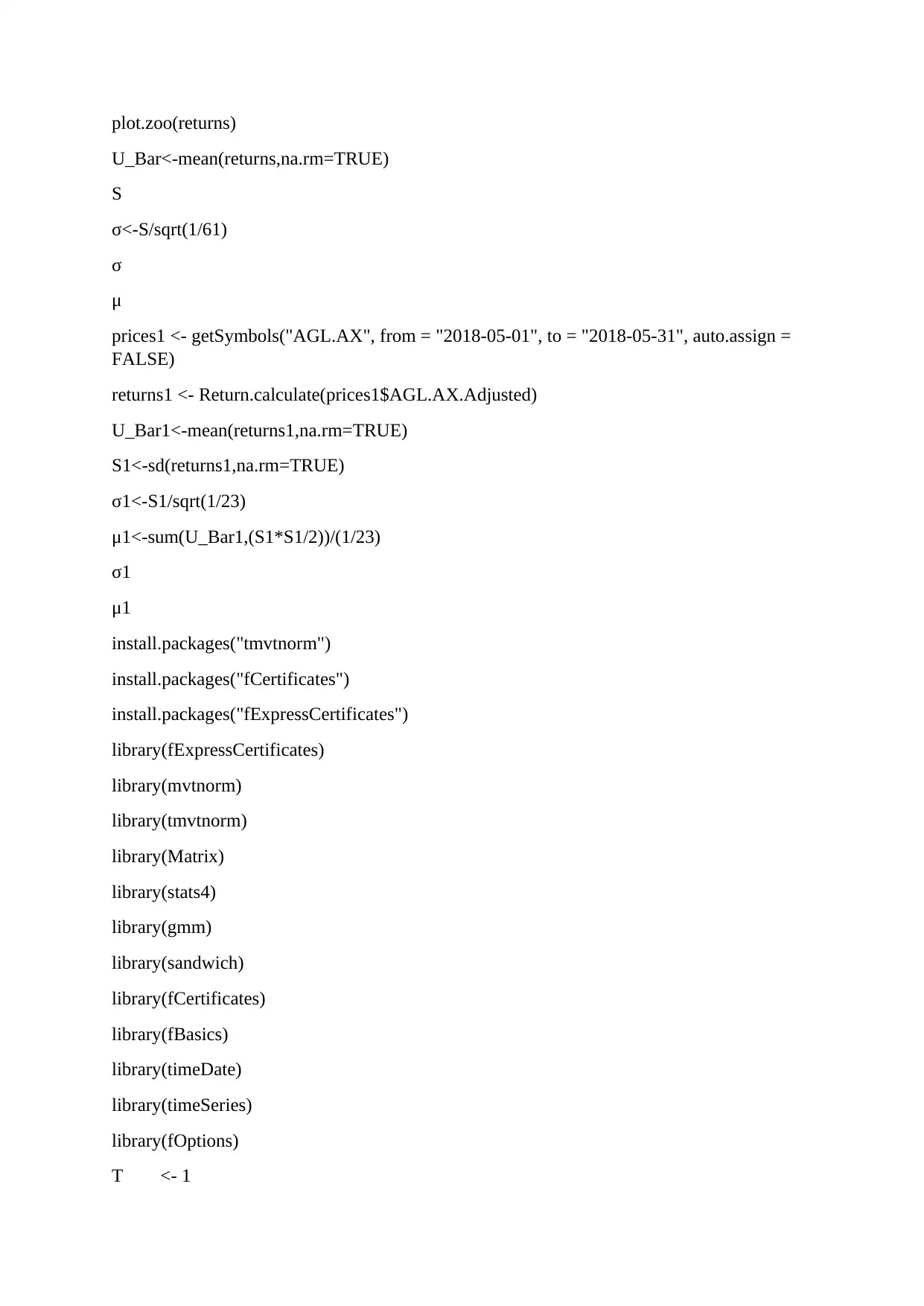
plot.zoo(returns)
U_Bar<-mean(returns,na.rm=TRUE)
S
σ<-S/sqrt(1/61)
σ
μ
prices1 <- getSymbols("AGL.AX", from = "2018-05-01", to = "2018-05-31", auto.assign =
FALSE)
returns1 <- Return.calculate(prices1$AGL.AX.Adjusted)
U_Bar1<-mean(returns1,na.rm=TRUE)
S1<-sd(returns1,na.rm=TRUE)
σ1<-S1/sqrt(1/23)
μ1<-sum(U_Bar1,(S1*S1/2))/(1/23)
σ1
μ1
install.packages("tmvtnorm")
install.packages("fCertificates")
install.packages("fExpressCertificates")
library(fExpressCertificates)
library(mvtnorm)
library(tmvtnorm)
library(Matrix)
library(stats4)
library(gmm)
library(sandwich)
library(fCertificates)
library(fBasics)
library(timeDate)
library(timeSeries)
library(fOptions)
T <- 1
U_Bar<-mean(returns,na.rm=TRUE)
S
σ<-S/sqrt(1/61)
σ
μ
prices1 <- getSymbols("AGL.AX", from = "2018-05-01", to = "2018-05-31", auto.assign =
FALSE)
returns1 <- Return.calculate(prices1$AGL.AX.Adjusted)
U_Bar1<-mean(returns1,na.rm=TRUE)
S1<-sd(returns1,na.rm=TRUE)
σ1<-S1/sqrt(1/23)
μ1<-sum(U_Bar1,(S1*S1/2))/(1/23)
σ1
μ1
install.packages("tmvtnorm")
install.packages("fCertificates")
install.packages("fExpressCertificates")
library(fExpressCertificates)
library(mvtnorm)
library(tmvtnorm)
library(Matrix)
library(stats4)
library(gmm)
library(sandwich)
library(fCertificates)
library(fBasics)
library(timeDate)
library(timeSeries)
library(fOptions)
T <- 1

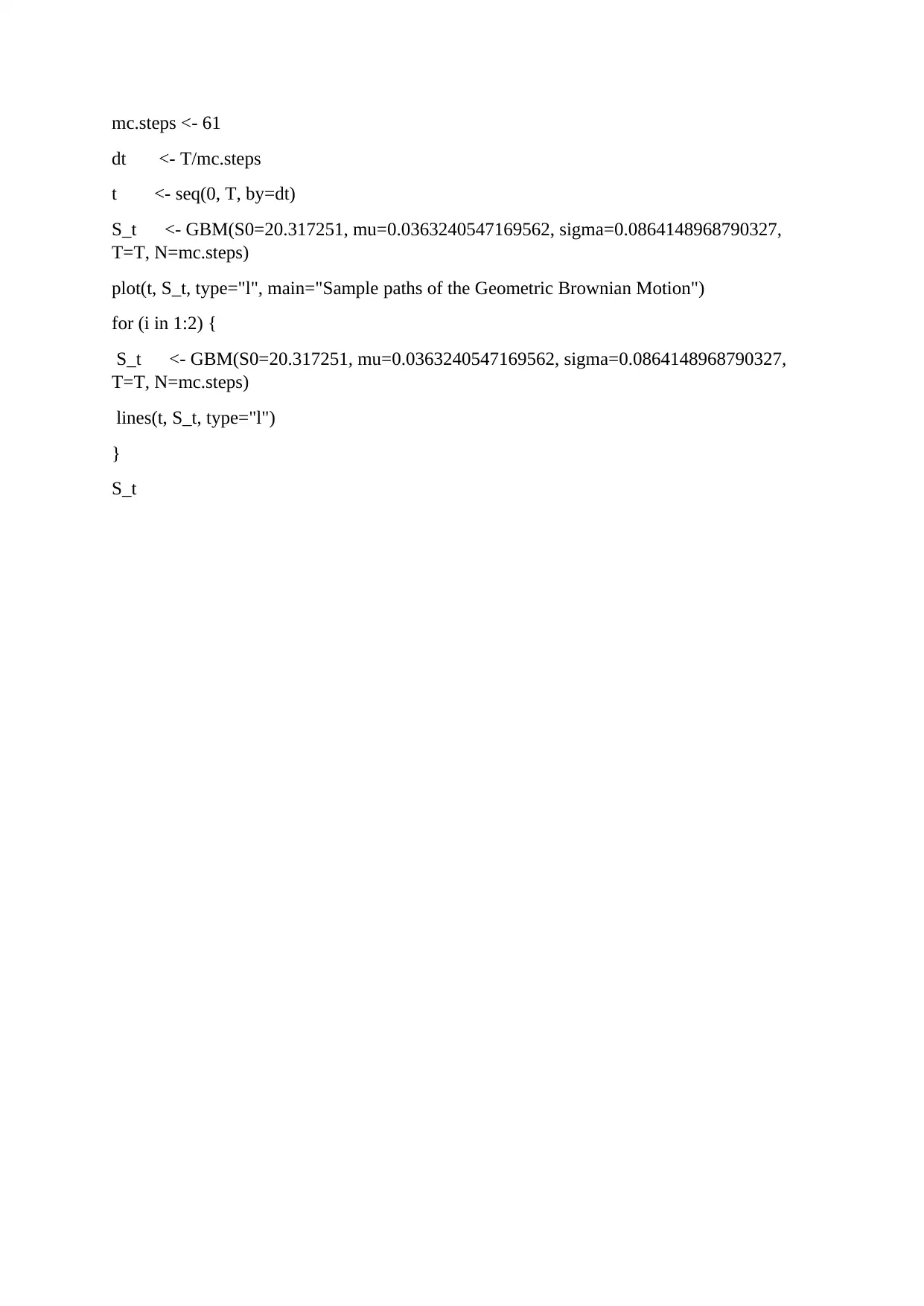
mc.steps <- 61
dt <- T/mc.steps
t <- seq(0, T, by=dt)
S_t <- GBM(S0=20.317251, mu=0.0363240547169562, sigma=0.0864148968790327,
T=T, N=mc.steps)
plot(t, S_t, type="l", main="Sample paths of the Geometric Brownian Motion")
for (i in 1:2) {
S_t <- GBM(S0=20.317251, mu=0.0363240547169562, sigma=0.0864148968790327,
T=T, N=mc.steps)
lines(t, S_t, type="l")
}
S_t
dt <- T/mc.steps
t <- seq(0, T, by=dt)
S_t <- GBM(S0=20.317251, mu=0.0363240547169562, sigma=0.0864148968790327,
T=T, N=mc.steps)
plot(t, S_t, type="l", main="Sample paths of the Geometric Brownian Motion")
for (i in 1:2) {
S_t <- GBM(S0=20.317251, mu=0.0363240547169562, sigma=0.0864148968790327,
T=T, N=mc.steps)
lines(t, S_t, type="l")
}
S_t
⊘ This is a preview!⊘
Do you want full access?
Subscribe today to unlock all pages.

Trusted by 1+ million students worldwide
1 out of 12
Related Documents
Your All-in-One AI-Powered Toolkit for Academic Success.
+13062052269
info@desklib.com
Available 24*7 on WhatsApp / Email
Unlock your academic potential
Copyright © 2020–2025 A2Z Services. All Rights Reserved. Developed and managed by ZUCOL.