Geotechnical Design 2: Practical, Construction, and Lab Report
VerifiedAdded on 2022/09/28
|12
|3268
|24
Report
AI Summary
This report presents a comprehensive analysis of geotechnical design principles, construction management strategies, and laboratory consolidation tests. The first section focuses on practical geotechnical engineering, including the identification of borehole data, generation of cross-sections, and the determination of soil parameters. The second section addresses construction management, specifically the application of the 'Just in Time' approach to address site restrictions, procurement issues, and leadership skills needed for timely project completion. The final section involves a laboratory consolidation test, where the student interprets data to obtain consolidation constants. The report highlights the importance of integrating theoretical knowledge with practical application in civil engineering projects. The report covers topics like borehole data analysis, cross-sectional development, soil parameter determination, construction management, and consolidation tests, providing a holistic view of geotechnical and construction engineering principles.

GEOTECHNICAL DESIGN 1
Geotechnical Design
Student Name
Institution Affiliation
Geotechnical Design
Student Name
Institution Affiliation

Paraphrase This Document
Need a fresh take? Get an instant paraphrase of this document with our AI Paraphraser
GEOTECHNICAL DESIGN 2
Task 1: Practical Geotechnical Engineering [40%]
For this, you will use the British Geological Surveys Onshore geo indexx to identify
appropriate borehole data. Http://mapapps2.bgs.ac.uk/geoindex/home.html Your task is to;
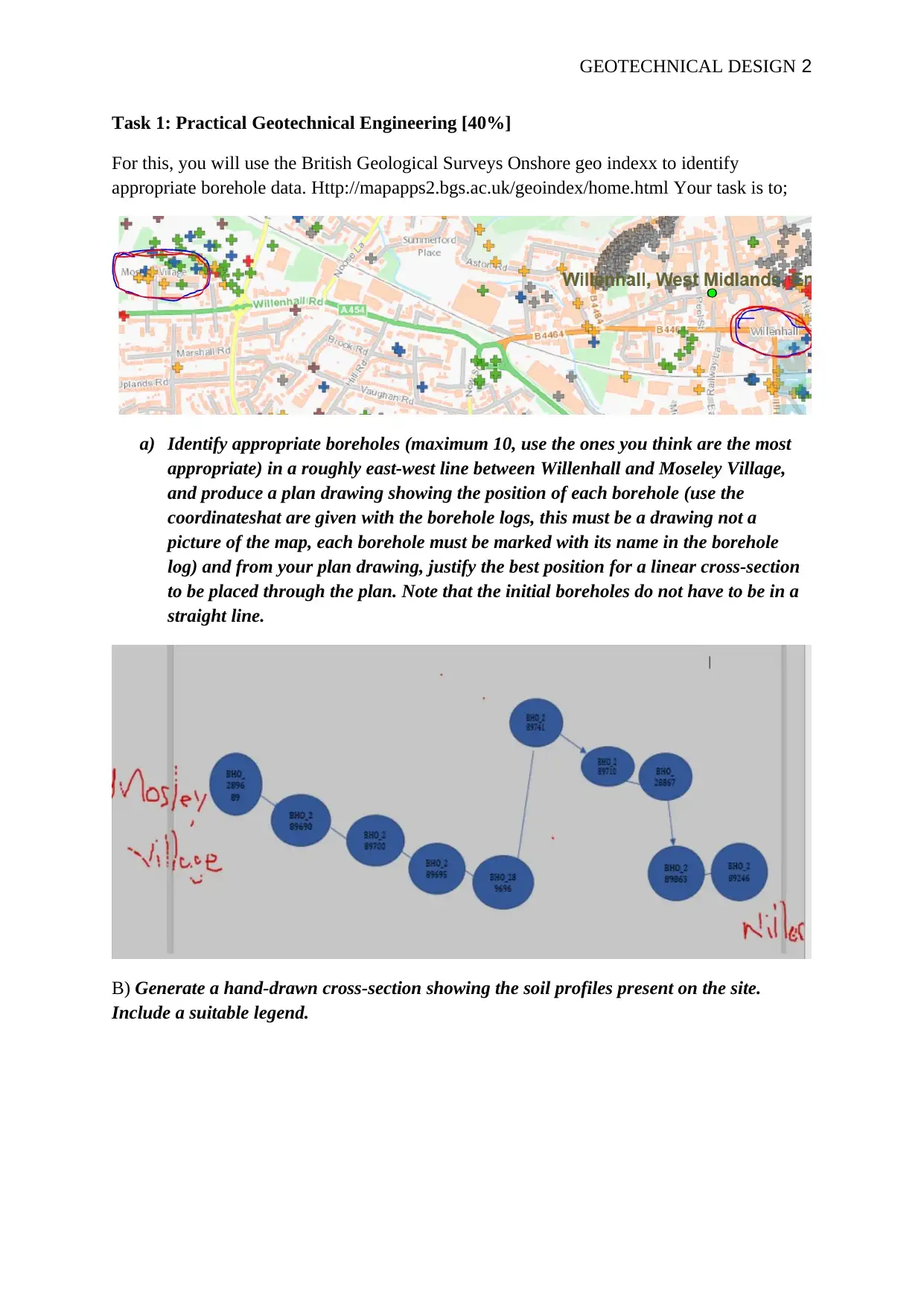
a) Identify appropriate boreholes (maximum 10, use the ones you think are the most
appropriate) in a roughly east-west line between Willenhall and Moseley Village,
and produce a plan drawing showing the position of each borehole (use the
coordinateshat are given with the borehole logs, this must be a drawing not a
picture of the map, each borehole must be marked with its name in the borehole
log) and from your plan drawing, justify the best position for a linear cross-section
to be placed through the plan. Note that the initial boreholes do not have to be in a
straight line.
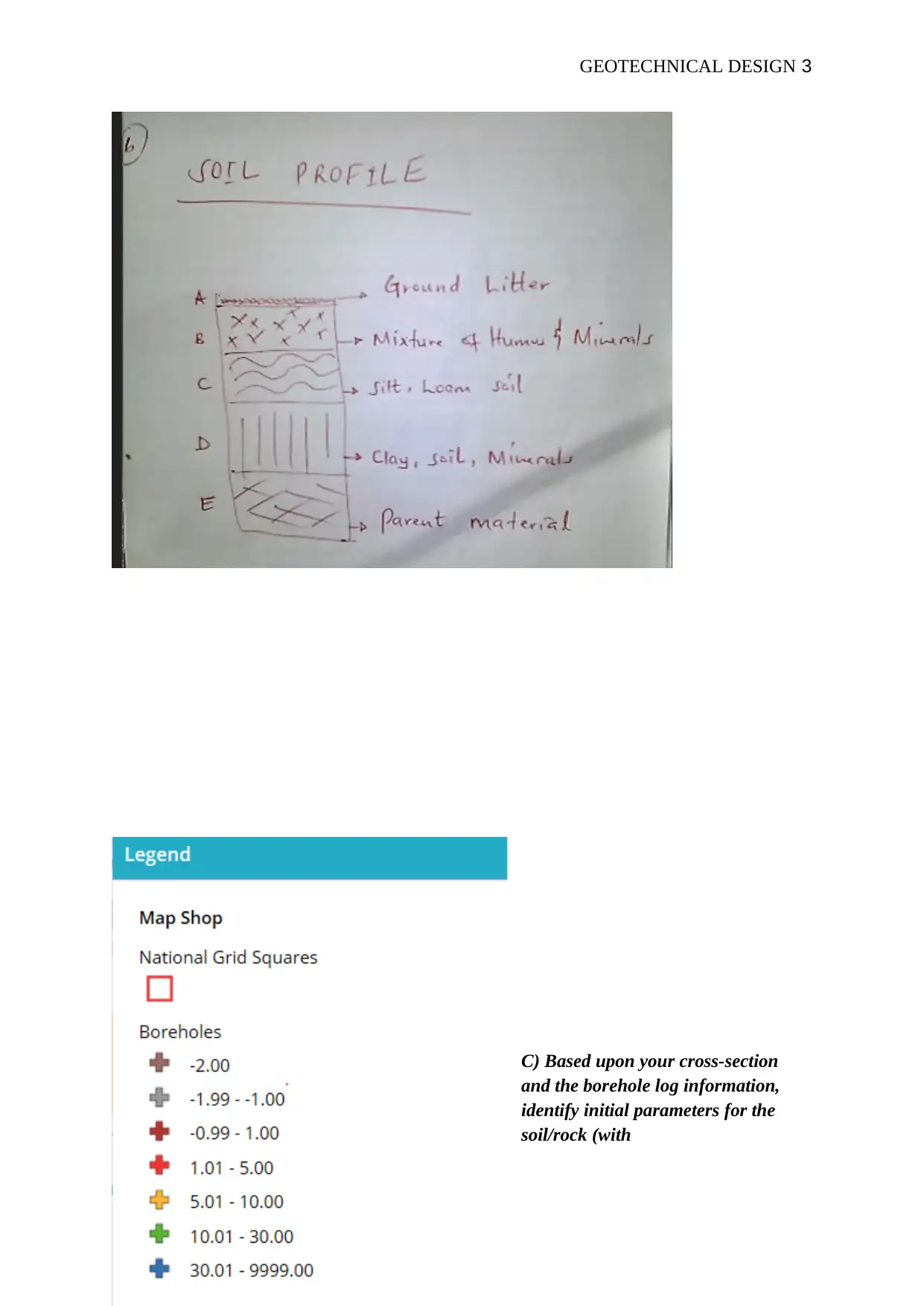
B) Generate a hand-drawn cross-section showing the soil profiles present on the site.
Include a suitable legend.
Task 1: Practical Geotechnical Engineering [40%]
For this, you will use the British Geological Surveys Onshore geo indexx to identify
appropriate borehole data. Http://mapapps2.bgs.ac.uk/geoindex/home.html Your task is to;
a) Identify appropriate boreholes (maximum 10, use the ones you think are the most
appropriate) in a roughly east-west line between Willenhall and Moseley Village,
and produce a plan drawing showing the position of each borehole (use the
coordinateshat are given with the borehole logs, this must be a drawing not a
picture of the map, each borehole must be marked with its name in the borehole
log) and from your plan drawing, justify the best position for a linear cross-section
to be placed through the plan. Note that the initial boreholes do not have to be in a
straight line.
B) Generate a hand-drawn cross-section showing the soil profiles present on the site.
Include a suitable legend.
GEOTECHNICAL DESIGN 3
C) Based upon your cross-section
and the borehole log information,
identify initial parameters for the
soil/rock (with
C) Based upon your cross-section
and the borehole log information,
identify initial parameters for the
soil/rock (with
⊘ This is a preview!⊘
Do you want full access?
Subscribe today to unlock all pages.

Trusted by 1+ million students worldwide
GEOTECHNICAL DESIGN 4
depth/location/geological material) from which preliminary geotechnical designs could be
carried out. (This requires you to
1. What field geotechnical parameters you have access to,
The various geotechnical parameters which requireccess in order to come up with the
preliminary geotechnical designs include:
Concentration and material indices,
Density gradient, (Burland et al.,
2012)
Stress ratio,
N-value,
Bearing capacity
Reaction modulus
2. What determinesss engineering parameters you would need?
The things which determinehe various mentioned engineering parameters includethe
characteristic values of the type of soil in the regions
The calibration of the resistance factors
The geotechnical information present (Fenton et al., 2015)
The method of calculation of various parameters
Also, it depends on the type of foundation laid in various structures within the region.
D) Based upon your cross-section, comment on the range of materials within the region
and how the ground conditions change across the region
Typically, from the cross-section of the two regions, the ground conditions of the place vary
depending on the time or rather the season. Additionally, the various projects which are takin
placee in the region also determinethe conditions of the ground.
Task 2: Construction Management [30%]
For this task, you are to assume that you are employed by a civil engineering company. Your
company has won a contract to carry out maintenance and remedial work along The Keyway
(A454 just outside Willenhall). The work is to take place during the evening and at
weekends. Your job as Chief Engineer is to oversee all the operations required to excavate
and replace defective sections of The Keyway. This section of the A454 is to remain open to
traffic throughout the period of the work. Actual timescales are not required for you to
undertake this task. Assumptions may be required, and you are to state these within your
answer. You are to compile a small report to your Directors informing them of the outcomes
to the following dilemmas.
a) The site is severely restricted and it is not possible for you to keep all materials
required for the work near the site. What is your strategy to complete the work using
the ‘Just in time’ approach?
depth/location/geological material) from which preliminary geotechnical designs could be
carried out. (This requires you to
1. What field geotechnical parameters you have access to,
The various geotechnical parameters which requireccess in order to come up with the
preliminary geotechnical designs include:
Concentration and material indices,
Density gradient, (Burland et al.,
2012)
Stress ratio,
N-value,
Bearing capacity
Reaction modulus
2. What determinesss engineering parameters you would need?
The things which determinehe various mentioned engineering parameters includethe
characteristic values of the type of soil in the regions
The calibration of the resistance factors
The geotechnical information present (Fenton et al., 2015)
The method of calculation of various parameters
Also, it depends on the type of foundation laid in various structures within the region.
D) Based upon your cross-section, comment on the range of materials within the region
and how the ground conditions change across the region
Typically, from the cross-section of the two regions, the ground conditions of the place vary
depending on the time or rather the season. Additionally, the various projects which are takin
placee in the region also determinethe conditions of the ground.
Task 2: Construction Management [30%]
For this task, you are to assume that you are employed by a civil engineering company. Your
company has won a contract to carry out maintenance and remedial work along The Keyway
(A454 just outside Willenhall). The work is to take place during the evening and at
weekends. Your job as Chief Engineer is to oversee all the operations required to excavate
and replace defective sections of The Keyway. This section of the A454 is to remain open to
traffic throughout the period of the work. Actual timescales are not required for you to
undertake this task. Assumptions may be required, and you are to state these within your
answer. You are to compile a small report to your Directors informing them of the outcomes
to the following dilemmas.
a) The site is severely restricted and it is not possible for you to keep all materials
required for the work near the site. What is your strategy to complete the work using
the ‘Just in time’ approach?
Paraphrase This Document
Need a fresh take? Get an instant paraphrase of this document with our AI Paraphraser
GEOTECHNICAL DESIGN 5
Issue
The site has been severely restricted thus making it difficult to keep/ store all the materials
that are required within the construction site.
Strategy
Just in time approach.
Each and every project is scheduled for some time constraints period. In some instances, the
schedule is beaten, and the project is completed earlier before the date in which completion
was expected. However, this should not be the case and in most cases, it is discouraged.
Majorly, it provides a great improvement when it comes to time and cost management. Its
major objectives is to meet the timeliness and also ensure the requirements are succinctly
followed. Just in time approach is the most appropriate in addressing this issue. In order to be
able to achieve the major goal, the first thing to ensure is that the initial resource allocation is
considered against the minimum overtime construction work. While the construction will be
on progress, one thing which also must be availed is the constant project control, which will
be aimed at monitoring the resources and progress only upon a matter of urgency or
requirement. The approach will be applied by means of just availing only the necessary
resources which are required in the site. In this way, the other materials and resources which
may not be necessary within the site will be eliminated thus preventing any issues related to
security. Further, it will be beneficial as it will prevent wastage of products while increasing
the efficiency of the work which is being done (juang & wang, 2013). Some notable
advantages in the just in time approach includes;
Minimisation of waste of the materials, efforts, finances as well as other logistics which
would rather been incurred. Also, efficiency of the logistics is enhanced through the just in
time approach. Kind et al., noted that when prefabrication is incorporated into just in time
approach, the impacts of the construction process sis minimized with the reductions in the
transportation as well as the impacts n the environment. For large projects, it also entails a
reduction in the traffic sector, as well as in the education of the contractors.
Another benefit of the just in approach when applied in this situation is that the risks related
to storage issues will be significantly reduced such as damage and theft. Normally, the safety
of the materials in the construction filed is not guaranteed, that why, this approach will be the
most effective solution. 1131739
Nonetheless, the adoption of the methodology necessitates for extra expenses for it to
guarantee long term risk reductions and savings for both the suppliers and the contractors.
Previously, it was found to helps in saving close to fifteen per cent of the labour costs as well
as the materials which are used.
The construction project is characterized by the small value of specific materials in
comparison with manufactory and a numerous specification position. Thus, JIT requires a
good project infrastructure that includes people skills and technologies. Inadequate staff
attitude sometimes lead to the ignoring of the potential problem before it becomes the
Issue
The site has been severely restricted thus making it difficult to keep/ store all the materials
that are required within the construction site.
Strategy
Just in time approach.
Each and every project is scheduled for some time constraints period. In some instances, the
schedule is beaten, and the project is completed earlier before the date in which completion
was expected. However, this should not be the case and in most cases, it is discouraged.
Majorly, it provides a great improvement when it comes to time and cost management. Its
major objectives is to meet the timeliness and also ensure the requirements are succinctly
followed. Just in time approach is the most appropriate in addressing this issue. In order to be
able to achieve the major goal, the first thing to ensure is that the initial resource allocation is
considered against the minimum overtime construction work. While the construction will be
on progress, one thing which also must be availed is the constant project control, which will
be aimed at monitoring the resources and progress only upon a matter of urgency or
requirement. The approach will be applied by means of just availing only the necessary
resources which are required in the site. In this way, the other materials and resources which
may not be necessary within the site will be eliminated thus preventing any issues related to
security. Further, it will be beneficial as it will prevent wastage of products while increasing
the efficiency of the work which is being done (juang & wang, 2013). Some notable
advantages in the just in time approach includes;
Minimisation of waste of the materials, efforts, finances as well as other logistics which
would rather been incurred. Also, efficiency of the logistics is enhanced through the just in
time approach. Kind et al., noted that when prefabrication is incorporated into just in time
approach, the impacts of the construction process sis minimized with the reductions in the
transportation as well as the impacts n the environment. For large projects, it also entails a
reduction in the traffic sector, as well as in the education of the contractors.
Another benefit of the just in approach when applied in this situation is that the risks related
to storage issues will be significantly reduced such as damage and theft. Normally, the safety
of the materials in the construction filed is not guaranteed, that why, this approach will be the
most effective solution. 1131739
Nonetheless, the adoption of the methodology necessitates for extra expenses for it to
guarantee long term risk reductions and savings for both the suppliers and the contractors.
Previously, it was found to helps in saving close to fifteen per cent of the labour costs as well
as the materials which are used.
The construction project is characterized by the small value of specific materials in
comparison with manufactory and a numerous specification position. Thus, JIT requires a
good project infrastructure that includes people skills and technologies. Inadequate staff
attitude sometimes lead to the ignoring of the potential problem before it becomes the
GEOTECHNICAL DESIGN 6
reasoned. The delay in planning and managing in two days may lead to the two months
delays in the project (opfer, 2011)
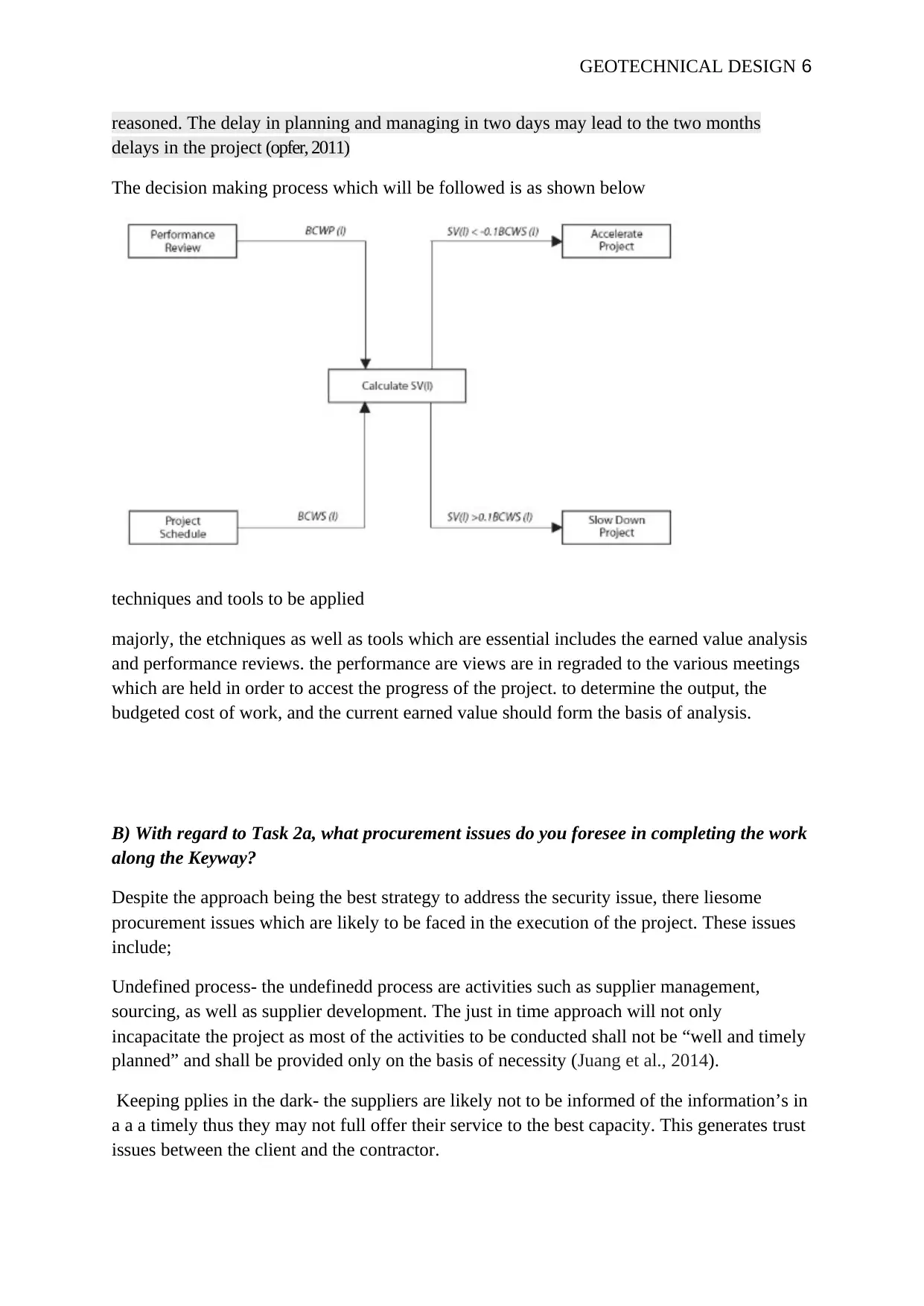
The decision making process which will be followed is as shown below
techniques and tools to be applied
majorly, the etchniques as well as tools which are essential includes the earned value analysis
and performance reviews. the performance are views are in regraded to the various meetings
which are held in order to accest the progress of the project. to determine the output, the
budgeted cost of work, and the current earned value should form the basis of analysis.
B) With regard to Task 2a, what procurement issues do you foresee in completing the work
along the Keyway?
Despite the approach being the best strategy to address the security issue, there liesome
procurement issues which are likely to be faced in the execution of the project. These issues
include;
Undefined process- the undefinedd process are activities such as supplier management,
sourcing, as well as supplier development. The just in time approach will not only
incapacitate the project as most of the activities to be conducted shall not be “well and timely
planned” and shall be provided only on the basis of necessity (Juang et al., 2014).
Keeping pplies in the dark- the suppliers are likely not to be informed of the information’s in
a a a timely thus they may not full offer their service to the best capacity. This generates trust
issues between the client and the contractor.
reasoned. The delay in planning and managing in two days may lead to the two months
delays in the project (opfer, 2011)
The decision making process which will be followed is as shown below
techniques and tools to be applied
majorly, the etchniques as well as tools which are essential includes the earned value analysis
and performance reviews. the performance are views are in regraded to the various meetings
which are held in order to accest the progress of the project. to determine the output, the
budgeted cost of work, and the current earned value should form the basis of analysis.
B) With regard to Task 2a, what procurement issues do you foresee in completing the work
along the Keyway?
Despite the approach being the best strategy to address the security issue, there liesome
procurement issues which are likely to be faced in the execution of the project. These issues
include;
Undefined process- the undefinedd process are activities such as supplier management,
sourcing, as well as supplier development. The just in time approach will not only
incapacitate the project as most of the activities to be conducted shall not be “well and timely
planned” and shall be provided only on the basis of necessity (Juang et al., 2014).
Keeping pplies in the dark- the suppliers are likely not to be informed of the information’s in
a a a timely thus they may not full offer their service to the best capacity. This generates trust
issues between the client and the contractor.
⊘ This is a preview!⊘
Do you want full access?
Subscribe today to unlock all pages.
Trusted by 1+ million students worldwide
GEOTECHNICAL DESIGN 7
Product quality issues- the products which are to be used may not b fully up to the standards
quality which is anticipated. This comes due to the frequent ordering of the resources and at
times it is costly on the side of the supplier to keep purchasing products one by one, instead
of just the overall resource listing.
Provision of unclear requirements- when the orders keep coming in attenuated form, it
becomes difficult to properly project the correct resources and the procurement team may
likely face the challenge of unclear requirements (Juang et al., 2013)
Lack of understanding the capability of the supplier- when the resources are being ordered for
at the time of necessity, it becomes tricky more s when there is no clear comprehension of the
supplier’s capability, who might be faced with various challenges and ending up passing the
unlikely outcomes to the project in question
Unnecessary risk acceptance- the just in approach is likely to be faced with unnecessary risks
during the process. The risk include delays and time delivery constraintss among others
Lack of proper synchronization- with the delivery of resources upon necessity, it means that
most of these resources required for the excavation activities will be garnered from different
areas. There is likeliness that the overall task may not be well synchronized as the products
are purchased from different avenues.
b) What leadership skills will you have to employ for the work to be completed on time
and budget and how will you carry them out?
Project management in terms of the time and resources isone key area which calls for a lot of
commitment. As the project team leader for this particular project, there are various skills
which I will have to employ time and againto ensure that their timely completion of the
project as well as the task with increased efficiency. Majorly, the focus will be controlling
and developing the project schedule. Some of these skills will include; (Orr & Farell, 2012)
Developing a schedule; in order to develop a schedule, there are three basic things that first
needo be done. These include defining the activities, sequencing of the activities and finally
estimating timelineor these activities.
Defining activities- defining the activities entails noting all the activities which need to be
done, through the use of work breakdown structure which will be developed during the
project scope management. All the variables which are required forr the completion of the
project are noted down in a succinct manner. All the activities which are to be conducted for
the particular timelines are also defined objectively (Péron et al., 2011)
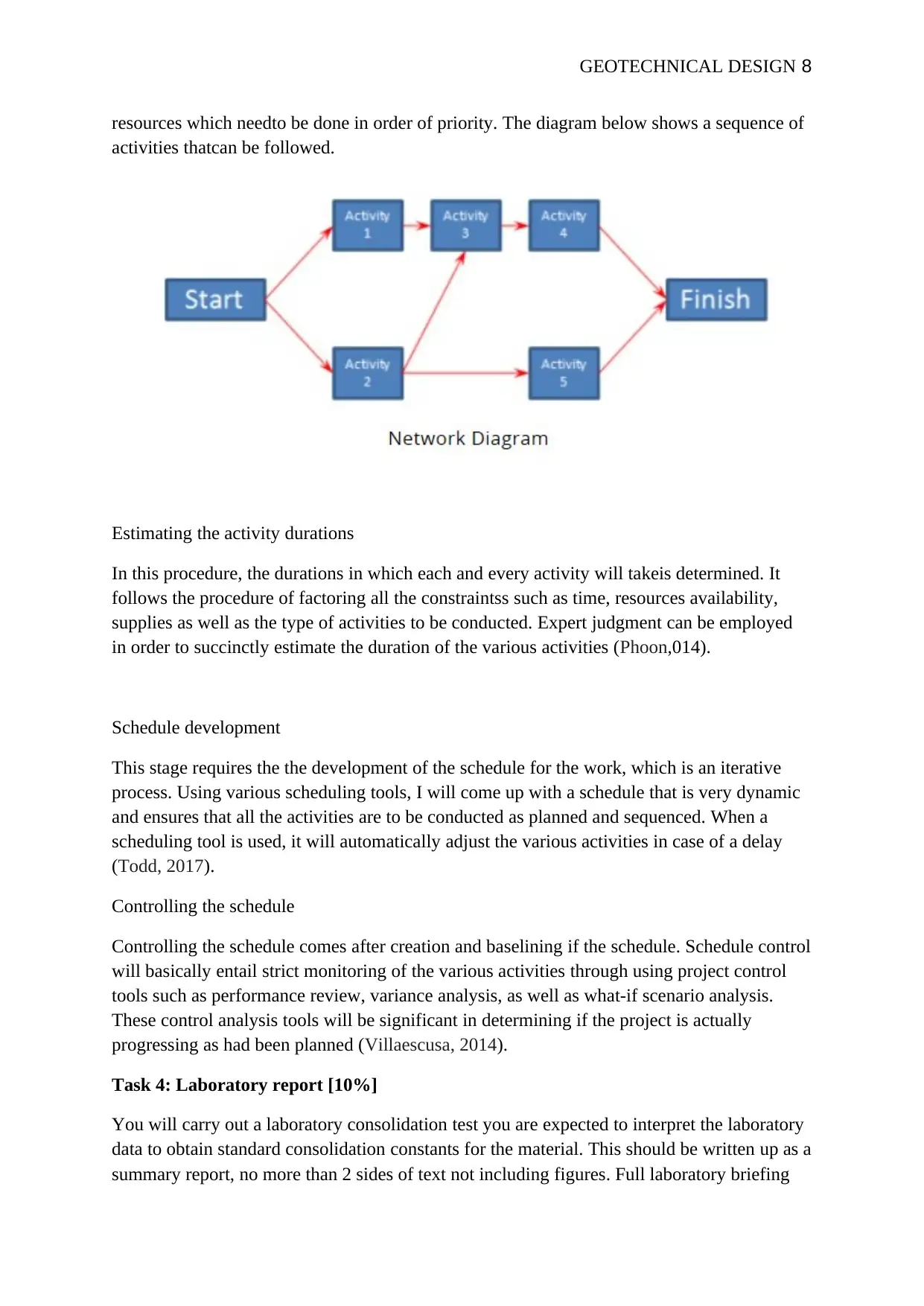
Sequence activities- after all the activities have been set, the next procedure is
Determining the order in which the activities need to be done. In order to do this, it requires
understanding the relationship between the various activities. By comprehending the
relationship between the various activities, it will be easy to determine the activities and
Product quality issues- the products which are to be used may not b fully up to the standards
quality which is anticipated. This comes due to the frequent ordering of the resources and at
times it is costly on the side of the supplier to keep purchasing products one by one, instead
of just the overall resource listing.
Provision of unclear requirements- when the orders keep coming in attenuated form, it
becomes difficult to properly project the correct resources and the procurement team may
likely face the challenge of unclear requirements (Juang et al., 2013)
Lack of understanding the capability of the supplier- when the resources are being ordered for
at the time of necessity, it becomes tricky more s when there is no clear comprehension of the
supplier’s capability, who might be faced with various challenges and ending up passing the
unlikely outcomes to the project in question
Unnecessary risk acceptance- the just in approach is likely to be faced with unnecessary risks
during the process. The risk include delays and time delivery constraintss among others
Lack of proper synchronization- with the delivery of resources upon necessity, it means that
most of these resources required for the excavation activities will be garnered from different
areas. There is likeliness that the overall task may not be well synchronized as the products
are purchased from different avenues.
b) What leadership skills will you have to employ for the work to be completed on time
and budget and how will you carry them out?
Project management in terms of the time and resources isone key area which calls for a lot of
commitment. As the project team leader for this particular project, there are various skills
which I will have to employ time and againto ensure that their timely completion of the
project as well as the task with increased efficiency. Majorly, the focus will be controlling
and developing the project schedule. Some of these skills will include; (Orr & Farell, 2012)
Developing a schedule; in order to develop a schedule, there are three basic things that first
needo be done. These include defining the activities, sequencing of the activities and finally
estimating timelineor these activities.
Defining activities- defining the activities entails noting all the activities which need to be
done, through the use of work breakdown structure which will be developed during the
project scope management. All the variables which are required forr the completion of the
project are noted down in a succinct manner. All the activities which are to be conducted for
the particular timelines are also defined objectively (Péron et al., 2011)
Sequence activities- after all the activities have been set, the next procedure is
Determining the order in which the activities need to be done. In order to do this, it requires
understanding the relationship between the various activities. By comprehending the
relationship between the various activities, it will be easy to determine the activities and
Paraphrase This Document
Need a fresh take? Get an instant paraphrase of this document with our AI Paraphraser
GEOTECHNICAL DESIGN 8
resources which needto be done in order of priority. The diagram below shows a sequence of
activities thatcan be followed.
Estimating the activity durations
In this procedure, the durations in which each and every activity will takeis determined. It
follows the procedure of factoring all the constraintss such as time, resources availability,
supplies as well as the type of activities to be conducted. Expert judgment can be employed
in order to succinctly estimate the duration of the various activities (Phoon,014).
Schedule development
This stage requires the the development of the schedule for the work, which is an iterative
process. Using various scheduling tools, I will come up with a schedule that is very dynamic
and ensures that all the activities are to be conducted as planned and sequenced. When a
scheduling tool is used, it will automatically adjust the various activities in case of a delay
(Todd, 2017).
Controlling the schedule
Controlling the schedule comes after creation and baselining if the schedule. Schedule control
will basically entail strict monitoring of the various activities through using project control
tools such as performance review, variance analysis, as well as what-if scenario analysis.
These control analysis tools will be significant in determining if the project is actually
progressing as had been planned (Villaescusa, 2014).
Task 4: Laboratory report [10%]
You will carry out a laboratory consolidation test you are expected to interpret the laboratory
data to obtain standard consolidation constants for the material. This should be written up as a
summary report, no more than 2 sides of text not including figures. Full laboratory briefing
resources which needto be done in order of priority. The diagram below shows a sequence of
activities thatcan be followed.
Estimating the activity durations
In this procedure, the durations in which each and every activity will takeis determined. It
follows the procedure of factoring all the constraintss such as time, resources availability,
supplies as well as the type of activities to be conducted. Expert judgment can be employed
in order to succinctly estimate the duration of the various activities (Phoon,014).
Schedule development
This stage requires the the development of the schedule for the work, which is an iterative
process. Using various scheduling tools, I will come up with a schedule that is very dynamic
and ensures that all the activities are to be conducted as planned and sequenced. When a
scheduling tool is used, it will automatically adjust the various activities in case of a delay
(Todd, 2017).
Controlling the schedule
Controlling the schedule comes after creation and baselining if the schedule. Schedule control
will basically entail strict monitoring of the various activities through using project control
tools such as performance review, variance analysis, as well as what-if scenario analysis.
These control analysis tools will be significant in determining if the project is actually
progressing as had been planned (Villaescusa, 2014).
Task 4: Laboratory report [10%]
You will carry out a laboratory consolidation test you are expected to interpret the laboratory
data to obtain standard consolidation constants for the material. This should be written up as a
summary report, no more than 2 sides of text not including figures. Full laboratory briefing
GEOTECHNICAL DESIGN 9
details will be provided nearer to the time. This will include a Health & Safety Risk
Assessment.
Observation of Consolidation Test Value
Height of Ring (Clay) mm 20
Diameter of ring (Clay) mm 74
Area of ring (Clay) A mm2 4298.66
Initial height of specimen, H mm 20
Volume of ring (Clay) Vc = A x H x 10-3 mm3 85973.2
Weight of ring g 116
Weight of ring + soil specimen g 298.5
Initial weight of soil specimen Mc g 182.5
Bulk density ρb = Mc / Vc g / cm3 0.002122
Initial water content
Final weight of soil specimen g
Final water content
Weight of ring + mug + soil 294.6
Mass top plate - Mplate
kg
0.146
Mass piston - Mpiston kg 0.362
M1 = Mplate + Mpiston kg 0.508
Weigh of container 1 g 45.7
Weight of container 1 + Sample 1 62
Weight of sample 1 16.3
Weight of sample 1 (Dry) 11.86
Weigh of container 2 46
Weigh of container 2 + Sample 2 60.3
Weight of sample 2 14.3
Weight of sample 2 (Dry) 7.98
Use the following tables to record the test data. Items in bold are recorded
Soil specific gravity assumed G = 2.65 Hanger Multiplier = 10
Sample type: Potters Clay
Load: 10 kg
Time (min) Vertical dial gauge reading Sample thickness
0 0
¼ (15 sec) 0.183
1 0.252
2 ¼ 0.318
4 0.375
9 0.494
16 0.606
25 0.704
36 0.779
Load: 15 kg
Time (min) Vertical dial gauge reading Sample thickness
0 0.0014
details will be provided nearer to the time. This will include a Health & Safety Risk
Assessment.
Observation of Consolidation Test Value
Height of Ring (Clay) mm 20
Diameter of ring (Clay) mm 74
Area of ring (Clay) A mm2 4298.66
Initial height of specimen, H mm 20
Volume of ring (Clay) Vc = A x H x 10-3 mm3 85973.2
Weight of ring g 116
Weight of ring + soil specimen g 298.5
Initial weight of soil specimen Mc g 182.5
Bulk density ρb = Mc / Vc g / cm3 0.002122
Initial water content
Final weight of soil specimen g
Final water content
Weight of ring + mug + soil 294.6
Mass top plate - Mplate
kg
0.146
Mass piston - Mpiston kg 0.362
M1 = Mplate + Mpiston kg 0.508
Weigh of container 1 g 45.7
Weight of container 1 + Sample 1 62
Weight of sample 1 16.3
Weight of sample 1 (Dry) 11.86
Weigh of container 2 46
Weigh of container 2 + Sample 2 60.3
Weight of sample 2 14.3
Weight of sample 2 (Dry) 7.98
Use the following tables to record the test data. Items in bold are recorded
Soil specific gravity assumed G = 2.65 Hanger Multiplier = 10
Sample type: Potters Clay
Load: 10 kg
Time (min) Vertical dial gauge reading Sample thickness
0 0
¼ (15 sec) 0.183
1 0.252
2 ¼ 0.318
4 0.375
9 0.494
16 0.606
25 0.704
36 0.779
Load: 15 kg
Time (min) Vertical dial gauge reading Sample thickness
0 0.0014
⊘ This is a preview!⊘
Do you want full access?
Subscribe today to unlock all pages.
Trusted by 1+ million students worldwide
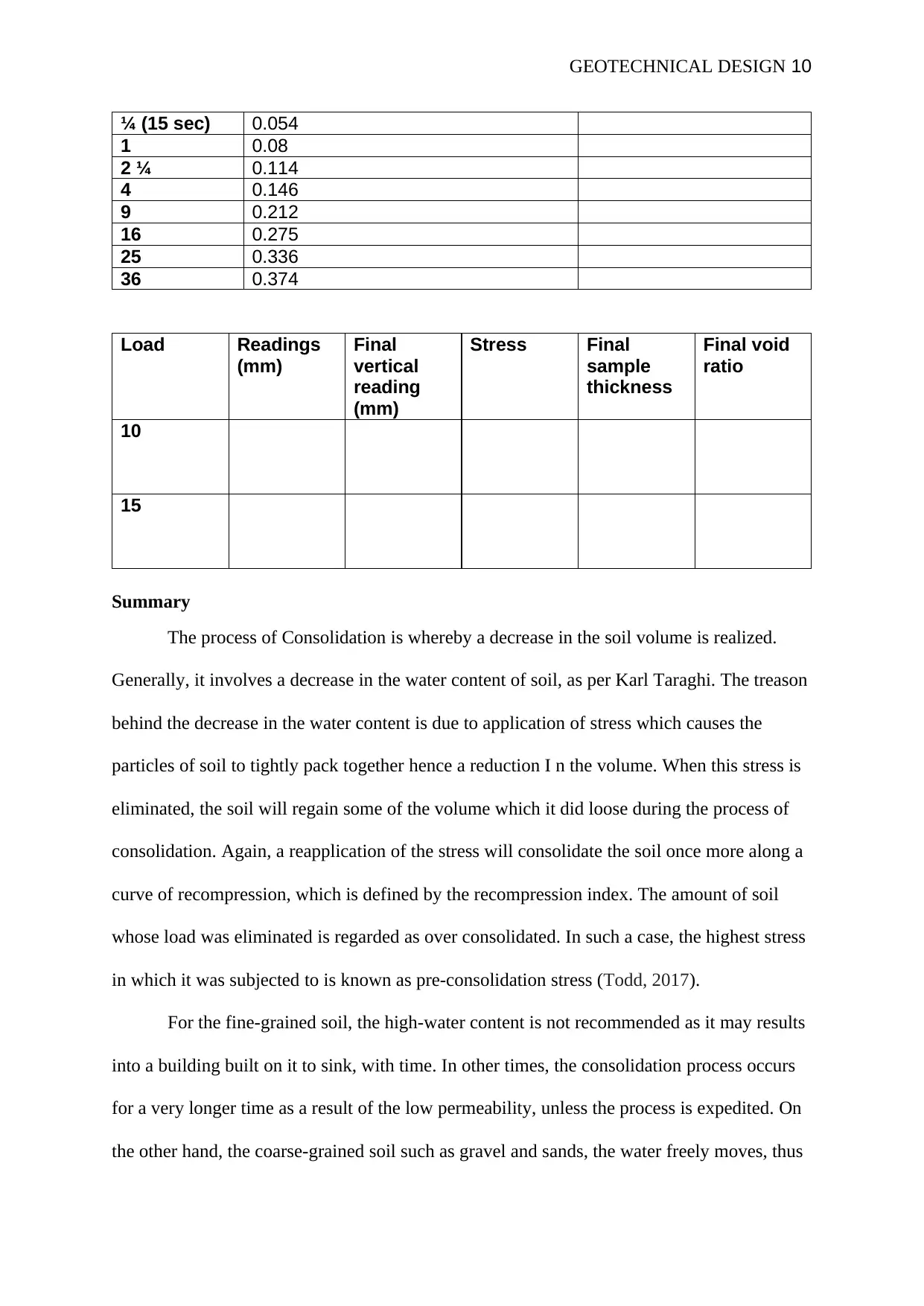
GEOTECHNICAL DESIGN 10
¼ (15 sec) 0.054
1 0.08
2 ¼ 0.114
4 0.146
9 0.212
16 0.275
25 0.336
36 0.374
Load Readings
(mm)
Final
vertical
reading
(mm)
Stress Final
sample
thickness
Final void
ratio
10
15
Summary
The process of Consolidation is whereby a decrease in the soil volume is realized.
Generally, it involves a decrease in the water content of soil, as per Karl Taraghi. The treason
behind the decrease in the water content is due to application of stress which causes the
particles of soil to tightly pack together hence a reduction I n the volume. When this stress is
eliminated, the soil will regain some of the volume which it did loose during the process of
consolidation. Again, a reapplication of the stress will consolidate the soil once more along a
curve of recompression, which is defined by the recompression index. The amount of soil
whose load was eliminated is regarded as over consolidated. In such a case, the highest stress
in which it was subjected to is known as pre-consolidation stress (Todd, 2017).
For the fine-grained soil, the high-water content is not recommended as it may results
into a building built on it to sink, with time. In other times, the consolidation process occurs
for a very longer time as a result of the low permeability, unless the process is expedited. On
the other hand, the coarse-grained soil such as gravel and sands, the water freely moves, thus
¼ (15 sec) 0.054
1 0.08
2 ¼ 0.114
4 0.146
9 0.212
16 0.275
25 0.336
36 0.374
Load Readings
(mm)
Final
vertical
reading
(mm)
Stress Final
sample
thickness
Final void
ratio
10
15
Summary
The process of Consolidation is whereby a decrease in the soil volume is realized.
Generally, it involves a decrease in the water content of soil, as per Karl Taraghi. The treason
behind the decrease in the water content is due to application of stress which causes the
particles of soil to tightly pack together hence a reduction I n the volume. When this stress is
eliminated, the soil will regain some of the volume which it did loose during the process of
consolidation. Again, a reapplication of the stress will consolidate the soil once more along a
curve of recompression, which is defined by the recompression index. The amount of soil
whose load was eliminated is regarded as over consolidated. In such a case, the highest stress
in which it was subjected to is known as pre-consolidation stress (Todd, 2017).
For the fine-grained soil, the high-water content is not recommended as it may results
into a building built on it to sink, with time. In other times, the consolidation process occurs
for a very longer time as a result of the low permeability, unless the process is expedited. On
the other hand, the coarse-grained soil such as gravel and sands, the water freely moves, thus
Paraphrase This Document
Need a fresh take? Get an instant paraphrase of this document with our AI Paraphraser

GEOTECHNICAL DESIGN 11
making the process of consolidation to be shorter. Hence, it reminds us of two aspects of
consolidation which should be taken into keen consideration: the total amount of
consolidation and the rate at which the consolidation is taking place (Todd, 2017).
For soils which in the past has not been exposed to pressure of current magnitude, it
will be ragweed as normally loaded soil, whereas if it has been subjected to some pressure, it
will be n over-consolidated soil or pre-consolidated soil. The amount of consolidation is
greater in the normally loaded soil than in the pre consolidated soil. The reason is due to
initial equal or greater pressure in the pre-consolidated soil, and the implication is that the
pre-consolidated soil is preferred over a normally consolidated soil.
making the process of consolidation to be shorter. Hence, it reminds us of two aspects of
consolidation which should be taken into keen consideration: the total amount of
consolidation and the rate at which the consolidation is taking place (Todd, 2017).
For soils which in the past has not been exposed to pressure of current magnitude, it
will be ragweed as normally loaded soil, whereas if it has been subjected to some pressure, it
will be n over-consolidated soil or pre-consolidated soil. The amount of consolidation is
greater in the normally loaded soil than in the pre consolidated soil. The reason is due to
initial equal or greater pressure in the pre-consolidated soil, and the implication is that the
pre-consolidated soil is preferred over a normally consolidated soil.
GEOTECHNICAL DESIGN 12
References
Burland, J., Chapman, T., Skinner, H.D. and Brown, M., 2012. ICE manual of geotechnical
engineering volume 2: Geotechnical design, construction and verification.
Fenton, G.A., Naghibi, F., Dundas, D., Bathurst, R.J. and Griffiths, D.V., 2015. Reliability-
based geotechnical design in 2014 Canadian highway bridge design code. Canadian
Geotechnical Journal, 53(2), pp.236-251.
Juang, C.H. and Wang, L., 2013. Reliability-based robust geotechnical design of spread
foundations using multi-objective genetic algorithm. Computers and Geotechnics, 48, pp.96-
106.
Juang, C.H., Wang, L., Hsieh, H.S. and Atamturktur, S., 2014. Robust geotechnical design of
braced excavations in clays. Structural Safety, 49, pp.37-44.
Juang, C.H., Wang, L., Liu, Z., Ravichandran, N., Huang, H. And Zhang, J., 2013. Robust
geotechnical design of drilled shafts in sand: New design perspective. Journal of
Geotechnical and Geoenvironmental Engineering, 139(12), pp.2007-2019.
Orr, T.L. and Farrell, E.R., 2012. Geotechnical design to Eurocode 7. Springer Science &
Business Media.
Péron, H., Knellwolf, C. And Laloui, L., 2011. A method for the geotechnical design of heat
exchanger piles. In Geo-Frontiers 2011: Advances in Geotechnical Engineering (pp. 470-
479).
Phoon, K.K. ed., 2014. Reliability-based design in geotechnical engineering: computations
and applications. CRC Press.
Todd, M.K., 2017. Handbook of geotechnical investigation and design tables. CRC Press.
Villaescusa, E., 2014. Geotechnical design for sublevel open stoping. CRC Press.
References
Burland, J., Chapman, T., Skinner, H.D. and Brown, M., 2012. ICE manual of geotechnical
engineering volume 2: Geotechnical design, construction and verification.
Fenton, G.A., Naghibi, F., Dundas, D., Bathurst, R.J. and Griffiths, D.V., 2015. Reliability-
based geotechnical design in 2014 Canadian highway bridge design code. Canadian
Geotechnical Journal, 53(2), pp.236-251.
Juang, C.H. and Wang, L., 2013. Reliability-based robust geotechnical design of spread
foundations using multi-objective genetic algorithm. Computers and Geotechnics, 48, pp.96-
106.
Juang, C.H., Wang, L., Hsieh, H.S. and Atamturktur, S., 2014. Robust geotechnical design of
braced excavations in clays. Structural Safety, 49, pp.37-44.
Juang, C.H., Wang, L., Liu, Z., Ravichandran, N., Huang, H. And Zhang, J., 2013. Robust
geotechnical design of drilled shafts in sand: New design perspective. Journal of
Geotechnical and Geoenvironmental Engineering, 139(12), pp.2007-2019.
Orr, T.L. and Farrell, E.R., 2012. Geotechnical design to Eurocode 7. Springer Science &
Business Media.
Péron, H., Knellwolf, C. And Laloui, L., 2011. A method for the geotechnical design of heat
exchanger piles. In Geo-Frontiers 2011: Advances in Geotechnical Engineering (pp. 470-
479).
Phoon, K.K. ed., 2014. Reliability-based design in geotechnical engineering: computations
and applications. CRC Press.
Todd, M.K., 2017. Handbook of geotechnical investigation and design tables. CRC Press.
Villaescusa, E., 2014. Geotechnical design for sublevel open stoping. CRC Press.
⊘ This is a preview!⊘
Do you want full access?
Subscribe today to unlock all pages.
Trusted by 1+ million students worldwide

1 out of 12


Your All-in-One AI-Powered Toolkit for Academic Success.
+13062052269
info@desklib.com
Available 24*7 on WhatsApp / Email
![[object Object]](/_next/static/media/star-bottom.7253800d.svg)
Unlock your academic potential
Copyright © 2020–2026 A2Z Services. All Rights Reserved. Developed and managed by ZUCOL.