1220HSL: Information Systems for Tourism Management Website Plan
VerifiedAdded on 2023/06/12
|13
|2459
|276
Report
AI Summary
This report presents a comprehensive website plan for GetSetGo, a tourism business, aiming to enhance its market presence and profitability. It outlines the business background, goals, and target audience, followed by a competitor website analysis and forecasted use environments. The plan details user tasks, website content, and development tools, including a storyboard and template designs. Process analysis, marketing techniques, and promotional strategies are also discussed to ensure the website's success. The report concludes that implementing the website will significantly benefit GetSetGo by increasing customer engagement and overall profits. This document is available on Desklib, a platform offering a range of study tools and resources for students.
Running head: INFORMATION SYSTEMS FOR TOURISM MANAGEMENT
Information Systems for Tourism Management
Name of the Student
Name of the University
Author’s note:
Information Systems for Tourism Management
Name of the Student
Name of the University
Author’s note:

Paraphrase This Document
Need a fresh take? Get an instant paraphrase of this document with our AI Paraphraser
1INFORMATION SYSTEMS FOR TOURISM MANAGEMENT
Executive Summary
This paper discusses about the implementation of a business model for the website of a tourism
business model. This paper focusses on the business background, the current processes of
business and the future perspectives after the implementation and the launch of the website of the
tourism business.
Executive Summary
This paper discusses about the implementation of a business model for the website of a tourism
business model. This paper focusses on the business background, the current processes of
business and the future perspectives after the implementation and the launch of the website of the
tourism business.
2INFORMATION SYSTEMS FOR TOURISM MANAGEMENT
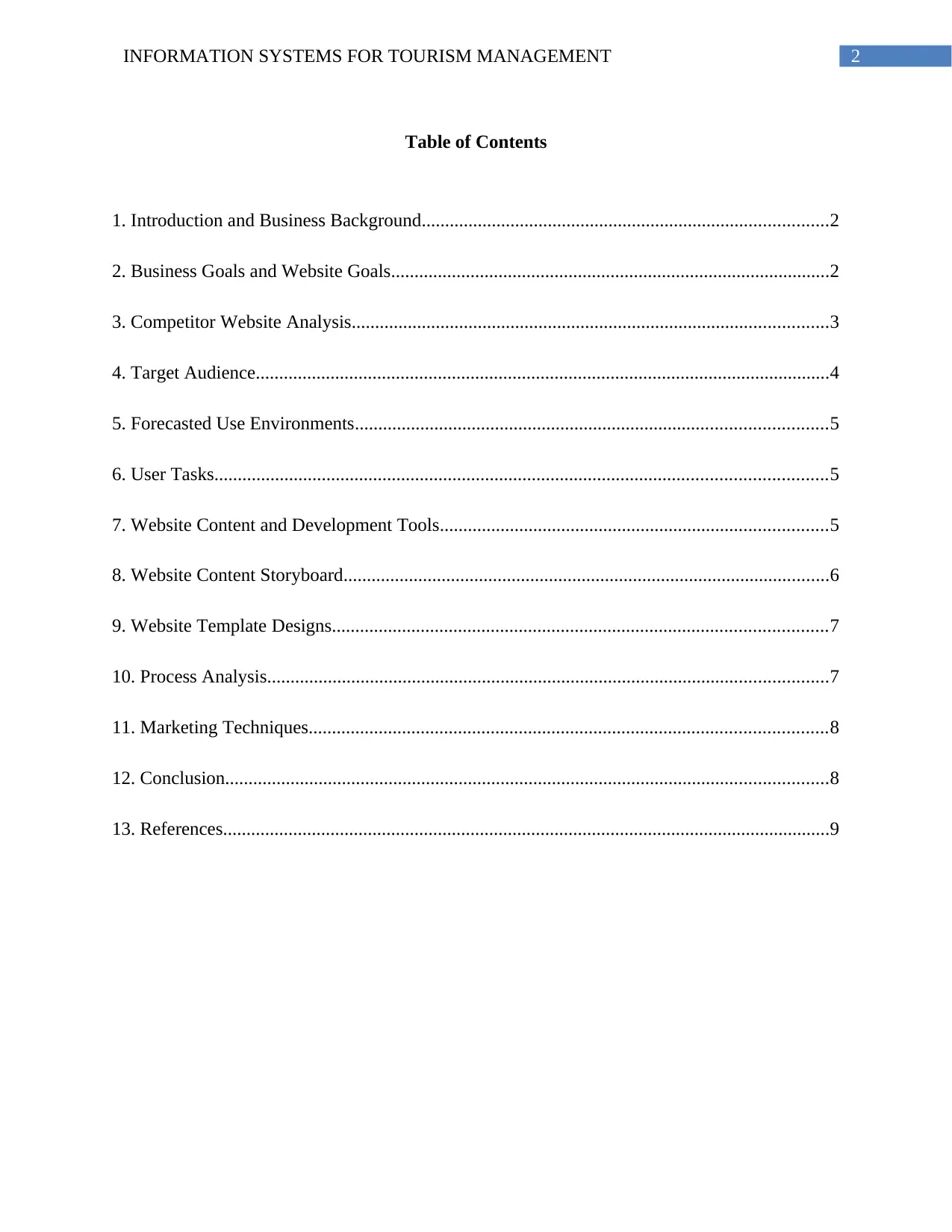
Table of Contents
1. Introduction and Business Background.......................................................................................2
2. Business Goals and Website Goals..............................................................................................2
3. Competitor Website Analysis......................................................................................................3
4. Target Audience...........................................................................................................................4
5. Forecasted Use Environments.....................................................................................................5
6. User Tasks...................................................................................................................................5
7. Website Content and Development Tools...................................................................................5
8. Website Content Storyboard........................................................................................................6
9. Website Template Designs..........................................................................................................7
10. Process Analysis........................................................................................................................7
11. Marketing Techniques...............................................................................................................8
12. Conclusion.................................................................................................................................8
13. References..................................................................................................................................9
Table of Contents
1. Introduction and Business Background.......................................................................................2
2. Business Goals and Website Goals..............................................................................................2
3. Competitor Website Analysis......................................................................................................3
4. Target Audience...........................................................................................................................4
5. Forecasted Use Environments.....................................................................................................5
6. User Tasks...................................................................................................................................5
7. Website Content and Development Tools...................................................................................5
8. Website Content Storyboard........................................................................................................6
9. Website Template Designs..........................................................................................................7
10. Process Analysis........................................................................................................................7
11. Marketing Techniques...............................................................................................................8
12. Conclusion.................................................................................................................................8
13. References..................................................................................................................................9
⊘ This is a preview!⊘
Do you want full access?
Subscribe today to unlock all pages.

Trusted by 1+ million students worldwide
3INFORMATION SYSTEMS FOR TOURISM MANAGEMENT
1. Introduction and Business Background
The tourism management has acquired a lot of attention over the years for the people who
love to travel to all parts of the world. The internet is changing the world of tourism. With the
help of the internet, it is possible to change the view of the tourism industry. The tourism
industry is one of the largest sectors in the market, which has the capability of attracting a mass
of people. This report discusses about the current business trends within the tourism industry and
the upcoming changes with the implementation of the current website. The plan for the website
is mainly designed in order to get a brief about the details of the future regarding the tourism
industry (Waligo, Clarke & Hawkins, 2013).
In the earlier times, the sector of tourism management was mostly limited to a certain
number of people. The GetSetGo was initially launched to provide services to a limited set of
people and explore few places of Australia. The business plan of the project is special as because
it has many innovative ideas, which they implement within their business strategies. This helps
them to make their position within the market and set their goals along with competitors.
GetSetGo is one of the largest business models in the tourism sector and is mostly preferred by
most of the people who love to explore the globe.
2. Business Goals and Website Goals
The GetSetGo tourism business deals with providing assistance to the tourists who like to
explore the globe. They provide 24-hour service to their tourists. They also assist in booking
hotels for their clients by providing them with exclusive offers. In the recent times, the business
model is planning to launch a website that would be able to provide online booking and special
assistance to the tourists. The main idea behind implementing internet based services within the
1. Introduction and Business Background
The tourism management has acquired a lot of attention over the years for the people who
love to travel to all parts of the world. The internet is changing the world of tourism. With the
help of the internet, it is possible to change the view of the tourism industry. The tourism
industry is one of the largest sectors in the market, which has the capability of attracting a mass
of people. This report discusses about the current business trends within the tourism industry and
the upcoming changes with the implementation of the current website. The plan for the website
is mainly designed in order to get a brief about the details of the future regarding the tourism
industry (Waligo, Clarke & Hawkins, 2013).
In the earlier times, the sector of tourism management was mostly limited to a certain
number of people. The GetSetGo was initially launched to provide services to a limited set of
people and explore few places of Australia. The business plan of the project is special as because
it has many innovative ideas, which they implement within their business strategies. This helps
them to make their position within the market and set their goals along with competitors.
GetSetGo is one of the largest business models in the tourism sector and is mostly preferred by
most of the people who love to explore the globe.
2. Business Goals and Website Goals
The GetSetGo tourism business deals with providing assistance to the tourists who like to
explore the globe. They provide 24-hour service to their tourists. They also assist in booking
hotels for their clients by providing them with exclusive offers. In the recent times, the business
model is planning to launch a website that would be able to provide online booking and special
assistance to the tourists. The main idea behind implementing internet based services within the
Paraphrase This Document
Need a fresh take? Get an instant paraphrase of this document with our AI Paraphraser
4INFORMATION SYSTEMS FOR TOURISM MANAGEMENT
business model is to improve the quality of life by attracting new aspects of tourism related to
the business. They also aim to incur profits for the company, expose themselves to the public,
change the perception of people regarding the tourism industry and thus gain a huge base of
customers (Saarinen & Rogerson, 2014).
The goals of the website of the travel business is directly linked to the goals set by the
business. The website would assist in supporting the concept of the business. The website would
provide a great support for the people who would want to contact the business. The website
would help in promoting the business and thus incur more customers to their business. The
primary goal of the website is to increase the volume of customers who would want to book their
hotels and would plan their travel with the GetSetGo business.
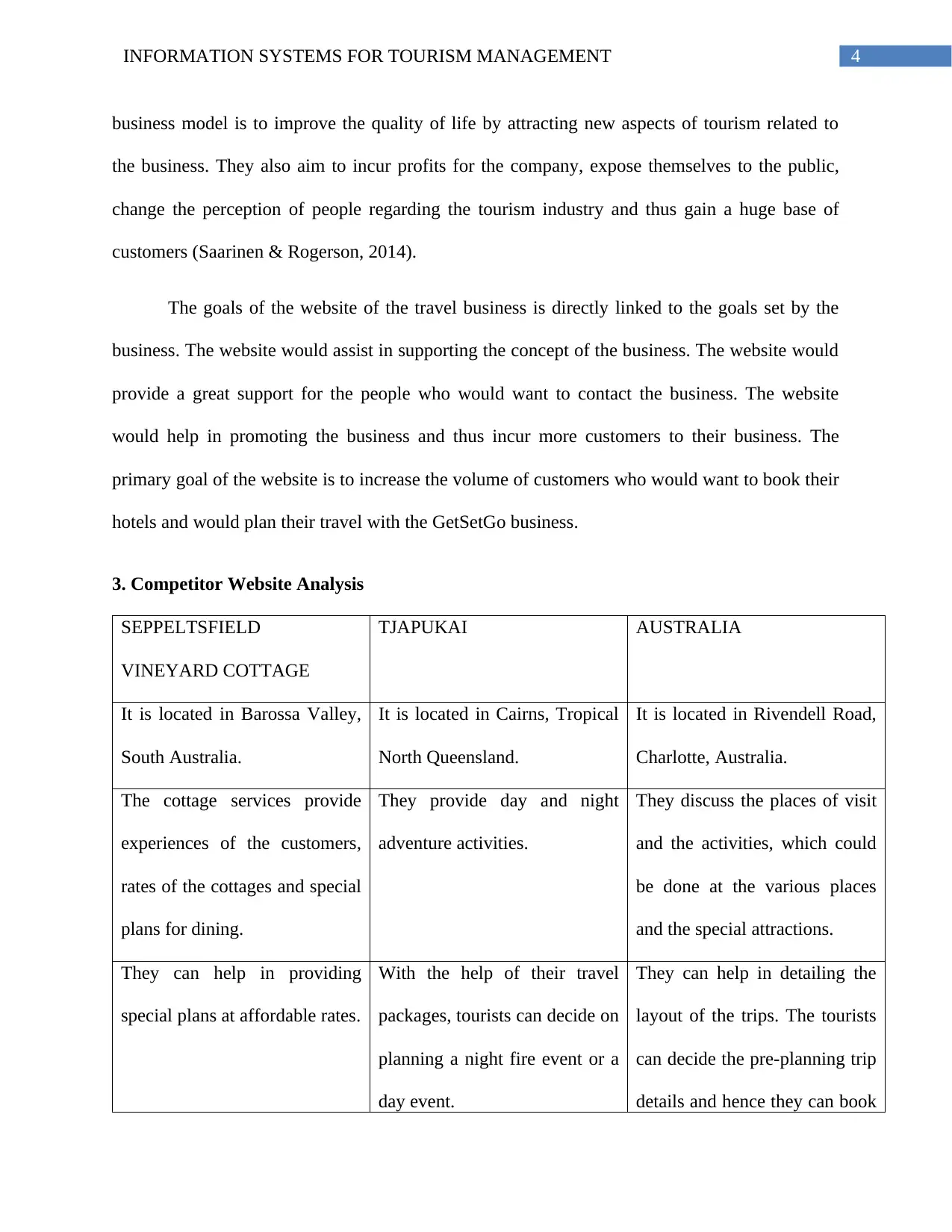
3. Competitor Website Analysis
SEPPELTSFIELD
VINEYARD COTTAGE
TJAPUKAI AUSTRALIA
It is located in Barossa Valley,
South Australia.
It is located in Cairns, Tropical
North Queensland.
It is located in Rivendell Road,
Charlotte, Australia.
The cottage services provide
experiences of the customers,
rates of the cottages and special
plans for dining.
They provide day and night
adventure activities.
They discuss the places of visit
and the activities, which could
be done at the various places
and the special attractions.
They can help in providing
special plans at affordable rates.
With the help of their travel
packages, tourists can decide on
planning a night fire event or a
day event.
They can help in detailing the
layout of the trips. The tourists
can decide the pre-planning trip
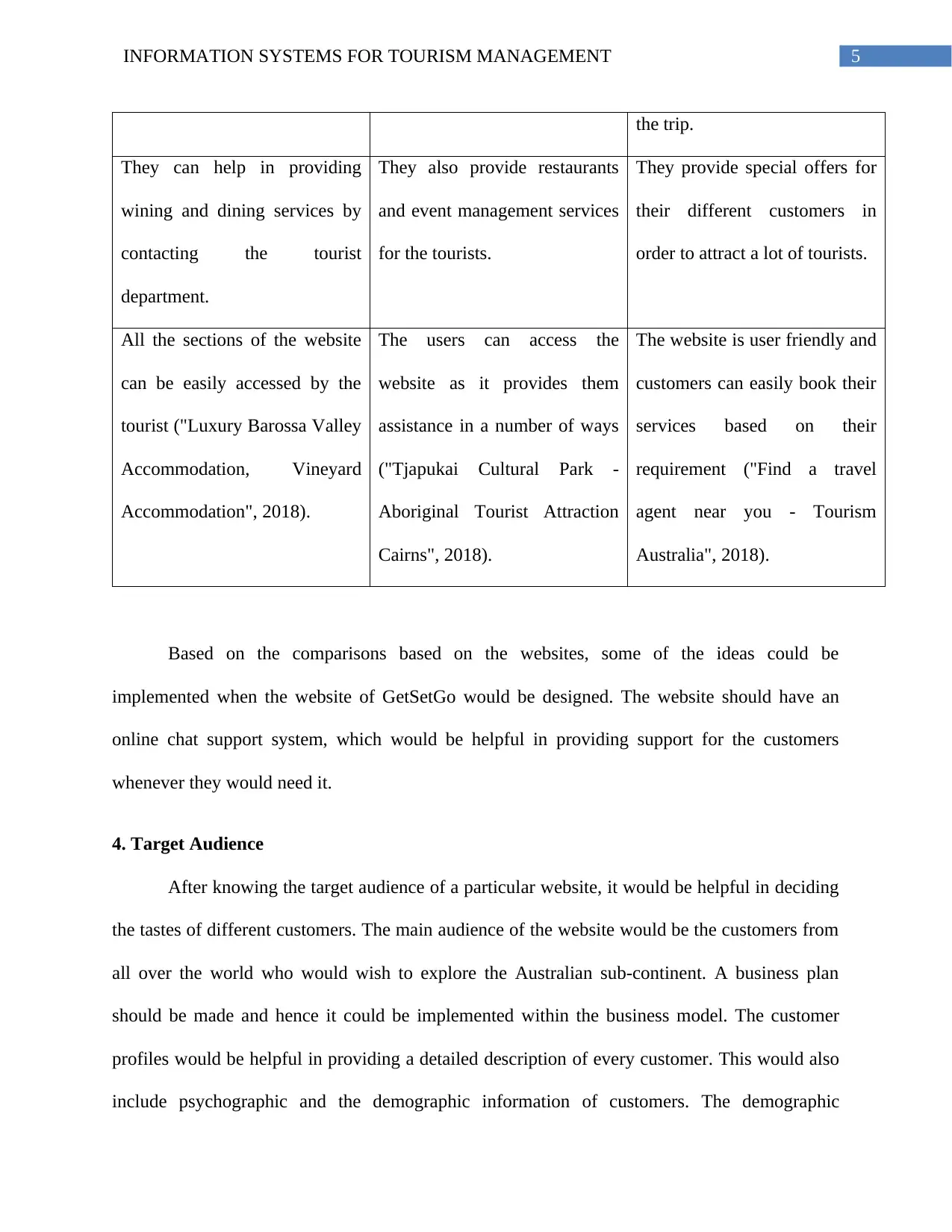
details and hence they can book
business model is to improve the quality of life by attracting new aspects of tourism related to
the business. They also aim to incur profits for the company, expose themselves to the public,
change the perception of people regarding the tourism industry and thus gain a huge base of
customers (Saarinen & Rogerson, 2014).
The goals of the website of the travel business is directly linked to the goals set by the
business. The website would assist in supporting the concept of the business. The website would
provide a great support for the people who would want to contact the business. The website
would help in promoting the business and thus incur more customers to their business. The
primary goal of the website is to increase the volume of customers who would want to book their
hotels and would plan their travel with the GetSetGo business.
3. Competitor Website Analysis
SEPPELTSFIELD
VINEYARD COTTAGE
TJAPUKAI AUSTRALIA
It is located in Barossa Valley,
South Australia.
It is located in Cairns, Tropical
North Queensland.
It is located in Rivendell Road,
Charlotte, Australia.
The cottage services provide
experiences of the customers,
rates of the cottages and special
plans for dining.
They provide day and night
adventure activities.
They discuss the places of visit
and the activities, which could
be done at the various places
and the special attractions.
They can help in providing
special plans at affordable rates.
With the help of their travel
packages, tourists can decide on
planning a night fire event or a
day event.
They can help in detailing the
layout of the trips. The tourists
can decide the pre-planning trip
details and hence they can book
5INFORMATION SYSTEMS FOR TOURISM MANAGEMENT
the trip.
They can help in providing
wining and dining services by
contacting the tourist
department.
They also provide restaurants
and event management services
for the tourists.
They provide special offers for
their different customers in
order to attract a lot of tourists.
All the sections of the website
can be easily accessed by the
tourist ("Luxury Barossa Valley
Accommodation, Vineyard
Accommodation", 2018).
The users can access the
website as it provides them
assistance in a number of ways
("Tjapukai Cultural Park -
Aboriginal Tourist Attraction
Cairns", 2018).
The website is user friendly and
customers can easily book their
services based on their
requirement ("Find a travel
agent near you - Tourism
Australia", 2018).
Based on the comparisons based on the websites, some of the ideas could be
implemented when the website of GetSetGo would be designed. The website should have an
online chat support system, which would be helpful in providing support for the customers
whenever they would need it.
4. Target Audience
After knowing the target audience of a particular website, it would be helpful in deciding
the tastes of different customers. The main audience of the website would be the customers from
all over the world who would wish to explore the Australian sub-continent. A business plan
should be made and hence it could be implemented within the business model. The customer
profiles would be helpful in providing a detailed description of every customer. This would also
include psychographic and the demographic information of customers. The demographic
the trip.
They can help in providing
wining and dining services by
contacting the tourist
department.
They also provide restaurants
and event management services
for the tourists.
They provide special offers for
their different customers in
order to attract a lot of tourists.
All the sections of the website
can be easily accessed by the
tourist ("Luxury Barossa Valley
Accommodation, Vineyard
Accommodation", 2018).
The users can access the
website as it provides them
assistance in a number of ways
("Tjapukai Cultural Park -
Aboriginal Tourist Attraction
Cairns", 2018).
The website is user friendly and
customers can easily book their
services based on their
requirement ("Find a travel
agent near you - Tourism
Australia", 2018).
Based on the comparisons based on the websites, some of the ideas could be
implemented when the website of GetSetGo would be designed. The website should have an
online chat support system, which would be helpful in providing support for the customers
whenever they would need it.
4. Target Audience
After knowing the target audience of a particular website, it would be helpful in deciding
the tastes of different customers. The main audience of the website would be the customers from
all over the world who would wish to explore the Australian sub-continent. A business plan
should be made and hence it could be implemented within the business model. The customer
profiles would be helpful in providing a detailed description of every customer. This would also
include psychographic and the demographic information of customers. The demographic
⊘ This is a preview!⊘
Do you want full access?
Subscribe today to unlock all pages.
Trusted by 1+ million students worldwide
6INFORMATION SYSTEMS FOR TOURISM MANAGEMENT
information would be helpful in identifying the type of customers who would wish for a
particular kind of service. Developing a user-friendly service would be helpful in attracting a
huge base of customers and thus this would be helpful in enabling much more profits for the
industry (Horner & Swarbrooke, 2016).
5. Forecasted Use Environments
The website should be designed in such a way such that it could be easily accessible from
PCs as well as smartphones. This would be helpful for the tourists who would wish to access the
website from outside of their homes. The website should be accessible form all kinds of common
web browsers that are mainly used by customers. This would be helpful for the business of the
organization (Sotiriadis & Van Zyl, 2013).
6. User Tasks
With the implementation of the GetSetGo business website, users would have huge
advantages. The website would provide online assistance for the customers. They would be able
to download brochures, view the hotels that they would like to visit. They would also be able to
view the pricing structure of their journey. An online calculator would also be provided in order
to support the customers to calculate the prices. The website would also provide a gallery section
that would provide photos and certain videos for the benefit of the clients (Kim et al., 2015).
7. Website Content and Development Tools
The website would provide the certain contents. They would provide a home page, which
would provide the basic details of the website and the details of GetSetGo business structure.
Users can make their own personalized account and could access the website. They could plan
their trips, view the places of visit, the pricing models and then they could get a whole range of
information would be helpful in identifying the type of customers who would wish for a
particular kind of service. Developing a user-friendly service would be helpful in attracting a
huge base of customers and thus this would be helpful in enabling much more profits for the
industry (Horner & Swarbrooke, 2016).
5. Forecasted Use Environments
The website should be designed in such a way such that it could be easily accessible from
PCs as well as smartphones. This would be helpful for the tourists who would wish to access the
website from outside of their homes. The website should be accessible form all kinds of common
web browsers that are mainly used by customers. This would be helpful for the business of the
organization (Sotiriadis & Van Zyl, 2013).
6. User Tasks
With the implementation of the GetSetGo business website, users would have huge
advantages. The website would provide online assistance for the customers. They would be able
to download brochures, view the hotels that they would like to visit. They would also be able to
view the pricing structure of their journey. An online calculator would also be provided in order
to support the customers to calculate the prices. The website would also provide a gallery section
that would provide photos and certain videos for the benefit of the clients (Kim et al., 2015).
7. Website Content and Development Tools
The website would provide the certain contents. They would provide a home page, which
would provide the basic details of the website and the details of GetSetGo business structure.
Users can make their own personalized account and could access the website. They could plan
their trips, view the places of visit, the pricing models and then they could get a whole range of
Paraphrase This Document
Need a fresh take? Get an instant paraphrase of this document with our AI Paraphraser
7INFORMATION SYSTEMS FOR TOURISM MANAGEMENT
offers. The website would also provide a contact page in which the details of the people who
would be contacted would be put in. A separate page would also be provided in which the
bookings would be confirmed. These sections would be implemented within the website for the
support of the customers (Xiang, Magnini & Fesenmaier, 2015).
The tools of development that would be implemented within the website of GetSetGo
are: Chrome Developer Tools, jQuery, Angular.js, a plug-in of Paypal for supporting the
transactions that would be done on the website during the time of booking. Google map plug-ins
would also be implemented for viewing the map of the places in which the tourists would visit. A
plug-in for the calendar should also be provided in order to schedule the date of the trips of the
customers.
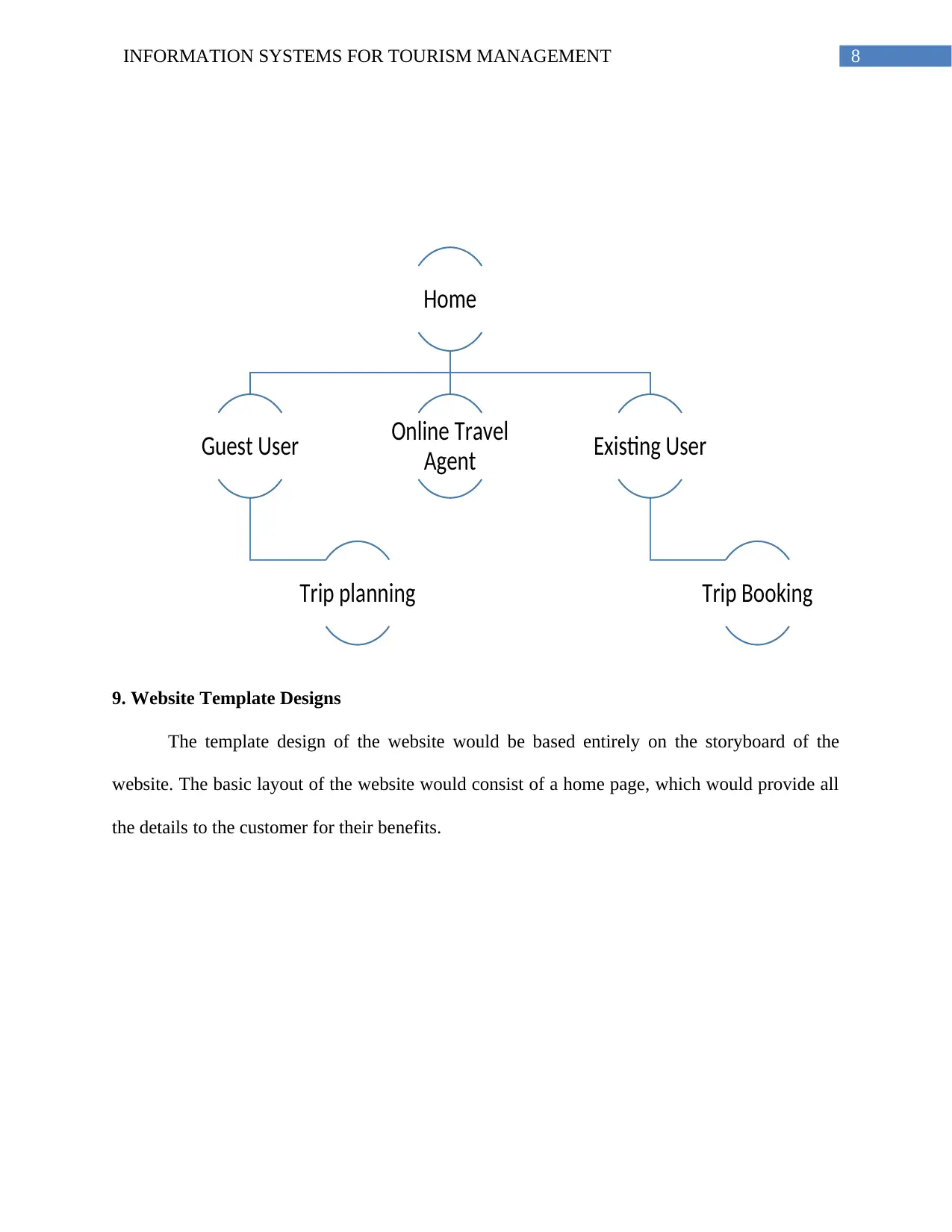
8. Website Content Storyboard
The hierarchy of the website would be designed as follows: A menu bar would be
provided within the website, which would include the entire details of the website. This would
include the home page, a page for the map in which the customer would like to explore, the
places of visit, a section for the planning of the trip and a customer login page.
offers. The website would also provide a contact page in which the details of the people who
would be contacted would be put in. A separate page would also be provided in which the
bookings would be confirmed. These sections would be implemented within the website for the
support of the customers (Xiang, Magnini & Fesenmaier, 2015).
The tools of development that would be implemented within the website of GetSetGo
are: Chrome Developer Tools, jQuery, Angular.js, a plug-in of Paypal for supporting the
transactions that would be done on the website during the time of booking. Google map plug-ins
would also be implemented for viewing the map of the places in which the tourists would visit. A
plug-in for the calendar should also be provided in order to schedule the date of the trips of the
customers.
8. Website Content Storyboard
The hierarchy of the website would be designed as follows: A menu bar would be
provided within the website, which would include the entire details of the website. This would
include the home page, a page for the map in which the customer would like to explore, the
places of visit, a section for the planning of the trip and a customer login page.
8INFORMATION SYSTEMS FOR TOURISM MANAGEMENT
9. Website Template Designs
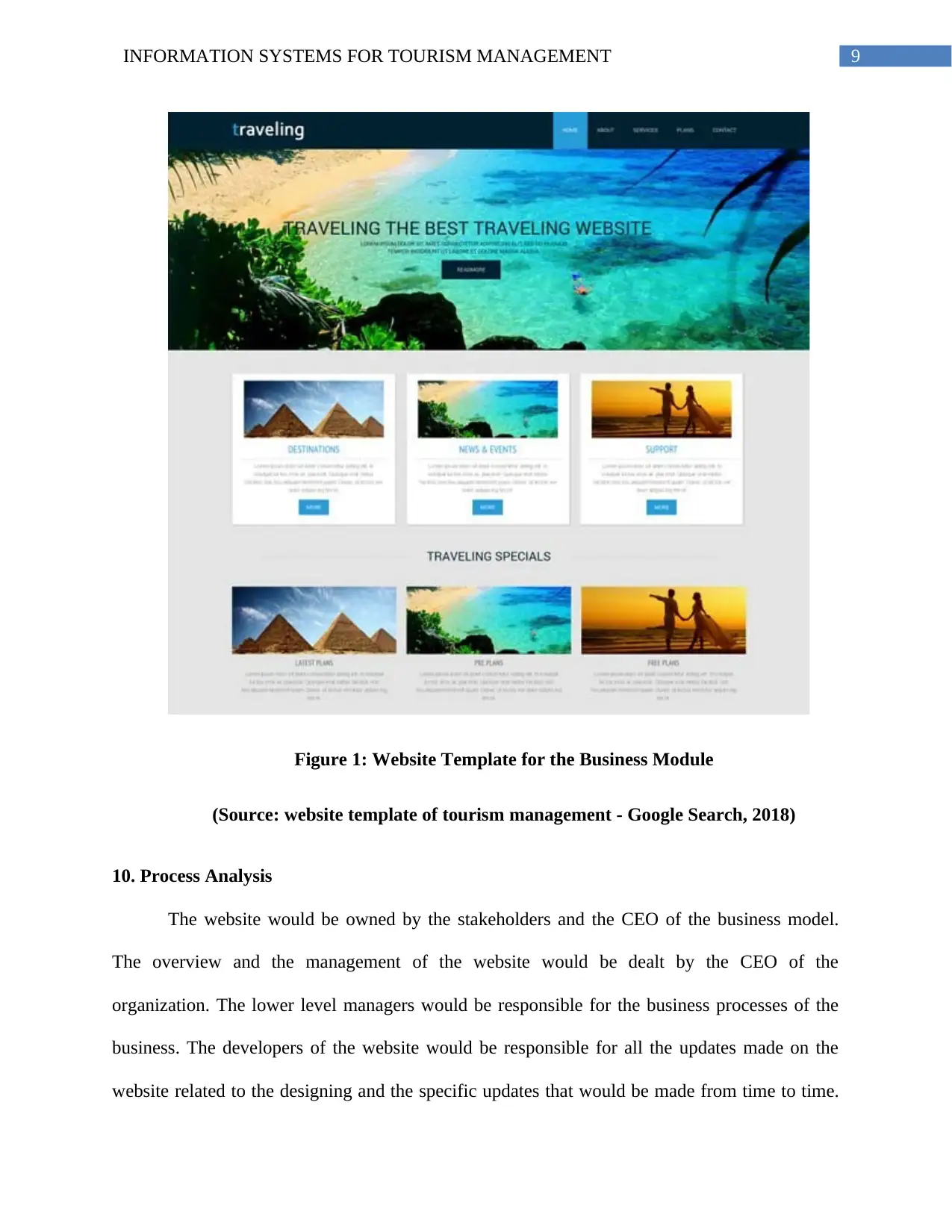
The template design of the website would be based entirely on the storyboard of the
website. The basic layout of the website would consist of a home page, which would provide all
the details to the customer for their benefits.
Home
Existing User
Trip Booking
Online Travel
Agent
Guest User
Trip planning
9. Website Template Designs
The template design of the website would be based entirely on the storyboard of the
website. The basic layout of the website would consist of a home page, which would provide all
the details to the customer for their benefits.
Home
Existing User
Trip Booking
Online Travel
Agent
Guest User
Trip planning
⊘ This is a preview!⊘
Do you want full access?
Subscribe today to unlock all pages.
Trusted by 1+ million students worldwide
9INFORMATION SYSTEMS FOR TOURISM MANAGEMENT
Figure 1: Website Template for the Business Module
(Source: website template of tourism management - Google Search, 2018)
10. Process Analysis
The website would be owned by the stakeholders and the CEO of the business model.
The overview and the management of the website would be dealt by the CEO of the
organization. The lower level managers would be responsible for the business processes of the
business. The developers of the website would be responsible for all the updates made on the
website related to the designing and the specific updates that would be made from time to time.
Figure 1: Website Template for the Business Module
(Source: website template of tourism management - Google Search, 2018)
10. Process Analysis
The website would be owned by the stakeholders and the CEO of the business model.
The overview and the management of the website would be dealt by the CEO of the
organization. The lower level managers would be responsible for the business processes of the
business. The developers of the website would be responsible for all the updates made on the
website related to the designing and the specific updates that would be made from time to time.
Paraphrase This Document
Need a fresh take? Get an instant paraphrase of this document with our AI Paraphraser
10INFORMATION SYSTEMS FOR TOURISM MANAGEMENT
The website would be needed to be updated regularly. The managers would be responsible for
checking the email content. The website would be linked to the social media pages for promoting
the ideas of the business (Benckendorff & Zehrer, 2013).
11. Marketing Techniques
Various promotional strategies would be needed to be taken in order to deal with the
techniques of marketing. The travel agents would be responsible for promoting the business.
They would provide pamphlets, advertisements on the streets, online advertisements and
promotional video advertisements on the television. These strategies might be helpful for
supporting the business ideas of this project (Morrison, 2013).
12. Conclusion
Based on the above report, it could be concluded that the implementation of the website
would be a great help to the business strategies with the launch of the website. This could be
helpful for the business model and thus help in increasing the profits.
The website would be needed to be updated regularly. The managers would be responsible for
checking the email content. The website would be linked to the social media pages for promoting
the ideas of the business (Benckendorff & Zehrer, 2013).
11. Marketing Techniques
Various promotional strategies would be needed to be taken in order to deal with the
techniques of marketing. The travel agents would be responsible for promoting the business.
They would provide pamphlets, advertisements on the streets, online advertisements and
promotional video advertisements on the television. These strategies might be helpful for
supporting the business ideas of this project (Morrison, 2013).
12. Conclusion
Based on the above report, it could be concluded that the implementation of the website
would be a great help to the business strategies with the launch of the website. This could be
helpful for the business model and thus help in increasing the profits.
11INFORMATION SYSTEMS FOR TOURISM MANAGEMENT
13. References
Benckendorff, P., & Zehrer, A. (2013). A network analysis of tourism research. Annals of
Tourism Research, 43, 121-149.
Find a travel agent near you - Tourism Australia. (2018). Australia.com. Retrieved 19 April
2018, from https://www.australia.com/en-us/facts-and-planning/accommodation-and-
tours/find-travel-agents.html
Horner, S., & Swarbrooke, J. (2016). Consumer behaviour in tourism. Routledge.
Kim, M. J., Chung, N., Lee, C. K., & Preis, M. W. (2015). Motivations and use context in mobile
tourism shopping: Applying contingency and task–technology fit theories. International
Journal of Tourism Research, 17(1), 13-24.
Luxury Barossa Valley Accommodation, Vineyard Accommodation. (2018). Seppeltsfield
Vineyard Cottage. Retrieved 19 April 2018, from
https://www.seppeltsfieldvineyardcottage.com.au/
Morrison, A. M. (2013). Marketing and managing tourism destinations. Routledge.
Saarinen, J., & Rogerson, C. M. (2014). Tourism and the millennium development goals:
Perspectives beyond 2015. Tourism Geographies, 16(1), 23-30.
Sotiriadis, M. D., & Van Zyl, C. (2013). Electronic word-of-mouth and online reviews in tourism
services: the use of twitter by tourists. Electronic Commerce Research, 13(1), 103-124.
Tjapukai Cultural Park - Aboriginal Tourist Attraction Cairns. (2018). Tjapukai Aboriginal
Cultural Park. Retrieved 19 April 2018, from http://www.tjapukai.com.au/
13. References
Benckendorff, P., & Zehrer, A. (2013). A network analysis of tourism research. Annals of
Tourism Research, 43, 121-149.
Find a travel agent near you - Tourism Australia. (2018). Australia.com. Retrieved 19 April
2018, from https://www.australia.com/en-us/facts-and-planning/accommodation-and-
tours/find-travel-agents.html
Horner, S., & Swarbrooke, J. (2016). Consumer behaviour in tourism. Routledge.
Kim, M. J., Chung, N., Lee, C. K., & Preis, M. W. (2015). Motivations and use context in mobile
tourism shopping: Applying contingency and task–technology fit theories. International
Journal of Tourism Research, 17(1), 13-24.
Luxury Barossa Valley Accommodation, Vineyard Accommodation. (2018). Seppeltsfield
Vineyard Cottage. Retrieved 19 April 2018, from
https://www.seppeltsfieldvineyardcottage.com.au/
Morrison, A. M. (2013). Marketing and managing tourism destinations. Routledge.
Saarinen, J., & Rogerson, C. M. (2014). Tourism and the millennium development goals:
Perspectives beyond 2015. Tourism Geographies, 16(1), 23-30.
Sotiriadis, M. D., & Van Zyl, C. (2013). Electronic word-of-mouth and online reviews in tourism
services: the use of twitter by tourists. Electronic Commerce Research, 13(1), 103-124.
Tjapukai Cultural Park - Aboriginal Tourist Attraction Cairns. (2018). Tjapukai Aboriginal
Cultural Park. Retrieved 19 April 2018, from http://www.tjapukai.com.au/
⊘ This is a preview!⊘
Do you want full access?
Subscribe today to unlock all pages.
Trusted by 1+ million students worldwide

1 out of 13


Related Documents


Your All-in-One AI-Powered Toolkit for Academic Success.
+13062052269
info@desklib.com
Available 24*7 on WhatsApp / Email
![[object Object]](/_next/static/media/star-bottom.7253800d.svg)
Unlock your academic potential
Copyright © 2020–2026 A2Z Services. All Rights Reserved. Developed and managed by ZUCOL.