BUSM4559: Analysis of the Gig Economy's Impact on Labor Markets, RMIT

Verified

Added on  2020/03/04

|5
|730
|75
Report
AI Summary
This report delves into the implications of the gig economy on labor and employment, examining the rise of app-based and crowd-based work. It highlights the evolving definitions of work, the challenges of misclassifying workers, and the risks associated with the gig economy. The report discusses the importance of understanding the gig economy not as a separate entity but as part of broader trends in employment, emphasizing the need for labor protection and advocating for worker rights. It also explores the emergence of worker self-organization and proposes potential solutions such as intermediate employment statuses and the extension of fundamental labor rights to all workers. The report underscores the importance of strong advocacy to mitigate the risks of commoditization and promote fair labor practices within the gig economy. The report also references several key articles and publications related to the gig economy.
Document Page
Running head: GIG ECONOMY
Gig economy
Name of the student
Name of the University:
Author note
tabler-icon-diamond-filled.svg

Paraphrase This Document

Need a fresh take? Get an instant paraphrase of this document with our AI Paraphraser
Document Page
1GIG ECONOMY
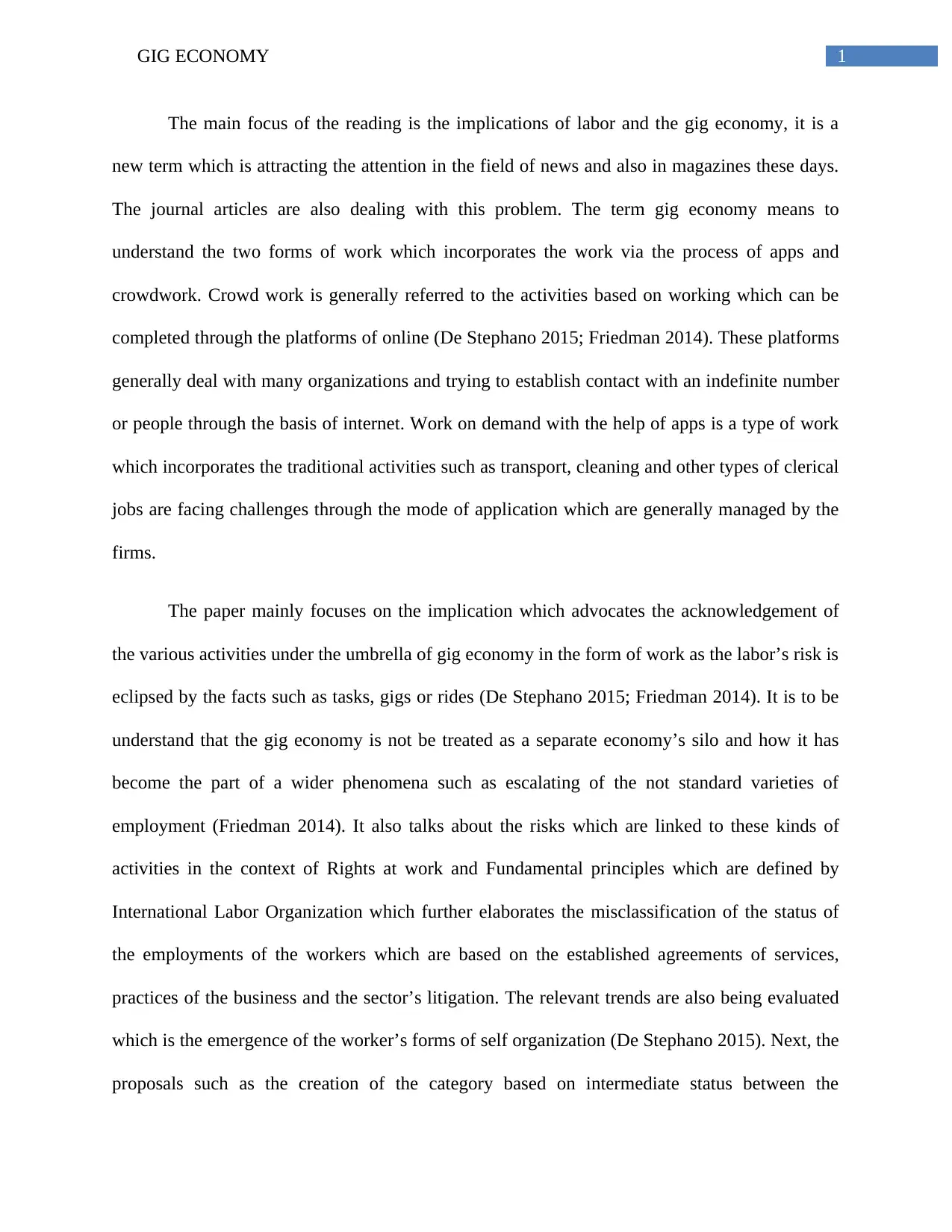
The main focus of the reading is the implications of labor and the gig economy, it is a
new term which is attracting the attention in the field of news and also in magazines these days.
The journal articles are also dealing with this problem. The term gig economy means to
understand the two forms of work which incorporates the work via the process of apps and
crowdwork. Crowd work is generally referred to the activities based on working which can be
completed through the platforms of online (De Stephano 2015; Friedman 2014). These platforms
generally deal with many organizations and trying to establish contact with an indefinite number
or people through the basis of internet. Work on demand with the help of apps is a type of work
which incorporates the traditional activities such as transport, cleaning and other types of clerical
jobs are facing challenges through the mode of application which are generally managed by the
firms.
The paper mainly focuses on the implication which advocates the acknowledgement of
the various activities under the umbrella of gig economy in the form of work as the labor’s risk is
eclipsed by the facts such as tasks, gigs or rides (De Stephano 2015; Friedman 2014). It is to be
understand that the gig economy is not be treated as a separate economy’s silo and how it has
become the part of a wider phenomena such as escalating of the not standard varieties of
employment (Friedman 2014). It also talks about the risks which are linked to these kinds of
activities in the context of Rights at work and Fundamental principles which are defined by
International Labor Organization which further elaborates the misclassification of the status of
the employments of the workers which are based on the established agreements of services,
practices of the business and the sector’s litigation. The relevant trends are also being evaluated
which is the emergence of the worker’s forms of self organization (De Stephano 2015). Next, the
proposals such as the creation of the category based on intermediate status between the
Document Page
2GIG ECONOMY
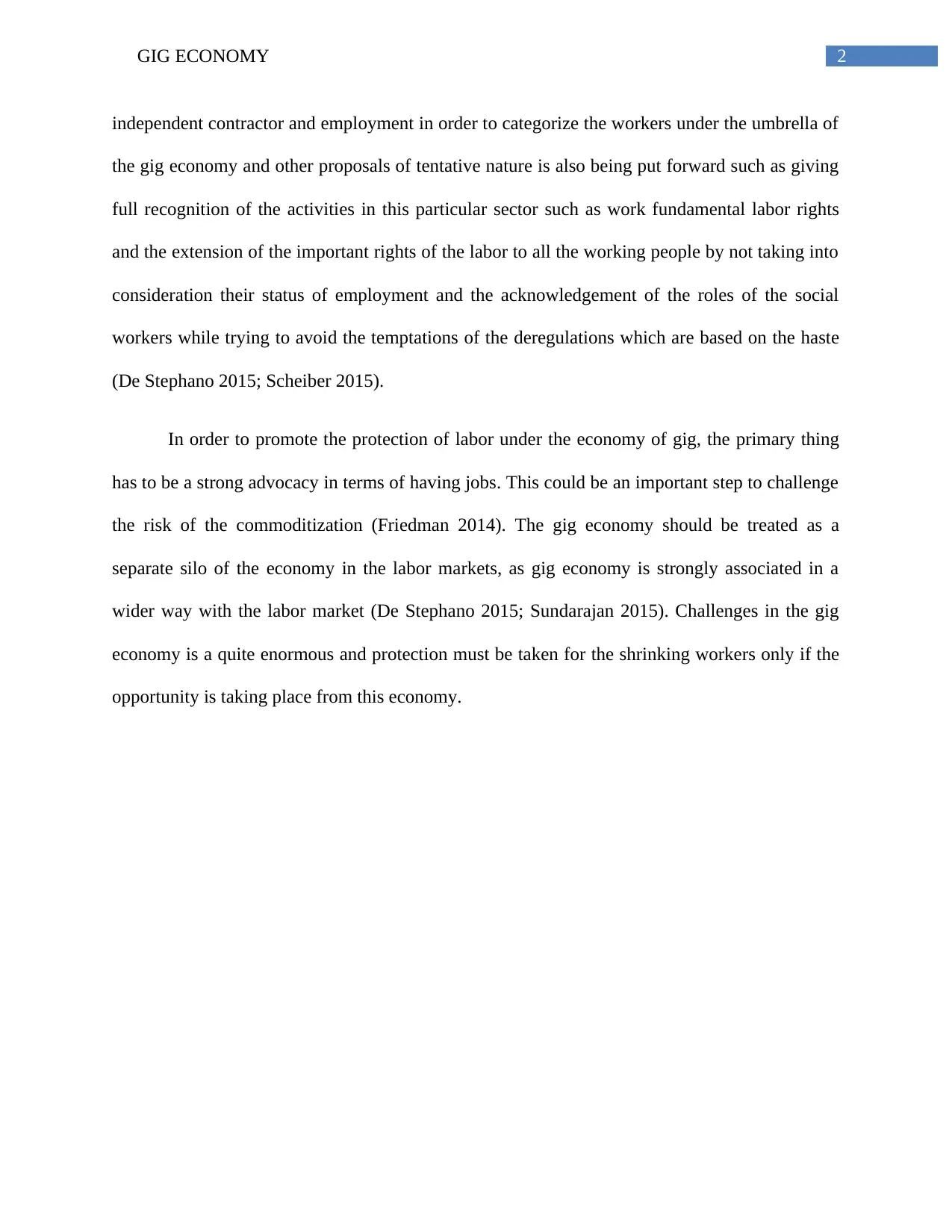
independent contractor and employment in order to categorize the workers under the umbrella of
the gig economy and other proposals of tentative nature is also being put forward such as giving
full recognition of the activities in this particular sector such as work fundamental labor rights
and the extension of the important rights of the labor to all the working people by not taking into
consideration their status of employment and the acknowledgement of the roles of the social
workers while trying to avoid the temptations of the deregulations which are based on the haste
(De Stephano 2015; Scheiber 2015).
In order to promote the protection of labor under the economy of gig, the primary thing
has to be a strong advocacy in terms of having jobs. This could be an important step to challenge
the risk of the commoditization (Friedman 2014). The gig economy should be treated as a
separate silo of the economy in the labor markets, as gig economy is strongly associated in a
wider way with the labor market (De Stephano 2015; Sundarajan 2015). Challenges in the gig
economy is a quite enormous and protection must be taken for the shrinking workers only if the
opportunity is taking place from this economy.
Document Page
3GIG ECONOMY
References
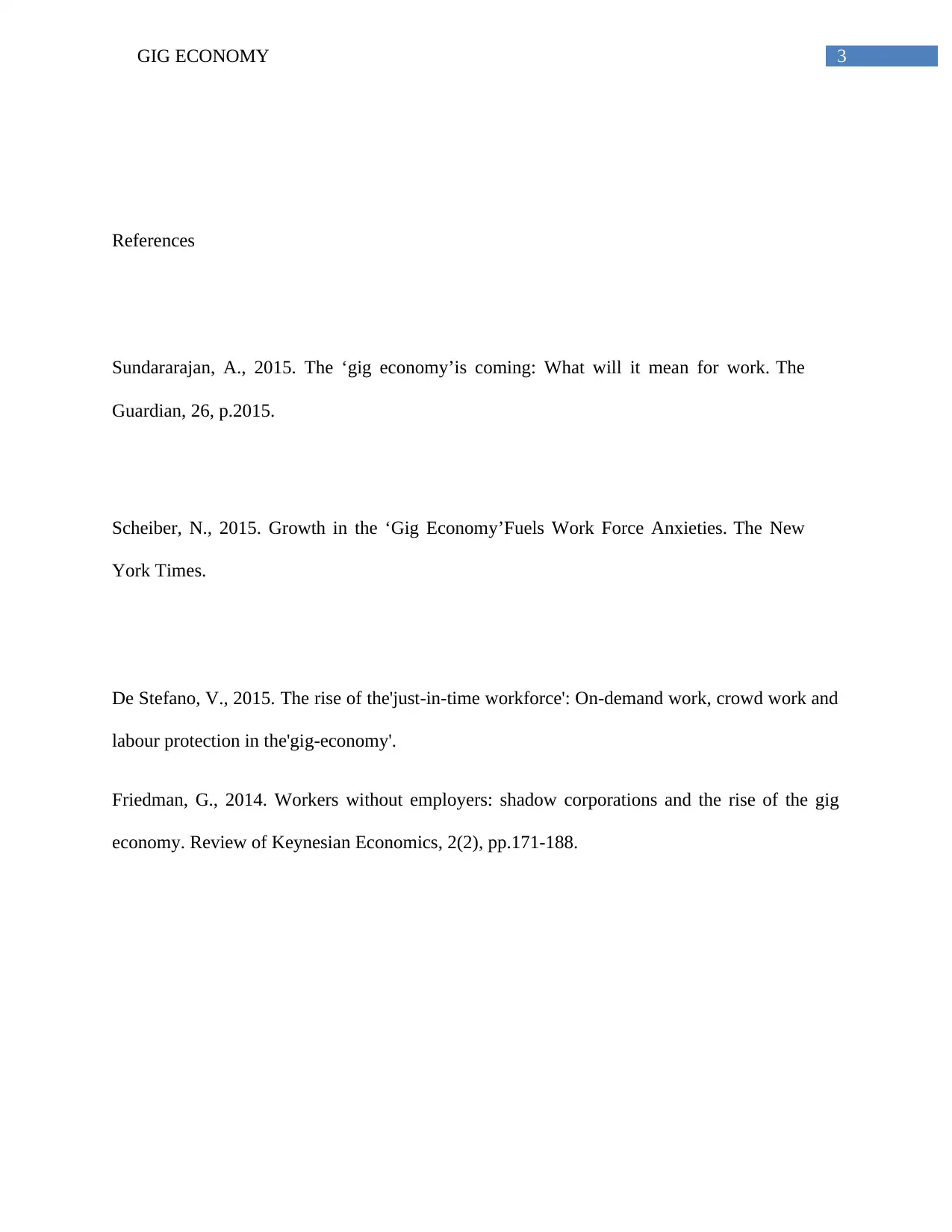
Sundararajan, A., 2015. The ‘gig economy’is coming: What will it mean for work. The
Guardian, 26, p.2015.
Scheiber, N., 2015. Growth in the ‘Gig Economy’Fuels Work Force Anxieties. The New
York Times.
De Stefano, V., 2015. The rise of the'just-in-time workforce': On-demand work, crowd work and
labour protection in the'gig-economy'.
Friedman, G., 2014. Workers without employers: shadow corporations and the rise of the gig
economy. Review of Keynesian Economics, 2(2), pp.171-188.
tabler-icon-diamond-filled.svg

Paraphrase This Document

Need a fresh take? Get an instant paraphrase of this document with our AI Paraphraser
Document Page
4GIG ECONOMY
chevron_up_icon
1 out of 5
circle_padding
hide_on_mobile
zoom_out_icon
[object Object]