Give and Take Analysis: Ethics, Goals, and Unethical Behavior

Verified

Added on  2023/01/17

|5
|913
|33
Homework Assignment
AI Summary
This assignment analyzes the concepts presented in Adam Grant's 'Give and Take' and an article on goal setting and unethical behavior. The student addresses the relationship between goal setting and unethical behavior, exploring how unmet goals can increase unethical actions, particularly when people fall short of their targets. The assignment also delves into the ethics of being a giver versus a taker, examining the benefits and drawbacks of each approach, and how these styles relate to ethical and unethical behavior. The student argues that givers, while potentially vulnerable, often achieve broader success. The assignment further explores how goal setting can be used to promote ethical behavior, advocating for a shift from focusing solely on outcomes to encouraging ethical decision-making in competitive situations, and suggests alternative methods like using goals as guidelines rather than strict targets.
Document Page
Running Head: GIVE AND TAKE 0
Management
Student Details
4/8/2019
tabler-icon-diamond-filled.svg

Paraphrase This Document

Need a fresh take? Get an instant paraphrase of this document with our AI Paraphraser
Document Page
Give and Take 1
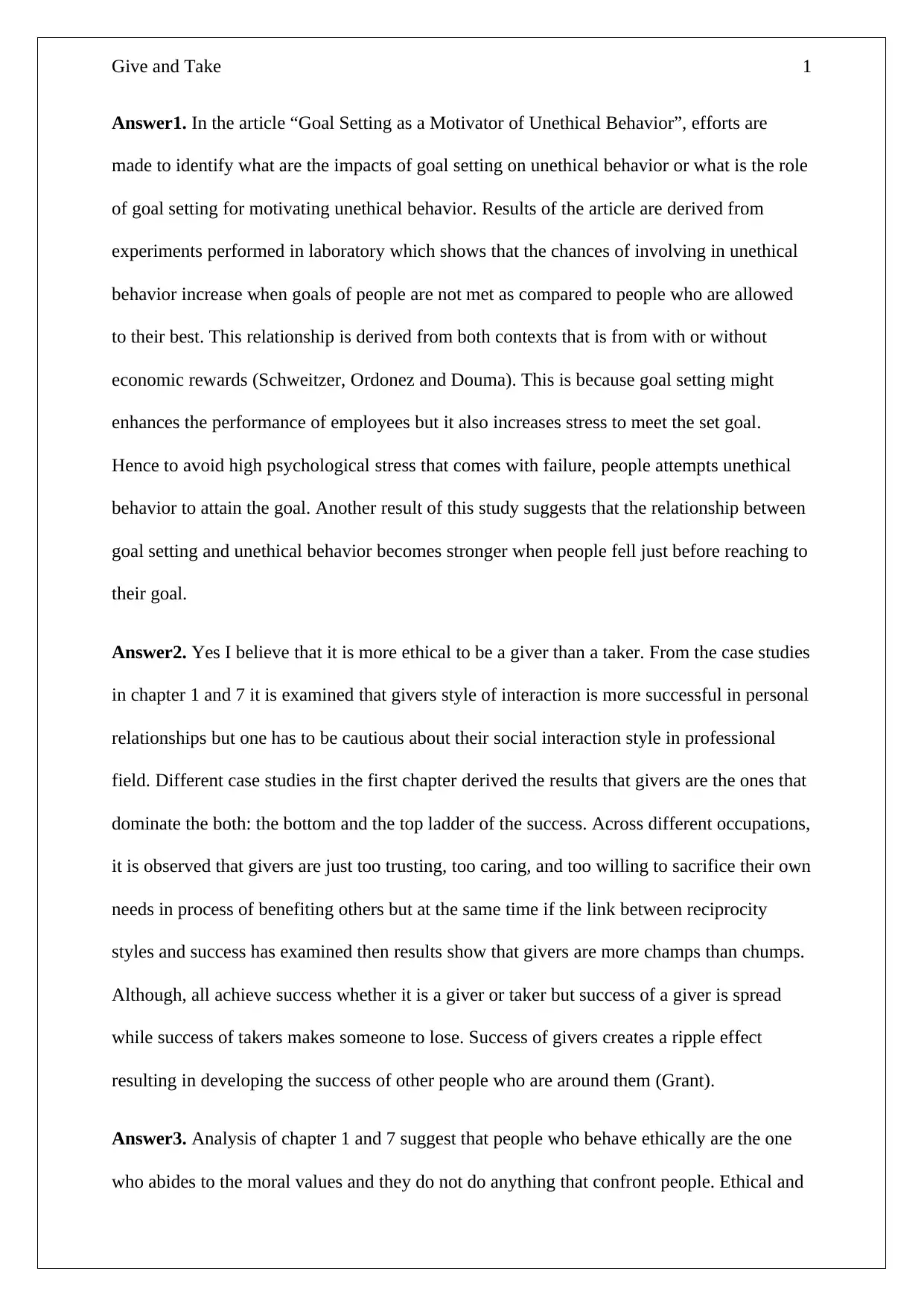
Answer1. In the article “Goal Setting as a Motivator of Unethical Behavior”, efforts are
made to identify what are the impacts of goal setting on unethical behavior or what is the role
of goal setting for motivating unethical behavior. Results of the article are derived from
experiments performed in laboratory which shows that the chances of involving in unethical
behavior increase when goals of people are not met as compared to people who are allowed
to their best. This relationship is derived from both contexts that is from with or without
economic rewards (Schweitzer, Ordonez and Douma). This is because goal setting might
enhances the performance of employees but it also increases stress to meet the set goal.
Hence to avoid high psychological stress that comes with failure, people attempts unethical
behavior to attain the goal. Another result of this study suggests that the relationship between
goal setting and unethical behavior becomes stronger when people fell just before reaching to
their goal.
Answer2. Yes I believe that it is more ethical to be a giver than a taker. From the case studies
in chapter 1 and 7 it is examined that givers style of interaction is more successful in personal
relationships but one has to be cautious about their social interaction style in professional
field. Different case studies in the first chapter derived the results that givers are the ones that
dominate the both: the bottom and the top ladder of the success. Across different occupations,
it is observed that givers are just too trusting, too caring, and too willing to sacrifice their own
needs in process of benefiting others but at the same time if the link between reciprocity
styles and success has examined then results show that givers are more champs than chumps.
Although, all achieve success whether it is a giver or taker but success of a giver is spread
while success of takers makes someone to lose. Success of givers creates a ripple effect
resulting in developing the success of other people who are around them (Grant).
Answer3. Analysis of chapter 1 and 7 suggest that people who behave ethically are the one
who abides to the moral values and they do not do anything that confront people. Ethical and
Document Page
Give and Take 2
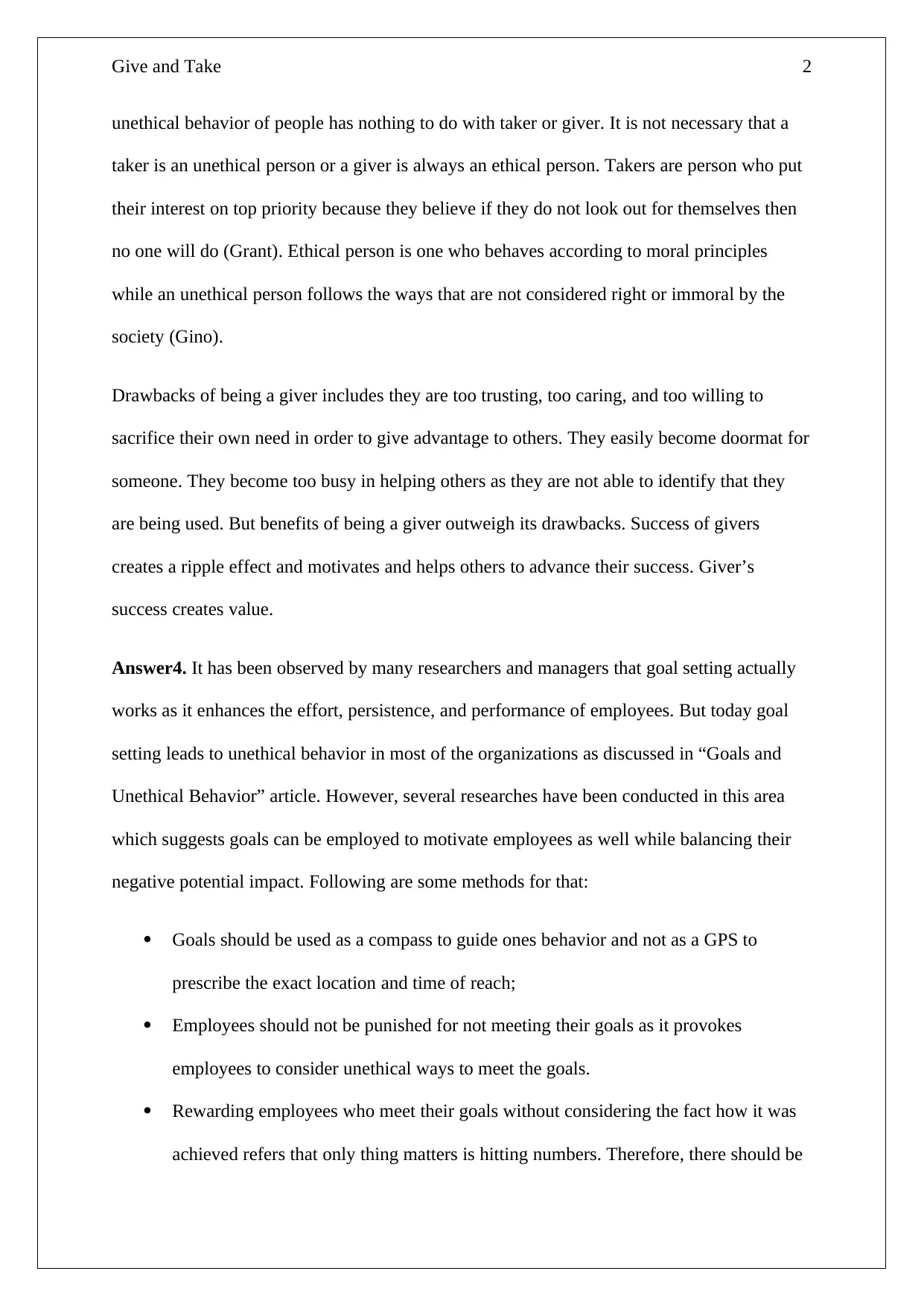
unethical behavior of people has nothing to do with taker or giver. It is not necessary that a
taker is an unethical person or a giver is always an ethical person. Takers are person who put
their interest on top priority because they believe if they do not look out for themselves then
no one will do (Grant). Ethical person is one who behaves according to moral principles
while an unethical person follows the ways that are not considered right or immoral by the
society (Gino).
Drawbacks of being a giver includes they are too trusting, too caring, and too willing to
sacrifice their own need in order to give advantage to others. They easily become doormat for
someone. They become too busy in helping others as they are not able to identify that they
are being used. But benefits of being a giver outweigh its drawbacks. Success of givers
creates a ripple effect and motivates and helps others to advance their success. Giver’s
success creates value.
Answer4. It has been observed by many researchers and managers that goal setting actually
works as it enhances the effort, persistence, and performance of employees. But today goal
setting leads to unethical behavior in most of the organizations as discussed in “Goals and
Unethical Behavior” article. However, several researches have been conducted in this area
which suggests goals can be employed to motivate employees as well while balancing their
negative potential impact. Following are some methods for that:
Goals should be used as a compass to guide ones behavior and not as a GPS to
prescribe the exact location and time of reach;
Employees should not be punished for not meeting their goals as it provokes
employees to consider unethical ways to meet the goals.
Rewarding employees who meet their goals without considering the fact how it was
achieved refers that only thing matters is hitting numbers. Therefore, there should be
Document Page
Give and Take 3
an evaluation team and leaders who create supportive work environments and
encourage them to think on how goals should be met (AU-YEUNG and Yan).
tabler-icon-diamond-filled.svg

Paraphrase This Document

Need a fresh take? Get an instant paraphrase of this document with our AI Paraphraser
Document Page
Give and Take 4
References
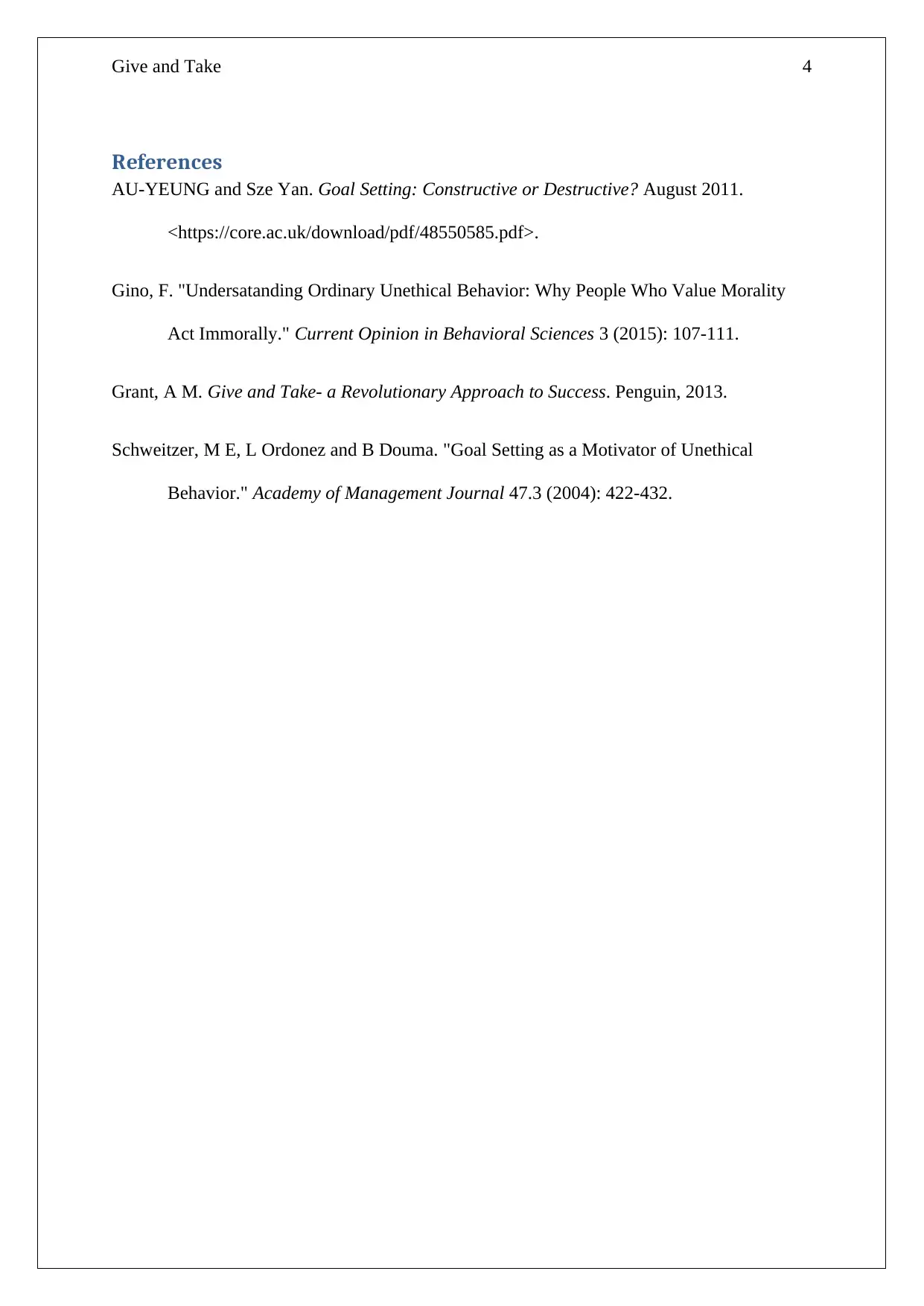
AU-YEUNG and Sze Yan. Goal Setting: Constructive or Destructive? August 2011.
<https://core.ac.uk/download/pdf/48550585.pdf>.
Gino, F. "Undersatanding Ordinary Unethical Behavior: Why People Who Value Morality
Act Immorally." Current Opinion in Behavioral Sciences 3 (2015): 107-111.
Grant, A M. Give and Take- a Revolutionary Approach to Success. Penguin, 2013.
Schweitzer, M E, L Ordonez and B Douma. "Goal Setting as a Motivator of Unethical
Behavior." Academy of Management Journal 47.3 (2004): 422-432.
chevron_up_icon
1 out of 5
circle_padding
hide_on_mobile
zoom_out_icon
[object Object]