Accounting Challenges Faced by Multinational Organizations: A Proposal
VerifiedAdded on 2020/07/22
|12
|3383
|226
Report
AI Summary
This research proposal examines the accounting challenges faced by global organizations. It begins with a literature review summarizing existing research on issues like human resources, accounting, and legal regulations, emphasizing the impact of globalization on accounting practices, including differences in standards, principles, and financial statement formats across countries. The proposal identifies gaps in the literature, specifically reporting issues such as the consolidation of financial transactions and currency conversions. The research questions address accounting challenges, sub-branches of accounting data, the importance of the International Accounting Standards Board (IASB), future accounting changes, and reporting issues. The methodology combines qualitative and quantitative approaches, including surveys and statistical analysis of data collected from accounting personnel at Tesco Plc. The research design includes detailed steps for data collection, reliability and validity approaches, sampling methods, and variable specifications, along with a time schedule and expected limitations. The proposal aims to provide insights into the current and future state of global accounting practices.

BUSINESS RESEARCH
PROPOSAL
PROPOSAL

Paraphrase This Document
Need a fresh take? Get an instant paraphrase of this document with our AI Paraphraser
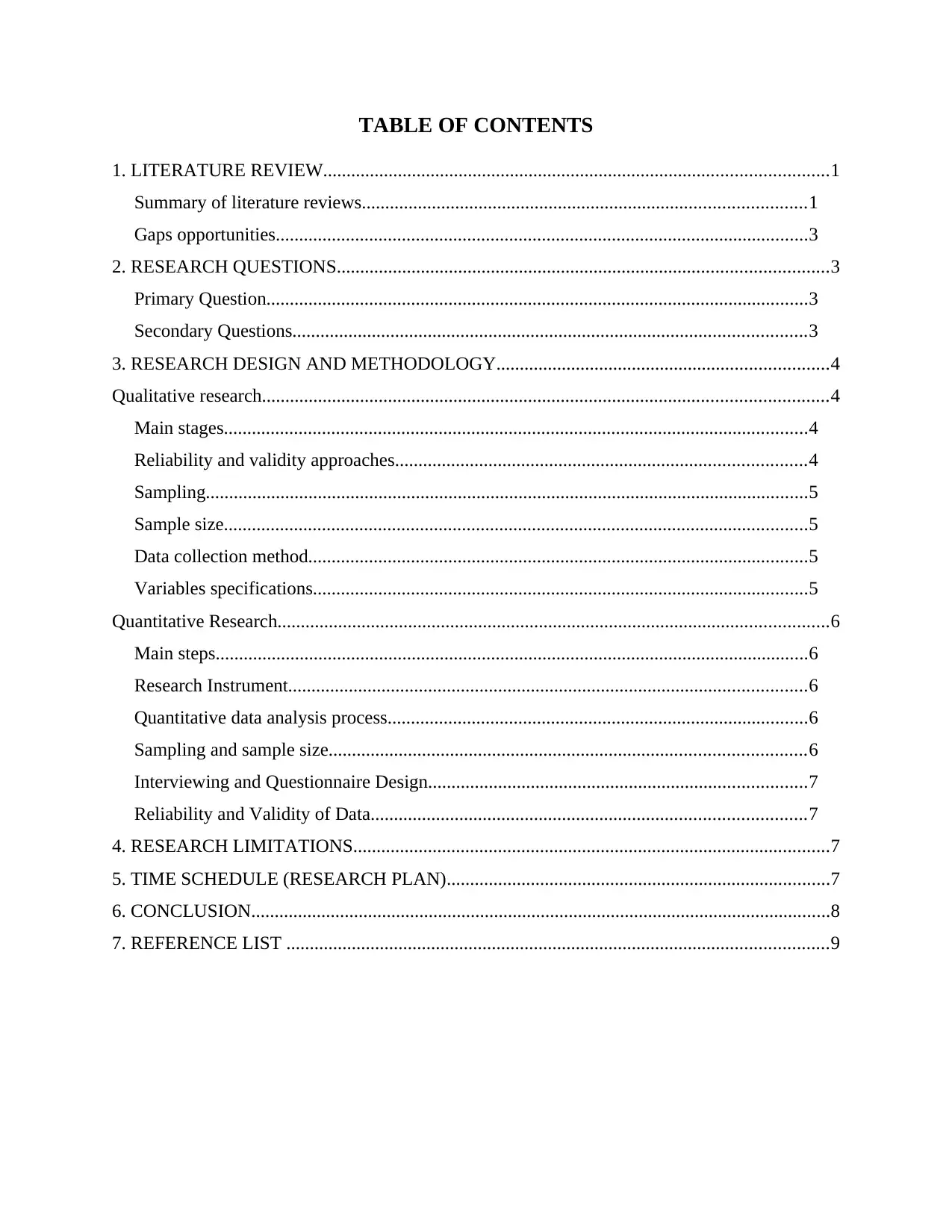
TABLE OF CONTENTS
1. LITERATURE REVIEW............................................................................................................1
Summary of literature reviews...............................................................................................1
Gaps opportunities..................................................................................................................3
2. RESEARCH QUESTIONS.........................................................................................................3
Primary Question....................................................................................................................3
Secondary Questions..............................................................................................................3
3. RESEARCH DESIGN AND METHODOLOGY.......................................................................4
Qualitative research.........................................................................................................................4
Main stages.............................................................................................................................4
Reliability and validity approaches........................................................................................4
Sampling.................................................................................................................................5
Sample size.............................................................................................................................5
Data collection method...........................................................................................................5
Variables specifications..........................................................................................................5
Quantitative Research......................................................................................................................6
Main steps...............................................................................................................................6
Research Instrument...............................................................................................................6
Quantitative data analysis process..........................................................................................6
Sampling and sample size......................................................................................................6
Interviewing and Questionnaire Design.................................................................................7
Reliability and Validity of Data.............................................................................................7
4. RESEARCH LIMITATIONS......................................................................................................7
5. TIME SCHEDULE (RESEARCH PLAN)..................................................................................7
6. CONCLUSION............................................................................................................................8
7. REFERENCE LIST ....................................................................................................................9
1. LITERATURE REVIEW............................................................................................................1
Summary of literature reviews...............................................................................................1
Gaps opportunities..................................................................................................................3
2. RESEARCH QUESTIONS.........................................................................................................3
Primary Question....................................................................................................................3
Secondary Questions..............................................................................................................3
3. RESEARCH DESIGN AND METHODOLOGY.......................................................................4
Qualitative research.........................................................................................................................4
Main stages.............................................................................................................................4
Reliability and validity approaches........................................................................................4
Sampling.................................................................................................................................5
Sample size.............................................................................................................................5
Data collection method...........................................................................................................5
Variables specifications..........................................................................................................5
Quantitative Research......................................................................................................................6
Main steps...............................................................................................................................6
Research Instrument...............................................................................................................6
Quantitative data analysis process..........................................................................................6
Sampling and sample size......................................................................................................6
Interviewing and Questionnaire Design.................................................................................7
Reliability and Validity of Data.............................................................................................7
4. RESEARCH LIMITATIONS......................................................................................................7
5. TIME SCHEDULE (RESEARCH PLAN)..................................................................................7
6. CONCLUSION............................................................................................................................8
7. REFERENCE LIST ....................................................................................................................9
1. LITERATURE REVIEW
Summary of literature reviews
According to Gomez (2015) when an organisation operates worldwide then faces various
number of issues and challenges. Due to this, smooth functioning of it in new market affects up
to the greater extent. Issues can be regarded with Human resource, accounting, financials,
organisational structure, legal rules and regulations etc. The present research is based on
accounting challenges which are faced by those firms which operating at the global level.
General issue is related with the usage of the information which relates with an accounting
system. It is an aspect in which all kind of monetary transactions recorded and on the basis of
that financial statements are framed in the company.
It can be summarised from the opinions of Guthrie, Burritt and Evans (2013) that, there
are different kinds of sub-branches available in the knowledge of accounting. All the global
companies consider various sub-branches due to which understanding level differs of an
organisation while preparing statements of the overall business group. Apart from this, wording
of one specific terms also differ from one country to another nation. For example: some entities
indicate value of turnover in sales and some know in form of revenue at the end of financial year.
In addition to this, value of income level can be known as profit or yield or any other. When one
organisation expands its business then has to consider accounting words of that country as well.
As per the views of Guthrie, Burritt and Evans (2013) each and every country not follows
same accounting standards, theories and principles. Various terms and factors relating to this
particular system differs from nation to nation. Due to this reason, when an organisation go for
globalisation then affected in terms of preparing final accounts. Along with the standards, rules
and principles, format of the financial statements also differ from each country. In this condition,
multinational entities not able to assess their financial position and performance in the industry in
an adequate manner. Therefore, they have to consider one specific accounting system which is
used at the global level. Under this, the company has to analyse new standards and theories and
then apply on the procedure at the time of operating in new market.
As per the opinion of Roman, Roman and Meier (2014) one of the highly pivotal role
played in accounting department is International Accounting Standards Board (IASB). It works
at the global level in which list of accounting standards and theories are framed. When an entity
1
Summary of literature reviews
According to Gomez (2015) when an organisation operates worldwide then faces various
number of issues and challenges. Due to this, smooth functioning of it in new market affects up
to the greater extent. Issues can be regarded with Human resource, accounting, financials,
organisational structure, legal rules and regulations etc. The present research is based on
accounting challenges which are faced by those firms which operating at the global level.
General issue is related with the usage of the information which relates with an accounting
system. It is an aspect in which all kind of monetary transactions recorded and on the basis of
that financial statements are framed in the company.
It can be summarised from the opinions of Guthrie, Burritt and Evans (2013) that, there
are different kinds of sub-branches available in the knowledge of accounting. All the global
companies consider various sub-branches due to which understanding level differs of an
organisation while preparing statements of the overall business group. Apart from this, wording
of one specific terms also differ from one country to another nation. For example: some entities
indicate value of turnover in sales and some know in form of revenue at the end of financial year.
In addition to this, value of income level can be known as profit or yield or any other. When one
organisation expands its business then has to consider accounting words of that country as well.
As per the views of Guthrie, Burritt and Evans (2013) each and every country not follows
same accounting standards, theories and principles. Various terms and factors relating to this
particular system differs from nation to nation. Due to this reason, when an organisation go for
globalisation then affected in terms of preparing final accounts. Along with the standards, rules
and principles, format of the financial statements also differ from each country. In this condition,
multinational entities not able to assess their financial position and performance in the industry in
an adequate manner. Therefore, they have to consider one specific accounting system which is
used at the global level. Under this, the company has to analyse new standards and theories and
then apply on the procedure at the time of operating in new market.
As per the opinion of Roman, Roman and Meier (2014) one of the highly pivotal role
played in accounting department is International Accounting Standards Board (IASB). It works
at the global level in which list of accounting standards and theories are framed. When an entity
1
⊘ This is a preview!⊘
Do you want full access?
Subscribe today to unlock all pages.

Trusted by 1+ million students worldwide
operates worldwide then use GAAP, principles, standards etc. of accounting same which not
differs from country to country. Further, it can be summarised that IASB is a framework which is
a very helpful for the global companies in order to reduce as well as overcome issues of
accounting. On the other side, registration and enrolment charges in the board of international
accounting standards are very expensive. It is big matter of concern for the multinational firms
because of enhancing total expenses and declining financial performance at the global level
within relevant industry.
It can be assessed from the views of Romanus and Arowoshegbe (2014) that issue related
to the interpretation and analysis of business financials are also come into consideration up to the
larger extent. In this according to one country performance of a global company is at the better
position. On the other side, if interpretation method of any other nation is applied on the financial
statements then may be possible that performance will either decline or increase. In order to
make solution of this particular accounting issue, re-measurement method would be considered.
This way of assessing business performance helps to make suitable as well as adequate
interpretation of the company. Henceforth, while operating at the global market challenges
regarding to the accounting occur up to the greater extent within workplace.
Brake (2017) sates that, in the upcoming three years various number of changes will be
incurred with reference to the accounting dialogues. Due to this, global companies will affect in
context to accounting up to the greater level. When talking about the respondents of such
changes then they should be professionals, educational institutes and individuals. First change
among three is like accountants will try to use traditional working techniques in the accounting
department on consistent basis. Therefore, modern and usual approach of working will be
replaced in the global firms. When look at the second change then that will be related with the
capital market and outsourcing. In this, due to increasing globalisation on continuous basis then
more number of difficulties will create for the individuals who are working in accounting. Apart
from this, when free cash flow within the capital market will increase or decrease then
outsourcing affects up to the larger extent. The third change which will come in next three
decades is regarding to extended control as well as disclosure laws related with this aspect.
It can be pertained from the views of Schaltegger, Etxeberria and Ortas (2017) that,
colleges should consider accounting modules in the study. Further, all the modules about
2
differs from country to country. Further, it can be summarised that IASB is a framework which is
a very helpful for the global companies in order to reduce as well as overcome issues of
accounting. On the other side, registration and enrolment charges in the board of international
accounting standards are very expensive. It is big matter of concern for the multinational firms
because of enhancing total expenses and declining financial performance at the global level
within relevant industry.
It can be assessed from the views of Romanus and Arowoshegbe (2014) that issue related
to the interpretation and analysis of business financials are also come into consideration up to the
larger extent. In this according to one country performance of a global company is at the better
position. On the other side, if interpretation method of any other nation is applied on the financial
statements then may be possible that performance will either decline or increase. In order to
make solution of this particular accounting issue, re-measurement method would be considered.
This way of assessing business performance helps to make suitable as well as adequate
interpretation of the company. Henceforth, while operating at the global market challenges
regarding to the accounting occur up to the greater extent within workplace.
Brake (2017) sates that, in the upcoming three years various number of changes will be
incurred with reference to the accounting dialogues. Due to this, global companies will affect in
context to accounting up to the greater level. When talking about the respondents of such
changes then they should be professionals, educational institutes and individuals. First change
among three is like accountants will try to use traditional working techniques in the accounting
department on consistent basis. Therefore, modern and usual approach of working will be
replaced in the global firms. When look at the second change then that will be related with the
capital market and outsourcing. In this, due to increasing globalisation on continuous basis then
more number of difficulties will create for the individuals who are working in accounting. Apart
from this, when free cash flow within the capital market will increase or decrease then
outsourcing affects up to the larger extent. The third change which will come in next three
decades is regarding to extended control as well as disclosure laws related with this aspect.
It can be pertained from the views of Schaltegger, Etxeberria and Ortas (2017) that,
colleges should consider accounting modules in the study. Further, all the modules about
2
Paraphrase This Document
Need a fresh take? Get an instant paraphrase of this document with our AI Paraphraser
accounting principles, standards, theories etc. must be from the international frameworks. The
reason is that it helps to provide education to the accounting students about international rules.
Therefore, challenges in context to this aspect faced by global companies will overcome up to
the greater level when they recruit students from these kinds of colleges.
Gaps opportunities
In the above study, different literatures give their opinion and say that wide range of
accounting problems came into consideration when an enterprise operates globally. However,
accounting issues in context to reporting financials are not explained in the above analysis.
Therefore, gap of the present study is reporting issues in accounting which will be analysed in
the further research in an appropriate manner. In context to the reporting problems basically two
types of the challenges come into workplace which will be discussed in the research project. First
issue is about consolidation of financial transactions of subsidiary firms within a global
enterprise. Apart from this, second challenge is about preparing financial statements of parent
companies using the transactions of subsidiaries (Global Accounting Issues, 2017). In this,
financial data of subsidiaries are in different currencies where an employee convert all the
information in central currency which is one of the major reporting issue. Therefore, in the
project challenges related to the accounting reporting will be analysed.
2. RESEARCH QUESTIONS
Primary Question
What are the accounting challenges faced by global organisations?
Secondary Questions
What are the sub-branches of using accounting data in global companies?
What is the importance of International Accounting Standards Board (IASB) within
global entities?
What are the three changes which will be noticed in next three decades in accounting
dialogue?
What are the reporting challenges faced by the global firms?
3
reason is that it helps to provide education to the accounting students about international rules.
Therefore, challenges in context to this aspect faced by global companies will overcome up to
the greater level when they recruit students from these kinds of colleges.
Gaps opportunities
In the above study, different literatures give their opinion and say that wide range of
accounting problems came into consideration when an enterprise operates globally. However,
accounting issues in context to reporting financials are not explained in the above analysis.
Therefore, gap of the present study is reporting issues in accounting which will be analysed in
the further research in an appropriate manner. In context to the reporting problems basically two
types of the challenges come into workplace which will be discussed in the research project. First
issue is about consolidation of financial transactions of subsidiary firms within a global
enterprise. Apart from this, second challenge is about preparing financial statements of parent
companies using the transactions of subsidiaries (Global Accounting Issues, 2017). In this,
financial data of subsidiaries are in different currencies where an employee convert all the
information in central currency which is one of the major reporting issue. Therefore, in the
project challenges related to the accounting reporting will be analysed.
2. RESEARCH QUESTIONS
Primary Question
What are the accounting challenges faced by global organisations?
Secondary Questions
What are the sub-branches of using accounting data in global companies?
What is the importance of International Accounting Standards Board (IASB) within
global entities?
What are the three changes which will be noticed in next three decades in accounting
dialogue?
What are the reporting challenges faced by the global firms?
3
3. RESEARCH DESIGN AND METHODOLOGY
The present study consists of both theoretical and technical aspect and necessitates the
application of both theoretic any statistical techniques to be applied on the collected set of data
(Flick, 2015). Therefore, it will be a study conducted using mixed approach consisting of both
qualitative and quantitative measures in which different methods will be included as mentioned
below:
Qualitative research
Main stages
In order to conduct effective research after taking base to the qualitative method there is
specific process is used by the scholar. In the present research, below stated seven steps will be
considered:
1. Determine problem and questions of research
2. Design the overall study after considering four W's: who, where, when and how (Sauro,
2013).
3. Collect valid information
4. Analyse the gathered data
5. Generate findings
6. Validate conclusion or findings
7. Submitting report
Reliability and validity approaches
The term reliability indicates that collected data are up to which extent trustworthy as
well as reliable in the research. There are different number of methods available which support to
scholar for measuring reliability of gathered information in the study. Further, for assessing
reliability of data in present research project internal consistency approach will be undertaken by
the investigator. Under this, responses of targeted people across the items are analysed on a
multiple-item (Reliability and Validity of Measurement, 2016). It helps to analyse actual terms
within study from data set due to which it will be considered in this project as compared to
others.
4
The present study consists of both theoretical and technical aspect and necessitates the
application of both theoretic any statistical techniques to be applied on the collected set of data
(Flick, 2015). Therefore, it will be a study conducted using mixed approach consisting of both
qualitative and quantitative measures in which different methods will be included as mentioned
below:
Qualitative research
Main stages
In order to conduct effective research after taking base to the qualitative method there is
specific process is used by the scholar. In the present research, below stated seven steps will be
considered:
1. Determine problem and questions of research
2. Design the overall study after considering four W's: who, where, when and how (Sauro,
2013).
3. Collect valid information
4. Analyse the gathered data
5. Generate findings
6. Validate conclusion or findings
7. Submitting report
Reliability and validity approaches
The term reliability indicates that collected data are up to which extent trustworthy as
well as reliable in the research. There are different number of methods available which support to
scholar for measuring reliability of gathered information in the study. Further, for assessing
reliability of data in present research project internal consistency approach will be undertaken by
the investigator. Under this, responses of targeted people across the items are analysed on a
multiple-item (Reliability and Validity of Measurement, 2016). It helps to analyse actual terms
within study from data set due to which it will be considered in this project as compared to
others.
4
⊘ This is a preview!⊘
Do you want full access?
Subscribe today to unlock all pages.
Trusted by 1+ million students worldwide
The tool which shows that for generating findings, up to which level scientific research
techniques will be required is known as validity. In the present study, information will be
collected using survey methodology and thematic analysis will be applied. Further, some
approaches available to assess validity of data which include face, context, criterion, and
discriminant validity. In the present project, criterion method will be considered which helps to
measure scores of targeted people and then correlated with variables used in the study.
Sampling
The method in which sample data determined from the targeted population in order to
collect proper and valid information is identified as sampling. It helps to summarise total
population and analyse the problem statement in an appropriate manner. Generally probabilistic
and non-probabilistic two kinds of basic sampling methods used by the scholar (Gast and
Ledford, 2014). In the present research, probabilistic sampling techniques will be used where
randomly sample will be derived by the scholar. When talking about the targeted population
then, accounting employees of Tesco Plc organisation will be undertaken.
Sample size
The tool of selecting number of respondents using specific methods for collecting data is
defined as sample size. 25 accounting personnel of Tesco will be taken as sample from whom the
responses will be collected.
Data collection method
The present study will be based on the primary data where secondary information will be
avoided for analysis. Further, with the help of survey source, scholar will gather information
from the above stated sample size (Hunleth, 2011). In the project, questionnaire will be framed
taking base of research questions and then distributed among accounting employees of Tesco
through online methodology. It is one of the best and effective method that will also result in less
consumption of time.
Variables specifications
In the present study, questions relating to the accounting issues will be asked from the
selected population of research. Therefore, basic and larger variable of the project will be
accounting in multinational companies. Apart from this, significance and effectiveness of
International Accounting Standards Board (IASB) is analysed which is another variable of the
5
techniques will be required is known as validity. In the present study, information will be
collected using survey methodology and thematic analysis will be applied. Further, some
approaches available to assess validity of data which include face, context, criterion, and
discriminant validity. In the present project, criterion method will be considered which helps to
measure scores of targeted people and then correlated with variables used in the study.
Sampling
The method in which sample data determined from the targeted population in order to
collect proper and valid information is identified as sampling. It helps to summarise total
population and analyse the problem statement in an appropriate manner. Generally probabilistic
and non-probabilistic two kinds of basic sampling methods used by the scholar (Gast and
Ledford, 2014). In the present research, probabilistic sampling techniques will be used where
randomly sample will be derived by the scholar. When talking about the targeted population
then, accounting employees of Tesco Plc organisation will be undertaken.
Sample size
The tool of selecting number of respondents using specific methods for collecting data is
defined as sample size. 25 accounting personnel of Tesco will be taken as sample from whom the
responses will be collected.
Data collection method
The present study will be based on the primary data where secondary information will be
avoided for analysis. Further, with the help of survey source, scholar will gather information
from the above stated sample size (Hunleth, 2011). In the project, questionnaire will be framed
taking base of research questions and then distributed among accounting employees of Tesco
through online methodology. It is one of the best and effective method that will also result in less
consumption of time.
Variables specifications
In the present study, questions relating to the accounting issues will be asked from the
selected population of research. Therefore, basic and larger variable of the project will be
accounting in multinational companies. Apart from this, significance and effectiveness of
International Accounting Standards Board (IASB) is analysed which is another variable of the
5
Paraphrase This Document
Need a fresh take? Get an instant paraphrase of this document with our AI Paraphraser
study. Further, accounting changes which that can come up in the upcoming three decades are
considered. Apart from this, variable related to gap analysis is reporting the issues of accounting
in global entities.
Quantitative Research
Main steps
Stages of the quantitative research process are stated below:
1. State problem and questions of research
2. Define objectives of the study
3. Review different literatures related to the topic
4. Derive variables and frame hypothesis
5. Select research design and instrument
6. Select targeted population and sample size
7. Collect data using selected research instrument
8. Analyse the data applying SPSS techniques
9. Derive findings and conclusion
Research Instrument
When research is of the qualitative nature then basically two instruments available like
questionnaire and interview. In the present research project, questionnaire research instruments
will be undertaken by the investigator (Instrument, Validity, Reliability, 2016).
Quantitative data analysis process
For making analysis of the collected data under quantitative research different number of
tools are applied. In the present study, statistical or SPSS tools will be applied on the data set and
the analysed in an appropriate way.
Sampling and sample size
Sampling method in the present research will be probabilistic where randomly sample
size will be derived. Apart from this, targeted population will be accounting employees of the
Tesco Plc. Further, sample size will be total 25 workers of the accounting department.
6
considered. Apart from this, variable related to gap analysis is reporting the issues of accounting
in global entities.
Quantitative Research
Main steps
Stages of the quantitative research process are stated below:
1. State problem and questions of research
2. Define objectives of the study
3. Review different literatures related to the topic
4. Derive variables and frame hypothesis
5. Select research design and instrument
6. Select targeted population and sample size
7. Collect data using selected research instrument
8. Analyse the data applying SPSS techniques
9. Derive findings and conclusion
Research Instrument
When research is of the qualitative nature then basically two instruments available like
questionnaire and interview. In the present research project, questionnaire research instruments
will be undertaken by the investigator (Instrument, Validity, Reliability, 2016).
Quantitative data analysis process
For making analysis of the collected data under quantitative research different number of
tools are applied. In the present study, statistical or SPSS tools will be applied on the data set and
the analysed in an appropriate way.
Sampling and sample size
Sampling method in the present research will be probabilistic where randomly sample
size will be derived. Apart from this, targeted population will be accounting employees of the
Tesco Plc. Further, sample size will be total 25 workers of the accounting department.
6
Interviewing and Questionnaire Design
In the study questionnaire instrument will be used by the research for making proper and
effective analysis. Therefore, questionnaire will be designed after taking base to the objectives
and research questions of the study.
Reliability and Validity of Data
The study will consider questionnaire method, due to which data will be highly real and
valid. Moreover, for assessing reliability and validity of the information, internal consistency
approach and criterion method will be used by the scholar.
4. RESEARCH LIMITATIONS
In order to conduct proper research of a specific research problem, there may exist
different issues faced by the scholar. Basic limitation in the present study is related to time
resources where data collection part will consume more time-frame. Due to which, overall
research and final submission of the project could delay. Apart from this, another drawback is
regarding the sample size which is less in number by which highly adequate data cannot be
collected. In opposite to this, sample size is selected on the basis of their knowledge about
accounting in a proper way (Taylor, Bogdan and DeVault, 2015). Therefore, this issue will be
overcome easily and research will be completed in an effective manner.
5. TIME SCHEDULE (RESEARCH PLAN)
Activities / weeks 1th 2nd 3rd 4th 5th 6th 7th 8th 9th 10th 11th
Select problem
statement for research
Frame aims and
objectives for the study
Collect secondary data
and review different
literatures
Select appropriate tools
and specifications of
7
In the study questionnaire instrument will be used by the research for making proper and
effective analysis. Therefore, questionnaire will be designed after taking base to the objectives
and research questions of the study.
Reliability and Validity of Data
The study will consider questionnaire method, due to which data will be highly real and
valid. Moreover, for assessing reliability and validity of the information, internal consistency
approach and criterion method will be used by the scholar.
4. RESEARCH LIMITATIONS
In order to conduct proper research of a specific research problem, there may exist
different issues faced by the scholar. Basic limitation in the present study is related to time
resources where data collection part will consume more time-frame. Due to which, overall
research and final submission of the project could delay. Apart from this, another drawback is
regarding the sample size which is less in number by which highly adequate data cannot be
collected. In opposite to this, sample size is selected on the basis of their knowledge about
accounting in a proper way (Taylor, Bogdan and DeVault, 2015). Therefore, this issue will be
overcome easily and research will be completed in an effective manner.
5. TIME SCHEDULE (RESEARCH PLAN)
Activities / weeks 1th 2nd 3rd 4th 5th 6th 7th 8th 9th 10th 11th
Select problem
statement for research
Frame aims and
objectives for the study
Collect secondary data
and review different
literatures
Select appropriate tools
and specifications of
7
⊘ This is a preview!⊘
Do you want full access?
Subscribe today to unlock all pages.
Trusted by 1+ million students worldwide
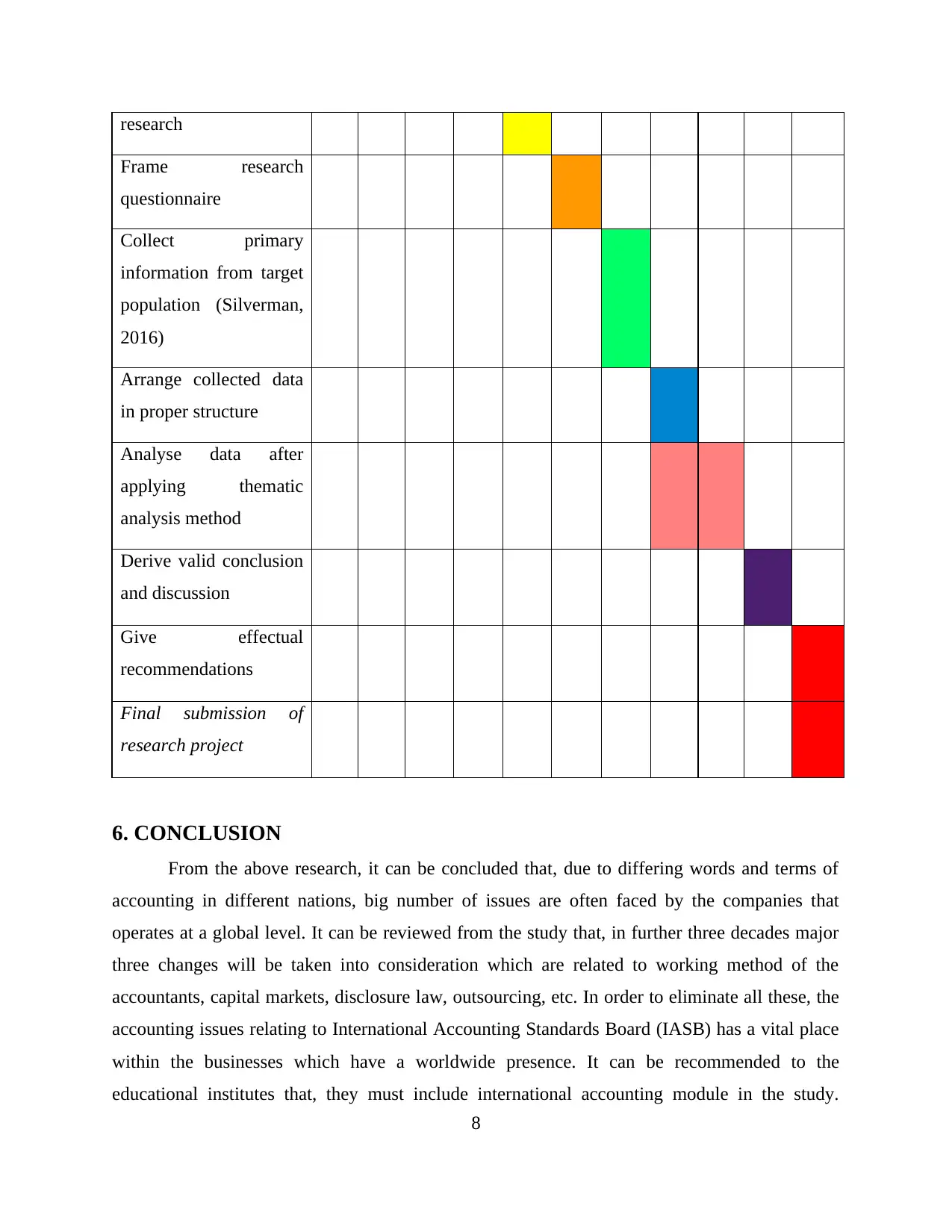
research
Frame research
questionnaire
Collect primary
information from target
population (Silverman,
2016)
Arrange collected data
in proper structure
Analyse data after
applying thematic
analysis method
Derive valid conclusion
and discussion
Give effectual
recommendations
Final submission of
research project
6. CONCLUSION
From the above research, it can be concluded that, due to differing words and terms of
accounting in different nations, big number of issues are often faced by the companies that
operates at a global level. It can be reviewed from the study that, in further three decades major
three changes will be taken into consideration which are related to working method of the
accountants, capital markets, disclosure law, outsourcing, etc. In order to eliminate all these, the
accounting issues relating to International Accounting Standards Board (IASB) has a vital place
within the businesses which have a worldwide presence. It can be recommended to the
educational institutes that, they must include international accounting module in the study.
8
Frame research
questionnaire
Collect primary
information from target
population (Silverman,
2016)
Arrange collected data
in proper structure
Analyse data after
applying thematic
analysis method
Derive valid conclusion
and discussion
Give effectual
recommendations
Final submission of
research project
6. CONCLUSION
From the above research, it can be concluded that, due to differing words and terms of
accounting in different nations, big number of issues are often faced by the companies that
operates at a global level. It can be reviewed from the study that, in further three decades major
three changes will be taken into consideration which are related to working method of the
accountants, capital markets, disclosure law, outsourcing, etc. In order to eliminate all these, the
accounting issues relating to International Accounting Standards Board (IASB) has a vital place
within the businesses which have a worldwide presence. It can be recommended to the
educational institutes that, they must include international accounting module in the study.
8
Paraphrase This Document
Need a fresh take? Get an instant paraphrase of this document with our AI Paraphraser
However, literatures that are unable to effectively explain the issues relating to account’s
reporting will be analysed in this research project.
7. REFERENCE LIST
Books and Journal
Brake, D., 2017. Accounting for Innovation in the Coming Consolidation: Telecom Merger
Analysis Under a Trump Administration. Elsevier.
Flick, U., 2015. Introducing research methodology: A beginner's guide to doing a research
project. Sage.
Gast, D. L. and Ledford, J. R., 2014. Single case research methodology: Applications in special
education and behavioral sciences. Routledge.
Guthrie, J., Burritt, R. and Evans, E., 2013. Challenges for accounting and business education:
blending online and traditional universities in an MOOC environment (Doctoral
dissertation, Institute of Chartered Accountants Australia; Centre for Accounting,
Governance and Sustainability, University of South Australia).
Hunleth, J., 2011. Beyond on or with: Questioning power dynamics and knowledge production in
‘child-oriented’research methodology. Childhood. 18(1). pp.81-93.
Roman, C., Roman, A. G., and Meier, E., 2014. The challenges of accounting profession as
generated by controlling. Theoretical & Applied Economics. 21(11).
Romanus, O. O. and Arowoshegbe, A., 2014. The Challenges of Accounting Education: The
Nigerian Experience. Accounting and Finance Research. 3(2). p. 129.
Schaltegger, S., Etxeberria, I. Á. and Ortas, E., 2017. Innovating Corporate Accounting and
Reporting for Sustainability–Attributes and Challenges. Sustainable Development. 25(2).
pp. 113-122.
Silverman, D., 2016. Qualitative research. Sage.
Taylor, S. J., Bogdan, R. and DeVault, M., 2015. Introduction to qualitative research methods: A
guidebook and resource. John Wiley & Sons.Neuman, W. L. and Robson, K., 2012. Basics
of social research: Qualitative and quantitative approaches.
9
reporting will be analysed in this research project.
7. REFERENCE LIST
Books and Journal
Brake, D., 2017. Accounting for Innovation in the Coming Consolidation: Telecom Merger
Analysis Under a Trump Administration. Elsevier.
Flick, U., 2015. Introducing research methodology: A beginner's guide to doing a research
project. Sage.
Gast, D. L. and Ledford, J. R., 2014. Single case research methodology: Applications in special
education and behavioral sciences. Routledge.
Guthrie, J., Burritt, R. and Evans, E., 2013. Challenges for accounting and business education:
blending online and traditional universities in an MOOC environment (Doctoral
dissertation, Institute of Chartered Accountants Australia; Centre for Accounting,
Governance and Sustainability, University of South Australia).
Hunleth, J., 2011. Beyond on or with: Questioning power dynamics and knowledge production in
‘child-oriented’research methodology. Childhood. 18(1). pp.81-93.
Roman, C., Roman, A. G., and Meier, E., 2014. The challenges of accounting profession as
generated by controlling. Theoretical & Applied Economics. 21(11).
Romanus, O. O. and Arowoshegbe, A., 2014. The Challenges of Accounting Education: The
Nigerian Experience. Accounting and Finance Research. 3(2). p. 129.
Schaltegger, S., Etxeberria, I. Á. and Ortas, E., 2017. Innovating Corporate Accounting and
Reporting for Sustainability–Attributes and Challenges. Sustainable Development. 25(2).
pp. 113-122.
Silverman, D., 2016. Qualitative research. Sage.
Taylor, S. J., Bogdan, R. and DeVault, M., 2015. Introduction to qualitative research methods: A
guidebook and resource. John Wiley & Sons.Neuman, W. L. and Robson, K., 2012. Basics
of social research: Qualitative and quantitative approaches.
9
Online
Global Accounting Issues, 2017. [Online]. Available through:
<https://academlib.com/670/accounting/global_accounting_issues> [Accessed on 15th
September 2017].
Gomez, A., 2015. Accountants' Biggest Concerns in 2015. [Online]. Available through:
<https://www.ifac.org/global-knowledge-gateway/practice-management/discussion/
accountants-biggest-concerns-2015> [Accessed on 15th September 2017].
Instrument, Validity, Reliability, 2016. [Online]. Available through:
<https://researchrundowns.com/quantitative-methods/instrument-validity-reliability/>
[Accessed on 16th September 2017].
Reliability and Validity of Measurement, 2016. [Online]. Available through:
<https://opentextbc.ca/researchmethods/chapter/reliability-and-validity-of-measurement/>
[Accessed on 15th September 2017].
Sauro, J., 2013. 7 STEPS TO CONDUCTING BETTER QUALITATIVE RESEARCH. [Online].
Available through: <https://measuringu.com/qualitative-steps/> [Accessed on 15th
September 2017].
10
Global Accounting Issues, 2017. [Online]. Available through:
<https://academlib.com/670/accounting/global_accounting_issues> [Accessed on 15th
September 2017].
Gomez, A., 2015. Accountants' Biggest Concerns in 2015. [Online]. Available through:
<https://www.ifac.org/global-knowledge-gateway/practice-management/discussion/
accountants-biggest-concerns-2015> [Accessed on 15th September 2017].
Instrument, Validity, Reliability, 2016. [Online]. Available through:
<https://researchrundowns.com/quantitative-methods/instrument-validity-reliability/>
[Accessed on 16th September 2017].
Reliability and Validity of Measurement, 2016. [Online]. Available through:
<https://opentextbc.ca/researchmethods/chapter/reliability-and-validity-of-measurement/>
[Accessed on 15th September 2017].
Sauro, J., 2013. 7 STEPS TO CONDUCTING BETTER QUALITATIVE RESEARCH. [Online].
Available through: <https://measuringu.com/qualitative-steps/> [Accessed on 15th
September 2017].
10
⊘ This is a preview!⊘
Do you want full access?
Subscribe today to unlock all pages.
Trusted by 1+ million students worldwide

1 out of 12


Related Documents


Your All-in-One AI-Powered Toolkit for Academic Success.
+13062052269
info@desklib.com
Available 24*7 on WhatsApp / Email
![[object Object]](/_next/static/media/star-bottom.7253800d.svg)
Unlock your academic potential
Copyright © 2020–2026 A2Z Services. All Rights Reserved. Developed and managed by ZUCOL.