Impact of Emerging Economies and Trump's Policies on Business
VerifiedAdded on 2020/10/22
|8
|1965
|134
Report
AI Summary
This report examines the global business environment, focusing on how emerging economies create opportunities for global expansion and the impact of President Trump's economic policies, particularly on China. The report begins by defining emerging economies and outlining their key characteristics, such as lower per capita income and rapid growth, which attract businesses seeking international expansion. It then provides examples like Coca-Cola and Apple Inc., demonstrating how companies leverage these markets. The report further analyzes President Trump's economic policies, including trade protectionism and tariffs, and their effects on China. It highlights the trade war between the US and China and the impact of tariffs on Chinese exports and the manufacturing sector. The report concludes that emerging economies and globalized businesses are interconnected, with emerging economies providing opportunities for global business while globalized entities stimulate the economic condition of such economies.
Global Business
Environment
Environment
Paraphrase This Document
Need a fresh take? Get an instant paraphrase of this document with our AI Paraphraser

Table of Contents
Emerging economies present opportunities for global expansion for businesses..................1
President Trump’s approach to economic policy impacts upon China..................................3
REFERENCES................................................................................................................................6
Emerging economies present opportunities for global expansion for businesses..................1
President Trump’s approach to economic policy impacts upon China..................................3
REFERENCES................................................................................................................................6

Emerging economies present opportunities for global expansion for businesses
Economy of a country is a key factor that determines the growth and development of
businesses situated there. Emerging economies are those countries whose economy is
increasingly growing as to become advanced but still not classified as a developed nation. The
key elements of emerging market economies are lower than average per capita income, more
than average return for potential investors, increasing market volatility, rapid growth witnessed
recently and lesser mature capital markets. All of these together helps in establishing a emerging
market economy. As per statistics March 2018, the Morgan Stanley Emerging Market
Index classified 24 countries as emerging economies. These are Brazil, Indonesia, Chile, Korea,
Malaysia, China, Colombia, Egypt, Czech Republic, Greece, Hungary, India and some more
(Outperformers: High-growth emerging economies and the companies that propel them, 2019).
Emerging economies encourage business enterprises to take their trade and production to
a global level. They present opportunities for fostering globalisation among entities by reducing
trade barriers and facilitating free flow of goods and services from one place to another.
Emerging economies play a key role in providing opportunities for companies in demographic as
well as economic terms, both at macroeconomic and microeconomic level. When economy of a
country is growing, it tends to create positive chances for corporate world wherein entities come
in contact to facilitate healthy business relationships. By making use of such relations,
enterprises intend to expand their businesses by taking to various geographical locations not yet
explored.
A leading example of how emerging economies strive to create opportunities for global
expansion of companies can be demonstrated by gaining an insight into Coca Cola. Over years,
this entity has taken the advantage of global expansion. Coke began with the process of
operating internationally in early 1920's and global expansion in early 1920's. This enterprise
mainly emphasizes upon selection of such regions which have a potential and capability for
facilitating business growth. Company's strategy over years has been to tap the advantage of
entering and functioning in unexplored, undeveloped and hostile economies. In the start, Coke
expanded its production by bottling the beverage facilities in locations like Guam and Europe.
When company gained significant popularity and recognition, they began expanding into
Austria, Australia, Italy, South Africa and Norway (The Chronicle of Coca-Cola: A Global
Business, 2018). By tapping advantage of good communication, transportation and infrastructure
1
Economy of a country is a key factor that determines the growth and development of
businesses situated there. Emerging economies are those countries whose economy is
increasingly growing as to become advanced but still not classified as a developed nation. The
key elements of emerging market economies are lower than average per capita income, more
than average return for potential investors, increasing market volatility, rapid growth witnessed
recently and lesser mature capital markets. All of these together helps in establishing a emerging
market economy. As per statistics March 2018, the Morgan Stanley Emerging Market
Index classified 24 countries as emerging economies. These are Brazil, Indonesia, Chile, Korea,
Malaysia, China, Colombia, Egypt, Czech Republic, Greece, Hungary, India and some more
(Outperformers: High-growth emerging economies and the companies that propel them, 2019).
Emerging economies encourage business enterprises to take their trade and production to
a global level. They present opportunities for fostering globalisation among entities by reducing
trade barriers and facilitating free flow of goods and services from one place to another.
Emerging economies play a key role in providing opportunities for companies in demographic as
well as economic terms, both at macroeconomic and microeconomic level. When economy of a
country is growing, it tends to create positive chances for corporate world wherein entities come
in contact to facilitate healthy business relationships. By making use of such relations,
enterprises intend to expand their businesses by taking to various geographical locations not yet
explored.
A leading example of how emerging economies strive to create opportunities for global
expansion of companies can be demonstrated by gaining an insight into Coca Cola. Over years,
this entity has taken the advantage of global expansion. Coke began with the process of
operating internationally in early 1920's and global expansion in early 1920's. This enterprise
mainly emphasizes upon selection of such regions which have a potential and capability for
facilitating business growth. Company's strategy over years has been to tap the advantage of
entering and functioning in unexplored, undeveloped and hostile economies. In the start, Coke
expanded its production by bottling the beverage facilities in locations like Guam and Europe.
When company gained significant popularity and recognition, they began expanding into
Austria, Australia, Italy, South Africa and Norway (The Chronicle of Coca-Cola: A Global
Business, 2018). By tapping advantage of good communication, transportation and infrastructure
1
⊘ This is a preview!⊘
Do you want full access?
Subscribe today to unlock all pages.

Trusted by 1+ million students worldwide

facilities, companies like Coca Cola expand globally and gain a strategic edge over those
companies that are operating in limited countries.
By expanding on a global level, companies tend to get access to talented personnel. It has
often been observed that labour in international markets pose a lot of advantages for enterprises.
They are much more skilled, competent and talented. They offer raised productivity, advanced
skills in relation to language and observation and often belong to diversified educational
backgrounds. This gives an edge to companies and thus, companies desire to expand globally. A
remarkable example of this is Apple Inc. which has established its major manufacturing units in
China. This is largely done so as to tap the advantage of cheap and qualified labour present there
which helps Apple Inc. to successfully execute the production process. Another example of this
can be the expansion of Netflix in Amsterdam. When company facilitated expansion,
management was highly impressed with the multilingual workforce present in the city which
Netflix could hire. By hiring multilingual staff, company aimed at ensuring that employees can
easily perceive the mindset and culture of consumers spread across different territories within
Europe (13 Businesses With Brilliant Global Marketing Strategies, 2019).
Some business enterprises also enter global market to take advantage of its healthy
relationship with other businesses to gain a strategic edge in market over its rivals. For instance-
Nike expanded in various geographical locations over a span of last few years. This owes to the
careful and tactful selection of international sponsorships across the globe. It sponsored
Manchester United Football Club (MUFC) for a long time with a view to gain global recognition
and popularity among masses of different locations (The Most Valuable Sponsorship Deals In
Soccer, 2019). Such collaborations largely help companies in gaining attention of people at a
large scale and ensuring their brand loyalty.
Thus, by significantly entering into international markets, business organisations can
ensure cross-border movement of products and services, efficient use of labour as well as capital
globally. All these possess significant benefits for giving an economic boost to the nation. Thus,
it can be largely said that emerging economies as well as globalised businesses are interrelated.
Emerging economies create opportunities for businesses to operate globally while globalised
entities give a push to present economic condition of such economies.
2
companies that are operating in limited countries.
By expanding on a global level, companies tend to get access to talented personnel. It has
often been observed that labour in international markets pose a lot of advantages for enterprises.
They are much more skilled, competent and talented. They offer raised productivity, advanced
skills in relation to language and observation and often belong to diversified educational
backgrounds. This gives an edge to companies and thus, companies desire to expand globally. A
remarkable example of this is Apple Inc. which has established its major manufacturing units in
China. This is largely done so as to tap the advantage of cheap and qualified labour present there
which helps Apple Inc. to successfully execute the production process. Another example of this
can be the expansion of Netflix in Amsterdam. When company facilitated expansion,
management was highly impressed with the multilingual workforce present in the city which
Netflix could hire. By hiring multilingual staff, company aimed at ensuring that employees can
easily perceive the mindset and culture of consumers spread across different territories within
Europe (13 Businesses With Brilliant Global Marketing Strategies, 2019).
Some business enterprises also enter global market to take advantage of its healthy
relationship with other businesses to gain a strategic edge in market over its rivals. For instance-
Nike expanded in various geographical locations over a span of last few years. This owes to the
careful and tactful selection of international sponsorships across the globe. It sponsored
Manchester United Football Club (MUFC) for a long time with a view to gain global recognition
and popularity among masses of different locations (The Most Valuable Sponsorship Deals In
Soccer, 2019). Such collaborations largely help companies in gaining attention of people at a
large scale and ensuring their brand loyalty.
Thus, by significantly entering into international markets, business organisations can
ensure cross-border movement of products and services, efficient use of labour as well as capital
globally. All these possess significant benefits for giving an economic boost to the nation. Thus,
it can be largely said that emerging economies as well as globalised businesses are interrelated.
Emerging economies create opportunities for businesses to operate globally while globalised
entities give a push to present economic condition of such economies.
2
Paraphrase This Document
Need a fresh take? Get an instant paraphrase of this document with our AI Paraphraser

President Trump’s approach to economic policy impacts upon China
Donald John Trump is currently the 45th president of United States. The term of his
presidency is to be from 2017 to 2021. The economic plan proposed by Trump largely
emphasizes upon "making America great again." The nationalistic philosophy of Donald Trump
reflects his dream to take America back to the favourable position it was in, in past. He took
campaign pledges which comprised of policies and regulations related to significant decline in
immigration of people, trade protectionism, reform of individual and corporate tax. Some other
were the dismantling of the Dodd Frank wall street reform along with the consumer protection
Act and also the revocation of 'Patients Protection and Affordable Care Act' (Inglehart and
Norris, 2016).
It was noted that Trump emphasized upon reduction of waste by eliminating the surplus
spent on federal agendas. Also, he proposed 'trade protectionism' which reflected protection
provided to domestic industries from foreign rivals. This was done by way of tariffs, import
quotas, subsidies or any other barrier which is imposed upon import of foreign goods and
services. Trump ensured that illegal immigration was blocked by deporting to 2-3 million
immigrants within US who possessed any sort of criminal records. He proposed a policy where it
was ensured that open jobs are first offered to workers in America. During the period of first 100
days of Trump's presidency, an enquiry was made to gain knowledge about a series of inefficient
regulations that were in force. This was done with the aim of eliminating all such laws and rules.
He revoked all executive orders which were passed priorly. In total, 29 executive actions were
deregulated in Trump's administration. Also, Trump gave orders to roll back Clean Water Act
and Clean Air Act rules (President Donald Trump's Economic Plan, 2019).
Trump focussed on making the US army so strong that nobody dares to fight with them.
For this, he proposed to raise the Department of Defence budget by approximately 10%. All the
rules and regulations made under his presidency became the cause of many complexities and
conflicts. Besides this, Trump's economic policy led to trade wars between countries. It implies
that nations got involved in attacking each other by way of quotas as well as taxes. This led to
political tensions between various countries.
Trump's policy had a widespread impact upon China. Under his administration, tariffs
were placed upon goods of around billions of dollars that came from various parts of globe,
especially China. US president levied heavy tariffs upon steel and aluminium trading against
3
Donald John Trump is currently the 45th president of United States. The term of his
presidency is to be from 2017 to 2021. The economic plan proposed by Trump largely
emphasizes upon "making America great again." The nationalistic philosophy of Donald Trump
reflects his dream to take America back to the favourable position it was in, in past. He took
campaign pledges which comprised of policies and regulations related to significant decline in
immigration of people, trade protectionism, reform of individual and corporate tax. Some other
were the dismantling of the Dodd Frank wall street reform along with the consumer protection
Act and also the revocation of 'Patients Protection and Affordable Care Act' (Inglehart and
Norris, 2016).
It was noted that Trump emphasized upon reduction of waste by eliminating the surplus
spent on federal agendas. Also, he proposed 'trade protectionism' which reflected protection
provided to domestic industries from foreign rivals. This was done by way of tariffs, import
quotas, subsidies or any other barrier which is imposed upon import of foreign goods and
services. Trump ensured that illegal immigration was blocked by deporting to 2-3 million
immigrants within US who possessed any sort of criminal records. He proposed a policy where it
was ensured that open jobs are first offered to workers in America. During the period of first 100
days of Trump's presidency, an enquiry was made to gain knowledge about a series of inefficient
regulations that were in force. This was done with the aim of eliminating all such laws and rules.
He revoked all executive orders which were passed priorly. In total, 29 executive actions were
deregulated in Trump's administration. Also, Trump gave orders to roll back Clean Water Act
and Clean Air Act rules (President Donald Trump's Economic Plan, 2019).
Trump focussed on making the US army so strong that nobody dares to fight with them.
For this, he proposed to raise the Department of Defence budget by approximately 10%. All the
rules and regulations made under his presidency became the cause of many complexities and
conflicts. Besides this, Trump's economic policy led to trade wars between countries. It implies
that nations got involved in attacking each other by way of quotas as well as taxes. This led to
political tensions between various countries.
Trump's policy had a widespread impact upon China. Under his administration, tariffs
were placed upon goods of around billions of dollars that came from various parts of globe,
especially China. US president levied heavy tariffs upon steel and aluminium trading against
3

China. In this regards, the announcement was done which declared the rates to be 10% on
aluminium and 25% upon steel and 10% on aluminium. This had a massive effect upon the
economic conditions of China and its exports. Both of these had an adverse impact on the nation.
Further, he had promised levy of additional charges upon Chinese products of almost $200
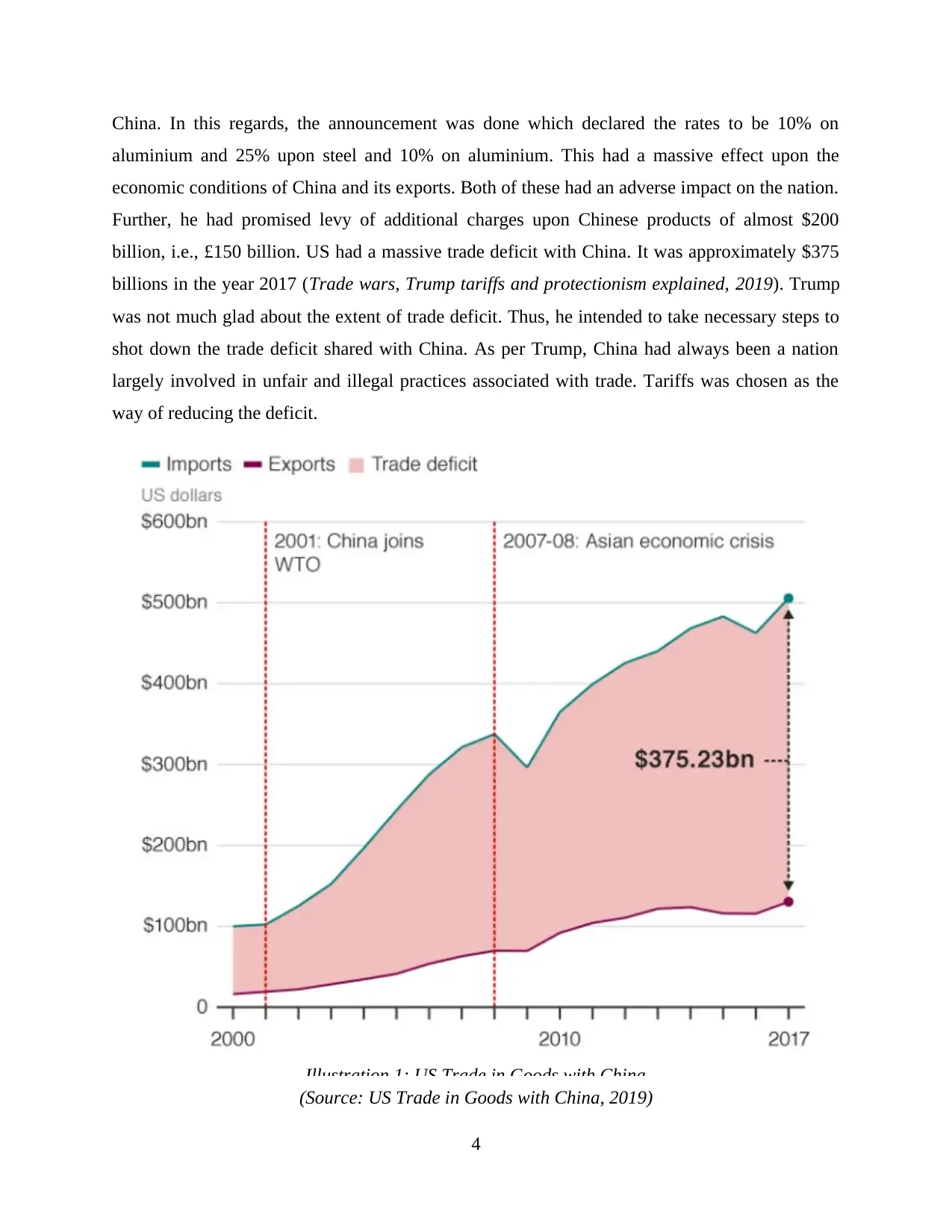
billion, i.e., £150 billion. US had a massive trade deficit with China. It was approximately $375
billions in the year 2017 (Trade wars, Trump tariffs and protectionism explained, 2019). Trump
was not much glad about the extent of trade deficit. Thus, he intended to take necessary steps to
shot down the trade deficit shared with China. As per Trump, China had always been a nation
largely involved in unfair and illegal practices associated with trade. Tariffs was chosen as the
way of reducing the deficit.
(Source: US Trade in Goods with China, 2019)
4
Illustration 1: US Trade in Goods with China
aluminium and 25% upon steel and 10% on aluminium. This had a massive effect upon the
economic conditions of China and its exports. Both of these had an adverse impact on the nation.
Further, he had promised levy of additional charges upon Chinese products of almost $200
billion, i.e., £150 billion. US had a massive trade deficit with China. It was approximately $375
billions in the year 2017 (Trade wars, Trump tariffs and protectionism explained, 2019). Trump
was not much glad about the extent of trade deficit. Thus, he intended to take necessary steps to
shot down the trade deficit shared with China. As per Trump, China had always been a nation
largely involved in unfair and illegal practices associated with trade. Tariffs was chosen as the
way of reducing the deficit.
(Source: US Trade in Goods with China, 2019)
4
Illustration 1: US Trade in Goods with China
⊘ This is a preview!⊘
Do you want full access?
Subscribe today to unlock all pages.

Trusted by 1+ million students worldwide

Many business enterprises of United States carry out their activities related to
manufacturing in China. When US President Trump came up with the economic policy which
proposed trade protectionism, it substantially affected the economy as well as manufacturing
sector of China (Rodrik, 2014). If tariffs are imposed on exports, then the cost of manufacturing
products of companies are likely to raise. This will imply less desire of enterprise to export
goods from China. Thus, it can be seen that the scenario will have a huge impact upon
manufacturing sector of nation. When manufacturing sector of the country gets affected at such a
large scale, it is likely to cause a significant decrease in number of job opportunities, value of
economy and many related issues. Thus, Trump's approach to economic policy had a massive
impact on China.
5
manufacturing in China. When US President Trump came up with the economic policy which
proposed trade protectionism, it substantially affected the economy as well as manufacturing
sector of China (Rodrik, 2014). If tariffs are imposed on exports, then the cost of manufacturing
products of companies are likely to raise. This will imply less desire of enterprise to export
goods from China. Thus, it can be seen that the scenario will have a huge impact upon
manufacturing sector of nation. When manufacturing sector of the country gets affected at such a
large scale, it is likely to cause a significant decrease in number of job opportunities, value of
economy and many related issues. Thus, Trump's approach to economic policy had a massive
impact on China.
5
Paraphrase This Document
Need a fresh take? Get an instant paraphrase of this document with our AI Paraphraser

REFERENCES
Books and Journals
Inglehart, R. and Norris, P., 2016. Trump, Brexit, and the rise of populism: Economic have-nots
and cultural backlash.
Rodrik, D., 2014. When ideas trump interests: Preferences, worldviews, and policy
innovations. Journal of Economic Perspectives. 28(1). pp.189-208.
Online
The Chronicle of Coca-Cola: A Global Business. 2018. [Online]. Available
Through:<https://www.coca-colacompany.com/stories/the-chronicle-of-coca-cola-a-
global-business>.
13 Businesses With Brilliant Global Marketing Strategies. 2019. [Online]. Available
Through:<https://blog.hubspot.com/marketing/global-marketing-and-international-
business>.
The Most Valuable Sponsorship Deals In Soccer. 2019. [Online]. Available
Through:<https://www.forbes.com/sites/chrissmith/2016/05/11/the-most-valuable-
sponsorship-deals-in-soccer/#7d30139b59e0>.
Outperformers: High-growth emerging economies and the companies that propel them. 2019.
[Online]. Available Through:<https://www.mckinsey.com/featured-insights/innovation-
and-growth/outperformers-high-growth-emerging-economies-and-the-companies-that-
propel-them>.
President Donald Trump's Economic Plan. 2019. [Online]. Available
Through:<https://www.thebalance.com/donald-trump-economic-plan-3994106>.
Trade wars, Trump tariffs and protectionism explained. 2019. [Online]. Available
Through:<https://www.bbc.com/news/world-43512098>.
6
Books and Journals
Inglehart, R. and Norris, P., 2016. Trump, Brexit, and the rise of populism: Economic have-nots
and cultural backlash.
Rodrik, D., 2014. When ideas trump interests: Preferences, worldviews, and policy
innovations. Journal of Economic Perspectives. 28(1). pp.189-208.
Online
The Chronicle of Coca-Cola: A Global Business. 2018. [Online]. Available
Through:<https://www.coca-colacompany.com/stories/the-chronicle-of-coca-cola-a-
global-business>.
13 Businesses With Brilliant Global Marketing Strategies. 2019. [Online]. Available
Through:<https://blog.hubspot.com/marketing/global-marketing-and-international-
business>.
The Most Valuable Sponsorship Deals In Soccer. 2019. [Online]. Available
Through:<https://www.forbes.com/sites/chrissmith/2016/05/11/the-most-valuable-
sponsorship-deals-in-soccer/#7d30139b59e0>.
Outperformers: High-growth emerging economies and the companies that propel them. 2019.
[Online]. Available Through:<https://www.mckinsey.com/featured-insights/innovation-
and-growth/outperformers-high-growth-emerging-economies-and-the-companies-that-
propel-them>.
President Donald Trump's Economic Plan. 2019. [Online]. Available
Through:<https://www.thebalance.com/donald-trump-economic-plan-3994106>.
Trade wars, Trump tariffs and protectionism explained. 2019. [Online]. Available
Through:<https://www.bbc.com/news/world-43512098>.
6
1 out of 8
Related Documents
Your All-in-One AI-Powered Toolkit for Academic Success.
+13062052269
info@desklib.com
Available 24*7 on WhatsApp / Email
Unlock your academic potential
Copyright © 2020–2025 A2Z Services. All Rights Reserved. Developed and managed by ZUCOL.