Analyzing Global Business Environment: Strategies & Barriers
VerifiedAdded on 2023/06/05
|10
|2951
|320
Report
AI Summary
This report provides a comprehensive analysis of the global business environment, focusing on the influences of globalization on organizational governance, leadership, structure, culture, and functions. It evaluates ethical and sustainable globalization's impact on organizational functions, including decision-making processes in a global context. The report also identifies various routes to internationalization for organizations, highlighting key barriers and offering recommendations to overcome them. Using the McKinsey 7's model, the analysis covers strategy, structure, systems, shared values, style, staff, and skills within a global setting. The report further discusses the importance of ethical considerations and sustainable development for long-term organizational success in international markets, emphasizing the need for adaptability and strategic decision-making. It differentiates between reactive and proactive decision-making approaches, and it provides insights into industry-specific and financial barriers to globalization, along with recommendations for mitigating their effects.
Unit-18 Global Business
Environment
Environment

Paraphrase This Document
Need a fresh take? Get an instant paraphrase of this document with our AI Paraphraser
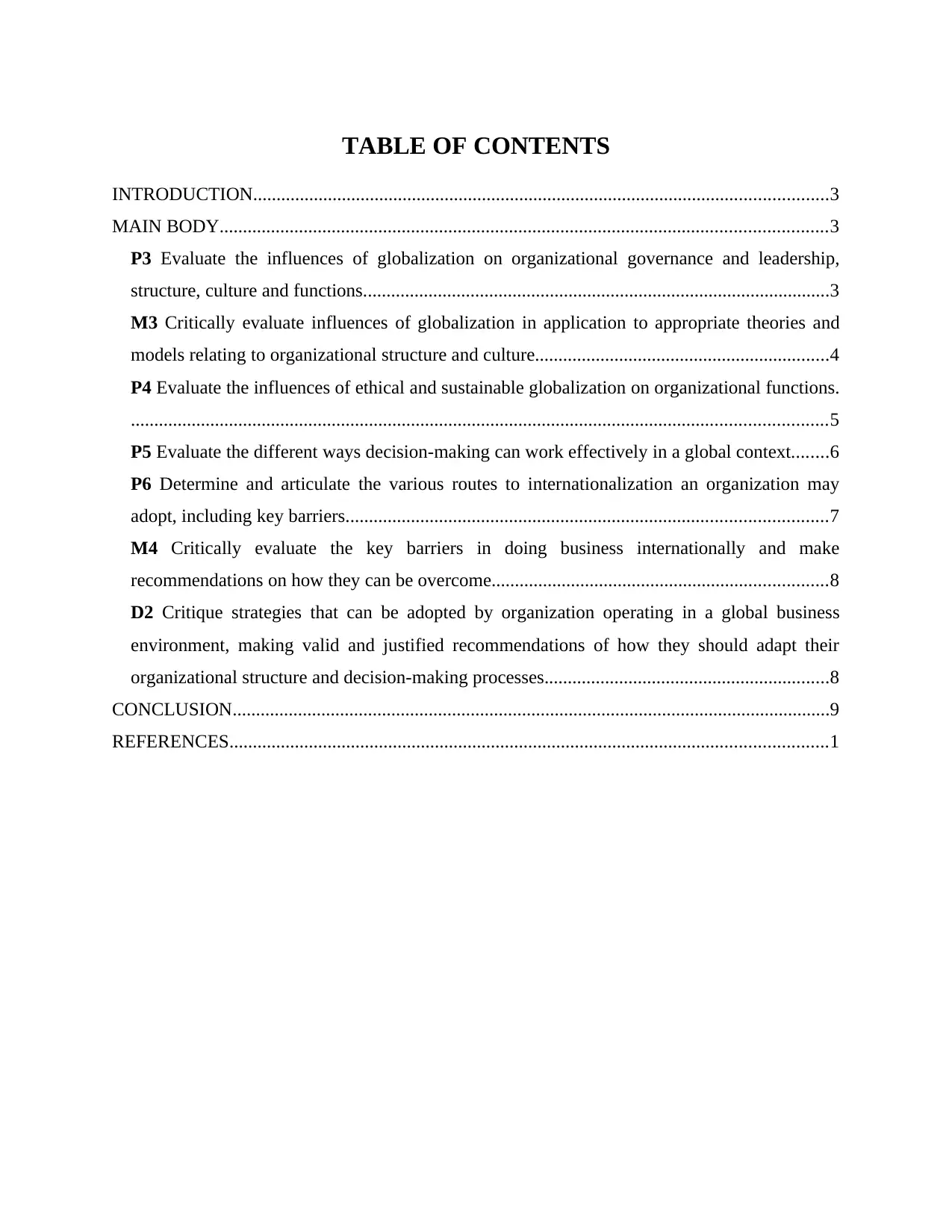
TABLE OF CONTENTS
INTRODUCTION...........................................................................................................................3
MAIN BODY..................................................................................................................................3
P3 Evaluate the influences of globalization on organizational governance and leadership,
structure, culture and functions....................................................................................................3
M3 Critically evaluate influences of globalization in application to appropriate theories and
models relating to organizational structure and culture...............................................................4
P4 Evaluate the influences of ethical and sustainable globalization on organizational functions.
.....................................................................................................................................................5
P5 Evaluate the different ways decision-making can work effectively in a global context........6
P6 Determine and articulate the various routes to internationalization an organization may
adopt, including key barriers.......................................................................................................7
M4 Critically evaluate the key barriers in doing business internationally and make
recommendations on how they can be overcome........................................................................8
D2 Critique strategies that can be adopted by organization operating in a global business
environment, making valid and justified recommendations of how they should adapt their
organizational structure and decision-making processes.............................................................8
CONCLUSION................................................................................................................................9
REFERENCES................................................................................................................................1
INTRODUCTION...........................................................................................................................3
MAIN BODY..................................................................................................................................3
P3 Evaluate the influences of globalization on organizational governance and leadership,
structure, culture and functions....................................................................................................3
M3 Critically evaluate influences of globalization in application to appropriate theories and
models relating to organizational structure and culture...............................................................4
P4 Evaluate the influences of ethical and sustainable globalization on organizational functions.
.....................................................................................................................................................5
P5 Evaluate the different ways decision-making can work effectively in a global context........6
P6 Determine and articulate the various routes to internationalization an organization may
adopt, including key barriers.......................................................................................................7
M4 Critically evaluate the key barriers in doing business internationally and make
recommendations on how they can be overcome........................................................................8
D2 Critique strategies that can be adopted by organization operating in a global business
environment, making valid and justified recommendations of how they should adapt their
organizational structure and decision-making processes.............................................................8
CONCLUSION................................................................................................................................9
REFERENCES................................................................................................................................1
INTRODUCTION
The international surrounding of the business is termed as global business surrounding.
Global business operates in more than one country by targetting the customers with different
preference inhabiting in distinct geographical locations.
The following report will be highlighting many aspects of the business organization in
context with global expansion. The influence of globalization on business areas will be
thoroughly highlighted. McKinsey 7s model is being used for analysing every aspect of business
to determine its future in the internation markets. Moreover, the concept of sustainable
development in regard to the international markets will be described. Further, the report will be
enlightening the barriers that comes in the journey of organization wanting to flourish in
international markets. Recommendation for tackling these barriers will be a part of the report that
can help in achieving higher sustainability.
MAIN BODY
P3 Evaluate the influences of globalization on organizational governance and leadership,
structure, culture and functions.
Global markets provides am higher extent of business opportunities to the organization
along with the influence on its culture, structure and many other aspect. It can be noticed that
majority of the companies follows a hierarchical structure for better and correctly accommodated
authorization in premises. However, there are many factors that influence the decision of
management to consider the organization structure. Such factors can be environmental, customer
demands, market position etc. organizational structure plays a vital role in business
commencement as it directs the flow of commend in a firm which is majorly aimed towards
higher revenues through customer support. In terms of Sasol, it needs a strong and simplified
structure that can help in survival in the market by grabbing the opportunities available in the
global market (Hampden-Turner and et.al., 2020). Management needs to take decision according
to the different factors that is going to effect the business in international markets. These decision
has to be heavily diverted towards meeting the customer needs by projecting a relation with their
culture. Cultural factor plays a vital role in international business commencement as it differs in
every geographical area.
The international surrounding of the business is termed as global business surrounding.
Global business operates in more than one country by targetting the customers with different
preference inhabiting in distinct geographical locations.
The following report will be highlighting many aspects of the business organization in
context with global expansion. The influence of globalization on business areas will be
thoroughly highlighted. McKinsey 7s model is being used for analysing every aspect of business
to determine its future in the internation markets. Moreover, the concept of sustainable
development in regard to the international markets will be described. Further, the report will be
enlightening the barriers that comes in the journey of organization wanting to flourish in
international markets. Recommendation for tackling these barriers will be a part of the report that
can help in achieving higher sustainability.
MAIN BODY
P3 Evaluate the influences of globalization on organizational governance and leadership,
structure, culture and functions.
Global markets provides am higher extent of business opportunities to the organization
along with the influence on its culture, structure and many other aspect. It can be noticed that
majority of the companies follows a hierarchical structure for better and correctly accommodated
authorization in premises. However, there are many factors that influence the decision of
management to consider the organization structure. Such factors can be environmental, customer
demands, market position etc. organizational structure plays a vital role in business
commencement as it directs the flow of commend in a firm which is majorly aimed towards
higher revenues through customer support. In terms of Sasol, it needs a strong and simplified
structure that can help in survival in the market by grabbing the opportunities available in the
global market (Hampden-Turner and et.al., 2020). Management needs to take decision according
to the different factors that is going to effect the business in international markets. These decision
has to be heavily diverted towards meeting the customer needs by projecting a relation with their
culture. Cultural factor plays a vital role in international business commencement as it differs in
every geographical area.
⊘ This is a preview!⊘
Do you want full access?
Subscribe today to unlock all pages.

Trusted by 1+ million students worldwide
M3 Critically evaluate influences of globalization in application to appropriate theories and
models relating to organizational structure and culture.
McKinsey 7's model of Sasol LTD.
Strategy
The strategy of the Sasol are clearly defined as the strategic direction is well articulated
that depicts the organization towards higher benefits by targetting the higher customer base.
These strategies are well-defined that helps the firm to achieve the objectives along with the
specification such as time limit. Strategies of the company is guided by the smart objectives that
are obtained with practicality that regulated the day to day business activities of the firm.
Structure
Sasol follows hierarchical structure in which the flow of command and delegation of
authority goes from upwards to downwards. Although, there are less managerial levels which
enables the availability of senior management to the staff (Ronit, 2018). Following this structure
the organization has achieved a smooth coordination between various departments of the firm
that has increased the quality of work delivered. It helps the firm to build strong internal abilities
that provides firm support in achievement of organizational benefits.
System
Well-defined system of the organization can be noticed as the organizational activities are
classified into various department to maintain the efficiency of work through assigning it to the
professionals. This system is managed to avoid conflicts in the firm that may harm its
functionality. Classified department is Sasol are HRM, finance, sales, marketing, customer
relation management, supply chain department and operations department.
Shared values
Core values of the organization depicts the morality of business and social values that are
thoroughly commuted to the staff in every department to maintain the decorum of these values
that is reflected in the goodwill of Sasol. Creativity, transparency, trust, quality, equality,
customer focus and global mindset are some core values of the firm that is centrally established
to ensure every aspect of business is enlightened with these values.
Style
Managers in the organization have adopted participative leadership style which
strengthen the business activities as the employees are guided throughout their job. Engagement
models relating to organizational structure and culture.
McKinsey 7's model of Sasol LTD.
Strategy
The strategy of the Sasol are clearly defined as the strategic direction is well articulated
that depicts the organization towards higher benefits by targetting the higher customer base.
These strategies are well-defined that helps the firm to achieve the objectives along with the
specification such as time limit. Strategies of the company is guided by the smart objectives that
are obtained with practicality that regulated the day to day business activities of the firm.
Structure
Sasol follows hierarchical structure in which the flow of command and delegation of
authority goes from upwards to downwards. Although, there are less managerial levels which
enables the availability of senior management to the staff (Ronit, 2018). Following this structure
the organization has achieved a smooth coordination between various departments of the firm
that has increased the quality of work delivered. It helps the firm to build strong internal abilities
that provides firm support in achievement of organizational benefits.
System
Well-defined system of the organization can be noticed as the organizational activities are
classified into various department to maintain the efficiency of work through assigning it to the
professionals. This system is managed to avoid conflicts in the firm that may harm its
functionality. Classified department is Sasol are HRM, finance, sales, marketing, customer
relation management, supply chain department and operations department.
Shared values
Core values of the organization depicts the morality of business and social values that are
thoroughly commuted to the staff in every department to maintain the decorum of these values
that is reflected in the goodwill of Sasol. Creativity, transparency, trust, quality, equality,
customer focus and global mindset are some core values of the firm that is centrally established
to ensure every aspect of business is enlightened with these values.
Style
Managers in the organization have adopted participative leadership style which
strengthen the business activities as the employees are guided throughout their job. Engagement
Paraphrase This Document
Need a fresh take? Get an instant paraphrase of this document with our AI Paraphraser
of employee in the organization and in decision-making process ensures the higher feasibility of
Sasol in both international and domestic markets. Collaborative teamwork is achieved through
this leadership style because of the lucrative management focusing of betterment of every area of
business.
Staff
Employee base of Sasol is sufficient for performing the activities for the organization that
works for global operations. However, the gaps or vacancies are filled with candidates that is
both internal and external depending upon the requirement of skills. To improve the abilities of
employees, training sessions are held on a frequent basis that makes them more proficient to
perform their job roles.
Skills
Employee base of the organization is skilled and proficient in their respective job roles.
Candidates are hired on the basis of their skills and knowledge that can contribute in the
organizational benefit (Ghauri and et.al., 2021). Staff of the organization are provided with
training which enhance their skill-set. Enhanced skill set of workforce helps the firm to
effectively operate on global level and achieve higher benefits.
P4 Evaluate the influences of ethical and sustainable globalization on organizational functions.
Sustainable development refers to the long term survival of the firm through lasting
development that is achieved through flexibility. This flexibility helps the organization to go
through any situation by formulating the strategies to overcome the barriers created by various
external factors. Sasol needs to follow certain factors that can help in gaining sustainable
position in the global markets. Wider use of market can be done y the organization by grabbing
every possible opportunity in the sector which can make the organization multidimensional
resulting in higher revenues. Decision making process has to be well articulated in order to
achieve higher success through every business activities. Sustainability gain through following
these factors can help the firm in enhancing its goodwill in the market and can make them
market leaders. Although, it is not an easy task to achieve higher sustainability in every
geographical region where the organization is operating. So the major focus should be on the
areas which are providing good results to the firm.
Sasol in both international and domestic markets. Collaborative teamwork is achieved through
this leadership style because of the lucrative management focusing of betterment of every area of
business.
Staff
Employee base of Sasol is sufficient for performing the activities for the organization that
works for global operations. However, the gaps or vacancies are filled with candidates that is
both internal and external depending upon the requirement of skills. To improve the abilities of
employees, training sessions are held on a frequent basis that makes them more proficient to
perform their job roles.
Skills
Employee base of the organization is skilled and proficient in their respective job roles.
Candidates are hired on the basis of their skills and knowledge that can contribute in the
organizational benefit (Ghauri and et.al., 2021). Staff of the organization are provided with
training which enhance their skill-set. Enhanced skill set of workforce helps the firm to
effectively operate on global level and achieve higher benefits.
P4 Evaluate the influences of ethical and sustainable globalization on organizational functions.
Sustainable development refers to the long term survival of the firm through lasting
development that is achieved through flexibility. This flexibility helps the organization to go
through any situation by formulating the strategies to overcome the barriers created by various
external factors. Sasol needs to follow certain factors that can help in gaining sustainable
position in the global markets. Wider use of market can be done y the organization by grabbing
every possible opportunity in the sector which can make the organization multidimensional
resulting in higher revenues. Decision making process has to be well articulated in order to
achieve higher success through every business activities. Sustainability gain through following
these factors can help the firm in enhancing its goodwill in the market and can make them
market leaders. Although, it is not an easy task to achieve higher sustainability in every
geographical region where the organization is operating. So the major focus should be on the
areas which are providing good results to the firm.
Ethics generally refers to the behaviour that is widely accepted in a positive way. There
are many such ethics in terms of business that depicts the true image of the ideology of the firm.
Fair trade practices is one of the centralized ethic which is expected to be followed by every
business organization in order maintain societal and legal decorum. There are several other ethics
that are followed in Sasol helps in fair business commencement. Authenticity is one of the major
factor that helps in achievement of higher sustainability as it eliminates various barriers that can
harm the organization such as legal barriers, social barriers, environmental barriers etc. ethical
consideration is every aspect of business can help in gaining higher authenticity through
following the basic values.
P5 Evaluate the different ways decision-making can work effectively in a global context.
Business organization operating on a global level needs an effective decision-making
process which can take crucial steps for the benefit of organization. There are many factors that
force the management to take decision on the concern to resolve the issue. On the global level,
the organization needs to take decisions depending upon he factors that surrounds the business.
Management has to take different decision in distinct geographical areas in which the cultural
aspect of the respective region has to be kept in mind (Kuofie and et.al., 2021). Although, it is
not an easy task for management to ensure every measure of the international markets in the
decision-making process but it should be done swiftly to make it more viable. However, there are
two major types of decision-making that is considered by the management that is reactive and
proactive decision-making.
Reactive decision-making
Reactive decision-making refers to taking immediate decision whenever the problem or
issue arises. In this type of decision-making the management has to be highly active and
concerned bout every fact that can harm the decisions. However, it is a known fact that the
immediate decision have higher chances to backfire which can impact the organization by
increasing the problem instead of solving it. This can create an extra and unnecessary burden on
the management. Although, there are many such situations as well in which this decision-making
helps the organization without delay that reduces the intensity of impact on the firm.
Proactive decision-making
are many such ethics in terms of business that depicts the true image of the ideology of the firm.
Fair trade practices is one of the centralized ethic which is expected to be followed by every
business organization in order maintain societal and legal decorum. There are several other ethics
that are followed in Sasol helps in fair business commencement. Authenticity is one of the major
factor that helps in achievement of higher sustainability as it eliminates various barriers that can
harm the organization such as legal barriers, social barriers, environmental barriers etc. ethical
consideration is every aspect of business can help in gaining higher authenticity through
following the basic values.
P5 Evaluate the different ways decision-making can work effectively in a global context.
Business organization operating on a global level needs an effective decision-making
process which can take crucial steps for the benefit of organization. There are many factors that
force the management to take decision on the concern to resolve the issue. On the global level,
the organization needs to take decisions depending upon he factors that surrounds the business.
Management has to take different decision in distinct geographical areas in which the cultural
aspect of the respective region has to be kept in mind (Kuofie and et.al., 2021). Although, it is
not an easy task for management to ensure every measure of the international markets in the
decision-making process but it should be done swiftly to make it more viable. However, there are
two major types of decision-making that is considered by the management that is reactive and
proactive decision-making.
Reactive decision-making
Reactive decision-making refers to taking immediate decision whenever the problem or
issue arises. In this type of decision-making the management has to be highly active and
concerned bout every fact that can harm the decisions. However, it is a known fact that the
immediate decision have higher chances to backfire which can impact the organization by
increasing the problem instead of solving it. This can create an extra and unnecessary burden on
the management. Although, there are many such situations as well in which this decision-making
helps the organization without delay that reduces the intensity of impact on the firm.
Proactive decision-making
⊘ This is a preview!⊘
Do you want full access?
Subscribe today to unlock all pages.
Trusted by 1+ million students worldwide
This types of decision-making are just opposite to the reactive one as it focuses on
thorough anticipation of the factors that has resulted in the problem (Tuleja, 2021). Every
alternative available for the firm to get through the situation is analysed from which the best one
is chosen. Various factors that can harm the feasibility of the decision taken is also assessed to
make a full proof plan to address the concern.
P6 Determine and articulate the various routes to internationalization an organization may adopt,
including key barriers.
There are various routes available to the organization for global expansion which are
thoroughly mentioned below:
International distributors
For entering the international markets the organization can tie up with distributors that
are the mediators who further transport the goods to the customers in different countries. There
are many suppliers who work individually and handles the supply of particular type of goods in
international markets. However, there are many such agencies or institutes available which deals
in the same manner, but they might do it on Higher commission than the individuals.
Joint ventures
These methods of international expansion is considered by majority of the organization
which needs the sacrifice of a percentage of ownership (Hamilton and Webster, 2018). This
means that two parties agree to commence business in which one supports the international
expansion of another for which they charge a percentage of equity.
Barriers to globalization
Commencing business on a global level is not an easy task as it needs various skills
throughout the organization to tackle the barriers (Zakaria and et.al., 2020). Core functionality of
the organization needs to be strong enough to handle the impact of the barriers and survive in
such tough conditions. Some of the barriers that can effect internationalization of Sasol are
mentioned below:
Industry specific barriers
There are several barriers that impacts a particular industry on international level. These
effects the whole industry and not specified to a particular organization. Competition in the
thorough anticipation of the factors that has resulted in the problem (Tuleja, 2021). Every
alternative available for the firm to get through the situation is analysed from which the best one
is chosen. Various factors that can harm the feasibility of the decision taken is also assessed to
make a full proof plan to address the concern.
P6 Determine and articulate the various routes to internationalization an organization may adopt,
including key barriers.
There are various routes available to the organization for global expansion which are
thoroughly mentioned below:
International distributors
For entering the international markets the organization can tie up with distributors that
are the mediators who further transport the goods to the customers in different countries. There
are many suppliers who work individually and handles the supply of particular type of goods in
international markets. However, there are many such agencies or institutes available which deals
in the same manner, but they might do it on Higher commission than the individuals.
Joint ventures
These methods of international expansion is considered by majority of the organization
which needs the sacrifice of a percentage of ownership (Hamilton and Webster, 2018). This
means that two parties agree to commence business in which one supports the international
expansion of another for which they charge a percentage of equity.
Barriers to globalization
Commencing business on a global level is not an easy task as it needs various skills
throughout the organization to tackle the barriers (Zakaria and et.al., 2020). Core functionality of
the organization needs to be strong enough to handle the impact of the barriers and survive in
such tough conditions. Some of the barriers that can effect internationalization of Sasol are
mentioned below:
Industry specific barriers
There are several barriers that impacts a particular industry on international level. These
effects the whole industry and not specified to a particular organization. Competition in the
Paraphrase This Document
Need a fresh take? Get an instant paraphrase of this document with our AI Paraphraser
industry is a barrier that can harm Sasol as there are many giants already operating at
international level and have a strong hold of the markets. This is a major barrier to the
organization as these giants won't let them easily slip to the market and grab the opportunities.
Financial barriers
For global expansion, an organization needs efficient funds that can support the business
activities and enough reserves to bear losses in the initial period. This barrier majorly creates
problem for small business organization (Brenner, 2018). However, Sasol also needs to allocate
funds effectively to avoid any miss happening that can lead to failure.
M4 Critically evaluate the key barriers in doing business internationally and make
recommendations on how they can be overcome.
International business operations for Sasol can be achieved successfully if proper
strategies are being followed for elimination of the factors that are creating barriers in the
success of the firm. Before starting the international operations the management can properly
formulate well-articulated and well-managed plans that directs the organization towards survival
in the difficult markets. For getting competitive advantage in the international markets the
organization can introduce low-cost goods with good quality. Effective advertising and branding
of the company can be done to gain higher recognition in the market that can attract higher
customer base. Funds can be raised by the organization which can be followed by its proper
allocation in such a manner that it can help in longer survival (Morrison, 2020). Necessary and
innovative resources can be purchased with the funds that can increase the quality of the
commodities offered by the firm.
D2 Critique strategies that can be adopted by organization operating in a global business
environment, making valid and justified recommendations of how they should adapt their
organizational structure and decision-making processes.
From the above evaluation it can be said that the organization needs strong and effective
strategies that is formulated after the consideration of various factors that can effect the business.
Sasol will be needing a strong support of such strategies which can help in its survival in the stiff
international markets. These strategies are to be planned according to the region in which the
organizations going to expand so that its local factors can be also taken in consideration. It has
international level and have a strong hold of the markets. This is a major barrier to the
organization as these giants won't let them easily slip to the market and grab the opportunities.
Financial barriers
For global expansion, an organization needs efficient funds that can support the business
activities and enough reserves to bear losses in the initial period. This barrier majorly creates
problem for small business organization (Brenner, 2018). However, Sasol also needs to allocate
funds effectively to avoid any miss happening that can lead to failure.
M4 Critically evaluate the key barriers in doing business internationally and make
recommendations on how they can be overcome.
International business operations for Sasol can be achieved successfully if proper
strategies are being followed for elimination of the factors that are creating barriers in the
success of the firm. Before starting the international operations the management can properly
formulate well-articulated and well-managed plans that directs the organization towards survival
in the difficult markets. For getting competitive advantage in the international markets the
organization can introduce low-cost goods with good quality. Effective advertising and branding
of the company can be done to gain higher recognition in the market that can attract higher
customer base. Funds can be raised by the organization which can be followed by its proper
allocation in such a manner that it can help in longer survival (Morrison, 2020). Necessary and
innovative resources can be purchased with the funds that can increase the quality of the
commodities offered by the firm.
D2 Critique strategies that can be adopted by organization operating in a global business
environment, making valid and justified recommendations of how they should adapt their
organizational structure and decision-making processes.
From the above evaluation it can be said that the organization needs strong and effective
strategies that is formulated after the consideration of various factors that can effect the business.
Sasol will be needing a strong support of such strategies which can help in its survival in the stiff
international markets. These strategies are to be planned according to the region in which the
organizations going to expand so that its local factors can be also taken in consideration. It has
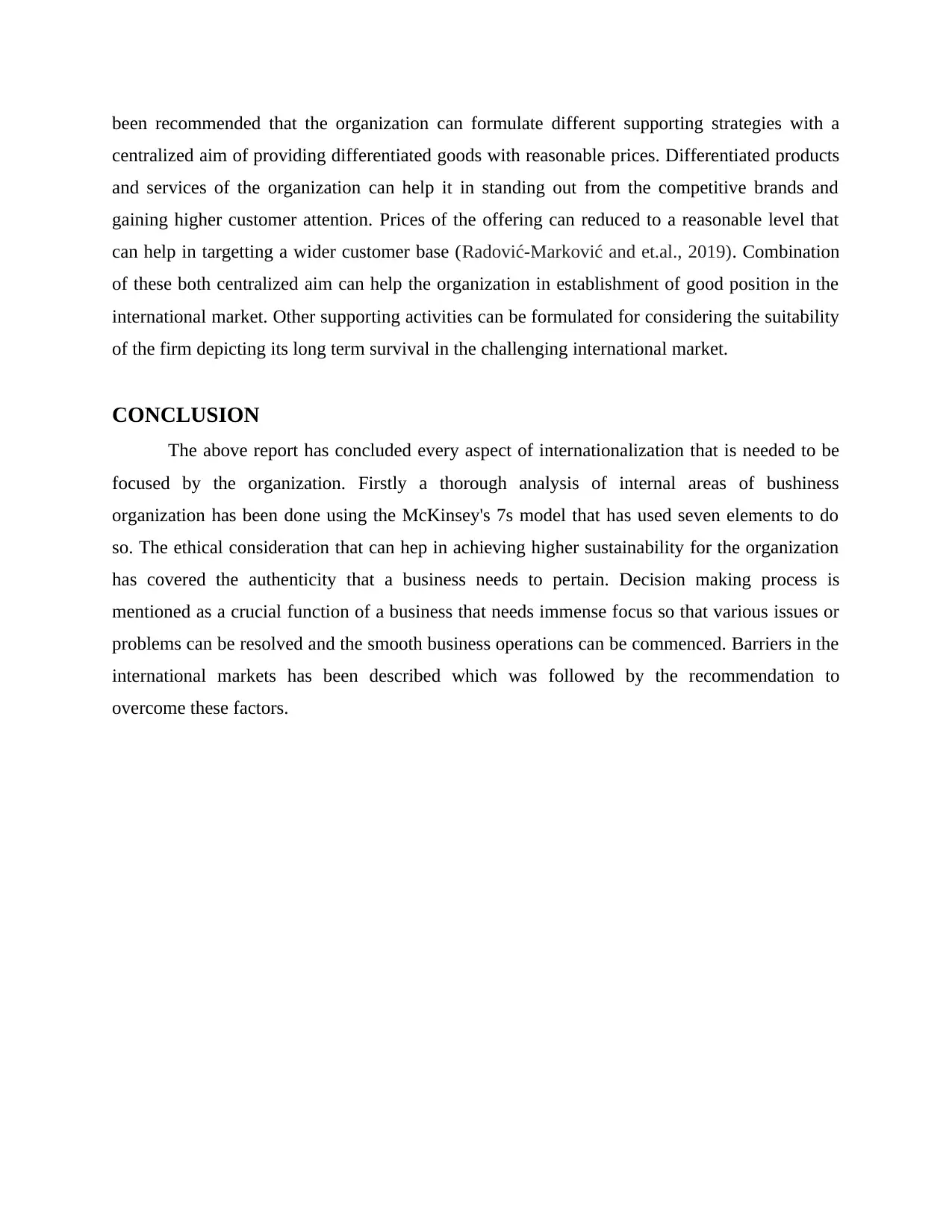
been recommended that the organization can formulate different supporting strategies with a
centralized aim of providing differentiated goods with reasonable prices. Differentiated products
and services of the organization can help it in standing out from the competitive brands and
gaining higher customer attention. Prices of the offering can reduced to a reasonable level that
can help in targetting a wider customer base (Radović-Marković and et.al., 2019). Combination
of these both centralized aim can help the organization in establishment of good position in the
international market. Other supporting activities can be formulated for considering the suitability
of the firm depicting its long term survival in the challenging international market.
CONCLUSION
The above report has concluded every aspect of internationalization that is needed to be
focused by the organization. Firstly a thorough analysis of internal areas of bushiness
organization has been done using the McKinsey's 7s model that has used seven elements to do
so. The ethical consideration that can hep in achieving higher sustainability for the organization
has covered the authenticity that a business needs to pertain. Decision making process is
mentioned as a crucial function of a business that needs immense focus so that various issues or
problems can be resolved and the smooth business operations can be commenced. Barriers in the
international markets has been described which was followed by the recommendation to
overcome these factors.
centralized aim of providing differentiated goods with reasonable prices. Differentiated products
and services of the organization can help it in standing out from the competitive brands and
gaining higher customer attention. Prices of the offering can reduced to a reasonable level that
can help in targetting a wider customer base (Radović-Marković and et.al., 2019). Combination
of these both centralized aim can help the organization in establishment of good position in the
international market. Other supporting activities can be formulated for considering the suitability
of the firm depicting its long term survival in the challenging international market.
CONCLUSION
The above report has concluded every aspect of internationalization that is needed to be
focused by the organization. Firstly a thorough analysis of internal areas of bushiness
organization has been done using the McKinsey's 7s model that has used seven elements to do
so. The ethical consideration that can hep in achieving higher sustainability for the organization
has covered the authenticity that a business needs to pertain. Decision making process is
mentioned as a crucial function of a business that needs immense focus so that various issues or
problems can be resolved and the smooth business operations can be commenced. Barriers in the
international markets has been described which was followed by the recommendation to
overcome these factors.
⊘ This is a preview!⊘
Do you want full access?
Subscribe today to unlock all pages.
Trusted by 1+ million students worldwide
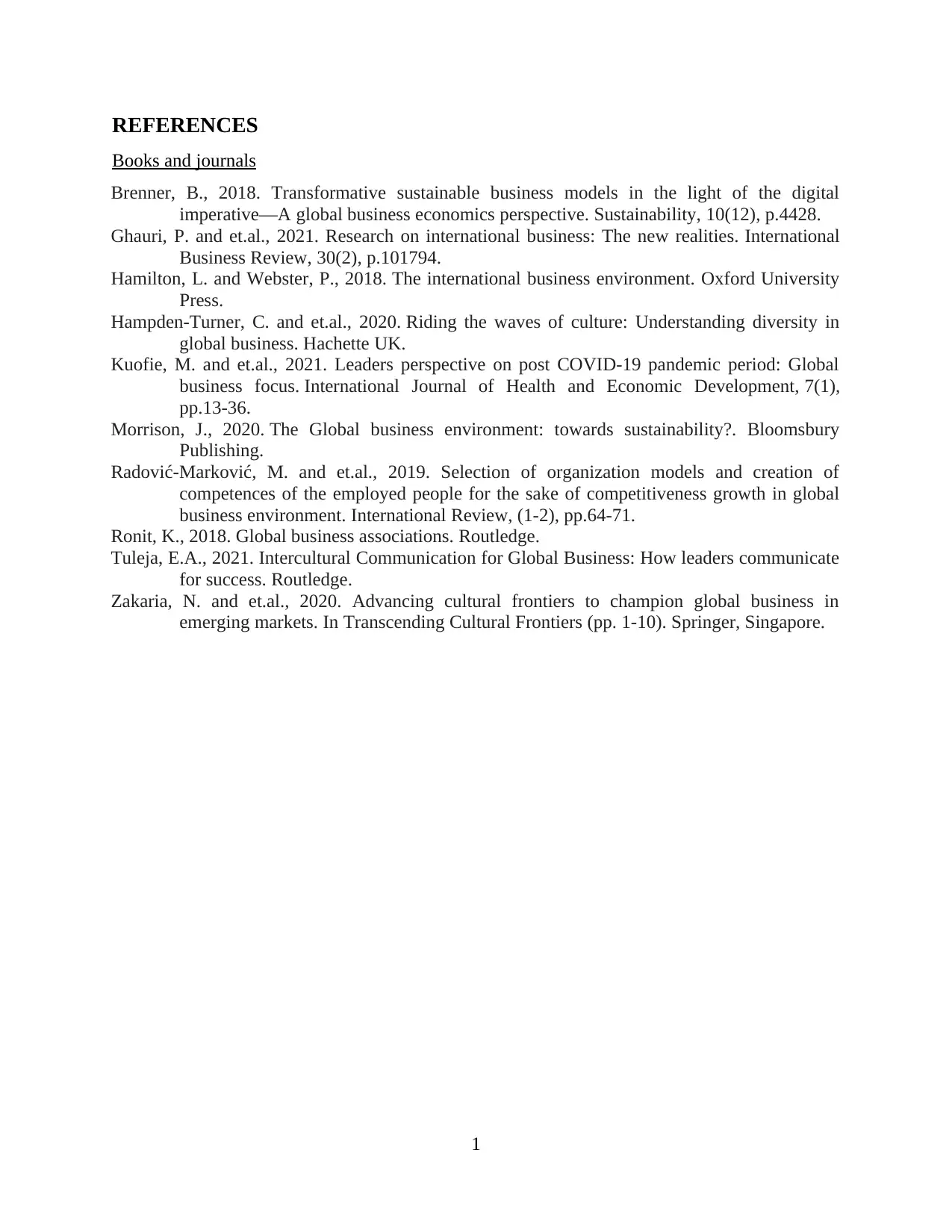
REFERENCES
Books and journals
Brenner, B., 2018. Transformative sustainable business models in the light of the digital
imperative—A global business economics perspective. Sustainability, 10(12), p.4428.
Ghauri, P. and et.al., 2021. Research on international business: The new realities. International
Business Review, 30(2), p.101794.
Hamilton, L. and Webster, P., 2018. The international business environment. Oxford University
Press.
Hampden-Turner, C. and et.al., 2020. Riding the waves of culture: Understanding diversity in
global business. Hachette UK.
Kuofie, M. and et.al., 2021. Leaders perspective on post COVID-19 pandemic period: Global
business focus. International Journal of Health and Economic Development, 7(1),
pp.13-36.
Morrison, J., 2020. The Global business environment: towards sustainability?. Bloomsbury
Publishing.
Radović-Marković, M. and et.al., 2019. Selection of organization models and creation of
competences of the employed people for the sake of competitiveness growth in global
business environment. International Review, (1-2), pp.64-71.
Ronit, K., 2018. Global business associations. Routledge.
Tuleja, E.A., 2021. Intercultural Communication for Global Business: How leaders communicate
for success. Routledge.
Zakaria, N. and et.al., 2020. Advancing cultural frontiers to champion global business in
emerging markets. In Transcending Cultural Frontiers (pp. 1-10). Springer, Singapore.
1
Books and journals
Brenner, B., 2018. Transformative sustainable business models in the light of the digital
imperative—A global business economics perspective. Sustainability, 10(12), p.4428.
Ghauri, P. and et.al., 2021. Research on international business: The new realities. International
Business Review, 30(2), p.101794.
Hamilton, L. and Webster, P., 2018. The international business environment. Oxford University
Press.
Hampden-Turner, C. and et.al., 2020. Riding the waves of culture: Understanding diversity in
global business. Hachette UK.
Kuofie, M. and et.al., 2021. Leaders perspective on post COVID-19 pandemic period: Global
business focus. International Journal of Health and Economic Development, 7(1),
pp.13-36.
Morrison, J., 2020. The Global business environment: towards sustainability?. Bloomsbury
Publishing.
Radović-Marković, M. and et.al., 2019. Selection of organization models and creation of
competences of the employed people for the sake of competitiveness growth in global
business environment. International Review, (1-2), pp.64-71.
Ronit, K., 2018. Global business associations. Routledge.
Tuleja, E.A., 2021. Intercultural Communication for Global Business: How leaders communicate
for success. Routledge.
Zakaria, N. and et.al., 2020. Advancing cultural frontiers to champion global business in
emerging markets. In Transcending Cultural Frontiers (pp. 1-10). Springer, Singapore.
1

1 out of 10


Related Documents


Your All-in-One AI-Powered Toolkit for Academic Success.
+13062052269
info@desklib.com
Available 24*7 on WhatsApp / Email
![[object Object]](/_next/static/media/star-bottom.7253800d.svg)
Unlock your academic potential
Copyright © 2020–2026 A2Z Services. All Rights Reserved. Developed and managed by ZUCOL.