Global Business: Pret a Manger International Expansion Report
VerifiedAdded on 2022/12/14
|17
|4824
|81
Report
AI Summary
This report provides a comprehensive analysis of the international expansion strategy of Pret a Manger, a UK-based fast-casual restaurant chain. The report begins with an introduction to multinational companies (MNCs) and discusses the European Economic Community (EEC), highlighting its advantages and disadvantages. It then explores the reasons behind international expansion for MNCs, such as market diversification and increased profit margins, as well as the barriers they face, including cultural differences and currency exchange rates. The report focuses on Pret a Manger's potential expansion into India, including domestic and international market analyses, internationalization strategies, environmental analysis of the Indian market, and suitable modes of entry. The report also includes an individual reflection on learned subjects and personal entrepreneurial attributes, concluding with a summary of the key findings and recommendations for Pret a Manger's successful international venture into the Indian market.

GLOBAL BUSINESS

Paraphrase This Document
Need a fresh take? Get an instant paraphrase of this document with our AI Paraphraser
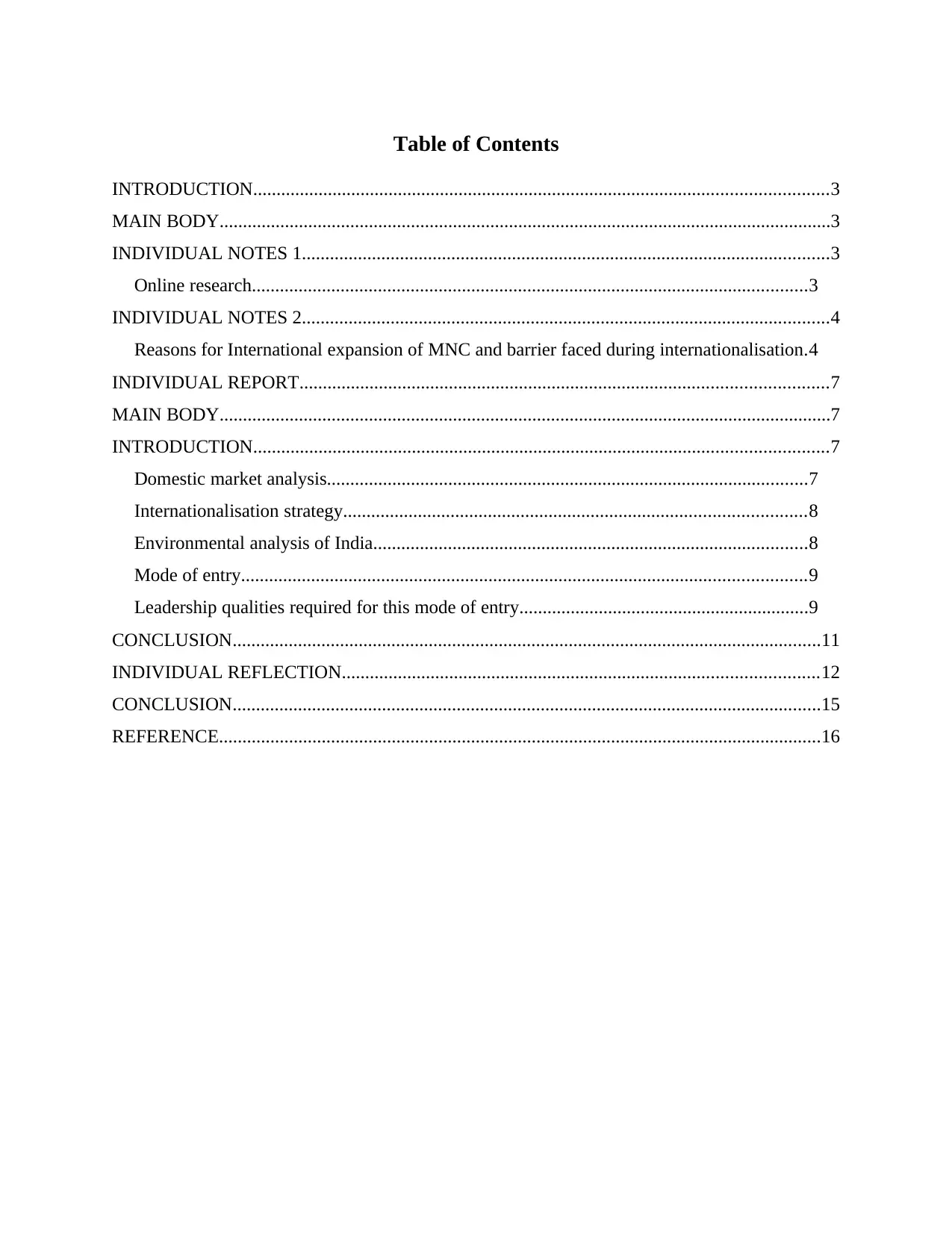
Table of Contents
INTRODUCTION...........................................................................................................................3
MAIN BODY...................................................................................................................................3
INDIVIDUAL NOTES 1.................................................................................................................3
Online research.......................................................................................................................3
INDIVIDUAL NOTES 2.................................................................................................................4
Reasons for International expansion of MNC and barrier faced during internationalisation.4
INDIVIDUAL REPORT.................................................................................................................7
MAIN BODY...................................................................................................................................7
INTRODUCTION...........................................................................................................................7
Domestic market analysis.......................................................................................................7
Internationalisation strategy...................................................................................................8
Environmental analysis of India.............................................................................................8
Mode of entry.........................................................................................................................9
Leadership qualities required for this mode of entry..............................................................9
CONCLUSION..............................................................................................................................11
INDIVIDUAL REFLECTION......................................................................................................12
CONCLUSION..............................................................................................................................15
REFERENCE.................................................................................................................................16
INTRODUCTION...........................................................................................................................3
MAIN BODY...................................................................................................................................3
INDIVIDUAL NOTES 1.................................................................................................................3
Online research.......................................................................................................................3
INDIVIDUAL NOTES 2.................................................................................................................4
Reasons for International expansion of MNC and barrier faced during internationalisation.4
INDIVIDUAL REPORT.................................................................................................................7
MAIN BODY...................................................................................................................................7
INTRODUCTION...........................................................................................................................7
Domestic market analysis.......................................................................................................7
Internationalisation strategy...................................................................................................8
Environmental analysis of India.............................................................................................8
Mode of entry.........................................................................................................................9
Leadership qualities required for this mode of entry..............................................................9
CONCLUSION..............................................................................................................................11
INDIVIDUAL REFLECTION......................................................................................................12
CONCLUSION..............................................................................................................................15
REFERENCE.................................................................................................................................16
INTRODUCTION
A multinational company is defined as an organisation which has the ownership and control over
minimum one other products or services manufacturing sites in a nation apart from its home
country. The international operations of an MNC are usually controlled and supervised by the
company headquarters located in the domestic market of the business firm. The present report is
based on multinational corporations. Online research about European Economic Community is
conducted in this report which highlights the advantages and disadvantages of EEC. In addition
to this the reasons behind international expansion of MNC is provided in this report along barrier
faced by the company during internationalisation. The MNC selected for internationalisation in
this report is UK based fast food chain Pret a manger. This report includes domestic market and
international market analysis along with strategies and entry mode suitable for the company. In
addition to this a reflection is provided in this report which provides an overview of subjects
learned and review of personal entrepreneurial attributes.
MAIN BODY
INDIVIDUAL NOTES 1
Online research
The European Economic community was a an organisation formed in the year 1957 with the help
of treaty of Rome in order to initiate economic integration of various member nations. This
organisation was renamed and included as a part of the European Union in the year 1993.
This economic union was established in the year 1958 after the treaty of Rome was signed
by the six intial six members which included Belgium, France, Luxembourg, The
Netherlands and Germany. The formation of this treaty resulted in the creation of a common
market between member nations which was known as internal market. This internal market
was formalised in the year 1994 with the help of the EEA agreement. The EEC is currently
incorporated in EU
The primary advantages of EEC are provided below:
A multinational company is defined as an organisation which has the ownership and control over
minimum one other products or services manufacturing sites in a nation apart from its home
country. The international operations of an MNC are usually controlled and supervised by the
company headquarters located in the domestic market of the business firm. The present report is
based on multinational corporations. Online research about European Economic Community is
conducted in this report which highlights the advantages and disadvantages of EEC. In addition
to this the reasons behind international expansion of MNC is provided in this report along barrier
faced by the company during internationalisation. The MNC selected for internationalisation in
this report is UK based fast food chain Pret a manger. This report includes domestic market and
international market analysis along with strategies and entry mode suitable for the company. In
addition to this a reflection is provided in this report which provides an overview of subjects
learned and review of personal entrepreneurial attributes.
MAIN BODY
INDIVIDUAL NOTES 1
Online research
The European Economic community was a an organisation formed in the year 1957 with the help
of treaty of Rome in order to initiate economic integration of various member nations. This
organisation was renamed and included as a part of the European Union in the year 1993.
This economic union was established in the year 1958 after the treaty of Rome was signed
by the six intial six members which included Belgium, France, Luxembourg, The
Netherlands and Germany. The formation of this treaty resulted in the creation of a common
market between member nations which was known as internal market. This internal market
was formalised in the year 1994 with the help of the EEA agreement. The EEC is currently
incorporated in EU
The primary advantages of EEC are provided below:
⊘ This is a preview!⊘
Do you want full access?
Subscribe today to unlock all pages.

Trusted by 1+ million students worldwide
The creation of internal market between the member states has removed trade barriers and given
access to business enterprises in UK to 27 nations and more than 480 million people to
conduct their business in the most effective way (The advantages of the EEC, 2017).
The member nations of the EEC have established a common currency for member nations which
is the Euro. The nation which utilise euro as their currency are considered a part of the
eurozone. This step is beneficial for business firms across the eurozone as the transaction
costs are lowered and fluctuations in the currency is low. This allows enterprises to expand
in the eurozone easily.
Disadvantage of the EEC are mentioned below:
The main disadvantage of the EEC is that it has not been able to complete the expectations of
economic integration within the eurozone. The years from 1998-2008, the average growth
rate of exports in EUR was 6.5 percent. This depicts the failure of EEC in attaining
economic growth as the average inflation rates were 2.9% during this time (The pro’s and
cons of the eurozone, 2017). In addition to this the trade between eurozone nations grew
slowly in comparison to trade between Eurozone members and non-eurozone countries. This
is another failure of the EEC.
INDIVIDUAL NOTES 2
Reasons for International expansion of MNC and barrier faced during internationalisation
Businesses firms aspire to create a strong international presence. This is conducted by
establishing subsidiaries or opening manufacturing sites in various nations. The reasons behind
focus of MNC on internationalisation are provided below:
Exploit growth opportunities through market diversification: This is one of the biggest reasons
for International expansion of corporations. They aim to exploit opportunities by offering their
services or products in a previously uncoloured market. This gives the company new revenue
generation sources. MNC expand in markets which do not have similar products and have
tremendous growth potential. Apart from this after the commodity offered by the company has
reached maturity in the domestic region, business firms expand globally to offer such services to
a potential consumer base in different regions in order to generate profitability (Bai, McColl and
Moor, 2021).
access to business enterprises in UK to 27 nations and more than 480 million people to
conduct their business in the most effective way (The advantages of the EEC, 2017).
The member nations of the EEC have established a common currency for member nations which
is the Euro. The nation which utilise euro as their currency are considered a part of the
eurozone. This step is beneficial for business firms across the eurozone as the transaction
costs are lowered and fluctuations in the currency is low. This allows enterprises to expand
in the eurozone easily.
Disadvantage of the EEC are mentioned below:
The main disadvantage of the EEC is that it has not been able to complete the expectations of
economic integration within the eurozone. The years from 1998-2008, the average growth
rate of exports in EUR was 6.5 percent. This depicts the failure of EEC in attaining
economic growth as the average inflation rates were 2.9% during this time (The pro’s and
cons of the eurozone, 2017). In addition to this the trade between eurozone nations grew
slowly in comparison to trade between Eurozone members and non-eurozone countries. This
is another failure of the EEC.
INDIVIDUAL NOTES 2
Reasons for International expansion of MNC and barrier faced during internationalisation
Businesses firms aspire to create a strong international presence. This is conducted by
establishing subsidiaries or opening manufacturing sites in various nations. The reasons behind
focus of MNC on internationalisation are provided below:
Exploit growth opportunities through market diversification: This is one of the biggest reasons
for International expansion of corporations. They aim to exploit opportunities by offering their
services or products in a previously uncoloured market. This gives the company new revenue
generation sources. MNC expand in markets which do not have similar products and have
tremendous growth potential. Apart from this after the commodity offered by the company has
reached maturity in the domestic region, business firms expand globally to offer such services to
a potential consumer base in different regions in order to generate profitability (Bai, McColl and
Moor, 2021).
Paraphrase This Document
Need a fresh take? Get an instant paraphrase of this document with our AI Paraphraser
Increase profit margin: Expansion to a new market opens the enterprise to a new consumer base.
This helps the company increase profitability by serving large number of consumers on a global
scale instead of catering to small consumer base in domestic market with high competition.
Enhance brand image: Internationalisation helps business firms enhance their brand image as the
global brand recognition of the company increases. With the help of international marketing
firms are able to create and maintain brand image suitable for continuous growth of the
company. Business firms which have strong global brand image are more trusted by consumers
as they are successful in various markets. This is beneficial for long term survival of the
company as it helps the firm create trust in their target consumer base. This reason helps the
company create a brand image which makes the firm synonyms with high quality products or
services. Such type of brand image is difficult to create by remaining a local or domestic
enterprise, which is the reason why business firms aim to expand globally.
Access low cost or improved production factors: International expansion can also helps business
firms decrease operating costs or increase quality of their commodities. This is completed by
expanding operations in a region which has low cost labour and raw material availability.
Businesses firms relocate their manufacturing plants in low cost countries in order to decrease
costs and accessing superior quality labour. In addition to this by expanding in areas which offer
high quality raw material, firms are able to improve the quality of their offerings at a lower cost.
This is another reason which drives global expansion of enterprises to become MNC (Farhan,
2020).
To gain independence from local market business cycles: MNC are able to conduct daily
business operations independent from local market business cycle. Domestic firms are bound to
business cycle of their limited market. This affects their profitability. In contrast international
business firms are able to gain independence from business cycle of their local markets by
diversification of the market.
Development of economies of scale: Internationalisation enables business firms to construct
economies of scale and gain competitive advantage in their industry. Building economies of
scales in sourcing, production and marketing helps business firm survive with stable growth rates
for a long time period. This cannot be attained by remaining a domestic enterprise which is why
businesses gravitate towards internationalisation and becoming a Multinational corporations.
This helps the company increase profitability by serving large number of consumers on a global
scale instead of catering to small consumer base in domestic market with high competition.
Enhance brand image: Internationalisation helps business firms enhance their brand image as the
global brand recognition of the company increases. With the help of international marketing
firms are able to create and maintain brand image suitable for continuous growth of the
company. Business firms which have strong global brand image are more trusted by consumers
as they are successful in various markets. This is beneficial for long term survival of the
company as it helps the firm create trust in their target consumer base. This reason helps the
company create a brand image which makes the firm synonyms with high quality products or
services. Such type of brand image is difficult to create by remaining a local or domestic
enterprise, which is the reason why business firms aim to expand globally.
Access low cost or improved production factors: International expansion can also helps business
firms decrease operating costs or increase quality of their commodities. This is completed by
expanding operations in a region which has low cost labour and raw material availability.
Businesses firms relocate their manufacturing plants in low cost countries in order to decrease
costs and accessing superior quality labour. In addition to this by expanding in areas which offer
high quality raw material, firms are able to improve the quality of their offerings at a lower cost.
This is another reason which drives global expansion of enterprises to become MNC (Farhan,
2020).
To gain independence from local market business cycles: MNC are able to conduct daily
business operations independent from local market business cycle. Domestic firms are bound to
business cycle of their limited market. This affects their profitability. In contrast international
business firms are able to gain independence from business cycle of their local markets by
diversification of the market.
Development of economies of scale: Internationalisation enables business firms to construct
economies of scale and gain competitive advantage in their industry. Building economies of
scales in sourcing, production and marketing helps business firm survive with stable growth rates
for a long time period. This cannot be attained by remaining a domestic enterprise which is why
businesses gravitate towards internationalisation and becoming a Multinational corporations.
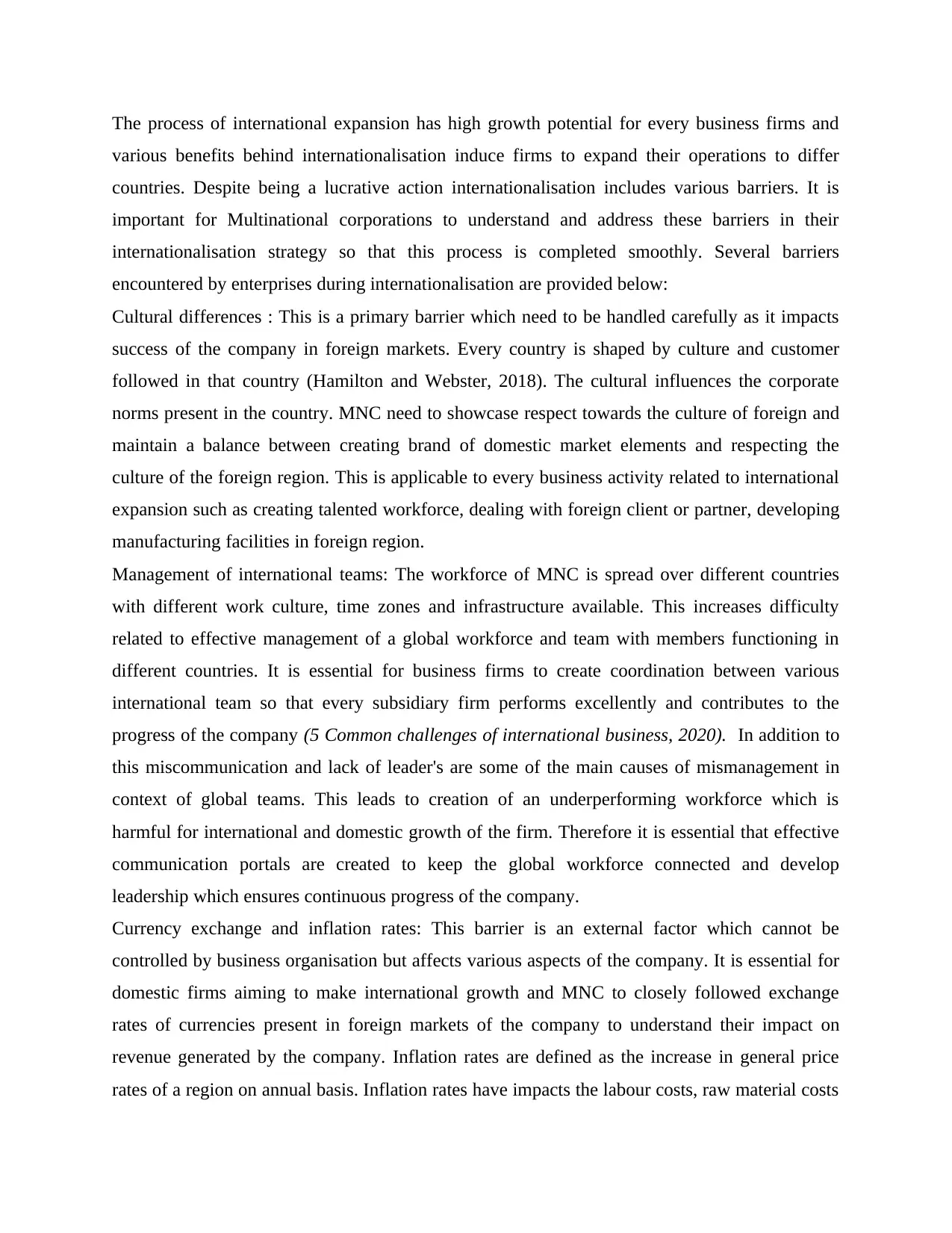
The process of international expansion has high growth potential for every business firms and
various benefits behind internationalisation induce firms to expand their operations to differ
countries. Despite being a lucrative action internationalisation includes various barriers. It is
important for Multinational corporations to understand and address these barriers in their
internationalisation strategy so that this process is completed smoothly. Several barriers
encountered by enterprises during internationalisation are provided below:
Cultural differences : This is a primary barrier which need to be handled carefully as it impacts
success of the company in foreign markets. Every country is shaped by culture and customer
followed in that country (Hamilton and Webster, 2018). The cultural influences the corporate
norms present in the country. MNC need to showcase respect towards the culture of foreign and
maintain a balance between creating brand of domestic market elements and respecting the
culture of the foreign region. This is applicable to every business activity related to international
expansion such as creating talented workforce, dealing with foreign client or partner, developing
manufacturing facilities in foreign region.
Management of international teams: The workforce of MNC is spread over different countries
with different work culture, time zones and infrastructure available. This increases difficulty
related to effective management of a global workforce and team with members functioning in
different countries. It is essential for business firms to create coordination between various
international team so that every subsidiary firm performs excellently and contributes to the
progress of the company (5 Common challenges of international business, 2020). In addition to
this miscommunication and lack of leader's are some of the main causes of mismanagement in
context of global teams. This leads to creation of an underperforming workforce which is
harmful for international and domestic growth of the firm. Therefore it is essential that effective
communication portals are created to keep the global workforce connected and develop
leadership which ensures continuous progress of the company.
Currency exchange and inflation rates: This barrier is an external factor which cannot be
controlled by business organisation but affects various aspects of the company. It is essential for
domestic firms aiming to make international growth and MNC to closely followed exchange
rates of currencies present in foreign markets of the company to understand their impact on
revenue generated by the company. Inflation rates are defined as the increase in general price
rates of a region on annual basis. Inflation rates have impacts the labour costs, raw material costs
various benefits behind internationalisation induce firms to expand their operations to differ
countries. Despite being a lucrative action internationalisation includes various barriers. It is
important for Multinational corporations to understand and address these barriers in their
internationalisation strategy so that this process is completed smoothly. Several barriers
encountered by enterprises during internationalisation are provided below:
Cultural differences : This is a primary barrier which need to be handled carefully as it impacts
success of the company in foreign markets. Every country is shaped by culture and customer
followed in that country (Hamilton and Webster, 2018). The cultural influences the corporate
norms present in the country. MNC need to showcase respect towards the culture of foreign and
maintain a balance between creating brand of domestic market elements and respecting the
culture of the foreign region. This is applicable to every business activity related to international
expansion such as creating talented workforce, dealing with foreign client or partner, developing
manufacturing facilities in foreign region.
Management of international teams: The workforce of MNC is spread over different countries
with different work culture, time zones and infrastructure available. This increases difficulty
related to effective management of a global workforce and team with members functioning in
different countries. It is essential for business firms to create coordination between various
international team so that every subsidiary firm performs excellently and contributes to the
progress of the company (5 Common challenges of international business, 2020). In addition to
this miscommunication and lack of leader's are some of the main causes of mismanagement in
context of global teams. This leads to creation of an underperforming workforce which is
harmful for international and domestic growth of the firm. Therefore it is essential that effective
communication portals are created to keep the global workforce connected and develop
leadership which ensures continuous progress of the company.
Currency exchange and inflation rates: This barrier is an external factor which cannot be
controlled by business organisation but affects various aspects of the company. It is essential for
domestic firms aiming to make international growth and MNC to closely followed exchange
rates of currencies present in foreign markets of the company to understand their impact on
revenue generated by the company. Inflation rates are defined as the increase in general price
rates of a region on annual basis. Inflation rates have impacts the labour costs, raw material costs
⊘ This is a preview!⊘
Do you want full access?
Subscribe today to unlock all pages.
Trusted by 1+ million students worldwide
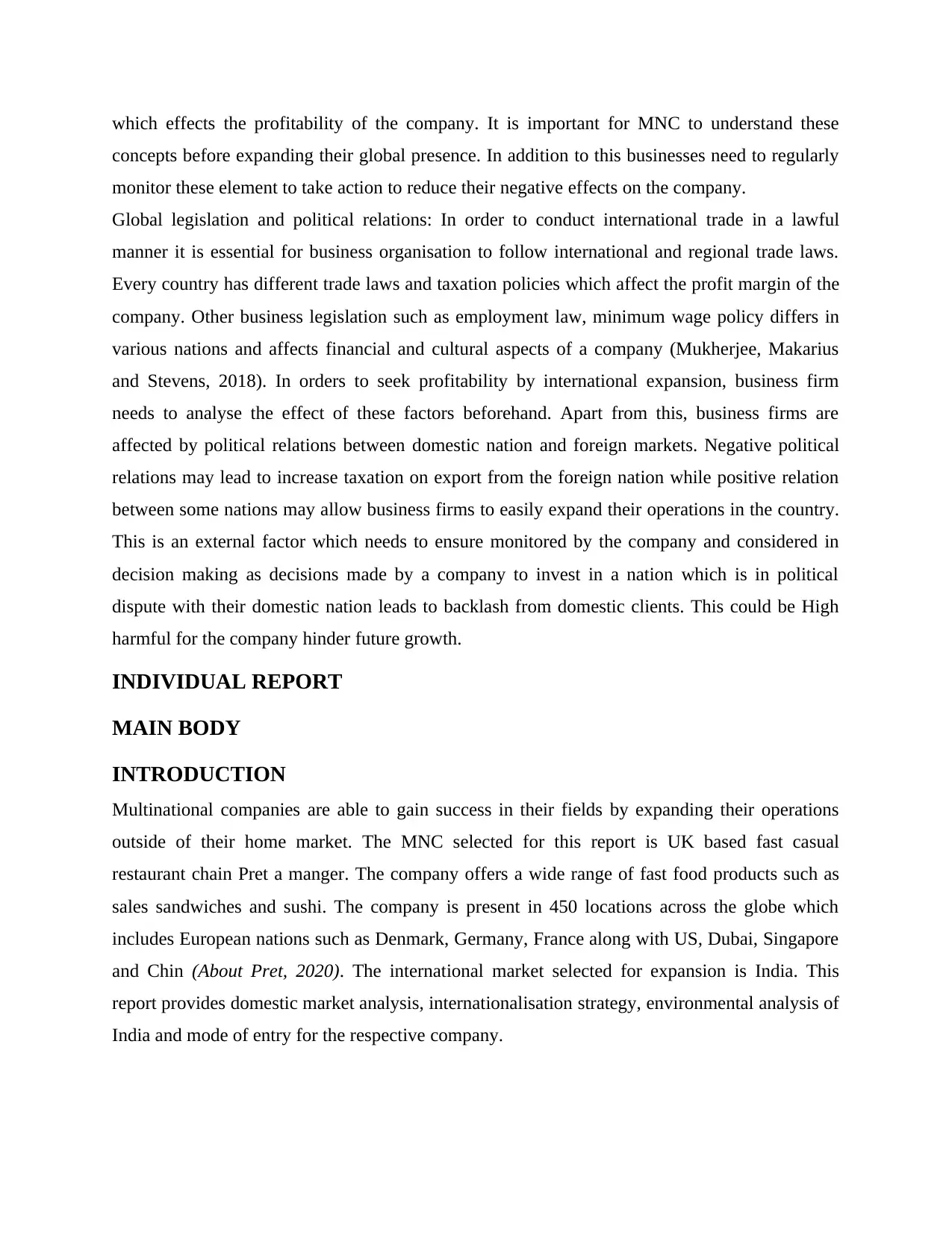
which effects the profitability of the company. It is important for MNC to understand these
concepts before expanding their global presence. In addition to this businesses need to regularly
monitor these element to take action to reduce their negative effects on the company.
Global legislation and political relations: In order to conduct international trade in a lawful
manner it is essential for business organisation to follow international and regional trade laws.
Every country has different trade laws and taxation policies which affect the profit margin of the
company. Other business legislation such as employment law, minimum wage policy differs in
various nations and affects financial and cultural aspects of a company (Mukherjee, Makarius
and Stevens, 2018). In orders to seek profitability by international expansion, business firm
needs to analyse the effect of these factors beforehand. Apart from this, business firms are
affected by political relations between domestic nation and foreign markets. Negative political
relations may lead to increase taxation on export from the foreign nation while positive relation
between some nations may allow business firms to easily expand their operations in the country.
This is an external factor which needs to ensure monitored by the company and considered in
decision making as decisions made by a company to invest in a nation which is in political
dispute with their domestic nation leads to backlash from domestic clients. This could be High
harmful for the company hinder future growth.
INDIVIDUAL REPORT
MAIN BODY
INTRODUCTION
Multinational companies are able to gain success in their fields by expanding their operations
outside of their home market. The MNC selected for this report is UK based fast casual
restaurant chain Pret a manger. The company offers a wide range of fast food products such as
sales sandwiches and sushi. The company is present in 450 locations across the globe which
includes European nations such as Denmark, Germany, France along with US, Dubai, Singapore
and Chin (About Pret, 2020). The international market selected for expansion is India. This
report provides domestic market analysis, internationalisation strategy, environmental analysis of
India and mode of entry for the respective company.
concepts before expanding their global presence. In addition to this businesses need to regularly
monitor these element to take action to reduce their negative effects on the company.
Global legislation and political relations: In order to conduct international trade in a lawful
manner it is essential for business organisation to follow international and regional trade laws.
Every country has different trade laws and taxation policies which affect the profit margin of the
company. Other business legislation such as employment law, minimum wage policy differs in
various nations and affects financial and cultural aspects of a company (Mukherjee, Makarius
and Stevens, 2018). In orders to seek profitability by international expansion, business firm
needs to analyse the effect of these factors beforehand. Apart from this, business firms are
affected by political relations between domestic nation and foreign markets. Negative political
relations may lead to increase taxation on export from the foreign nation while positive relation
between some nations may allow business firms to easily expand their operations in the country.
This is an external factor which needs to ensure monitored by the company and considered in
decision making as decisions made by a company to invest in a nation which is in political
dispute with their domestic nation leads to backlash from domestic clients. This could be High
harmful for the company hinder future growth.
INDIVIDUAL REPORT
MAIN BODY
INTRODUCTION
Multinational companies are able to gain success in their fields by expanding their operations
outside of their home market. The MNC selected for this report is UK based fast casual
restaurant chain Pret a manger. The company offers a wide range of fast food products such as
sales sandwiches and sushi. The company is present in 450 locations across the globe which
includes European nations such as Denmark, Germany, France along with US, Dubai, Singapore
and Chin (About Pret, 2020). The international market selected for expansion is India. This
report provides domestic market analysis, internationalisation strategy, environmental analysis of
India and mode of entry for the respective company.
Paraphrase This Document
Need a fresh take? Get an instant paraphrase of this document with our AI Paraphraser
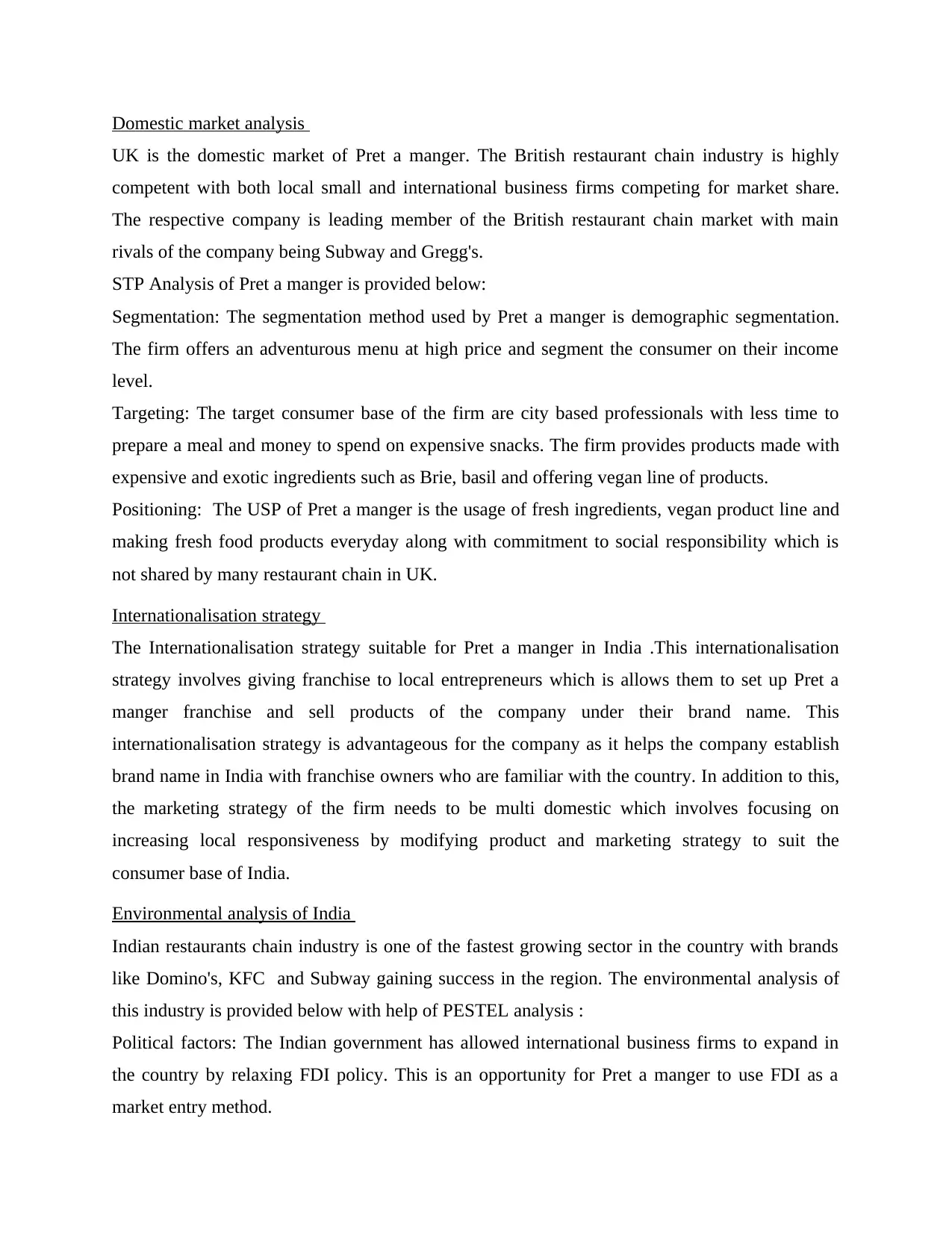
Domestic market analysis
UK is the domestic market of Pret a manger. The British restaurant chain industry is highly
competent with both local small and international business firms competing for market share.
The respective company is leading member of the British restaurant chain market with main
rivals of the company being Subway and Gregg's.
STP Analysis of Pret a manger is provided below:
Segmentation: The segmentation method used by Pret a manger is demographic segmentation.
The firm offers an adventurous menu at high price and segment the consumer on their income
level.
Targeting: The target consumer base of the firm are city based professionals with less time to
prepare a meal and money to spend on expensive snacks. The firm provides products made with
expensive and exotic ingredients such as Brie, basil and offering vegan line of products.
Positioning: The USP of Pret a manger is the usage of fresh ingredients, vegan product line and
making fresh food products everyday along with commitment to social responsibility which is
not shared by many restaurant chain in UK.
Internationalisation strategy
The Internationalisation strategy suitable for Pret a manger in India .This internationalisation
strategy involves giving franchise to local entrepreneurs which is allows them to set up Pret a
manger franchise and sell products of the company under their brand name. This
internationalisation strategy is advantageous for the company as it helps the company establish
brand name in India with franchise owners who are familiar with the country. In addition to this,
the marketing strategy of the firm needs to be multi domestic which involves focusing on
increasing local responsiveness by modifying product and marketing strategy to suit the
consumer base of India.
Environmental analysis of India
Indian restaurants chain industry is one of the fastest growing sector in the country with brands
like Domino's, KFC and Subway gaining success in the region. The environmental analysis of
this industry is provided below with help of PESTEL analysis :
Political factors: The Indian government has allowed international business firms to expand in
the country by relaxing FDI policy. This is an opportunity for Pret a manger to use FDI as a
market entry method.
UK is the domestic market of Pret a manger. The British restaurant chain industry is highly
competent with both local small and international business firms competing for market share.
The respective company is leading member of the British restaurant chain market with main
rivals of the company being Subway and Gregg's.
STP Analysis of Pret a manger is provided below:
Segmentation: The segmentation method used by Pret a manger is demographic segmentation.
The firm offers an adventurous menu at high price and segment the consumer on their income
level.
Targeting: The target consumer base of the firm are city based professionals with less time to
prepare a meal and money to spend on expensive snacks. The firm provides products made with
expensive and exotic ingredients such as Brie, basil and offering vegan line of products.
Positioning: The USP of Pret a manger is the usage of fresh ingredients, vegan product line and
making fresh food products everyday along with commitment to social responsibility which is
not shared by many restaurant chain in UK.
Internationalisation strategy
The Internationalisation strategy suitable for Pret a manger in India .This internationalisation
strategy involves giving franchise to local entrepreneurs which is allows them to set up Pret a
manger franchise and sell products of the company under their brand name. This
internationalisation strategy is advantageous for the company as it helps the company establish
brand name in India with franchise owners who are familiar with the country. In addition to this,
the marketing strategy of the firm needs to be multi domestic which involves focusing on
increasing local responsiveness by modifying product and marketing strategy to suit the
consumer base of India.
Environmental analysis of India
Indian restaurants chain industry is one of the fastest growing sector in the country with brands
like Domino's, KFC and Subway gaining success in the region. The environmental analysis of
this industry is provided below with help of PESTEL analysis :
Political factors: The Indian government has allowed international business firms to expand in
the country by relaxing FDI policy. This is an opportunity for Pret a manger to use FDI as a
market entry method.
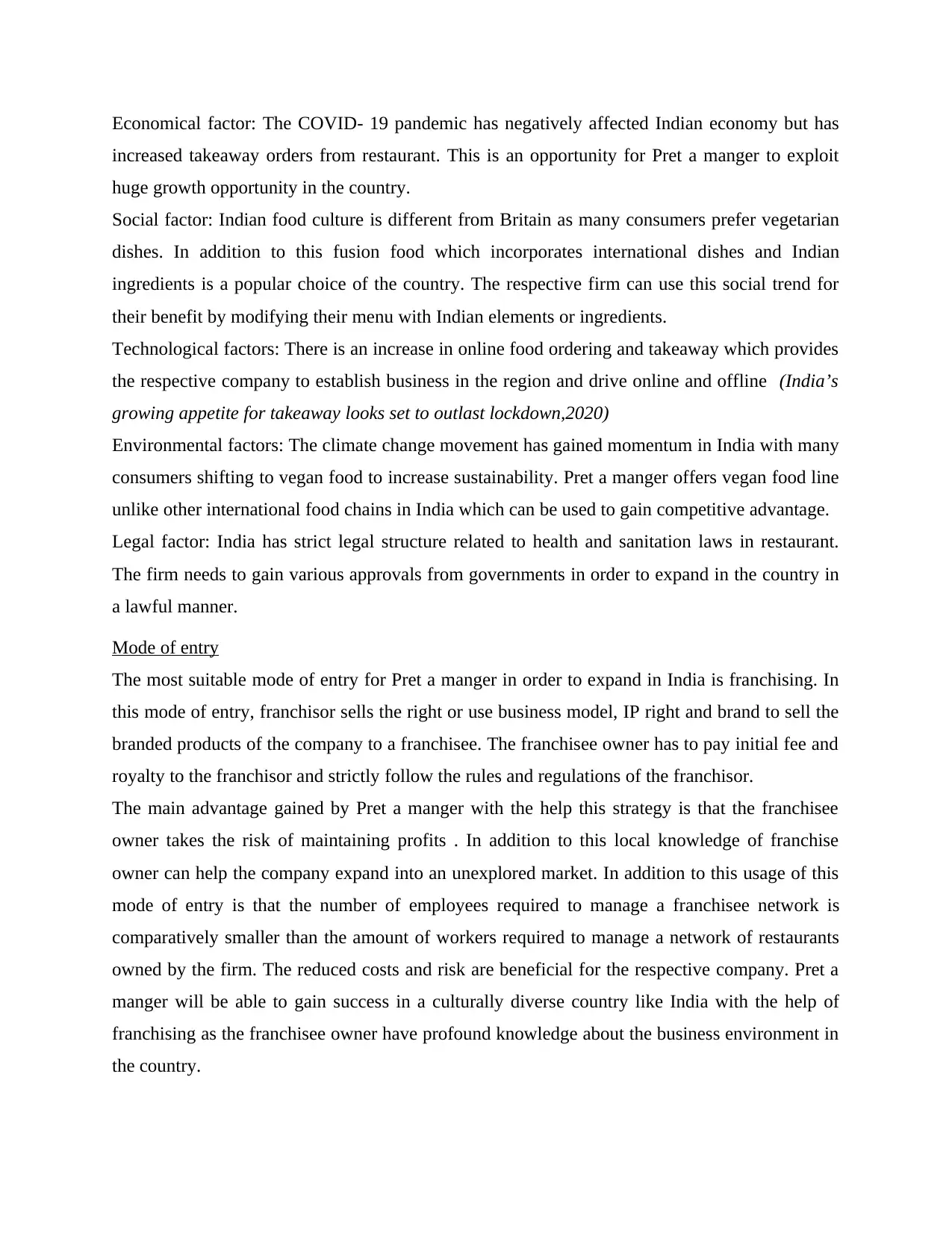
Economical factor: The COVID- 19 pandemic has negatively affected Indian economy but has
increased takeaway orders from restaurant. This is an opportunity for Pret a manger to exploit
huge growth opportunity in the country.
Social factor: Indian food culture is different from Britain as many consumers prefer vegetarian
dishes. In addition to this fusion food which incorporates international dishes and Indian
ingredients is a popular choice of the country. The respective firm can use this social trend for
their benefit by modifying their menu with Indian elements or ingredients.
Technological factors: There is an increase in online food ordering and takeaway which provides
the respective company to establish business in the region and drive online and offline (India’s
growing appetite for takeaway looks set to outlast lockdown,2020)
Environmental factors: The climate change movement has gained momentum in India with many
consumers shifting to vegan food to increase sustainability. Pret a manger offers vegan food line
unlike other international food chains in India which can be used to gain competitive advantage.
Legal factor: India has strict legal structure related to health and sanitation laws in restaurant.
The firm needs to gain various approvals from governments in order to expand in the country in
a lawful manner.
Mode of entry
The most suitable mode of entry for Pret a manger in order to expand in India is franchising. In
this mode of entry, franchisor sells the right or use business model, IP right and brand to sell the
branded products of the company to a franchisee. The franchisee owner has to pay initial fee and
royalty to the franchisor and strictly follow the rules and regulations of the franchisor.
The main advantage gained by Pret a manger with the help this strategy is that the franchisee
owner takes the risk of maintaining profits . In addition to this local knowledge of franchise
owner can help the company expand into an unexplored market. In addition to this usage of this
mode of entry is that the number of employees required to manage a franchisee network is
comparatively smaller than the amount of workers required to manage a network of restaurants
owned by the firm. The reduced costs and risk are beneficial for the respective company. Pret a
manger will be able to gain success in a culturally diverse country like India with the help of
franchising as the franchisee owner have profound knowledge about the business environment in
the country.
increased takeaway orders from restaurant. This is an opportunity for Pret a manger to exploit
huge growth opportunity in the country.
Social factor: Indian food culture is different from Britain as many consumers prefer vegetarian
dishes. In addition to this fusion food which incorporates international dishes and Indian
ingredients is a popular choice of the country. The respective firm can use this social trend for
their benefit by modifying their menu with Indian elements or ingredients.
Technological factors: There is an increase in online food ordering and takeaway which provides
the respective company to establish business in the region and drive online and offline (India’s
growing appetite for takeaway looks set to outlast lockdown,2020)
Environmental factors: The climate change movement has gained momentum in India with many
consumers shifting to vegan food to increase sustainability. Pret a manger offers vegan food line
unlike other international food chains in India which can be used to gain competitive advantage.
Legal factor: India has strict legal structure related to health and sanitation laws in restaurant.
The firm needs to gain various approvals from governments in order to expand in the country in
a lawful manner.
Mode of entry
The most suitable mode of entry for Pret a manger in order to expand in India is franchising. In
this mode of entry, franchisor sells the right or use business model, IP right and brand to sell the
branded products of the company to a franchisee. The franchisee owner has to pay initial fee and
royalty to the franchisor and strictly follow the rules and regulations of the franchisor.
The main advantage gained by Pret a manger with the help this strategy is that the franchisee
owner takes the risk of maintaining profits . In addition to this local knowledge of franchise
owner can help the company expand into an unexplored market. In addition to this usage of this
mode of entry is that the number of employees required to manage a franchisee network is
comparatively smaller than the amount of workers required to manage a network of restaurants
owned by the firm. The reduced costs and risk are beneficial for the respective company. Pret a
manger will be able to gain success in a culturally diverse country like India with the help of
franchising as the franchisee owner have profound knowledge about the business environment in
the country.
⊘ This is a preview!⊘
Do you want full access?
Subscribe today to unlock all pages.
Trusted by 1+ million students worldwide
The main barrier faced by the firm with usage of this mode of entry is cost required to maintain
initial franchisees before enough franchisee are set up to gain profitability. In order to face this
challenge, Pret a manger needs to implement marketing strategy to attract customers in Indian
and adjust prices so that it does not repel middle income consumer in the region.
Another challenge associated with franchising is identification of right people to sell the
franchisee. In context of the respective company it is essential that the most experienced and
competent people gain the right to open a franchisee as it plays a vital role I. the success of the
company in India. The firm needs to find people which are familiar with restaurant decor in India
and have expertise in managing food business in the country.
Leadership qualities required for this mode of entry
It is essential for Pret a manger to develop leadership skills for managing franchisee network .
This will ensure that the network does not fail in any aspect and provides favourable outcome.
The leadership skills for using franchisee as a mode of entry include effective communication
skills. It is important for leaders at Pret a manger to have effective communication skills so that
every franchisee owner gains information about decision made by senior leadership and changes
made in the business model are implemented in an effective manner. Interpersonal skill is
another leadership skill essential for the usage of this mode of market entry. Leadership of Pret a
manger need to have this skill to identify right people for selling their franchisee. In addition to
this, interpersonal skill can help the leaders at Pret a manger to form strong bonds with the
franchisee owner to increase their loyalty towards the company. The absence of this leadership
skill will result in creation of franchise network which is managed by incompetent franchisee
owners. This decreases consumer satisfaction and company reputation which is harmful for the
company on domestic and international scale.
initial franchisees before enough franchisee are set up to gain profitability. In order to face this
challenge, Pret a manger needs to implement marketing strategy to attract customers in Indian
and adjust prices so that it does not repel middle income consumer in the region.
Another challenge associated with franchising is identification of right people to sell the
franchisee. In context of the respective company it is essential that the most experienced and
competent people gain the right to open a franchisee as it plays a vital role I. the success of the
company in India. The firm needs to find people which are familiar with restaurant decor in India
and have expertise in managing food business in the country.
Leadership qualities required for this mode of entry
It is essential for Pret a manger to develop leadership skills for managing franchisee network .
This will ensure that the network does not fail in any aspect and provides favourable outcome.
The leadership skills for using franchisee as a mode of entry include effective communication
skills. It is important for leaders at Pret a manger to have effective communication skills so that
every franchisee owner gains information about decision made by senior leadership and changes
made in the business model are implemented in an effective manner. Interpersonal skill is
another leadership skill essential for the usage of this mode of market entry. Leadership of Pret a
manger need to have this skill to identify right people for selling their franchisee. In addition to
this, interpersonal skill can help the leaders at Pret a manger to form strong bonds with the
franchisee owner to increase their loyalty towards the company. The absence of this leadership
skill will result in creation of franchise network which is managed by incompetent franchisee
owners. This decreases consumer satisfaction and company reputation which is harmful for the
company on domestic and international scale.
Paraphrase This Document
Need a fresh take? Get an instant paraphrase of this document with our AI Paraphraser
CONCLUSION
From the above report it is determined that business organisation utilise various strategies in
order to expand globally. Franchising is a internationalisation strategy which includes selling
brand names and business models in exchange of small initial fee and royalty. In order to expand
successfully business firms need to understand corporate environment of the foreign markets. In
order to use the franchising strategy the leaders of a business firm need to have several skills
which include communication and interpersonal skills.
From the above report it is determined that business organisation utilise various strategies in
order to expand globally. Franchising is a internationalisation strategy which includes selling
brand names and business models in exchange of small initial fee and royalty. In order to expand
successfully business firms need to understand corporate environment of the foreign markets. In
order to use the franchising strategy the leaders of a business firm need to have several skills
which include communication and interpersonal skills.
INDIVIDUAL REFLECTION
Gibbs reflective cycle is one of the most popular models used for conducting a reflection. This
cycle includes six stages which need to be completed in order to explore a particular experience
or incident. The usage of this model is helpful in effectively reflecting on past occurences and
learn from them.
The Gibbs model of reflection is applied for this reflective report below:
Description: This report involves conducting online research about EEC and the benefits and
drawbacks associated with this community. This research was to be completed individually. In
addition to this, the reason for internationalisation and barriers associated with this bedded to be
identified as a part of individuals notes 2. Apart from this, an MNC needed to be selected along
Gibbs reflective cycle is one of the most popular models used for conducting a reflection. This
cycle includes six stages which need to be completed in order to explore a particular experience
or incident. The usage of this model is helpful in effectively reflecting on past occurences and
learn from them.
The Gibbs model of reflection is applied for this reflective report below:
Description: This report involves conducting online research about EEC and the benefits and
drawbacks associated with this community. This research was to be completed individually. In
addition to this, the reason for internationalisation and barriers associated with this bedded to be
identified as a part of individuals notes 2. Apart from this, an MNC needed to be selected along
⊘ This is a preview!⊘
Do you want full access?
Subscribe today to unlock all pages.
Trusted by 1+ million students worldwide

1 out of 17


Related Documents


Your All-in-One AI-Powered Toolkit for Academic Success.
+13062052269
info@desklib.com
Available 24*7 on WhatsApp / Email
![[object Object]](/_next/static/media/star-bottom.7253800d.svg)
Unlock your academic potential
Copyright © 2020–2026 A2Z Services. All Rights Reserved. Developed and managed by ZUCOL.