Global Business Environment Analysis: SASOL Strategic Report
VerifiedAdded on 2023/01/18
|15
|2065
|33
Report
AI Summary
This report provides a comprehensive analysis of the global business environment, focusing on the South African energy and chemical company, SASOL Limited. It explores key drivers of globalization and their impact on business operations. The report applies McKinsey's 7S model to examine SASOL's culture, structure, and governance, and evaluates ethical and sustainable factors within the global market. It utilizes Hofstede's cultural dimensions to understand how the organization is affected by cultural differences across various countries. Furthermore, it examines the factors influencing decision-making processes and evaluates strategic expansion routes, including exporting and licensing, along with their respective advantages and disadvantages. The analysis provides insights into SASOL's strategies for navigating the complexities of the global business landscape.
Global Business
Environment
Environment
Paraphrase This Document
Need a fresh take? Get an instant paraphrase of this document with our AI Paraphraser

Table of Contents

INTRODUCTION
Global business environment refer to the interaction of business with outside stakeholders
in order to take the necessary decision and influence the decision making process. It is risky to
engage in external environment and carry out the functioning of business due to influence of
external factors which can hinder the ability to perform operations effectively. Certain factors
such as innovation in existing technology, preferences of customer and government regulation
directly or indirectly hamper the performance of business. To better understand the concept of
global business environment, SASOL limited company has been selected which is energy and
chemical company of South Africa. Due to the fast growing size the company has expanded its
operations in various areas like Canada, Australia, Mozambique as well as plan to expand in the
other countries as well. This report cover topics like analyse the key factors that can drive to
globalisation. Along with that determine strategic complexities which are associated while
operating the business environment. Moreover, evaluate the influence of global market within
the structure, culture as well as functions of an organisation. Further, evaluation of the influence
of globalisation within the decision making and formulating strategy are covered in the report.
Global business environment refer to the interaction of business with outside stakeholders
in order to take the necessary decision and influence the decision making process. It is risky to
engage in external environment and carry out the functioning of business due to influence of
external factors which can hinder the ability to perform operations effectively. Certain factors
such as innovation in existing technology, preferences of customer and government regulation
directly or indirectly hamper the performance of business. To better understand the concept of
global business environment, SASOL limited company has been selected which is energy and
chemical company of South Africa. Due to the fast growing size the company has expanded its
operations in various areas like Canada, Australia, Mozambique as well as plan to expand in the
other countries as well. This report cover topics like analyse the key factors that can drive to
globalisation. Along with that determine strategic complexities which are associated while
operating the business environment. Moreover, evaluate the influence of global market within
the structure, culture as well as functions of an organisation. Further, evaluation of the influence
of globalisation within the decision making and formulating strategy are covered in the report.
⊘ This is a preview!⊘
Do you want full access?
Subscribe today to unlock all pages.

Trusted by 1+ million students worldwide

PART 1
Paraphrase This Document
Need a fresh take? Get an instant paraphrase of this document with our AI Paraphraser


⊘ This is a preview!⊘
Do you want full access?
Subscribe today to unlock all pages.

Trusted by 1+ million students worldwide

Paraphrase This Document
Need a fresh take? Get an instant paraphrase of this document with our AI Paraphraser


⊘ This is a preview!⊘
Do you want full access?
Subscribe today to unlock all pages.

Trusted by 1+ million students worldwide

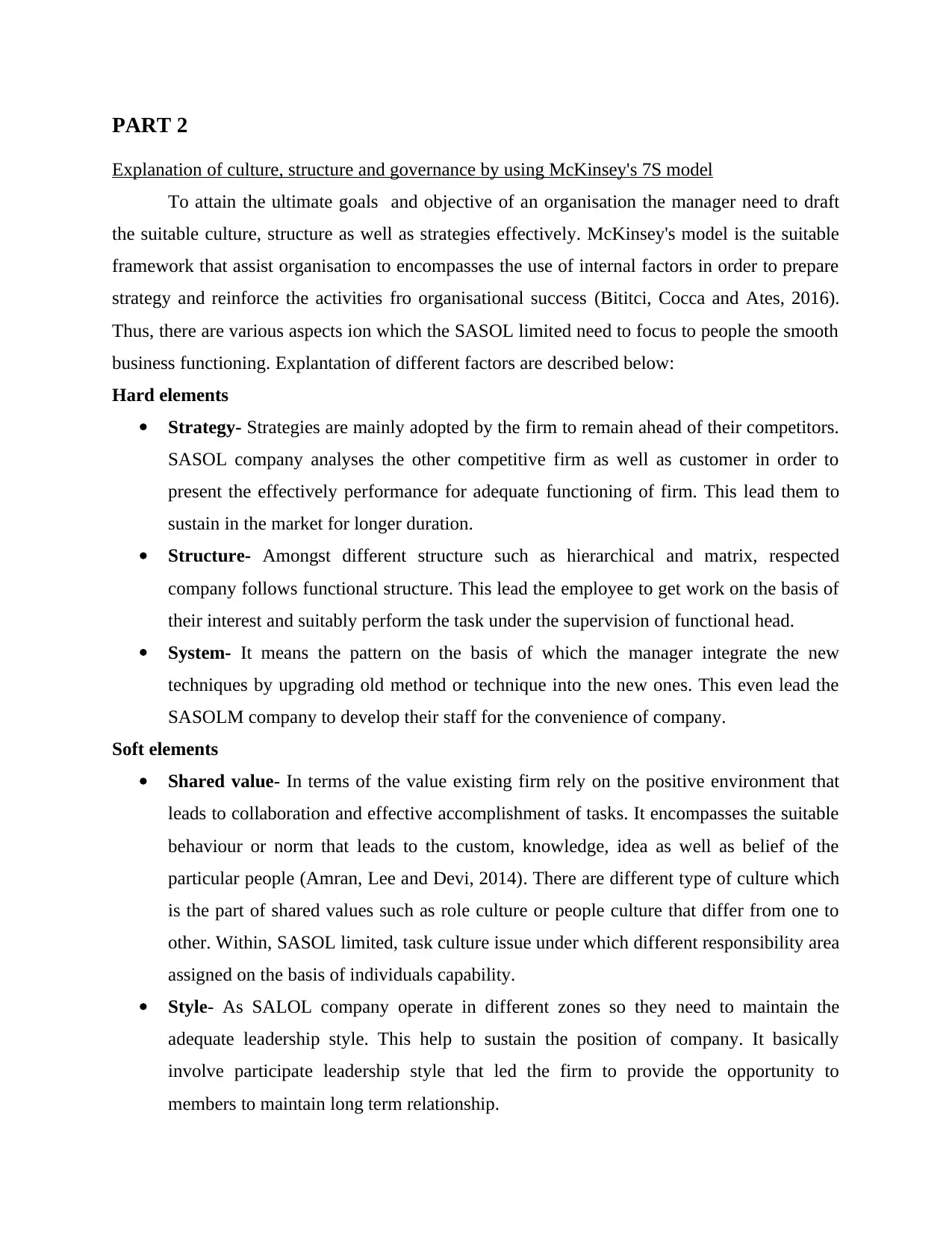
PART 2
Explanation of culture, structure and governance by using McKinsey's 7S model
To attain the ultimate goals and objective of an organisation the manager need to draft
the suitable culture, structure as well as strategies effectively. McKinsey's model is the suitable
framework that assist organisation to encompasses the use of internal factors in order to prepare
strategy and reinforce the activities fro organisational success (Bititci, Cocca and Ates, 2016).
Thus, there are various aspects ion which the SASOL limited need to focus to people the smooth
business functioning. Explantation of different factors are described below:
Hard elements
Strategy- Strategies are mainly adopted by the firm to remain ahead of their competitors.
SASOL company analyses the other competitive firm as well as customer in order to
present the effectively performance for adequate functioning of firm. This lead them to
sustain in the market for longer duration.
Structure- Amongst different structure such as hierarchical and matrix, respected
company follows functional structure. This lead the employee to get work on the basis of
their interest and suitably perform the task under the supervision of functional head.
System- It means the pattern on the basis of which the manager integrate the new
techniques by upgrading old method or technique into the new ones. This even lead the
SASOLM company to develop their staff for the convenience of company.
Soft elements
Shared value- In terms of the value existing firm rely on the positive environment that
leads to collaboration and effective accomplishment of tasks. It encompasses the suitable
behaviour or norm that leads to the custom, knowledge, idea as well as belief of the
particular people (Amran, Lee and Devi, 2014). There are different type of culture which
is the part of shared values such as role culture or people culture that differ from one to
other. Within, SASOL limited, task culture issue under which different responsibility area
assigned on the basis of individuals capability.
Style- As SALOL company operate in different zones so they need to maintain the
adequate leadership style. This help to sustain the position of company. It basically
involve participate leadership style that led the firm to provide the opportunity to
members to maintain long term relationship.
Explanation of culture, structure and governance by using McKinsey's 7S model
To attain the ultimate goals and objective of an organisation the manager need to draft
the suitable culture, structure as well as strategies effectively. McKinsey's model is the suitable
framework that assist organisation to encompasses the use of internal factors in order to prepare
strategy and reinforce the activities fro organisational success (Bititci, Cocca and Ates, 2016).
Thus, there are various aspects ion which the SASOL limited need to focus to people the smooth
business functioning. Explantation of different factors are described below:
Hard elements
Strategy- Strategies are mainly adopted by the firm to remain ahead of their competitors.
SASOL company analyses the other competitive firm as well as customer in order to
present the effectively performance for adequate functioning of firm. This lead them to
sustain in the market for longer duration.
Structure- Amongst different structure such as hierarchical and matrix, respected
company follows functional structure. This lead the employee to get work on the basis of
their interest and suitably perform the task under the supervision of functional head.
System- It means the pattern on the basis of which the manager integrate the new
techniques by upgrading old method or technique into the new ones. This even lead the
SASOLM company to develop their staff for the convenience of company.
Soft elements
Shared value- In terms of the value existing firm rely on the positive environment that
leads to collaboration and effective accomplishment of tasks. It encompasses the suitable
behaviour or norm that leads to the custom, knowledge, idea as well as belief of the
particular people (Amran, Lee and Devi, 2014). There are different type of culture which
is the part of shared values such as role culture or people culture that differ from one to
other. Within, SASOL limited, task culture issue under which different responsibility area
assigned on the basis of individuals capability.
Style- As SALOL company operate in different zones so they need to maintain the
adequate leadership style. This help to sustain the position of company. It basically
involve participate leadership style that led the firm to provide the opportunity to
members to maintain long term relationship.
Paraphrase This Document
Need a fresh take? Get an instant paraphrase of this document with our AI Paraphraser

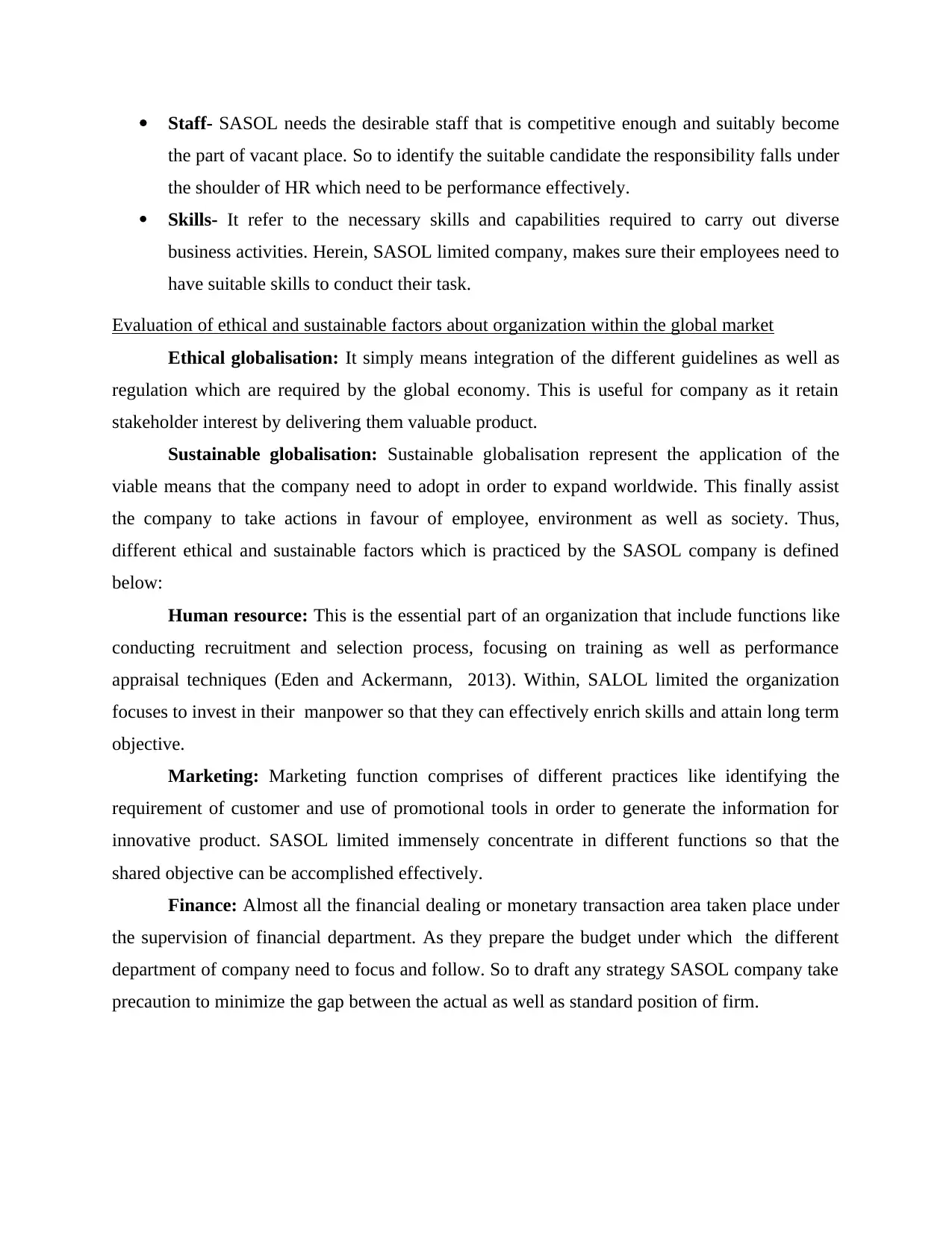
Staff- SASOL needs the desirable staff that is competitive enough and suitably become
the part of vacant place. So to identify the suitable candidate the responsibility falls under
the shoulder of HR which need to be performance effectively.
Skills- It refer to the necessary skills and capabilities required to carry out diverse
business activities. Herein, SASOL limited company, makes sure their employees need to
have suitable skills to conduct their task.
Evaluation of ethical and sustainable factors about organization within the global market
Ethical globalisation: It simply means integration of the different guidelines as well as
regulation which are required by the global economy. This is useful for company as it retain
stakeholder interest by delivering them valuable product.
Sustainable globalisation: Sustainable globalisation represent the application of the
viable means that the company need to adopt in order to expand worldwide. This finally assist
the company to take actions in favour of employee, environment as well as society. Thus,
different ethical and sustainable factors which is practiced by the SASOL company is defined
below:
Human resource: This is the essential part of an organization that include functions like
conducting recruitment and selection process, focusing on training as well as performance
appraisal techniques (Eden and Ackermann, 2013). Within, SALOL limited the organization
focuses to invest in their manpower so that they can effectively enrich skills and attain long term
objective.
Marketing: Marketing function comprises of different practices like identifying the
requirement of customer and use of promotional tools in order to generate the information for
innovative product. SASOL limited immensely concentrate in different functions so that the
shared objective can be accomplished effectively.
Finance: Almost all the financial dealing or monetary transaction area taken place under
the supervision of financial department. As they prepare the budget under which the different
department of company need to focus and follow. So to draft any strategy SASOL company take
precaution to minimize the gap between the actual as well as standard position of firm.
the part of vacant place. So to identify the suitable candidate the responsibility falls under
the shoulder of HR which need to be performance effectively.
Skills- It refer to the necessary skills and capabilities required to carry out diverse
business activities. Herein, SASOL limited company, makes sure their employees need to
have suitable skills to conduct their task.
Evaluation of ethical and sustainable factors about organization within the global market
Ethical globalisation: It simply means integration of the different guidelines as well as
regulation which are required by the global economy. This is useful for company as it retain
stakeholder interest by delivering them valuable product.
Sustainable globalisation: Sustainable globalisation represent the application of the
viable means that the company need to adopt in order to expand worldwide. This finally assist
the company to take actions in favour of employee, environment as well as society. Thus,
different ethical and sustainable factors which is practiced by the SASOL company is defined
below:
Human resource: This is the essential part of an organization that include functions like
conducting recruitment and selection process, focusing on training as well as performance
appraisal techniques (Eden and Ackermann, 2013). Within, SALOL limited the organization
focuses to invest in their manpower so that they can effectively enrich skills and attain long term
objective.
Marketing: Marketing function comprises of different practices like identifying the
requirement of customer and use of promotional tools in order to generate the information for
innovative product. SASOL limited immensely concentrate in different functions so that the
shared objective can be accomplished effectively.
Finance: Almost all the financial dealing or monetary transaction area taken place under
the supervision of financial department. As they prepare the budget under which the different
department of company need to focus and follow. So to draft any strategy SASOL company take
precaution to minimize the gap between the actual as well as standard position of firm.

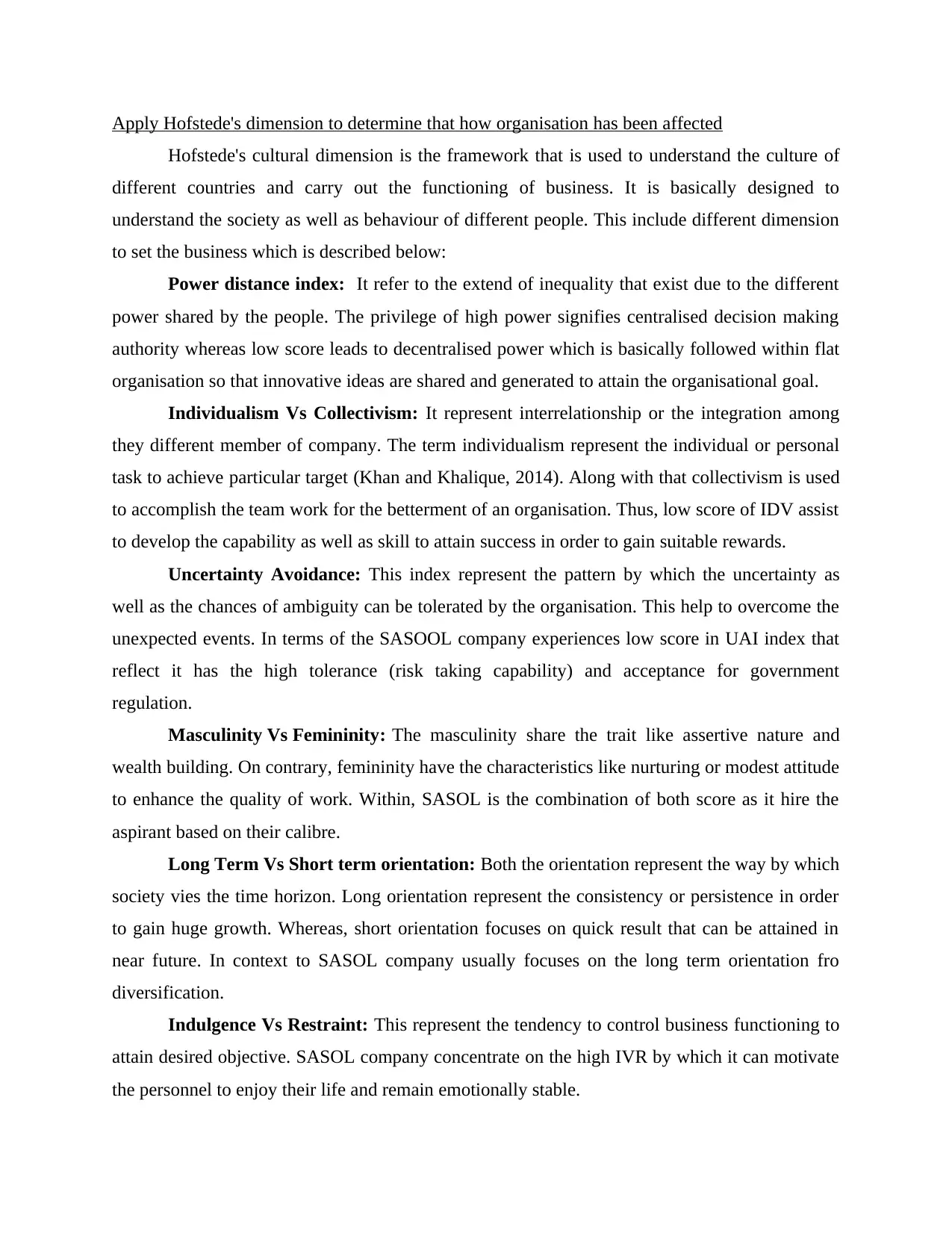
Apply Hofstede's dimension to determine that how organisation has been affected
Hofstede's cultural dimension is the framework that is used to understand the culture of
different countries and carry out the functioning of business. It is basically designed to
understand the society as well as behaviour of different people. This include different dimension
to set the business which is described below:
Power distance index: It refer to the extend of inequality that exist due to the different
power shared by the people. The privilege of high power signifies centralised decision making
authority whereas low score leads to decentralised power which is basically followed within flat
organisation so that innovative ideas are shared and generated to attain the organisational goal.
Individualism Vs Collectivism: It represent interrelationship or the integration among
they different member of company. The term individualism represent the individual or personal
task to achieve particular target (Khan and Khalique, 2014). Along with that collectivism is used
to accomplish the team work for the betterment of an organisation. Thus, low score of IDV assist
to develop the capability as well as skill to attain success in order to gain suitable rewards.
Uncertainty Avoidance: This index represent the pattern by which the uncertainty as
well as the chances of ambiguity can be tolerated by the organisation. This help to overcome the
unexpected events. In terms of the SASOOL company experiences low score in UAI index that
reflect it has the high tolerance (risk taking capability) and acceptance for government
regulation.
Masculinity Vs Femininity: The masculinity share the trait like assertive nature and
wealth building. On contrary, femininity have the characteristics like nurturing or modest attitude
to enhance the quality of work. Within, SASOL is the combination of both score as it hire the
aspirant based on their calibre.
Long Term Vs Short term orientation: Both the orientation represent the way by which
society vies the time horizon. Long orientation represent the consistency or persistence in order
to gain huge growth. Whereas, short orientation focuses on quick result that can be attained in
near future. In context to SASOL company usually focuses on the long term orientation fro
diversification.
Indulgence Vs Restraint: This represent the tendency to control business functioning to
attain desired objective. SASOL company concentrate on the high IVR by which it can motivate
the personnel to enjoy their life and remain emotionally stable.
Hofstede's cultural dimension is the framework that is used to understand the culture of
different countries and carry out the functioning of business. It is basically designed to
understand the society as well as behaviour of different people. This include different dimension
to set the business which is described below:
Power distance index: It refer to the extend of inequality that exist due to the different
power shared by the people. The privilege of high power signifies centralised decision making
authority whereas low score leads to decentralised power which is basically followed within flat
organisation so that innovative ideas are shared and generated to attain the organisational goal.
Individualism Vs Collectivism: It represent interrelationship or the integration among
they different member of company. The term individualism represent the individual or personal
task to achieve particular target (Khan and Khalique, 2014). Along with that collectivism is used
to accomplish the team work for the betterment of an organisation. Thus, low score of IDV assist
to develop the capability as well as skill to attain success in order to gain suitable rewards.
Uncertainty Avoidance: This index represent the pattern by which the uncertainty as
well as the chances of ambiguity can be tolerated by the organisation. This help to overcome the
unexpected events. In terms of the SASOOL company experiences low score in UAI index that
reflect it has the high tolerance (risk taking capability) and acceptance for government
regulation.
Masculinity Vs Femininity: The masculinity share the trait like assertive nature and
wealth building. On contrary, femininity have the characteristics like nurturing or modest attitude
to enhance the quality of work. Within, SASOL is the combination of both score as it hire the
aspirant based on their calibre.
Long Term Vs Short term orientation: Both the orientation represent the way by which
society vies the time horizon. Long orientation represent the consistency or persistence in order
to gain huge growth. Whereas, short orientation focuses on quick result that can be attained in
near future. In context to SASOL company usually focuses on the long term orientation fro
diversification.
Indulgence Vs Restraint: This represent the tendency to control business functioning to
attain desired objective. SASOL company concentrate on the high IVR by which it can motivate
the personnel to enjoy their life and remain emotionally stable.
⊘ This is a preview!⊘
Do you want full access?
Subscribe today to unlock all pages.

Trusted by 1+ million students worldwide
1 out of 15
Related Documents
Your All-in-One AI-Powered Toolkit for Academic Success.
+13062052269
info@desklib.com
Available 24*7 on WhatsApp / Email
Unlock your academic potential
Copyright © 2020–2026 A2Z Services. All Rights Reserved. Developed and managed by ZUCOL.