CORP 1528: Global Business Issues Report on Technology and Currency
VerifiedAdded on 2023/06/10
|10
|2560
|493
Report
AI Summary
This report delves into two key global business issues: the contribution of technology to e-commerce and the influence of a country's currency value on economic activities. The first section analyzes how technology, particularly during the COVID-19 pandemic, has boosted e-commerce, transforming activities such as online store setup, supply chain management, and financial transactions. The report highlights the increasing adoption of digitalization across various sectors, including education and services, and the impact of e-commerce giants. The second section examines the relationship between currency value fluctuations and economic performance, exploring the advantages and disadvantages of currency depreciation. It discusses how a falling currency can impact exports, imports, inflation, and foreign reserves, using examples from the Indian economy. The report concludes by emphasizing the importance of these issues in the global business landscape and the need for businesses to adapt to these changing dynamics.
GLOBAL BUSINESS
ISSUES
ISSUES

Paraphrase This Document
Need a fresh take? Get an instant paraphrase of this document with our AI Paraphraser

TABLE OF CONTENTS
INTRODUCTION...........................................................................................................................3
MAIN BODY...................................................................................................................................3
CONCLUSION................................................................................................................................3
REFERENCES................................................................................................................................4
INTRODUCTION...........................................................................................................................3
MAIN BODY...................................................................................................................................3
CONCLUSION................................................................................................................................3
REFERENCES................................................................................................................................4
⊘ This is a preview!⊘
Do you want full access?
Subscribe today to unlock all pages.

Trusted by 1+ million students worldwide
MAIN BODY
Contribution of technology in boosting activates of E-commerce-
Over the time the progress and hyper use of E-commerce in various activities has been
seen. Specifically, in Covid-19, when the world experienced severe challenges such as keeping
distance, not attending meeting, avoiding physical touch etc. In such predicaments it became
essential to go with E-commerce.
On the other hands, besides such unexpected circumstances with the time, e-commerce is
becoming and inevitable aspects which is taking place in various activities and eradicating
nonconventional realm of performance.
As McKinsey Global Survey presented their views that many organizations digitalized their
services due to unpredictable circumstances took place in Covid-19. There are a range of
activities such as supply chain, supply or delivery, production, data management, order taking
and many other activities are being performed with the help of E-commerce (Garfin, 2020)
To stay competitive in such drastic situation and changing business environment the only
way is to abide with E-commerce. Specifically, during pandemics digital adoption became
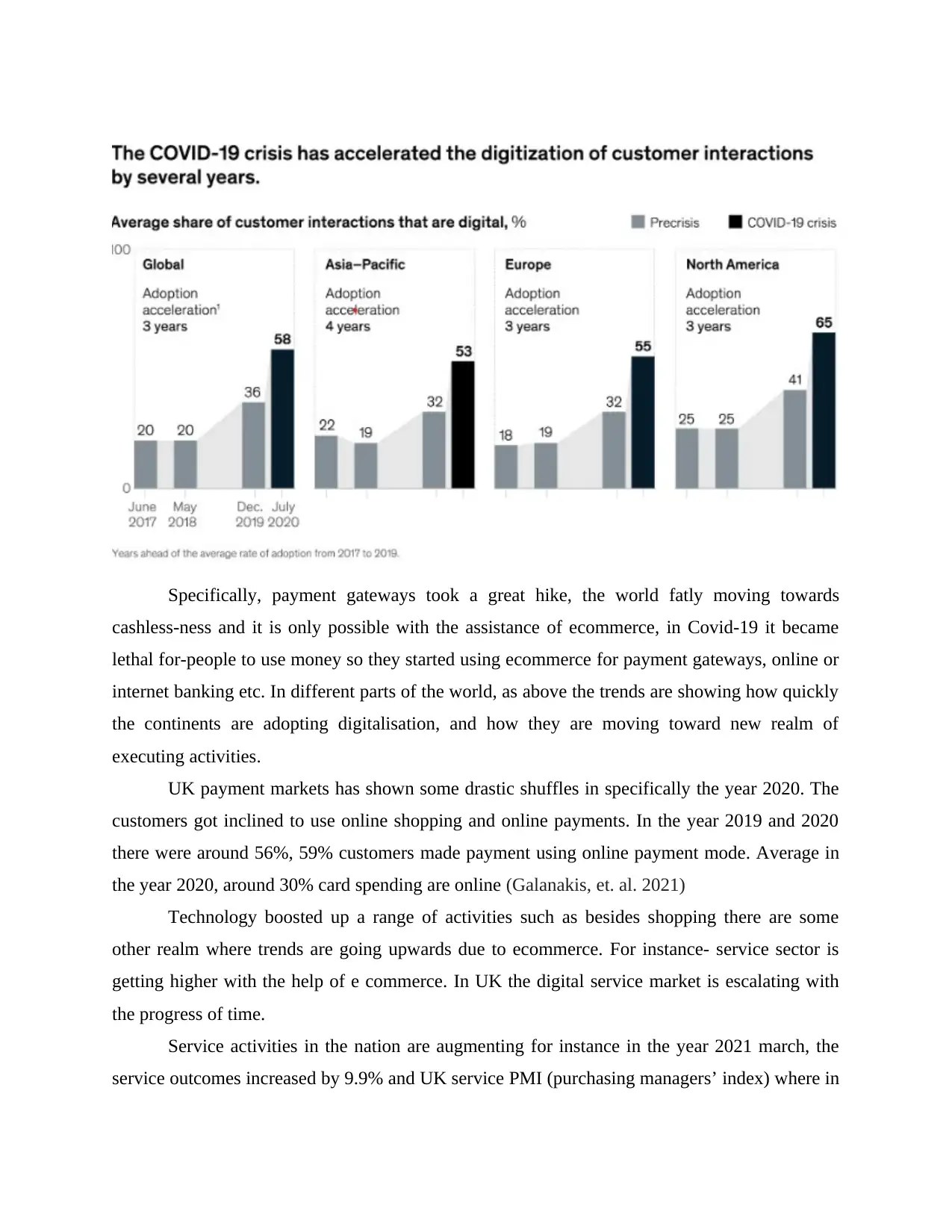
quantum leap and obliged entities to pay attention to digitalisation. It can be seen from the chart
shown below.
E-commerce is being used in many actives for instance- online store setup, buying and
selling actives, supply chain management, e-mail marketing, monetary business transaction,
educational businesses, hospitality actives, medical consultancy, financial consultancy etc.
Earlier in these all actives there was strong need to make direct interaction but now with the
hyper use of digitalised tools and technology there is no need to do so, now even such services
which were never ever supposed to be executed without direct interactions are getting done with
the help of ecommerce facility (Sharma, et. al. 2020)
As it can be observed from the chart below, which shows that earlier there was less
inclination of the world to abide with digitalisation but in the years 2019 and 2020 there has been
a radical surge in the adaption of people. It is clear evidence that some way or the other Covid-19
compelled people to go with ecommerce to perform uninterruptedly.
The below depicted graph is showing that across the world in different realm the use of
digital technology and services took a robust surge in pandemic, this augmentation in the
ecommerce actives is vital evidence of great contribution of technology.
Contribution of technology in boosting activates of E-commerce-
Over the time the progress and hyper use of E-commerce in various activities has been
seen. Specifically, in Covid-19, when the world experienced severe challenges such as keeping
distance, not attending meeting, avoiding physical touch etc. In such predicaments it became
essential to go with E-commerce.
On the other hands, besides such unexpected circumstances with the time, e-commerce is
becoming and inevitable aspects which is taking place in various activities and eradicating
nonconventional realm of performance.
As McKinsey Global Survey presented their views that many organizations digitalized their
services due to unpredictable circumstances took place in Covid-19. There are a range of
activities such as supply chain, supply or delivery, production, data management, order taking
and many other activities are being performed with the help of E-commerce (Garfin, 2020)
To stay competitive in such drastic situation and changing business environment the only
way is to abide with E-commerce. Specifically, during pandemics digital adoption became
quantum leap and obliged entities to pay attention to digitalisation. It can be seen from the chart
shown below.
E-commerce is being used in many actives for instance- online store setup, buying and
selling actives, supply chain management, e-mail marketing, monetary business transaction,
educational businesses, hospitality actives, medical consultancy, financial consultancy etc.
Earlier in these all actives there was strong need to make direct interaction but now with the
hyper use of digitalised tools and technology there is no need to do so, now even such services
which were never ever supposed to be executed without direct interactions are getting done with
the help of ecommerce facility (Sharma, et. al. 2020)
As it can be observed from the chart below, which shows that earlier there was less
inclination of the world to abide with digitalisation but in the years 2019 and 2020 there has been
a radical surge in the adaption of people. It is clear evidence that some way or the other Covid-19
compelled people to go with ecommerce to perform uninterruptedly.
The below depicted graph is showing that across the world in different realm the use of
digital technology and services took a robust surge in pandemic, this augmentation in the
ecommerce actives is vital evidence of great contribution of technology.
Paraphrase This Document
Need a fresh take? Get an instant paraphrase of this document with our AI Paraphraser
Specifically, payment gateways took a great hike, the world fatly moving towards
cashless-ness and it is only possible with the assistance of ecommerce, in Covid-19 it became
lethal for-people to use money so they started using ecommerce for payment gateways, online or
internet banking etc. In different parts of the world, as above the trends are showing how quickly
the continents are adopting digitalisation, and how they are moving toward new realm of
executing activities.
UK payment markets has shown some drastic shuffles in specifically the year 2020. The
customers got inclined to use online shopping and online payments. In the year 2019 and 2020
there were around 56%, 59% customers made payment using online payment mode. Average in
the year 2020, around 30% card spending are online (Galanakis, et. al. 2021)
Technology boosted up a range of activities such as besides shopping there are some
other realm where trends are going upwards due to ecommerce. For instance- service sector is
getting higher with the help of e commerce. In UK the digital service market is escalating with
the progress of time.
Service activities in the nation are augmenting for instance in the year 2021 march, the
service outcomes increased by 9.9% and UK service PMI (purchasing managers’ index) where in
cashless-ness and it is only possible with the assistance of ecommerce, in Covid-19 it became
lethal for-people to use money so they started using ecommerce for payment gateways, online or
internet banking etc. In different parts of the world, as above the trends are showing how quickly
the continents are adopting digitalisation, and how they are moving toward new realm of
executing activities.
UK payment markets has shown some drastic shuffles in specifically the year 2020. The
customers got inclined to use online shopping and online payments. In the year 2019 and 2020
there were around 56%, 59% customers made payment using online payment mode. Average in
the year 2020, around 30% card spending are online (Galanakis, et. al. 2021)
Technology boosted up a range of activities such as besides shopping there are some
other realm where trends are going upwards due to ecommerce. For instance- service sector is
getting higher with the help of e commerce. In UK the digital service market is escalating with
the progress of time.
Service activities in the nation are augmenting for instance in the year 2021 march, the
service outcomes increased by 9.9% and UK service PMI (purchasing managers’ index) where in
April 2022 it was 58.9%. so form this evaluation it can be summarized that the activities are
experienced growth due to use of ecommerce (Khan and Jawaid, 2020)
Digitalisation is supporting various sectors and a range of activities are being carried out
with the aid of ecommerce. For instance, the education field which is one of the fastest growing
set of activities, as it is being seen there are multiple applications and tools which are paving way
for its upgradation.
Supply chain management which is one of the most prominent aspect, now in the age of
globalisation the world cannot keep itself away, and if supply chain is not working efficiently
then there would be perilous situations to perform commercial activities affectively. Use of
ecommerce made it easy, couple of months back there was a severe form of supply chain crisis
was felt by USA.
Here it would be fair to say that it is digitalisation which made the way easier, now in the
globalised world supply chain is well diversified so there is rigorous need to abide with
digitalization, this is only alternative to carry out activities in proficient manner. Supply chain is
now becoming more complicated which can be managed using digitalised tools, it has been
experienced in the duration of Covid-19, when entire world started augmenting their dependency
on ecommerce.
Buying and selling trends are getting changed, the use of ecommerce platforms is
advancing these activities and paving way for higher use. Earlier there were direct shopping
being a common phenomenon but now in the market trading activities are more likely to be in
form of ecommerce which is a living testimony of changing dynamics due to technological
upgradation.
Some e commerce giants such as Amazon, Flip cart, Walmart are notching up mammoth
success, pointedly after the pandemic, so one of the biggest reason which made their work handy
is technological development, now for them operating their business in a number of nations is
doable (Intawong, Olson and Chariyalertsak, 2021)
There are a range of new technological advancements took place, for instance in Covid-
19 one of the most burning challenge for the entity was to manage their workforce where modern
tools of technologies helped than for instance for performing organisational activities
applications such as zoom, and Microsoft team etc. which enhanced their capacity to work
without being affected much.
experienced growth due to use of ecommerce (Khan and Jawaid, 2020)
Digitalisation is supporting various sectors and a range of activities are being carried out
with the aid of ecommerce. For instance, the education field which is one of the fastest growing
set of activities, as it is being seen there are multiple applications and tools which are paving way
for its upgradation.
Supply chain management which is one of the most prominent aspect, now in the age of
globalisation the world cannot keep itself away, and if supply chain is not working efficiently
then there would be perilous situations to perform commercial activities affectively. Use of
ecommerce made it easy, couple of months back there was a severe form of supply chain crisis
was felt by USA.
Here it would be fair to say that it is digitalisation which made the way easier, now in the
globalised world supply chain is well diversified so there is rigorous need to abide with
digitalization, this is only alternative to carry out activities in proficient manner. Supply chain is
now becoming more complicated which can be managed using digitalised tools, it has been
experienced in the duration of Covid-19, when entire world started augmenting their dependency
on ecommerce.
Buying and selling trends are getting changed, the use of ecommerce platforms is
advancing these activities and paving way for higher use. Earlier there were direct shopping
being a common phenomenon but now in the market trading activities are more likely to be in
form of ecommerce which is a living testimony of changing dynamics due to technological
upgradation.
Some e commerce giants such as Amazon, Flip cart, Walmart are notching up mammoth
success, pointedly after the pandemic, so one of the biggest reason which made their work handy
is technological development, now for them operating their business in a number of nations is
doable (Intawong, Olson and Chariyalertsak, 2021)
There are a range of new technological advancements took place, for instance in Covid-
19 one of the most burning challenge for the entity was to manage their workforce where modern
tools of technologies helped than for instance for performing organisational activities
applications such as zoom, and Microsoft team etc. which enhanced their capacity to work
without being affected much.
⊘ This is a preview!⊘
Do you want full access?
Subscribe today to unlock all pages.
Trusted by 1+ million students worldwide
So form the evaluation above it can be concluded that technological upgradation is
changing the prevailing dynamics and bringing better to the world, there are number of activities
which are being performed using digitalised tools and applications. Now the retail market,
supply chain management, service activities are getting intensive opportunities to be evolved due
to digitalization.
Question-2 Value of country’s currency plays role in influencing economic activities-
Fluctuations in the value of currency is a general phenomenon. The value of money is being
decided by free market forces so there is huge possibility of being toppled or augmented. It is
directly related to the economic activities. Money is the base which stands for the things which
makes work of transactions easier. So if it is not stable and getting escalated then would bring
drastic shifts to the economic performance. As it has been seen that the nations with strong
currency performed great when it comes to their economic performance so here it can be
concluded that value of money is a driver of economy (Mohan, 2018)
There are some advantages and disadvantage in the fall of value of currency, these aspects are
as-
Advantages-
If the value of money is falling this is known as currency depreciation, which is taken as
negative thing yet there are some positives too which give upper hand to the economy. If the
value is being toppled by intention then it is known as devaluation but if it is falling down itself
then it is called depreciation, which is a negative phenomenon for an economy.
The value of rupee which is Indian currency is getting toppled. There are range of reasons
which are making this situation yet it is helping Indian economy in many ways. Due to fall in the
value of rupee, it increases wages in the nation so labour class may feel relaxed, at the same
time increased wage also paves way to higher employment. If the value of money is falling then
the inflation rate would be hiked so there may be revolt from labour side that can be handled by
higher wage, so it drives to it.
If the value falls down, then it hikes exports since it becomes handy for the exporters of a nation
to sell out their products outside nation. For importers it is very advantageous to import form
such nations. Indian exports are one of the best example- for the year 2015,2016,2017 the
exports were 416.79, 439.64, 498.26 billion USD. At the same time the value of rupee is being
fallen in these three consecutive years. It is the best example the fall in the value of money paves
changing the prevailing dynamics and bringing better to the world, there are number of activities
which are being performed using digitalised tools and applications. Now the retail market,
supply chain management, service activities are getting intensive opportunities to be evolved due
to digitalization.
Question-2 Value of country’s currency plays role in influencing economic activities-
Fluctuations in the value of currency is a general phenomenon. The value of money is being
decided by free market forces so there is huge possibility of being toppled or augmented. It is
directly related to the economic activities. Money is the base which stands for the things which
makes work of transactions easier. So if it is not stable and getting escalated then would bring
drastic shifts to the economic performance. As it has been seen that the nations with strong
currency performed great when it comes to their economic performance so here it can be
concluded that value of money is a driver of economy (Mohan, 2018)
There are some advantages and disadvantage in the fall of value of currency, these aspects are
as-
Advantages-
If the value of money is falling this is known as currency depreciation, which is taken as
negative thing yet there are some positives too which give upper hand to the economy. If the
value is being toppled by intention then it is known as devaluation but if it is falling down itself
then it is called depreciation, which is a negative phenomenon for an economy.
The value of rupee which is Indian currency is getting toppled. There are range of reasons
which are making this situation yet it is helping Indian economy in many ways. Due to fall in the
value of rupee, it increases wages in the nation so labour class may feel relaxed, at the same
time increased wage also paves way to higher employment. If the value of money is falling then
the inflation rate would be hiked so there may be revolt from labour side that can be handled by
higher wage, so it drives to it.
If the value falls down, then it hikes exports since it becomes handy for the exporters of a nation
to sell out their products outside nation. For importers it is very advantageous to import form
such nations. Indian exports are one of the best example- for the year 2015,2016,2017 the
exports were 416.79, 439.64, 498.26 billion USD. At the same time the value of rupee is being
fallen in these three consecutive years. It is the best example the fall in the value of money paves
Paraphrase This Document
Need a fresh take? Get an instant paraphrase of this document with our AI Paraphraser
way for higher exports. Indian exports are going up in the international market, so one of the
most rational reason is falling value of rupee (ECONOMY, 2019)
The falling value of currency is a good thing if the nation is having mammoth amount of
trade imbalance. This imbalance can be sorted out with the help of such fall down in the value of
currency. It becomes expensive for the importers so can reduce imports. When the value of
currency gets toppled it turns imports costlier.
For example- Indian imports are coming down, in for the years 2018, 2019, 2020 it was
639.01, 601.58, 482.45 billion USD, so it can be concluded that the falling value of currency
made it feasible to reduce imports and keeping the trade of balance positive.
If in a nation the dependency is lower on imported materials, then it gives good chance to
get fostered. Higher prices of imports would not affect the performance, even it will reduce
external competition, may also give competitiveness to the country.
Disadvantages-
If the nation is depended on imports, then it would be very expensive for them to
import goods and services. Indian rupee which is dipping form last couple of years it is surging
the cost of imports. Products like petroleum, Gold, coal, briquettes, diamonds and gas are some
of the products which are major imports.
For example- due to falling value of rupee these items are becoming pricy for Indians and they
are paying huge amount for it. India spends 59 billion USD for petroleum but due to fall in value
of rupee in global market is paying more, it has been salient reason of augmenting prices of
petroleum. On the other hands, from last five years the prices of gold are increasing with
intensive rate, it is due to inflation and some other adverse aspects which are taking place in the
wake of poor performance of rupee. The prices are from 2018 to 2022 have been 31438, 35220,
48651, 48720, 52690 rupees so the trends are articulating that the falling value of rupee is
affecting Indian imports, which cannot be avoided (Bhadeshiya, 2018)
Geopolitical risks cannot be denied if the rupee is falling. If the value keep falling, then
it reduces people’s belief in it. They avoid investing in rupee then it would not perform good in
the global market. For example- Rupee is still not a global currency so if it wants this status so it
is only possible with better performance in the market.
Inflation concerns are higher if the value of rupee is being toppled. Due to fall in rupee the
inflation rate of India is as- for 2020, 6.62%, for 2019, 3.72%, for 2018 3.95% and for 2017 it
most rational reason is falling value of rupee (ECONOMY, 2019)
The falling value of currency is a good thing if the nation is having mammoth amount of
trade imbalance. This imbalance can be sorted out with the help of such fall down in the value of
currency. It becomes expensive for the importers so can reduce imports. When the value of
currency gets toppled it turns imports costlier.
For example- Indian imports are coming down, in for the years 2018, 2019, 2020 it was
639.01, 601.58, 482.45 billion USD, so it can be concluded that the falling value of currency
made it feasible to reduce imports and keeping the trade of balance positive.
If in a nation the dependency is lower on imported materials, then it gives good chance to
get fostered. Higher prices of imports would not affect the performance, even it will reduce
external competition, may also give competitiveness to the country.
Disadvantages-
If the nation is depended on imports, then it would be very expensive for them to
import goods and services. Indian rupee which is dipping form last couple of years it is surging
the cost of imports. Products like petroleum, Gold, coal, briquettes, diamonds and gas are some
of the products which are major imports.
For example- due to falling value of rupee these items are becoming pricy for Indians and they
are paying huge amount for it. India spends 59 billion USD for petroleum but due to fall in value
of rupee in global market is paying more, it has been salient reason of augmenting prices of
petroleum. On the other hands, from last five years the prices of gold are increasing with
intensive rate, it is due to inflation and some other adverse aspects which are taking place in the
wake of poor performance of rupee. The prices are from 2018 to 2022 have been 31438, 35220,
48651, 48720, 52690 rupees so the trends are articulating that the falling value of rupee is
affecting Indian imports, which cannot be avoided (Bhadeshiya, 2018)
Geopolitical risks cannot be denied if the rupee is falling. If the value keep falling, then
it reduces people’s belief in it. They avoid investing in rupee then it would not perform good in
the global market. For example- Rupee is still not a global currency so if it wants this status so it
is only possible with better performance in the market.
Inflation concerns are higher if the value of rupee is being toppled. Due to fall in rupee the
inflation rate of India is as- for 2020, 6.62%, for 2019, 3.72%, for 2018 3.95% and for 2017 it
has been 3.33%. so it can be concluded that the downfall of currency value directly raises
inflation rate, inflation is a severe ailment for an economy, because inflation is behind a number
of jeopardies (Thakolsri, 2021)
Ultimately affects foreign reserves, value of a currency is one of the main or deciding
factor of foreign reserves, in the modern era of business for a nation running its economy is not
possible without sufficient forex. Higher inflation which is due to value depreciation, is directly
linked to foreign reserves, if there is lack of forex then a nation cannot perform its international
trading.
So altogether it can be summarized that there are less advantages of such escalation of
currency value, there are some advantages too but their diaspora is very limited and influence of
negative dynamics are higher so it can be said that such fall affects negatively the performance of
an economy. Economic activities are hugely depended on the performance of currency so the
role of rupee is very significant to ensure better performance of rupee.
inflation rate, inflation is a severe ailment for an economy, because inflation is behind a number
of jeopardies (Thakolsri, 2021)
Ultimately affects foreign reserves, value of a currency is one of the main or deciding
factor of foreign reserves, in the modern era of business for a nation running its economy is not
possible without sufficient forex. Higher inflation which is due to value depreciation, is directly
linked to foreign reserves, if there is lack of forex then a nation cannot perform its international
trading.
So altogether it can be summarized that there are less advantages of such escalation of
currency value, there are some advantages too but their diaspora is very limited and influence of
negative dynamics are higher so it can be said that such fall affects negatively the performance of
an economy. Economic activities are hugely depended on the performance of currency so the
role of rupee is very significant to ensure better performance of rupee.
⊘ This is a preview!⊘
Do you want full access?
Subscribe today to unlock all pages.
Trusted by 1+ million students worldwide
REFERENCES
Books and Journals
Garfin, D. R., 2020. Technology as a coping tool during the COVID‐19 pandemic: Implications
and recommendations. Stress and Health.
Sharma, A., et. al. 2020. Blockchain technology and its applications to combat COVID-19
pandemic. Research on Biomedical Engineering, pp.1-8.
Galanakis, C. M., et. al. 2021. Innovations and technology disruptions in the food sector within
the COVID-19 pandemic and post-lockdown era. Trends in Food Science &
Technology, 110. pp.193-200.
Khan, R. A. and Jawaid, M., 2020. Technology enhanced assessment (TEA) in COVID 19
pandemic. Pakistan journal of medical sciences, 36(COVID19-S4), p.S108.
Intawong, K., Olson, D. and Chariyalertsak, S., 2021. Application technology to fight the
COVID-19 pandemic: Lessons learned in Thailand. Biochemical and biophysical
research communications, 534. pp.830-836.
Mohan, D., 2018. The slide of a floating rupee: what should and shouldn't be done?.
ECONOMY, O. I., 2019. BET SADATHUNNISA COLLEGE.
Bhadeshiya, H., 2018. IPO-An emerging avenue of investment for mediocre investor: A critical
review of financial year 2017–18. ZENITH International Journal of Multidisciplinary
Research, 8(7). pp.131-136.
Thakolsri, S., 2021. Modeling the relationships among gold price, oil price, foreign exchange,
and the stock market index in Thailand. Investment Management and Financial
Innovations, 18(2). pp.261-272.
Books and Journals
Garfin, D. R., 2020. Technology as a coping tool during the COVID‐19 pandemic: Implications
and recommendations. Stress and Health.
Sharma, A., et. al. 2020. Blockchain technology and its applications to combat COVID-19
pandemic. Research on Biomedical Engineering, pp.1-8.
Galanakis, C. M., et. al. 2021. Innovations and technology disruptions in the food sector within
the COVID-19 pandemic and post-lockdown era. Trends in Food Science &
Technology, 110. pp.193-200.
Khan, R. A. and Jawaid, M., 2020. Technology enhanced assessment (TEA) in COVID 19
pandemic. Pakistan journal of medical sciences, 36(COVID19-S4), p.S108.
Intawong, K., Olson, D. and Chariyalertsak, S., 2021. Application technology to fight the
COVID-19 pandemic: Lessons learned in Thailand. Biochemical and biophysical
research communications, 534. pp.830-836.
Mohan, D., 2018. The slide of a floating rupee: what should and shouldn't be done?.
ECONOMY, O. I., 2019. BET SADATHUNNISA COLLEGE.
Bhadeshiya, H., 2018. IPO-An emerging avenue of investment for mediocre investor: A critical
review of financial year 2017–18. ZENITH International Journal of Multidisciplinary
Research, 8(7). pp.131-136.
Thakolsri, S., 2021. Modeling the relationships among gold price, oil price, foreign exchange,
and the stock market index in Thailand. Investment Management and Financial
Innovations, 18(2). pp.261-272.

1 out of 10


Related Documents


Your All-in-One AI-Powered Toolkit for Academic Success.
+13062052269
info@desklib.com
Available 24*7 on WhatsApp / Email
![[object Object]](/_next/static/media/star-bottom.7253800d.svg)
Unlock your academic potential
Copyright © 2020–2026 A2Z Services. All Rights Reserved. Developed and managed by ZUCOL.