Economics Article Analysis Report: Global Economic Issues - Semester 2
VerifiedAdded on 2022/08/25
|19
|5066
|9
Report
AI Summary
This report provides an analysis of several articles focusing on diverse global economic issues. The first article examines the challenges faced by central banks in designing monetary policies, highlighting the discrepancies between economic theories and real-world scenarios. The second article discusses the economic impact of the Chilean protests, emphasizing the damage and potential recession. The third article analyzes the effects of the US-China trade war on Chinese FDI, and the fourth article discusses the interest rate cuts by the Reserve Bank of Australia to boost the faltering economy. Other articles cover the challenges of central banks in a changing global environment, the impact of Australian bushfires on retailers, softwood lumber trade disputes, fashion brands, new trade policies, and the tourism industry. Each article summary is followed by a reflection review, providing insights and opinions on the discussed topics. The report covers a wide range of economic subjects and provides a detailed overview of current global issues.
Running head: ARTICLE ANALYSIS
ARTICLE ANALYSIS
Name of the Student
Name of the University
Author Note
Course ID:
ARTICLE ANALYSIS
Name of the Student
Name of the University
Author Note
Course ID:

Paraphrase This Document
Need a fresh take? Get an instant paraphrase of this document with our AI Paraphraser
1ARTICLE ANALYSIS
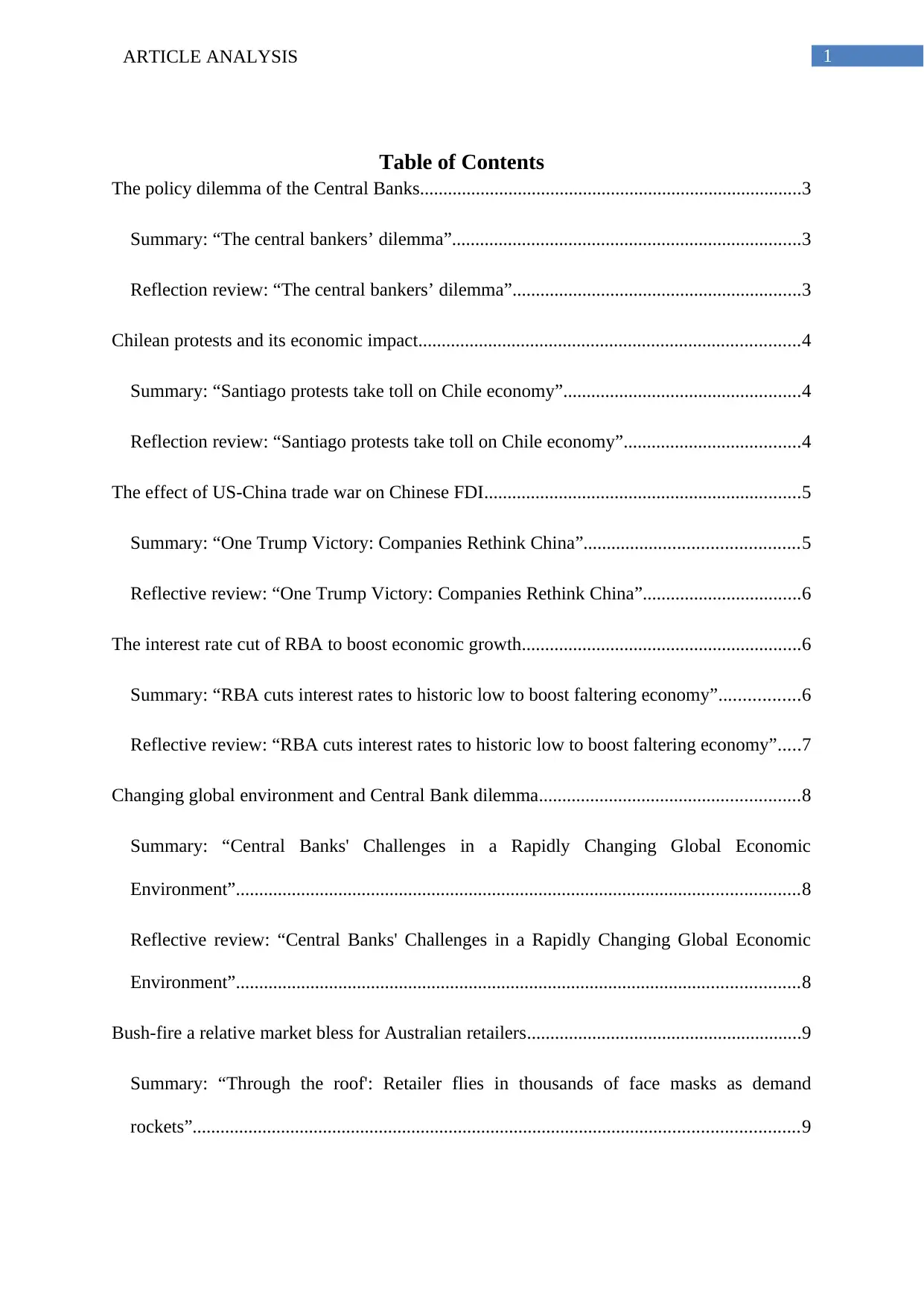
Table of Contents
The policy dilemma of the Central Banks..................................................................................3
Summary: “The central bankers’ dilemma”...........................................................................3
Reflection review: “The central bankers’ dilemma”..............................................................3
Chilean protests and its economic impact..................................................................................4
Summary: “Santiago protests take toll on Chile economy”...................................................4
Reflection review: “Santiago protests take toll on Chile economy”......................................4
The effect of US-China trade war on Chinese FDI....................................................................5
Summary: “One Trump Victory: Companies Rethink China”..............................................5
Reflective review: “One Trump Victory: Companies Rethink China”..................................6
The interest rate cut of RBA to boost economic growth............................................................6
Summary: “RBA cuts interest rates to historic low to boost faltering economy”.................6
Reflective review: “RBA cuts interest rates to historic low to boost faltering economy”.....7
Changing global environment and Central Bank dilemma........................................................8
Summary: “Central Banks' Challenges in a Rapidly Changing Global Economic
Environment”.........................................................................................................................8
Reflective review: “Central Banks' Challenges in a Rapidly Changing Global Economic
Environment”.........................................................................................................................8
Bush-fire a relative market bless for Australian retailers...........................................................9
Summary: “Through the roof': Retailer flies in thousands of face masks as demand
rockets”..................................................................................................................................9
Table of Contents
The policy dilemma of the Central Banks..................................................................................3
Summary: “The central bankers’ dilemma”...........................................................................3
Reflection review: “The central bankers’ dilemma”..............................................................3
Chilean protests and its economic impact..................................................................................4
Summary: “Santiago protests take toll on Chile economy”...................................................4
Reflection review: “Santiago protests take toll on Chile economy”......................................4
The effect of US-China trade war on Chinese FDI....................................................................5
Summary: “One Trump Victory: Companies Rethink China”..............................................5
Reflective review: “One Trump Victory: Companies Rethink China”..................................6
The interest rate cut of RBA to boost economic growth............................................................6
Summary: “RBA cuts interest rates to historic low to boost faltering economy”.................6
Reflective review: “RBA cuts interest rates to historic low to boost faltering economy”.....7
Changing global environment and Central Bank dilemma........................................................8
Summary: “Central Banks' Challenges in a Rapidly Changing Global Economic
Environment”.........................................................................................................................8
Reflective review: “Central Banks' Challenges in a Rapidly Changing Global Economic
Environment”.........................................................................................................................8
Bush-fire a relative market bless for Australian retailers...........................................................9
Summary: “Through the roof': Retailer flies in thousands of face masks as demand
rockets”..................................................................................................................................9
2ARTICLE ANALYSIS
Reflection review: “Through the roof': Retailer flies in thousands of face masks as demand
rockets”................................................................................................................................10
The dispute over softwood lumber trade..................................................................................10
Summary: “Identification of the Long-Run Determinants of US-Canada Softwood Lumber
Trade”...................................................................................................................................10
Reflective review: “Identification of the Long-Run Determinants of US-Canada Softwood
Lumber Trade”.....................................................................................................................11
Fashion brands are at stake due to bush-fire............................................................................12
Summary: “Aussie retail icon’s shock announcement”.......................................................12
Reflection review: “Aussie retail icon’s shock announcement”..........................................12
New trade policy and the intra-industry trade..........................................................................13
Summary: “New trade, new politics: intra-industry trade and domestic political coalitions”
..............................................................................................................................................13
Refection review: “New trade, new politics: intra-industry trade and domestic political
coalitions”............................................................................................................................14
Australian bush-fire a tourism industry....................................................................................14
Summary: “Hidden billion-dollar cost of bushfire crisis”...................................................14
Reflection review: “Hidden billion-dollar cost of bushfire crisis”......................................15
References................................................................................................................................16
Reflection review: “Through the roof': Retailer flies in thousands of face masks as demand
rockets”................................................................................................................................10
The dispute over softwood lumber trade..................................................................................10
Summary: “Identification of the Long-Run Determinants of US-Canada Softwood Lumber
Trade”...................................................................................................................................10
Reflective review: “Identification of the Long-Run Determinants of US-Canada Softwood
Lumber Trade”.....................................................................................................................11
Fashion brands are at stake due to bush-fire............................................................................12
Summary: “Aussie retail icon’s shock announcement”.......................................................12
Reflection review: “Aussie retail icon’s shock announcement”..........................................12
New trade policy and the intra-industry trade..........................................................................13
Summary: “New trade, new politics: intra-industry trade and domestic political coalitions”
..............................................................................................................................................13
Refection review: “New trade, new politics: intra-industry trade and domestic political
coalitions”............................................................................................................................14
Australian bush-fire a tourism industry....................................................................................14
Summary: “Hidden billion-dollar cost of bushfire crisis”...................................................14
Reflection review: “Hidden billion-dollar cost of bushfire crisis”......................................15
References................................................................................................................................16
⊘ This is a preview!⊘
Do you want full access?
Subscribe today to unlock all pages.

Trusted by 1+ million students worldwide
3ARTICLE ANALYSIS
The policy dilemma of the Central Banks
Summary: “The central bankers’ dilemma”
The article summarises about the challenges and difficulties of the Central Banks in
designing appropriate policies to meet the requirements of the economy. In addition to this,
the article focuses on the differences between economic theories and real-life movements of
indicators. The article begins by providing a brief overview of the issues faced by world
economies in terms of interest rates, inflation and the policies to stabilise these two
indicators. After that, the article explores various macroeconomic theories and concepts,
which includes Phillips curve relation, quantitative easing policy, forward guidance and lastly
NAIRU (a non-accelerating inflation rate of unemployment) (economist.com, 2016).
Focusing on these economic theories, the article then relates to the macroeconomic and
contrasting situation of the United Kingdom and the United States. The relation shown by the
indicators of these two countries contradicts with the relation portrayed by Phillips and other
economic theories. Thus, the article directs that in real-life scenarios, Central Banks face
difficulties from an unexpected situation.
Reflection review: “The central bankers’ dilemma”
Reading the article, any reader like me will come into the conclusion that Central
Banks around the world faces several obstacles and restrictions during the process of
designing monetary policies. Being a viewer, the Phillips theory I have read implies an
inverse relationship between two crucial macroeconomic indicators, which consist of the
inflation rate and unemployment rate. As portrayed in the article, despite a fall in the
unemployment rate in both the UK and the US, the inflation rate remained significantly low.
The Bank of England and the Federal Reserve Bank of the US adopted monetary policies to
The policy dilemma of the Central Banks
Summary: “The central bankers’ dilemma”
The article summarises about the challenges and difficulties of the Central Banks in
designing appropriate policies to meet the requirements of the economy. In addition to this,
the article focuses on the differences between economic theories and real-life movements of
indicators. The article begins by providing a brief overview of the issues faced by world
economies in terms of interest rates, inflation and the policies to stabilise these two
indicators. After that, the article explores various macroeconomic theories and concepts,
which includes Phillips curve relation, quantitative easing policy, forward guidance and lastly
NAIRU (a non-accelerating inflation rate of unemployment) (economist.com, 2016).
Focusing on these economic theories, the article then relates to the macroeconomic and
contrasting situation of the United Kingdom and the United States. The relation shown by the
indicators of these two countries contradicts with the relation portrayed by Phillips and other
economic theories. Thus, the article directs that in real-life scenarios, Central Banks face
difficulties from an unexpected situation.
Reflection review: “The central bankers’ dilemma”
Reading the article, any reader like me will come into the conclusion that Central
Banks around the world faces several obstacles and restrictions during the process of
designing monetary policies. Being a viewer, the Phillips theory I have read implies an
inverse relationship between two crucial macroeconomic indicators, which consist of the
inflation rate and unemployment rate. As portrayed in the article, despite a fall in the
unemployment rate in both the UK and the US, the inflation rate remained significantly low.
The Bank of England and the Federal Reserve Bank of the US adopted monetary policies to
Paraphrase This Document
Need a fresh take? Get an instant paraphrase of this document with our AI Paraphraser
4ARTICLE ANALYSIS
stabilise inflation rate at the targeted level of 2 percent and reduce the unemployment rate.
However, the forward guidance and the easing policy failed to stabilise inflation. Forward
guidance was applied by the Fed to ease monetary movements. This article indicates that
NAIRU can be the reason behind this unexpected situation. Moreover, I have noticed that
monetary policies take a significant amount of time to reflect on their outcome. Additionally,
monetary policies are not always successful in boosting business and growth. These are the
reason behind the difficulties of Central Banks in designing appropriate monetary policies to
restrict the economic downturn.
Chilean protests and its economic impact
Summary: “Santiago protests take toll on Chile economy”
The article is based on the ongoing protests in Chile. However, the article
concentrates on the violence of protestors in Santiago, the capital city of Chile. The author
initially begins by portraying the destructions caused by the protestors to the infrastructures
in Chile. The article elaborates about the damages caused to the metro operating in the city,
which faced a loss of $400 million. It also focuses on the $1.4 billion loss in business activity
in the country (euronews.com, 2019). The article includes the expectation of Finance minister
regarding the growth of the economy. Additionally, the article includes the different reasons
behind the onset of the protests. The main reason being the declining income and increasing
expenditures of the households. The article describes the arrests being made by the security
personnel to control the damaged done to public property in Santiago. Lastly, it includes an
alarming note for the administration regarding the need for reform in policies.
Reflection review: “Santiago protests take toll on Chile economy”
stabilise inflation rate at the targeted level of 2 percent and reduce the unemployment rate.
However, the forward guidance and the easing policy failed to stabilise inflation. Forward
guidance was applied by the Fed to ease monetary movements. This article indicates that
NAIRU can be the reason behind this unexpected situation. Moreover, I have noticed that
monetary policies take a significant amount of time to reflect on their outcome. Additionally,
monetary policies are not always successful in boosting business and growth. These are the
reason behind the difficulties of Central Banks in designing appropriate monetary policies to
restrict the economic downturn.
Chilean protests and its economic impact
Summary: “Santiago protests take toll on Chile economy”
The article is based on the ongoing protests in Chile. However, the article
concentrates on the violence of protestors in Santiago, the capital city of Chile. The author
initially begins by portraying the destructions caused by the protestors to the infrastructures
in Chile. The article elaborates about the damages caused to the metro operating in the city,
which faced a loss of $400 million. It also focuses on the $1.4 billion loss in business activity
in the country (euronews.com, 2019). The article includes the expectation of Finance minister
regarding the growth of the economy. Additionally, the article includes the different reasons
behind the onset of the protests. The main reason being the declining income and increasing
expenditures of the households. The article describes the arrests being made by the security
personnel to control the damaged done to public property in Santiago. Lastly, it includes an
alarming note for the administration regarding the need for reform in policies.
Reflection review: “Santiago protests take toll on Chile economy”
5ARTICLE ANALYSIS
Reading the article, I have come to know that Chile is among the wealthiest nations in
Latin America. However, in terms of income, the country is one of the most unequally
distributed nations in the region. According to my knowledge, the reason behind the onset of
the riots is the increasing cost of living and the minimum wages offered by the employers.
Chile is known for its neoliberal markets and flourishing privatised sectors. Since the
privatisation of the educational, pension and healthcare system, people are burdened with an
increase in expenditures. This has induced the residents of the country to protest against the
current government and the constitution. The damaged caused by the protests are huge and
there is stagnation in the business operations. As a result, the economy is expected to witness
a technical and financial recession in the upcoming years. Thus, in my opinion, the
government should restructure the policies and consider the elimination of privatisation of
social sectors. Moreover, the government should remove the minimum wage and create new
employment opportunities for the population. Furthermore, the government should supervise
pension payouts and the tax system of the country to enhance the free-market capitalism of
Chile. These reformations can calm down the population and reduce further destructions.
The effect of US-China trade war on Chinese FDI
Summary: “One Trump Victory: Companies Rethink China”
The US-China trade war is a threat to several economies around the world. The article
reflects the success of Donald Trump’s protectionist policy in lowering foreign direct
investment (FDI) in China. The article begins by displaying the reasons behind FDI interest
in the Chinese economy. Several manufacturing organisations are attracted to China’s low-
cost labour and efficient business environment. China is an emerging economy and a large
portion of its exports goes to the United States. Since the implementation of tariff by the US,
there is a fall in revenue of the FDI established in China. Thus, they are shifting to other
Reading the article, I have come to know that Chile is among the wealthiest nations in
Latin America. However, in terms of income, the country is one of the most unequally
distributed nations in the region. According to my knowledge, the reason behind the onset of
the riots is the increasing cost of living and the minimum wages offered by the employers.
Chile is known for its neoliberal markets and flourishing privatised sectors. Since the
privatisation of the educational, pension and healthcare system, people are burdened with an
increase in expenditures. This has induced the residents of the country to protest against the
current government and the constitution. The damaged caused by the protests are huge and
there is stagnation in the business operations. As a result, the economy is expected to witness
a technical and financial recession in the upcoming years. Thus, in my opinion, the
government should restructure the policies and consider the elimination of privatisation of
social sectors. Moreover, the government should remove the minimum wage and create new
employment opportunities for the population. Furthermore, the government should supervise
pension payouts and the tax system of the country to enhance the free-market capitalism of
Chile. These reformations can calm down the population and reduce further destructions.
The effect of US-China trade war on Chinese FDI
Summary: “One Trump Victory: Companies Rethink China”
The US-China trade war is a threat to several economies around the world. The article
reflects the success of Donald Trump’s protectionist policy in lowering foreign direct
investment (FDI) in China. The article begins by displaying the reasons behind FDI interest
in the Chinese economy. Several manufacturing organisations are attracted to China’s low-
cost labour and efficient business environment. China is an emerging economy and a large
portion of its exports goes to the United States. Since the implementation of tariff by the US,
there is a fall in revenue of the FDI established in China. Thus, they are shifting to other
⊘ This is a preview!⊘
Do you want full access?
Subscribe today to unlock all pages.
Trusted by 1+ million students worldwide
6ARTICLE ANALYSIS
countries to avoid the harsh tariff rates of Trump administration. Companies like GoPro,
Steve Madden, Crocs, Sony, Hasbro and Danfoss are leaving the country (nytimes.com,
2019). Lastly, the article mentions that the shift of these companies and the continuously
increasing wage rate can lead to the unemployment problem in China.
Reflective review: “One Trump Victory: Companies Rethink China”
Several articles are present that provides information regarding the ill effects of the
US-China trade conflict. The article reflects the fall in FDI inflows in China due to the tariff
imposed by the US. According to my opinion, the article provides importance to the downfall
of China and fails to address the issues that are currently faced by the United States. Not only
China is experiencing a downfall in economic activity, and the US is experiencing a fall in
export revenue due to the Chinese retaliation. This retaliatory tariff of the Chinese economy
is another crucial reason behind the shift of FDI from China to Thailand, Cambodia and so
on. According to me, a reduction in FDI can raise unemployment level and affect the
economy China negatively. Moreover, the movement of international organisations does not
only cause unemployment but also increasing wages and other costs. These costs includes
infrastructural damage done by the shift of MNCs. China is transitioning from a cheaper
input source to an expensive business environment. This is another reason behind the fall in
business activity and operation in China. Therefore, China is facing great loss from the
shifting of these organisations, but its technology sector is about to experience a good boom.
The interest rate cut of RBA to boost economic growth
Summary: “RBA cuts interest rates to historic low to boost faltering economy”
The article on the policy administration of the Reserve Bank of Australia (RBA)
revolves around the reasons behind the reduced interest rates. The article portrays that the
countries to avoid the harsh tariff rates of Trump administration. Companies like GoPro,
Steve Madden, Crocs, Sony, Hasbro and Danfoss are leaving the country (nytimes.com,
2019). Lastly, the article mentions that the shift of these companies and the continuously
increasing wage rate can lead to the unemployment problem in China.
Reflective review: “One Trump Victory: Companies Rethink China”
Several articles are present that provides information regarding the ill effects of the
US-China trade conflict. The article reflects the fall in FDI inflows in China due to the tariff
imposed by the US. According to my opinion, the article provides importance to the downfall
of China and fails to address the issues that are currently faced by the United States. Not only
China is experiencing a downfall in economic activity, and the US is experiencing a fall in
export revenue due to the Chinese retaliation. This retaliatory tariff of the Chinese economy
is another crucial reason behind the shift of FDI from China to Thailand, Cambodia and so
on. According to me, a reduction in FDI can raise unemployment level and affect the
economy China negatively. Moreover, the movement of international organisations does not
only cause unemployment but also increasing wages and other costs. These costs includes
infrastructural damage done by the shift of MNCs. China is transitioning from a cheaper
input source to an expensive business environment. This is another reason behind the fall in
business activity and operation in China. Therefore, China is facing great loss from the
shifting of these organisations, but its technology sector is about to experience a good boom.
The interest rate cut of RBA to boost economic growth
Summary: “RBA cuts interest rates to historic low to boost faltering economy”
The article on the policy administration of the Reserve Bank of Australia (RBA)
revolves around the reasons behind the reduced interest rates. The article portrays that the
Paraphrase This Document
Need a fresh take? Get an instant paraphrase of this document with our AI Paraphraser
7ARTICLE ANALYSIS
Australian economy is facing an upward rising unemployment rate and poor business growth.
The real estate market of Australia is characterised by wide fluctuations and government
restriction on construction. This is one of the major reason behind the fall in economic
activity. Another reason highlighted by the article is that a large number of international
visitors are distorting the labour market of Australia as well as the residential property market
(abc.net.au, 2019). Therefore, unemployment remains the major point behind the monetary
policy movements of the RBA. Thus, to create employment in the country, the administration
is focusing on increasing business activity. Additionally, the article focuses on the stress that
the Australian banks are going to face from such falling interest rate and this can harm the
depositors. The article also mentions that the housing market is facing rapid stabilisations
from falling interest rates, and it is expected to bring fruitful results.
Reflective review: “RBA cuts interest rates to historic low to boost faltering economy”
Since decades, Australian property market is claimed to be a bubble due to its
variability in prices. The country faces volatility in prices of property due to the wide range
of government restrictions in land use. I have witnessed that the article focuses on the reasons
behind RBA’s decision of reducing the interest rate. Central Bank of a country reduces the
interest rate to induce investment and increase business operations in the country. The
financial markets require business boost and the central bank is facilitating this boost by
reducing the cost of borrowing for investors. When the cost of borrowing and lending rates
are low, investors find it profitable to indulge in business activities. Currently, the housing
values of Sydney and Melbourne are taking a dramatic turn despite the fall in interest rates.
This is expected to increase employment opportunities in the country. According to the
theory of economics, an increase in productivity leads to an increase in the hiring of
employees. Thus, the RBA is expecting an increase in employment opportunities to
Australian economy is facing an upward rising unemployment rate and poor business growth.
The real estate market of Australia is characterised by wide fluctuations and government
restriction on construction. This is one of the major reason behind the fall in economic
activity. Another reason highlighted by the article is that a large number of international
visitors are distorting the labour market of Australia as well as the residential property market
(abc.net.au, 2019). Therefore, unemployment remains the major point behind the monetary
policy movements of the RBA. Thus, to create employment in the country, the administration
is focusing on increasing business activity. Additionally, the article focuses on the stress that
the Australian banks are going to face from such falling interest rate and this can harm the
depositors. The article also mentions that the housing market is facing rapid stabilisations
from falling interest rates, and it is expected to bring fruitful results.
Reflective review: “RBA cuts interest rates to historic low to boost faltering economy”
Since decades, Australian property market is claimed to be a bubble due to its
variability in prices. The country faces volatility in prices of property due to the wide range
of government restrictions in land use. I have witnessed that the article focuses on the reasons
behind RBA’s decision of reducing the interest rate. Central Bank of a country reduces the
interest rate to induce investment and increase business operations in the country. The
financial markets require business boost and the central bank is facilitating this boost by
reducing the cost of borrowing for investors. When the cost of borrowing and lending rates
are low, investors find it profitable to indulge in business activities. Currently, the housing
values of Sydney and Melbourne are taking a dramatic turn despite the fall in interest rates.
This is expected to increase employment opportunities in the country. According to the
theory of economics, an increase in productivity leads to an increase in the hiring of
employees. Thus, the RBA is expecting an increase in employment opportunities to
8ARTICLE ANALYSIS
strengthen the economic growth of Australia. The article indicates this by demonstrating the
increase inflows of investments and lower riskiness of assets.
Changing global environment and Central Bank dilemma
Summary: “Central Banks' Challenges in a Rapidly Changing Global Economic
Environment”
The article is based on the economic environment and global challenges faced by the
central bank. The global economic crisis gave serious threats to all the central banks around
the world. The article focuses on the various challenges faced by the central bank of
developing economies and advanced economies. The article mentions that developing
economies have huge faith over strong economic growth and improvement. This anticipation
leads to the creation of threats among central banks of such emerging nations. The author also
portrays the increase in capital inflows of certain developing nations such as Thailand,
Indonesia and India. On the other hand, developed economies like the United States, the
United Kingdom and the Euro area faced negative growth in capital and credit. However, the
housing sector of Japan, the UK and the Euro area fared well (Boj.or.jp, 2014). This is due to
the quantitative easing policy of the central banks. Additionally, the author mentions the
limitations of monetary policy during recessionary situations by giving examples from the
Great Recession of 2007-2008.
Reflective review: “Central Banks' Challenges in a Rapidly Changing Global Economic
Environment”
According to my viewpoint, the author is concerned about the financial market and
the growth of credit in developing and emerging nations. The author begins by describing the
failure received by the Federal Reserve Banks of the US during the great recession of 2007-
strengthen the economic growth of Australia. The article indicates this by demonstrating the
increase inflows of investments and lower riskiness of assets.
Changing global environment and Central Bank dilemma
Summary: “Central Banks' Challenges in a Rapidly Changing Global Economic
Environment”
The article is based on the economic environment and global challenges faced by the
central bank. The global economic crisis gave serious threats to all the central banks around
the world. The article focuses on the various challenges faced by the central bank of
developing economies and advanced economies. The article mentions that developing
economies have huge faith over strong economic growth and improvement. This anticipation
leads to the creation of threats among central banks of such emerging nations. The author also
portrays the increase in capital inflows of certain developing nations such as Thailand,
Indonesia and India. On the other hand, developed economies like the United States, the
United Kingdom and the Euro area faced negative growth in capital and credit. However, the
housing sector of Japan, the UK and the Euro area fared well (Boj.or.jp, 2014). This is due to
the quantitative easing policy of the central banks. Additionally, the author mentions the
limitations of monetary policy during recessionary situations by giving examples from the
Great Recession of 2007-2008.
Reflective review: “Central Banks' Challenges in a Rapidly Changing Global Economic
Environment”
According to my viewpoint, the author is concerned about the financial market and
the growth of credit in developing and emerging nations. The author begins by describing the
failure received by the Federal Reserve Banks of the US during the great recession of 2007-
⊘ This is a preview!⊘
Do you want full access?
Subscribe today to unlock all pages.
Trusted by 1+ million students worldwide
9ARTICLE ANALYSIS
2008. This recession challenged several Central Banks around the globe. This possessed
severe threats to the Central Bank of the core Euro area as well as the Bank of England. To
increase business activity, these two economic zones are accepting negative interest rate
policy or zero lower bound. This is done to raise business confidence, which was affected by
the fall of the major investment banks of the United States. Afterwards, the explanation of
emerging economies suggests that there is strong growth in capital inflows into certain
emerging nations. However, among those nations, some economies are still suffering to
acquire the fame of an advanced economy. Therefore, there are several loopholes in the
policy designing and implementation of the central banks, which leads to certain
uncertainties. Moreover, it is difficult for the central banks to anticipate exact policies to
correct an unstable macroeconomic environment. As a result, Central Banks faces problems
and dilemma, while designing an appropriate policy.
Bush-fire a relative market bless for Australian retailers
Summary: “Through the roof': Retailer flies in thousands of face masks as demand
rockets”
The effect of the Australian bush-fire over the market movements of Australian
retailers has been described in the news article. The authors indicate an increase in sales of
the facemask and respirators produced by the Australian retailer firm the Wesfarmers
(smh.com.au, 2020). There is a continuous increase in the demand for facemasks among the
residents of the country and the people living around the area of bush-fire. The author
mentions that despite the widespread donations of foreign economies, residents are
continuously purchasing facemasks and respirators from the nearby retail shops. The increase
in the fire has anticipated a further increase in demand for respirators among citizens. As a
result, retailers such as Wesfarmers are piling up stocks of respirators and facemasks. The
2008. This recession challenged several Central Banks around the globe. This possessed
severe threats to the Central Bank of the core Euro area as well as the Bank of England. To
increase business activity, these two economic zones are accepting negative interest rate
policy or zero lower bound. This is done to raise business confidence, which was affected by
the fall of the major investment banks of the United States. Afterwards, the explanation of
emerging economies suggests that there is strong growth in capital inflows into certain
emerging nations. However, among those nations, some economies are still suffering to
acquire the fame of an advanced economy. Therefore, there are several loopholes in the
policy designing and implementation of the central banks, which leads to certain
uncertainties. Moreover, it is difficult for the central banks to anticipate exact policies to
correct an unstable macroeconomic environment. As a result, Central Banks faces problems
and dilemma, while designing an appropriate policy.
Bush-fire a relative market bless for Australian retailers
Summary: “Through the roof': Retailer flies in thousands of face masks as demand
rockets”
The effect of the Australian bush-fire over the market movements of Australian
retailers has been described in the news article. The authors indicate an increase in sales of
the facemask and respirators produced by the Australian retailer firm the Wesfarmers
(smh.com.au, 2020). There is a continuous increase in the demand for facemasks among the
residents of the country and the people living around the area of bush-fire. The author
mentions that despite the widespread donations of foreign economies, residents are
continuously purchasing facemasks and respirators from the nearby retail shops. The increase
in the fire has anticipated a further increase in demand for respirators among citizens. As a
result, retailers such as Wesfarmers are piling up stocks of respirators and facemasks. The
Paraphrase This Document
Need a fresh take? Get an instant paraphrase of this document with our AI Paraphraser
10ARTICLE ANALYSIS
article indicates that this increase in demand is boosting economic activity by raising revenue
of such Australian retailers. Additionally, the perception of the author suggests that if the fire
continues, then demand such respirators and masks are like to increase.
Reflection review: “Through the roof': Retailer flies in thousands of face masks as
demand rockets”
According to me, the article reflects on the positive view of the bush-fire over the
retailers of facemasks and respiratory items. However, it also indicates the worsening
condition of the Australian economy due to such a fire outbreak. The Australian bush-fire is
said to be triggered by the increasing temperatures of Australia. The continuously changing
environment and hot weather conditions are acting as a catalyst for the bush-fire. Residents of
the nation are unable to breathe and work. As a result, the economy is expected to witness a
macroeconomic downfall. This is because being dependent on the tourism industry; such a
climatic disorder can reduce tourist activities and limit revenue of recreational services. This
can generate major shocks for the wealth account of the country. Therefore, even though
retailers like Wesfarmers are experiencing growth in their sales, the entire economy can
suffer in the long run. This is because the demand for retail or consumers product are rapidly
declining in Australia. As per my opinion, Australia should take steps to control the extreme
environmental degradation and implement restrictive policies to control further pollution.
This can help the country to stabilise the economic downturn. This has been indirectly
portrayed in the article as well.
The dispute over softwood lumber trade
Summary: “Identification of the Long-Run Determinants of US-Canada Softwood
Lumber Trade”
article indicates that this increase in demand is boosting economic activity by raising revenue
of such Australian retailers. Additionally, the perception of the author suggests that if the fire
continues, then demand such respirators and masks are like to increase.
Reflection review: “Through the roof': Retailer flies in thousands of face masks as
demand rockets”
According to me, the article reflects on the positive view of the bush-fire over the
retailers of facemasks and respiratory items. However, it also indicates the worsening
condition of the Australian economy due to such a fire outbreak. The Australian bush-fire is
said to be triggered by the increasing temperatures of Australia. The continuously changing
environment and hot weather conditions are acting as a catalyst for the bush-fire. Residents of
the nation are unable to breathe and work. As a result, the economy is expected to witness a
macroeconomic downfall. This is because being dependent on the tourism industry; such a
climatic disorder can reduce tourist activities and limit revenue of recreational services. This
can generate major shocks for the wealth account of the country. Therefore, even though
retailers like Wesfarmers are experiencing growth in their sales, the entire economy can
suffer in the long run. This is because the demand for retail or consumers product are rapidly
declining in Australia. As per my opinion, Australia should take steps to control the extreme
environmental degradation and implement restrictive policies to control further pollution.
This can help the country to stabilise the economic downturn. This has been indirectly
portrayed in the article as well.
The dispute over softwood lumber trade
Summary: “Identification of the Long-Run Determinants of US-Canada Softwood
Lumber Trade”
11ARTICLE ANALYSIS
The journal focuses on the softwood lumber dispute between the United States and
Canada. The authors uses monthly export data over 22 years. Using the ordinary least squares
measure, the author finds that there is a reduction in trade between the two countries. The
reasons being parallel with the previous research findings. The paper provides results
consistent with the other reports based on the same topic. The research finding and the
outcomes of the research suggest that apart from increasing prices and cheap lumber, there is
a substantial contribution to the exchange rate over a fall in the exports between the two
economies. The article mentions that soon after the expiry of the trade agreement of
SLA2006, the US wood manufacturers are imposing anti-dumping laws (Liaqat & Wang,
2018). Additionally, the paper recommends policies and decisions to overcome the falling
revenue of exporters. All these is due to the expiration of the free trade agreement as well as
the conflict over lumber wood production.
Reflective review: “Identification of the Long-Run Determinants of US-Canada
Softwood Lumber Trade”
The softwood lumber dispute is a matter of concern for both the economies. Going
through the article, I have not come up with a discussion about the various reasons behind the
trade dispute between the US and Canada. The low prices and the good quality wood
produced by the manufacturers of Canada are suitable for the domestic producers of the US.
The softwood lumber manufactured in the US market is expensive and the quality is not a
match with the woods produced in Canada. Additionally, the demand for Canadian woods are
huge in the world market and the entire Canadian population depends on the employment
generated from theses wood industries. A fall in export demand from the US can lead to a rise
in unemployment in the country. The tests performed in the research article indicates that
exchange rates are also responsible for the fall in trade between the two nations. However,
The journal focuses on the softwood lumber dispute between the United States and
Canada. The authors uses monthly export data over 22 years. Using the ordinary least squares
measure, the author finds that there is a reduction in trade between the two countries. The
reasons being parallel with the previous research findings. The paper provides results
consistent with the other reports based on the same topic. The research finding and the
outcomes of the research suggest that apart from increasing prices and cheap lumber, there is
a substantial contribution to the exchange rate over a fall in the exports between the two
economies. The article mentions that soon after the expiry of the trade agreement of
SLA2006, the US wood manufacturers are imposing anti-dumping laws (Liaqat & Wang,
2018). Additionally, the paper recommends policies and decisions to overcome the falling
revenue of exporters. All these is due to the expiration of the free trade agreement as well as
the conflict over lumber wood production.
Reflective review: “Identification of the Long-Run Determinants of US-Canada
Softwood Lumber Trade”
The softwood lumber dispute is a matter of concern for both the economies. Going
through the article, I have not come up with a discussion about the various reasons behind the
trade dispute between the US and Canada. The low prices and the good quality wood
produced by the manufacturers of Canada are suitable for the domestic producers of the US.
The softwood lumber manufactured in the US market is expensive and the quality is not a
match with the woods produced in Canada. Additionally, the demand for Canadian woods are
huge in the world market and the entire Canadian population depends on the employment
generated from theses wood industries. A fall in export demand from the US can lead to a rise
in unemployment in the country. The tests performed in the research article indicates that
exchange rates are also responsible for the fall in trade between the two nations. However,
⊘ This is a preview!⊘
Do you want full access?
Subscribe today to unlock all pages.
Trusted by 1+ million students worldwide

1 out of 19


Your All-in-One AI-Powered Toolkit for Academic Success.
+13062052269
info@desklib.com
Available 24*7 on WhatsApp / Email
![[object Object]](/_next/static/media/star-bottom.7253800d.svg)
Unlock your academic potential
Copyright © 2020–2026 A2Z Services. All Rights Reserved. Developed and managed by ZUCOL.